Brødrene A & O Johansen A/S vs Solar Group A/S – A short comparison
I always wanted to have a quick look at A&O and was finally motivated again reading about it several times in my Twitter timeline. In my All Danish Stocks series, A&O didn’t make the cut because I had already Solar in the portfolio, but still I want to look at them as this often yields some insights into the other company.
Both companies are headquartered in Denmark and in principle distribute supplies for craftsmen/installers.
From what I understand, Solar Group is focused a little more on electrical equipment, A&O has a broader assortment but focused on renovation and remodeling. A&O Johanson has a small B2C segment that makes up ~12% of sales but less in profits, as margins in B2C are smaller.
A&O is active in Denmark, Sweden and Norway, however 90% of sales seem to be in Denmark. A&O has a dual share structure, with “super voting” shares owned by the family and CEO giving copntrol to the family. Also Solar Group has a dual share class structure, with the majority of the votes owned by the heirs of the original founder (4th generation).
Solar is active also in Denmark, Sweden and Norway, but also has a sizeable business in the Netherlands and Poland. Denmark is around ⅓ of sales and 45% of profits for Solar. Apart from craftsmen(installers, 33% of their sales go to industrial clients and a small “trade” segment. Interestingly, the craftsmen/installer segment is the lowest margin segment.
In 2023 they acquired a heat pump business (large pumps for commerce), so they are branching out to a certain extent into manufacturing. That is clearly a risk but SFS for instance shows that a company can do both successfully.
Numbers, numbers, numbers
Here are a number of KPIs that I found interesting to compare with some color coding attached:
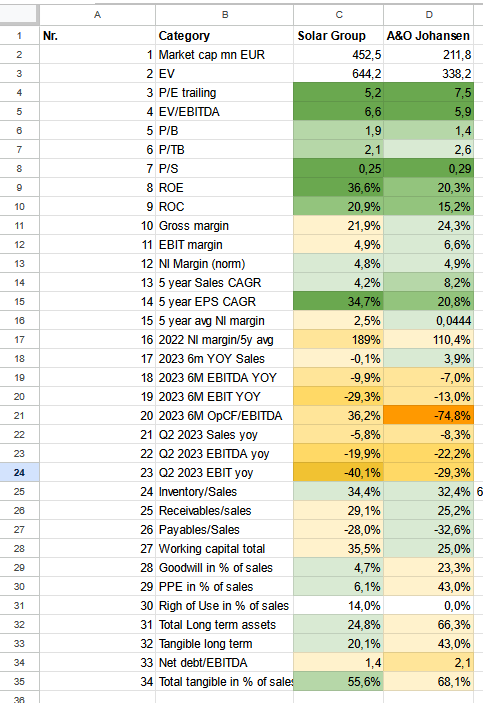
Both companies look very cheap on 2022 numbers and have decent return on capital which is quite important for distributors.
One thing that stands out is that Solar has been earning much higher margins in recent years than some years before. In my understanding the reason for this is that up to 2017, Solar was basically a turn-around case and they brought in a new CEO to fix things.Going through the annual reports since then, there is a clear effort (and success) in focusing the business and making it gradually more profitable every year.
The main difference between Solar and A&O is that Solar seems to carry more inventory, whereas A&O has a lot more fixed assets. Solar is more capital efficient (even without the goodwill) and therefore lower margins nevertheless translate into higher ROCEs and ROEs despite slightly lower leverage.
Both companies are struggling a little bit this year, interestingly Solar Group more than A&O after depreciation. However, when looking at Cash flow, things look different: Solar has managed to return to positive Operating cashflow whereas A&O had still negative operating CF. I am not sure why and this could turn quickly but it is something to watch.
Solar has been writing off Goodwill quite aggressively in the first 6M, however there is no detailed explanation. A&O doesn’t show amortization separately in the 6M numbers.
Stock Performance (incl. Dividends):
These are the Total return charts from NAsdaq Nordic, unfortunately I found no way to show them in one chart. Over 10 years, A&O has clearly outperformed Solar.
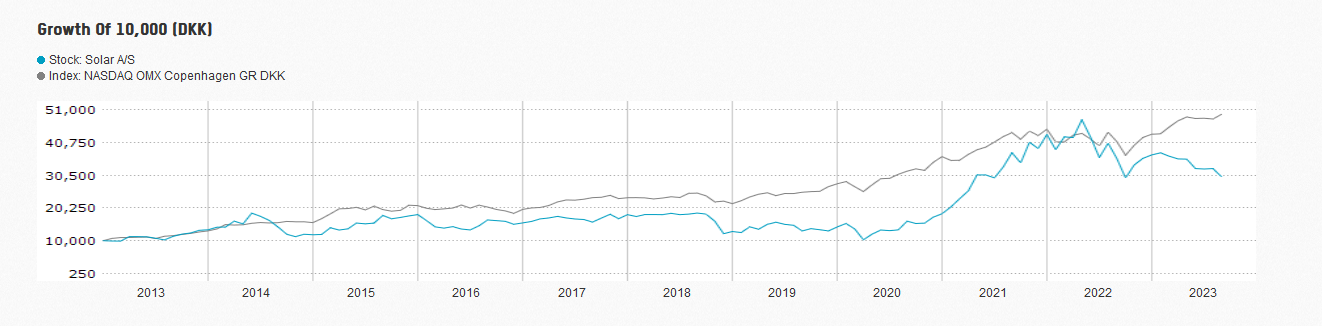
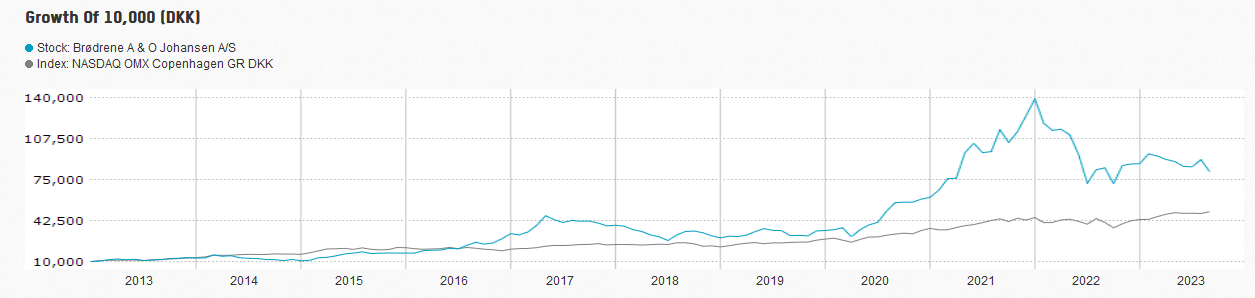
I guess the main reason is that Solar made a loss in 2014 and no profits both in 2017 and 2019. A&O clearly has the more consistent track record.
Capital allocation wise, both companies seem to prioritize dividends before share buy backs.
Summary:
Overall, I think both are very good companies. A&O has a very good Denmark focused strategy whereas Solar has a more complex business model with different customer groups and jurisdictions. However, this might also allow them to find more growth opportunities.
A&O has a better long term track record, however Solar’s trajectory since the CEO change in 2017 is quite encouraging and the turn-around seems to have been confirmed.
For both companies, investors most likely think that they have massively “over earned” in 2021 and 2022, otherwise the single digit P/Es for these really nice distribution businesses with very good returns on capital make no sense. They will clearly see some headwinds if construction slows down but in my understanding, both companies have limited exposure to new building construction.
I’ll therefore stick with Solar for the time being, but will monitor A&O as well. This seems to be also a cheap but good quality business “under the radar” of many investors and should do both well over the next 3-5 years despite significant short term headwinds.
 value and opportunity
Sorry, forgot the link: https://research-api.cbs.dk/ws/portalfiles/portal/60731982/108408_Vardiansattelse_Solar.pdf
I am doing a lot of research on A&O. In that process, I just found a master thesis on Solar A/S from 2016. It’s in Danish, but can easily be translated by google translate (just did it). Maybe interesting for you, because A&O etc. are also mentioned in the thesis. Regards, Ole.
I only briefly looked at Solar on TIKR. I hate this business model. As a shareholder, you are always ranking behind the inventory. Most of the Net Income is generated in increased inventory rather than cash. The ROCE looks great until they do a stock write down – and I bet you they do that at least once every 5 years (though admittedly I haven’t looked). Then “poof” there goes the shareholder’s net income, oh and by the way we need to buy more inventory because the inventory we wrote down was obviously the wrong type and we don’t have enough of the right type. Just compare the increase in stock over 5 years with the reported income – 75% of your ROCE is sat on a shelf in a warehouse rather than in your pocket! Hard pass for me!
Well, that is the business model of a distribution business that you describe. You hold inventory for your clients so that they don’t need to hold it. Sometimes one does hold the wrong inventory, but in general, I do like the business model very much.
In Solar’s case one needs to see how sustainable the higher margins are.
Great comparison!
The only thing I wonder about is why you like their margins?
I don’t know their industry but 4.9% EBiT margin or 21% operating margin does not seem attractive to me, no matter the industry. A 5% cost increase or slight pressure in selling prices and your profit is gone…
A 5% EBIT margin for a distributor is quite OK. The combination of Return on capital and margins are relevant, not margins alone.
Do you know their average credit durations?
No, I would need to look that up.
That’s always my concern when reading your ideas on capital intensive corps like Energiekontor and Solar: how resilient are they to long term high internet rate
I really like your analysis but I wonder why you dont look deeper into this as times clearly seem to change vs last 15 years credit 4 free
For a company like Solar and Energiekontor, that can earn 15-20% return on capital employed, interest rates of 5% are not a big issue in my opinion, especially if leverage is only around 1,4x EBITDA (Solar) . If you provide an essential service, I assume you can pass increased cost through sooner or later.
I would be very carefull with highly leveraged companies, but in my opinion, both Solar and Energiekontor have very manageable debt levels compared to peers.
Howver I can understand concerns with regards to capital intensive business models in the current environement. In my opinion, the valuations already reflect this concern, but I can of course be totally wrong.
The situation is very different for business models that are highly leveraged and do have structural issues such as Office Real estate or certain Teclo/Cable assets.
Agreed – contracts for essential services can always be opened one sided if market environment changes (as semiconductor companies have done in 2020 onwards). So entry barriers are again key consideration
Thx for sharing your thoughts
Great to read this comparison. Motivated by your Danish Stock series I had a deeper in both stocks during this year and came to very similar conclusions. Finally I couldn’t decide for one or the other and invested in both after both shares dropped lower in May :-). Really appreciate your blog, always helps to learn and to generate investment ideas! Many thanks!