How to screw your clients – Deutsche Bank “Aktienanleihe” edition (WKN DX2UZZ)
From time to time I use the blog to look at some “grey market” stuff, usually from obscure issuers with a very bad risk/return relationship. Examples were Prokon, WGF or Solar Millenium.
However, one should not forget that the established financial institutions are also “capable” to screw their clients over and over.
Let’s, for example, look at a currently marketed “Aktienanleihe” from Deutsch Bank with the WKN DX2UZZ.
The paper flyer comes with the slogan “Sichern Sie sich einen attraktiven Zinssatz” (meaning: secure your attractive yield right now) and a big 7% sticker.
On the second page you see “7 % interest p.a and repayment at 23.10.2012”. Then in fine print on the left side you see something like “In times of low interest rates, “Aktienanleihen” (direct translation “Stockbonds”) offer an interesting alternative with an attractive coupon but higher risk bla bla bla…”
So this is clearly a case where the bank tries to sell a quite risky investment based on a coupon which looks attractive on a nominal basis.
So let’s look at what this particular “investment” is about:
An “Aktienanleihe” is a structured bond which has the following features:
– you get a fixed coupon
– the repayment depends on the value of an underlying share
– in this case, the underlying share is interestingly the Deutsche Bank share itself
– if, at maturity, the share is below a certain level (here only a range is indicated from 60%-70%), you don’t get your money back, but you will receive the shares at the lower value
In sales speak this is sold as “Your coupon is secure plus you have a (30-40%) buffer before you loose money”.
Where is the problem ?
I do not know where the Deutsche Bank share price will be in one year’s time, but other than the Prokon and WGF securities, here the underlying is a traded security which means that the structured security can be modeled and valued.
Analytically, in a first step one has to slice the security into the funded part, a 1 year Deutsch bank unsecured senior bond and the “structure”.
We can easily find on Bloomberg the “fair price” for a 1 year Deutsche Bank Senior bond: Thats 0.65% for the Euribor plus 0.45% 1 year senior Deutsche spread. So a plain vanilla 1 year Deutsche Bond would yield 1,1%.
Now comes the tricky part: How to value the structure ? Without going into option pricing theory, I can tell you that the structure is basically the following “exotic option” of the following type:
“Short put with terminal knock-in feature”, meaning you, as buyer of the security are selling Deutsche Bank a put option on their own share.
Luckily, if you have a Bloomberg, you can very easily price this “beauty” with their standard option valuation tool. Please see the screenshot (i used 70%) :
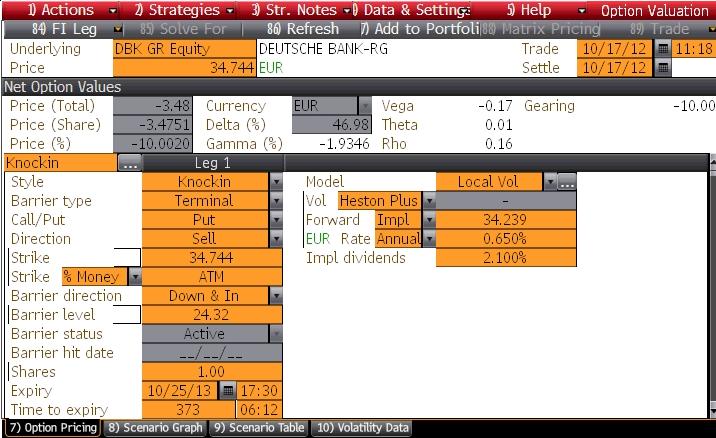
What we see is that the standard valuation tool says you should receive 10% (of nominal) if you are selling such an option. Add on the 1.1% for the “plain vanilla” bond, then the “fair” value of the coupon would be 11.1% not 7%.
Why bother might some people say, 7% is better than 1% and the probability of the Deutsche Bank share going down so much is probably not so big. The problem is: Deutsch eBank takes out almost 40% of the “Fair value”. No one knows the probability, but there is a market for this kind of risk.
Deutsch Bank can easily hedge their part and directly pocket the 4% at the moment when they sell this “beauty” to the German retail investor. Although they have to share their “harvest” with the distribution partners.
For the “little investor” this is bad, because a large share of his “expected” return is taken out by the bank, which means simply on average he will loose money with this if he invests in such products.
I don’t even want to mention all the other issues like “asynchron information” if the issuer of the security is also the issuer of the underlying. There are a couple of more possibilities to screw the investor because off this.
Summary:
This Deutsche bank “security” in my opinion represents everything which is wrong with the financial system. The banks still try to sell complicated stuff to investors who don’t understand it and cut out fat fees in order to make sure the little guy looses over time.
In my opnion, the banks should have to disclose at least the “fair value” of such securiteis based on available standard models so that teh invetsor knows what amount Deutsche is earning upfront. The current disclosure would indicate that they only charge 1% addional issuing fee.
However I guess I will not see in my lifetime that banks will offer “fair products” to little investors unless they are forced too. Maybe the little guys do have to share the blame by being too greedy (or desperate), but Deutsche Bank knows exactly what they are doing.
 value and opportunity