Tag Archives: GRR000000010

Update Greek GDP Linker (ISIN GRR000000010) – research mistake or by-product of value investing principles ?

Last year I had a couple of posts about the (in)famous Greek GDP linker (introduction, valuation approach) a result of the “restructuring” of Greek debt last year.

I concluded that the security is fundamentally worthless and criticised in August 2012 a post by FT’s John Dizzard recommending the linker at 33 cents. In the last few weeks and months, I recognized increasing clicks on my old articles and I even got an Email from a UK based hedge fund manager asking for the prospectus.

So its time to look at the score between me and the FT since I wrote that post:
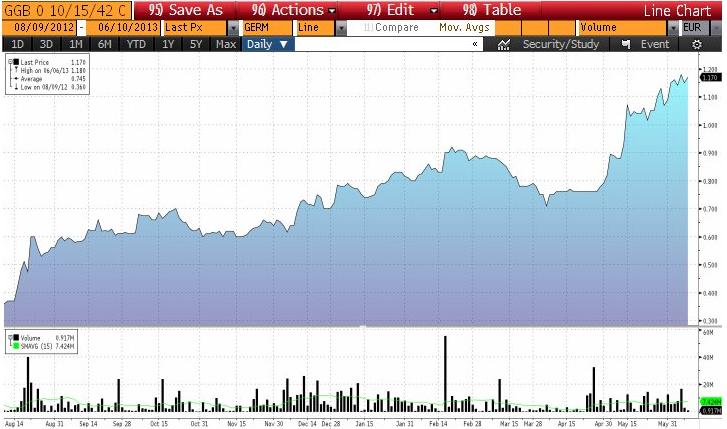
Holy cow !!! The price of this security tripled since I made fun of the FT. guy, so I would say 3 for the FT, nil for me.

First lesson learned: I was clearly wrong on that one for the time being. If you followed the FTs advise, you made big bucks in only a year. if you have followed my advice you made nothing.

So whenever I see one of my analysis going wrong so horrible, I keep asking myself: Was I wrong or ist the market (price) wrong ?

Let’s go back to the fundamental analysis and see if something has changed to the better in the meantime ?

Well, the Greek stock exchange doubled, but as we know for the analysis, for the GDP linker the only two things that count are: Nominal value of GDP and GDP growth rates. Let’s look at the hardest hurdle which in my opinion is nominal GDP.

Those are the levels of nominal GDP required to get a single cent out of this security:

year nominal GDP yoy
2014 210.1  
2015 217.9 3.71%
2016 226.4 3.90%
2017 235.7 4.11%
2018 245.5 4.16%
2019 255.9 4.24%
2020 266.47 4.13%
therafter 266.47 0.00%

So again, let’s go to the original Greek statistics website and do a quick update on Greek GDP including 2012:

Year GDP
2000 136,281
2001 146,428
2002 156,615
2003 172,431
2004 185,266
2005 193,050
2006 208,622
2007 223,160
2008* 233,198
2009* 231,081
2010* 222,151
2011* 208,532
2012* 193,749

So we can clearly see that nominal GDP decreased quite dramatically. For 2013 it doesn’t seem to get much better. If we look at the last quarter, we can see that in Q1, Greek GDP decreased ~ 7% on market prices basis.

So lets just assume that things pick up in the rest of the year and the Greek GDP shrinks only by -5%. That would leave us with a GDP of around 184 bn. Now we can easily calculate what kind of compound annual growth rates (CAGR) Greece needs in order for the GDP linker to “jump” the nominal GDP hurdle:

Hurdle Actual CAGR required
2013   184  
2014 210.1   14.2%
2015 217.9   8.82%
2016 226.4   7.16%
2017 235.7   6.39%
2018 245.5   5.94%
2019 255.9   5.65%
2020 266.47   5.43%

This table can be read as follows: In order to hit the GDP hurdle in 2014 (and receive money in 2015), Greek GDP has to rise 14% in 2014. Or: in order to hit the hurdle in 2015 (and get paid in 2016), the Greek GDP has to have a compound growth rate of 8.8% in 2014 and 2015.

Now it is clearly open to discussion how likely that is. I would however argue fundamentally this is more or less impossible because Greek is under a lot of deflationary pressure.

So the fundamental outlook didn’t really improve from last year, but why the hell did the linker trade up so much ?

I have a few explanations:

a) The linker looks optically cheap. It “officially” trades at 1.1% of nominal value, so for many investors that means it trades “for almost nothing”. In the post last year I mentioned, that the quotation is highly misleading. As the maximum cash (undiscounted) you get is around 18% of the stated “nominal”, the linker is in fact trading rather at 1.2/18= 6.7% of nominal, not adjusting for coupons. So still “cheap” but not so cheap as some investors think.

b) Argentinian experience: Argentinian GDP linker have been a very good investment. However part of that was that Argentina could inflate its economy because they have their own currency. Greece can not inflate in EUR, instead they have to deflate salaries, costs etc. This is fundamentally different to Argentina.

c) People are betting on some kind of Greek recovery and use the GDP linker as a levered proxy for a Greek recovery without really understanding it.

Of course, my fundamental analysis could be all wrong and I missed something. However I woudl need to read something fundamentally justified to accept this. If someone knows something about such a piece of research, please let me know !!!

Summary (and implications for value investing):

I was clearly wrong about the future price of the GDP linker last year. However I am still convinced that I am right on the ultimate “value” of this GDP linker which is close to zero. So one could see this as a weakness of the “value investing” approach because I never consider that someone might pay a higher price despite the value of this security being close to zero.

And clearly, as a value investor you rarely share in “speculative gains” but on the other hand, you also avoid many speculative losses if you really stick to your strategy.

This is also one of the biggest mistakes (and one of the hardest parts of the startegy) I see with some value investors: It is really hard to resist the urge to “speculate” at some point in time. Our mind often plays tricks on us that we can recall great trades much easier than bad trades. But i think that mixing in speculations (investments not based on intrinsic value but based on the hope that someone buys it even more expensive) into a value investing strategy might be the biggest “detractor” for a superior long term performance.

For every GDP linker you miss out as a value investor, you also miss out a couple of “bad trades” and in my experience the balance of those missed out trades is negative (or positive for your performance) over the cycle.

There are clearly people who are great “speculators” and got rich with that (Soros & Co), but for every successful speculator, there is a large graveyard of bankrupt losers. Whereas I don’t know that many bankrupt value investors…..

Bad research example: FT’s John Dizard and the Greek GDP linker

I was quite surprised that my old Greek GDP warrant post got hit a lot in the last few days.

By coincidence I just saw that on Monday, a guy called John Dizard recommended the GDP linker as a “great bet on Greek long-term growth”.

You have to register in order to read the article online, but although its almost a half page in the print FFm supplement, the essence is the following:

– the Argentinian linkers were a great deal
– the Greek linkers are cheap (30 cents)

In my opinion, he makes some plain wrong statements like:

“The Greek GDP warrants could begin to pay out in 2015, based on the country having experienced a minimal recovery by then”

.

As I have mentioned in the post, Greece needs to hit the 2011 nominal GDP (in EUR) by 2014, to get any payout in 2015. In 2012, I think Greece is running at around -7%. So Greek needs nominal increases in GDP by at least north of 3.5% both in 2013 and 2014 to hit this trigger. I am not sure if this could be called a “minimal” recovery.

I am not sure what happens if Greece leaves the EUR, but I would assume that the Linkers would only pay if EUR GDP is triggered, not “new Drachma” GDP.

He then goes on and says the following:

“Right now they trade at about 32 or 33 cents, which means that is what you pay for the possibility of receiving one euro in 2015”.

Again, no points. The 33 cents represent the chance that you get any cash flow over the next 30 years. I am pretty sure that Mr. Dizard never really to bothered reading the prospectus, he will be busy writing his next “analysis”.

Finally he quotes a trader who says “the discount rate on future payments is just to high”. This is of course bullshit as well. Normal “non optional” Greek Government bonds trade at 20% yield p.a. If one discounts the cashlofs without taking the options into account, one ends up with a “bond equivalent” value of 3.28%. So you are paying at 33 cent an option premium” of 10% for the bond equivalent market value which is not cheap in my opinion.

Summary: So maybe it turns out that the Greek linker is a good investment. But if it does, it is certainly not for the reasons this genius has identified. My advice would be for people who want to speculate on Greece’s future to buy the GGBs instead. At 15% of nominal, they have enough “optionality” and upside in the good case. Or you buy shares like OPAP if you want to mitigate the Sovereign default risk. Optionality wherever you look.

Edit: At least the article moved the price up by 10-15% for the linker. This is the advantage of writing for the FT.

Exotic securities: “Detachable GDP linked Greek warrant” – Valuation approach

In the first post i quickly looked at the features of the “Detachable GDP linked Greek warrant” (ISIN GRR000000010)

With securities like this, there are usually many ways to try to value this. You could eiher lock up a handfull of rocket scientists into an office and only let them out if they produce a model which is mind boggingly difficult, including at least features like “Monte Carlo simulation, path dependend barrier option etc.” or you can try a “common sense” approach to get a feeling about the risks and value drivers of such a complex structure. As anon-rocket scientist, I prefer the second one.

In order to get a rough idea how to evaluate this, we have to make sure to understand the following issues and risk factors:

Default risk

If Greece defaults, we don’t have to worry about GDP growth anymore. We should assume zero value (no recovery) in this scenario.

Maximum pay out

As discussed, the bond pays out a maximum of 1% on outstanding notional starting 2015. Based on the amortisation schedule (by the way: here is the Reg_S_Invitation_Memorandum1 GDP warrant starts at page 52) we can compute the best case cashflows:

Nominal Coupon max Payment in % of original amount
2012 100.0%    
2013 100.0%    
2014 100.0%    
2015 100.0% 1% 1.00%
2016 100.0% 1% 1.00%
2017 100.0% 1% 1.00%
2018 100.0% 1% 1.00%
2019 100.0% 1% 1.00%
2020 100.0% 1% 1.00%
2021 100.0% 1% 1.00%
2022 100.0% 1% 1.00%
2023 100.0% 1% 1.00%
2024 95.2% 1% 0.95%
2025 90.5% 1% 0.90%
2026 85.7% 1% 0.86%
2027 81.0% 1% 0.81%
2028 76.2% 1% 0.76%
2029 71.1% 1% 0.71%
2030 66.0% 1% 0.66%
2031 61.0% 1% 0.61%
2032 55.9% 1% 0.56%
2033 50.8% 1% 0.51%
2034 45.7% 1% 0.46%
2035 40.6% 1% 0.41%
2036 35.6% 1% 0.36%
2037 30.5% 1% 0.30%
2038 25.4% 1% 0.25%
2039 20.3% 1% 0.20%
2040 15.2% 1% 0.15%
2041 10.2% 1% 0.10%
2042 5.1% 1% 0.05%
2043 0.0% 1% 0.00%
       
Total     18.62%

So in the “perfect recovery case” and ignoring the option of the Government, the bond will pay out a maximum total of 18,62% of nominal value over its life.

Bond equivalent

If we then forget for a moment about the GDP triggers, we could calculate a market value for a bond with a fixed payement schedule resembling the best case of the GDP linker. For this we can use the current traded yield of the new greek Bonds, which is around 16% p.a.

Nominal Coupon max Payment in % of original amount NPV at 16%
2012 100.0%      
2013 100.0%      
2014 100.0%      
2015 100.0% 1% 1.00% 0.6%
2016 100.0% 1% 1.00% 0.6%
2017 100.0% 1% 1.00% 0.5%
2018 100.0% 1% 1.00% 0.4%
2019 100.0% 1% 1.00% 0.4%
2020 100.0% 1% 1.00% 0.3%
2021 100.0% 1% 1.00% 0.3%
2022 100.0% 1% 1.00% 0.2%
2023 100.0% 1% 1.00% 0.2%
2024 95.2% 1% 0.95% 0.2%
2025 90.5% 1% 0.90% 0.1%
2026 85.7% 1% 0.86% 0.1%
2027 81.0% 1% 0.81% 0.1%
2028 76.2% 1% 0.76% 0.1%
2029 71.1% 1% 0.71% 0.1%
2030 66.0% 1% 0.66% 0.0%
2031 61.0% 1% 0.61% 0.0%
2032 55.9% 1% 0.56% 0.0%
2033 50.8% 1% 0.51% 0.0%
2034 45.7% 1% 0.46% 0.0%
2035 40.6% 1% 0.41% 0.0%
2036 35.6% 1% 0.36% 0.0%
2037 30.5% 1% 0.30% 0.0%
2038 25.4% 1% 0.25% 0.0%
2039 20.3% 1% 0.20% 0.0%
2040 15.2% 1% 0.15% 0.0%
2041 10.2% 1% 0.10% 0.0%
2042 5.1% 1% 0.05% 0.0%
2043 0.0% 1% 0.00% 0.0%
         
Total     18.62% 4.23%

This table shows us, that the value of such a bond would be currently 4.23% based on the yields of the traded Greek Goevernment bonds

So let’s summarize this:

If the GDP linker would be a bond with a fixed payout amounting to the maximum payout of the discussed mechanism, its current value would be 4.23% of nominal value.

Next step: Assuming a “binary” option

Now just for fun, we could assume that the bond would only contain one option: If the first threshold is reached (2014 GDP 210 bn EUR, real 2014 yoy GDP growth of >= 2.34%) we could approx. work out the implied probabilityin current market prices.

So very simplistic (and mathematically not correct), with a curent price of the GDP warrant of ~0.80 % of nominal, the implied probability would be 0.80 EUR / 4.23 = 18.93% of achieving the required GDP scenario

Next step: More options !!!!!

As each years coupon payment of the bond depends independently on each years YoY real GDP growth, in theory each coupon would have to be valued as a seperate option. So theoretically, ignoring the nominal GDP hurdle, we have 29 single options packed into this security !!!

However, as we have seen in the second table, the options in the later year are worth almost nothing due to the high discount rate.

They payout itself is defined as the difference of the actual yoy GDP growth rate times 1.5 minus a reference GDP growth rate.

The reference rates are the following rates,the second colum shows the required rates for max.payout:

ref GDP yoy required for max
201400.00% 2.35% 2.23%
201500.00% 2.90% 2.60%
201600.00% 2.85% 2.56%
201700.00% 2.77% 2.51%
201800.00% 2.60% 2.40%
201900.00% 2.50% 2.33%
202000.00% 2.25% 2.16%
202100.00% 2.00% 2.00%

If we look at the Eurostat page, which publishes the relevant rate we can see that from 1996 until 2007, Greece had growth rates usually north of 3.5% with few exceptions. Interestingly they offer projections for 2012 and 2013 as well.

GDP hurdle: more fun

Maybe late at night during those negotiations an advisor thought: “hmm 29 different options with a non traded underlying is not difficult enough, so lets add some funky stuff !!!”.

As I described in the first post, no matter what the actual yoy growth rate looks like, the security only pays if certain nominal GDP thresholds are reached.

The thresholds are as follows:

year nominal GDP yoy
2014 210.1  
2015 217.9 3.71%
2016 226.4 3.90%
2017 235.7 4.11%
2018 245.5 4.16%
2019 255.9 4.24%
2020 266.47 4.13%
therafter 266.47 0.00%

To compare this with current data, I downloaded the GDP numbers directly from the official Greek statistical service, ELSTAT.

YEAR 2001 2002 2003 2004 2005 2006* 2007* 2008* 2009* 2010* 2011*
gdp 142 151 166 180 189 204 215 222 225 223 212

Interestingly, all numbers since 2006 are “provisional” whatever that means.

So in order to hit the nominal trigger, Greek GDP hast to reach 2011 levels in 2014.

Purchase Option

According to the prospectus, Greece has the “option” to purchase the warrants back. Howver this “option” isnot based on a fixed strike price but atrailing 30 day market price. Theoretically, an option at market price does not have any theoretical option value. However it introduces some “moral hazard” into the scheme. Greece could give a very bad outlook and then buy the Warrants back cheaply beforethen revising the outlook upwards.

So before this gets boring, let’s apply some common sense instead indulging in further quant dreams. In my opion one could think about the two main features as two “bets”:

A) Nominal GDP “bet”

This is basically a bet that Greece doesn’t fall in a deflationary trap and regains Nominal GDP around 2014.

B) Back to historical growth “bet”

This is the second bet that Greece goes back to historical growth and we get the full payout

In order to win this “game” one has to win both bets, winning only one is not enough.

If we further assume that the possibility of a Greek bankruptcy is independently reflected in our calculated discounted cash flows, we can value the security in the following way:

Probability of “Nominal GDP bet” times probability of “Historical growth bet” times NPV of max payout

With this assumption one can calculate a very simple valuation grid based on the NPV of 4.23% for the maximum payout:

Nominal bet        
Back to Growth 10% 20% 30% 40% 50%
10% 0.04% 0.08% 0.13% 0.17% 0.21%
20% 0.08% 0.17% 0.25% 0.34% 0.42%
30% 0.13% 0.25% 0.38% 0.51% 0.63%
40% 0.17% 0.34% 0.51% 0.68% 0.85%
50% 0.21% 0.42% 0.63% 0.85% 1.06%

So the picture is relatively clear: Only if one asumes for both, the non-deflation scenario and the return to historical growth bets a chance of 40-50% EACH, then the current market prices of around 80 cents might makes sense.

Personally, I don’t see the returns to historical growth rates any time soon, although I might accept a chance of maybe 50% that they can reach the nominal target.

At the moment, I would not buy this at any price. I think this is one of the securities which will “sleep” for a long time eventually die or maybe become interesting in 5 years when everyone has forgotten about them and Greece for some reason avoided bankruptcy again and one can get this for virtually nothing.

Edit:Some changes made with regard to the GDP growth formula and the repurchase option.Thanks to Dante for reminding me.

Exotic securities: “Detachable GDP linked Greek warant” (ISIN GRR000000010)

Yiiihaaa, this Monday was the first day this “beauty” is trading. As mentioned before, this is a security which is part of the “PSI package”.

As one could expect, this security is mind boggingly complex. As far as I understand, the features are as follows:

1. The max payout is 1% per year based on the nominal value
2. the first potential payment date will be 15th October 2015
4. The nominal Value will amortise after year 2022 to zero in year 2043
3. In order to trigger the payout, two principle conditions have to apply (apart from Greece not being not bankrupt)
a) the greek GDP has to be abvove a certain specified nominal amount
b) the growth rate of the real Greek GDP has to be aboev a certain specified rate
4. The Greek Government can “call” the warrants anytime from 2020 on based on a 30 day trailing market price

The specified nominal GDP hurdle for 2014 is 210 billion and increases to 260 bn EUR in 2020. Through Google I found an estimated GDP number for 2011 of 310 bn USD or ~ 238 mn EUr for 2011, so they could shrink further to a certain extent and still be above the trigger. Currently, GDP shrinks at -5.5 nominal rate. Two years with this rate would bring as very close to the trigger level.

The required real growth rates are in the area of ~2.35 to 2.8% in the first few years and then 2% thereafter.

I haven’t built a model yet, but from a theoretical point of view it will be a really fun exercise.

Market prices:

On monday the first trades on the German Exchange were ~1.25 % of nominal value, at the moment small lots are traded at 0.95 EUR. The lowest trades were executed at 0.85 EUR. The broker quotes I see are something like 0.75/1.00 so the banks don’t seem to be keen to make a market.

So let’s wait and see how this develoipes. In any case I always find it big fun to look at such “exotics”….