This is not a deep dive but more like my typical “first round screening” of a potential interesting investment. In the past, I would have not necessarily published it if I didn’t invest. Going forward, I will now and then publish these “initial assessments” mainly in order to receive feedback from readers who might see it differently. So please give feedback if you see things different !!!
As a Management Summary, I did not invest. Although I like the company, I could not build up the conviction for a 3-5 year investment case mainly due to recent slow growth and a somewhat risky acquisition.
Company History:
Cewe Color traces its roots back to 1912 to a photo finishing lab in the Northern German town Oldenburg. And that’s what they did for the next ~100 years: “finishing” or “developing” Fotos from films that were given or sent to them. For the (few) younger readers: In the old days, there were real photo cameras where you took the pictures on a rol of film and you could only look at the pictures after they came back from the phot finishing lab.
In 1951 they introduced color pictures, 1994 they started to develop digital pictures and in 2025 they introduced the category that is today’s most relevant: The photo book.
in 2007/2008, CEWE became the target of US activist Guy Wyser-Pratte, who wanted CEWE to speed up its transformation into a digital player. However, in 2008, the activists lost interest.
As a consequence of this “activist attack”, CEWE changed into a KGaA structure in 2013, which makes it factually impossible to take over the company as the listed shares are effectively only non-voting shares.
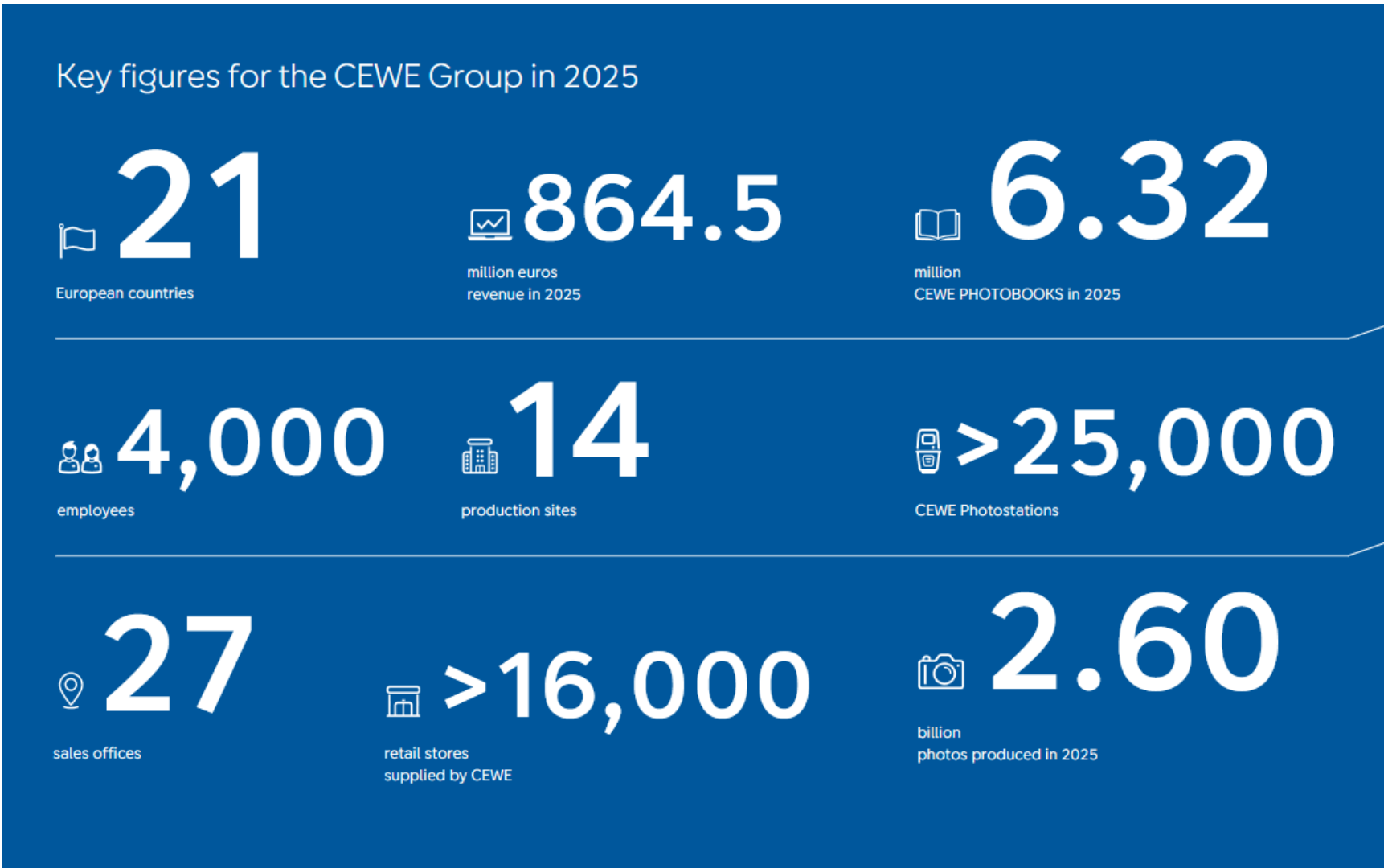
Here are some current highlights:
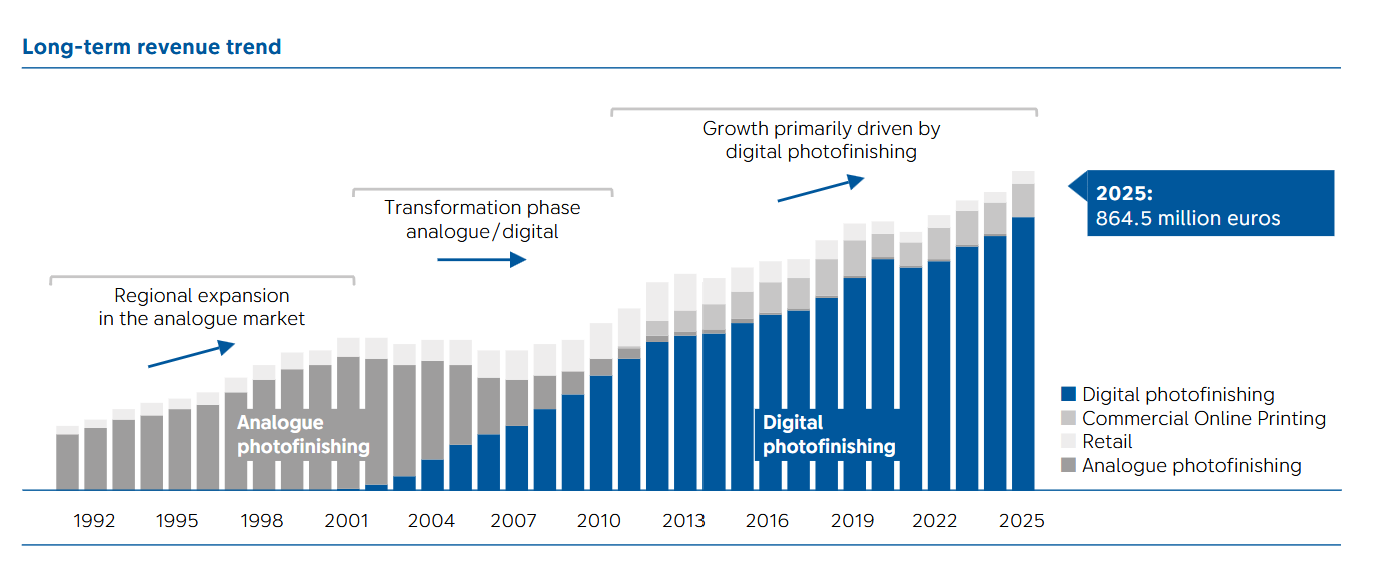
This chart from the annual report is very interesting which shows the transition from analogue to digital over the years:
When Wyser-Pratt “attacked” the company in 2007, only~50% of the business was digital, however that changed pretty rapidly.
From different sources, one gets an estimated market share for CEWE in Europe of ~30% and an estimated market share in Germany of >50%.
This seems to result in an one-off gain of around 50 mn EUR.
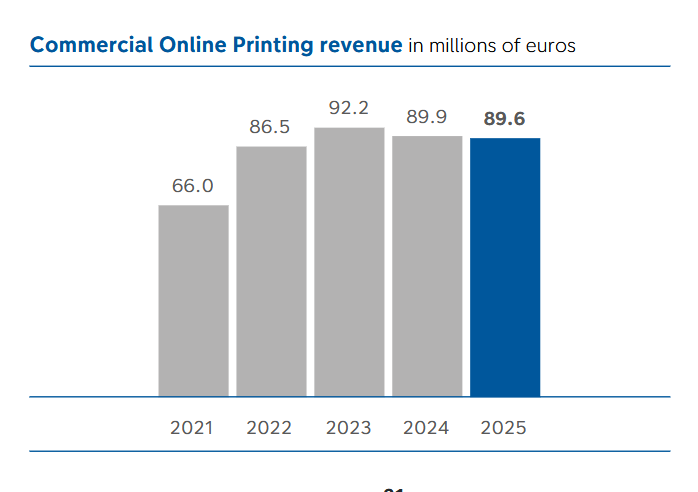
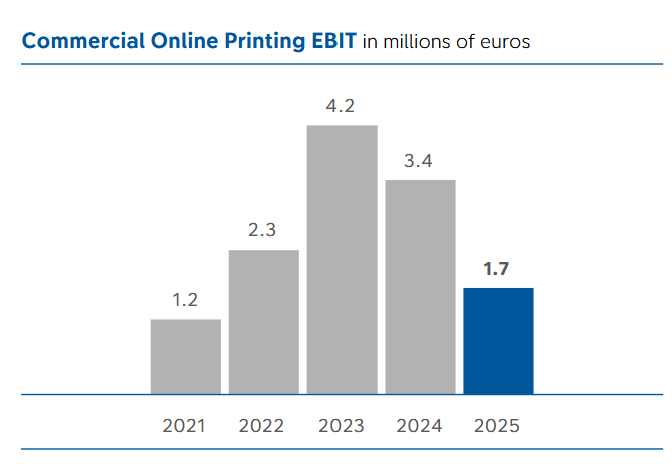
As we see in the numbers, the division was barely profitable and not growing but represented 10% of total sales:
More or less at the same time, CEWE announced an acquisition: They are buying the Kodak Moments business which is basically very similar to their CEWE in-store kiosk business from a US PE fund,
I found some information about the business from 2023 where it seems that 40% of the Kodak moments business seems to have been generated in Europe, 3% in the US and the rest in Australia and South America.
So CEWE sold ~2 mn in EBIT and acquired 11 mn EBIT, which seems like an OK deal. The big question s of course if and how fast they can bring the Kodak Moments business up to CEWE’s standards with double digit EBIT Margins.
The main risk that I see is that CEWE’s German Board (one exception) might struggle a bit with the non-European parts of the Kodak Moments business. I am also not 100% sure in what condition this business is after years of bankruptcy and 2 years of PE ownership.
General development
In general, looking at different sources, printing single photos still seems to be in a decline, while photo books seem to be growing, at least from a value perspective.. To my understanding, the acquired Kodak Moments business includes both.
Another question is at what stage, Agentic AI might be an issue for “branded” Photo book offerings. My feeling is that things move quickly, but I have no idea if and when this could be a threat.
Other aspects:
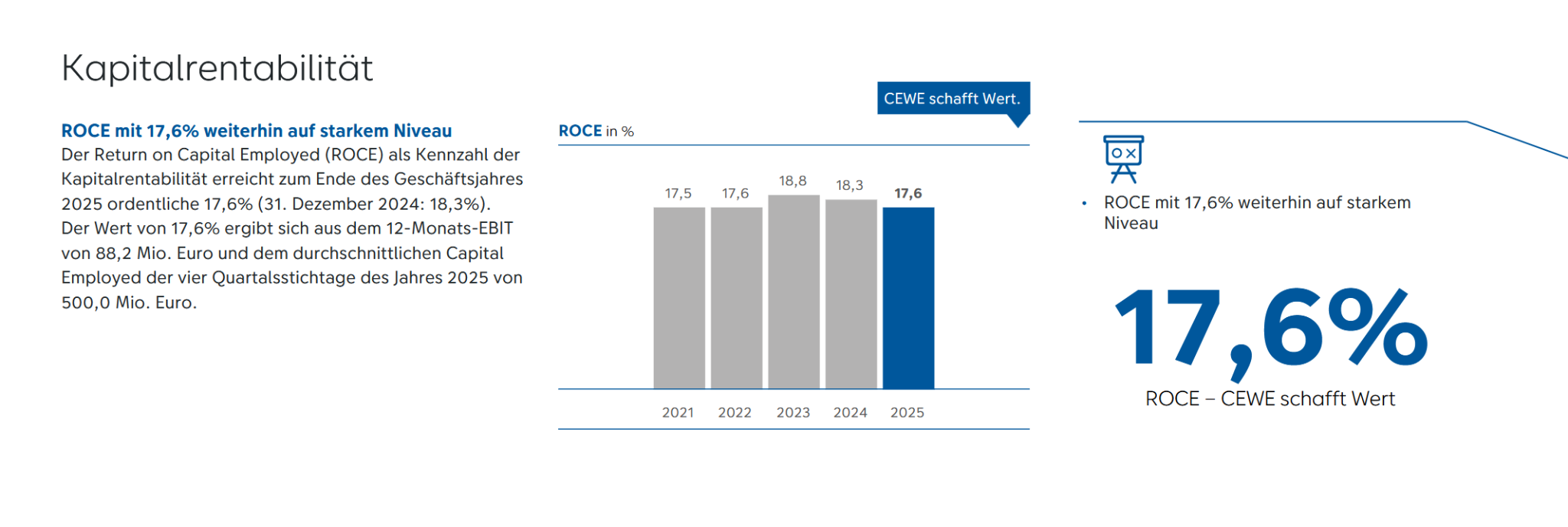
What I do like about CEWE is that they report ROCE which is rather unusual for a German small cap. ROCE numbers are pretty OK:
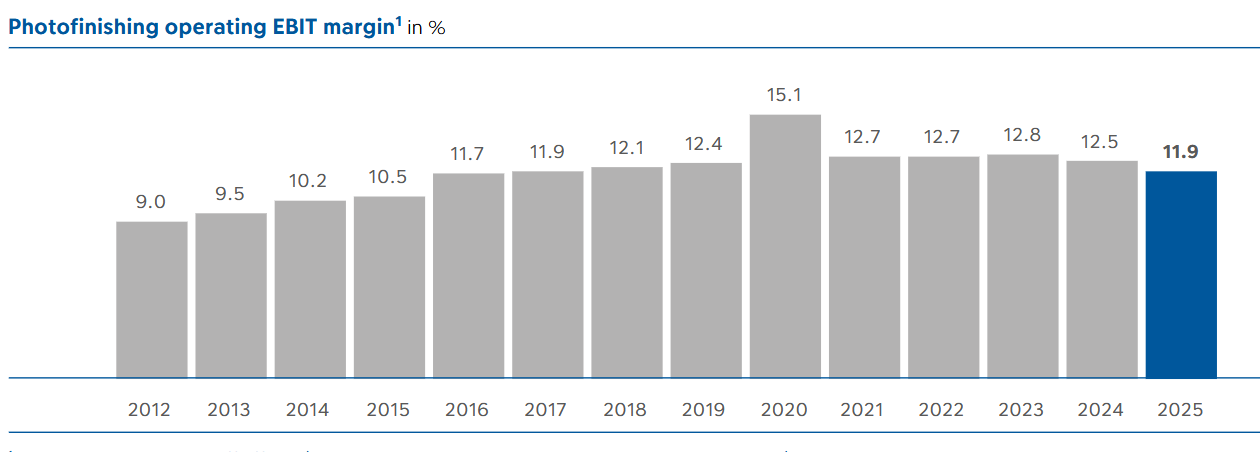
Ebit margins are double digit, however since the Covid Boom, they have been going down a little bit.
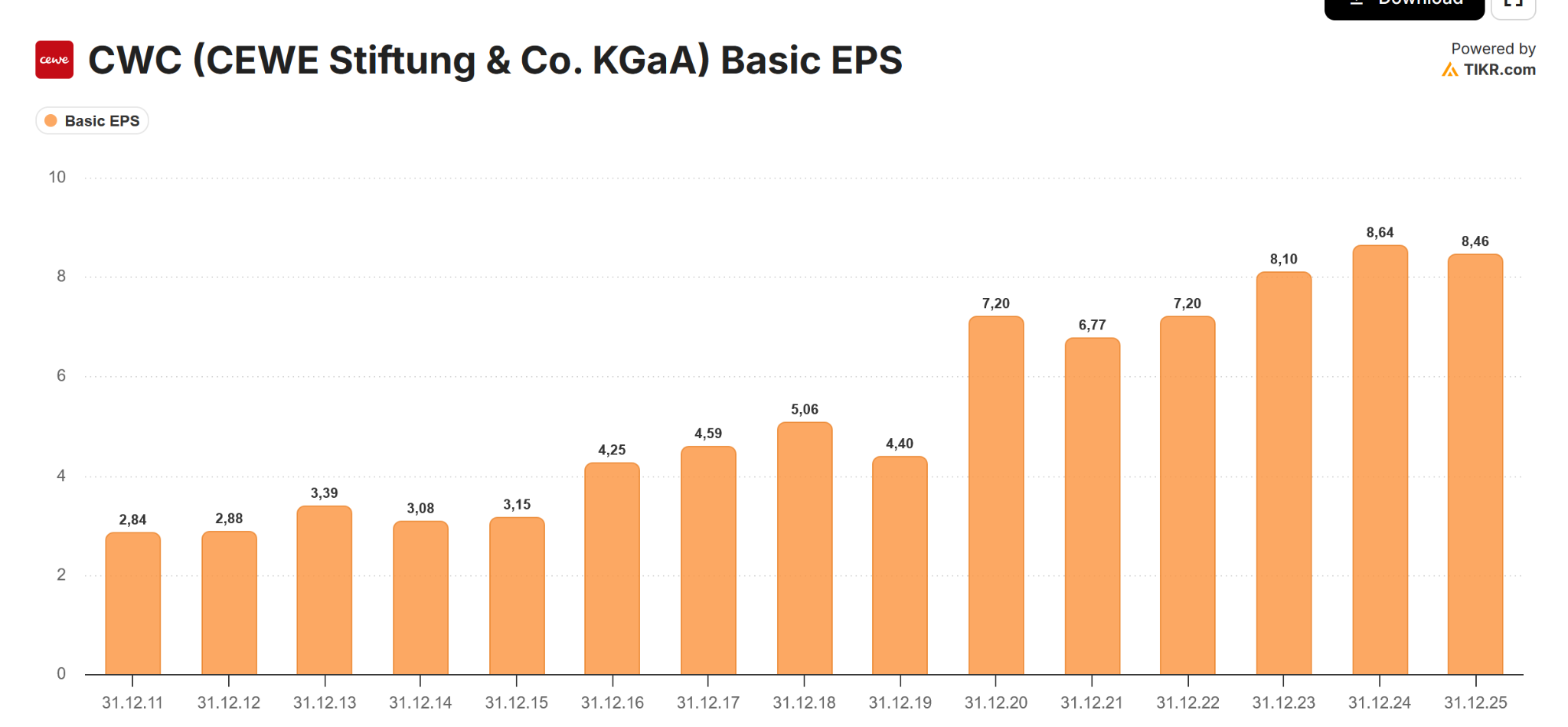
10 year EPS growth from 2015 to 2025 has been ~10,4% p.a. which is pretty impressive. However, since 2023, EPS was rather flatish. The main growth came in the years up to 2022.
This is the EPS chart from Tikr:
Valuation & Share price:
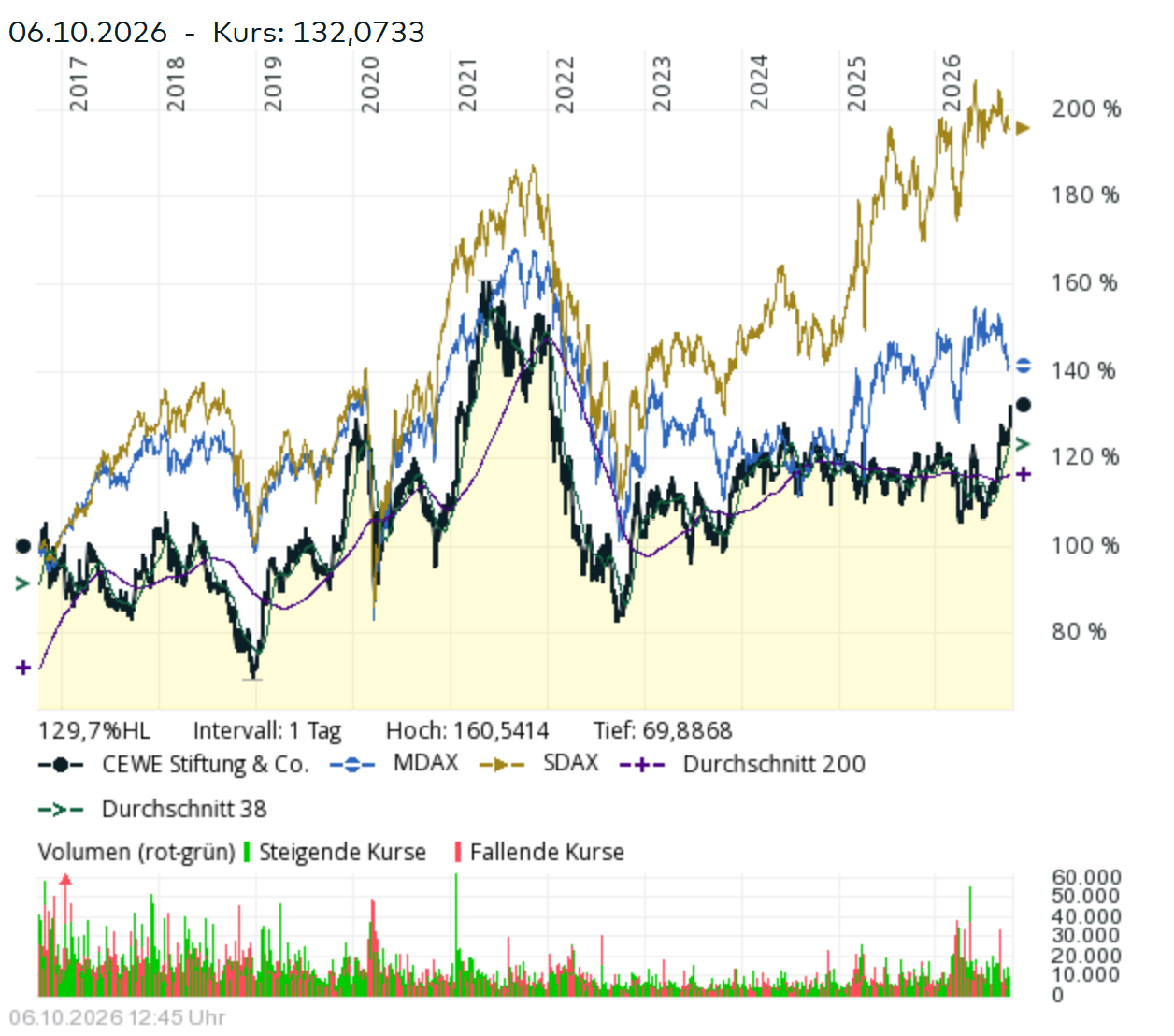
Looking at the chart we can see that CEWE peaked during COVID and traded sideways until recently, underperforming both, SDAX and MDAX (before dividends)::
Recently the stock went up from the trading range as some market participants seem to see a better future.
Valuation wise, the stock is still relatively cheap.
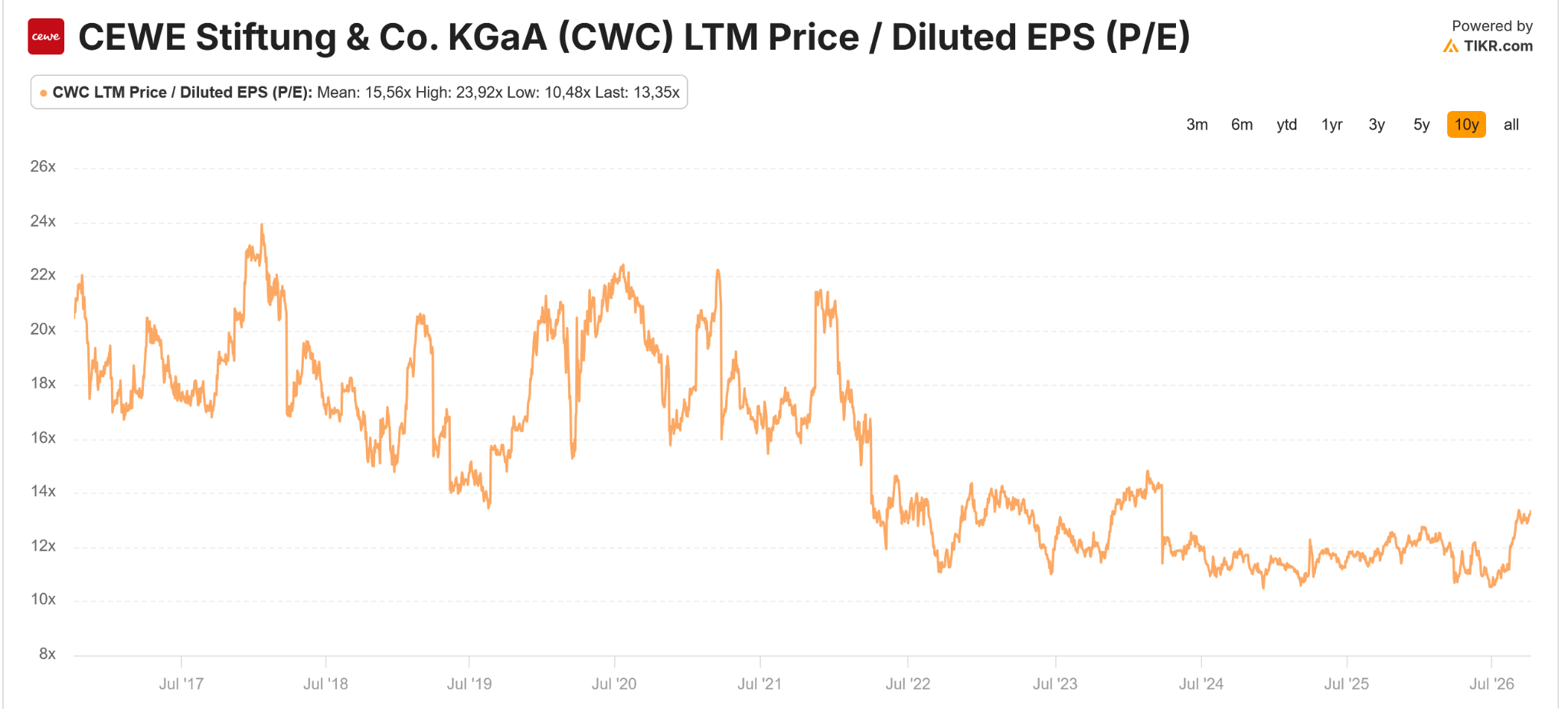
Based on trailing 12M P/E, the stock trades at around 13x P/E vs. an average of 15x:
Pro’s & Con’s
still cheap
profitable
no debt
3% dividend yield
sale of unprofitable division
+/- some share buy backs
low growth in the last 3 years
super seasonal business, all in Q4
KGAA Stiftung
EBIT margins creeping down
Kodak Moments acquisition risky
Large exposure to the German/European consumer
Intermediate conclusion
Although I kind of like CEWE, at this stage I don’t see myself investing into the stock on a 3-5 year horizon,
Yes, it’s cheap, quite profitable and the stock price has just trended upwards. On the other hand, I do see the risk that the recent acquisition might not go so smoothly and I am also not sure about growth prospects after that one time bump from the acquisition.
If I would be in the mood for shorter term trades, I might set up a 3-6 month trade trying to ride the current momentum, but the high interest rates make me nervous.
I also need to manage my exposure in the portfolio to the European consumer to which I am exposed directly and indirectly through stocks like Sixt, Fielmann, Thermador, Italmobiliare etc.
Therefore, for the time being, I am not investing into CEWE but keep it on the watch list.Upfront remarks & Management summary:
This is not a deep dive but more like my “first round screening” of a potential interesting investment. In the past, I would have not necessarily published it if I didn’t invest. Going forward, I will now and then publish these “initial assessments” mainly in order to receive feedback from readers who might see it differently. So please give feedback if you see things different !!!
As a Management Summary, I did not invest. Although I like the company somehow, I could not build up the conviction for a 3-5 year investment case mainly due to recent slow growth and a somewhat risky acquisition.
Some readers might remember that I did a series on Online travel companies some years ago. Here is the link to the last post, including links to previous posts (2017 to 2022, time flies…)
I ended up investing for a short time in Expedia but, for some reason, never looked at Booking.com, which even back then was the clear market leader.
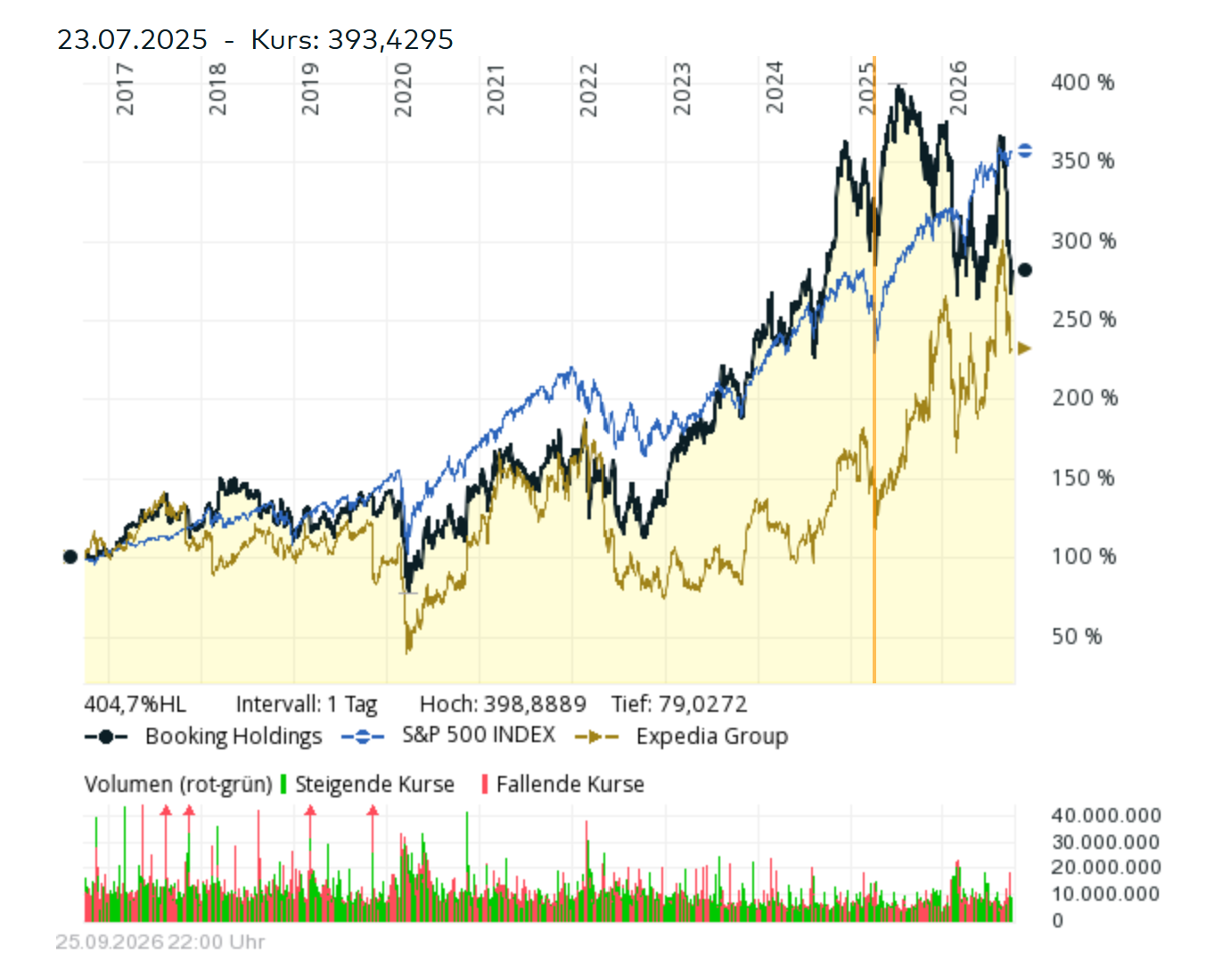
Looking at the charts we can see that Expedia and Booking have done OK. Booking actually did better than the S&P until early 2026:
Back then when I wrote the series, the newly launched Google Travel was the big bogeyman and mostly killed the pure “display aggregators” like TripAdvisor and Trivago, whereas the “Booking engines with inventory” like Booking and Expedia did ok.
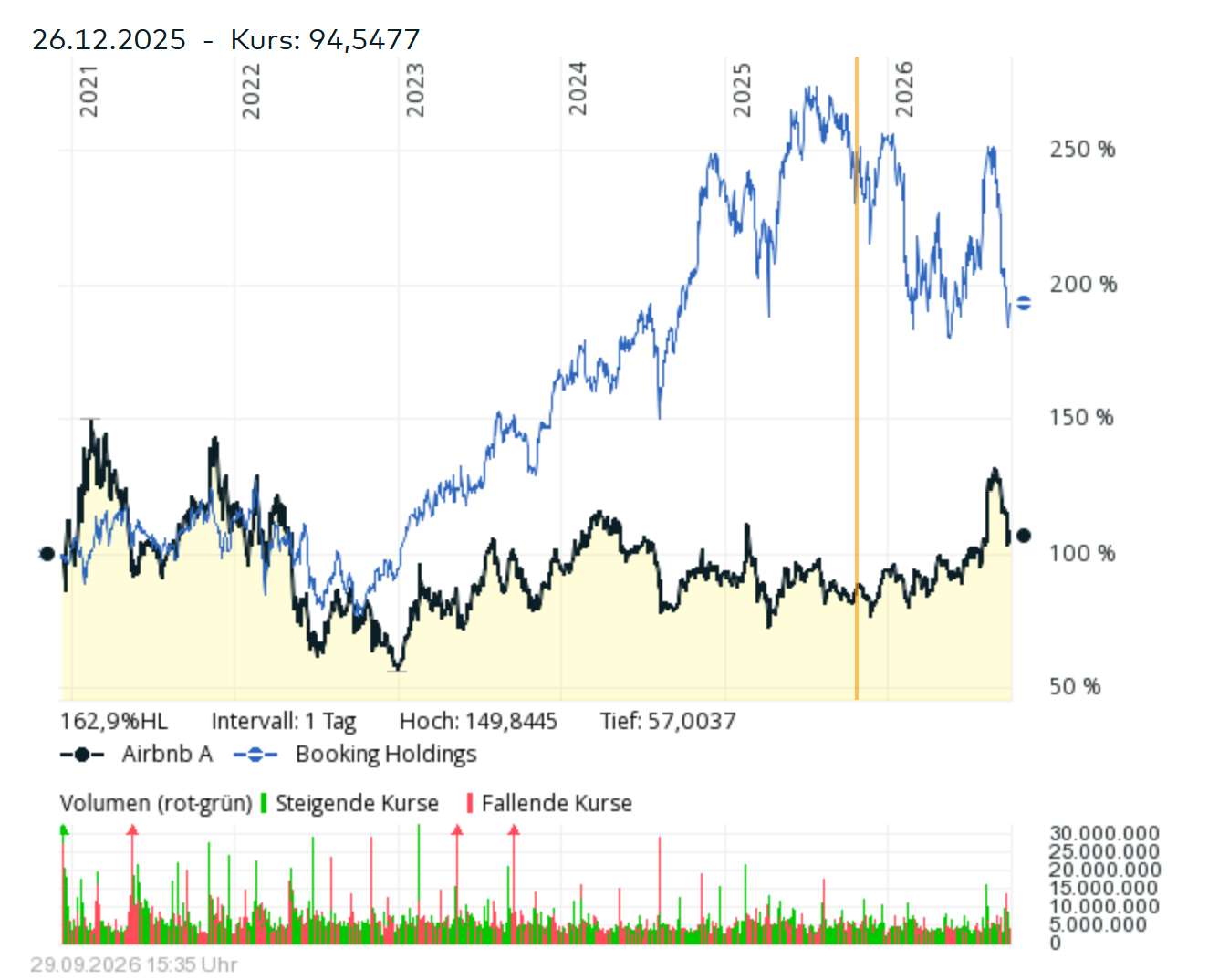
Another interesting comparison is AirBnB and Booking. Comparing both since AirBnBs much hyped IPO in Decmeber 2020 is pretty interesting:
While Booking is still up nicely, AirBnB didn’t go anywher. for the last 5-6 years-
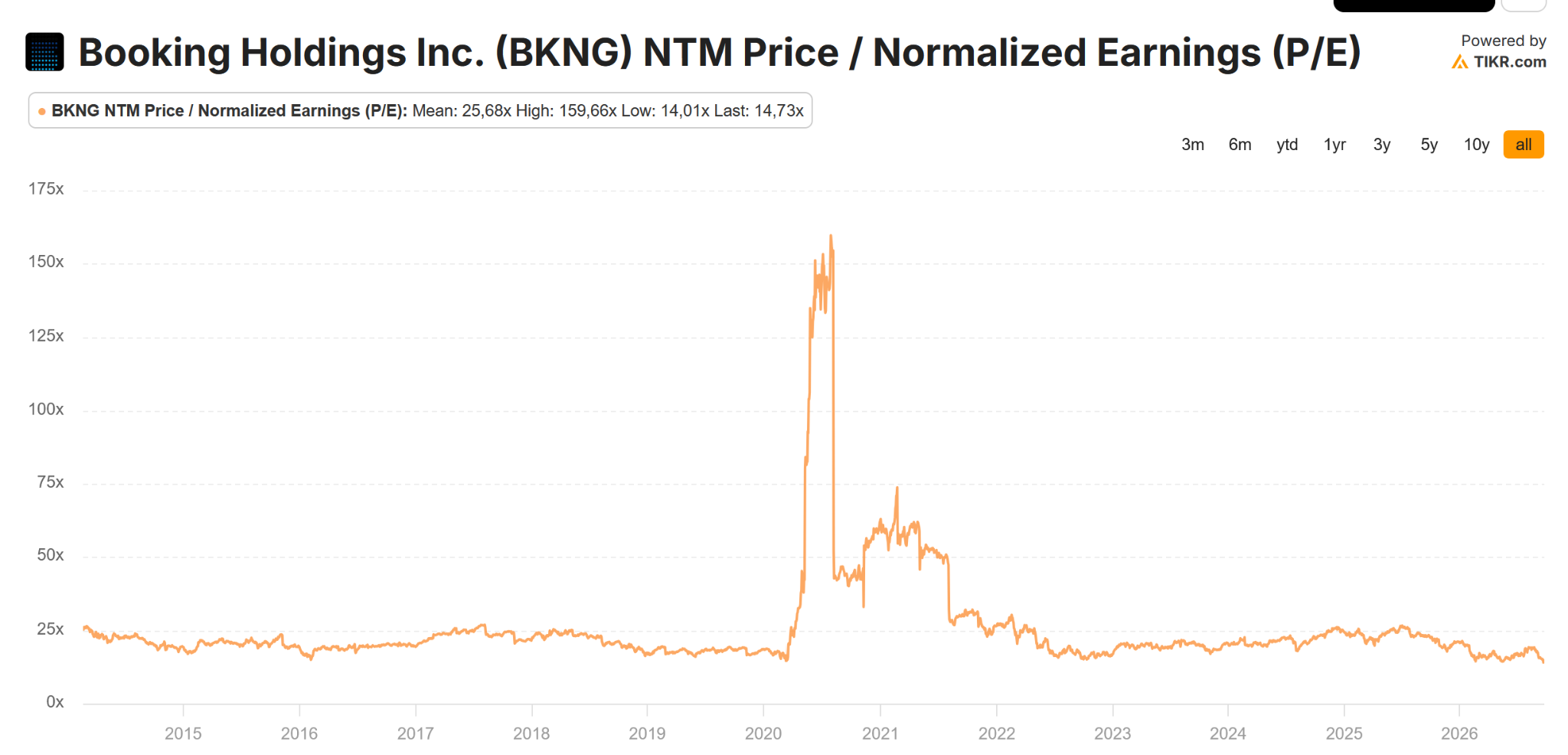
Under the hood however we can see Booking, with the exception of the Covid period, historically traded at a NTM P/E of ~25x whereas today it is only trading at ~15x NTM P/E-
This is the reason why I decided to have at least a first look into it, as a P/E of 15 for a “high quality compounder” is not a bad starting point.
Booking has changed over the past years
One of the most striking things about Booking is how they have changed their underlying business model over the past few years compared to when I started the travel series.
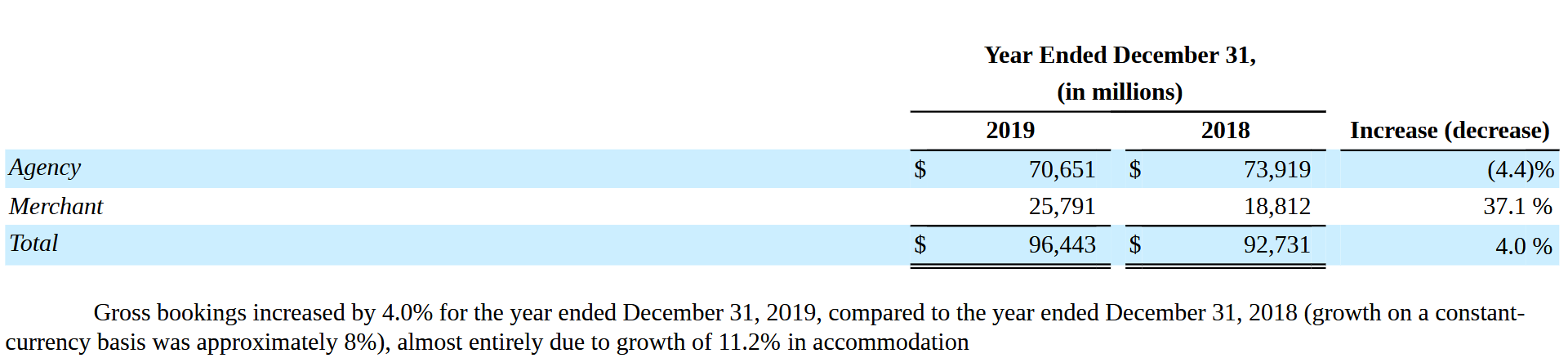
They always distinguished between Merchant vs. Agency bookings. A merchant booking is when you pay to Booking first and then Booking pays the Hotel/Airline/Car rental. An agency booking in contrast is when Booking is not involved in the payment and just creates the “match”.
This is how things looked in 2018/2019:
80% of Booking’s business was Agency, only 20% were merchant transactions. Now let’s compare with the first 6M 2026:
Today, 73% of the bookings are Merchant bookings and the merchant share is still increasing.
Booking initially focused on the Agency because this was market standard and easier to implement especially with the hotels but not very cash efficient, as they had to “front” all advertisement expenses and could only collect the commissions much later.
With the merchant model, similar to airlines or package holiday companies, they can create a nice, interest free “float” of customer prepayments. In total, that results in significant negative working capital, meaning that further growth actually creates capital instead of requiring capital which is a very nice position to be in.
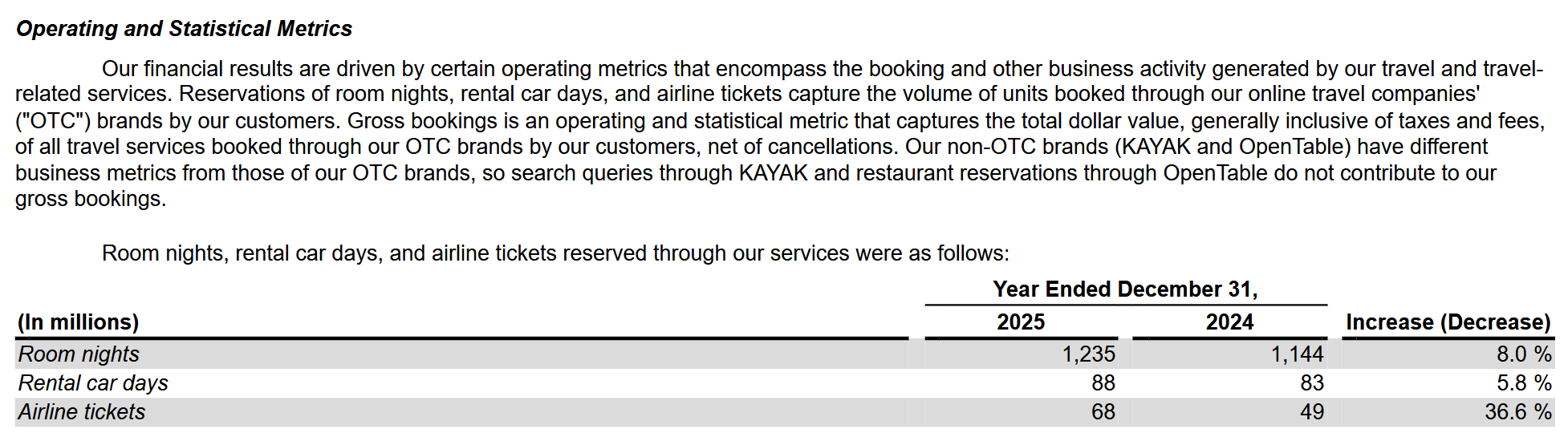
In addition, Booking has diversified much more into apartment rentals, airline tickets and car rentals. They don’t tell us how much the share of these categories is in USD, but this part from the 2025 report shows that especially airline ticket sales are growing significantly:
Booking is calling this the “connected trip” which is currently still a relatively small slice of the pie but seems to grow faster than the overall business:
Cash generation & share buybacks
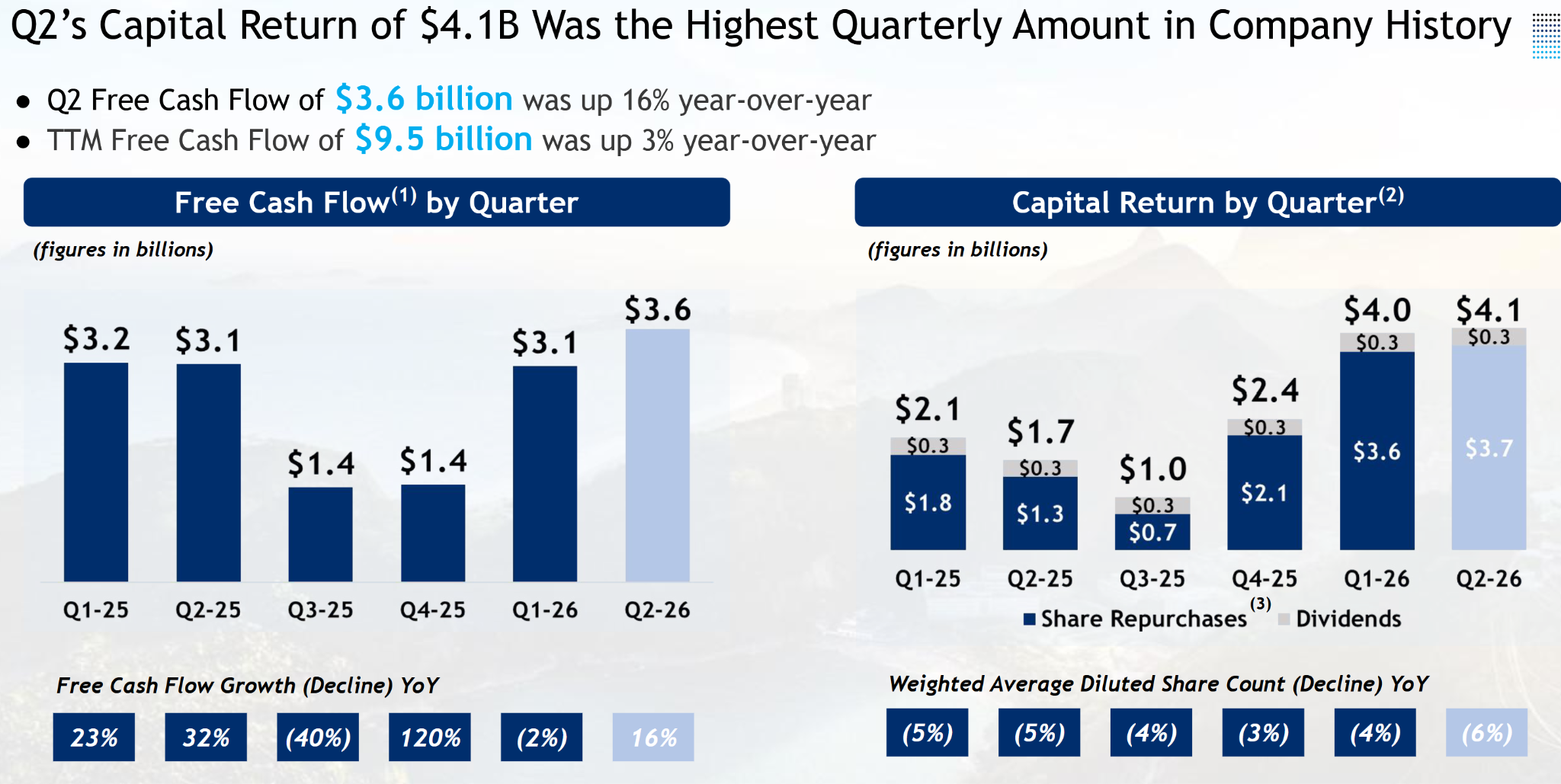
Increasing the merchant model share means that Booking holding has been creating tons of cash despite nice growth in the past and uses most of that cash to buy back shares on top of a small dividend.
This is a chart from their latest presentation:
This TIKR chart shows how share count has evolved over the past 10 years:
With the exception of Covid, they have been reducing sharecount by around -5% CAGR over the past 8 or 9 years.
Geopolitical exposure
Travel and tourist related stocks like Booking are always exposed to Geopolitical tensions. As they mention in their Q2 report, the Iran war has dampened demand from the important Gulf region.
High fuel and ticket prices will also maybe lead to shorter holidays in many cases and less nights that are booked.
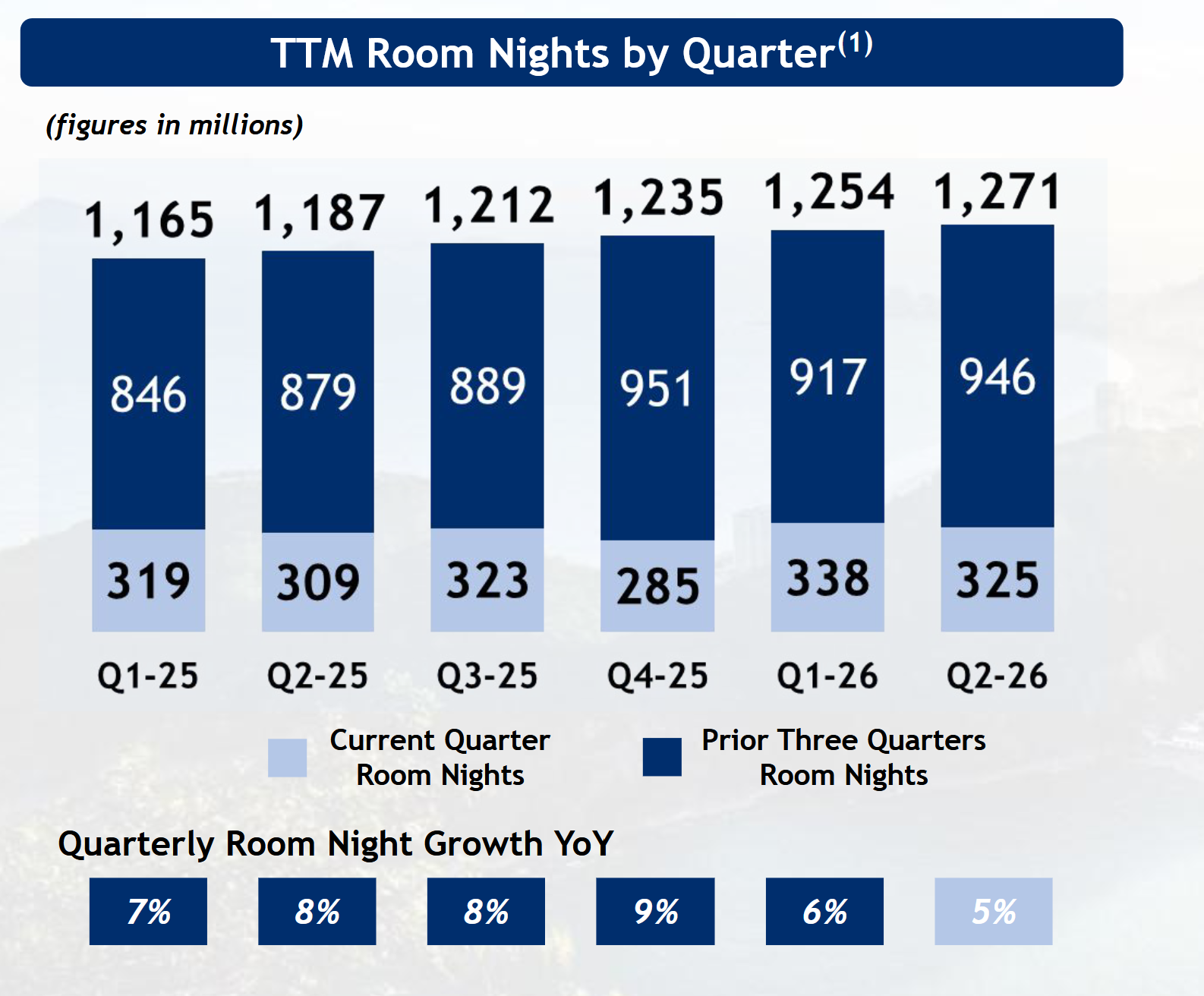
As we can see in Bookings 6M report, growth rates already came down in Q1 and further in Q2 because of the start of the Iran war:
Especially the Q1 number is quite surprising, as the war started “only” at the end of February.
Normally, such a (temporary) weakness in global travel has always been a good time to invest especially in a market leader like Booking. From the lows in the initial Covid months, the stock had made 4x in the next 5 years or so. But: Also for Booking, the perceived threat of “Agentic AI” has to be considered.
So let’s move on now to the Agentic Thread (MUSE & Co)
Booking is a company where many people have some experience with the product, myself included. I have to admit that I have some kind of love&hate relationship. I love Booking for doing initial research on hotels. But in many cases I try to find out after choosing an option if I can get it at least as cheap directly. Sometimes it works, sometimes it doesn’t.
A big risk in investing especially with “consumer stocks” is always to look at ones own behaviour and then make conclusions for all the other consumers based on your own behaviour. That only works, if your behaviour is similar to the majority of consumers. If not, this can land you in a lot of trouble.
So in this case, I don’t think that my own behaviour is a good proxy for all consumers. I actually enjoy doing research for a family holiday trip, which is something that most likely not a lot of people share.
From what I am reading right now, Muse is not very good and makes a lot of mistakes. A friend of mine experimented with Clawbot, which also had its limits. But as ChatGPT, I do assume that those agents get better rather quickly.
So the question is: Will a lot of people delegate more and more tasks to these agents and which ones ?
The big question one needs to answer is the following: Is, maybe, travel a category that gets more easily disrupted by Agents compared to buying a car, an insurance policy or even a house ?
My answer to that is: I do not know, but I guess Travel is more exposed to this than Cars or houses. The next question then is: Will Agents “cut out” the middle man (Booking) or rather use the middle man as an easy source in order to fulfil tasks ?
Those are very difficult questions which in the case of Travel, I am not able to answer.
One indication that it could take more time than current “Agentic maxxers” think it takes is this page from the Booking presentation:
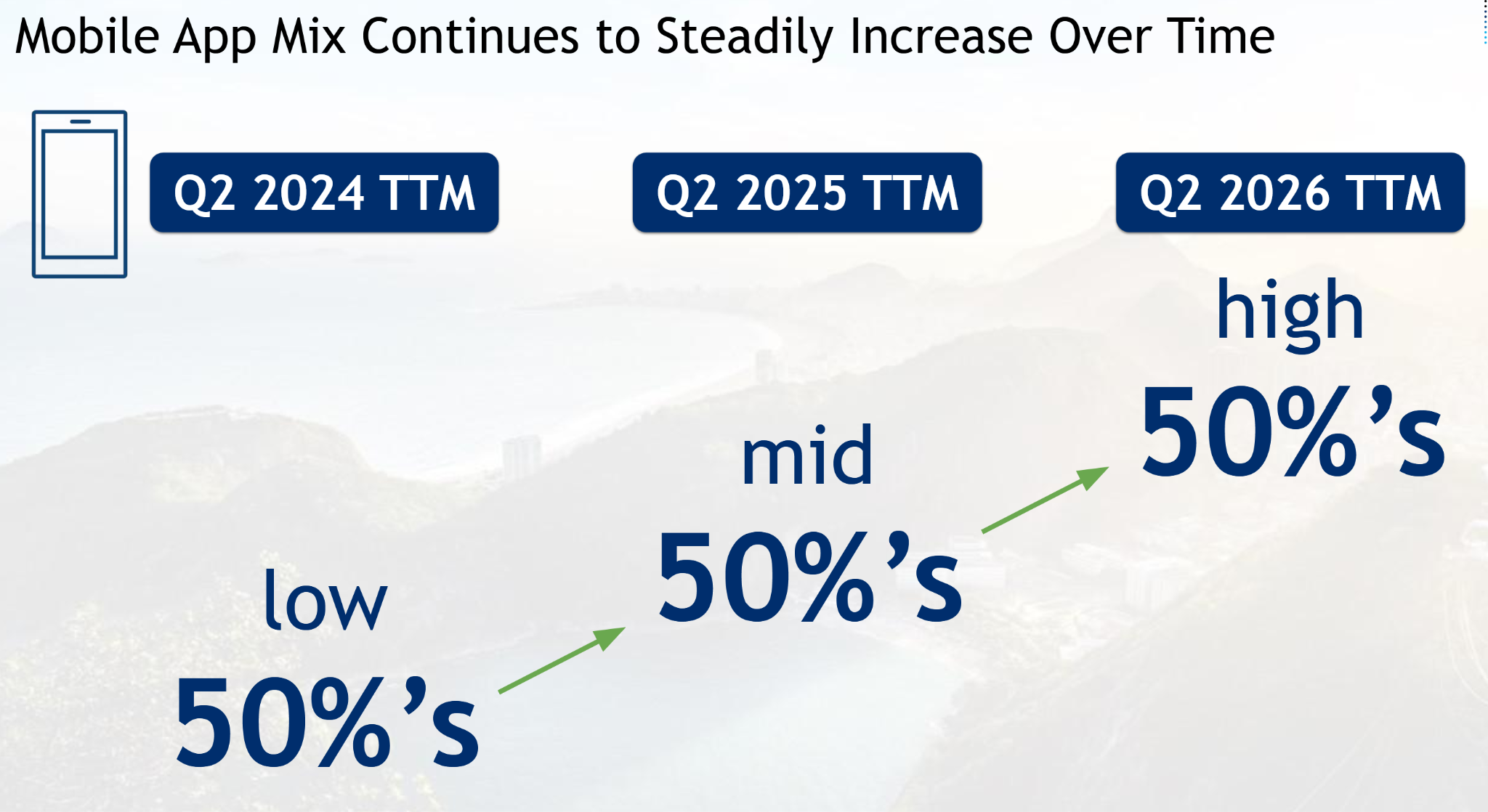
I think it’s still kind of interesting that only slightly more than half of Bookings clients are using a mobile device. This is interestingly below the average in E-Commerce which indicates that travel might be a little bit different compared to buying a new vacuum cleaner etc.
Some statistics show that more and more people use Chatbots for planning a trip, which so far however has not structurally changed the business model of Expedia and Booking, as they were able to integrate themselves into those conversations. So there is clearly also a path, where Expedia and Booking remain (very) relevant even within Agentic commerce.
On the other hand, Booking’s fast growing segments “connected trips” and airline tickets could be the first ones to see some kind of disruption.
But in any case, I find it much harder to underwrite Booking at 15x NTM P/E compared to an Autotrader at 12x or a Rightmove at 15x. Maybe I am wrong here, but only time will tell.
I do think that the risk is clearly higher for Travel and therefore for Booking than for categories such as Cars, real estate and even insurance which is regulated.
Summary:
Not looking at Booking 7-8 years ago because they were expensive, was clearly a “failure of omission”.
However, despite the rather attractive valuation, in Booking’s case, I am less sure if and how fast Agentic E-Commerce could negatively impact the business model.
Letting an AI Agent book a (cheap) flight is clearly less a leap of faith then letting an AI agent buy a new car or even a new home for you.
I will keep Booking on my watch list and might revisit if it becomes even cheaper, but for the time being, I could not convince myself to establish a position in the stock, despite all the obvious qualities of the Business model.
Appendix: Good Podcast discussing Booking’s business model
In the first 6 months of 2026, the Value & Opportunity portfolio gained +8,1% (including dividends, no taxes) against a gain of +6,2% for the Benchmark (Eurostoxx50 (25%), EuroStoxx small 200 (25%), DAX (30%), MDAX (20%), all TR indices).
Links to previous Performance reviews can be found on the Performance Page of the blog.
Performance review:
As mentioned in the last 12M review, I decided to do only one midyear review instead of 3 quarterly ones.
Relative to my European focused Benchmark, the first 6 months were pretty Ok. In absolute terms, once again I was lucky not to have had a Crystal ball at the beginning of the year.
With the Iran war, the Strait of Hormuz still being closed and inflation ticking up, I would have not thought that stock markets would be up in the first 6 months.
Some of my positions disappointed, such as EVS, Wise or the Active Ownership Fund (once again). However, my bigger positions, especially Jensen, Eurokai, Bombardier and DCC did well.
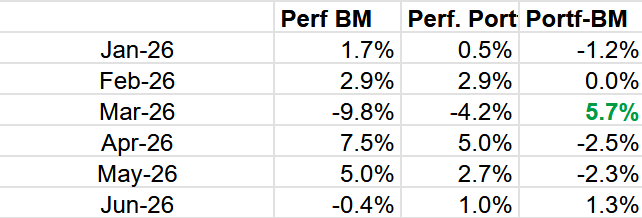
For the record, this is the monthly development of the relative performance for 6M/2026:
For the first 6 months, the portfolio performed as intended: Lower drawdown in bad months but also less upside in good months. As I have mentioned several times over the years, I feel better having less than market volatility in my portfolio.
Going forward this will be not only about feelings but also a necessity as I will soon enter the “harvesting” period in my investor career. Which means more money will flow out of the portfolio than inflows which makes it even more important to manage volatility. But more on that at a later time.
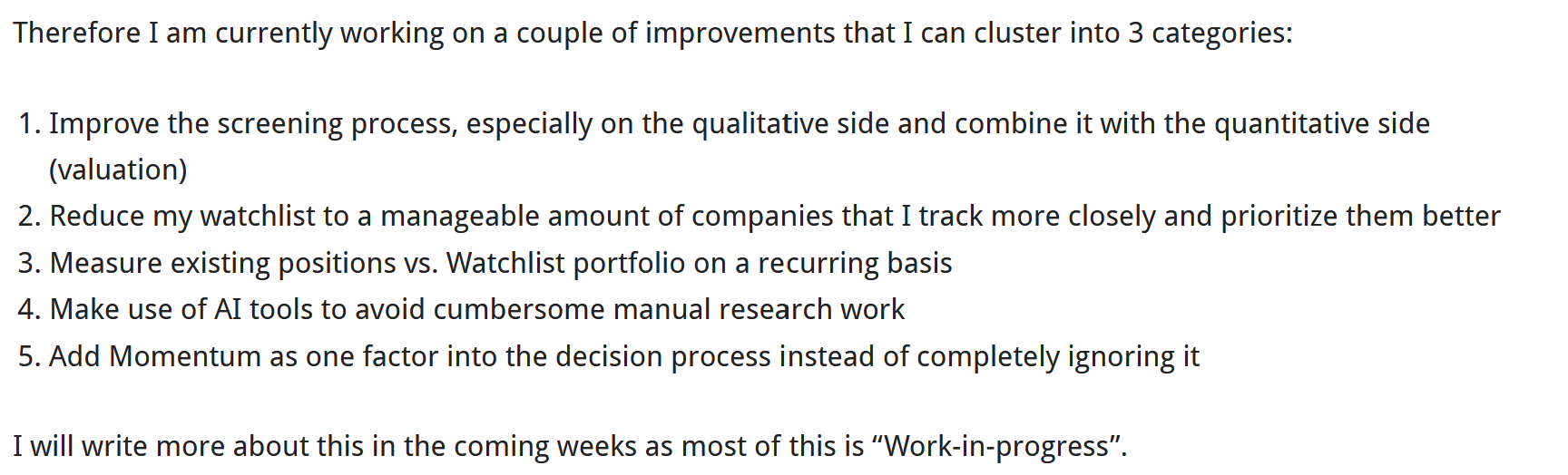
I have implemented everything now in my investment process. Did it help ? Hard to say, because a short term performance record is subject to a lot of random noise.
One thing I can say is that my portfolio would look differently if I had not implemented these changes. I might not have bought for instance more Eurokai, Jensen and Bombardier. I might have added to EVS instead after the share price dropped or actually sold some of the larger positions.
So far, I “feel” that these changes help me focus better but of course this could turn out to be wrong. To be continued.
Transactions 6M 2026:
The current portfolio can be seen as always on the Portfolio page. Cash is currently around 9% of the portfolio.
I exited Special Situation Bois Sauvage after a decent run up as well as SFS which I found too expensive in relative terms. I also sold my little bet in Sixt common shares, SAMSE and Laurent Perrier.
I bought and sold as Special Situations BioNTech and Rocket Internet.
New positions were Frosta, Bachem, Norma and 7C Solarparken. I added to Frosta, Gerard Perrier, Frosta and recently Sixt. I reinvested the gross dividends into Eurokai and Sixt. I reduced my EVS position after the quite disappointing outlook and the exit of the CFO. In addition, I also reduced STEF mainly because of their cutting the dividend. Both, STEF and EVS declined significantly in my internal ranking which makes it difficult to justify a large position.
In addition, I also decided to quit the Active Ownership Capital Fund and sent a cancellation order which will be executed by year end.
Current Cash levels are at around 9,3%, the largest 10 positions sum up to 56% with the top 3 totalling 25%,
Random ramblings: AI winners vs. losers, European AC, Volkswagen & Football 2026 Worldcup
AI winners & losers
Despite some setbacks, the “AI trade” is still strong and I think very few people now seriously doubt that the AI revolution is for real. Sometimes it is hard to believe that only 3 ½ years ago, the world experienced the “ChatGPT” moment when the first version of OpenAI’s chatbot had been released and this crazy journey started.
What I find very interesting is how quickly the favorites have changed on the “front end” side of things. Initially, everyone agreed that OpenAi and Microsoft would be the winners in this game among the big Hyperscalers. Microsoft secured early a big stake in OpenAI and immediately tried to integrate it into a product called “Co-Pilot”. The same playbook they used for instance to crush Zoom with Teams. “Distribution always wins” was the early verdict.
Now, It currently looks like Alphabet/Google is winning on the retail side and Anthropic on the B2B side if the current US Administration will let them do so. OpenAI, the “first mover” on the other hand seems to be pushing its much anticipated IPO into 2027 and Anthropic might not want to IPO either, as at any second, the US Administration could try to kneecap them again.
Microsoft’s Copilot is only used by people who have no other choice. Despite Microsoft having sold 20 million seats, some sources say that only 20-30% of those seats are used on a weekly (!!) basis.
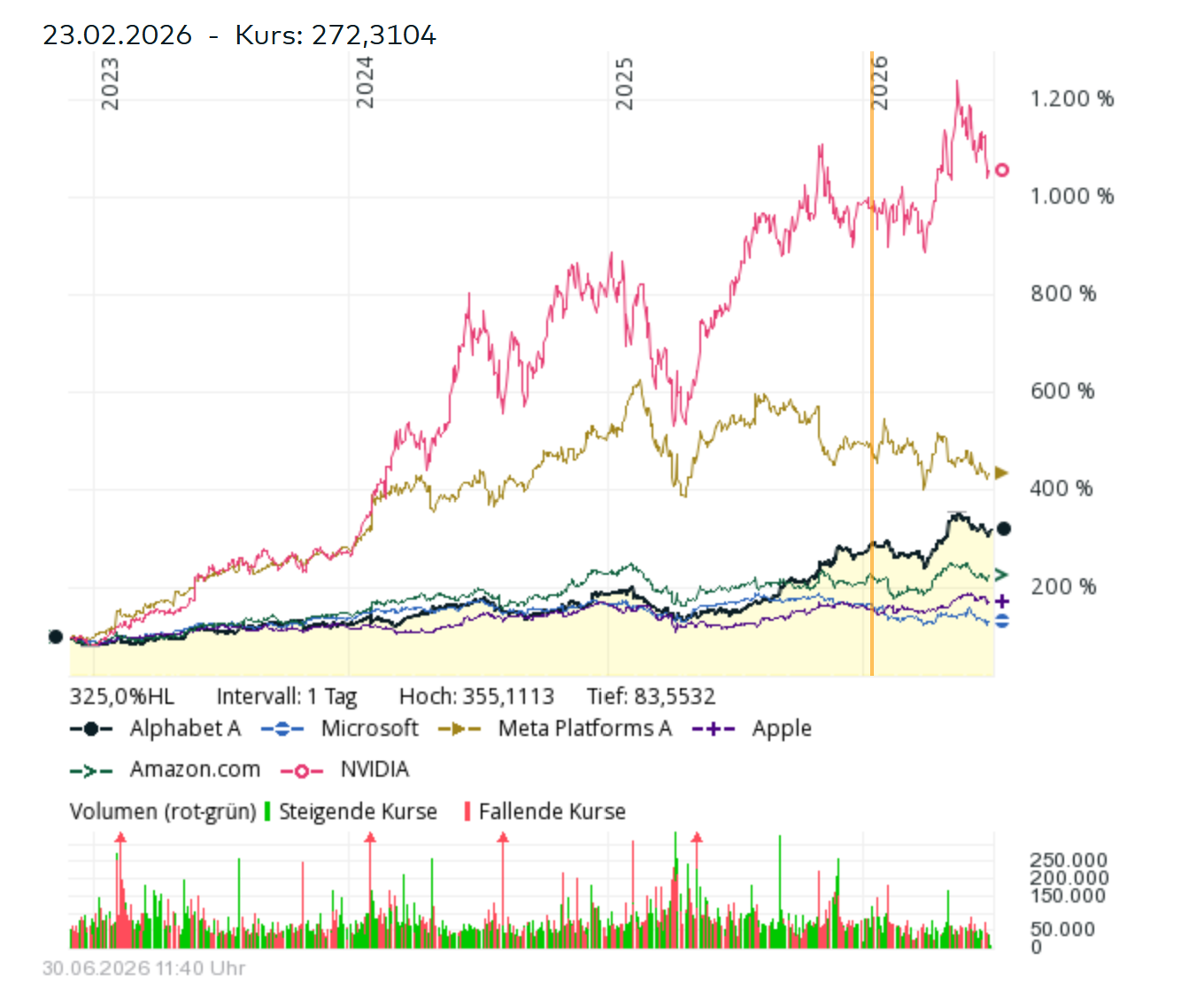
Looking at the “Mag 6 (ex Tesla)” stock charts since November 2022, the best trade was clearly Nvidia which is no surprise. But Meta, which clearly has not been very successful at the AI business, is clearly number 2.
Meanwhile the initial clear winner, Microsoft, is the worst performer. Even Apple, which so far has done very little on the AI side, is doing better.
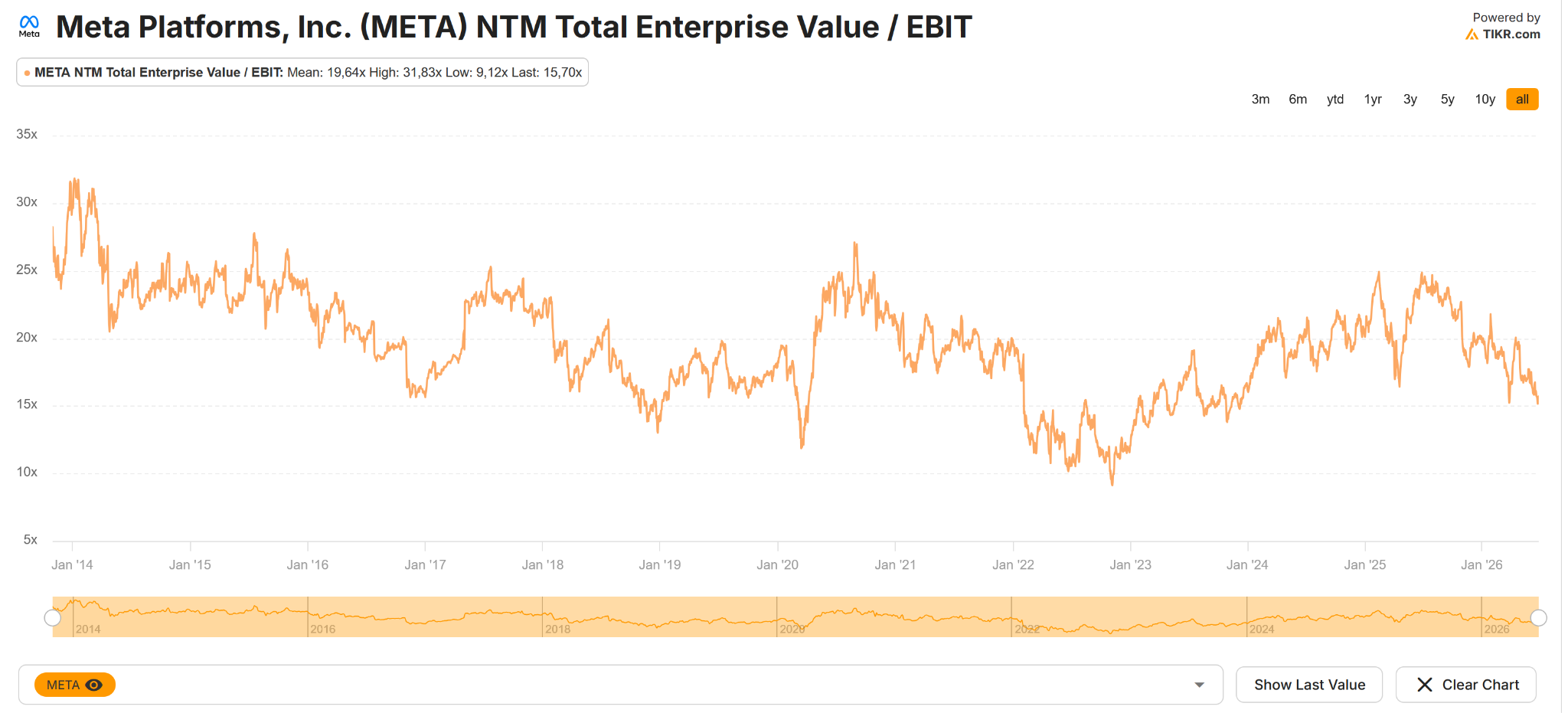
For Meta, part of the explanation is clearly that they were trading historically cheap in autumn 2022 at around 10x LTM EV/EBIT. On the other hand, they also tripled EPS from 2022 to 2025:
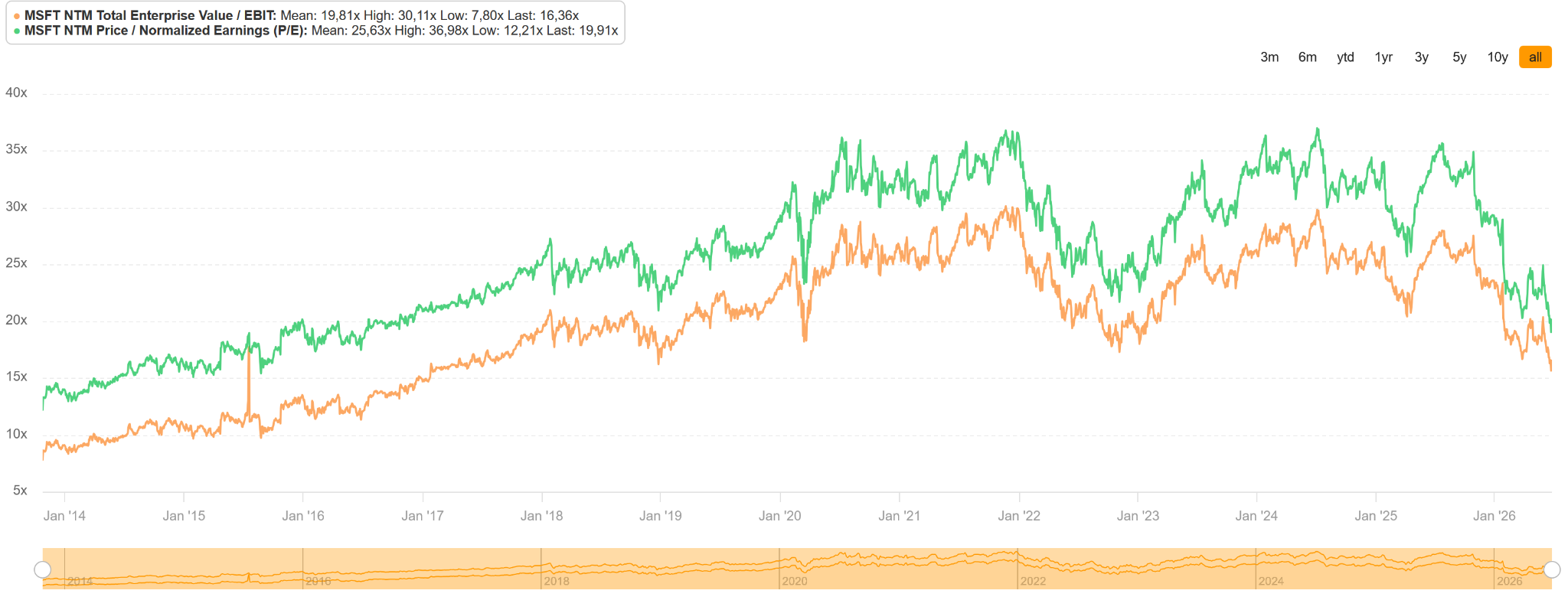
Microsoft in comparison traded at around 20x EV/EBIT in Autumn 2022 and is now trading at a slightly lower multiple:
And more importantly, EPS “only” increased by less than 100% depending on where you make the cut-off.
So what I want to say here is that even looking at the Hyperscalers, starting valuation and EPS increase are at least equally important than the pure story telling.
We are still early in the race and so far, the “first mover advantage” didn’t really seem to have worked out for Microsoft and AI. I guess we will see in the next years if maybe even Apple’s approach of wait and see is maybe the best one ? Prof. Damodaran even praised them with an article called “An ode to restraint”. In my opinion, the winners of this “platform shift” are clearly not carved in stone and maybe we will see completely new players in the next few years and don’t forget the Chinese players.
On the other side, with all the Capex, the risk on the side of the Hyperscalers clearly increases, especially if they are not among the winners.
European AC & Climate adaptation
During the recent heat wave, my Twitter feed was full of posts that “Europeans are too stupid” or too poor to have AC.
As always, generalizations like this are generally extremely stupid (with the exception of this generalization of course). While I am writing this, we have heavy rains and ~20 degrees Celsius and the worst seems to be over for now.
But behind that stupid discussion, there lurks an “unconvenient” truth: The climate is getting warmer and half a degree more on average in a year unfortunately does not mean half a degree more every day but more and more very hot days in summer.
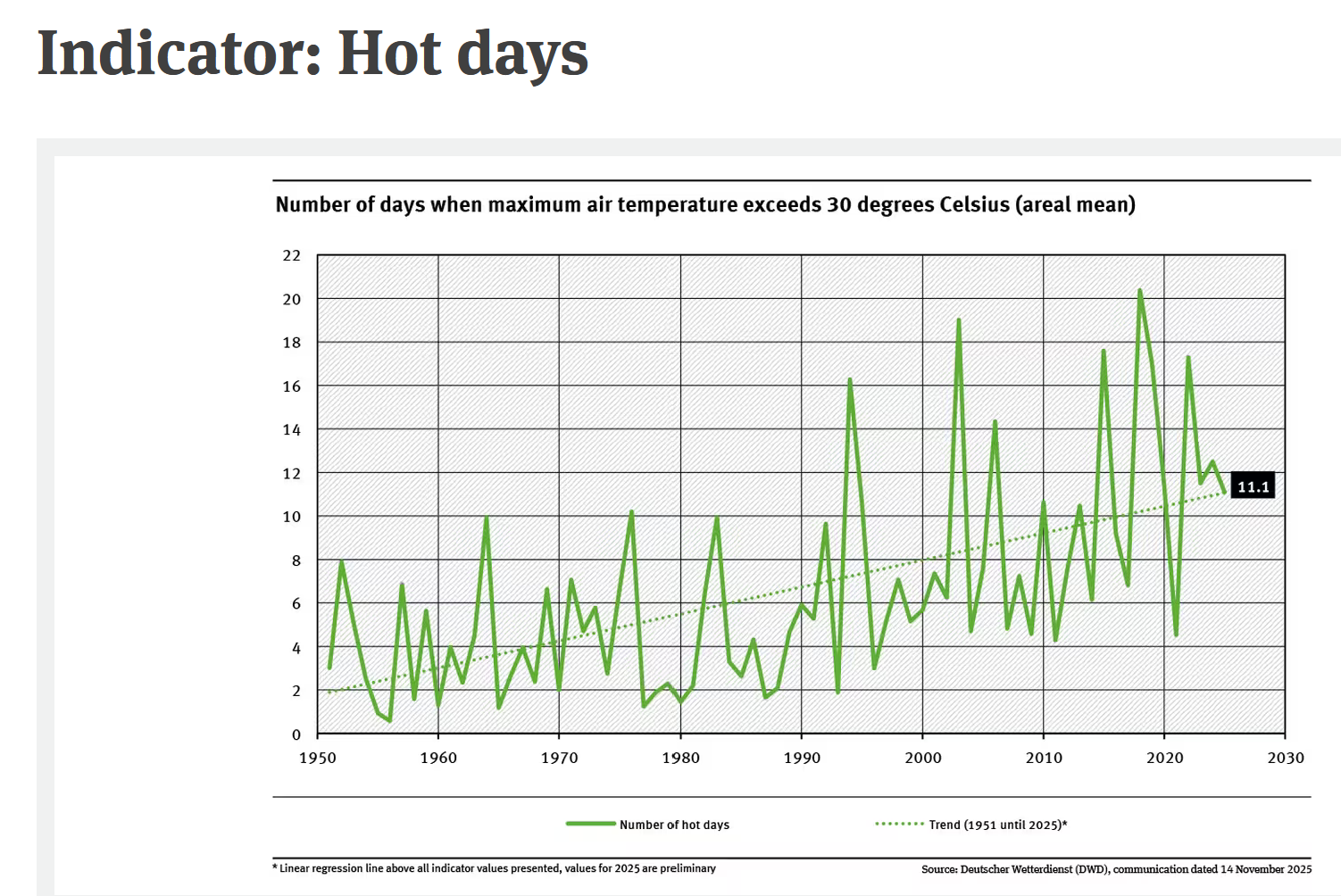
20, 30 years ago, there were maybe 2-3 really hot days in Summer, now it is maybe on average 11 and still increasing:
This is surprisingly (or not) a bigger problem in the more moderate climate zones like central Europe than in the North or in the South of Europe. Anyone who has actually travelled in Europe for the last 20-30 years knows, that the poorer Mediterranean countries like Portugal, Spain, Italy or Greece are very well equipped with AC. Summers were always hot in Italy and that’s why Italians are at the Beach in July and August and only stupid tourists are walking around on foot in Rome and complaining.
The problem is clearly much more in areas like Southern/Middle Germany for instance. The Rhine basin where a lot of the big population centers are in Germany is generally a relatively warm region. Traditionally they have always been wine growing regions unlike for instance Bavaria where I live or Northern Germany near the coast,
Really hot days in a row, where the temperature does not go down at nights are clearly a strain without air conditioning.
The average age of residential buildings in Germany is around 40-50 years. That means they were built in a time where on average there were only half the hot days that we have now. In addition, a lot of renovations increased the “vulnerability” like increasing window size or remodelling roof storage units into apartments.
Many homeowners that I know have already installed AC in the last few years. However, one of the issues in Germany is that more than 50% of Germans are renters and installing an AC in a rental unit is much more difficult.
In addition, a lot of public buildings still get built without AC and authorities are really slow to retrofit AC in public buildings. This in my opinion is the real issue: Hospitals, old age homes, schools etc. need to be upgraded as quickly as possible. On the weekend, there was an “open house” of the brand new Fire Brigade building in my neighbourhood and of course it does not have AC.
According to some articles, an existing program to fund AC in public buildings has been actually cancelled for 2026 by the current Government. As always, there is a struggle between local authorities and the Central Government who is responsible.
But AC is only a part of the story. The much more inconvenient part of that story is that Global Warming is real, that countries with relatively moderate climates are not well prepared and that the lack AC might only be the tip of the iceberg. In the past few years, we already had some really dry summers that led to pretty bad harvests for instance.
Climate adaptation is a much bigger topic than just installing more AC units. I think even the hardcore Greens are beginning to understand that one has to face reality and cannot only dream of stopping Global Warming but really make an effort to compensate for the effects.
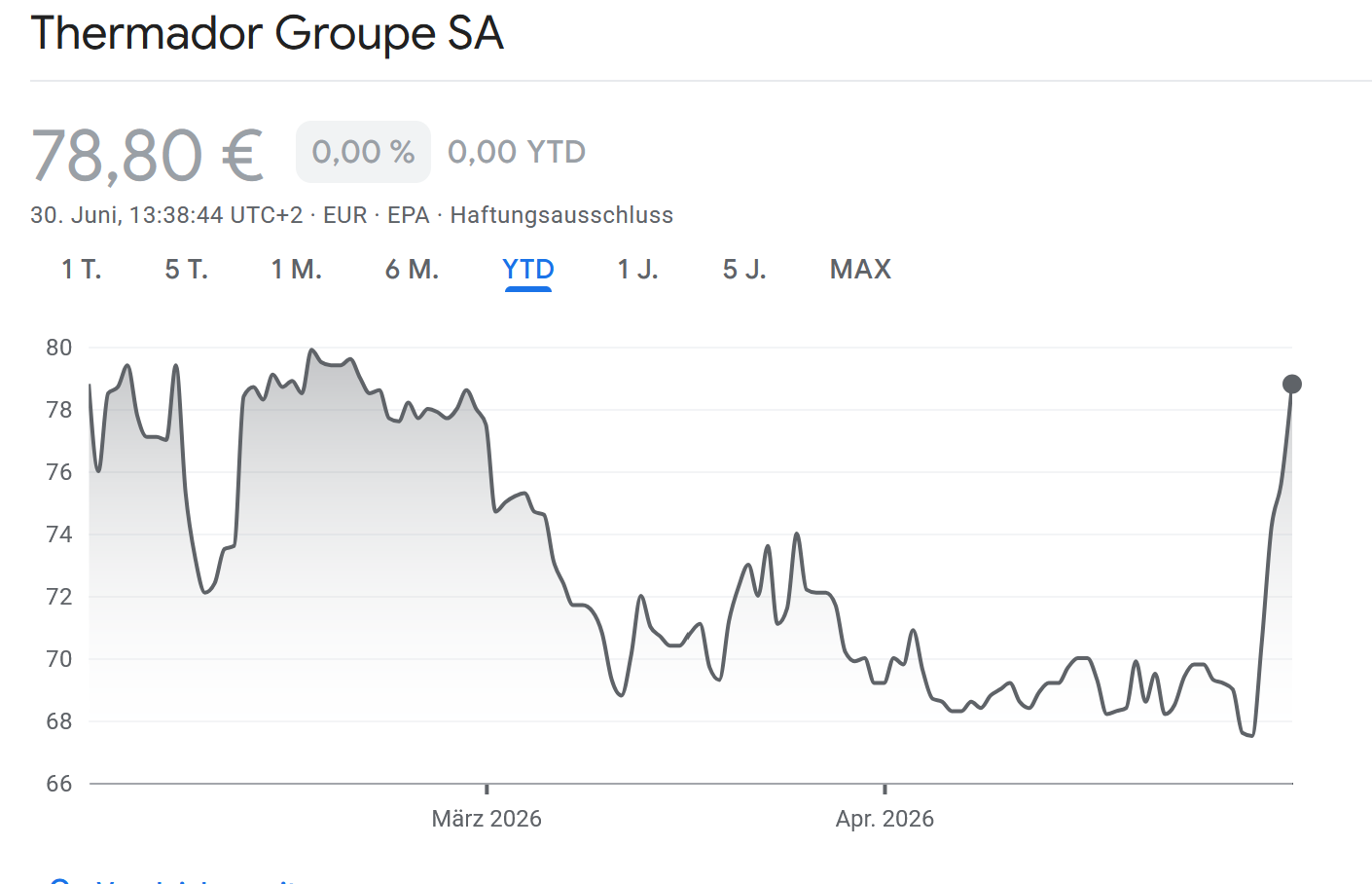
Right now, everyone is looking for more exposure to AC manufacturers, but in my opinion a company like Thermador which specializes in irrigation components also plays an important part in helping with climate adaptation. The stock chart already shows some life in the past few days:
Volkswagen
Volkswagen made a big wave this week that they are planning to “fire” up to 100K workers. As with the German National Football team, each and everyone seems to know exactly why Volkswagen seems to be doing so badly.
The main culprits mentioned are often the Decommissioning of the Nuclear plants in Germany or the EU guidance to not allow Internal Combustion Engine (ICE) cars to be built from 2035 onwards and the general laziness of German workers.
From my perspective, Volkswagen troubles are more a function of the following factors:
Legendary bad Corporate Governance: With the Government owning a “golden share” and the Porsche/Piech families not really knowing what to do, the only common denominator for a long time was just size which is never a good strategy in the long term
Too many brands that are hard to differentiate (VW, Audi; Cupra, Skoda…..)
The combination of US tariffs, JPY/KRW devaluation and cratering sales in China
The unwillingness and inability to fully compete with Chinese EV makers, reducing the profit in China from 5 bn EUR p.a. at its peak to currently below 1 bn EUR
Difficult footprint for accessing the US market (no Northern American plant for Audi/Porsche), Volkswagen is only in Mexico)
The inability to offer state of the art software for their “premium cars”
Badly managing their premium Sports car brand Porsche which became more and more similar to Audi
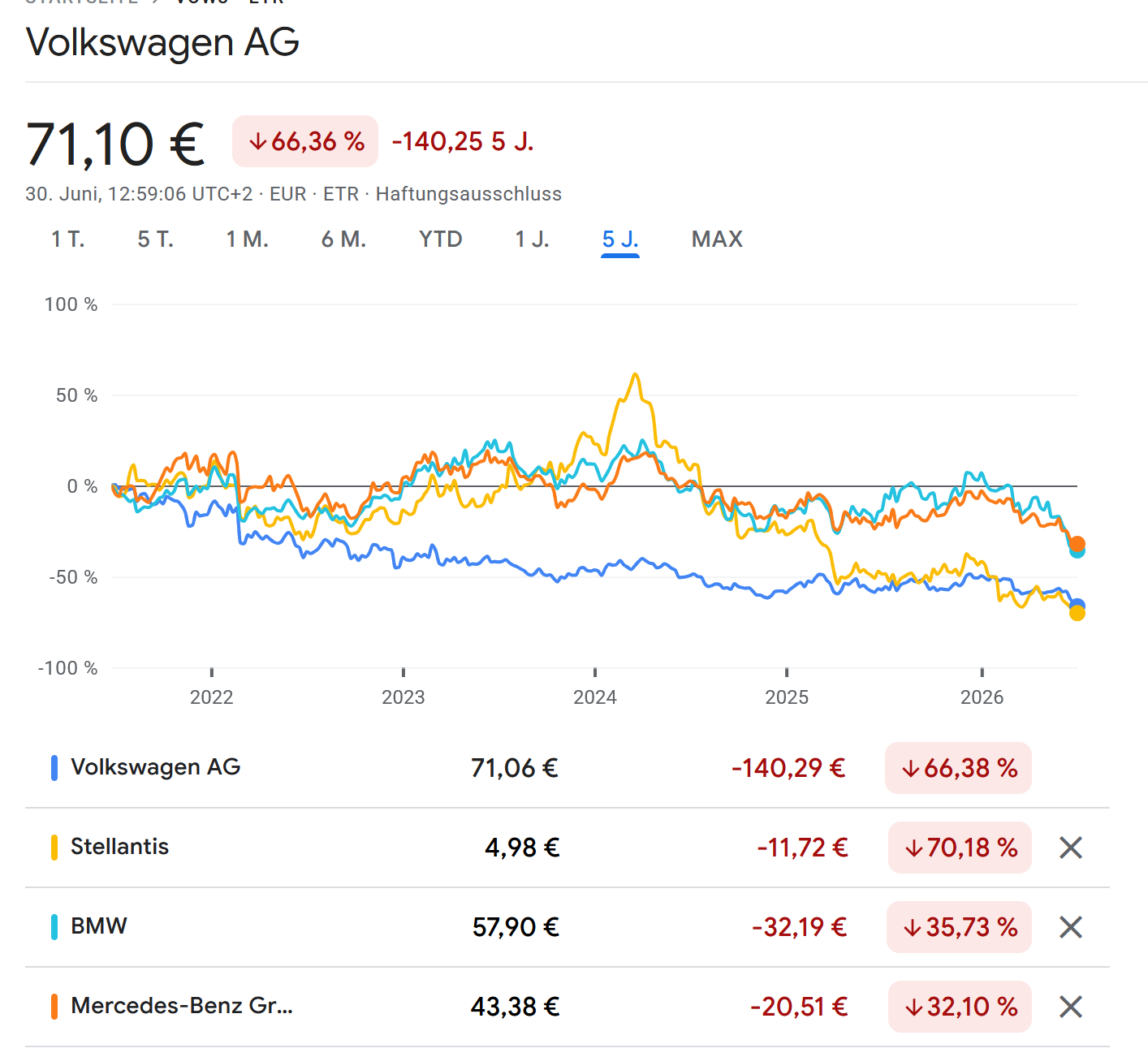
If we look at the stock chart of the big 4 remaining European car makers, we can see that we have two groups: The bad and the ugly:
BMW and Mercedes are kind of hanging in there but Volkswagen and Stellantis are both struggling. Interestingly, until early 2025, Stellantis looked like the superstar, but that did not last long.
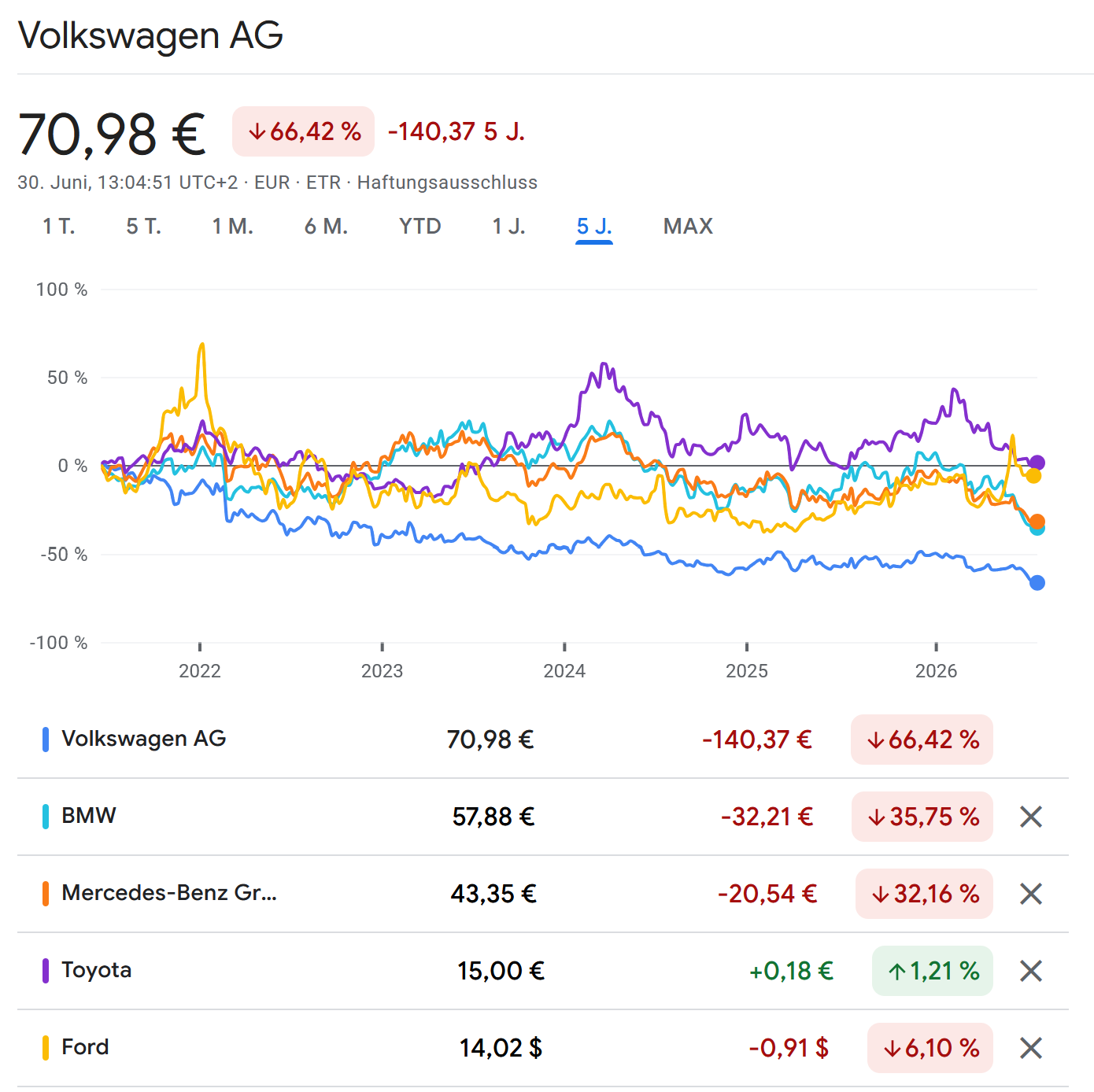
If we compare Toyota and Ford with the German players, we can see that especially Ford jumped from the Group with Mercedes and BMW into a new Group with Toyota.
My guess is that the market is pricing in the protection for Ford in its US home market via Trump’s “liberation day” tariffs.
In any case, there is no easy and quick solution for Volkswagen. If I have counted correctly, Volkswagen (incl. Audi) has ~13 or 14 main plants in Germany compared to BMW which only has 4. Per employee, BMW and Mercedes generate more than 2 the amount of sales than Volkswagen.
So if Volkswagen wants to remain competitive, they need to do some slimming down now or things might even get worse in the future.
From a pure tactical perspective, I guess Management may have mentioned a larger number than what they are aiming for in order to give the Trade Unions and the Government some kind of “sacrifice” during negotiations.
Overall, I see this as a necessary step. The worst case in my opinion would be if they are not able to increase productivity due to political interference. This would be really bad mid- and long term, not only for Volkswagen but for the whole economic complex around it.
It hink the only remotely interesting listed asset of the Group would be Porsche (the manufacturer, not the holding), if they were to become more independent from Volkswagen.
Football World Cup
With a one day period to stomach the loss against Paraguay, a few (maybe unqualified) thoughts on the 2026 Word Cup:
Overall, the decision to let more teams play in this final tournament was in my opinion a pretty good one, although I didn’t like it in the first place. A lot of interesting teams that might otherwise not make it to the finals played really well (e.g. Paraguay, Cabo Verde or most African teams)
Although people don’t seem to like the Hydration breaks, I personally find it quite convenient to have a quick break to get something to drink myself.
The new rule to require an “injured” player to stay out of the match for 60 seconds is a really good rule. It limits these situations very much which were very common in the knock-out matches before when one team had a narrow lead and suddenly players were falling like flies.
The quality of the matches on average is pretty good. I watched a few matches so far (with convenient starting times) and they were all very good and enjoyable.
In general there doesn’t seem to be a big skill difference at overall team level between the best 30 teams or so. So far, the main difference really has been the exceptional performance of some of the Superstars who then really make the difference
Teams like Germany (and Italy or Uruguay) are at the moment really lacking these individual Superstars which might explain the lack of success for those traditionally strong football nations.
The only negative is that for Europeans, the starting times of the matches are sometimes very inconvenient. On the other hand, the availability of summary videos on the next day compensates to a certain extent.
This post does not contain any actionable investment advice but rather some personal ramblings on Vibe coding and the attempt to analyze a specific Software company (Guidewire) according to a Template of 10 Moats for Software companies and their vulnerability to the AI threat.
Introduction:
My track record as a Software investor is to put it mildly, very poor. My best Software Investment so far is Chapters Group which I bought as a net-net before it even became a VMS Serial Acquirer. My blog and portfolio archive also tell me that I sold Microsoft in 2011 at ~25$ per share with a 4% gain because I thought that the Office products had no future. So please take everything I say about Software with a grain of salt or even better, just ignore it.
I do have a background in Software development. Although I would not call it Software development but “Code butchering”. It started as a teenager on a C64 with Basic and Assembler and ended in the late 1990s with Cobol/PLSQL working for a large US Consulting Company (yes, I was young and needed the money). Knowing the speed of financial institutions, I would not be surprised if some of my Spaghetti code would still be running somewhere….
Why am I saying this ? Because of course, Software stocks have been doing quite poorly over the past weeks/months. In addition, I also had the opportunity to play around with Claude Code first hand.
“Navel gazing” alert: This post doesn’t contain any actionable investment ideas but rather explores how I can enrich my own investment process in the future by incoprorating some measures of Stock price and fundamental momentum.
Excursion: My secret hobby
First I have to admit that for a few months now, I do have a secret hobby: I am watching on a regular basis a Wikifolio (Wikifolio is a German/Austrian platform where everyone can set up a “fund” and other investors can participate) from an Austrian trader with the name Richard “”Ritschy” Dobensberger.
Not only has he managed to attract 160 mn EUR in investments into his portfolio but he has averaged 33% CAGR over the last 13 years, resulting in an overall performance of around 4000% which is really really remarkable and puts him into the top of any trader I know.
If you have 2 hours to spare and want to know more about AI LLMs than 99,8% of your peers, then this video from Andrej Karpathy is what you should watch
Thermador released 2024 numbers last Friday. The most positive part of the release is the fact that Thermador manages to put everything you need to know on two pages without any BS. The numbers were clearly not good, with sales down -13,5% in 2024 and profit down -23,3%:
On the positive side, Thermador seems to continue to look for acquisition targets: