Category Archives: capital management

DCC – Interesting “Special Situation” following KKR potential buyout offer at 58 GBP ?

Disclaimer: This is not investment advice. PLEASE DO YOUR OWN RESEARCH !!!!!

DCC is an investment I made back in December 2022. The investment thesis back then was that it was a successful compounder/serial acquirer that had the opportunity to grow further through its 3 platforms (Energy, Healthcare, Technology).

In the meantime, a lot of unexpected things happened. After issues in the non-Energy segments, DCC is currently transforming itself back into the original Energy distributor and sold already a significant part of its non.Energy businesses. The transformation has progressed well including a share buy back tender but is not finished yet.

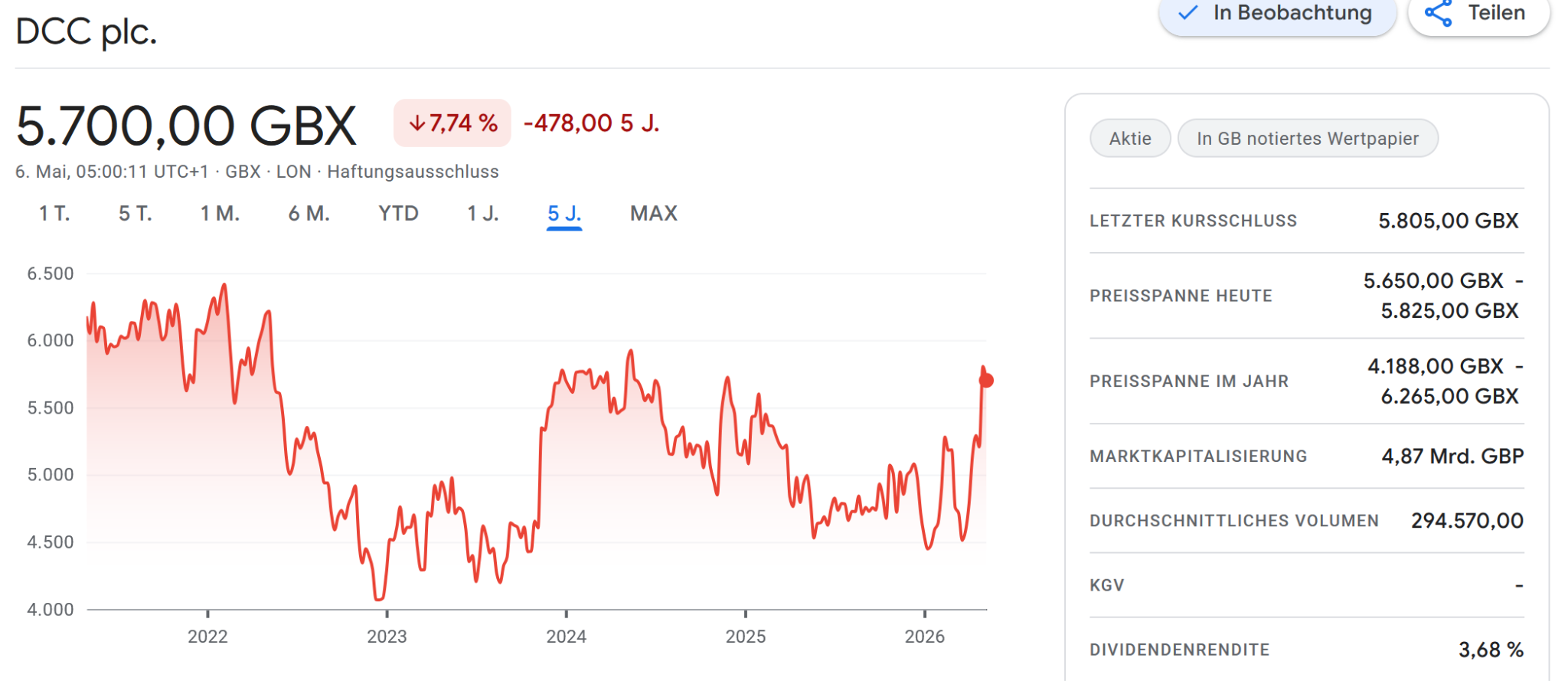
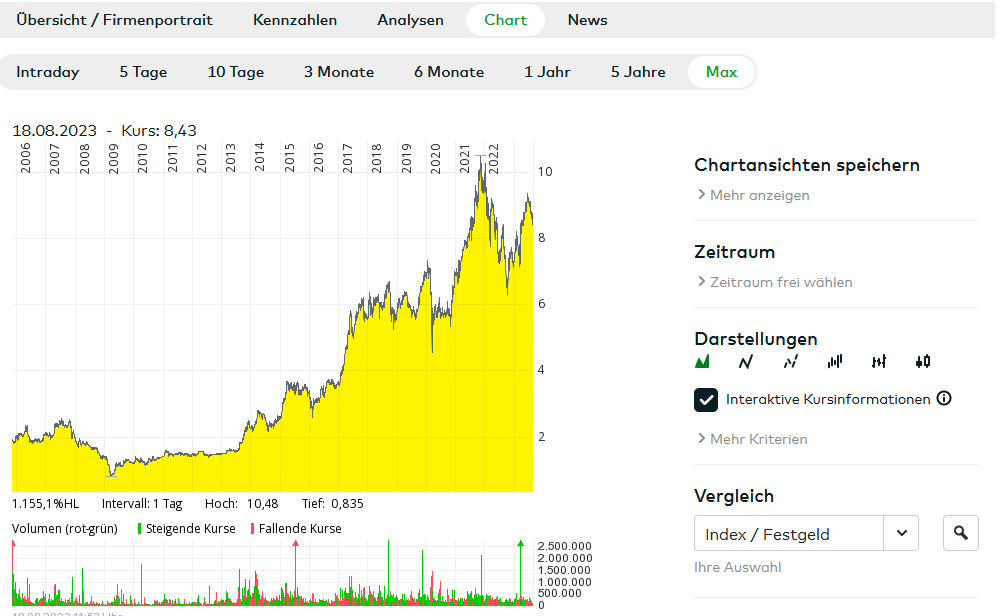
Looking at the share price, we can see that not much happened over the last 5 years but that the timing for buying into DCC in Dec 2022 retrospect was quite lucky:

After the recent jump to 58 GBP, I am up 42% in total (in EUR, including dividends) which is not spectacular and rather at the lower end of my expected outcome. However, given the “Pivot” it is still a decent result and mostly attributable to the low entry point and the relevant dividends.

Now fast forward to last week: 

Private Equity behemoth KKR and another energy focused PE called Energy Capital Partners approached DCC and seem to have informally offered to take over DCC at 58 GPB per share which only represents a 15% premium over the average share price for the last few months.

DCC immediately declined the offer as “too low”.

Energy Capital Partners is a pretty large Energy focused US PE/Infrastructure investor that owns a lot of “Energy Transition” businesses. AuM seems to be north of 40 bn USD.

Although KKR did not disclose which fund is bidding, it looks that both KKR and ECP see this as an infrastructure play which makes a lot of sense.

58 GBP per share is clearly a low ball offer and no formal offer has yet been made. Under the applicable Irish laws, KKR has time until June 10th to either submit a formal offer or walk away.

From a shareholder perspective, I assume that maybe a lot of investors have been frustrated that the stock only went sideways for the last 5 years or so and are maybe happy to exit at that level.

The “asset heavy” Infrastructure PE playbook

DCC so far has operated as a relatively capital light distributor, but I think it is relatively easy to pivot them into an Infrastructure like business that usually enjoys significantly lower cost of capital.

In contrast to “normal” Private Equity, Infrastructure Private Equity still enjoys a pretty good time. Many players have raised large funds and are eager to deploy money. Infrastructure is often considered “AI safe” these days.

So I guess there might be a chance that some other players might look very closely at this situation. DCC is a very obvious target and the timing is quite nice from a PE perspective. The refocusising on Energy at DCC is still underway and the results don’t look so “clean” at the moment,

DCCs business model, especially the LPG distribution business has a lot of potential to get easy access to many SME companies and sell them solutions.

Especially the current volatility in fossil energy prices opens up a unique selling opportunity for solutions that offer less exposure like rooftop solar etc. 

According to TIKR, DCC’s Net debt to EBITDA ratio is only around 1,2x. The company is valued at around 7xEV/EBITDA. The typical infrastructure playbook would be to make the company more “asset heavy”. Due to the low gearing, this could be financed by more leverage. A typical “asset owning” infrastructure company with longer term contracts can be easily levered 4-5x Net debt/EBITDA, 

In DCC’s case, with around 900 mn in EBITDA, increasing the leverage ratio to 4x would allow them to issue almost 3 bn in debt which could finance a lot of assets. Those assets then will automatically increase EBITDA,

A stabilized infrastructure like company can then be sold at much higher multiples, usually at 12-15x EV/EBITDA. So the value creation potential for a good Infrastructure PE shop is significant. 

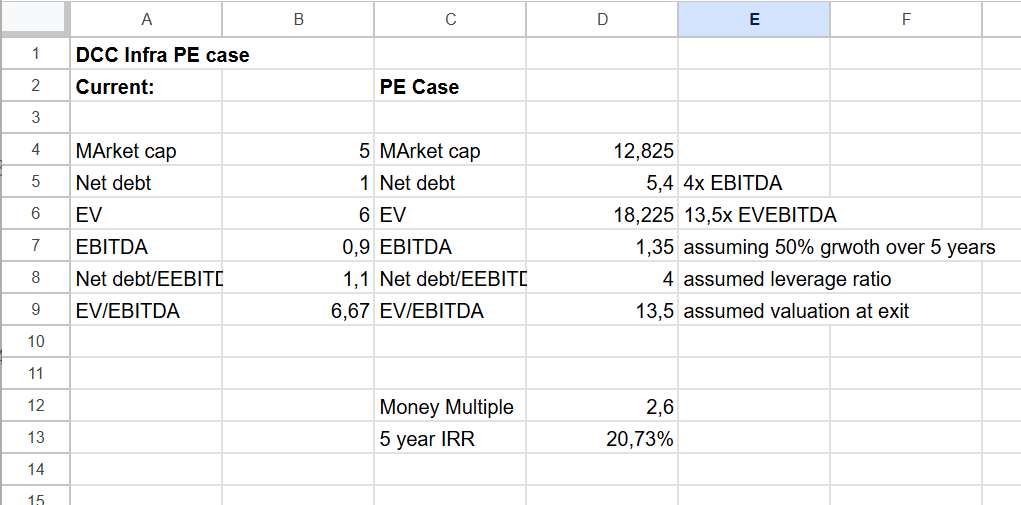
Just for fun I did a high level calculation how that exercise would look from this perspective (I just took the current numbers from TIKR, before further disposals):

A potential IRR of above 20% p.a. is highly attractive for an Infrastructure fund and as I have written before, PE’s have some more levers to “juice up” the IRR and earn even higher performance fees.

Is DCC now an interesting special situation play ?

There is clearly the risk that DCC might reject even higher offers, but I do think the 58 GBP low ball offer provides a decent “floor” for the stock (“Anchoring effect”).

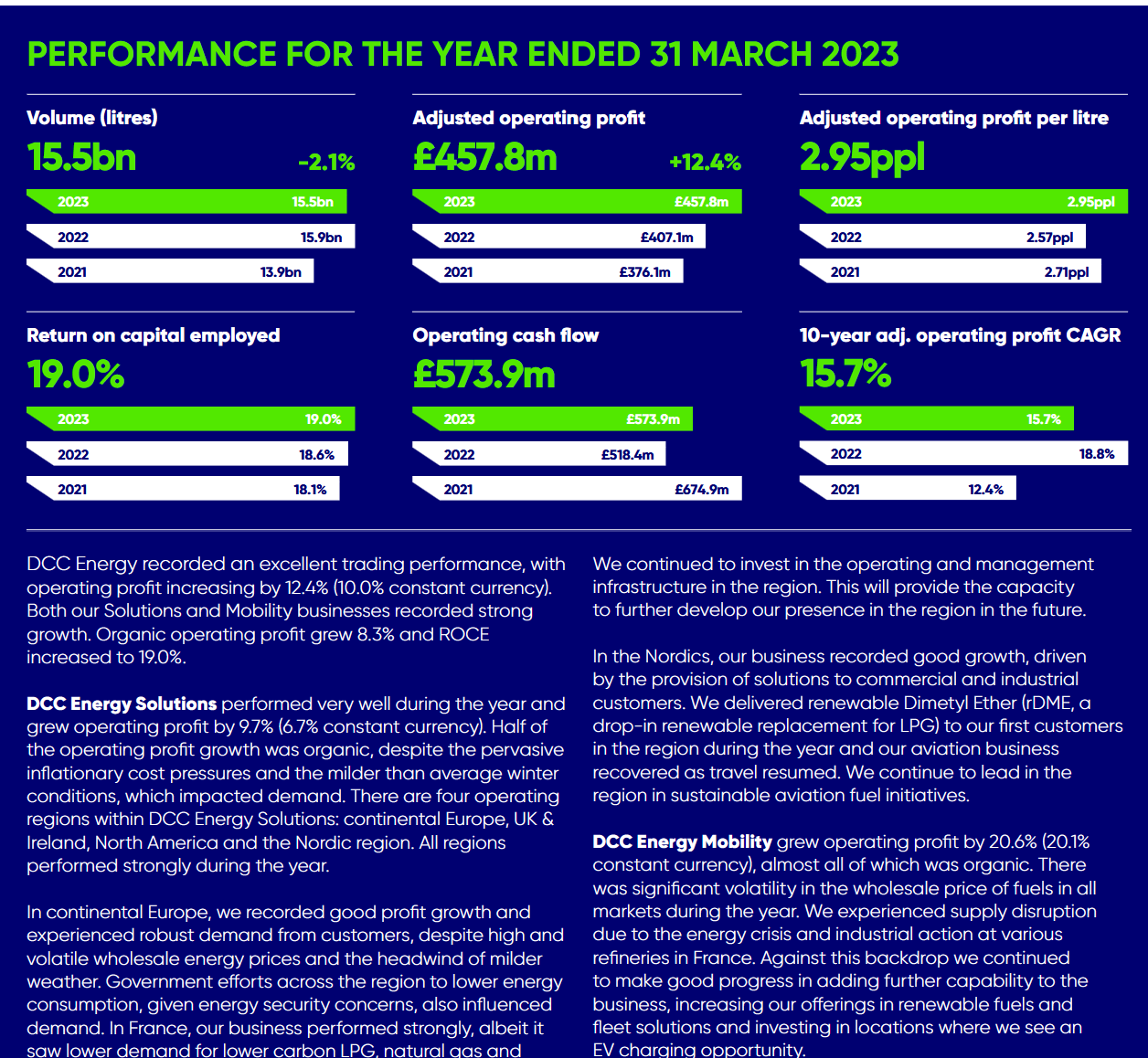
For one, DCC should expect some positive operational tailwinds. Volatile and high energy prices in the past have been good for DCC’s energy business. As we can see every day “at the pump”, distributors like normal Petrol stations immediately increase prices although they often have inventories for some weeks/months and often drop prices much slower.

Looking back to the last energy price shock in 2022, we can see that this was DCC’s best year, especially for the energy business:

Although there is no guarantee that the same will apply to 2026, there is a high likelihood that 2026 will look good for DCC from an operational perspective.

In addition, I do expect that the transformation will be more or less completed in the 2026 calendar year. 

So all in all, 2026 seems to look pretty good for DCC. I think this also explains the timing of KKR and ECP, as they don’t want to wait until this improvement shows in the results of DCC.

Even in case, DCC gets sold relatively quickly at 58 GBP per share, one would still get the Dividend that will be recorded end of may.

Quick handicapping exercise:

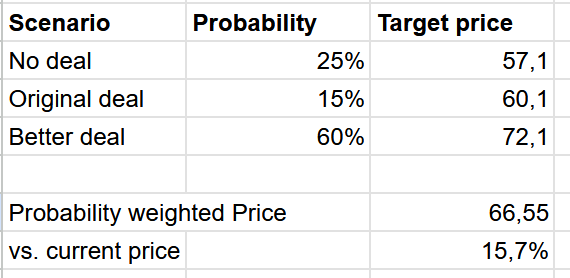
Overall, I would see the probabilities as follows until the end of the year::

25% probability of no deal with 55 GBP as the outcome (plus dividend, currently estimated at 2,10 GBP/share)

15% of a deal at 58 GBP (plus dividend)

60% probability of a better deal. My guess here would be 70 GBP plus Dividend

This is the quick and dirty calculation:

So based on my assumptions, my probability weighted expected return is around 16% until year end. This looks attractive to me, as in my opinion, the downside is very limited.

Of course, all the assumptions can be challenged and changed.

Summary:

So in total I see the following situation here:

  • The bid of 58 GBP is clearly too low
  • DCC’s short term operational results are supported by increasing energy prices
  • in addition, the full effect of the transformation “back to energy” will materialize in the following quarter
  • Other Infrastructure funds might also be interested in DCC

So even if the bid from KKR would not be successful, I do think that the share price has much more upside than downside potential at the moment.

From that perspective, I decided not to sell any DCC shares but rather increase my position by ~1,5 % of total portfolio value at around 57,50 GBP per share.

Some thoughts on Vibe Coding, SaaS vs AI (10 Moats) and Guidewire Software

Executive Summary:

This post does not contain any actionable investment advice but rather some personal ramblings on Vibe coding and the attempt to analyze a specific Software company (Guidewire) according to a Template of 10 Moats for Software companies and their vulnerability to the AI threat.

Introduction:

My track record as a Software investor is to put it mildly, very poor. My best Software Investment so far is Chapters Group which I bought as a net-net before it even became a VMS Serial Acquirer. My blog and portfolio archive also tell me that I sold Microsoft in 2011 at ~25$ per share with a 4% gain because I thought that the Office products had no future. So please take everything I say about Software with a grain of salt or even better, just ignore it.

I do have a background in Software development. Although I would not call it Software development but “Code butchering”. It started as a teenager on a C64 with Basic and Assembler and ended in the late 1990s with Cobol/PLSQL working for a large US Consulting Company (yes, I was young and needed the money). Knowing the speed of financial institutions, I would not be surprised if some of my Spaghetti code would still be running somewhere….

Why am I saying this ? Because of course, Software stocks have been doing quite poorly over the past weeks/months. In addition, I also had the opportunity to play around with Claude Code first hand. 

Re-underwriting Sixt AG:  Family owned & run long term compounder with a great US growth story at a “bonkers bargain” price

DISCLAIMER: This is not investment advice. The Author is known for making lots of mistakes in his write-ups and will frontrun you whenever possible. DO YOUR OWN RESEARCH !!!!

As always in my longer write-up, this post only contains selected sections of the write-up- A full pdf is embedded below.

  1. Management Summary

Sixt AG, a family-owned and -run Car rental company from Munich, has been compounding profits and shareholder returns at a double digit CAGR for the last 20 years. Following Covid, they accelerated their organic growth in the US which now represents ⅓ of their business and is growing rapidly at 20% plus p.a.. 

As most of their competitors (Hertz, AVIS, Europcar) are overleveraged, they will continue to take market share from them in the coming years. The recent (temporary) issues with residual (EV) car values depressed valuation multiples so that Sixt trades at a very low P/E for 2025 (~8 times for the Prefs, 11x for the common) for what I consider a high quality company resulting in an attractive risk return profile.

  1. Background 

Sixt is a company I owned several times in my investment career, unfortunately never long enough. During the initial Covid panic, I bought a “half” position as a part of a wider Covid basket” without any deep fundamental research at that time. Initially, this turned out to be a brilliant investment and almost tripled until the end of 2021, however since then, the stock struggled. 

When the Pref Shares hit 50 EUR I tweeted that I couldn’t believe how cheap the stock is.

Following that Tweet, I thought it’s a good  time to dive a little bit more into the rental car industry and see if I should “re-underwrite” Sixt or not.

3. Sixt History & some KPIs 

3.1. Company history

Sixt was founded in 1912 and so technically is the oldest of the large car rental companies. However, only with Erich Sixt, who became CEO in 1969, Sixt started to expand significantly. Sixt went public in 1986 and opened the first US Branch in 2011. In 2021, Erich Sixt after 42 years finally passed to lead over to his two sons who now run Sixt as Co-CEOs in the 4th generation.  

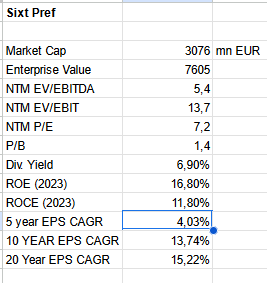
3.2. Some KPIs

We can see that over 10 and 20 years (based on 2023), Sixt has been a great compounder. Only over the last 5 years (EPS 2018 adjusted for DriveNow one off gain), EPS growth slowed. But one has to remember that this time period includes a beginning recession (2019), Covid, interest rate increases etc.

It’s also worth mentioning that all that growth was achieved organically. To my knowledge, Sixt never acquired another company.

Full PDF:

10. Why is the stock cheap ?

As always, when a stock is cheap, the question is: Are there any perfectly good reasons for the stock being so cheap ?

Despite the general weakness in European small and midcaps, these factors might play a role:

  1. A common theme I hear is that the rental car business is a shitty one. I think this is mainly due to the fact that the problems of AVIS, Hertz and Europcar are very public, but the success of Enterprise is not. On a P/E basis, both Hertz and Avis have traded at similar multiples (but with a lot more debt). As Enterprise is not publicly traded, some analysts might look at Sixt and decide that it is even “expensive” compared to  Hertz and Avis.
  2. Falling residual values for cars have impacted Sixt in 2024. Initially, an EBT of 400-520 mn had been forecasted. After Q1, where they had to book a loss because of unexpected depreciation, they had to cut the guidance again with the Q2 results in May to 350-450 mn EUR. In Q2 once again they again reduced the outlook to 340-390 mn EUR. So investors might be afraid that Q3 might contain more negative surprises.
  3. Investors might still not fully trust the two sons to continue what Erich has achieved over  more than 40 years. I have to admit that I am also not 100% convinced. Only time will tell.
  4. Sixt is clearly also exposed to the overall economic situation. A deepening recession in Europe might soften the demand, both for vacation rentals and business customers. Or customers might trade down from Sixt’s premium offer to a cheaper competitor.

11. Summary & conclusion

The initial question that I asked myself before writing this post was: Should I re-underwrite Sixt despite the quite disappointing performance over the past months ?

Thea answer after this exercise for me is clearly YES.

Sixt is a stock that offers an interesting growth story, a strong track record for a very low valuation which in my opinion creates a very attractive risk-return profile on a mid-term time horizon.

There are clearly some risks, as mentioned my main concern is how the sons will perform once Erich is not around anymore.

In any case, I decided not only to “re-underwrite” the stock but to increase my exposure by buying an additional 1% of the portfolio of Common shares.

I might add further, both to the Prefs and the Commons in the future if no negative surprises happen. The date for the release of Q3 earnings is November 11th.

Fuchs SE (FPE) – A Hidden Champion “Greased for Growth” after a 10 year consolidation phase ?

Disclaimer: This is not investment advice. PLEASE DO YOUR OWN RESEARCH !!!

As always with my more detailed writeups, I will focus on the general sections in the post and attach the full pdf for anyone interested in the details. And of course the Bonus Sound Track.

  1. Elevator Pitch

    Fuchs SE is a 4,5 bn EUR market cap, family owned and run Lubricant manufacturing and distribution company that had been a super star performer until 2013/2014. Since then, the stock traded more or less sideways and had to fight some margin compression. Since early 2023 however, Fuchs seems to be back on a growth and margin expansion path. 

    This very well managed  company earns double digit EBIT margins and Returns on capital of >20%.The valuation is very moderate with 13,5x 2024 or 12x 2025 earnings for this very boring but high quality small cap company. Based on company projections, EPS should grow organically by ~9% plus any additional effects from share buy backs and M&A over the next 4-6 years and the current dividend of around 3,5%.

    Read more

    EVS Broadcast SA – A Hidden Global Champion “Breaking free from the Van” with Software & AI at a Bargain Price

    Disclaimer: This is not investment advice. PLEASE DO YOUR OWN RESEARCH !!!

    As always with my more detailed writeups, I will focus on the gernal section in the post and attach the full pdf for anyone interested in the details.

    1. Elevator pitch:

    EVS Broadcast is a 400 mn EUR market cap Belgian technology firm that is the global leader in Live sports broadcasting/production technology that once earned margins higher than Nvidia does today.

    After a relatively long phase of stagnation from 2008-2019, EVS seems to have found its path to decent growth again under new management. The main driver is a new technology cycle that will shift the product offerings from hardware focused solutions to more Software/Saas products and a move into adjacent markets (Studio production).

    For a company with EBIT margins > 20%, capital return >20%, net cash and a targeted growth rate of 10% p.a. (which they have achieved since 2019), the current valuation of ~9x EV EBIT or 10-11x P/E is dirt cheap and offers considerable upside for the patient investor.

    As EVS has been working on AI solutions since at least 2017 and has already functioning products to show, one gets any potential “AI upside optionality” for absolutely free. 

    Read more

    Tamburi Investment Partners (ISIN IT0003153621) – NAV vs. “Intrinsic Value”

    Tamburi Investment Partners (TIP) is kind of a “secret star” in the area of European Holding companies. I looked at it briefly within my Italmobiliare write-up friom last week. The stock price has performed extremely well especially over a 10 year horizon:

    TIP has been founded in 2000, listed in 2005 and the history is well documented on TIP’s homepage.

    Read more

    Italmobiliare (ISIN IT0005253205) – Buying “Italy’s Finest” for only 50 Cents on the Euro ?

    Disclaimer: This is not investment advice. PLEASE DO YOUR OWN RESEARCH !!!!

    What better day to publish a post about an Italian company than Ferragosto, the Italian Public Holiday where virtually any Italian family is somewhere close to a beach and Italian offices only are staffed with the most junior person to take up the telefone in order to say: “No one here, please call next week/next month”.

    With Italmobiliare, I fell deeply into a rabbit hole, which lead to a quite extensive analysis. Due to some problems with the WordPress editor, I wrote it with a different Editor and have attached the PDF with the full version. In the blog post I’ll focus on the executive summary, the Pro’s and Con’s and the return expectations. The rest of the gory details can be read in the attached PDF document.

    Executive summary:

    Italmobiliare (IM) is an Italian Holding company with a market cap of ~1 bn EUR that underwent 2 pivots in its 40 year history as a listed company. The first pivot, in the 1990s, from conglomerate to Cement (Italcementi) and then once again in 2017 after a 2 bn sale to Heidelberger into an Italy focused, “Quality-growth small/mid cap PE” style investment company.

    What makes the company very attractive to me, is a very interesting portfolio (including at least two potential “Super Star” holdings), decent value creation, good strategy/transparency  and especially a 50% Discount to NAV

    Read more

    Collectors Corner Series Part 1: Laurent-Perrier SA (ISIN FR0006864484)

    Disclaimer: This is not investment advice. PLEASE DO YOUR OWN RESEARCH !!!

    Collector’s Corner Introduction

    I always wanted to introduce this category of stocks that normally I would not buy as a larger position, but for some reason or the other I want to own nevertheless. Many of such stocks I had passed on in the past and they often performed better than I would have thought. So instead of a typical Investment portfolio, that part would rather be a “collection of fine stocks” and this series will therefore be the collector’s corner. The goal here would be a small pocket of “special” stocks that might look not so attractive from a purely financial perspective, but still have are attractive to me. This could be luxury stocks but also some very strange stocks that I find interesting for other reasons. I am now long enough in the stock market that I cannot afford myself a few “guilty pleasures”.

    I don’t have a target allocation here but this should stay below 10% overall at portfolio level. Also, don’t expect a super detailed analyis as with bigger positions.

    And, by coincidence, I already have the first stock for the “collector’s corner:

    Read more

    Mikron Group AG – Super Cheap (EV/EBIT ~4) and +33% EBIt 6M 2023- what is not to like ?

    Disclaimer: This is not investment advice. PLEASE DO YOUR OWN RESEARCH !!!!

    Spoiler: If you are short on time: I did not buy a position here. No need to read everything.

    Mikron is a company that I had on my (passive) radar since my “All Swiss shares” series some years ago (since I passed on it, it made around +100%, so keep this in mind for the rest of the post). It is a Swiss based machinery manufacturer with a market cap of 200 mn CHF and has some connection to SFS (SFS is a client, same Chairman in the past).

    These were the main items that motivated me to looks deeper into Mikron this time:

    + currently very (very !!) cheap (P/E 7,5, EV/EBIT 3,5)
    + currently VERY good business momentum (6M 2023: Sales +22%, EBIT +33%)
    + better customer/product mix than in the past
    + Rock solid balance sheet (100 mn CHF cash vs 200 mn CHF market cap)
    + good share price momentum

    Read more

    « Older Entries