Bachem AG: Riding the “Golden Age of Peptides” with this Hidden Champion from Switzerland
Disclaimer: This is not investment advice. PLEASE DO YOUR OWN RESEARCH !!!
- Elevator pitch:
Bachem is a 5 bn CHF market cap Swiss listed pharmaceutical/specialty chemical company which is the global market leader in the (outsourcing of) manufacturing of Polypeptide, a complex molecule and Active Pharmaceutical Ingredient (API) that is, among others, behind the blockbuster drugs Wegovy, Ozempic etc. Demand for those molecules is poised to grow exponentially over the coming 5-7 years (15% market growth p.a. ,“Golden age of Peptides”).
This growth is driven by several different fundamental growth drivers which increases the certainty of the projected growth rates. The complexity of the production process in addition to regulatory requirements and “Anti China” legislation in the US provides a decent “moat” for the coming years which makes Bachem, despite its relatively high valuation (28×2026 P/E), a very interesting investment case on a 3-5 year time horizon in my opinion.
It is clearly not an investment for everyone, but for more growth oriented investors, Bachem could be an interesting stock to look at. In my case, it is a 3% position for my small “quality growth bucket” alongside Wise and Chapters Group.
- Some editorial remarks:
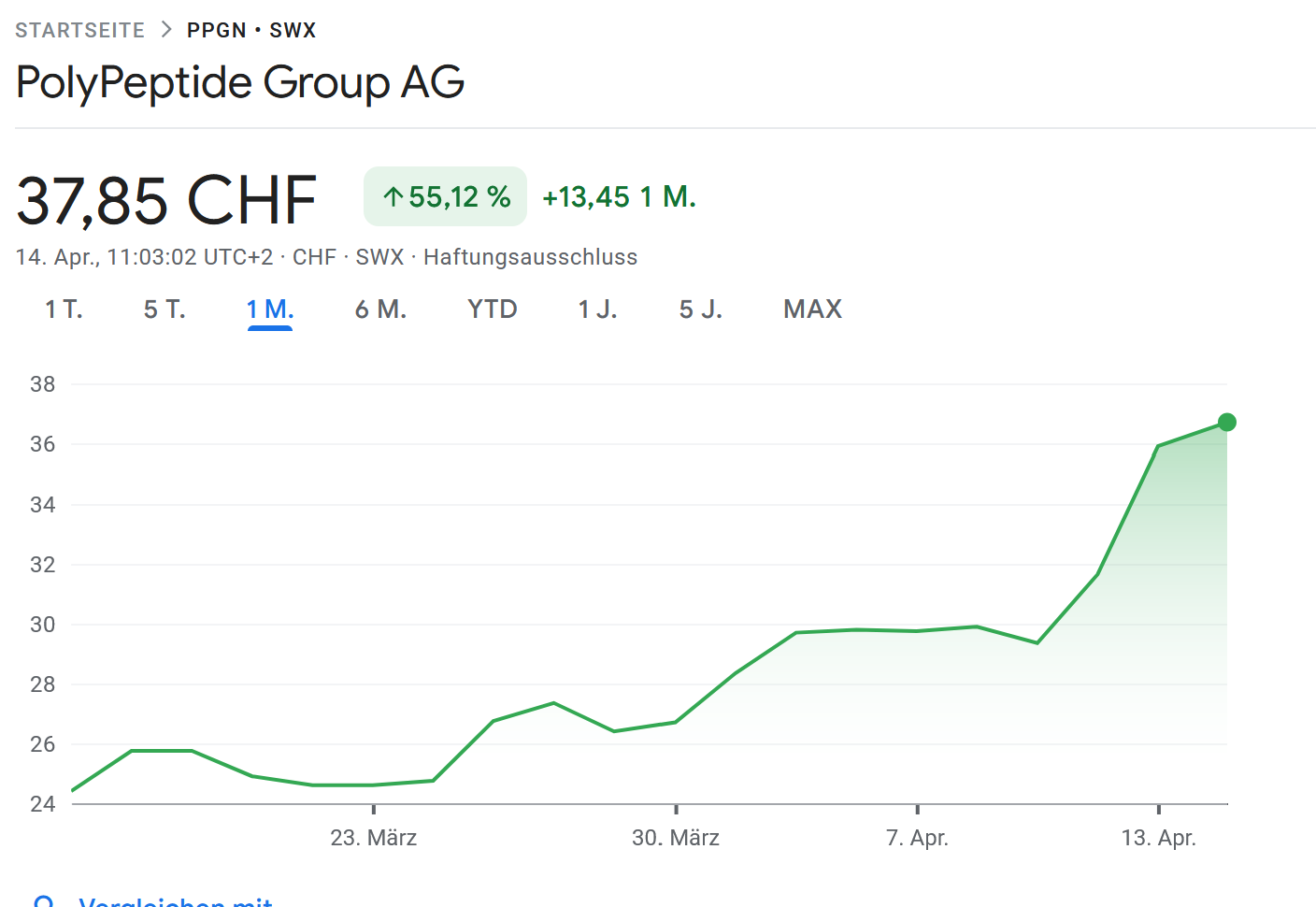
Initially, I planned to write up and invest into both Bachem and its Swiss listed competitor Polypeptide Group. Due to vacation time and the rumour of a PE take-over, Polypeptide share price increased by +50% since I started to deep dive into those two companies which made the stock less attractive. Bachem only went up like +15% so I therefore concentrate on Bachem.
In addition, I just wanted to make it clear that I write “by hand” but I do use several AI tools during my research (NotebookLM, Claude Cowork). You will find some output of AI models here in this write-up, as for some cases (i.e. making pictures), AI has just much better capabilities than I have.
In any case, I do expect a lot of critical comments on this.
- Soundtrack:
In order for my readers to actually listen to the obligatory soundtrack during reading the write-up, I’ll post it right at this spot. I think “Golden Years” from David Bowie is the perfect Soundtrack for this
And here is the complete write-up (28 pages), Have fun !!!


When colleagues order custom peptides, they will usually not consider Bachem, simply because their custom synthesis service is too expensive. Instead, they will order from Chinese companies of which there are several. This may be different if the peptide is difficult to synthesize, e.g. if it is very long or contains fancy amino acids (for example, phosphopeptides containing several phosphates are very difficult). But 34 amino acids are no problem for Chinese companies. It is possible, like MMI states in his writeup, that the U.S. will restrict the import of Chinese peptides, and Europe may follow; while this would be good for the industry, it would be bad for the – already financially strained – health care system.
With regard to oligonucleotides, I think Bachem is a relatively new player in this market. Custom-made oligonucleotides have been around for decades, and there are several companies that will synthesize whole genes for you (e.g. Eurofins, Thermo, GenScript). I am unable to judge whether Bachem may have advantages in knowing how to scale up these processes compared to their competitors.
Thanks again for the comment. With Oligonucleotides I found it interesting that it interesting that they have a strstegic Partnership with Eli Lilly. And yes, competing on price with Chinese players is not their game.
I have not had the time yet to read your writeup completely but in my opinion it confuses chemical and biotechnological synthesis. Neither the currently marketed insulins nor the GLP1 analogues (i.e. Semaglutide etc.) are synthesized by chemical synthesis; that would be far too expensive. Their peptide backbone is produced biotechnologically (also shown in Figure 14; therein it says “Fermentation”), then purified, and finally the desired chemical modifications are added by chemical synthesis.
After some further research, I need to somewhat correct myself. Some of the newer GLP1 analogues, such as tirzepatide or retatrutide, are indeed solely produced by solid-phase synthesis. Semaglutide is apparently currently produced by a two-step mechanism: the N-terminal tetrapeptide (which contains a non-natural amino acid) is produced by solid-phase synthesis and then fused to the rest of the peptide which has been produced by biotechnological means. Generally speaking, if a peptide contains non-natural amino acids (which cannot be genetically encoded), it is more difficult to produce by biotechnology, as bacteria or cells normally cannot incorporate non-natural amino acids into the peptide backbone. Human insulin contains no non-natural amino acids; semaglutide contains one, tirzepatide contains two, and retatrutide contains three non-natural amino acids.
Thanks for the clarification. To my knowledge, biotechnological processes are also more efficent for longer molecules (more than 50 Amino acids). But I am not an expert.
„In any case, I do expect a lot of critical comments on this.“
This is so sad! I hope that you at least get more positive comments on your posts!
Thank you for supplying us with your hard work for free! I will definitly enjoy reading this investment analysis!
Have you ever read Lawrence Goldstein/Santa Monica Partners letters on Balchem? They’ve owned shares since (I think) the late 1980s, and their adjusted purchase price was well under $1.00/share!
Thanks for the comment. Never heard of that Manager. Bachem went public in 1998, so they must have invested when it was still private.
Warum erwartest Du gerade hier kritische Kommentare? Deine Analyse ist extrem schlüssig und Bachem wird ganz sicher proportional mit dem Abnehm-Boom steigen. Sogar die Billig-Inder kaufen von Bachem. Risiko natürlich, dass der GLP1 Boom abebbt oder (wegen gesundheitlicher Problematiken) ins Stocken gerät. Ansonsten ist das auf die Sicht 2030 ein “free lunch”. Einzig eine Übernahmefantasie fehlt, weil die Familie die Mehrheit halten will, aber so eine Konstellation ist ja auch oft ein Vorteil. Ich sehe sehr wenig Haare in der Suppe und habe mich da mal drangehängt. 🙂 Danke für diese Anregung.
Danke für den Kommentar. Bis jetzt habe ich tatsächlich fast nur negative Kommentare bekommen 😉
Many thanks for sharing your thoughts, always excited to read your takes.
In Bachem’s case, I would only see a higher risk posed by small molecules substances (FDA approval of orforglipron/Foundayo looks very promising to me). The CEO change last year also puzzles me: Why would he leave the company after initiating an investment boom that will be crucial for the future, only to start at a significantly smaller company? Of course, both points could be harmless, but in combination with the high multiple there is some risk.
Thanks for the comment. With regard to the CEO, I am not sure if he left the company or if he was made to leave.
With regard to Foundayo: The oral small molecule drug clearly has a use case. I twil lbe interesting if patients will prefer this to more potent future drugs (Triple agonists). I guess there is room for both. But to my knowledge, testing is not yet complete for Foundayo.
Danke, viel gelernt aus dem write-up. Ein gewisses Risko kann schon der Tod des Gründers sein, da gibt es ja leider zahlreiche Beispiele, wo der Faden dann etwas abreisst. Mit 83 Jahren war er ja noch nicht sehr alt. Scheint ein richtiger Unternehmer gewesen zu sein:
https://www.fuw.ch/peter-grogg-er-schuf-einen-weltmarktfuehrer-aus-dem-nichts-nachruf-auf-bachem-gruender-375325526939
Ich glaube dass der Gründer nicht mehr so aktiv war bei Bachem. Im Verwaltungsrat war er zumindest schon seit einigen Jahren nicht mehr.