Tag Archives: Private Equity

Private Equity Series (7): Secondaries – The Magic Money Machine for the PE industry 

Previous Episodes of the Private Equity (Mini) Series:

Private Equity Mini Series (1): My IRR is not your Performance
Private Equity Mini series (2) – What kind of “Alpha” can you expect from Private Equity as a Retail Investor compared to public stocks ?
Private Equity Mini Series (3): Listed Private Asset Managers (KKR, Apollo & Co)
Private Equity Mini series (4) : “Investing like a “billionaire” for retail investors in the UK stock market via PE Trusts
Private Equity Mini Series (5): Trade Republic offers Private Equity for the masses (ELTIFs) -“Nice try, but hell no”
Private Equity (Mini) Series 6: Private Equity for the masses – Y2K edition

Background:

Maybe a quick word why I am doing this series on Private Equity: 

I have to admit that I am fascinated by the PE industry as such and whatever happens there has a definite impact on the stock market, either through take-privates or IPOs or other more indirect developments (Private Credit boom etc.).

In addition, as Private Equity is now targeting more and more retail investors, I want to provide some background information as currently these products are sold on a very “asymmetric” basis. There is very little objective information available about these products besides the glossy sales pitches.

I am very much afraid that many retail investors will regret putting money into Retail structures in a few years from now.

What are PE “Secondaries” anyway ?

There are two things that I really do really admire from the Private Equity industry: First, that they managed to keep their 2/20 fee schedule since their beginnings in the 1980s and never shared any “scale economics” with investors. And second, that they are very creative in finding new ways to sell their product.

I have been discussing the relatively new retail products already but a similar big trend in Private Equity are socalled “Secondary Funds”.

Secondary funds come in many flavors but the main one is to buy Private Equity assets from unhappy investors and sell them to new investors. There are two different “flavours” of this:

  1. Secondary LP Fund stakes

Here, existing investors want to sell their Fund stakes (“Limited Partner”, LP) for one reason or the other. As these are illiquid and often intransparent vehicles, buyers will only buy them for a certain discount. 

  1. GP Led secondaries / Continuation vehicles

In those cases, the PE manager (“General Partner”, GP) cannot exit an investment inside a fund via the normal route of an IPO or M&A transaction and is looking for new LPs to which he can sell these company stakes to, also often at a discount to the last valuation in the fund..

The FT had a recent article that both types of secondary transactions are booming. 
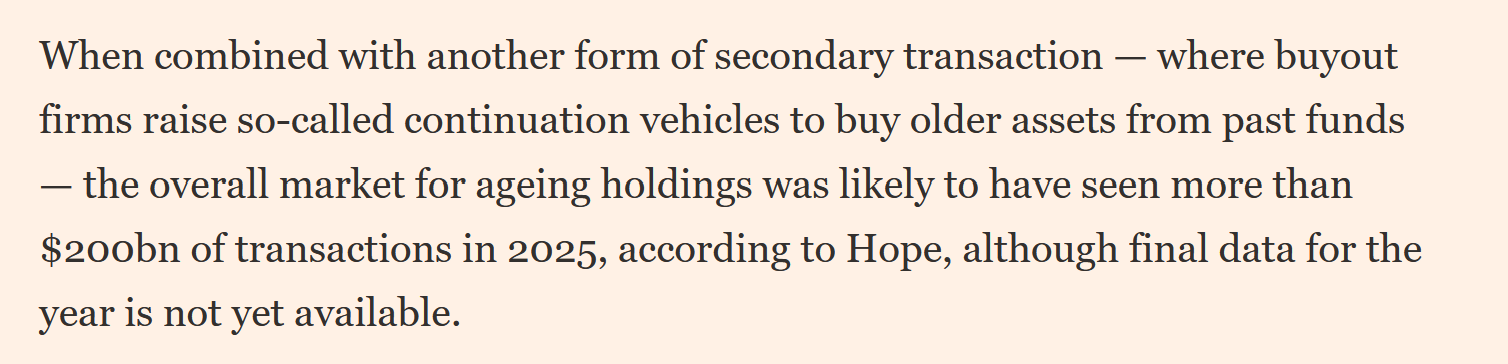
The article speculates that in 2026, the total volume of secondary deals could be up to 50% higher:
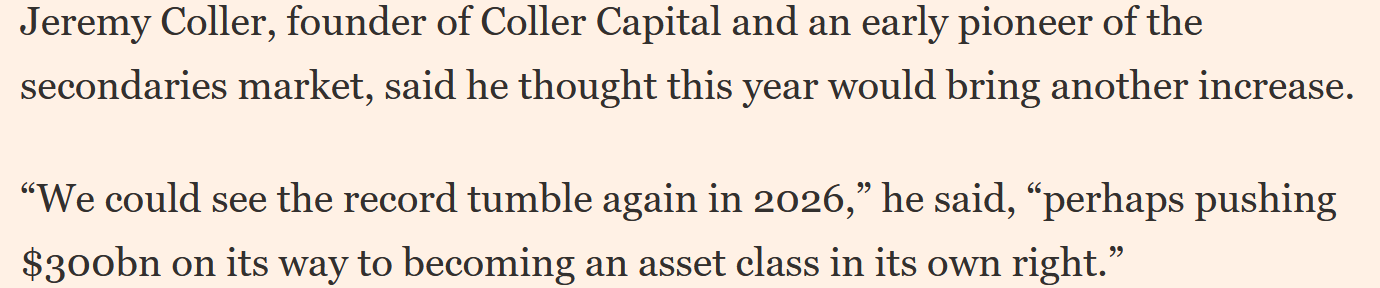
This is even more remarkable as fundraising for “primary” i.e. new funds has declined significantly in 2025. So secondaries are the only bright spot for PE firms at the moment.

The big question is of course: Who is selling all these stakes and who is buying it ? The first question is rather difficult to answer, as those transactions are mostly private.

The second question is much easier to answer: The Private Equity industry is buying all these stakes and “repackaging them” as Secondary funds and selling them again to institutional investors, quite often to those who were selling those primary stakes in the first place.

But why would institutional investors do this ? The answer is surprisingly simple: 

It’s an accounting trick.

I had linked to a Morningstar post already last year where this was nicely explained:
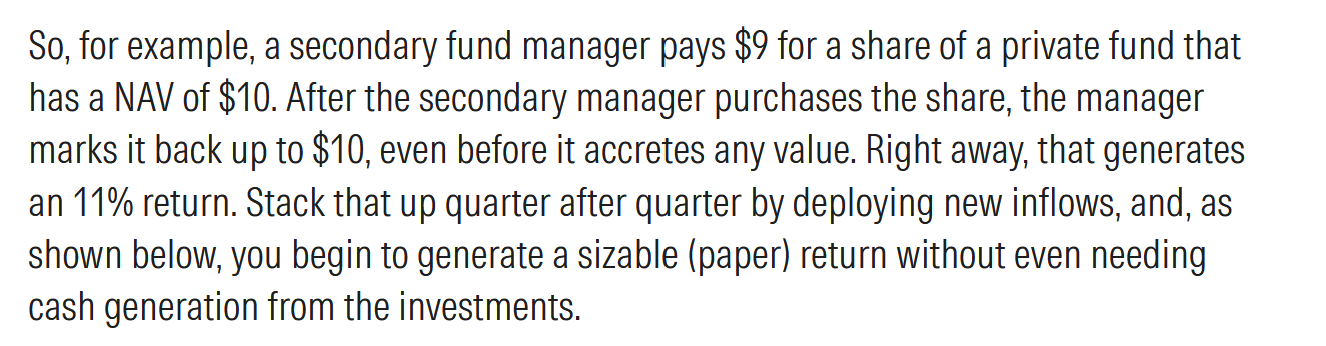
So just to compare this with a listed stock fund. Italian Holding company Exor SPA (famous for its stake in Ferrari) has currently an NAV of around 180 EUR per share but only a share price of 70 EUR.

If a portfolio manager buys a share of Exor, he might think that the share is worth more than 70 EUR, but the share will be valued at 70 EUR in his portfolio. The actual share price will need to rise in order to be able to show a positive performance.

If he would be a PE guy and Exor would be a secondary stake in an unlisted portfolio company,, he could mark up that share immediately from 70 to 180 EUR and show more than 150% profit without the market price moving a cent. This sounds crazy, right ?

But this is exactly what Private Equity is doing with secondaries:

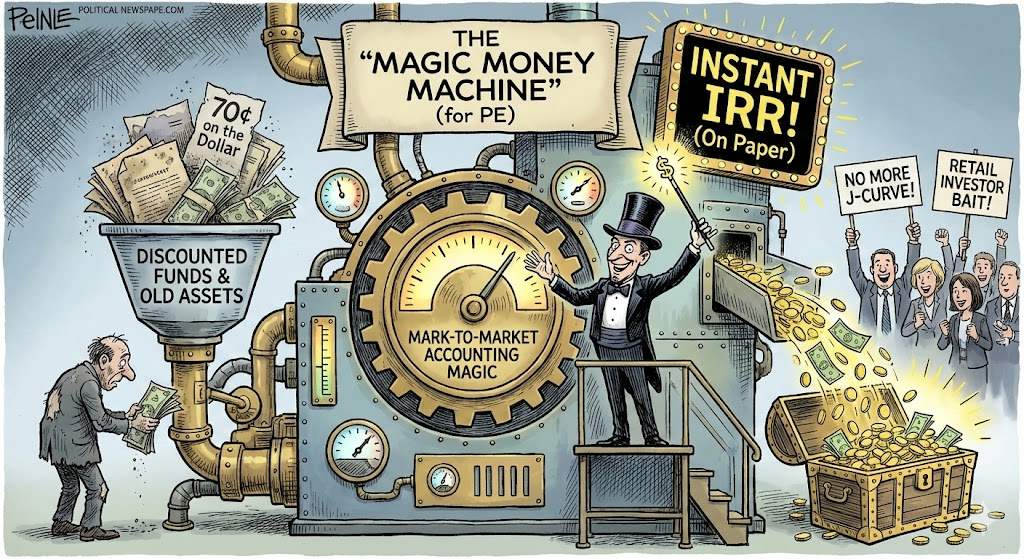
You buy the asset as a discount and (almost always) on day one, you can actually write-up the asset to the NAV stated by the Fund Manager and show a so-called “day one profit”.

The higher the discount, the better and the better the “performance” of the Secondary fund.

Interestingly, in the current environment, both Private Equity Managers and investors love it.

The PE managers obviously because they can “recycle” their old stuff and in many cases can earn an additional fee layer on top of the existing fees in the underlying funds.

Investors love it because the performance looks so good right from (and especially from) the start. In traditional PE, you normally have to wait a few years until you see significant positive performance as a lot of the initial costs drag down Fund performance (J Curve).

So buying into these secondary funds looks like a brilliant investment decision despite the double layer of Private Equity fees that these investors are often paying.

This is wath Gemini Nano Banana came up with when I asked it to illustrate the mechanics and I think it’s absolutely brilliant:
But can it last ?

The main argument and the “story” of the PE industry is that those discounts are purely “liquidity discounts”, i.e. the sacrifice that “forced sellers” of these stakes have to endure and therefore presents more or less a “free lunch” for buyers.

On the other hand, it is no secret that many market participants think that stated NAVs and valuations of most PE funds are not realistic. 

I have personally witnessed a situation where the valuation of a PE fund dropped from 130% of invested capital to 60% (i.e. -50%) in 9 months due to “structural changes” at the PE firm.

Personally, I do think that “true” liquidity discounts only represent a small minority of the deals and that a much larger share of those discounts are more realistic assumptions on the actual values of PE funds and their constituents.

Many of the sellers are rather sophisticated addresses that will not sell a really good fund at a large discount.

Maybe a big rebound for “Value” and “Old Economy” stocks will narrow the over-valuations. On the other hand, the current carnage in Saas stocks creates new problems for funds exposed to that sector (Thomas Bravo for instance) which used to be one of the few bright spots.

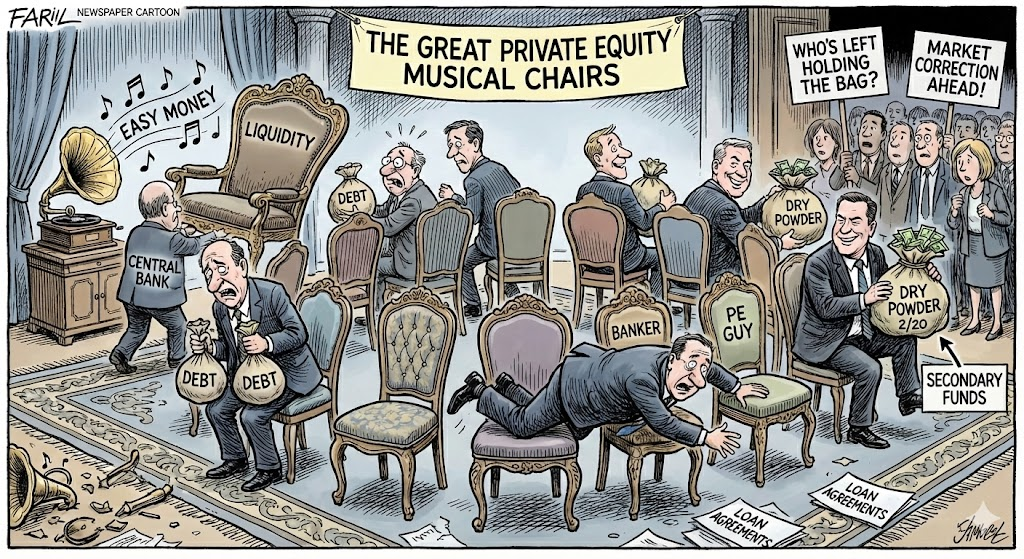
In any case, the “Day one game” only works as long as “fresh money” is coming into a product. Once the fresh money stops, there are no new “day one gains”.

What’s the take away for private investors ?

As those secondary transactions are also quite popular to juice up returns in the short run for retail PE structures (ELTIFS etc.), this is one more reason to stay away from those fee laden, intransparent structures.

This is for instance from the July report of the EQT ELTIF (sold by Trade republic):

Boosting the “performance” just by buying a new asset is a great thing to have if you are a Private Equity retail fund.

And of course, some “smart” people are trying to play this game in public markets, too. Swiss liste company Matador for instance does exactly the same. Buying secondary stakes at a discount and then marking them up right away.

If you are an institutional investor, you should check if the fund prospectus contains information on what percentage of the performance is generated through “one day gains” and what is generated through actual performance.

Especially those secondary funds that contain the most overvalued PE funds might see a very “rude awakening” in the coming months/quarters when those NAVs might be revised downwards and those “day one gains” disappear.

Until then, the music is still playing…..again illustrated nicely by Nano Banana:
Bonus Song: Let the music play – Barry White

Barry White – Let The Music Play (Official Music Video)

Private Equity (Mini) Series 6: Private Equity for the masses – Y2K edition

Previous Episodes of the Private Equity (Mini) Series:

Private Equity Mini Series (1): My IRR is not your Performance
Private Equity Mini series (2) – What kind of “Alpha” can you expect from Private Equity as a Retail Investor compared to public stocks ?
Private Equity Mini Series (3): Listed Private Asset Managers (KKR, Apollo & Co)
Private Equity Mini series (4) : “Investing like a “billionaire” for retail investors in the UK stock market via PE Trusts
Private Equity Mini Series (5): Trade Republic offers Private Equity for the masses (ELTIFs) -“Nice try, but hell no”

Time Machine: Y2K

Some of the older readers of my blog might have active memories about the year 2000. There was the so-called “2YK Scare” in the late 1990ies, the fear that computer systems (and planes) would crash when the year 2000 would start. Of course it didn’t happen, the Dot.com bubble got pumped up once more and the rest is history.

Another event that got less attention was the that back in the year 2000, the now long gone Dresdner Bank issued a Certificate (which is a popular structure in Germany to give retail investors exposure to anything) that was actually a bond linked to the long term returns of an underlying Private Equity Portfolio managed by Swiss PE manager Partners Group. The very same Partners Group that now has teamed up with Deutsche Bank to run an ELTIF.

Read more

Private Equity Mini Series (5): Trade Republic offers Private Equity for the masses (ELTIFs) -“Nice try, but hell no” 

Previous episodes in this series:

Private Equity Mini Series (1): My IRR is not your Performance
Private Equity Mini series (2) – What kind of “Alpha” can you expect from Private Equity as a Retail Investor compared to public stocks ?
Private Equity Mini Series (3): Listed Private Asset Managers (KKR, Apollo & Co)
Private Equity Mini series (4) : “Investing like a “billionaire” for retail investors in the UK stock market via PE Trusts

Management summary:

In this post of the “Private Equity Mini series”, I look a little bit deeper into a Retail Private Equity offering (ELTIF) that has been distributed to 10 mn clients of German Neo Broker Trade Republic since last week (including myself).

There were a lot of articles in the German press trying to explain the product and the associated fees, which in my opinion were mostly wrong. Not surprisingly, as it is extremely difficult to find out what these vehicles actually charge in fees and costs. I’ll therefore concentrate only on the fees and expected returns.

As a spoiler, I do not think that the return expectations of 12-15% p.a. net after fees and costs are anywhere close to reality. I would go as far and even call this “miss selling” as these levels would be “best case” outcomes in my opinion.

Fees and cost based on my estimates will be between 4-7% p.a. (for the deal that I analysed) depending on the performance of the underlying assets and overall returns are dragged further down by the required cash allocation.

I also think that the regulator should here require a full and fair disclosure of Total Expense ratios (including all fees and costs) for different gross return scenarios. For a normal investor, it is close to impossible to gain this information, even for a professional it is hard to estimate based on the provided documentation.

Due to the effort of analyzing the fee structure, I did not have the motivation to look into issues like liquidity windows, early redemption panalties etc. as it just makes things worse for the retail investor.

In the case of the analyzed “Single Manager” EQT Nexus product, the whole purpose of giving private investors access to Private Equity is an actual waste of time, as investors can easily get a very similar exposure with a much better return/risk profile simply by investing into the underlying share of EQT.

In any case, a low cost, diversified Equity ETF will most likely outperform these retail Private Equity structures significantly in the mid- to long term. Although I have analysed only one fee structure, I do think that the main take-aways are applicable to most similar “Semi liquid” structures targeted towards retail investors.

Here is the “full monty” on 18 pages if you are interested in the details.

I have a link for the fee model in the pdf but you can also send me an Email/message if you like to receive it.

Private Equity Mini series (4) : “Investing like a “billionaire” for retail investors in the UK stock market via PE Trusts

Private Equity Mini series (4) : “Investing like a “billionaire” for retail investors in the UK stock market via PE Trusts

This is the 4th part of my Private Equity “mini” series. The previous posts can be found here:

Private Equity Mini Series (1): My IRR is not your Performance
Private Equity Mini series (2) – What kind of “Alpha” can you expect from Private Equity as a Retail Investor compared to public stocks ?
Private Equity Mini Series (3): Listed Private Asset Managers (KKR, Apollo & Co)

Background:

Not sure if this is mainly a German phenomenon, but you can’t listen to a German finance podcast without being quite aggressively advertised on how Private Equity is finally being democratized through some “revolutionary” retail offerings that almost always are quite complicated and contain another layer of fees on top of what the PE guys are charging.

The main pitch is that now even the small guy on the street can do what previously only billionaires could do: Invest into Private Equity and make boat loads of money.

The hard truth is that Private Equity has been democratized long ago in the UK but no one gives a sh** about it.

Read more

Private Equity Mini Series (3): Listed Private Asset Managers (KKR, Apollo & Co)

Background:

After part 2 of the Private Equity Mini series a few days ago, I wanted to focus on how to access the asset class as a private investor via the “normal” capital markets.

Currently, the PE industry and the broader “Private Asset” industry is massively trying to lure private investors into its Fund offering via a variety of “NEW” and usually structured instruments, such as “ELTIFS” in Europe or lobbying hard in the US to get access to private investors.

In the past, Private Assets, including its subgroups like Buyout, Venture, Growth, Infrastructure and Private Credit were “exclusive” to larger institutional investors and Ultra High Net Worth individuals.

These days, with declining commitments from those traditional investors, the PE industry now tries to access the vast pools of money that smaller, private investors collectively own.

Often you hear the pitch that now is the time to “democratize” the asset class, which is an expression that should make the targeted investors extremely nervous. I had linked to the excellent Bain PE report already in one of the link collections.

A key slide of the report is the one that shows that for the Buy-out category, 2024 was the first year ever with declining AuM:

Read more

Private Equity Mini series (2) – What kind of “Alpha” can you expect from Private Equity as a Retail Investor compared to public stocks ?

Management summary:

In this post I wanted to dig a little deeper on why I think that many currently offered Retail Private Equity offerings (e.g. ELTIFS) will most likely underperform public equity markets going forward. Despite some structural advantages of Private Equity as such, the double layer of fees and costs will be a huge drag on performance. On top of that, historic tailwinds for the PE industry (low interest rates and low purchase multiples) have most likely disappeared.

Introduction:

After the first installment of this mini series, where I tried to explain why stated PE IRRs should not be confused with actual performance, I wanted to briefly touch another important point in order to understand this “asset class” better:

Many Private Equity players claim that both, past returns and future returns of Private equity will be significantly better than comparable indices of listed equity. 

Read more

Private Equity Mini Series (1): My IRR is not your Performance

These days, more and more offerings for Private Investors are popping up to participate in Private Equity, which until now was mostly exclusive for Institutional investors and very wealthy people. In Europe, the socalled ELTIF II format allows now fund companies to directly target individual investors from as low as a few thousand EUR.

Private Equity in my opinion has its place. The good Private Equity funds are indeed “value investors” that have a decent ability to identify undervalued assets. However, Private Equity Investing also is not directly comparable with investing into public markets.

In particular, any prospective investors should take any returns stated by PE funds with a grain of salt and I want to explain why these “PE IRRs” cannot be directly compared with Stock market performance. This is due to 2 main differences:

Critical point 1: IRR calculation – critical assumption: Reinvestment at the IRR is possible

Read more

SAPEC SA (ISIN BE0003625366) Still an attractive Special Situation despite +350% YTD ?

Disclaimer: This is not investment advice. The stock mentioned is relatively illiquid and potentially risky. Please do your own research !!!!

Management Summary:

SAPEC SA, despite having gained already 350% YTD is in my opinion still a highly attractive special situation. The company is in the process of selling its main business which will result in around 230 EUR net cash per share compared to a share price of 135 EUR. Deal closing is very likely and management promised to distribute a “significant amount” of the proceeds. For me this is very attractive as I expect this to happen in the first half of 2017.

SAPEC is a somewhat strange company. Although the company is listed in Belgium, business activities are almost exclusively in the Iberian Peninsula (Portugal & Spain). This is how the company describes itself:

Read more

Update Altamir SA: No “CEO self service vehicle” but still the same fees

A few days ago, I looked briefly at Altamir, the French listed Private Equity vehicle which invests exclusively into APAX funds.

This is what I wrote about the CEO and largest shareholder Maurice Tchenio based on how I understood the fee structure:

So the “privilege” of a shareholder to invest into APX via Altamir is purchased quite expensively. This also puts the CEO investment a little bit in perspective. Yes, he has invested around 100 mn of his own money into Altamir, but in 2014, the management fees and profit share netted him close to 30 mn EUR direct, whereas the proportional profit of his share position was “only” 15 mn EUR.

Last week I got a very friendly Email from Altamir’s IR with the offer to explain the fee schedule in more detail. As a follow up they did send me a nice memo with all the details.

In a Nutshell, Tchenio only receives around 2,5 mn EUR from two sources:

– he is entitled to ~22,5% of the “carry” on the old direct investments

– plus he keeps 5% of the adivisory fee paid to the general partner for the direct investments

As the IR pointed out, Tchenio earns more in dividends on the stock than on those fees, so the alignement between him and shareholders is better then I have assumed before.

Just to recap how the fees and carried interest are structured a short list based on 2014

Fees/costs: 17 mn EUR thereof

– 6,8 mn EUR fund level fees

– 1,9 mn EUR HoldCo cost

– 8,4 mn EUR fees charged by the GP (inlc. 1,4 mn VAT), 95% passed on to APAX

Carried interest: 13 mn EUR thereof

– 4,3 mn APAX fund level

– 8,5 mn direct investments, therof Mr Tchenio as former APAX partner 1,9 mn EUR

Having clarified this, this still leaves the issue that 17 mn cost for a 600 mn portfolio is quite a lot. The almost 3% fee includes ~30% listed stocks (Altran, Albioma, GFI) and cash.

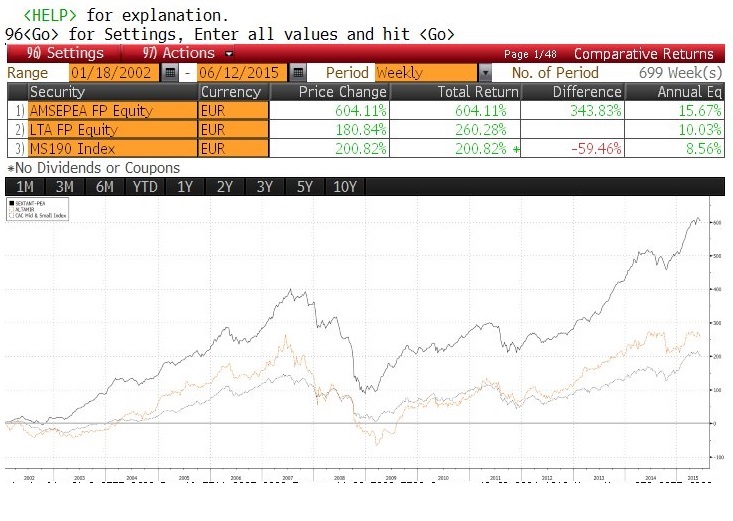
As an investor, I could replicate those stocks much cheaper than what Altamir is offering, or alternatively I could invest in a French based value fund like for instance Amiral. This is a comparison chart between the CAC Small&MidCap index, Altamir and the Amiral Sextant PEA, a smallcap value fund since 2002:

alta3

The lowest line is the index and we can see that Altamir has beaten the index by around +1,5% p.a. However the Amiral fund has beaten Altamir by a large margin despite charging also around 2% fees and a 15% performance fee. Although this is clearly no apples-to-apples comparison it clearly shows that Altamir’s perfomance is not that stellar (after fees).

Summary:

So my assumption that Mr. Tchenio is pocketing a large amount of the fees was clearly wrong. Nevertheless, at least for a “non tax advantaged” investor like me, Altamir doesn’t really offer any value. The fees are much to high and justify a discount. If the right dicount is 30% or less could be discussed but paying 3% + carry on 30% listed stocks is not a real value proposition and will always lead to a discount epsecially on cash and listed companies. Again, if the discount would widen more, it would be maybe worth an investment but for now, I think I can find better investments, especially in France.

Altamir SA (ISIN FR0000053837) – French PE at an attractive discount or CEO “self-service” vehicle ?

Altamir is a French holding company whose main purpose is to invest into private equity funds. Such a structure is called in general “listed private equity”.

To be more specific, this is what they state as the company strategy:

Altamir invests exclusively with Apax Partners, in three ways:

In the funds managed by Apax Partners France:

€200m to €280m committed to Apax France VIII;

In the funds advised by Apax Partners LLP: €60m in Apax VIII LP;

Occasionally, in direct co-investment with the funds managed and/or advised by Apax Partners France and Apax Partners LLP

As investing in only one Private Equity fund company is a quite special arrangement, one asks oneself only one question: Why ? Well, this is explained in the annual report:

Apax Partners was founded in 1972 by Maurice Tchenio in France and Ronald Cohen in the UK. In 1976, they teamed up with Alan Patricof in the United States, bringing the independent entities together under a single banner, Apax Partners, with a single investment strategy and similar corporate cultures, and applying the rigorous standards of international best practices. In 1999, Apax Partners began to merge its various domestic entities into a single structure (Apax Partners LLP), with the exception of the French entity, and reoriented its mid-market investment strategy towards larger transactions (enterprise values between €1bn and €5bn). Apax Partners France opted to remain independent and conserve its mid-market positioning, targeting companies between €100m and €1bn. There are currently no cross-shareholdings or legal relationships between Altamir on the one hand and Apax Partners MidMarket and Apax Partners LLP on the other, nor between Apax Partners Midmarket and Apax Partners LLP

This closes the circle: Maurice Tchenio is the CEO of Altamir and was the founder of Apax Partners in France.

Tchenio retired from Apax only in 2010, so for quite some time he was running Altamir in parallel to being actually part of Apax himself. Maybe to provide stable funding to APAX France ? i don’t know.

So why could this be interesting ?

Looking at Altamir, there were some very positive aspects to be found:

+ CEO owns 26%, is buying (2009: 22%)

+ transparent documentation, reporting. Quarterly NAVs, detailed asset lists

+ French Midcap PE is attractive

+ discount vs. NAV (~30%, 11,20 EUR vs. ~16 EUR NAV). The discount is relatively high compared to other listed P/E stocks (currently on average ~10-15%)

+ no double leverage, net cash

+ paying dividends

+ valuation of unlisted assets relatively conservative, sales prices always higher than last valuation

+ the legal structure seems to be tax efficient for long-term holders (no tax on dividends for French shareholders if one commits to hold > 5 years)

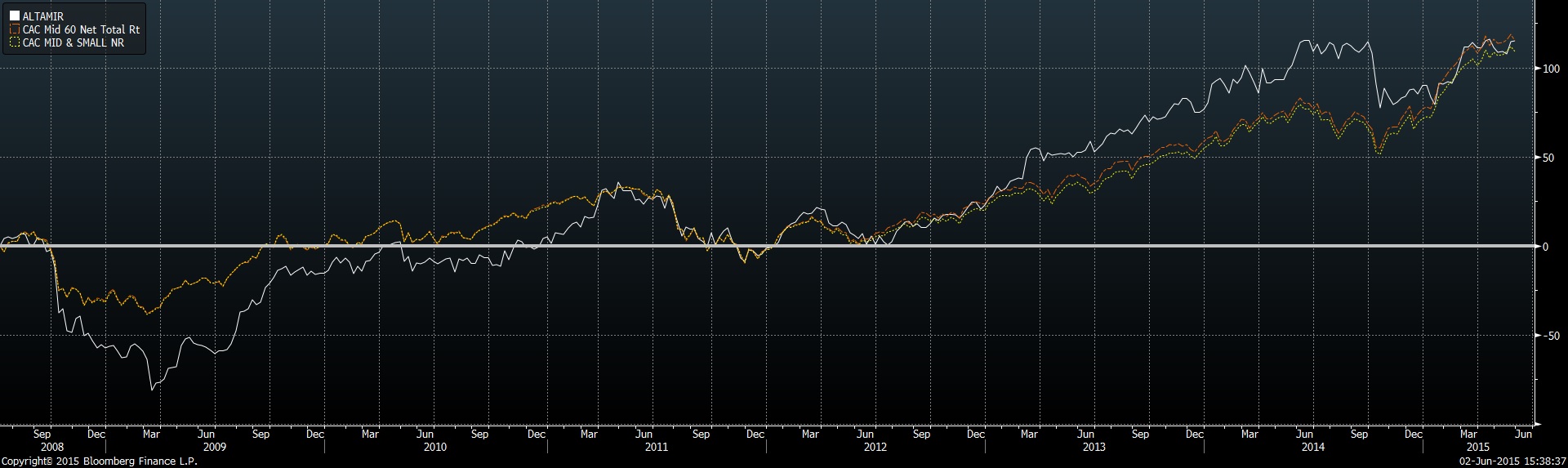
+ track record is pretty OK as we can see in the chart: They did manage to outperform the CAC Mid& Samll cap index since inception based on their stock price, although only at a relatively small margin:

altamir vs cac mid

Actually, those points, especially the “juicy discount” in connection with the large CEO share holding makes this quite interesting

However, the most important thing in looking at such vehicles is the question: How much cost do they add and how much aligned are the interests of management and shareholders ?

And this is where things get a little bit messy. According to the annual report, direct fees are around 17 mn EUR or 2,9% of NAV. This includes in my understanding also the underlying APAX funds. This is not cheap but most likely “in line” with other “fund of fund” PE structures. But the real “fun” starts with the following issue:

The Company has issued Class B shares that entitle their holders to carried interest equal to 18% of adjusted net statutory income, as defined in §25.2 of the Articles of Association. In addition, a sum equal to 2% calculated on the same basis is due to the general partner. Remuneration of the Class B shareholders and the general partner is considered to be payable as soon as an adjusted net income has been earned. Remuneration of these shares and the shares themselves are considered a debt under the analysis criteria of IAS 32.
The remuneration payable to the Class B shareholders and the general partner is calculated taking unrealised capital gains and losses into account and is recognised in the income statement. The debt is recognised as a liability on the balance sheet. Under the Articles of Association, unrealised capital gains are not taken into account in the amounts paid to Class B shareholders and the general partner.

So this is in fact a 18% “carried interest” of the general partner (i.e. the CEO) on any realized profits of the company. So for 2014 for instance, 87 mn EUR of realzed income “shrink” to 57 mn EUR shareholder income as first the management fee gets deducted and then further 18% profit share.

So the “privilege” of a shareholder to invest into APX via Altamir is purchased quite expensively. This also puts the CEO investment a little bit in perspective. Yes, he has invested around 100 mn of his own money into Altamir, but in 2014, the management fees and profit share netted him close to 30 mn EUR direct, whereas the proportional profit of his share position was “only” 15 mn EUR.

Ok, maybe being the Ex Founder of APAX France opens the door to invest into APAX, but charging “3% and 18%” for this privilege (all in) looks quite expensive and explains some of the discount.

Activist angle:

The whole fee issue might also explain why French asset manager Moneta seems to have started in 2012 and “activist campaign” against altamir, see here and here.

They seemed to have pushed for a run-off of the company but so far only succeeded in pressuring to pay a higher dividend than before (increase from 0,10 EUR 2012 to currently 0,50 EUR).

According to Moneta’s homage, they are still active. To me it looks like that the increase in the CEO’s share position has much more to do with control than with actually believing that the shares are undervalued, but of course this could be wrong.

Summary:

In principle, a listed PE vehicle specializing in French mid-market Private Equity could be interesting if the discount is significant. At Altamir however, as I have described above, the structure takes out a lot of money and one needs significant Alpha over time to break even compared to a “do it yourself” portfolio of French small and midcaps.

Tha activist involvement is interesting, but I don’t know enough about French Governance rules to assess the chances of a fundamental change.

So for the time being no investment, however if for some reason (market stress), the discount becomes really large I might be revisiting the case.

« Older Entries