Tag Archives: Reply SpA

Reply SpA part 3 – Strange cashflow –> RED FLAG ALERT

In the last two posts (part 1, part 2) about Reply, I mentioned that there was some questionable provisioning for overdue receivables and that free cash flow generation in general looks relatively weak.

So let’s look at a further example, if and how reliable Reply’s accounting is.

In 2009, Reply made an interesting deal, as stated in the 2009 annual report:

Acquisition of Motorola Research centre
In February 2009 Reply Group, through the subsidiary company Santer Reply S.p.A., finalized the acquisition of the Motorola research centre based in Turin.
The acquisition, accountable as a “net asset acquisition” was purchased by Reply for a symbolic amount of 1 Euro and comprised 339 employees, 20.6 million Euros in cash, 2.9 million Euros of assets and liabilities for 23.5 million Euros. Reply has committed to the operation on the basis of the research perspectives outlined at the time of acquisition and the agreements defined with the public administrations (Region and Ministry of Development).

Such agreements foresee that the Piedmont Region finance through a free grant a maximum of 10 million Euros on the condition that the Research centre carries out projects within the research and development of Machine to Machine (“M2M”) and that proof can be provided. Furthermore, the Ministero dello Sviluppo Economico (S.M.E.) has made a commitment to grant the Research centre a loan for a maximum of 15 million Euros of which 10 million a free grant for research and development projects similar to those agreed with the Piedmont Region.
In the last months the Board of directors of Reply Group and Santer Reply S.p.A have outlined and defined organizational strategies of the course of business of the Centre. More specifically costs related to research projects have been quantified and the financial resources necessary for such research projects and means of disbursement have been defined by the Public Administrations.

So they “bought” a company for 1 EUR which had 20.6 mn in cash. In theory, we should see this as a positive investing cashflow in the CF statement. Lets look at the 2009 statement:
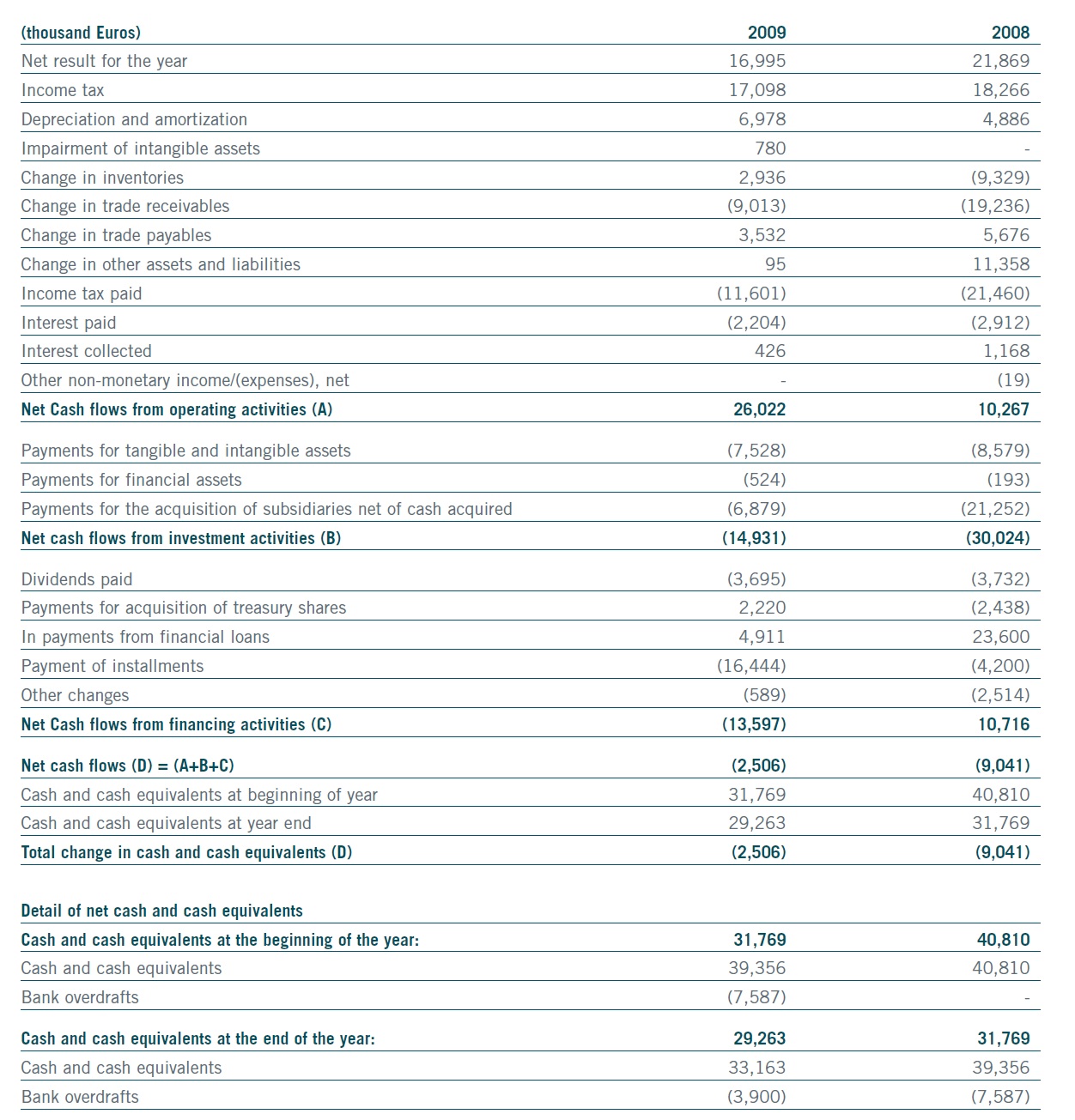
Strangely, the stated “payments for the acquisition of subsidiaries net of cash received” is negative !! We know that they only paid 1 EUR, received 20 mn and didn’t do other big acquisitions in 2009.

I do not know where they actually booked the acquired 20 mn EUR liquidity, but this is very very strange.

The second part of the puzzle are the Government grants out of this deal.

In their notes, they state the following:

Government grants
Government grants are recognized in the financial statements when there is reasonable assurance that the company concerned will comply with the conditions for receiving such grants and that the grants themselves will be received. Government grants are recognized as income over the periods necessary to match them with the related costs which they are intended to compensate.

So what in theory should happen is the following:

-when they receive the money, the book a liability against the money (P&L neutral)
– then over time they reduce the liability by booking this release as profit

Based on Note 29, Reply booked already such a provision of ~23 mn EUR at the end of 2009, from where they used half of it again. I am not sure why,but again, where is the corresponding asset ? I would assume somewhere in other receivables (as they may not have received the Government money in 2009).
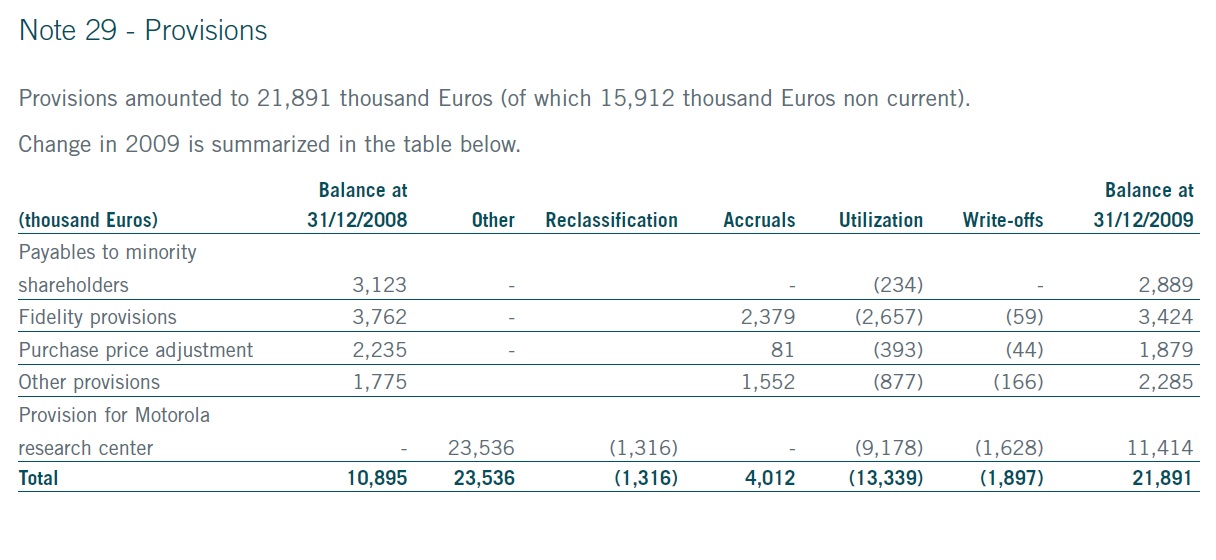
If one of the readers really understands what is going on here, then please help me.

In 2010, the provisioning continues, it looks like the increase and use those provisions as they like to:
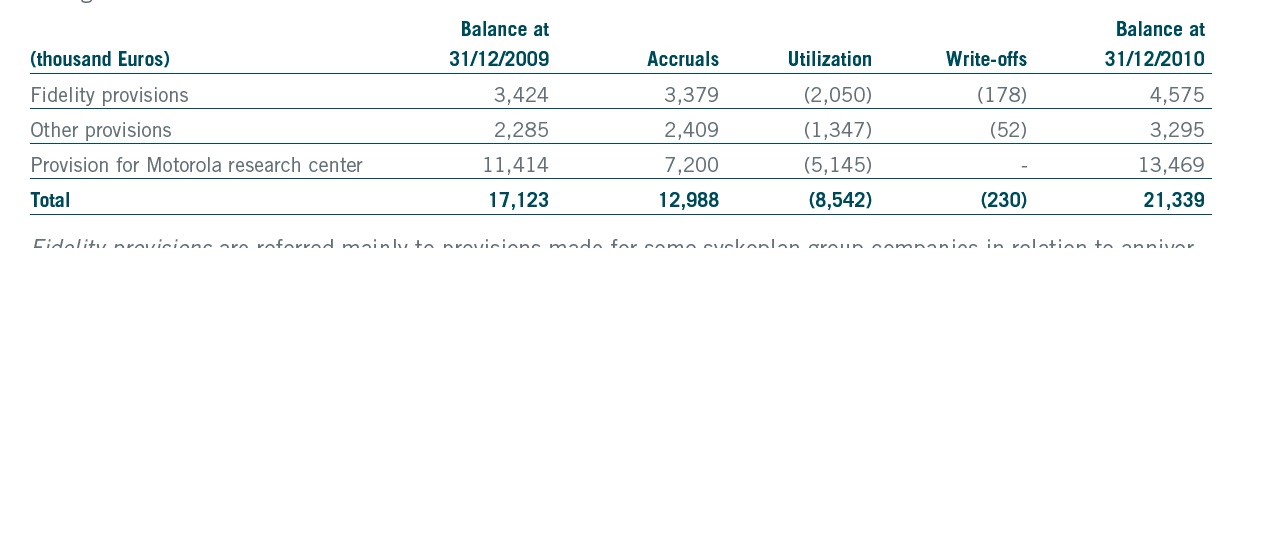
This might explain why the very unusual and unexplained line item “changes in other assets and liabilities” makes up 2/3 of Reply’s 2010 operating cashflow.
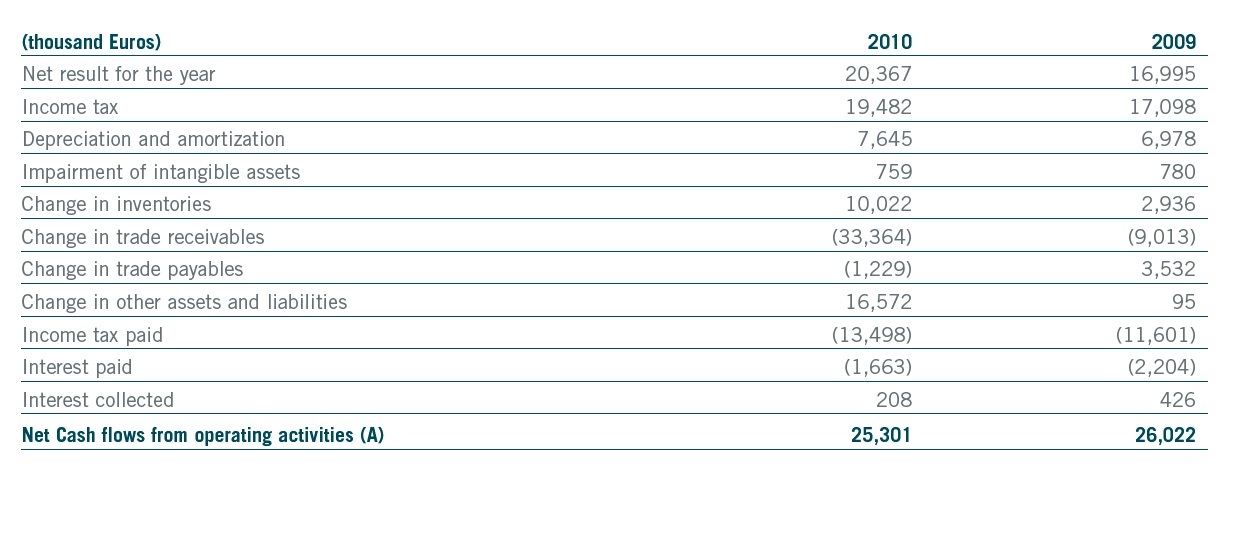
in 2011, the provision is still significant:
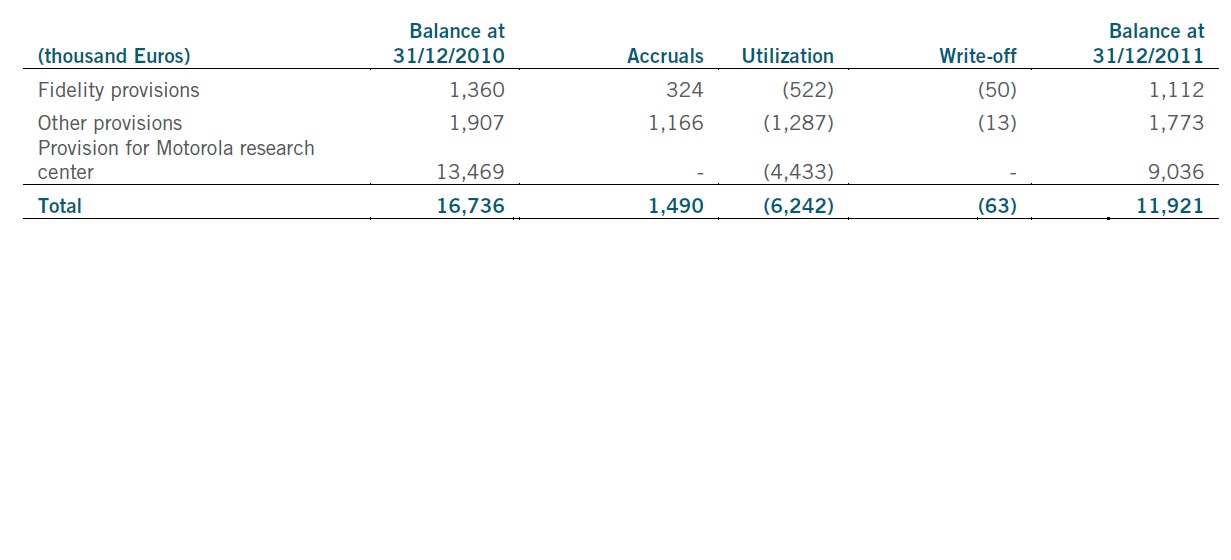
So what does that mean ?

In my opinion, there is poor visibility in the accounts and especially in the cash flow statements. We know now, that the Motorola transaction netted them around 40 mn EUR net cash, but didn’t show up in the investment cashflow. As it didn’t show up in financing cashflow neither, it has to be moved into operating cash.

As operating cash in total from 2009-2011 was only 55 mn EUR, basically a large amount of the operating cashflow in this period seems to be non-operating and coming from the acquired Motorola Research center.

At this point it is time to stop and summarize:

– at least to me, the accounting and cashflow treatment of the Motorola acquisition is not transparent
– together with the weak cash flow generation, large goodwill position and a large number of acquisitions this is A BIG RED FLAG

Maybe I am just not clever enough, but my philosophy to avoid companies with large intangibles and non-transparent accounting makes me stop here and not further investigate the company.
Reply SpA (ISIN IT0001499679) part 2: – Peer Group, Free Cash flow & receivables

First of all thank you for the many helpful comments in part 1 of the Reply post.

I think as a next step, a standard Peer Group comparison might be interesting. I selected a couple of midsize European IT system providers. Lets look how they compare based on some standard ratios:

Name Mkt Cap (EUR) P/E EV/EBITDA (FY1) Return on Equity 3 Yr Average
REPLY SPA 159.56M 5.76 3.48 15.39%
BECHTLE AG 638.40M 11.02 6.21 13.20%
TIETO OYJ 984.66M 15.91 5.42 10.28%
PRODWARE 51.15M 3.51 3.06 18.47%
CANCOM AG 127.49M 9.37 4.6 16.46%
SOPRA GROUP 465.04M 10.05 4.43 17.58%
ATOS 3.90B 20.87 4.29 5.59%
GROUPE STERIA SCA 335.76M 5.96 3.91 7.31%
COMPUTACENTER PLC 750.09M 9.42 4.45 13.81%
INDRA SISTEMAS SA 1.30B 9.34 6.77 20.07%
         
Avg   10.12 4.66 13.82%

One could say despite good profitability, all of those companies are relatively cheap. Apart from tiny Prodware, Reply is the second cheapest despite above average ROEs.

Interesting are of course also the operating statistics:

Name Days Sales Outstanding (A/R Days) Revenue per Employee Operating Profit per Employee Operating Margin
REPLY SPA 169.5 128.67k 14.22k 11.05%
BECHTLE AG 49.0 364.10k 14.96k 4.11%
TIETO OYJ 72.1 100.87k 5.64k 5.60%
PRODWARE 152.8 93.23k 14.82k 15.90%
CANCOM AG 47.0 259.60k 8.80k 3.39%
SOPRA GROUP 124.0 83.29k 7.30k 8.76%
ATOS 84.7 92.98k 5.77k 6.20%
GROUPE STERIA SCA 59.6 87.44k 6.26k 7.16%
COMPUTACENTER PLC 64.8 298.50k 7.65k 2.56%
INDRA SISTEMAS SA 226.5 86.47k 8.67k 10.03%
         
Avg 105.0     7.48%

It is obvious, that Reply and Indra (from Spain) do have issues with receivables. Reply Germany only has ~64 days of receivables outstanding. Based on profit per employee Reply looks good as well on par with German Bechtle and French prodware. Operating margins are far above average.

So what not to like ?

The answer is relatively clear if we look at this tabel: Free Cashflow

Name FCF Yld Dvd Yld
REPLY SPA -11.99% 2.92%
PRODWARE 5.87% 1.08%
ATOS 9.94% 2.44%
CANCOM AG 10.23% 2.79%
BECHTLE AG 3.91% 3.24%
GROUPE STERIA SCA 13.52% 4.27%
COMPUTACENTER PLC 13.07% 4.43%
SOPRA GROUP 3.63% 4.75%
TIETO OYJ 5.17% 5.45%
INDRA SISTEMAS SA 6.95% 8.66%

As we can see, the business is usually quite cash generative, only Reply has negative free cashflow. How comes ?

As some of you might know, I like to structure the cash flow statement a little bit differently to see where the cash goes to:

2011 2010 2009 2008 2007 Total
Op CF 4.7 25.3 26.0 10.3 19.6 85.9
Delta WC -21.8 -24.6 -2.5 -22.9 -9.9 -81.7
Free CF adj. 26.5 49.9 28.6 33.2 29.5 167.6
             
             
Capex -7.8 -5.8 -7.5 -8.6 -4.7 -34.3
acqu -8.0 -4.1 -6.9 -21.3 -7.1 -47.3
             
Div. -4.5 -3.3 -3.7 -3.7 -3.0 -18.2
             
other fin cf -4.6 -13.9 -9.9 7.0 2.2 -19.2
             
             
Depr. -6.0 -7.6 -6.9 -4.9 -4.0 -29.4
Capex-Depr -1.8 1.9 -0.6 -3.7 -0.7 -4.9
 
Net income 24.2 20.4 16.6 18.9 15.7 95.8
FCF adj/NI 109.7% 244.9% 171.7% 175.2% 188.0%

So over the last 5 years, 50% of the free cashflow had to be invested back into working capital, 25% into acqisitions, the rest into Capex, dividends and financing.

If we look at 2010, we can see that this was a very strange year with a big jump in cashflow whereas 2011 looks rather bad, especially compared to net income.

One of the major factors in 2011 for the low cashflow seems to be an abnormally high tax payment (30 mn va. 13 mn the year before). I have to admit that taxes are my weakest point in my analytic skill set and I don’t really understand this. The 2010 payment seems to have been lower than the tax expense, the 2011 higher, on average they seem to be similar to expenses.

Receivables:

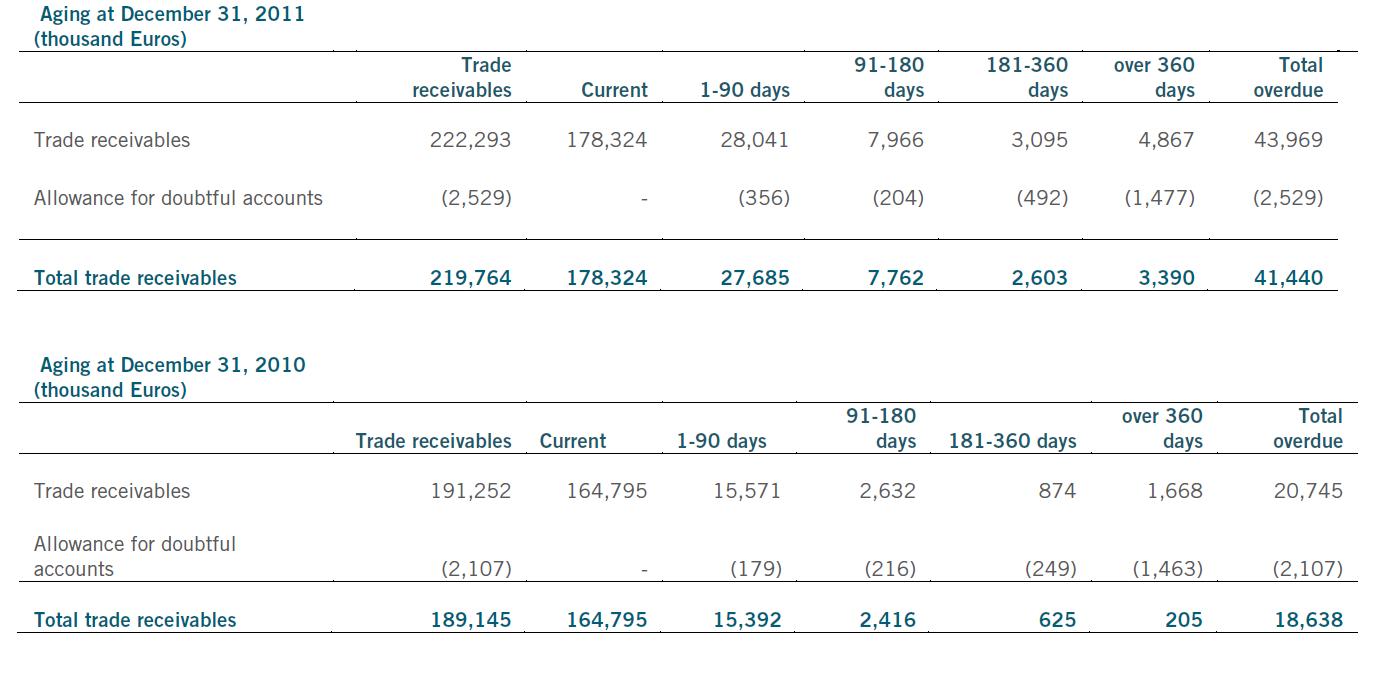
Now to the fun part. Let’s look at he 2011 report and we see something truly worrysome here:

“Overdue” receivables jumped up from ~10% of receivables to almost 20% of receivcables. We can also see that in 2010, almost 100% of the 360 day overdue receivables were written of, wheres only 25% were written of in 2011.

Let’s compare 2010 and 2011:

1-90 91-180 181-360 > 360
Overdue 2010 15.6 2.6 0.9 1.7
allowance 0.2 0.2 0.2 1.5
in % 1.15% 8.21% 28.49% 87.71%
 
  1-90 91-180 181-360 > 360
Overdue 2011 28.0 8.0 3.1 4.9
allowance 0.4 0.2 0.5 1.5
in % 1.27% 2.56% 15.90% 30.35%

This is a real issue from my point of view and could mean some “optimistic” accounting on the side of Reply SpA. If we would apply the same percentages as in 2010, we would get the following additional charges:

1-90 91-180 181-360 > 360
Overdue 2011 28.0 8.0 3.1 4.9
2010% 1.15% 8.21% 28.49% 87.71%
2011 allow (2010) 0.32 0.65 0.88 4.27
Delta -0.03 0.45 0.39 2.79

So this would mean 3.6 mn pre tax charges. One could even argue that based on the recent developements even higher charges would be necessary so for instance a full write off of 360+ receivabels. So we migth want to adjust Reply’s earnings maybe for ~5 mn EUR pre tax or 2.75 mn (~30 cents per share) after tax, which would still give us EPS of ~ 2.60 or a P/E of 6.6.

Summary:

Free cashflow generation at Reply is somehow limited as 50% of FCF go directly into an increase in working capital. Additionally, receivables accounting seems to be optimistic. So we have already 2 reasons why the stock is so cheap. However I will have to dig a little bit deeper to understand if there is still value there.

In general, I do have problems when I discover “optimistic” accounting as I loose confidence in their overall accounts. For a company like Reply with a lot of goodwill and intangibles, the accounting should be more on the conservative side.