Tag Archives: Special Situation

Special situation “Quickie”: Flughafen Wien AG (ISIN AT0000911805) partial Tender offer

Just by chance I looked at Flughafen Wien these days where since a few weeks an interesting situation is playing out.

Although Flughafen Wien is owned 50% by the Government and cannot be taken over, an Australian based Infrastructure fund called IFM made a partial tender offer for up to 29,9% of the shares.

Initially, IFM offered 80 EUR per share with a minimum threshold of 20% acceptance.

A few days ago, after pressure from soem shareholders, IFM increased the offer to 82 EUR and waived the 20% minimum threshold.

If I understood correctly, the new final date to tender the shares is December 18th. The money then is being paid within 3 working days, so before year end according to the official offer.

IFM seems to have secured around 12% from 2 funds already (Silchester, Kairos).

IFM seems to be a “reputable” investor, there seems to be no relevant operational risks for the offer from a technical point of view as far as I can tell.

However, the stock doesn’t trade at 82 EUR but rather at around 79,20 EUR per share:

This implies that investors expect 2 things

a) that more than 29,9% will be offered
b) and that the share price will fall after the offer below the offer price

Now we can play around a little bit to see if this is something worth betting on. We could start for instance assuming that the stock directly drops to 70 EUR after the offer expires.

Then we can calculate at the current price of 79,2 EUR an implicit or “break even” acceptance ratio:

79,20 = X*82 + (1-x)*70 = 76,67%.

So if 76,67% of the offers get accepted, the remaining not accepted stocks can drop to 70 EUR before one is making a loss on the transaction.

If all tendered shares are accepted, the max. profit would be 2,8 EUR per share or +3,54% for a period of 2 weeks.

Worst case: All minority shareholders tender (The Austrian government will definitely not tender…), then the lowest possible acceptance rate is 29,9/50 = 59,8% and the price falls directly to the value before the ofer (~61,50 EUR). Then the maximum loss per share would be -5,44 EUR or -7,4%.. At a more realistic drop to 70 EUR, the downside would be 2,02 EUR or -2,6%. This would be a positive expected value if the assumption of 70 EUR as a post tender price is correct.

I do think that this is a nice liltle side bet, so I will invest 2,5% of the portfolio at 79,25% into this little “special situation” with a time horizon of 2 weeks

One important note here: There is clearly a downside here and I would not recommend this to anyone who doesn’t regularily do such things, as the “single bet” might be not super attractive. However if one runs such bets on a continous basis (as I do, like MAN, Sky etc.), over time one will make money even with a few loosing trades.
Banca Monte dei Paschi Siena (BMPS)- Another deeply discounted rights issue “Italo style”

Capital Raising in Italy is always worth looking into. Not always as an investment, but almost always in order to see interesting and unusal things. I didn’t have BMPS on my active radar screen, but reader Benny_m pointed out this interesting situation.

Banca Monte dei Paschi Siena, the over 600 year old Italian bank has been in trouble for quite some time. After receiving a government bailout, they were forced to do a large capital increase which they priced in the beginning of last week.

The big problem was that they have to issue 5 bn EUR based on a market cap of around 2,9 bn.

After a reverse 1:10 share split in April, BMPS shares traded at around 25 EUR before the announcement. In true “Italian job” style, BMPS did a subscription rights issue with 214 new shares per 5 old shares at 1 EUR per share, in theory a discount of more than 95%.

The intention here was relatively clear: The large discount should lead to a “valuable” subscription right which should prevent the market from just letting the subscription right expire. What one often sees, such as in the Unicredit case is the following:

– the old investors sell partly already before the capital increase in order to raise some cash for the new shares
– within the subscription right trading period, there will be pressure on the subscription right price as many investors will try to do a “operation blanche”, meaning seling enough subscription rights to fund the exercise of the remaininng rights. This often results in a certain discount for the subscription rights

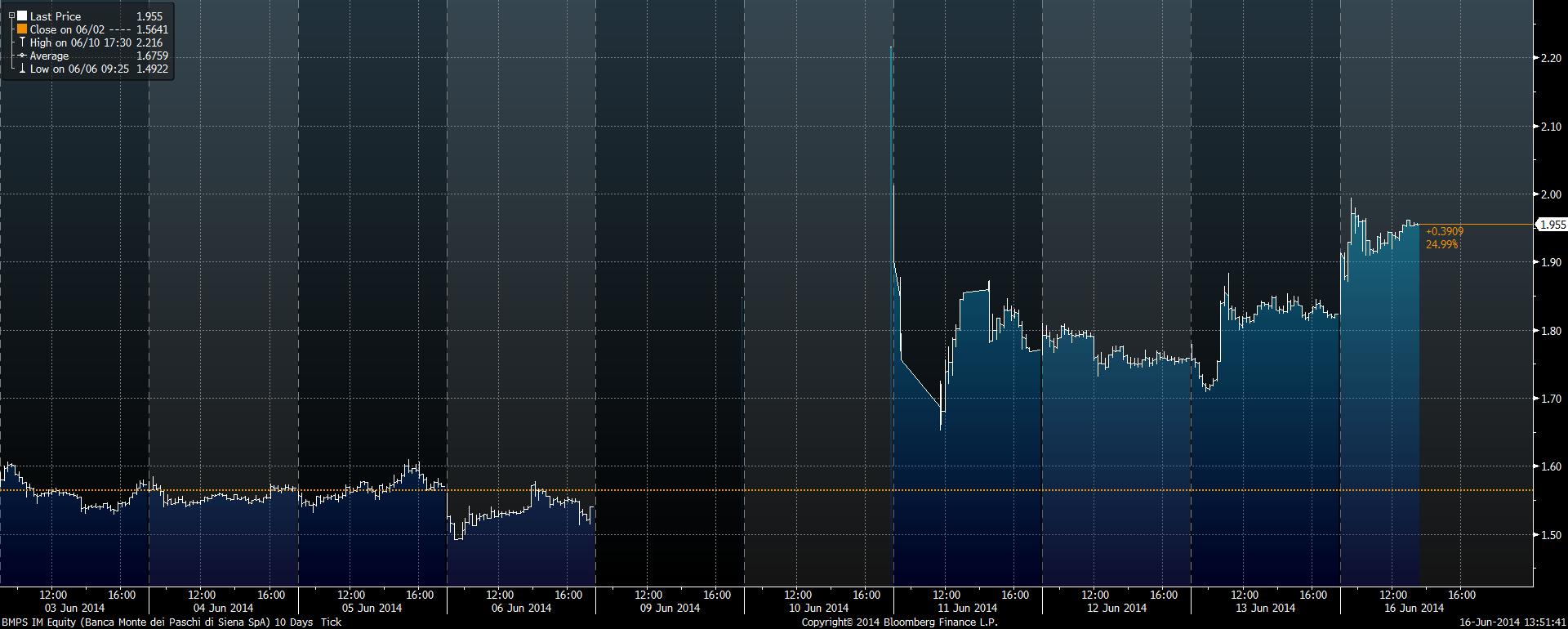
In BMPS’s case, the first strange thing ist the price of the underlying stock:

BMPS IM Equity (Banca Monte dei  2014-06-16 13-51-34

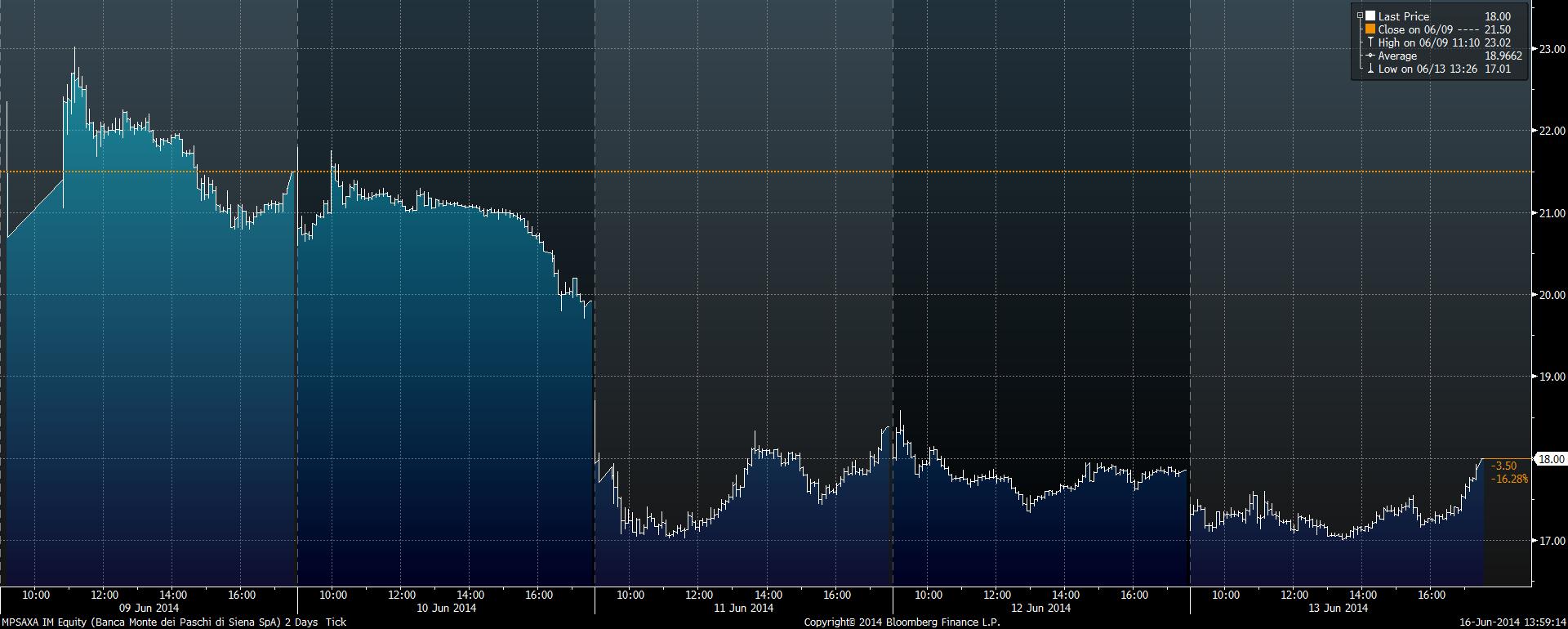
Adjusted for the subscription right, the stock gained more than 20% since the start of the subscription right trading period and it didn’t drop before, quite in contrast, the stock is up ~80% YTD. As a result of course, the subscription right should increase in value. But this is how the subscription rights have performed since they started trading:

MPSAXA IM Equity (Banca Monte de 2014-06-16 13-59-10

It is not unusual that the subscription rights trade at a certain discount, as the “arbitrage deal”, shorting stocks and going long the subscription right is not always easy to implement.

At the current price however, the discount is enormous::

At 1,95 EUR per share, the subscription right should be worth (214/5)* (1,95-1,00)= 40,66 EUR against the current price of 18 EUR, a discount of more than 50%. The most I have seen so far was 10-15%. So is this the best arbitrage situation of the century ?

Not so fast.

First, it seems not to be possible to short the shares, at least not for retail investors. Secondly, different to other subscription right situations, the subscription right are trading extremely liquid. Since the start of trading on June 9th, around 560 mn EUR in subscription rights have been traded, roughly twice the value of the ordinary shares. The trading in the ordinary shares themselves however is also intersting, trading volume since June 9th has been higher than the market cap.

Thirdly, for a retail investors, the banks ususally require a very early notice of exercise. So one cannot wait until the trading period and decide if to exercise or not, some banks require 1 week advance notice or more. My own bank, Consors told me that I would need to advice them until June 19th 10 AM, which is pretty OK but prevents me from buying on the last day.

In general, in such a situation like this the question would be: What is the mispriced asset, the subscription right or the shares themselves ? Coming from the subscription right perspective, the implicit share price would be 1+ (18/((214/5)*1,95-1)))= 1,44 EUR. This is roughly where BMPS traded a week before the capital increase.

For me it is pretty hard to say which is now the “fair” price, the traded stock price at 1,95, the implict price from the rights at 1,44 or somewhere in between. As the rights almost always trade at a discount, even in non-Italian cases, one could argue that there might be some 10-15% upside in buying the shares via the rights. On the other hand, I find the Italian stock market rather overheated at the moment and the outstanding BMPS shares are quite easy to manipulate higher due to the low market cap of the “rump shares” at around 200-250 mn EUR.

The “sure thing” would be to short the Stock at 1,96 EUR, but that doens’t seem to be possible.

Summary:

Again, this “Italian right” capital raising creates a unique situation, this time with a price for the subscription right totally disconnected from the share price.

Nevertheless I am not quite sure at the moment what to to with this. One strategy would be to buy the subscription right now and then sell the new shares as quickly as possible, but it looks like that this is exactly what the “masterminds” behind this deal have actually want investors to do. They don’t care about the share price, they just want to bring in 5 bn EUR in fresh money and an ultra cheap subscription right is the best way to ensure an exercise. In this case we should expect a significant drop in the share price once the new shares become tradable. So for the time being am sitting on the sidelines and watch this with (great) interest as it is hard for me to “handicap” this special situation at the moment.

Update: Portugal Telecom & Oi Merger & Oi capital increase

DISCLAIMER: The stock discussed is again very risky and not a typical “value stock”. Please do your own homework and never commit large amounts of your capital to such investments. The author might buy or sell the shares without giving advance notice. Do your wn homework !!

Last year I had a mini series (part 1, part 2, part 3) about the merger between Portugal Telecom and the Brazilian Oi. My initial idea was a long PTC / short OI deal as the mechanics of the merger seemed to imply a signifcant dilution for OI shareholders.

Interestingly, since I wrote the first post in October 2013, both shares lost siginficantly, however Oi with around -37% more than double than PTC with -15%.

Oi is now in the process of preparing the planned capital increase and it looks that they did push through the share offering though there have been some hickups along the way.

Just as a quick reminder:

Oi was supposed to do a big capital increase first before then the company gets merged with PTC.

Oi seems to have priced the new shares aggresively at the bottom of the expected range:

Grupo Oi SA, Brazil’s largest fixed-line telephone carrier, priced an offering of preferred shares at 2 reais each, at the bottom of the indicative range set by bankers, sources said on Monday.

So at current prices with PTC at ~3 EUR and OI common shares at 2,50 Reais (or ~0,81 EUR) PTC sharesholders will receive “new shares” of OI at the value of 2,2911 Euros plus 0,6330 “CorpCo” shares which should equal common shares. So at 3 EUR there seems to be a small discount but I think this is hardly exploitable as an arbitrage situation.

For me, the current situation is an interesting combination of a special situation (capital increase regardless of price) and Emerging Markets exposure.

However, much more interesting for me is that aspect:

It is pretty clear that Oi wanted to raise a defined amount without really caring about the share price. This looks similar to EMAK and Unicredit in Italy 2 years ago. This is one of the rare cases where we clearly have a seller who does not care about the price but just wants to raise a fixed amount of money.

The “special-special” aspect of this one are the following feature:

1. We do not have subscription rights despite the massive amount of new shares
2. We have the additional complexity of the subsequent PTC merger

In such a situation, it is extremely hard to come up with a solid valuation of the business. Both, OI and PTC look very cheap on a trailing EV/EBITDA basis but honestly, i did not try to figure out how the combined entity will look like. Oi minorities clealry got screwed by this transaction whereas PTC shareholders had been protected to a certain extent.

The good part of the this capital raising is that the entity will have some fresh cash which will allow them to operate for some time. Although there is clearly the risk of further dilutions if they want to bid for instance for additional businesses in Brazil.

Summary:

For me, the Oi capital increase looks very similar to situations like EMAK and Unicredit, where the companies issued new shares regardless of price. This increases the possibility that the price has been pushed significantly below fair value. Buying PTC now looks like an interesting way to get exposure to the merged entity at a depressed price. I will therefore invest a 1% position into PTC at current prices (3 EUR) for my “special situation” bucket.

Portugal Telecom & OI merger – another PIIGS stock transformation ?

It seems like that many PIIGS companies with significant international business operations try to transform their companies in some way or another in order to get rid of the “PIIGS” discount. Basically a first mover was Hellenic Botteling, which delisted in Greece and relisted as Swiss based company in the UK market in 2012. A second, very succesful attempt was made by Autogrill, spinning off the international business.

Now, a few days ago, Portugal Telecom (PTC), the Portuguese TelCo with a large Brazilian subsidiary, came up with a potential new way:

They want to merge with the Brazilian TelCo OI and effectively become a Brazilian Telecom company with a Portuguese subsidiary.

This alone is in my opinion already an interesting special situation. But it gets even more interesting. The structure of the merger is quite complicated, but in general, there will be a merger plus capital increase.

For Portugal Telecom shareholders, it looks like the following:

Each Oi common share will be exchanged for 1 share in CorpCo, and each Oi preferred share will be swapped for 0.9211 CorpCo stock. Each Portugal Telecom share will be the equivalent of 2.2911 euros in CorpCo shares to be issued at the price of the capital hike, plus 0.6330 CorpCo shares.

So on a first look, this looks interesting for Portugal Telecom shareholders. The lower the price of the capital increase, the higher the share in the combined company. Clever Hedge funds might even be able to construct a short OI long PTC trade. Although there is a corridor where either PTC or OI can step back from the transaction if prices would move too strongly in one or the other direction.

Some figures / ratios:

PTC:
Market cap 3.1 bn EUR
P/E 7.4
P/B 1.5
EV/EBITDA 5.5

OI:
Market Cap 6.5 bn BRL (~2.1 bn EUR)
P/E 11
P/B 0.6
EV/EBITDA 4.5

Both companies carry significant debt.

The share prices of both companies reacted at first positively, but in the recent days, OI shares dropped quite significantly and PTC is back to where it was before (after hitting +30% in the first day):

This might be the reaction to the large cash capital increase undertaken by OI in the course of the deal:

As part of the merger, Oi proposes to undertake a cash capital increase of a minimum of R$ 7.0 billion (Euro 2.3 billion), and with a target of R$ 8.0 billion (Euro 2.7 billion) to improve the balance sheet flexibility of CorpCo. Shareholders of Telemar Participações S.A. (“Tpart”) and an investment vehicle managed by Banco BTG Pactual S.A. (“BTG Pactual”), will subscribe approximately R$ 2.0 billion (Euro 0.7 billion) of the cash capital increase

So from an OI shareholder point of view, one could argue that this exercise is somehow quite dilutive.

For some PTC shareholders, the problem might be that the suddenly do not hold a Portuguese/European stock but a Brazilian one. According to the official announcement, the new stock will be listed in Brazil, US and on NYSE Euronext, so technically it should be not a problem for shareholders.

On the “plus side” for this transaction one could argue with the following points

+ A Portuguese company with a potential “PIIGS” discount will be “transformed” into a potential BRIC growth story.
+ The valuation of the overall group might improve as well, as the OI pref shares will cease to exist
+ As PTC shareholder, there is an additional opportunity with regard to the OI share capital increase. The lower the price for the new shares, the higher will be the percentage in the new company
+ it is very likely that the deal will go through. The CEO of both companies is the same guy and regulators will have no reason to object
+ part of the synergies (i.e. lower refinancing costs) might be relatively easy to achieve.

On the other hand, there are also some clear issues:

– Brazil itself is not in the “sweet spot” anymore
– OI itself is struggling. Being only the number 4 mobile operator, especially ROA and ROE is far below the competition
– in the presentation, the CEO committed to pay 500 mn BRL p.a. in dividends. Including the new shares, this will result in a much lower dividend yield going forward from the current 7-8%. As they want to grow, this makes sense, but for some investors this could be an issue
– debt will be relatively high, further capital increase in combination with acquisitions are not unlikely

At the moment, I need to dig a little bit more deeply into this, but in order to keep me motivated and interested, I take a 0.5 % position at current prices (3.40 EUR per share) in Portugal Telecom for my “special situation” bucket.

DISCLAIMER: As always, do your own research. This is not meant to be any kind of investment advise. When publishing this, the author will most likely own the stock already. Do not blindly follow any tips etc. Use your own brain. The author will also most likely sell the stock before posting this on his website.

Recent Entries »