Author Archives: memyselfandi007

Lancashire Group (ISIN BMG5361W1047) – The UK equivalent of Buffett’s National Indemnity ?

While I was writing this post which I do normally over 1-2 weeks, the excellent WertArt Capital blog has released a very good post on Lancashire a few days ago. I higly recommend to read the post as it contains a lot of usefull information.

This saves me a lot of time and I only need to summarize the highlights:

– Lancashire is a specialist insurance company which insures mostly short tail “Excess loss” type of risks. It was founded by Richard Brindle, an experienced underwriter

– Since founding & IPO in 2009, the company has shown an amazing track record. No loss year, 59% average combined ratio and 19,5% ROE is simply fantastic.
– the company has a very disciplined underwriting focused business model, investment returns are negligible
– focus in on capital allocation and efficiency. If rates are not good, Lancashire returns capital to shareholders
good alignment of management and shareholders (majority of bonus depends if ROE hurdle of 13% + risk free is hit)
– The company looks cheap at ~8,5x P/E and 1,3 x P/B

For non-insurance experts a few quick explanations of insurance terms:

“Short tail” insurance business:

“Short tail” means that one is only insuring stuff where you pretty quickly see if there is a loss or not. For instance a “plane crash” insurance will be good for 1 year and if a plane crashes, the insurer will pay. After that 1 year there are no obligations for the insurer.

“Long tail” in contrast is an insurance policy which again covers a calendar year but where the damage can come up much later. A good example is D&O (director and officers) insurance. Often, when a big company goes bankrupt, some fraud etc. was involved at management level. Until a jury finally makes a verdict, many years can pass by but still the insurance company which has underwritten the policy remains liable. A good example is for instance the recent Deutsch Bank /Kirch trial where insurers will have to pay 500 mn EUR for something that happened 12 years ago.

Long tail has the advantage that the “float” can be invested long-term and illiquid, on the other hand the risk if a significant miss-pricing is much higher.

Excess Loss contracts

Excess loss contracts are contracts where the insurer only pays above a normally quite high threshold. This means that in normal cases, one does not need to pay but as a result premiums are lower than with normal contracts or “lower attachment points”. These kind of contracts are also often called “catastrophe risk” or “Cat Risk”. If such an event hits, then the hit will be big. Lancashire initially expected to make a loss 1 out of 5 years but up to now they had no loosing year. A company which has many excess loss contracts will report very good results in some years but very very bad in others.

What is the connection to Warren Buffett ?

Lancashire and Co. are relatively similar to Buffet’s National Indemnity Insurance, maybe the most overlooked part of his insurance empire after GEICO and Berkshire/General Re. Buffet has commented several times on National Indemnity and the competitive advantages of this company. The major competitive advantage of this business according to him was the ability NOT to write business if premiums are too low. The problem with this approach is of course that if you write less business, cost will be higher and the all important “Combined Ratio” (costs+claims divided by premium) will go up and investors will get nervous.

I wrote down this quote from last’s year Berkshire AGM from Buffett:

“I prefer the underwriters playing golf all day instead of underwriting risks at the wrong price. I don’t care of combined ratios grow well above 100% in such years.” For normal Insurance companies this is almost impossible to achieve as investors want to see increasing sales and profits any year and so most Insurance companies will underwrite no matter what the price is just to maintain the premium.

On the web I found similar quotes from him on the National Indemnity (NICO) which the bought in the 80ties:

Nevertheless, for almost all of the past 38 years, NICO has been a star performer. Indeed, had we not made this acquisition, Berkshire would be lucky to be worth half of what it is today.

What we’ve had going for us is a managerial mindset that most insurers find impossible to replicate.

and:

Most American businesses harbor an “institutional imperative” that rejects extended decreases in volume. What CEO wants to report to his shareholders that not only did business contract last year but that it will continue to drop? In insurance, the urge to keep writing business is also intensified because the consequences of foolishly-priced policies may not become apparent for some time. If an insurer is optimistic in its reserving, reported earnings will be overstated, and years may pass before true loss costs are revealed (a form of self-deception that nearly destroyed GEICO in the early 1970s).

Additionally, Buffett is already participating in the London/Lloyd’s market via another structure. Last year, he underwrote a socalled “side car” deal with Aon. The deal is still controversial but indicates a change of how things are being done at Lloyds. Funnily enough, Lancashire CEO Richard Brindle called the Buffet/Aon deal “foolish” in an interview last year.

Why is the company cheap ?

1. In general, all the socalled “London market” insurers are cheap. Let’s look at the “London” peer group:

Name Est Price/Book Current Yr P/E P/E FY1 Current Div. Yld (%)
         
LANCASHIRE HOLDINGS LTD 1,24 8,76 8,77 8,26
HISCOX LTD 1,62 10,47 13,48 8,21
BRIT PLC 1,23 #N/A N/A 8,59 #N/A N/A
BEAZLEY PLC 1,55 8,11 9,55 10,00
AMLIN PLC 1,36 7,94 11,13 6,07

Compared to those London players, all European P&C Insurance peers trade on average at~ 2,2 x book and 12 x earnings. So why are the London insurers so cheap ? In my opinion, the answer lies in the cyclicality of the business similar to Admiral. The “London market” is even more cyclical as it is primarily an institutional price driven market. The London market specialises in large and complex risks with “natural catastrophe” exposure. Despite the headline news, in the last years there were very few NatCat events which really led to large insured losses. In those times, profit margin increase and there is big pressure to lower premium. As companies accumulate capital, the appetite for risk increases, which further lowers premiums. This works as long as either a large NatCat event happens or capital markets crash and the insurers then have to raise premiums in order to restore their capital levels.

2. Management and strategy change

Lancashire so far has shown excellent underwriting discipline and outstanding an outstanding ability to allocate capital. However in the last few months a couple of things have changed:

a) The founder & CEO has “retired” in April at an age of 54. I haven’t found out why. Since 2005 I would guess that he has earned 50+ mn GBP, maybe he thought that this is enough ? At least he got an extra 10 mn package according to this article. He has been selling shares before his retirement.

b) In a change of strategy, Lancashire bought at the end of 2013 a Lloyd’s syndicate called Cathedral for ~200 mn GBP. Although the Lloyd’s business is not necessarily bad business, it is clearly a change. Lloyd’s underwriting is often reinsurance in contrast to Lancashire’s direct insurance. In their previous reports they claimed that their strategy of insuring directly was a competitive advantage. The Lloyd’s market on the other side is mostly reinsurance and more vulnerable.

c) Finally, after having been invested in short-term no-risk bonds since their IPO, they suddenly disclosed beginning at year-end 2013 that they now invest also into stocks and “Low volatility” hedge funds. Most likely not a good idea at this point.

For me, the cyclicality of the business itself would be no problem. But the combination of Management change and strategy change is very hard to swallow. I would happily invest if there would be EITHER a management change OR a strategy change but not both.

Summary:

To quote Donald Rumsfeld, those two changes lead Lancashire into the “unknown unknowns” territory. Sure, the new CEO is at Lancashire since 2007 and an underwriter, but overall I am not sure if the superior capabilities of the forme CEO have been “institutionalized” in the 8+ years of company history. Having three platforms instead of one sounds great, but it can also mean a loss of focus. So at the moment, Lancashire for me is not a “buy” as I do not have a clear idea how and if they can replicate their past results. T

However in general, the business model is attractive and the “London Insurers” could become interesting, especially if the market softens further so I will try to look into the others at some point in time.

Edit: I have just seen via the “Corner of Berkshire and Fairfax” board a link to an “Insurance Insider” article which states that the former CEO has completely sold out and is expected to launch a new company. A reason more not to rely on past results as this business is very dependent on the persons and the old CEO wil be a pretty tough competitor if he starts over again.

Book review: “Only the paranoid survive” – Andy Grove

Andy Grove was senior manager and CEO at Intel for a very long time and was one of the architects of the spectacular rise of Intel as microprocessor powerhouse. The book was written by Andy grove in 1997, one year before he stepped down as CEO of Intel.

He outlines how he dealt with what he called “inflection points” at Intel. An inflection point is in his definition a point where business changes so profoundly that either the business changes as well or the company will be killed by competitors. For Intel, this was the case when in the 1980ties, the Japanese suddenly were able to produce better and cheaper memory chips which were until then Intel’s main business.

Grove managed then to shut down the memory business and concentrate the efforts on the microprocessor business which was until then only a small part of the business. His first person (CEO) perspective is very interesting to read as change doesn’t come naturally to large and succesful companies.

I also found the book especially interesting because Intel is one of the famous cases for a “size moat” in Bruce Greenwald’s “Competition demystified”. Greenwald there argues that Intel’s success in microprocessors was more or less given because they had such a size advantage compared to AMD, their major competitor. Reading the book, I got the impression that Prof. Greenwald greatly simplified this. There seemed to have been several junctions on the way where Intel easily could have went “of course”, such as the rise of the RISC processors or the question at that time if multimedia will be won by PCs or TV sets. For me, one of the lessons o f the book is that Moats, at least in technology are always “weak moats” as the development is just too dynamic.

The most powerful concept of the book in my opinion is the following concept from Andy Grove: If you see someone coming up with a new idea or a competing product, then you should ask yourself the question: Is this a thread to the business if this gets 10 times bigger or better or faster ? His theory (and paranoia) was that if it is a thread at 10x bigger/better/faster than the probability of this actually happening is very big and you have to do something about it. And fast…

If I use this concept for instance for electrical cars, then as a traditional car manufacturer I should ask the question: What if electrical cars have 10 times better reach, 10 times more charging stations, charge 10 times quicker then now ?. Would I have a problem with this ? The answer would clearly be yes.

Grove also observes that you only have a chance to survive such inflection points if you start early, so when the old stuff is still selling well. Once the company is in real trouble, then change is much much more difficult.

The final chapter in the book deals with how Grove thought about the internet. One should remind that this book was written in 1997, but it is fascinating how Grove already identified industries which would be badly effected by the internet. He already was aware that for instance a lot of ad revenues would flow from print into the internet. One should not forget that this book was written a year before Google was even founded !!!

Another interesting aspect was that at that time Apple was considered by Grove a failed company as they did not change their vertical business model to a “Horizontal” one. Clearly , mobile was not on his radar screen at that time. As a final observation: Without the great run up in the stock price this year, Intel’s stock would have been more or less flat against the time when Grove stepped down as CEO in 1998. So even a great company as intel might not be a great investment at any price….

Anyway, in my opinion this is a truly great book. I think both, investors and managers can profit a lot from this book. I do like “first person perspective” books a lot, especially if you can compare them against articles and theories about the same company written by other people.

Performance review July 2014 – Comment “Anchoring”

Performance:

In July, the Benchmark (Eurostoxx50 (Perf.Ind) (25%), Eurostoxx small 200 (25), DAX (30%), MDAX (20%)) lost -4,5%. This is actually the biggest monthly loss since May 2012. The portfolio lost “only” -2,6%, an outperformance of +1,9% for the month. YTD, the score is +7,4% for the portfolio against -0,5% for the benchmark, a relative outperfomance of +7,9%..

Interestingly, especially the German part of the benchmark is struggling, with the MDAX down almost -6,5% for the year. My cautious stance towards German shares seems to have been justified so far.

The biggest looser in %terms in the portfolio were not surprisingly Sistema with -19,4% and Sberbank (-15,9%) followed by Trilogiq with -12,5%. Portugal Telecom would have been even worse with -39,7% but thankfully I sold that one early. Winners were few, among them Koc with +7,6%, TFF +4,7% and Gronlandsbanken +4,2%.

My Emerging Markets “Basket” has clearly added some volatility but on the other hand I think it was a good idea to diversify and only invest small amounts in risky stuff.

Current portfolio & Transaction

In July, I sold my small position in Portugal Telecom at a loss after the connection to Banco Espirito Santo became public. My relatively quick reaction saved me from much steeper losses. Sometimes it pays to react quickly.

Additionally I sold Vetropack as my investment case was clearly not fully valid anymore. The only new position was the Sky Deutschland “special situation”, which is a relatively low risk low upside investment. Finally I scaled down the Draeger position from 6,7% to 5% as the multiple against the pref shares increased to 6 times.

Cash at month end was around 12,4%, with a further 10% (Depfa LT2, MAN, SkyD) invested in special situations which I would consider close to cash. So the portfolio should be quite well prepared for any more significant corrections.

The current portfolio can be seen here.

Comment: “Anchoring”

During the month, I faced 2 situations where I was confronted with one of the most common but also most dangerous behavioural biases: Anchoring. On Stockopedia I found a pretty good description:

The concept of anchoring draws on the tendency to attach or “anchor” our thoughts to a reference point – even though it may have no logical relevance to the decision at hand.

The first situation this month was the case of Portugal Telecom (PTC). PTC announced quite surprisingly that they had extended almost 1 bn EUR to the now bankrupt Espirito Santo Group. When I had time to look at this, the stock dropped already significantly and I was already down -30% compared to my purchase price. For a short time I was tempted to speculate on a rebound as I hated to realize such a “loss”, especially as there were some positive news like potential collateral from ESF etc. But then I realized that I was “anchored” on my purchase price. Even at a loss, the risk/return relationship for the stock had worsened significantly. Instead of a speculation on a Brazilian merger, the situation had changed to a potentially corrupt management, unreliable financial statements and a speculation of Espirito Santo not going bankrupt. If the fundamentals of an investment change so much, being anchored on the purchase price is one of the worst things that can happen. It is much sfer to sell first and then sit back and think about if you would buy the stock again at the current price.

The second instance was Vetropack. Vetropack was one of my original investments. During the 3,5 year holding period, at one time the stock price had been almost 2000 CHF, a nice round numbers. Again, when I reviewed the business case and found some significant flaws compared to my own case, I was tempted to keep the position, speculating that it may reach 2000 CHF again and then sell at least at a small profit. But being anchored on previous higher prices is as bad as being anchored on the purchase price.

Those biases are also quite common in the business world. Selling a subsidiary at a loss, despite how bad and desperate the situation is, is very often an absolute “no go” for most senior managers. Only when the old managers are getting kicked out, the successors then finish the job because it was not “their” purchase price. For me, this is by the way a sign for good capital allocation if the management of a company sells a subsidiary at a loss or closes it down if they can’t turn around the business themselves as this is clearly not easy for any management. Much more often you see companies throwing good money after bad in those situations. The argument is often: “If we sell now, we lose everything we have invested before”. This “sunk cost” fallacy is extremely common and very hard to argue against.

So how can an investor protect against this anchoring ?

An easy solution would be just to forget purchase prices. In practice, this is not that easy as you usually see your purchase price in each and every broker statement.

What works best for me is also very simple: Writing down the original investment thesis and comparing the positions on a regular basis against this thesis. If something has changed significantly to the worse, then sell independent of the purchase price or previous highs. If nothing has changed and the case is still valid, then hold.

Vetropack Update – SELL

Vetropack is one of the original constituents of the portfolio. A few weeks ago I already posted my doubts on Vetropack.

So why did I decide to sell now ? Despite the Ukaraine issues, one other aspect caught my eye while reading the annual report:

Market trends.
Unlike the packaging market for glass containers, which is growing worldwide, the glass market in Europe has been trending negatively since 2012. Regional differences in purchasing power and consumer behaviour have also affected this trend. In the Eastern European countries, it is primarily declining purchasing power that is increasingly causing consumers to turn to cheaper products in alternative packaging.

Vetropack is mostly making beer bottles. For me, this looked like a utility business. From my own (Western European) experience I know that for instance German beer drinkers don’t easily change their favourite beer brand for a cheaper one. As it does not make sense to transport glass bottles across Europe, a local glass bottle manufacturer should enjoy some “utility like” competitive advantages and stable sales.

But it seems to be that in Eastern Europe, where Vetropack makes a large amount of business, people just subsitute more expensive brands in glass bottles with cheap ones in cans or plastic bottles. This basically eliminates a large part of my investment case.

On top of that, Vetropack did nothing with regard to share repurchases that year and the chart looks quite ugly:

So overall, after holding the share for 3,5 years, I will sell Vetropack at current prices as I do not have any indication of a clear higher value of the stock. Including dividends, I lost ~ -6% in total on this position.

The last remaining “intitial” positions are now Hornbach, Tonellerie, Draeger and HT1.

Some links

Jim Chanos on Charlie Rose with an update on his China bear case

Great story about the 32 year old CEO of Burger King

Detailed presentation on the (not so bad) future of television

Red Corner has two posts about in interesting China/Macau stock called Future Bright Holdings (part 2)

David Einhorn’s Q2 commentary with some colour on his short positions

Damodaran on why the Fed should not be your preferred investment advisor

Good 15 minute feature on Ben Graham, the “father of value investing”

“Bonus savings account” with Sky Deutschland (ISIN DE000SKYD000) voluntary tender offer

Ruppert Murdoch is reshuffling his empire. Today he announced that BskyB, his British carrier has bought the 21st Century Fox 57% stake in German broadcaster Sky Deutschland.

Under German rules, once you transfer more than 30%, you have to make an offer to all other shareholders as well. This is from the offical web site:

Offer to minority Sky Deutschland shareholders
Following the agreement to acquire 21st Century Fox’s 57.4% stake in Sky Deutschland, BSkyB has announced that it will launch a voluntary cash offer to Sky Deutschland’s minority shareholders at €6.75 per share. There is no minimum acceptance condition as BSkyB believes it can realise the advantages of closer collaboration with Sky Deutschland and support its continued growth and development with the 57.4% stake it is acquiring through this transaction.

Although no details have been published yet, I think the likelihood of this going through is very high. Consequently, the stock now trades at 6,75 EUR.

However I find this quite interesting because if you buy the stock now, you get a free put option, as you will be able to tender the stock into the offer at some point in time. Depending on the time horizon, this option is worth between 4,5-8% (30-90 days). I don’t think that there will be a higher offer or something, but based on the historical volatility there is a good chance that we see slightly higher prices. Effectively it is a 0% savings account (quite attractive these days) with a bonus component.

Of course you cannot sell the option directly, but you can buy the share and make a pretty one sided bet on higher prices until the offer expires. At current prices there is no downside risk. A more sophisticated investor could buy the stock and sell a call in order to monetize the put option.

It is to a certain extent quite similar to the FIAT case but in my opinion with less execution risk.

Just to be on the safe side: I would not buy Sky Deutschland outright, this is a pure “special situation” investment.

For the portfolio, I will allocate a 2,5% position at current prices to this special situation, my return target is 5% within the next 30-90 days.

DISLAIMER: This is not a free lunch, of course there are risks which I haven’t mentioned or though of. But to me it looks like a pretty good risk/return progile.

Short cuts: KAS Bank, April SA, Draegerwwerke GS

KAS Bank

When I invested into KAS Bank, the Dutch, the main motivation was the cheap valuation and the stable core business (custody). One add-on was that they wanted to extend their retail business together with dwp bank from Germany.

For some reason, dwp decided not to go ahead with this cooperation and cancelled it in June 2014. Kas Bank will be compensated for this according to the press release:

As a compensation for the loss of the anticipated annual saving that KAS BANK would have realised from 2016 onwards, dwp bank will pay KAS BANK a lump sum at the end of June which, after deducting the costs in 2014, amounts to approximately € 20 million. KAS BANK will use this one-off compensation to invest in further improving its efficiency and its services to institutional investors. dwp bank will focus its future investments on improving the quality and standards of its operations and IT.

20 mn compensation for a 160 mn Market company is a lot, but it seems that this contract would have been quite good for KAS Bank going forward. Maybe it was so good that dwp bank only recognized it after signing ? I don’t know. In any case, I think the “Value case” for KAS Bank is still intact. Book value should still be achievable, which would mean the stock has still 50% upside let, despite the quite satisfactory performance of +58% (incl. dividends) since I bought the stock 2 years ago.

April SA

A few weeks ago, I finally sold the rest of my April SA position. I never really explained this in more detail. When I first looked at April SA, I didn’t buy it because the stock was not cheap enough (part 1, part 2, follow up, follow up).

I only established a position when the stock got hammered during the EUR crisis, as they were then trading in single digit P/E territory and implcitly I asumed at least constant earnings going forward. Fast forward 2 years. EPS developed negatively, both in 2012 and 2013:

EPS
31.12.2010 1,96
30.12.2011 1,37
31.12.2012 1,32
31.12.2013 1,26

Nevertheless, the new-found enthusiasm for European and especially French stocks led to a significant multiple expansion from around 8xP/E to ~ 14xP/E in June. Although I still think that April is not a bad company, I had to admit that the ~63% return I made on the stock was much more luck than anything else as I don’t think that multiple expansion like this (even considering shrinking EPS) could be forecasted. Additionally, I found much more interesting alternatives in the insurance sector (Admiral, NN Group), so I decided to sell although the two years holding period were shorter than I would normally target.

Draegerwerke GS

A few days ago, Draeger revised their guidance for 2014 significantly downwards. The stock got hammered significantly, the Genußscheine lost some value as well but less than the shares.

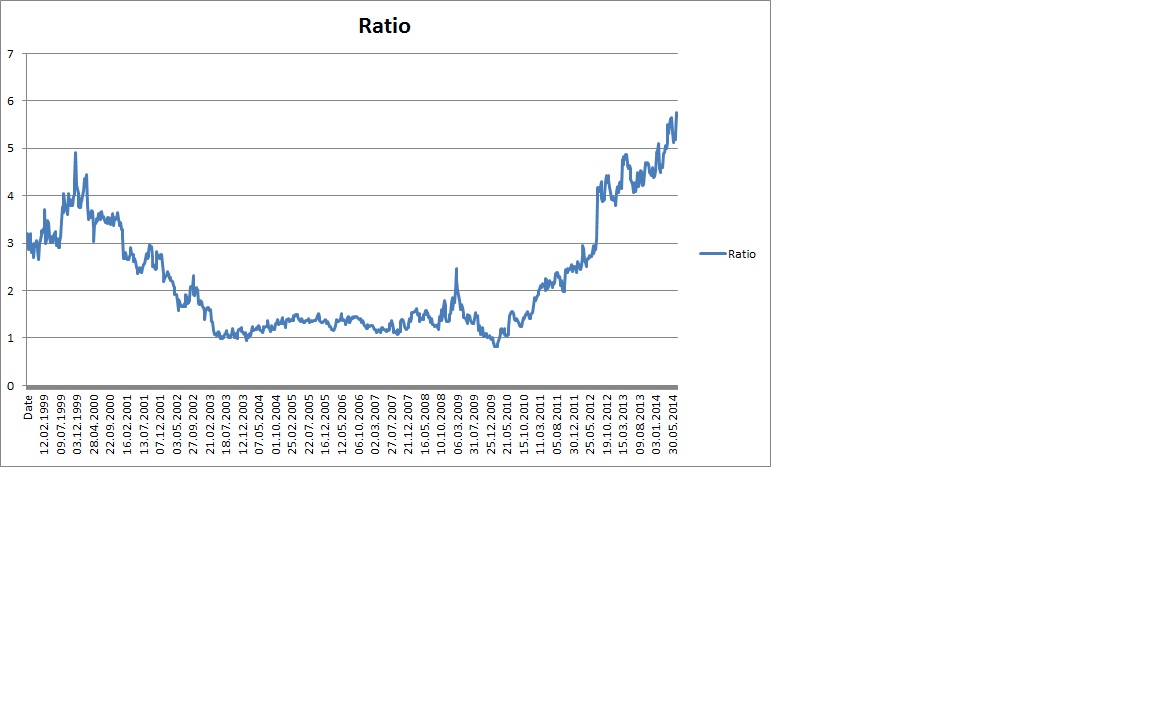
For me, Draeger was always a relative bet, assuming that the intrinsic value of the Genußscheine (10 times the Vorzuege) would at sometime close. I never believed that Draeger itself was a “great” company. Looking at the developement of the ratio (price Genußschein / Price Vorzuege) we can clearly see that currently we are in a territory which we haven’t seen for the last 15 years:

draeger upd 2014

At almost 6 times the Pref shares, the relative risk/return ratio is not as good as it was before. With almost 7%, the Draeger Genußschein is still with a margin my largest position. In order to reflect the somehow lower relative potential of this position, I will cut the position to a 5% stake going forward.

Some links

GMO’s very interesting Q2 letter. Their speculation about a massive M&A boom is quite realistic

Wexboy’s 6 month performance review

A list of 5 unknown but interesting books about investing

A great profile of Hedge Fund honcho Leon Cooperman

An interesting but very exotic stock analysis from WertArt (UK listed Indian private equity…..)

Finally, in German, the second quarter report of ProfitlichSchmidlin Fonds. Especially the bond section is worth reading with a lot of interesting ideas.

Book review: “The Go Go years” – John Brooks

“The Go Go years” was how the late 1960ties were called at Wall Street. Although covering a time almost 50 years ago and written in the early 1970ties, this book is still a very good read as a lot of things that happened and a lot of things invented in the 1960ties still influence capital markets.

Among the innovations of the 1960ties were Mutual funds, conglomerates, earnings per share games via acquisitions, financial “innovation” like convertibles, letter stocks etc. etc. Especially the interaction between the new and red-hot Mutual funds and the acquisition hungry conglomerates pushed up stock market levels significantly over the 60ties.

The book gives a very good account especially how stocks were actually traded back then. Paper certificates had to e moved from seller to buyer and due to the increasing trading levels, a lot of transactions wer not correctly settled. Also woman were rarely seen in “real” finance jobs and were denied entry to most of the restaurants around Wall street.

The book contains also some amusing side stories about the beginning the Hippy movement, for instance that many of the back office guys were pretty much on drugs all the time which further added to the back office problems.

There is also good coverage on some of the most “notorious” conglomerates and early “Raiders” like Saul Steinberg, who, finally unsuccessfully tried to take over one of the biggest banks back then, Chemical Bank.

Although this isn’t mentioned in the book we all know that Warren Buffett closed his partnership in 1969 because he didn’t find anything interesting to invest in, but he was definitely not a houshold name back then. Funnily enough, Buffet’s Berkshire itself became the most succesful conglomerate ever over the next 50 years, although with a clearly more conserative structure then the “Go go” guys.

The whole story culminates in the “almost fail”of two of the biggest brokerage houses at that time, Goodbody and Du Pont in the early 1970ties. Du Pont was actually rescued by Ross Perot, founder of EDS and future billionaire presidential candidate.

This part of story almost reads like a 1:1 copy to Bear Stearns and Lehman Brothers 40 years later. Too much leverage, aggressive deals etc. Interestingly, the partnership structures did not prevent those problems as “partners” could take out their capital with a 30 day notice. of course those institutions “had to be saved”, a 1970ties version of to big to fail. Goodbody by the way was “saved” by Merril Lynch, which as we all know now had to be saved 40 years later by Bank of America. Other than now, no tax payer money was involved though.

There is a pretty good Wikipedia entry about the author John Brooks, a “New Yorker” staff writer who has written a couple of other interesting sounding books.

Overall I found this a very very good book and a “must read” for anyone interested in the history of Wall Street and the stock markets in general.

Some lessons to be learned are from my point of view:

1. On Wall Street and in finance generally, “innovation” very often means gains for the guys who run them and big risks and big pain in the long-term for investors

2. Brokerage houses and banks are naturally unstable institutions. Even the best regulation will not make them stable businesses

3. Investors forget quickly, only 10-15 years after that episode, the junk bond mania broke out. After 10-15 years it seems one can run the same schemes again. The current startup, social media etc “craze” is taking place 15 years after the first dot.com boom

4. Whenever the “plumbing” of the market is not working, it gets dangerous. Something similar was happening in 2007/2008 with unsettled CDS contracts

5. Business stratgies relying on ongoing and ever biiger acquisitions are risky and most often do not end well (Valleant anyone ?)

The author closes the book with the expectation that Wall Street will never be the same. To a certain extent he was right as future events were not “The same” but the basic patterns were very similar. Boom bust, speculation, greed, fraud belong to Wall Street, only their appearance changes slightly.

P.S.: The “go go” years were called so because quite often, people would stand before stock tickers in brokerage offices and shouting “Stock x – go go go stock x”….

Fiat Merger Cash Exit rights – Short term “high yield deposit” ?

Thanks to the reader who sent me this idea. Althought the stock price has risen in between, I still think it is interesting to look at this country specific “special situation”.

The Italian stock market is always worth a look as things are definitely different south of the Alps. I have documented a couple of cass where minority shareholders were the victims, but sometimes, Italian stockmarket laws actually seem to protect minority shareholders.

The FIAT merger

FIAT Spa is currently in the process to merge its Italian operations with a Dutch Holding company which holds Fiat’s interest in Chrysler.

In order to do so, FIAT is holding an Extraordinary shareholder meeting on August 1th. Now comes the interesting part: Under Italian law, any FIAT shareholder can vote against the merger (or not vote for it) and is then entitled for a so called “cash exit right”, which gives him the right to sell the shares back to the company. Normally, this compensation is a 6 month average, but in Fiat’s case the cash compensation has been fixed at 7.727 EUR per share.

Details about the cash exit rights can be found in the official prospectus.

Q: Are Fiat shareholders entitled to exercise dissenters’, appraisal, cash exit or similar rights?
A: Under Italian law, Fiat shareholders are entitled to cash exit rights because, as a result of the Merger, the
registered office of the surviving company in the Merger, FCA, will be outside of Italy, Fiat ordinary shares will
be delisted from the MTA, and FCA will be governed by the laws of a country other than Italy. Cash exit rights
may be exercised by Fiat shareholders that did not concur in the approval of the merger plan at the extraordinary
general meeting. The exercise of such cash exit rights will be effective subject to completion of the Merger. A
Fiat shareholder that has voted shares in favor of the Merger may not exercise any cash exit right in relation to
those shares. A Fiat shareholder that properly exercises cash exit rights will be entitled to receive an amount of
cash equal to the average closing price per Fiat ordinary share for the six-month period prior to the publication of
the notice of call of the extraordinary general meeting which is equal to €7.727 per share. If the aggregate
amount of cash to be paid to Fiat shareholders in connection with the exercise by such shareholders of cash exit
rights under Italian law and to creditors pursuant to creditor opposition rights proceedings under Italian law and
Dutch law, respectively, exceeds €500 million, a condition to closing of the Merger will not be satisfied.

Exercise period Timeline:

This is from the prospectus:

In accordance with Article 2437-bis of the ICC, Qualifying Shareholders may exercise their cash exit rights, in relation to some or all of their shares, by sending notice via registered mail to the registered offices of FIAT no later than 15 days following registration with the Companies’ Register of Turin of the minutes of the FIAT Extraordinary Meeting of Shareholders. Notice of the registration will be published in the daily newspaper La Stampa and on the FIAT corporate website.

If I read this correctly, this will at the earliest start with the day of the annual shareholder’s meeting, if they manage to register on the very same day. I asume that it is then 15 calender days. The money will be received on the “effective date of the merger” (A-15), which after reading the

The 500 mn EUR threshold

If more than 500 mn EUR “cash exit rights” are exercised, the merger will not take place and the cash exit rights are not valid. How big is the risk ? Fiat did the same structure with Fiat International and there, only 25 mn EUR rights were exerecised. In my opinion, FIAT will want to make this merger happen IN ANY CASE so I consider this as a very remote risk.

Stock chart

Last week, when I first looked at this, Fiat was still trading at around 7,35 EUR which would have meant a 5% upside (or 10% annualised) for this relatively riskless trade. At the current price of almost 7,60 EUR and considering transaction costs, it looks less compelling.

Nevertheless it is worth watching the FIAT stock in the next few days i there is a potential entry point if we see weakness in the overall market.

Summary:

Although at the moment, the Fiat Merger Cash Exit Rights do not look that interesting, in general this looks like an interesting short term “high yield” opportunity. I could imagine that also other Italian companies are trying this sort of cross border merger to escape onerous Italian provisions so it will be worth keeping an eye on similar situations.

« Older Entries Recent Entries »