Quick update KPN – Sold rights & stock

Today I sold, both the KPN Shares and the rights .

All in all, I got around 2,91 EUR (1.68 for the shares, 1.23 EUR for the rights) which results in a gain of ~ 11.5% before trading cost. Quite a nice outperformance against the AEX with ~ 3.5% in the same time period.

Nevertheless, this was clearly a “bumpy ride” as the chart for the rights shows:

The optimal timing would have been to buy on the second day of the trading period. I guess this was the result of the very short time period between announcement of the terms and the start of trading.

I heard that for instance US investors were completely taken by suprise and couldn’t actively trade the rights.

Main reason for selling was that I was not sure if I want to exercise the rights and I have some other, in my opinion better ideas in the pipeline. Also I am not really optimistic about KPN in the long term.

In general, those “deeply discounted rights issues” are interesting special situations for a short term trade but have to be handled with a lot of care and patience …

Edit:
Someone asked me why I don’t show annualized returns for my single portfolio stocks. In my opinion, annualized returns for single stocks are pretty meaningless. The KPN Trade would have been an annualised 280% but what does such a number say ? As my investment strategy includes a lot of “sleeping” stocks, I think that showing annualized returns on single stock level do not provide any benefit at least not for me. Much more interesting than an annualized return per stock is the potential gap between the current price and intrinsic value.

Voodoo IFRS Accounting: Lufthansa AG pension liabilities Q1 2013

Lufthansa AG, the large German airline company has a serious problem with pension liabilities. Some people even call it the “flying pension plan”. In the past, under IFRS, they could defer the recognition of higher pension liabilities over a very long-term via the so-called “corridor” method.

However in 2013, IFRS 19 changed this. Now, pension liabilities have to be fully recognized in equity via OCI (other comprehensive income).

This is what Lufthansa wrote in their 2012 annual report:

Change in accounting standard IAS 19 will lead to higher pension provisions
The Group runs defined benefit pension plans for staff in Germany and abroad, which are funded by external plan assets and by pension provisions for obligations in excess of these assets.
In the context of these defined benefit pension plans, the amendments to the accounting standard IAS 19, Employee Benefits, applicable as of 1 January 2013, mean that actuarial gains and losses from the revaluation of pension obligations and the corresponding plan assets are recognised immediately and in full in equity, without effect on profit and loss. One important effect of this retroactive application of the standard
will be that the balance of actuarial losses previously carried off- balance-sheet will be offset against equity at one stroke as of
1 January 2013. After accounting for taxes, this will reduce Group equity by EUR 3.5bn. The change in the accounting standard does not result in higher pension payments, however, nor does it establish an obligation to make additional contributions to fund assets.

When I read their Q1 2013 report, I was however really puzzled:

On the very first page the show that the equity ratio remained relatively constant (15.4% against 17.7% at year end). Based on the information above (3.5 bn pension off-balance sheet liability) and 8 bn equity, the equity ratio should have been dropping by almost a half.

Further on, they write the following in the quarterly report:

The revised version of IAS 19 Employee Benefits (revised in 2011, IAS 19R), application of which has been mandatory from 1 January 2013, had a substantial influence on the presentation of the assets and financial position in this interim report.
The revision caused pension obligations and other provisions under partial retirement and similar programmes to go up by a total of EUR 3.8bn as of 1 January 2013 compared with the financial statements for 2012.

On the same page the reiterate the almost unchanged equity:

Shareholders’ equity (including minority interests) fell by EUR 262m (– 5.4 per cent) to EUR 4.6bn as of the reporting date. The decline
is largely due to the negative after-tax result of EUR – 455m, offset by an increase of EUR 166m in neutral reserves from positive changes
in the market value of financial instruments. The equity ratio of 15.4 per cent was lower than at year-end 2012 (16.9 per cent).

So wtf happened ? How can you increase liabilities by 3.8 bn and equity remains unchanged ? Even if we look at my “beloved” OCI statement (page 23) we can see that OCI statement, we can see that OCI is in fact POSITIVE ?

Dark Side of IFRS Accounting: Restatements

Before it gets to exciting, let us introduce to an instrument from the “Dark side” of IFRS accounting: The so-called “Accounting Restatements”.

Definition:
An Accounting restatement means, that already “closed” accounting periods will be “opened up again” and the P/L will be retroactively changed. Usually this is done, when real errors (or fraud) are detected and the auditors force the restatements. In some special cases however, very creative CFOs use this tool to shift losses into the past and bury them in the hard to read (and understand) part of the accounts.

How to detect ?
Well you can either try to understand the “change in equity” portion of the balance sheet. Which is quite hard sometimes. Or you perform a quite simple check:

Just look at the equity of the last report (here annual report 2012) against the value of the current report. And surprise surprise:

In the annual report 2012 (which was only issued a few weeks ago), equity for 31.12.2012 was stated at 8.2 bn EUR. In the quarterly report issued now, equity for 31.12.2012 now suddenly has shrinked by 3.4 bn to 4.8 bn.

So just to summarize this:
Between issuing the annual report 2012 in Mid mArch and the quarterly report which was issued in the beginning of May, Lufthansa decided to change their accounts retroactively for a fact which was already well known since quite a long time.

This is not illegal,but in my opinion they could have explained that better that they used a restatement to book this retroactively.

Why did they do it ?
The reason is relatively clear in my opinion: In order to not put a spotlight on the fact that now almost 50% of the equity have disappeared. The strategy so far looks quite succesful:

The stock even outperformed the DAX.

What to do ?

One interpretation of this is that the capital market is so efficient and this has all been priced in already. The other interpretation would be that Lufthansa is trying to bury bad news into past results and this opens up a nice short selling opportunity if reality finally catches up with investors.

I tend two favour the second interpretation.

For a cpaital intensive busienss like airlines with no real moats, the book value (or replacement value) is not a bad proxy for the value of an airline. Lufthansa now “jumped” from around 0.8 times book to 1.6 times book.

Name P/B
DEUTSCHE LUFTHANSA-REG 1.61
GARUDA INDONESIA PERSERO TBK 1.31
INTL CONSOLIDATED AIRLINE-DI 1.31
MALAYSIAN AIRLINE SYSTEM BHD 1.25
SINGAPORE AIRLINES LTD 1.01
AEROFLOT-RUSSIAN AIRLINES 1.00
THAI AIRWAYS INTERNATIONAL 0.97
CATHAY PACIFIC AIRWAYS 0.96
AIR NEW ZEALAND LTD 0.93
AER LINGUS GROUP PLC 0.89
QANTAS AIRWAYS LTD 0.68
AIR FRANCE-KLM 0.63
SAS AB 0.44
DELTA AIR LINES INC na
 
Avg 1.00

Funny enough, the average of those 13 airline companies for P/B is exactly 1.0 but that is a coincidence. On the other hand, I don’t see a compelling reason why Lufthansa should trade signifcantly above book value.

Going forward, Lufthansa will be on my “short watch list”. I am tempted to bet that most analysts didn’t really understand what Lufthansa has done and P/B will most likely go towards the industry average.
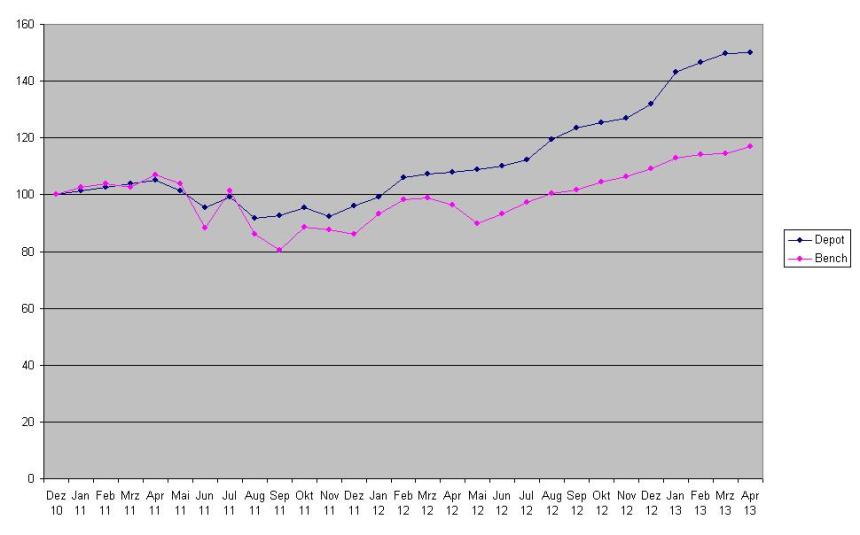
Performance April 2013 & comment: “All time highs”

Performance April 2013:

Performance for the month April was +0.5% against +2.1%, an underperformance of -1.6% vs. the Benchmark (50% Eurostoxx, 30% Dax, 20% Dax). YTD, the portfolio is up 14.0% against 4.9% for the Benchmark.

For some reason, the underperformance in April reassures me that my strategy is working. I would assume in “up months” a weaker performance than the benchmark, in down months a significant better relative performance. However, in the first 3 months of 2013, the portfolio strongly outperformed although we had seen 3 “up months” in a row and I ran at ~15% net cash in the portfolio. Despite the nice developement, one has to ask if there isn’t a lot of “hidden beta” in the portfolio.

However the current month shows that the stocks do have “their own life” versus the benchmark. For instance Tonnellerie, which acted like a high beta stock in the beginning of the year came down to earth with a -17,7% performance in April. As a reader asked me for it, here is the graphical performance since Inception:

Portfolio as of 30.04.2013:

Name Weight Perf. Incl. Div
Hornbach Baumarkt 3.8% 2.8%
AS Creation Tapeten 4.7% 55.2%
Tonnellerie Frere Paris 5.3% 62.2%
Vetropack 4.4% 7.4%
Installux 2.8% 8.7%
Poujoulat 0.9% 6.4%
Dart Group 4.1% 124.0%
Cranswick 5.4% 26.6%
April SA 3.3% 4.2%
SOL Spa 2.7% 25.4%
Gronlandsbanken 2.2% 23.2%
G. Perrier 3.0% 4.8%
     
     
KAS Bank NV 4.7% 23.0%
BUZZI UNICEM SPA-RSP 5.2% 24.8%
SIAS 5.4% 48.6%
Bouygues 2.6% 10.2%
Drägerwerk Genüsse D 10.1% 193.0%
IVG Wandler 4.1% -17.7%
DEPFA LT2 2015 2.7% 58.8%
HT1 Funding 4.7% 56.4%
EMAK SPA 4.3% 31.2%
Rhoen Klinikum 2.2% 8.4%
KPN shares 0.6% 0.2%
KPN rights 0.4% -1.0%
     
Short: Focus Media Group -0.9% -8.5%
Short: Prada -1.0% -13.7%
Short Kabel Deutschland -1.0% -5.0%
Short Lyxor Cac40 -1.2% -11.7%
Short Ishares FTSE MIB -2.0% -10.3%
     
Terminverkauf CHF EUR 0.2% 6.4%
     
Cash 16.4%  


Value 42.5%  
Opportunity 47.0%  
Short+ Hedges -5.9%  
Cash 16.4%  
  100.0%

Major changes were: Increase in Perrier to now 3%, sale of Total Produce and WMF pref shares, increase in IVG convertible plus 1% KPN as a new share. For my portfolio, this was a very active month.

Comment: All time highs

A lot of newspaper articles are concerned with the current “all time highs”, both in the DAX and the S&P 500 as well as the Dow Jones. Many people argue that level is of very high significance, either as an upper boundary or support.

In my opinion this is one of the most prominent cases of “Anchoring”, a well documented behavioural finance bias. Yes, the Dax already 2 times bounced back from the 8000 point level, in 2000 and 2007 as this chart clearly shows:

However if you look at the composition of the DAX in those years one can quickly see that the Dax is a very different animal now than in the past.

Those are the Top 5 stocks now:

Weight
BASF SE 9.9%
Bayer AG 9.8%
Siemens AG 9.0%
SAP AG 8.1%
Allianz SE 7.6%

Compare this to the top 5 a mere 5 years ago on December 2007:

Weight
E.ON SE 10.1%
Siemens AG 9.9%
Allianz SE 8.4%
Daimler AG 8.2%
BASF SE 6.2%

Yes, 3 stocks are still in the Top 5 (Allianz, BASF and Siemens) but 2 out of 5 are new and the weights are significantly different.

Even if we compare the top 5 based on their P/Es, we can see that even those shares which remained in the top 5 trade at quite different P/Es:

PE 2007     PE 2013
E.ON SE 15.6   BASF SE 14.6
Siemens AG 26.3   Bayer AG 26.3
Allianz SE 7.5   Siemens AG 14.1
Daimler AG 23.3   SAP AG 25.4
BASF SE 12.4   Allianz SE 10.4

So what does that mean ?

In my opinion, the current absolute level of the DAX compared to the past is totally irrelevant. Any investment decision on such an arbitrary basis is a clear “anchoring bias”. Investment decisions should be made irrespective of index levels. If you find a cheap stock buy it, when a stock is too expensive, sell it. It doesn’t matter where the Index is compared to its past.

The Warren and Charlie Show

This year I fulfilled myself a long dream: I joined the pilgrimage to Omaha in order to listen to these 2 elderly Gentlemen

Ähhhh sorry,that was the wrong picture, I actually listened to those 2 Gentlemen

I guess you can easily find transcripts and quotes of the meeting in many places for instance here, or here.

So instead of doing this once again (and by the way a I did not take notes….), I will just make a few random observations:

1. I didn’t expect any “actionable investment ideas” and there were none

2. As a “first timer”, I found the event genuinely entertaining. They make a very good show. The movie was great and the 2 guys are really funny.

3. The questions from the audience were a lot better than in any other shareholder meeting I have been

4. Doug Kass as the evil short seller was relatively tame. He mostly asked about the obvious succession issue

5. In general, the meeting was a lot about succession, Buffet said many times “when I will be gone”

6. Buffet thinks there is no need to split the company. Berkshire’s “culture” will prevail.

7. However he indicated that Berkshire would be prepared to buy a lot of stock back at the right price

8. Sometimes the answers were a bit shallow. For instance when someone asked why Iscar is better than Sandvik (i.e. which moat), the answer was “better management” or when asked about the moat of IBM he talked about a pension problem. Buffet surely knows better but I guess he is not sharing everything with his shareholders.

9. The exhibition of the Berkshire companies looked liked a flea market to me. Maybe its my European taste but i found that they sold quite crappy products.

10. Buffet was slightly subdued about growth in America for the next few years (“New Normal” anyone ?)

11. Some Omaha restaurants behave like cafes at the St. Marcus place in Venice, Italy. One night we went to the “Chophouse“. “Unfortunately” the cheapest wine at 60 USD/bottle (!!!!) was not available any more, the second cheapest was already 100 USD …..additionally they tried to talk us into ordering magnum bottles at 295 USD … DON’T GO THERE.

The two Buffet quotes I wrote down were those:

Interest rates are to asset prices what gravity is to the apple. With such low interest rates there is not a lot of gravity for asset prices.

For many companies book value has almost no correlation to intrinsic value

Would I go there again ? I have to admit that for the shareholders meeting alone I am not sure. The whole trip is quite expensive and time consuming. However I had the privilege to attend a 2 day (invitation only) value investing conference just before Saturday in Omaha which was absolutely fantastic !!!

I met a lot of very nice people who to a large extent were very good or even outstanding value investors. Many ideas were shared and interesting discussions were made.

The whole package (conference + shareholder meeting) is definitely worth the trip.

What were my take aways ?

The “hard” take aways were:

and of course these:

And I might have some posts about some ideas which have been discussed soon……

The weekly IVG post – more info on hedge fund activity

Thanks to a reader, I got this piece of information:

23-Apr-13
19:04
IVG eases constraints to secondary buyers to open direct talks with distressed investors

Story:
German real estate group IVG Immobilien lifted restrictions for secondary buyers of its corporate loan facilities last week, two sources familiar with the situation said.

With distressed buyers rapidly moving into IVG’s bank debt, management decided to remove hurdles for alternative investors, who had so far been forced to sub participations. Around EUR 500m loans moved into the hands of hedge funds and other distressed investors in the past month.

“The company simply found out that a lot of its bank debt had changed hands and inevitably would need to deal with these people [hedge funds] in the next months,” the first source said. Under the loan documentation, secondary buysiders needed the company’s approval to become lenders of record. With restrictions in place, new buyers would have been left out of the negotiating table in the restructuring process and forced to act through the mediation of the bank which sold the debt piece at discount to the fund.

The Bonn-based group announced it would restructure its capital structure on 27 March taking a holistic approach to the workout of its capital structure. Negotiations will include senior lenders, convertible holders, hybrid holders, and shareholders as the company aims to reach an out-of-court agreement.

“As a distressed debt holder you would have had a seat only through the bank you had bought from,” the second source commented.

“For IVG is better to lift restrictions and talk straight to the distressed investors. The easing of the constraints could help broaden the buyside space and support the price of the loans going forward,” the first source noted.

Following the EUR 500m trades earlier in April, another EUR 200m debt piece has been shown to potential buyers since Thursday of last week, including a EUR 100m strip of syndicated loan 1 and a EUR 100m tranche of syndicated loan 2. The two pieces, issued in 2007 and 2009 respectively, both mature in September 2014 for a combined bullet repayment of EUR 2.11bn.

The 2007 syndicated loan 1 is currently indicated in the 81 area, while the 2009 syndicated loan 2 is seen at 91, the two sources and a trader said.

The two loans are secured against different assets, with the 2007 syn loan 1 looking undercollateralised and the 2009 syn loan 2 marginally overcollateralised at book value, the first source said.

“From this, you need to calculate what the recovery value is in terms of distressed scenario,” he added.

“I would still wait before going long on IVG bank debt,” a buysider commented. “We went private, but there’s very little clarity on asset coverage. Using some market comparable, I would feel comfortable buying into the syndicated loan 1 only below 70.”

Under the EUR 2.11bn of loans due in September 2014 and around EUR 740m of project financing loans and other facilities, sit EUR 400m 1.75% unsecured convertible notes due 2017 and EUR 400m 8% perpetual hybrid notes. Both bonds took a dip in the last few days.

Convertible notes tripped down around 20 points to the low 50s in the last 10 days as bondholders are increasingly seen at risk of full equitisation, the first source commented.

“In a windup situation, converts could end up out of the money,” the first source said.

Convert holders could exercise a put for redemption at par in March 2014 to get their money back before the senior facility is due in September. However, senior debt holders could notify the company they are not going to refinance the September facilities, which would mean IVG would not be a going concern anymore.

Perpetual notes are indicated in the mid 10s, down around seven points in the same period, the trader said.

While the company hired Rothschild and Freshfields Bruckhaus as financial and legal advisors respectively, the creditor classes have appointed no advisors yet.

by Luca Casiraghi

Source:
Debtwire

In my opinion, the most interesting pieces on that report are

a) the pricing points: 81% for the undercollateralized loan and 91% for the collateralized

For, this reinforces two of my arguments (but again, I am surely biased):

– those buyers do not apply huge haircuts to the collateral (if they pay 90% for the 110% collateralized loan)
– In my opnion, it does not make sense for a HF to buy the collateralized loan at 91% if you expect insolvency and a 2-3 year workout period. To me this looks more like the “molest the other banks” strategy.

b) interestingly, the funds bought in on a kind of “Non voting” basis. In the syndicated loan markets, usually one has direct members of the syndicate at the beginning. As there is always some trading going on, banks sometimes sell the loan on a “sub participating” basis to a third party. Without the approval of the lender, those third parties have no vote if something has to be changed with the covenants etc.

So the price paid for those first tranches includes a certain discount for the risk that for some reasons IVG would not grant those rights to the buyer. One can compare this to buying a pref share instead of a common share.

All in all, this kind of reassures me that the probability for a “hard default” at IVG is maybe a little bit lower than some market participants think.

BUT AGAIN THE DISCLAIMER: DO YOUR WON WORK. I CANNOT RECOMMEND BUYING IVG SECUTITIES TO ANYONE. THIS IS HIGHLY RISKY WITH AN UNCERTAIN OUTCOME

How to raise capital – Deutsche Bank edition

In a surprise move, yesterday after the close of the stock market, Deutsche Bank announced that the increase their capital by ~2.8 bn.

For this they used the possibility of selling up to 10% of new shares without granting rights to the old shareholders.

So this would be the perfect case for the “formula” I mentioned yesterday:

Equilibrium Price = (price pre-cap raising announcement x # shares + price cap raising x # shares) / total # shares

The closing price of Deutsch Bank was 33.60 EUR. The price for the new shares 32.90 EUR. Outstanding shares were 929 mn, new shares 90 mn.

So the “Equilibrium Price” should have been:

(33.60 * 929 + 32.90 * 90)/ 1019 = 33.53 EUR per share.

Reality check: The stock actually opened around 33.50 but is now up +7.5% at ~35.40 EUR.

Learning experience:

The stock market is full of surprises. For some reason, the capital market considers it as extremely positive that Deutsche Bank increases its share count by 10%. I don’t know why.

And: Don’t rely on formulas…….

Bad research KPN edition (and why my readers are a lot smarter than professional analysts)

This is “research” directly from Bloomberg:

KPN NA: 2.74 TARGET: 2.20-2.40
April 25, 2013
We recommend shorting KPN on the share issue announcement. The equilibrium price is Eur 2.04/share and the stock price should trend toward this level in the near future.
Equilibrium Price = (price pre-cap raising announcement x # shares + price cap raising x # shares) / total # shares.
The shares were trading at around 4.0 pre-announcement and there were 1.431 bn shares outs.
The company is issuing 2.84bn shares at 1.06. This works out 2.04/share. Let’s imagine that thanks to the cap raising the
fundamentals are slightly better now than they were before, and we set our target at 2.20-2.40, or 10-20% lower than the current price. The stock should be sold/shorted.

Let’s look at their “formula”:

Equilibrium Price = (price pre-cap raising announcement x # shares + price cap raising x # shares) / total # shares

“Wow, they are professionals and have a formula, this must be right” was my first thought and I briefly thought that I have made a mistake. Although I had a nagging feeling that the formula (or the application of it) was not right.

Enter readers JM and Martin in the comments of the last KPN post:

26. April 2013 um 09:57 | #8 Antwort | Zitat | Bearbeiten
ok…I join the game. When the capital increase was announced the share price was Euro 3,1…so 3,1+1,06+1,06/3 = 1,74. If the dust settles this share price is my personal target…more I do not expect .

memyselfandi007
26. April 2013 um 10:35 | #9 Antwort | Zitat | Bearbeiten
The day BEFORE the capital increase was announced, the stock price was 4.10 EUR.

Martin
26. April 2013 um 10:55 | #10 Zitat | Bearbeiten
(4.10+1.06+1.06)/3=2,073
price today 1,56
discount 24,7%
As there were cost for KPN real economic discount is somewhat lower.

Martin and JM (by the way, thank you for your many helpful comments) are using the very same formula, however with one big difference: They compare the result with the stock price AFTER the rights have been split of.

So the question is: Who is right ? The “professional” reasearch on Bloomberg or the comments on my amateur blog ?

Well, if you are a KPN shareholder before and KPN would sell the new shares directly to new shareholders at 1.03 EUR per share, then of course the old shareholders would be massively diluted.

In reality however, no one is able to by the shares directly at 1.03. You can only access those cheap new shares by buying the subscription rights which have been giving to the old shareholders as compensation for the dilution.

So the big mistake made by the “professional” analyst was that he somehow forgot to account for the subscription right. as the subscription right was worth 1 EUR pr share, suddenly an overvalued share according to the “professional” is an undervalued share.

How can a “professional” be so stupid ?

My guess is that the “analyst” mixed u a rights issue with an issue of shares without rights. Companies usually can issue a certain amount of shares (usually max. 10%) directly to new shareholders without any rights to old shareholders.

In those cases, the announcement is usually made shortly before the trading day starts and then the formula above is applied to the price the day before and the price for the new shares.

Nevertheless it is really embarrassing for any institution that such a mistake slipped through and this report gets actually published on Bloomberg

Applying the formula to a rights issue

The “formula” rests on 3 critical assumptions:

1) The price of the shares on the day before the announcement is exactly the right (and efficient) price. There was no information out there before about the capital increase

2) Nothing happened in between

3) the additional capital will not create any additional value

I think all three assumptions are quite difficult to hold for the KPN rights issue. Talk about the issue started already in September last year, so at the time of the announcement (Feb. 5th), the stock price reflected already a part of that.

Also, the time period between announcement and pricing of the issue is quite long with 6-7 weeks.

Summary:

It is amazing, how bad some of the “professional” research actually is. In that case the analyst used a formula without accounting for the subscription rights. However this also shows that in those situations, the price discovery might be not fully efficient.

I wouldn’t put too much faith into the “formula”, as the application towards rights issues really stretches the implied assumptions.

Book review: Antifragile – Nassim Taleb

In his third popular book (after “Fooled by Randomness” and “black Swan”), Taleb now introduces a new concept called “antifragilty”. As in the first two books, in his opinion on the big scale, the world is shaped by “black swans”, totally unpredictable events.

Something that gets hurt by those Black Swans is fragile. Someone/Something that is not hurt by Black Swans is robust. Antifragile finally is something/someone that gains from the chaos a Black Swan event is creating.

So far so good, however if one would have expected some implications for an investment strategy, one gets almost completely disappointed. At some points, financial markets are mentioned, but not very often.

Instead, the book is more a “Paleo” style nutrition and work out guide than a finance or investment book. Taleb shares his never ending wisdom with the readers, on topics like why the Greek philosophers were idiots (or not so smart as Taleb) to all kind of medical advice and why you shouldn’t eat oranges because the are much sweeter than 3000 years ago (hint: the only way is to eat the stuff a cave man would have had access to…).

From time to time he looks at two fictional characters called Nemo and Fat Tony. If we assume that Nemo is his alter ago, we know now at least that Taleb made a “low 2 digit million” amount of money when he bet against the financial crisis.

Don’t get me wrong, there is some good “common sense” wisdom in the book, for instance that one should not take medical studies to seriously, but in total I found the book pretty much a waste of time.

Maybe I am not intelligent enough to appreciate Taleb’s genius, but for a pure mortal like me the book looks like the attempt, to cash in on the same idea for the third time.

In the view passages about investing, Taleb promoted very vaguely a style he calls the “barbel” style: Invest most of your money in “safe” assets (whatever that is) and a small part in risky stuff with lots of optionality. Although he mentions that financial options is not what he means because they are mostly overpriced.

I think this kind of “advice” shows the major issue with Taleb: He is by heart a trader, not an investor. Otherwise he migth have mentioned that “Buffet style” long term compounding plus margin of safety is a much easier way to become “antifragile”. But that wouldn’t sell as many books and create invitations to speaker events and hobnobbing at the Davos Forums.

Summary:
Unless you are a big Taleb fan and you need his advice on how and what to eat and work out, don’t buy the book. Save your time and money for something more interesting.

KPN rights issue: Final terms

I have covered KPN as a potential “deeply discounted risghts issue” special situation in the past.

Today, KPN announced the final terms for their rights issue (bold marks mine):

2 for 1 rights issue of 2,838,732,182 new ordinary shares at an issue price of EUR 1.06 for each ordinary share
• Issue price represents a 35.1% discount to the theoretical ex-rights price, based on the closing price of KPN’s ordinary shares on NYSE Euronext in Amsterdam at 24 April 2013
AMX has committed to subscribe for the Rights pro rata to its current participation in the issued share capital (excluding treasury shares) of 29.77%
Record Date for Offering is set at 25 April 2013 at 5.40 pm CET
Exercise Period runs from 9.00 am CET on 26 April 2013 until 3.00 pm CET on 14 May 2013• Rump Offering (if any) is expected to take place on 15 May 2013

What I find very remarkable is that there is only a very short time period between announcement of the terms and the start of the trading of the rights. Basically they announced today and trading starts tomorrow.

For the portfolio, I will start with a 1% investment as a rather “short term” special situation based on current prices of around 2.61 EUR per share. Lets wait and see how that one works out.

« Older Entries Recent Entries »