Tag Archives: Berkshire

Hello Japan – A quick look at Berkshire’s new partner Tokio Marine

Background & Hello Japan

There was a lot of noise around Berkshire’s 10 bn participation in the Alphabet capital increase. However, at the Berkshire AGM, Greg Able mostly singled out the investment of Berkshire into Japanese Insurer Tokio Marine as a great investment.

He also mentioned explicitly that this was Ajit Jain’s idea. Many Berkshire Aficionados know of course that Ajit is behind the rise and success of Berkshires Insurance business.

So when Ajit is brokering a deal with Tokio Marine, I decided to have a first look into this company despite having never looked at a Japanese company more seriously.

Therefore “Hello Japan” for the first time on the blog.

Interestingly, I was not able to find any real write-ups on Substack, just a few very “light” ones mentioning the Berkshire partnership. The “Buffetologists” have ignored that one so far.

The Berkshire deal

The Berkshire Deal with Tokio Marine covers the following “legs” according to Tokio Marine’s webpage:

Strategic Investment: NICO acquired a 2.49% stake in Tokio Marine Holdings for approximately $1.8 billion, with options to increase its holding up to 9.9%. To my understanding, Tokio Marine sold Treasury shares to Berkshire.

Reinsurance Agreement: Berkshire entered a whole-account quota-share reinsurance arrangement, absorbing a portion of Tokio Marine’s globally diversified portfolio to help the Japanese insurer mitigate natural catastrophe and underwriting volatility.

M&A Collaboration: Both companies plan to collaborate on global M&A and strategic investment opportunities.

Technically, the investment is done by NICO (National Indemnity), not Berkshire. The third part is really interesting and unique. It will be interesting to see how this would look in practice.

Tokio Marine overview
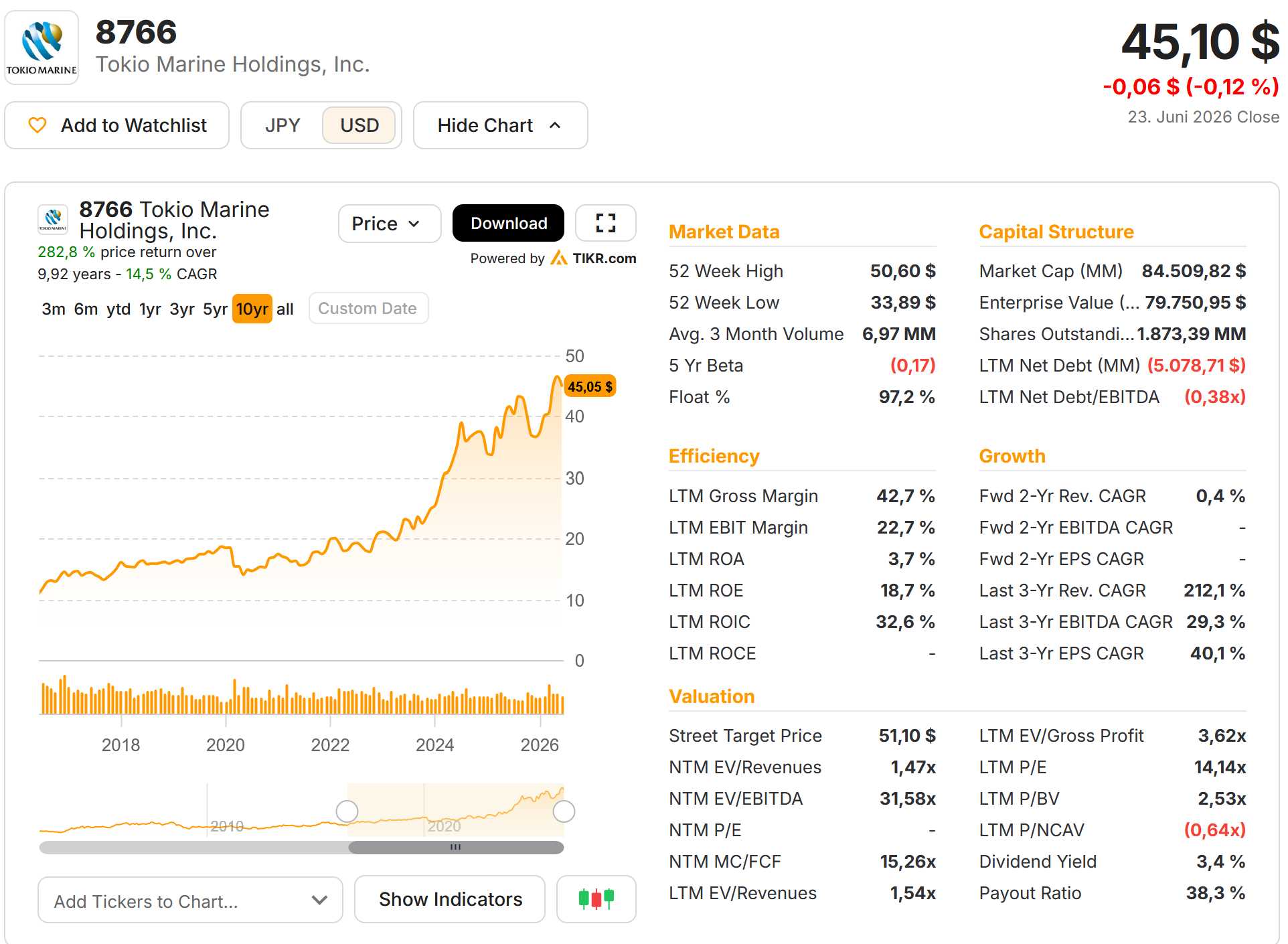
Looking at the TIKR overview, we can see that Tokio Marine has a market cap of around 85 bn USD, is quite profitable and trades at 14x LTM P/E. The 3% dividend yield is quite high for Japanese standards.

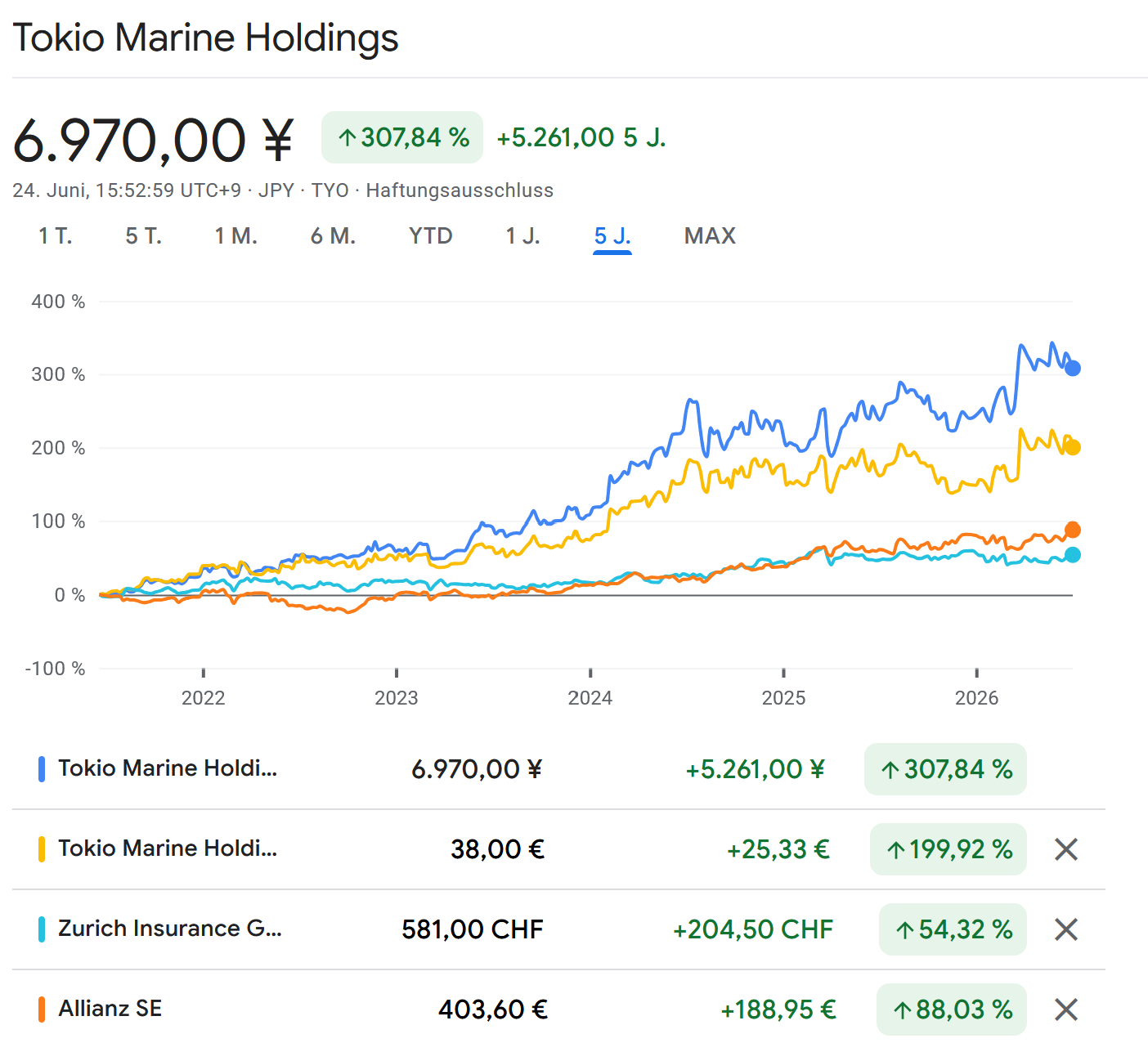
The share price has done very well in Yen. Although as this chart shows, part of the more recent performance is also due to the very weak yen. But the company still easily outperformed the European peers Zurich and Allianz by a wide margin over the past 5 years:
One interesting aspect is that Tokio Marine is widely owned. It was linked to the Mitsubishi Group (Kereitsu in Japanese) but they sold their remaining Mitsubishi shares in 2025.

They also stated a goal to sell all remaining listed equity investments by 2029.

The business

Tokio Marine has a surprisingly comprehensive Investor Presentation on its website.

One aspect that really surprised me is that their business seems to be by majority in the US (measured by “adjusted net income”) as this chart shows:
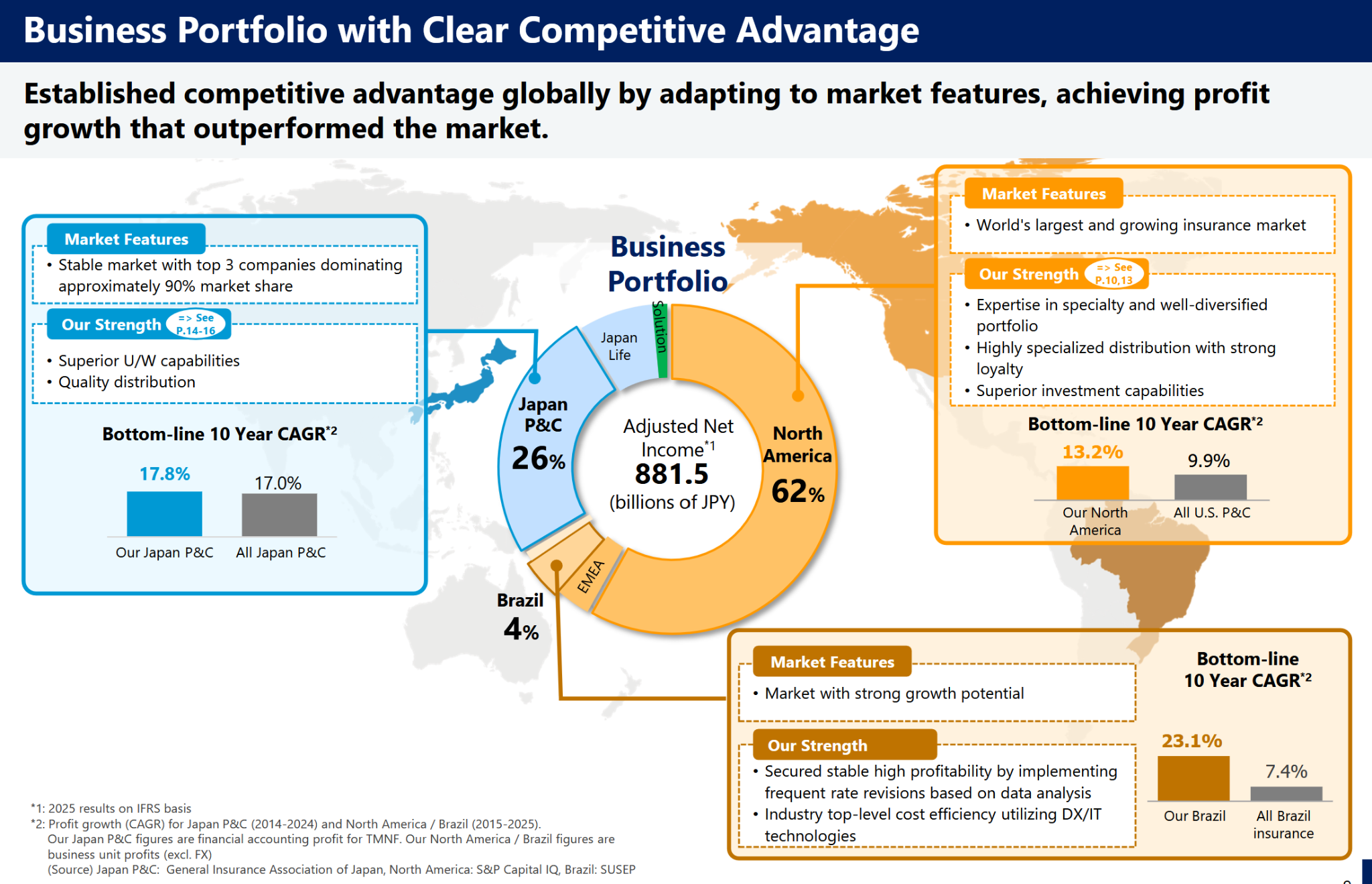
So essentially, Tokio MArine is a US Specialty Insurer with a Japanese business. Looking at the mixed track record of Japanese acquisitions in the US, this looks rather smart in comparison.

Business plan: 

Their plan is to double Net income by 2035:
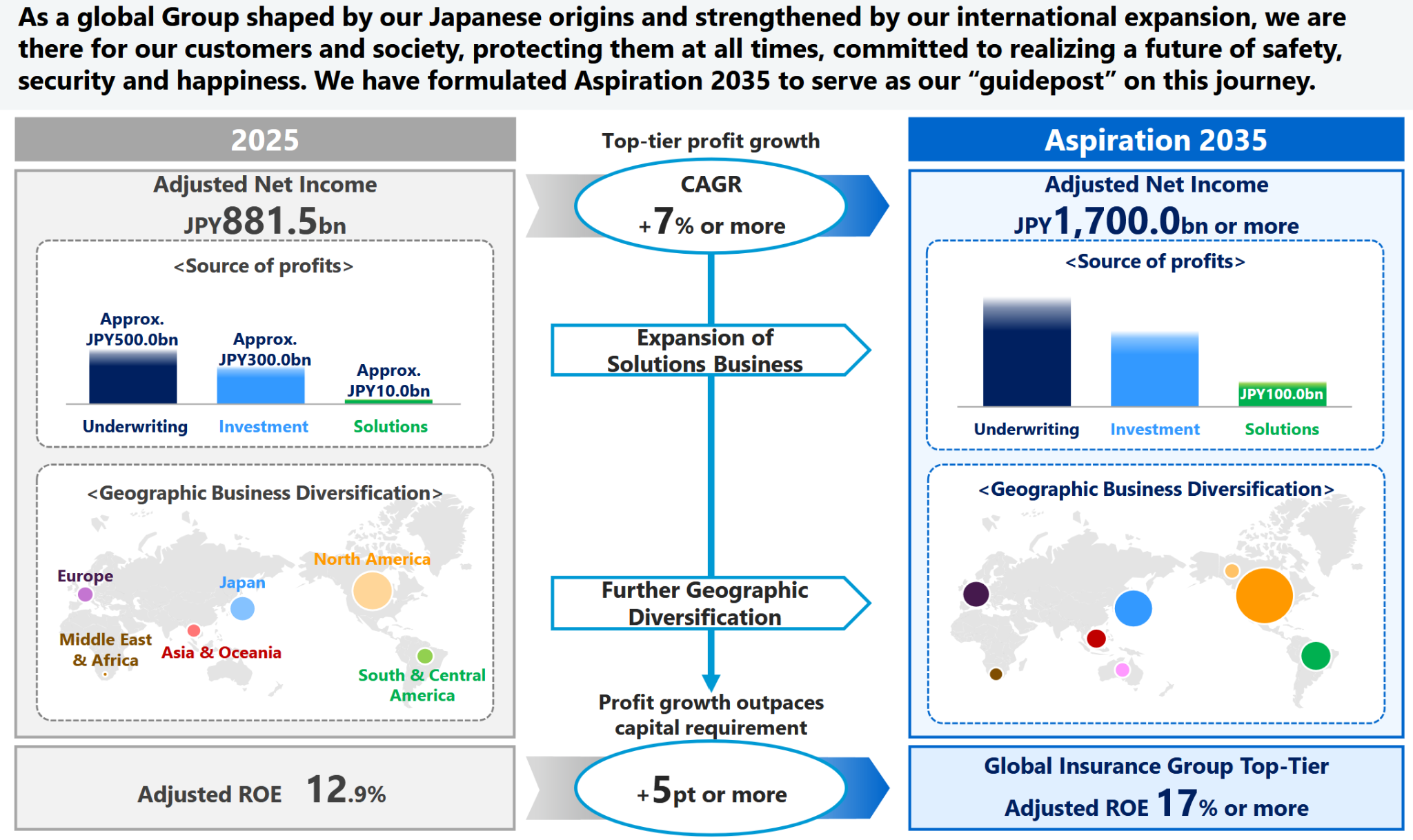
This is some more detail:
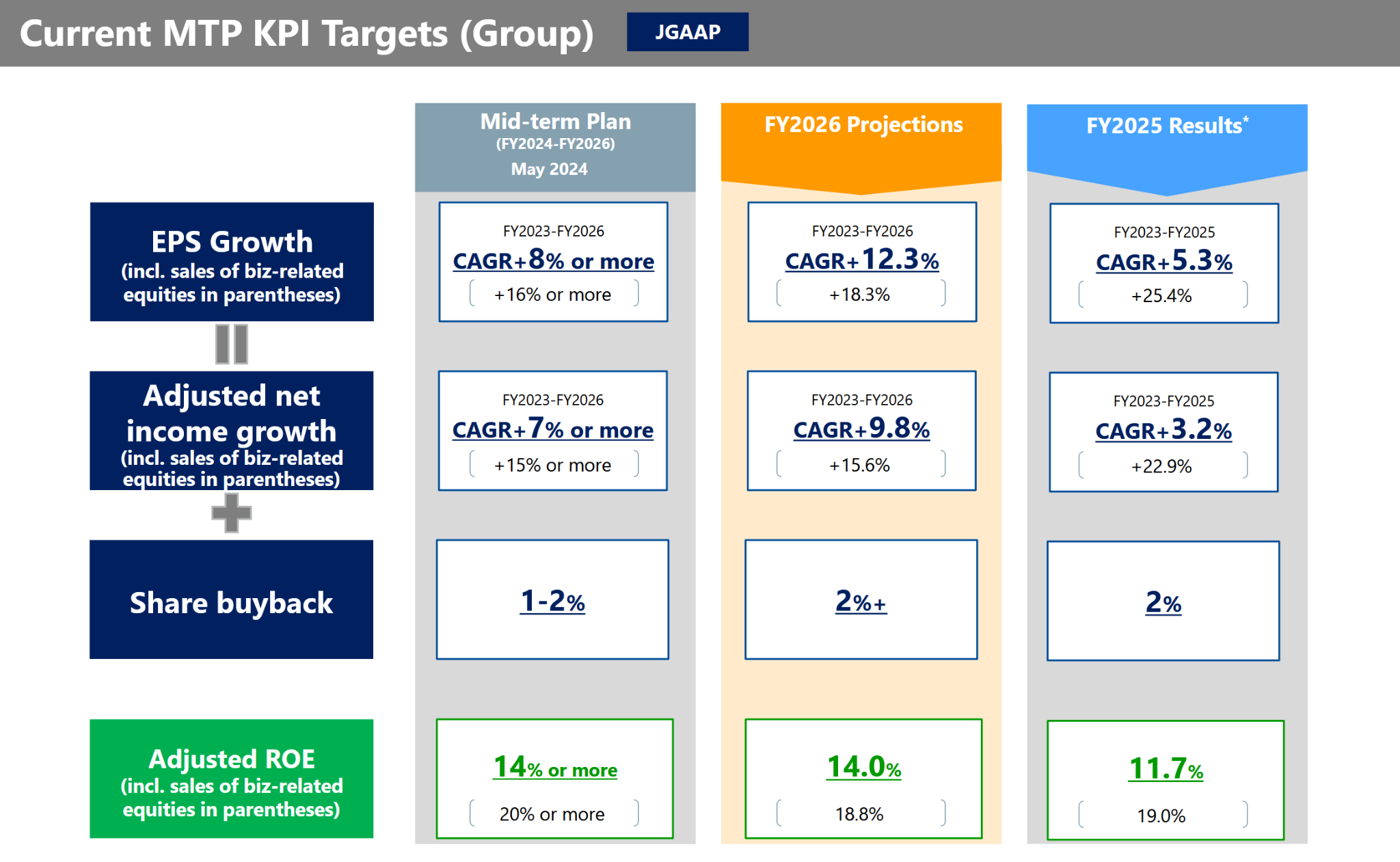
Of course, as insurance is not always predictable, this should be taken with a grain of salt, but putting out a 10 year plan is nevertheless a very positive aspect.

Switch from Japanese GAAP to IFRS

What makes things a little bit more complicated to analyze is the fact, that according to the presentation, Tokio Marine is switching from Japanese GAAP to IFRS in 2026.

They have this table which seems to indicate that IFRS profits are higher, but ROE lower, as net assets (Equity) is jumping after the switch:
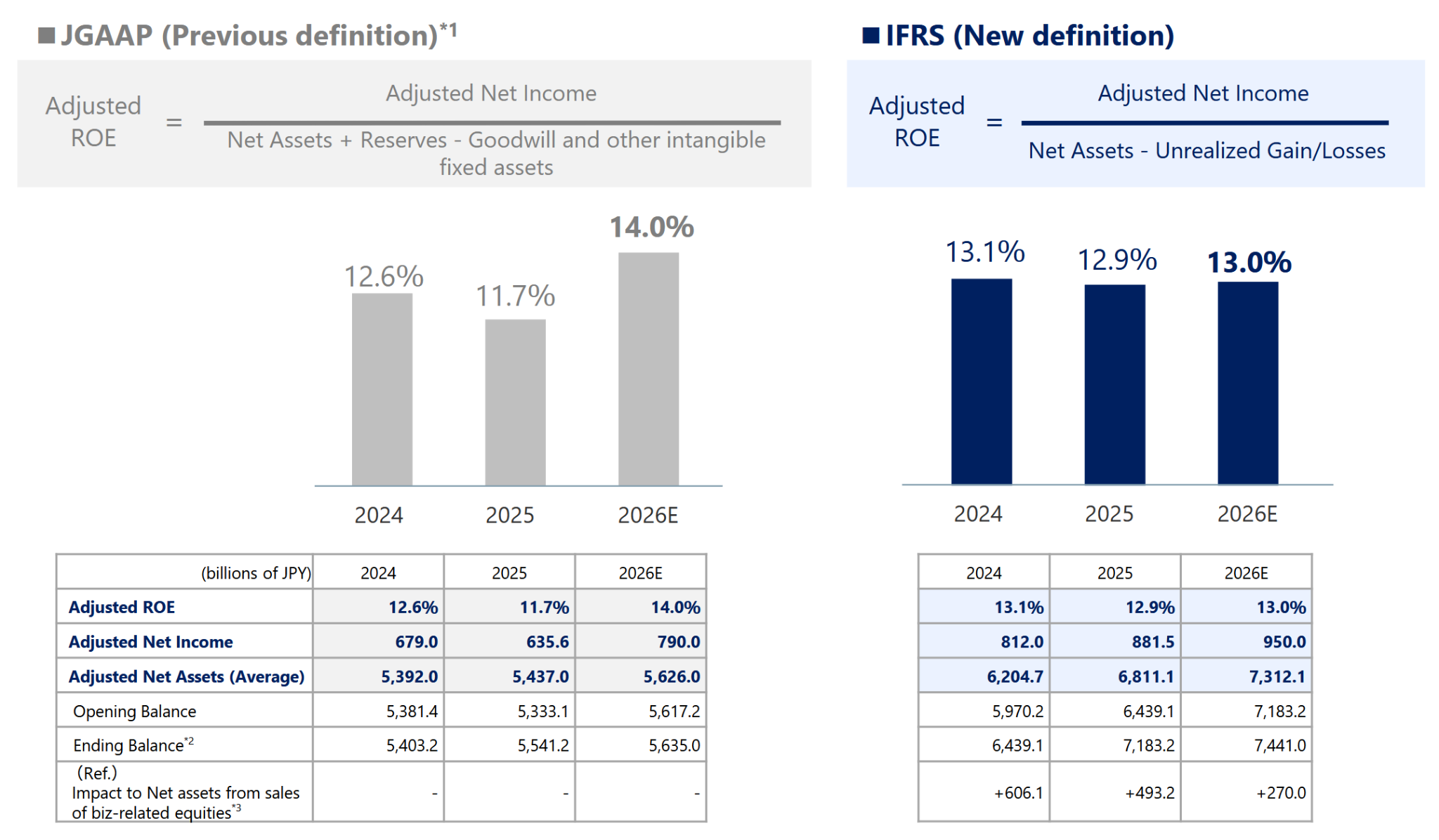
Overall; Tokio Marine estimates that profits on an adjusted basis will be higher and less volatile compared to JGAAP.

Buying an Engineering design company

One pretty unique transaction was their purchase of an Engineering design company in 2025. That’s pretty unique among insurers.
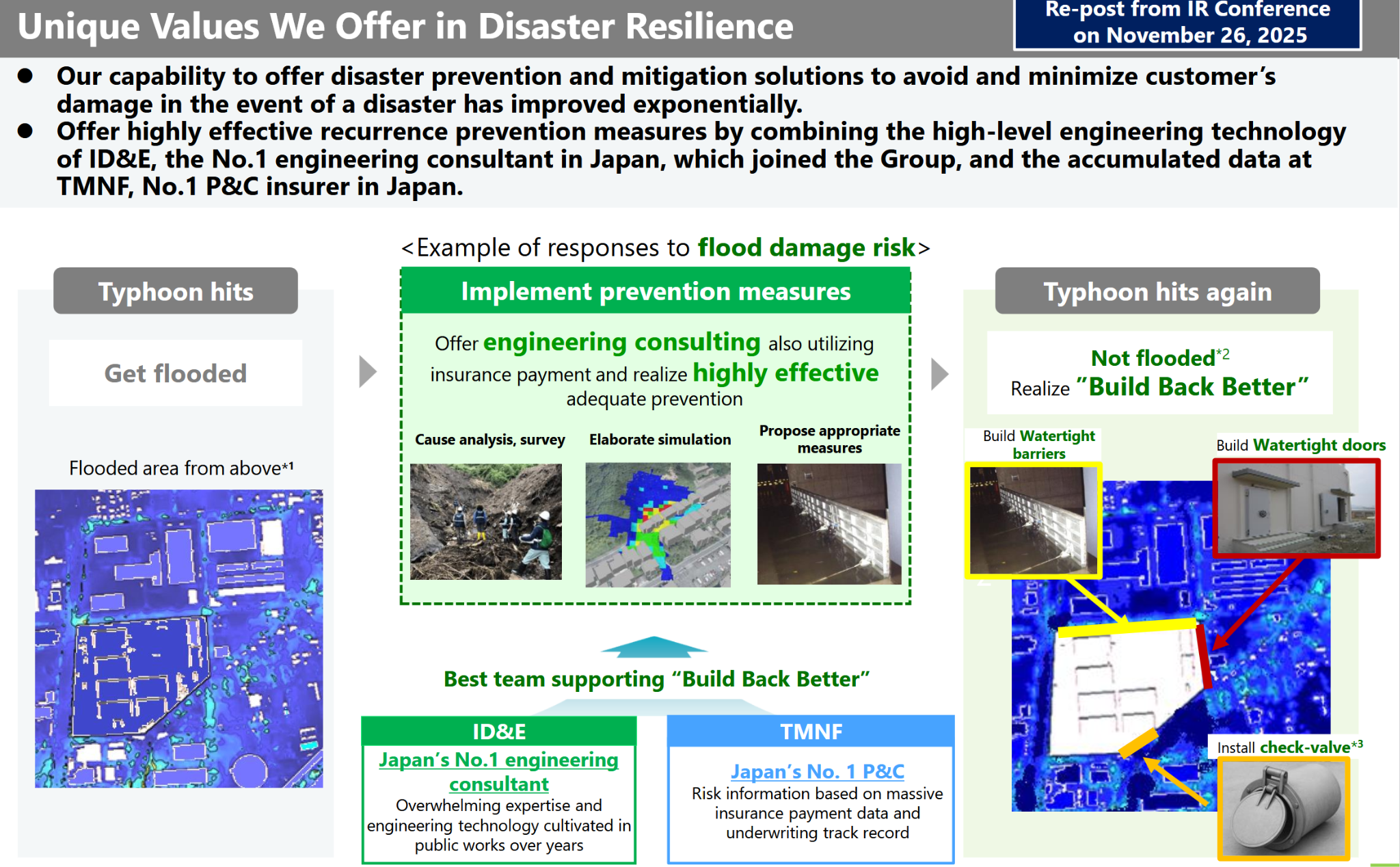
I am really curious if and how this will actually develop in the next 2-3 years.

Capital optimisation

One of the “dirty secrets” of Insurance stocks is that a significant part of the Big Insurer’s capital base consists of bonds, so called “hybrid bonds”. Those are significantly cheaper than equity. This is Tokio Marine’s slide that shows that they have made little use of that so far:
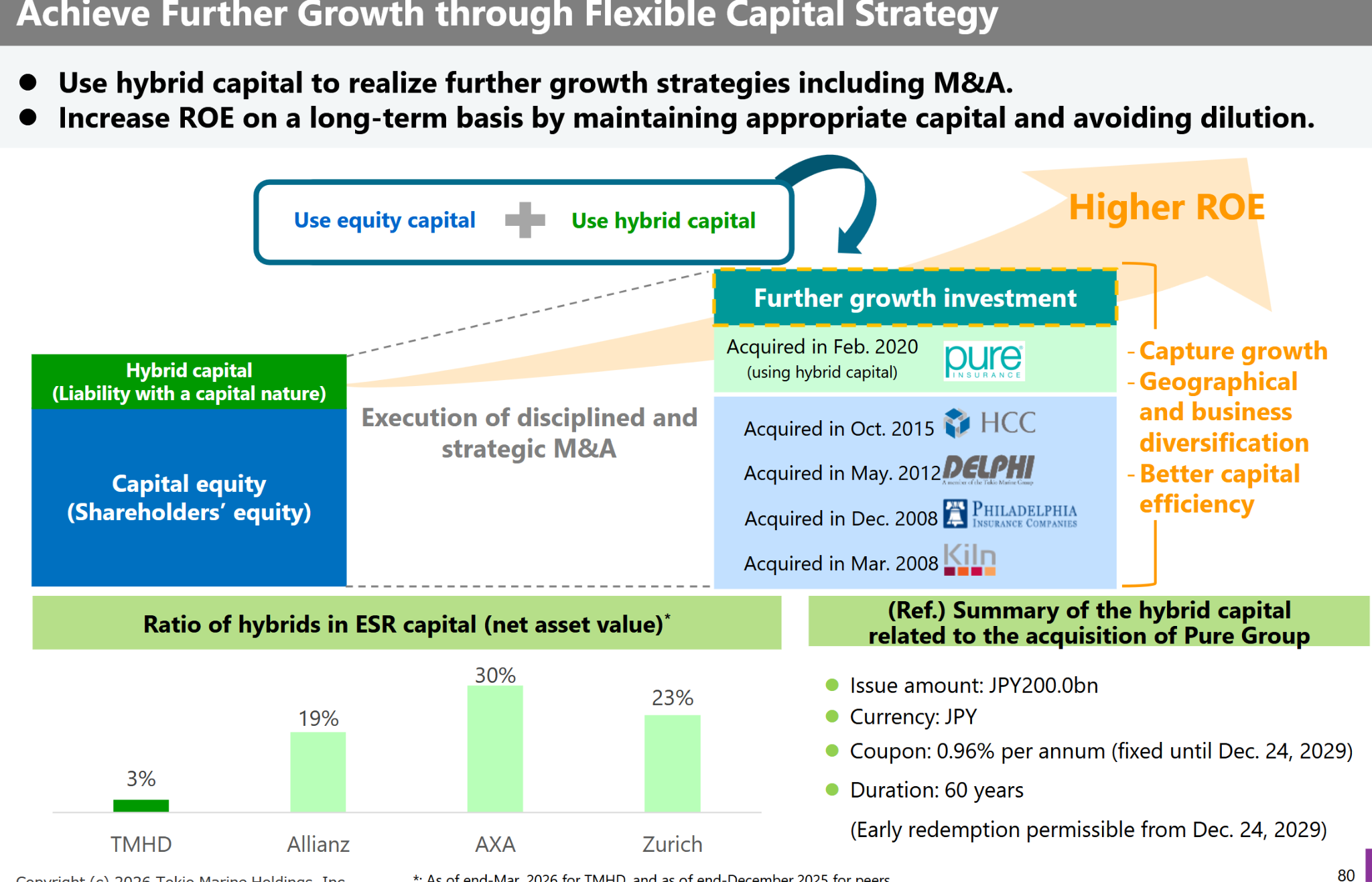
Just getting to their competitor’s levels gives them a lot of flexibility with regard to M&A and/or share buybacks.

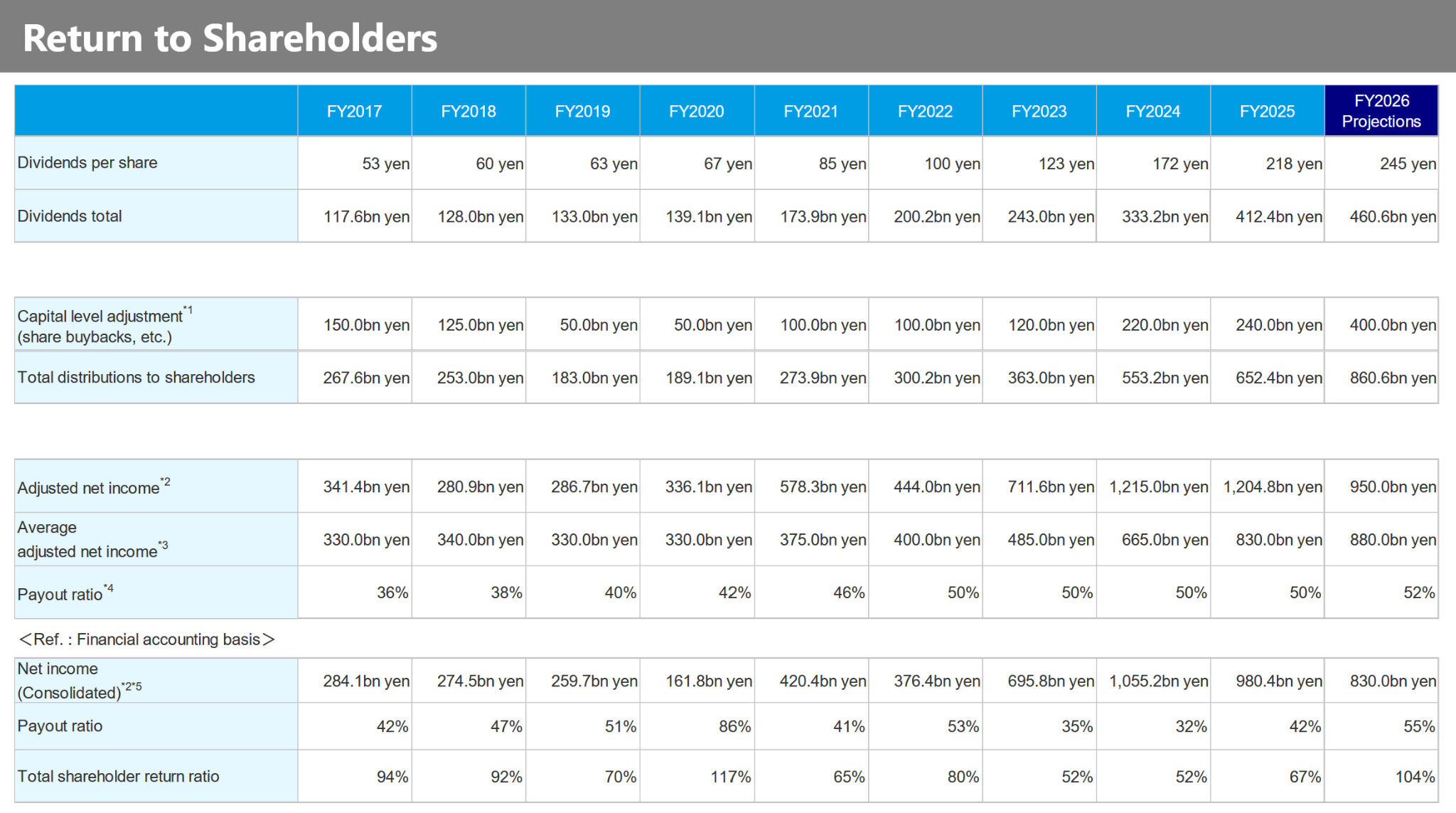
What’s interesting is clearly also how Tokio Marine has increased dividends and share buybacks over the past 10 years which can be seen in this table:
Return expectation:

A simplified return expectation for Tokio MArine would look like this:

Dividend yield + Buyback yield + growth rate

Taking Tokio Marine’s numbers this would result in:

3,1% + 1,5-2% + 7% = 11,6-12,1% p.a. without assuming any multiple expansion

This is not bad, but to be honest, also not super great.

Here is a quick Peer Group table which shows that Tokio Marine enjoys an absolute average valuation in my subjective Peer Group:
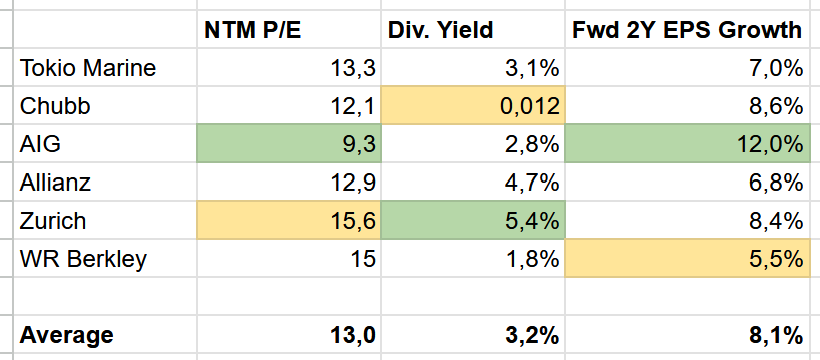
The question or upside would be if Tokio Marine is really an “above average” player, then maybe they would deserve an above average multiple. Based on their very conservative capital structure, they should (in theory) be able to grow more than competitors. 

To be honest, based on this quick check, I am not yet ready to give them an “above average” rating despite Ajit’s endorsement.

Pro’s/Con’s

As always, a quick summary of Pro’s and Con’s

  • Ajit generally knows what he is doing & Berkshire Cooperation
  • High capital flexibility
  • Good business mix
  • Shareholder friendly distribution/buyback strategy
  • Good share price /earnings momentum
  • Very good historic growth

+/- not super cheap, expected return below my hurdle rate
+/- Japan GAAP to IFRS transition
+/- complex business 

+/- USD/JPY risk (as EUR investor)

  • General Nat Cat exposure (famous Japanese Earthquake)

Summary:

Tokio Marine looks kind of interesting. Especially the fact that the majority of its profit comes form the US is a big surprise to me.

However, after the Berkshire announcement, the stock is not so cheap anymore.

So for the time being I will put it onto my “focus watch list” but not invest. I think it will be interesting to see how IFRS results will look like in 2026.

In any case, this shift from JGAAP to IFRS seems to be a very interesting item for Japanese insurers.

Quick check: John Deere (DE) – Great “cannibal” or cyclical trap ?

Looking at Berkshire’s portfolio is clealry a “must” for any value investor. Whenever they disclose a new stake it makes clearly a lot of sense to look at least briefly at what they are buying. Berkshire disclosed the John Deere position in late February this year. I assume this is a “Ted & Todd” stock. Looking at the track record of Berkshire’s public holdings, this is actually a good sign as Ted&Todd have beaten the “master” now several years in a row.

Looking quickly at Deere, it is not difficult to see some of the attractions:

+ relatively cheap (trailing P/E of 12,6, Stated EV/EBITDA of 5,5, EV EBIT 7)
+ organic growth, low Goodwill, good profitability in the past
+ good strategy /incentives in place
+ solid business model, significance of dealer network (quick repairs during harvest season…)
+ “Cannibal”, is massively buying back stocks

Especially the massive share buy backs are clearly a common theme for “Ted&Todd stocks”. Starting in 2014, Deer has reduced the sharecount constantly from around 495 mn shares to now ~344 mn shares.

However we can also see quickly a few “not so nice” things at Deere:

– pension /health liabilities (health – how to value ? 6bn uncovered. Very critical, healthcare sunk GM, not pension (EV multiples need to be adjusted for this)
– they do not cancel shares, held as “treasury”, why ?
– Financing business –> receivables & ROA most likely not “true”..
– lower sales but higher financing receivables ? Channel stuffing ?
– comprehensive income to net income volatility
– cyclical business. current profit margins still above historical average

Financing business

One of the most interesting aspects of John Deere is clearly the financing business. As other companies they offer financing, here mostly to dealers and not to the ultimate clients. A financing business is nothing else than an “in-house bank”, sharing much more characteristics with a financial than a corporate business, for instance requirement of continuous capital market access, default risk etc.

What I found especially interesting is the following: looking at Bloomberg, they already strip out automatically all the debt from the financing business when they show EV multiples. This could be OK if the debt is fully non-recourse however I am not so sure with Deere. Although they not explicitly guarantee the debt, there seems to be some “net worth maintenance” agreement in place which acts as a defacto guarantee for the debt.

An additional important point is the following: Deere shows very good profitability on capital in its “core” business. However, this is partly due to the fact that they show almost no receivables in the core segment. the receivables are indirectly shown in the financing business. To have the “true” ROIC or ROCE, one would need to add back several months of receivables to the core segment in my opinion.

Cyclical aspect: Corn prices

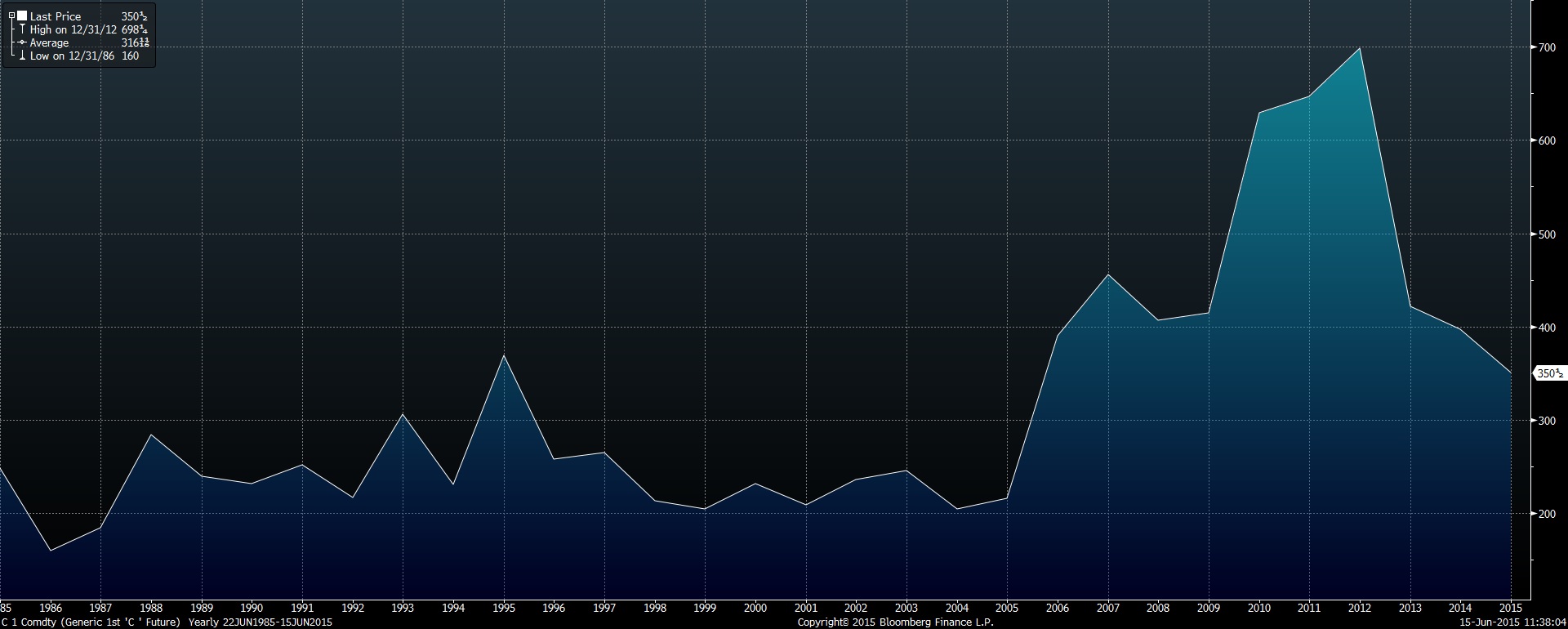
This is a 35 year chart of annual corn prices:

corn annual

We can clearly see that corn prices went up dramatically in around 2006 but are dropping since 2013 back to their historical levels. Demand for farm equipment is pretty easy to explain: If you make a lot of money on your harvest, you have money to spent for a new tractor (with a small time lag).

This is the 17 year history of Deere’s net margins:

Net margin
31.12.1998 7,52%
31.12.1999 2,08%
29.12.2000 3,76%
31.12.2001 -0,49%
31.12.2002 2,32%
31.12.2003 4,17%
31.12.2004 7,04%
30.12.2005 6,89%
29.12.2006 7,82%
31.12.2007 7,68%
31.12.2008 7,32%
31.12.2009 3,78%
31.12.2010 7,17%
30.12.2011 8,75%
31.12.2012 8,48%
31.12.2013 9,36%
31.12.2014 8,77%
Avg total 6,02%
Avg 2006-2014 7,68%
Avg. 1998-2005 4,16%

So it is quite interesting to see, that in the 7 years before the “price explosion” of corn, margins were quite volatile and around 4,2% on average. In the last 9 years however, the average jumped to 7,7% with 2014 being still above that “high price period” average.

Clearly, Deere doesn’t only sell to corn farmers, but many other agricultural prices have faced similar declines.

To be honest: I do not know enough if Deer can maybe keep the high margins they are enjoying currently, but to me at least the risk of margin mean reversion is pretty high for such a cyclical business.
Even if we assume mean reversion only to the overall average of ~6%, this would mean around 6 USD profit per share which seems to be currently also the analyst consensus.

Summary:

For me, despite a lot of positive aspects, John Deere is not an attractive investment at the moment. Despite being well run, the business is cyclical and has profited from high crop prices in the past. The balance sheet is not as clean as I like it and the valuation is not that cheap if we factor in pensions and the financing arm. Clearly the stock looks relatively cheap to other US stocks but the risks are significant. Maybe there is more if one diggs deeper (network moats via dealers etc.) but for the time being I will look at other stuff. At an estimated 2015 P/E of 16-17, there are many opportunities which look relatively speaking more attractive and where I can maybe gain a better “informational advantage” than for such a widely researched stock.

Edit: By the way, if someone has a view on the moat / brand value of John Deere I would be highly interested……

Apple and the value of paying a dividend

Yesterday, the most important news was the fact that Apple announced to start paying a dividend and additionallyto buy back shares in an amount of up to 10 bn USD.

Contrary to many news stories, the announced dividend plus the share repurchase program will not lower the 100 bn USD cash pile as the free cash flow of Apple is currently way above the amounts they plan to distribute.

Nevertheless the Apple shares gained above the market gains yesterday, so the news was received positive by investors (good collection of stories here at Abormal Returns)

Let’s have a quick look at the theory of how to value such annoncements in general.

Efficient market

In a truly efficient market, a decision to distribute a dividend would not matter at all. Every investor would value the company purely based on free cashflows at company level, adjust correctly for any retained cash on the balance sheet and being indifferent if the money is distributed or not.

Potential positive impacts:

In many articles about the Apple price move, commentators mentioned the following reasons why paying (or increasing) a dividend should be positive for shareholders

a) Management shows more confidence in future cash flow generation
b) Management has less money to spend on (stupid) acquisitions, especially for former high growth companies (see e.g. HP)
c) Investors have a preference for current income
d) Unadjusted P/Es go down for cash rich companies, which then leads to a further increase in stock prices

Negative impacts

e) Dividends get taxed at the level of the shareholder
f) management has run out of growth options, paying a dividend signals “peak growth”

In the conference call, Tim Cook started the call with emphasizing the potential growth opportunities of Apple, clearly targeting point f) in the list above.

Personally, I think with especially with Apple c) and d) does not apply either. No one is buying Apple now because of the dividend and everyone knows the amount of the cash pile. I think argument b) could have some merit, especially when you look at HP when Leo Apotheker took over and directly overspent on an acquisition.

However, as I do not own Apple and don’t want to buy or short it for the time being either, I wanted to focus on some general aspects of dividend payouts.

Well managed companies (Compounders, steady growers)

For a well managed company with significant growth opportunities which is managed on a long term basis, I couldn’t care less about dividend payouts. Soo in my opnion, for really well managed companies with growth potential, the “efficient market” thesis holds

Indebted companies

Companies, which are for some reasons relatively heavily indebted but have a solid business model, should in most cases not start to pay dividends before they have significantly reduced their debt burden. Paying back debt and reducing cost of capital can be in many cases much more value enhancing than starting to pay dividends too early. So in suchh cases, an increase in dividend could be a bad sign.

Badly managed but cheap companies

Here the case is clear: As long as the cash stays on the balance sheet of a badly managed company, there is always the risk that the cash could dissapear any time, either through stupid acquisitions, over-investment or even fraud (Chinese RTOs anyone ?). In such cases, the announcement to pay significant dividends out of retained cash would definitely be value enhancing by reducing implicit risk.

Declining companies

The best documented example of a declining company is WB’s very own Berkshire Hathaway. This was the classic case of a company which would have kept investing in its declining business until they would have been bankrupt. In such cases, the commitment of paying out or maintaining large dividends instead of reinvesting is definitely a plus.

Announcement of Dividends vs. buy backs

In my very simple view, the announcement of a dividend and a stock buy back are very different. Whereas for the dividends, any non-payment would be highly difficult, buy backs often get announced but only partially executed. Additionally, a buy back is always a one time item whereas a dividend implcitly assumes a certain continuity in payments. So I would put much more weight on dividend announcements than stock buy back announcements.

In some case, one will really have to look deeply into companies to judge if a dividend announcement is positive or not. For instance if a higly indebted shrinking company increases its divdends, is this good or bad ? Or if a highly indebted company shrinking stops paying dividends to pay off debt, what is the net result of this ?

Nevertheless I want to summarize the impact of dividend and stock buy back announcements as follows:

Announcements of increased dividends and/or stock buy backys are most value enhancing for

+ badly managed companies with high a cash pile
+ shrinking companies with high free cash flows and a relatively low debt burden

For well managed and growing company, such announcements should not impact the value significantly.

Especially if analyzing “cheap” and “contrarian” companies, one could use the payout ratio also as an indicator for the required return on capital. A higher payout ratio should lead to a lower required ROC and vice versa.