Author Archives: memyselfandi007

Quick check: Fabasoft AG (AT0000785407) – Cheap EV/EBITDA 2.4 stock or value trap ?

From time to time, readers ask my about my opinion on certain stocks. First of all this is of course flattering, secondly it is also a good motivation to look at as many stocks as possible.

However, I am not an expert on all stocks in the universe, but nevertheless I want to share some of my thoughts from time to time on the blog.

Fabasoft

Fabasoft is a small Austrian software company which is active in Document management solutions, mostly for Government and Defence companies. Fabasoft was IPOed in the middle of the “Neuer Markt” boom in 1999.

According to Pat Dorsey, Software companies can be interesting “moat” business, also the business scales pretty well, meaning increasing sales incrrease profits over-proportionally.

For Fabasoft, this doesn’t really hold true. Although they managed a turn-around in 2011/2012 according to their annual report, they seem to swing from profit to loss like a pendulum from year to year. The loss in 2010/2011 was preceded by a profit in 2009/2010 and again a loss in 2008/2009. the same again for the preceeding 2 periods. Loss, profit, loss, profit.

Since 2000 this looks like this:

TRAIL_12M_EPS BOOK_VAL_PER_SH NI Margin
29.12.2000 -0.37 3.24 -21.35%
31.12.2001 -0.20 3.09 -12.11%
31.12.2002 -0.12 2.91 -6.14%
31.12.2003 0.41 3.31 12.90%
31.12.2004 0.53 3.80 13.21%
30.12.2005 0.34 3.92 7.57%
29.12.2006 -0.07 3.68 -1.98%
31.12.2007 0.09 3.80 2.36%
31.12.2008 -0.29 3.27 -7.35%
31.12.2009 0.45 3.45 10.02%
31.12.2010 -0.05 2.76 -2.03%
30.12.2011 0.15 2.91 3.35%

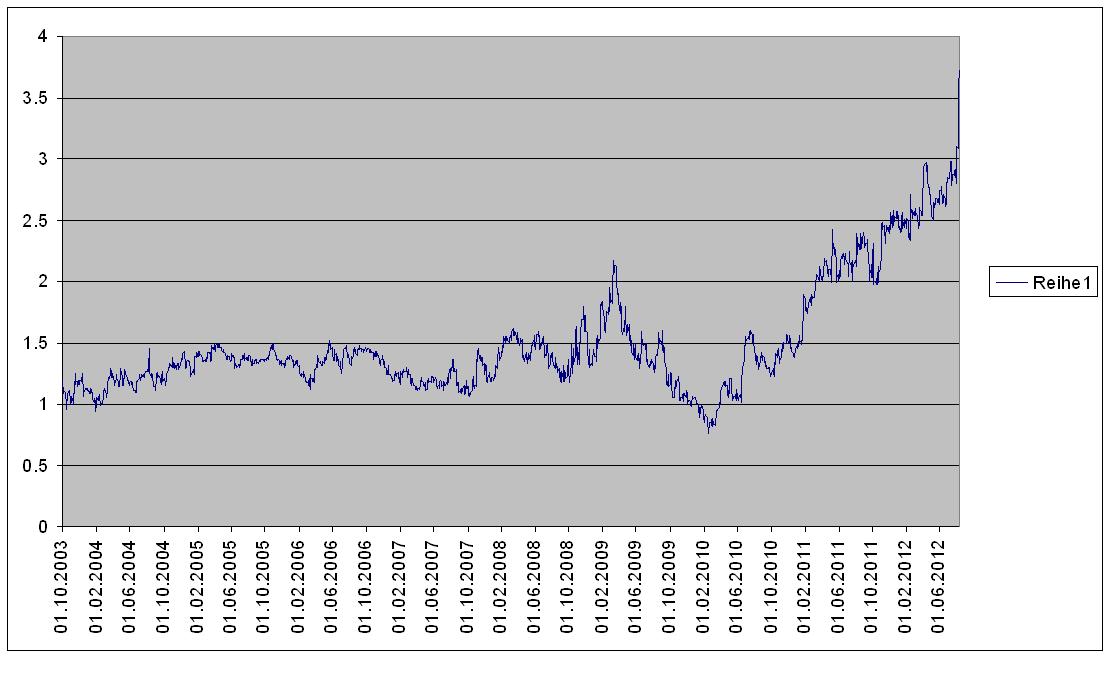
The stock chart shows that since 2005/2006 the stock is trading sideways:

Sales have remained more or less constant since at least 2006. What makes the stock attractive under EV metrics is the relatively large cash pile.

As of 31.03.2012, the company showed around 14 mn EUR in cash which, based on 5 mn shares, a shareprice of 3.75 EUR and roughly 2 mn EUR EBITDA results in an implied EV/EBITDA of around 2.4, which looks very cheap.

However, this is one of the cases where a simple EV/EBITDA calculation might be a bit misleading. On the liability side for instance, they show prepayments of around 7 mn EUR. One could discuss this now for some time if we have to deduct prepayments from EV, but the major point for me is the followng:

Fabasoft is not a Net-Net, the market cap is still higher (19 mn EUR) than net short term assets (13 mn EUR) as well as net equity (14 mn) and the business is not consistently profitable. We do not know what they do with the cash. They paid some dividends and bought back some shares in the past, but nothing regular.

So even if they pay out all the cash, one is still left with a business which over the cycle does not earn its cost of capital. At least for me that doesn’t sound very attractive. I would prefer companies like Installux, who have a profitable business AND low EV/EBITDAs, there are plenty of them out there.

Summary: Despite an optical low EV/EBITDA, I don’t think Fabasoft is a very attractive investment. Mainly because they couldn’t prove that their business is actally profitable ovewr a longer period of time. If one is sure about a lasting turn around, than it might be a good investment, but as I don’t really know the business, this would be too risky for me. Based on past performance, this could well be a typical value trap.

Weekly links

Howard Marks on making and exploiting mistakes.

Must Read: Damodaran on Contrarian Investing

Interesting article in the FTD about Prokon. Looks like this might be ending soon.

Bronte on how the financial system in China works.

Citron is out with a new report on one of the biggest Chinese real estate developer Evergrande.

Long post at Brookly investor how interest margins at Wells Fargo correlate with overall yields.

Boss Score Harvest part 4: Tipiak SA (ISIN FR0000066482) & Toupargel (ISIN FR0000039240)

Back to the micro level ;-). Let’s jump back over the channel from Dart Group, Braemar and Cranswick to France.

Tipiak is a French Company which according to Bloomberg does the following:

Tipiak SA manufactures and distributes frozen food, prepared dishes, grains and sauces in France and abroad. The Company’s products are marketed under the “Tipiak” and “Relais” names.

So its basically the French version of Frosta AG, the company I used as Benchmark for Cranswick.

The company looks cheap under standard metrics:

Market Cap 32 mn EUR
P/B: 0.7
P/S: 0.2
P/E 2011: 10.1
P/E 2012 (est): 6
Dividend yield trailing 8.5%
EV/EBITDA 4,5

In the Boss model, they show an average ROE of 16% over the last 10 years with a standard deviation of only 6.6%, which puts them in the absolute “top decile” in the database.

However if we look at the “Boss ROEs”, we can quickly see that this is a company where things deteriorated significantly in 2011:

Boss ROE NI margin
2002 14% 1.7%
2003 15% 1.7%
2004 31% 3.1%
2005 19% 3.7%
2006 21% 2.9%
2007 19% 3.8%
2008 12% 2.9%
2009 12% 2.7%
2010 14% 2.8%
2011 6% 1.9%

The stock chart shows a pretty alarming picture:

So this is definitely a warning sign at first glance.

A quick look in to the French annual report 2011 shows that the reason for the decline in profits is mostly a relatively strong increase in costs across all categories which could not be compensated through the increase in sales. Somewhere hidden in the annex they show that the reserves for doubtful receivables on outstanding receivables have increased from 2% of outstanding to 4% which explains around half of the decrease in profits.

As we had checked Cranswick and Frosta with regard to capital management and capital efficiency, let us quickly check how Tipiak looks there:

2011 2010 2009
Sales 167.6 158.1 154.6
NI 3.2 4.5 4.2
NI in % 1.91% 2.85% 2.72%
 
Inventory 19.8 18.6 15.9
Receivables 50.1 47.1 48.3
Trade liabil- -27.6 -27.8 -27.2
 
Net WC 42.3 37.9 37
In % of sales 25.24% 23.97% 23.93%
 
PPE 44.6 45 45.3
in % of sales 26.6% 28.5% 29.3%
Goodwill 6.9 6.9 6.9
 
Net WC+ PPE in % of sales 51.85% 52.44% 53.23%

Short answer: Bad news.

Both, working capital and fixed investments in comparison to sales are higher than at Frosta (25% WC vs. 20%, 27% PPE against 21% at Frosta) and miles away from the efficient capital management at Cranswick. Interestingly, in one of his many writings Warren Buffet warned that companies with high working cpital requirements are suffering most from inflation. This is what one can see live at Tipiak.

So without digging deeper: Tipiak might be a “reversion to the mean” play at some point in time but at the moment it is a business in trouble and not what I am actively looking for.

To make this post a kind of “French frozen food” edition, lets look at another company as well, Toupargel Group SA.

Toupargerl has a slightly different business model:

Toupargel Groupe specializes in the home delivery of food products to individuals. The Company operates through two segments: Frozen Foods and Fresh Foods & Groceries. Toupargel Groupe is based in France.

Toupargel also looks “suspiciously”cheap:

Market Cap 75 mn EUR

P/B 0.9
P/S 0.2
P/E (2011) 9
EV/EBITDA 2.9 (!!!)
Div. yield 5.5%

The stock chart looks similar bad like Tipiak’s:

Average “Boss ROEs” and NI margins are higher than Tipiak but also more volatile and declining as well:

Boss ROE NI margin
2002 20.6% 1.7%
2003 44.7% 1.7%
2004 43.0% 3.1%
2005 34.2% 3.7%
2006 18.0% 2.9%
2007 17.7% 3.8%
2008 20.3% 2.9%
2009 23.0% 2.7%
2010 15.4% 2.8%
2011 13.0% 1.9%

Still this would result in an excellent score overall.

A quick view into the business developement looks impressive but only if one reads it from the wrong side. according to the annual report, sales and profits are shrinking almost every year since 2006.

According to their annual report, they are a clear market leader in the French market, but it seems to be that the market is shrinking as well.

Just for fun a quick look at capital usage:

Toupargel    
  2011 2010 2009
Sales 339 351 359
NI 8.1 12.9 12.9
NI in % 2.39% 3.68% 3.59%
 
Inventory 12.6 11.6 12.2
Receivables 2.9 1.7 1.8
Trade liabil- -23.6 -22.6 -22.4
 
Net WC -8.1 -9.3 -8.4
In % of sales -2.39% -2.65% -2.34%
 
PPE 43 46 47.6
in % of sales 12.7% 13.1% 13.3%
Goodwill      
 
Net WC+ PPE in % of sales 10.29% 10.46% 10.92%

And surprise surprise, they manage to run their business with negative working capital !!! Overall capital requirements are very low which explains the historically strong ROEs.

The reason is also relatively clear: Like a super market, Toupargel distributes directly to retail clients against cash, but enjoys the usual payment terms from its suppliers. So capital wise this business model is much nicer than being a supplier to a supermarket etc. but it seems to be that despite the internet boom, frozen food home delivery has seen its best days in the past.

Summary:

Both companies show, that of course the “Boss Score” is not the perfect model for each and every situation. As with every mechanical screener one has to be carefull not to get sucked into value traps.

Of the two companies, Toupargel seems to have the more capital efficient business model, but unfortunately the business model looks like terminal decline. If they manage to reinvent them somehow (Internet ?) they would be however a prime turn around story. But so far both companies do not qualify as “BOSS” (boring sexy stock).

Macro: The Bull case for Europe and the Euro

If you read any news source today, there is one common theme: “The EUR and the European union are doomed”.

Every economist, politician, bank boss, asset manager, talk show host (and their grandmothers) now know exactly what Target2 accounts are and why Europe is on a one way track into doom and bust. Additionally they ussually mention that they always said so. Some of them offer additional advice for instance how helpful it would be if countries would go back to theri own currencies, or adapt the gold standard etc. etc.
Read more

Italian updates – Piquadro, Sol Spa, Emak

Reporting season in Italy. Among my portfolio and watch list, several companies issued relevant material.

Piquadro:

Piquadro had a sort of “trading update” which for some reason cannot be found on the homepage but for instance here.

Although sales went up 4.3%, Profits declined from 9.1 mn to 7.8 mn (0.18 EUR per share to 0.156 EUR per share). And they are cutting the dividend from 0.10 EUR per share to 0.06 EUR.

Based on my initial valuation, Piquadro is still within the base case (20% EBITDA margin). So for the time being no action, but a reminder to check the annual report how non-Italien sales and own shops performed against the other segment.

Sol Spa

Watchlist stock Sol Spa has issued two interesting pieces of information. First of all, they were able to place a 12 year private placement bond at 4.75% in USD. With 12 year USD swap rates at around 2%, this represents a credit spread of around 2.75%. This is around 1.5% lower than Italy has to pay for the same duration. So we clearly see that a well managed Italian corporate can finance cheaper than the Italian Government !!!

Secondly, they have issued an investor presentation which shows that for some unkown reasons they are also investing in Hydro Power in Slovenia and Macedonia. I am not sure how this fits into the corporate strAtegy, but it explains part of the increase in Capex.

Q1 results are a mixed bag. Increasing sales but a reduction in margins. Capex still high as the aggressively move into Eastern Europe (Bulgaria, Albania).

Difficult stock. Still on watch.

EMAK

Emak had issued Q1 numbers already a couple of weeks ago. Interestingly again the acquired companies dare doing relatively well. Based on the first quarter, Emac could earn around 0.08 EUR per share which would result in a 2012 P/E of around 6.

Cranswick Plc (ISIN GB0002318888) – Business model and valuation

After the first post on Cranswick Plc, as promised some more thoughts about the business model and valuation.

Business model – peer company Frosta

As mentioned, Cranswick operates mostly in the private label market. Frosta AG a company I owned when I started the blog is a relatively similar company. They are also food producers (however frozen food and fish instead of “chilled” food and poork) and most of their sales are private label products for supermarkets.

Let’s look at a quick comparison table focusing on net margin, ROE and debt/assets for both companies:

Cranswick Cranswick Cranswick Frosta Frosta Frosta
  NI Margin ROE Debt/Assets NI Margin ROE Debt/Assets
31.12.2002 5.3% 22.0% 6.2% 0.8% 5.9% 31.9%
31.12.2003 4.7% 19.3% 12.6% -2.9% -23.4% 36.3%
31.12.2004 5.1% 20.1% 39.2% 2.9% 18.7% 26.1%
30.12.2005 5.2% 22.2% 35.7% 3.1% 14.3% 30.8%
29.12.2006 4.4% 18.2% 30.4% 3.4% 15.6% 30.9%
31.12.2007 4.6% 17.6% 31.6% 3.5% 16.2% 35.0%
31.12.2008 3.1% 11.8% 27.1% 3.1% 14.4% 37.6%
31.12.2009 4.4% 18.1% 17.7% 2.9% 13.2% 36.1%
31.12.2010 4.7% 17.0% 15.2% 2.5% 10.0% 30.1%
30.12.2011 4.6% 16.1% 11.0% 2.3% 8.4% 27.2%
 
Avg 4.6% 18.2% 22.7% 2.2% 9.3% 32.2%

One can easily see that Cranswick earns twice the margins and ROEs of Frosta. Additionally they are employing on average a lot less financial debt than Frosta.

So what are the reasons for this discrepancy ?

One thing which distiguishes many good companies from mediocre companies is capital management. The less capital a company needs, the better is not only the return on capital (and equity) but also the net margin.

So let’s have a quick look at how those to companies compare with regard to Asset (and capital usage)

First Frosta AG:

Frosta      
  2010 2009 2008 2007
Sales 392.6 411.3 391.8 348.7
NI 9.8 12 12.1 12.2
NI in % 2.50% 2.92% 3.09% 3.50%
         
Inventory 56.5 61 70.9 57.7
Receivables 68.2 67 68.9 62.9
Trade liabil- -40.6 -27.7 -44 -34.3
         
Net WC 84.1 100.3 95.8 86.3
In % of sales 21.42% 24.39% 24.45% 24.75%
         
PPE 77.9 78.9 84.5 71.8
in % of sales 19.84% 19.18% 21.57% 20.59%
Goodwill 1.2 1.1 2.2 1
         
Net WC+ PPE in % of sales 41.26% 43.57% 46.02% 45.34%
         
Net WC +PPE+GW in % of sales 41.57% 43.84% 46.58% 45.63%

I have concentrated on Working capital and fixed assets only. Frosta needs ~24% of sales in net working capital. Besides inventory, receivables are always much higher than payables which means that Frosta basically finances the supermarkets as they are not able to mirror their payment terms with their suppliers.

Fixed assets account for another 20% of sales on average, Frosta does not show any Goodwill as they haven’t made any acquisitions in the past.

So how does Cranswick look compared to this ?

Cranswick      
  2010/2011 2009/2010 2009 2008
Sales 758.3 740.3 606 559
NI 35.3 32.5 19.9 25.7
NI in % 4.66% 4.39% 3.28% 4.60%
         
Inventory 35.7 36 28.5 30.6
Receivables 78.7 84.1 73.7 77.3
Trade liabil- -84.9 -86.7 -75.2 -73
         
Net WC 29.5 33.4 27 34.9
In % of sales 3.89% 4.51% 4.46% 6.24%
         
PPE 123.3 106.1 91.7 92.7
in % of sales 16.26% 14.33% 15.13% 16.58%
Goodwill 127.8 128.7 117.8 117.8
         
Net WC+ PPE in % of sales 20.15% 18.84% 19.59% 22.83%
         
Net WC +PPE+GW in % of sales 37.00% 36.23% 39.03% 43.90%

The short answer is: Much much better !!!

Especially working capital management seems to be extremely efficient. They can basically finance their receivables out of payables and inventory is on average only 5% of sales compared to 15% at Frosta.

Also fixed assets are around 5% less compared to sales than at Frosta, however Goodwill adds to assets which have to be financed.

The interesting fact about this asset usage is also the impact on the P&L. More fixed assets mean higher depreciations charges and maintenance capex. Goodwill on the other hand doesn’t require depreciation nor a lot of maintenance capex.

When we compare the two companies, Cranswick showed around 1.8% of sales in depreciation over the last 4 years against 3.0% at Frosta. If we assume equal tax rate, this alone explains the difference in net income margins over the last 4 years !!!!

A second smaller effect where capital management influences net margins is the cost of interest. Currently interest rates are low, but nevertheless, Frosta had 0.2% higher interest cost compared to sales over the last 4 year on average. Especially for instance in 2010, where Forsta’s NI margin was 2.5% against 4.6% for Cranswick, the difference in interest expense (-0.7. ) and the difference in depriciation charges (-1.5%) fully explain the difference in profitablity.

Why is Cranswick managing capital so much better than Frosta ?

As we all know (now), competitive advantages are almost always local. If we look at Cranswick’s business locations, one can clearly see the regional concentration:

Most of theiz facilities are concentrated in and around the Yorkshire area. Due to their overall size one can assume that Cranswick has a dominating position in this local area with the local suppliers. Their suppliers are most likely several hundreds or thousands of pig farmers. Another aspect of this is that for a British farmer it is much more difficult to export living pigs to Europe for instance. I highly doubt that the Eurostar transports live pigs so you have to involve ships in the transport route which makes it much harder to transport the pigs than for instance driving them form Poland to Germany. If you just want to export just the meat, you will have to go to a Cranswick facility first……

In terms of payyments, it is most likely easier to negotiate “back to back” pamant terms than for Frosta which has to buy its suplies from fish markets or b2b traders etc. So this leaves Cranswick with a significant amount of negotiation power with its suppliers.

Another advantage of the regional concentration is of course inventory management. The longest distance between any of their sites is 250 kilometers, a distance which could be covered back and forth most likely within a day. With such short supply routes it is much easier to run “just in time” production than if you get your supplies from thousands of miles away by ships.

This was for instance also the problem of another company I used to own but sold, Einhell AG. They are sourcing most of their supplies in Asia but have to pay before the merchandise even gets shipped from China. Due to the relatively long time of ship travel, they have to finance 6-9 months of supplies upfront and then they have to wait another few weeks to get their money from the DIY stores.

Cranswick, on the other hand seems to have a quite powerfull local position, being able to pass through the payment terms of the supermarkets to the pif farmers, leaving it only with a relatively small amount of “just in time” invesntory to finance.

I am not sure how easy this is to copy, but it protects them at least also to a certain amount against cheaper imports.

Valuation:

As mentioned in the first part, the value in Cranswick doesn’t is not in its asset base or any mean reversion phantasy. It lies in a consistent business developement with stable and high ROEs.

If Cranswick would manage to deliver 20% ROE going forward, my Boss modell would indicate a fair value of around 2.000 Pence per share or an upside of 160%. If we assume going forward 15% ROE, Cranswick would still be a double with an Intrinsic value of ~1.550 pence per share. I think this is definetely possible over a time period of 3-5 years without any P/E expansion.

Risks

Of course, as any company, the busienss of Cranswick is subject to a lot of risks.

As Tobias mentioned in the comments, among them are:

Hygienic risks

This can kill food companies. One of the most recent examples is Mueller Brot in Germany. However at least in Germany, this is usually a developement over years. Normally, the authorities give many warnings before they really take actions. Of course in the interent age, this can go much quicker. But this is not only an issue for Cranswick, but for all food and beverage companies incl. the “Star” companies like Coca Cola and Danone as well (anyone remembering the Perrier scandal ?).

Customer power

The custumors of Cranswick are of course extremely powerfull, with a few names dominating the client list. But again, this is an issue for many food producers and other consumer product producers have, as retail is consolidating more and more. The loss of one client can harm the business significantly.

On the other hand, I highly doubt that any of the supermarkets can come up from scratch with such an efficient organization like Cranswick. As we have seen, they do not calculate crazy margins into their products but they are really great capital managers.

Subsitution

Of course, Pork products can be substituted through different meats. As we have seen, in the downturn, Cranswick has profited from substitution, so chances are high that in an upturn they will suffer from the tendency to buy more expensive products. It will be interesting to see how successfull they are with their other ventures, such as dried ham, olives, meat pastries etc. This should lower the risk of substitution to a certain extent.

Imports

If for some reason, for instance the EUR would depreciate strongly against the GBP, EU imports would be a lot cheaper than locally produced pork. Although I assume there is “sticky” demand for British pork, this could impact Cranswick’s margins to a certain extent. On the other hand this might be a good hedge against Dart Group’s off setting EUR exposure !! Howver Cranswick has proved that it can maintain margins in the past and I do not see any reason why this should suddenly change.

Summary:

Although Cranswick is no “cheapie”, I do think that Cranswick has some local competitive advantages which allow them an extremely efficient capital management and corresponding high returns on equity. As they have proved to maintain this through out the cycle, I will add a half position (2.5% of the portfolio) of Cransdwick Plc Shares to my portfolio.

The current valuation looks attractive enough, any take-over or recap upside is basically “for free”.

After the 2011/2012 report in July I will then decide if I double up to a full stake.

Weekly links

Interesting post about possible moats at Indian IT companies

Interactve Investor is tired of “mechanical screening” and wants to analyse UK companies one by one

Greenbackd with yet another (16 page) study which about the advantages of “mechanical” value investing

Damodaran also has a great post about screening. Interestingly he concludes that screening itself seems to be not a competitive advantage for an invetor any more due to the abundance of available resources.

Great post about net-net investing from Nate at Oddball

Interesting interview with Ed Thorpe, one of the first Quants about momentum strategies

Brooklyn investor analysis about the current state of the stock market compared to the good old times.

The case for Greek stocks.

Boss score harvest part 3 – Cranswick Plc (ISIN GB0002318888)

After Dart Group and Braemer, another UK stock with interesting characteristics is Cranswick Plc.

Cranswick according to Bloomberg

Cranswick plc manufactures and supplies food products to grocery retailers in the United Kingdom and the food service sector. The Company supplies fresh pork, gourmet sausages, charcuterie, cooked meats, sandwiches, and dry cured bacon. ”

Standard valuation metrics are extremely unspectacular:

Market Cap 390 mn GBP
P/E: 10.3
P/B: 1.6 (P/B tangible 3.1)
P/S: 0.5
EV/EBITDA 6.8
Div. Yield 3.9%

However what makes Cranswick interesting in the Boss model is the really high and constant ROEs over the last 10 years:

BV/share Dvd/Share EPS CI ROE (CI)
2002 147.81 0.13 0.31 0.30 21.7%
2003 165.63 0.14 0.30 0.31 19.9%
2004 210.76 0.15 0.39 0.59 31.3%
2005 251.59 0.17 0.51 0.56 24.2%
2006 295.36 0.19 0.50 0.61 22.2%
2007 335.86 0.21 0.52 0.59 18.8%
2008 358.33 0.23 0.41 0.43 12.5%
2009 409.01 0.25 0.70 0.73 19.1%
2010 463.79 0.29 0.75 0.80 18.3%
2011 514.1 0.31 0.79 0.79 16.2%
 
    2.06 5.16 5.71

So even in real tough environments like 2008, Cranswick is still able to manage 12% ROE calculated on the basis of the comprehensive income which I find pretty remarkable.

So we do have a company which trades significantly (1.6) above book value, but churns out 20% ROE over the last 10 Years with a standard deviation of only 5%.

If I just look at my current database of around 1.100 stocks, I only have 12 stocks which show similar ROE/Std deviation characteristics and they trade on average at 2.8 times book value. Among those are well-known market leaders like Fastenal, Fielmann or Becton Dickinson.

Balance Sheet quality (based on “old” annual report 2010/2011) :

Debt:
Debt to total assets is at only 10% and has declined since 2004 when they had around 40% gross debt to total assets.

M&A
Cranswick did 6-7 smaller acquisitions in the last 10 years, mostly in the 15-20 mn GBP range (Sandwich Factory in 2003 for 15 mn, Delico in 2006 for 18 mn, Bowas of Nrofolk in 2009 for 18 mn). There was one larger acquisition, Perkins Chilled Food for 80 mn GBP in 2005. All in all it looks like a very reasonable add-on acquisition strategy funded out of free cash flow

Pensions

No problems here, company has only a small DBO plan with ~17 mn GBP and a deficit of around 2 mn GBP.

Operating Leases

Also only 12 mn GBP of total operating leasing liabilities as of year end 2010/2011

So balance sheet quality looks really good and conservative.

Management /Shareholders

According to Bloomberg, the largest Shareholder is fund manager Invesco with ~30%, the rest is distributed among several fund managers, however no “famous” value investor amongst them.

Management

In 2011, management received a total comp of 3.8 mn GBP, based on total profit of 35 mn GBP, that’s 11% which is quite a lot. But maybe its OK for a UK company. Management holds around 400 k shares which is not much. However there is a LTIP with a couple of hundred k shares for the management which hopefully should align interest to a certain extent.

Business

It seems that Branswick sold a lot of their products not under their own brands but as private label to UK supermarkets. Somewhere in the annual report they state that the two largest customers (most likely Tesco and Morrison) account for almost 50% of sales.

According to the annual report they try to establish own brands with the help of Jamie Oliver and Weight Watcher’s:

They seem to concentrate on pork products. It seems that pork as one of the cheapest “red meats” has benefited from price increases for lamb and beef as strained UK customers then substitute with pork. This might also explain part of the resilient returns.

Unfortunately, they do not split out the different food categories themselves. According to the overview they also deliver sandwiches for airlines and are moving more into other staff like pork pastries.

One question which I could not answer was the issue why the UK supermarkets allow Cranswick to earn relatively high returns. If I look at comparable German companies, they earn much lower returns, especially if they sell under private label.

Maybe UK supermarkets are not as tough as Aldi and Lidl in Germany with their suppliers or Cranswick has some competitive advantages like size. They stress their origin as pig food producer and pig rearing, so I guess they have very long-established relationships with pig farmers etc.

What others say

As always for UK stocks, you find interesting posts from the “usual” suspects:

Expecting Value has an excellent post mentioning that Cranswick seems to be able to increase exports significantly. He also links to this fantastic chart which shows Cranswick’s growth over the last 2 decades:

A quick look at the stock chart:

Interestingly, Cranswick underperformed against the FTSE 250 index significantly. Against Tesco, they just managed to “equalize” the score lately:

Even Swiss meat company Bell AG managed to significantly outperform Cranswick:

However, if we look at 2004/2005, Cranswick traded at around 2.5-3 times book and EV/EBITDA of 12, almost double the level of today.

Summary: At a first glance, Cranswick looks like an interesting “boring but sexy” company. They generate nice ROEs very consistently and manage to grow even in difficult times. Although the stock is not “dirt cheap”, I will do a “deep dive” into the business model and valuation hopefully next week.

Boss Score harvest part 2: Braemar Shipping Services (GB0000600931)

As mentioned in the first article about Dart Group, I am looking at the moment at UK companies.

Within my “Boss Screener”, the following company scored really good: Braemer Shipping Services.

According to their website, they are doing the following:

The Group is divided into four operating divisions: Shipbroking, Technical, Logistics and Environmental. These work together to offer a unique combination of skills for clients, at any time, anywhere in the world.

Basic valuation metrics look Ok but not spectacular:

Market Cap ~ 70 mn GBP
P/E 9.8
P/B 1.1
P/S 0.5
Div. Yield 8%
EV/EBITDA 5.7

The company has no debt, but net cash (positive).

historically, returns on equity following my “boss” definition were really good:

EPS BV p.Sh. DVD CI ROE
31.12.2002 0.10 1.04 0.13 14.4%
31.12.2003 0.08 1.14 0.13 21.9%
31.12.2004 0.24 1.29 0.16 23.0%
30.12.2005 0.37 1.69 0.18 37.6%
29.12.2006 0.32 1.78 0.20 15.6%
31.12.2007 0.49 2.00 0.23 22.5%
31.12.2008 0.57 2.51 0.26 32.7%
31.12.2009 0.48 2.80 0.27 20.7%
31.12.2010 0.48 3.07 0.28 18.3%
30.12.2011 0.34 3.08 0.29 9.7%

Although one has to mention, that 2001 for example was a loss year for them. They do make smaller acquisitions from time to time which explains that tangible book is only 50% of actual book value.

As one can also clearly see, 2011 was a more difficult year for them. As one could expect for a potential UK value stock, it is widely covered by the excellent UK value blogs, for instance

Kelpie Capital
Interactive Investor

Especially the Interactive Investor has a very good coverage about the company and another listed UK shipbroker Clarkson Plc.

Shipbroking Business

Again, thanks to Richard Beddard for this fantastic post about the business and the link to some very interesting material about long-term cycles in the shipping industry.

So to summarize it in my own words:

– ship broking (i.e. broking of shipping capacity, not ships themselves) is a cyclical business
– ship broking also seems to be a fragmented business where people seem to have more loyalty to persons than to corporations
– ship oversuply and depressed freight rates will most likely persist for many years to come
– Bramer itself is in a transformation process to diversify into more service oriented areas

If one looks into the annual report, one can clearly see that the ship broking business is in a drastic downturn with sales shrinking by -20%. on the other hand they managed to earn ~14% operating margin (down from 21%). So this means that fixed costs are relatively small. Any manufacturing business would not retain a profit when sales drop 20%.

The other divisions did compensate for revenue loss but not fully for profits. Although the environmental segment looks interesting with almost doubling sales and tripling the operating margin.

So lets stop here and reflect a minute:

The boss score tries to identify reliable boring companies which deliver solid ROEs over several cycles. With Bramer we have here clearly a different situation:

There seems to be a “long-term cycle issue” with the core business and they are in the middle of a strategic business shift. So the past profitability numbers are maybe a relatively weak indicator for future profitablity, as the underlying business changes significantly.

Braemer could be an interesting investment, but it does not really fit into the pattern I am looking for.

Although other factors look good (Management owns a significant share of the company, stock is relatively unknown and not well covered, string free cashflow generation in the past, attractive dividend yield etc.), for the time being I only put it on my watch list, as I don’t know enough about the shipping business to make an informed investment judgement. Also the stock is not cheap enough to qualify as a asset play or mean reversion investment.

Summary:

Based on historical profitability, Braemer would be a clear buy. But as the whole shipping sector seems to have a long-term problem and Braemer has put itself into a business transformation process, I think at the moment the risk does not justify an investment at current prices.

« Older Entries Recent Entries »