Category Archives: Anlage Philosophie

Imploding Dutch stock of the week: Royal Imtech (ISIN NL0006055329)

After KPN and TNT Express, we highly welcome another Dutch company with an imploding stock price, Royal Imtech.

The company:

Royal Imtech seems to be active mostly in everything which on can install into buildings, such as heating, securities, electrical equipments etc. although the company profile on its website sounds like a perfect score at “bullshit bingo”:

Imtech offers added value with integrated and multidisciplinary total solutions that lead to better business processes and more efficiency for customers and the customers they, in their turn, serve. Imtech also offers solutions that contribute towards a sustainable society – for example, in the areas of energy, the environment, water and traffic.

Nevertheless, until recently (November 2011) Imtech was highly coveted by analysts as “clean tech” super star , with a 100% buy rating and price targets of 30 EUR per share and more.

The problem

In beginning of February, Imtech came out with a “bombshell” press release.

Not only did they have to postpone their earnings release, but they also indicated that they have a loss of min. 100 mn EUR in their fast growing Polish business. The press release contains this “gem” of potential accounting fraud:

The Board of Management has also determined that a promissory note and pledged accounts related to the Adventure World Warsaw project – amounting to around 200 million euro – that had been recognised in the half-yearly 2012 financial statements under cash and cash equivalents must, according to IFRS, be reclassified under current financial assets. Most of this amount was recognised as an advance payment under work in progress for the four projects concerned. This advance payment was considerably higher than the incurred costs. As stated above, the advance payments have not become available to Imtech. The effect of this is incorporated in the expected write-off of at least 100 million euro

This potential fraud leads to another problem: As net cash is part of their loan covenants, the company already indicates that all of a sudden, they are now in breach with their loan covenants:

The consequence of the expected write-off will be that, when its 2012 financial statements are drawn-up, Imtech will no longer fulfil its covenants with lenders – average ratios of 3.0 maximum for net debt/EBITDA and 4.0 minimum for interest coverage. As a result Imtech will begin consultations with its lenders. Imtech has retained Rabobank as its financial advisor for these consultations.

The share price fell of course like a stone following this announcements:

One interesting aspect about Imtech is the fact that some rumours about aggressive accounting were circulating already late last year. Of course management denied all allegations at that time.

Interestingly, Imtech had already a quite high short interest at that time, almost 10% of the market cap was short at the end of the year. Thanks to the new regulations about short disclosure one could see that the “smart money” like Dan Loeb’s Third Point is short the share.

Why bother at all ?

One of the reasons I looked at Imtech is that based on many metrics, Imtech looked like a great stock and even more now at the current price levels. I am sure, Imtech will show up now on many “value screens”. Even in my BOSS model, Imtech looks quite compelling.

If we look at some measures, Imtech really looks like a great company:

EPS DIV ROE ROIC
31.12.2002 0.61 0.42 17.4% 21.9%
31.12.2003 0.57 0.36 14.5% 41.7%
31.12.2004 0.58 0.36 12.5% 17.1%
30.12.2005 0.69 0.36 18.4% 18.6%
29.12.2006 0.86 0.36 21.9% 19.5%
31.12.2007 1.17 0.36 26.4% 21.4%
31.12.2008 1.46 0.47 29.7% 18.3%
31.12.2009 1.62 0.59 28.2% 16.3%
31.12.2010 1.70 0.64 21.4% #WERT!
30.12.2011 1.72 0.65 17.3% 11.4%

One can see growing earnings, growing dividends, nice free cashflow and double digit ROIC and ROEs. So what is not to like ?

The big question

So the question is: Is Imtech a great company which has just facing a bump on its road to further success or is there a real problem with the company ?

There are some examples of great companies with similar problems, for instance Hugo Boss AG, the German luxury Group. In 2002, they detected fraud in their US subsidiary (“channel stuffing”) and had to restate their 2001 balance sheet significantly. I just found this research note from Commerzbank in 2002 where they downgraded the stock from 16 to 9 EUR per share. Looking back, this would have been the perfect entry point for Hugo Boss. The stock since then performed ~30 p.a. until now (a 15-bagger so to say) against 7.7% of the CDAX.

However with Imtech, I have some doubts due to the following reasons:

Acquisitions:
Imtech more or less looks like a typical “roll up”. On the “acquisitions” page of their homepage one can see that they have done like 10–15 acquisitions per year. With roll ups, it is very difficult to asses the reported numbers of such a company because of the large leeway available for accounting for acquisition. Even cash flows can be “massaged” quite significantly as we have seen many times before.
As a result, Imtech carries significant goodwill. This in itself is not necessarily a problem, but together with significant accounting problems, this might become a problem quite soon.

Type of fraud
As mentioned above, this fraud was not “only” about faking sales but also about faking on-balance sheet cash. As we know now, Imtech has quite tight credit covenants. So in my opinion this implies that the fraud has some connection to the whole group and is not only a result of some renegade employees in a subsidiary. Imtech seemed to have general problems with cash and fulfilling its covenants before.

Summary:

In theory, Imtech could be a great company which had bad luck with management in a subsidiary. This would be a good entry point to buy a great business at rock bottom prices.

However, at least in my opinion, the history of the company as a “roll up” as well as the type of fraud makes me cautious. So for the time being this will be just sit back and watch what is going to happen (and trying to learn more…).

Maybe if they really go the way of a big rights issue as indicated in this Bloomberg story might be an interesting entry point, but only if the issues regarding the fraud have been clarified in the meantime and the business is viable. Otherwise, the good parts of the business will most likely go to the creditors and the shareholders might get nothing (but the blues).

A few more thoughts on KPN (potential deeply discounted rights issue)

As discussed last week, KPN might become a potentially interesting “special situation” because of its announced massive equity raising.

In any case it makes sense to look a little bit deeper into KPN, even if it would be only a “short-term” special situation invest.

Relative valuation

let’s look at some standard valuation metrics:

Name P/B P/E Dvd Ind Yld EV/EBITDA T12M EV/MC
           
KONINKLIJKE KPN NV 1.88 6.47 3.81 3.80 3.79
DEUTSCHE TELEKOM AG-REG 1.46   8.04 4.28 2.22
BELGACOM SA 2.30 9.45 7.74 4.98 1.26
FRANCE TELECOM SA 0.76 5.63 17.49 3.81 2.60
BT GROUP PLC   9.78 3.26 5.02 1.41
VODAFONE GROUP PLC 1.23   5.67 8.20 1.34
TELIASONERA AB 1.72 9.51 6.56 7.28 1.35
PORTUGAL TELECOM SGPS SA-REG 1.55 17.25 15.71 5.43 3.23
SWISSCOM AG-REG 5.05 11.92 5.49 7.09 1.39
TELECOM ITALIA SPA 0.55   6.39 4.11 3.99
TELE2 AB-B SHS 2.20 13.92 6.91 5.95 1.34
TDC A/S 1.54 8.99 11.23 5.39 1.69
TELENOR ASA 2.53 41.85 4.20 5.65 1.20
TELEFONICA SA 2.19 7.37   5.29 2.41
ILIAD SA 5.04 42.03 0.27 11.09 1.14
TELEKOM AUSTRIA AG 2.53     3.75 2.39

KPN looks relatively cheap based on some metrics, especially P/E and EV/EBITDA. However we can also see that KPN is one of the TelCo companies with the highest debt loads. I used here´EV divided by market cap, but one could also use simple debt/equity ratios.

What is interesting to see is for me that despite the very weak performance of the sector, price/book is still relatively high for most of the companies. I think this is a result of the high dividends being paid by the TelCos which “eroded” book equity.

KPN history

In the case of KPN, things look a little bit different. If we look at this first set of numbers, dividends don’t’ seem to be the problem:

EPS DIV BOOK Value
31.12.2002 -3.94 #N/A N/A 1.83
31.12.2003 1.11 #N/A N/A 2.90
31.12.2004 0.72 0.16 2.69
30.12.2005 0.66 0.40 2.36
29.12.2006 0.79 0.48 2.19
31.12.2007 1.42 0.52 2.51
31.12.2008 0.77 0.56 2.18
31.12.2009 1.33 0.63 2.36
31.12.2010 1.15 0.73 2.23
30.12.2011 1.06 0.81 2.05

If we exclude 2003 (which contained the losses from the 3G licence excesses), KPN paid out only ~45% of its earnings as dividends. So what happened ?

This becomes clearer if we look at the next tabel, which shows free cash flow, net debt per share and outstanding shares:

FCF p. Share Net debt per share Shares outstanding
31.12.2002 1.17 4.99 2,491
31.12.2003 1.08 3.37 2,491
31.12.2004 0.91 2.90 2,410
30.12.2005 1.16 3.82 2,151
29.12.2006 1.31 4.32 2,036
31.12.2007 1.35 5.92 1,843
31.12.2008 1.21 6.32 1,714
31.12.2009 1.23 6.56 1,629
31.12.2010 1.54 7.45 1,573
30.12.2011 1.66 8.46 1,478

So we can easily see that until recently, KPN looked like the classical “anglo saxon style” shareholders dream: Fat free casflows used together with increasing debt to repurchase around 40% of their outstanding shares since 2003.

If you would take Charlie munger by his words, KPN should have been an excellent “Cannibal company”.

Looking at the stock chart, this seemed to help KPN to outperform for instance Deutsche Telekom for a long time, but now finally they both seem to have met at the bottom again:

So one lesson one can learn here is that being a “cannibal” company does not mean automatically that this will be a good investment. Based on a rough calculation, KPN had purchased around 10 bn EUR of its own shares between 2003 and 2011, nevertheless, the market cap of the company remained more or less constant over this period in time.

So looking back, this share repurchase looks rather like a debt financed liquidation than a value enhancing share buy back.

Debt profile

Having so much debt, it makes sense to look at the maturity profile of KPN.

Payments Principal Only
Year Amt(Mln)
2013 1,085
2014 1,400
2015 1,000
2016 1,250
2017 1,000
2019 1,046
2020 1,000
2021 1,250
2022 750
2024 700
2026 473

The table shows, that KPN has quite some debt to roll. So far they still have investment grade ratings (Baa2 from Moody’s, BBB- from S&P). Moody’s has them on negative outlook, S&P on stable.

The problem seems to be S&P. Despite having a BBB- rating on long term debt, S&P has them as “A-3” short term, which is the second worst rating available in the short term rating scale. This means effectively that KPN is shut out of short term financial markets as there are only a very small number if institutions permitted to buy such low grade paper. Even Telekom Italia still has an A-2 rating.

Especially the December S&P report clearly outlines some of the most important weaknesses of KPN. An interesting aspect is that one:

That said, the group is facing intense pressures on its domestic mobile revenues in particular, owing to the cannibalization of consumer revenues by IP-based instant messaging applications.

I have read that several times, that mobile carriers made most of their money with SMS. Now however, applications like “What’s App” are eating their lunch because they just use the internet flat fee, effectively eliminating the need to send SMS. As always, the established players were much to slow to react to this threat and I guess that now it is already to late.

KPN seemed to have identified this threat quite early and according to this article tried to increase fees for those services, but this actually resulted in a backlash called “net neutrality”. So The Netherlands and Chile are now the only 2 countries with full “net neutrality” which means the following:

The new law requires companies providing access to the Internet to treat all Internet services equally. They cannot favor their own services, nor charge extra to access a competitor’s service.

I guess this is one of the reasons why they earn higher margins in Germany as number 4 than as market leader in the Netherlands.

Another interesting point here:
If one reads the S&P anaylsis carefully, their major issue seems to be the 1.5 bn spectrum purchase which they think seems to be expensive. The big question here is:

Why does KPN target 4 bn as a capital increase although the rating agency problem seems to be a lot smaller ?

In my opnion, both the amount and the way to raise capital does not make sense. Why don’t they try to to the same as Telefonica and list a minority stake of their German business on the stock exhange ? With an EBITDA of almost 1.3 bn EUR of E-Plus in Germany, a 49% stake could easily raise 2-3 bn EUR on the basis of the Telefonica Dutschland valuation. This would be more than enough to resolve the rating issue and secure roll over of debt.

After being quite shareholder friendly over the last 8 years or so, suddenly, they don’t seem to care any more for shareholders. This is something which really worries me.

One explanation could of course be that they want to annoy or shake off Carlos Slim as large shareholder. In my opnion, this looks like the most likely reason why they behave in such a way. This howver would present exactly the short term opportunity I would be looking for. Management acting irrationally could open up an interesting sitauation, once the capital increase is being executed.

The other explanation would be that management sees a lot mor bad news coming and want to build up a cushion for big future losses. This would be bad.

Summary:

Honestly, I would not want to own KPN as a long term investment, however I will watch the situation carefully especially if they are going through with a deeply discounted issuance price. If the shareprice than will go down close to the discounted issuance price, there migth be a good “special situation” opportunity.

Deeply discounted rights issue watch: KPN NV (NL0000009082)

I had briefly covered deeply discounted rights issue as a potential “special situation” opportunity a couple of weeks ago.

Now, with KPN, we have an interesting non-financial candidate. This is what KPN issued today:

Dutch telecoms group KPN confirmed a €4bn rights issue to shore up its capital position after heavy expenses on bandwidth that have led to dividend cuts and lower profit margins.

The company announced the move along with its 2012 annual results, which showed a 3.5 per cent drop in revenues and a 12 per cent fall in earnings from the year before.

As one might expect, the stock tanked some 16% or so. Currently, at around 3.45 EUR per share, KPN has a market Cap of only 5 bn EUR, so raising 4 bn via a rights issue might require a large discount on potential new shares.

The “wild card” in this game will be Mexican Billionaire Carlos Slim who owns currently 27.5% of the company. If he fully participates as lead investor and even taking up more than his share, then the “forced selling” aspect might not be too relevant.

If for some reason, he would refuse to participate, the situation will become very interesting.

Just for fun, let’s look how the performance was for Unicredit. I would distinguish the following events / time periods:

– 4 weeks before announcement
– announcement day
– period between announcement and price setting (for new shares)
– price setting day
– period between price setting and start trading of subscription rights
– trading period
– 4 weeks after end of trading period

First the relevant dates:

Unicredit
Announcement first trade date 14.11.2011
Price setting of rights issue 04.01.2012
First trade date subscr. rights 09.01.2012
Subscription trading until 01.02.2012
 
Discount 43%
New share 2 new for 1 old

Now the relative performance:

Performance UCG MIB Relative
– 4 weeks before announcement -18.35% -4.98% -13.37%
– Date of announcement -6.18% -1.99% -4.19%
– announcement until price setting -14.40% 2.95% -17.35%
– day of price setting -17.27% -3.65% -13.62%
– price setting to start trading -26.46% -4.45% -22.01%
– trading period 73.75% 12.94% 60.81%
– 4 weeks after trading period 0.05% 2.82% -2.77%
– 6 months after trading period -32.25% -11.39% -20.86%
– 12 months after trading period 12.53% 9.53% 3.00%

In the Unicredit example, clearly the period where the subscription rights were traded showed the best relative performance of the shares. Interestingly, on the announcement day, the price drop was much less in percentage points than KPN. This might have to do with the short selling ban which was in place (at least to my knowledge) when Unicredit announced the rights issue.

Again for fun, a quick look at Banco Popular’s rights issue from the end of last year.

Again the dates first:

POP
Announcement first trade date 01.10.2012
Price setting of rights issue 10.11.2012
First trade date subscr. rights 14.11.2012
Subscription trading until 28.11.2012
 
   
New share 3 new for 1 old

and then relative performance to the IBEX:

Performance POP IBEX Relative
– 4 weeks before announcement -3.95% 5.11% -9.06%
– Date of announcement -6.17% 0.98% -7.15%
– announcement until price setting -29.95% -1.71% -28.24%
– day of price setting 4.56% -0.90% 5.46%
– price setting to start trading -8.86% 1.39% -10.25%
– trading period 8.12% 2.16% 5.96%
– 4 weeks after trading period -6.71% 3.74% -10.45%

One can see a similar pattern first, with the stock losing 4 weeks before announcement, as well as on the announcement date until the final price setting. However of the date of price setting, the stock jumped, until loosing only a little bit until starting of the trading period.

Then however, the gains within this period were relatively low compared to Unicredit. Overall it looks a lot less volatile than Unicredit, so maybe less forced selling here.

Back to KPN:

Other than Unicredit and Banco Popular, KPN had outperformed the AEX almost +11% in the last 4 weeks, so today’s large drop might compensate for this (unjustified) outperformance.

If the other two stocks are any guide, one could still expect lower prices until the price for the new shares will be set.

The stock price of KPN look really really ugly long term:

But make no mistake, any company which needs to go into deeply discounted rights issues is in trouble. This is “distressed” territory.

(…to be continued….)

Performance January 2013 – The importance of being patient

Performance
In December I said the following:

To be honest, I don’t think that the current portfolio has an equal upside potential like in the beginning of last year, mostly due to the lack of really interesting special situation investments. For instance, the upside of athe Draeger Genußschein was much higher when it trades at~2.5 times the pref shares than the current 4.5 times.

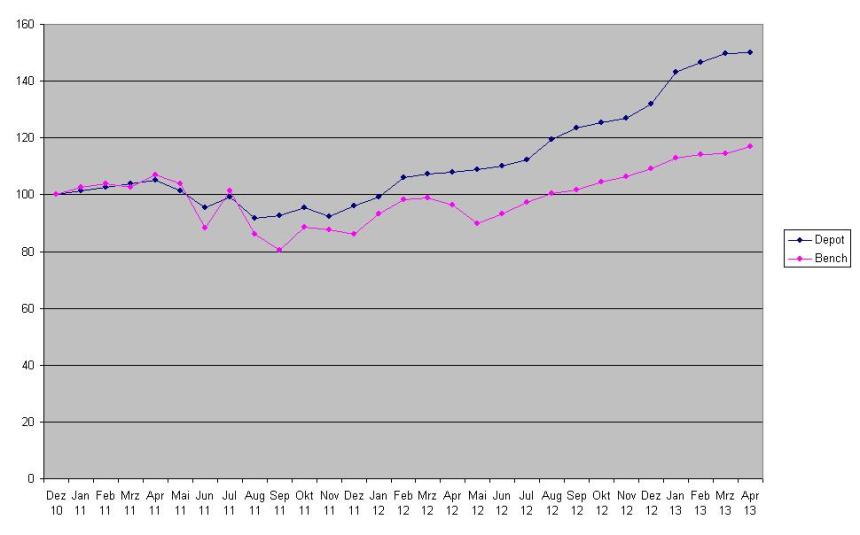
Well, I was obviously very wrong on that one. The portfolio gained gained 8.6% in January, the largest single month gain in the 25 months of the portfolio’s history. The Draegerwerke Genußschein alone gained 25%, other top performers were Tonnelerie (+19%), KAS Bank (+17%) and Dart & Cranswick 15% despite the strong Euro.

The outperformance again the Benchmark (4.9% outperformance) can be almost fully explained by the typical January small cap effect which has been covered quite well by Mebane Faber. The German small cap index SDAX for example gained 10% in January.

Portfolio as of January 31st

Name Weight Perf. Incl. Div
Hornbach Baumarkt 4.3% 9.5%
AS Creation Tapeten 4.0% 29.0%
WMF VZ 3.5% 57.0%
Tonnellerie Frere Paris 5.4% 56.2%
Vetropack 4.4% 4.6%
Total Produce 5.8% 55.9%
Installux 2.9% 6.7%
Poujoulat 0.9% 6.4%
Dart Group 3.8% 100.7%
Cranswick 5.1% 12.9%
April SA 3.4% 39.0%
SOL Spa 2.4% 6.8%
Gronlandsbanken 1.1% 24.4%
     
KAS Bank NV 5.1% 27.5%
BUZZI UNICEM SPA-RSP 5.2% 18.9%
SIAS 6.1% 59.5%
Bouygues 2.7% 8.7%
Drägerwerk Genüsse D 10.6% 142.9%
IVG Wandler 4.5% 13.7%
DEPFA LT2 2015 2.8% 56.6%
HT1 Funding 4.6% 44.9%
EMAK SPA 4.2% 23.1%
Rhoen Klinikum 2.2% 3.0%


Short: Focus Media Group -0.9% -2.7%
Short: Prada -1.0% -10.8%
     
Short Lyxor Cac40 -1.2% -8.5%
Short Ishares FTSE MIB -2.2% -13.7%
     
Terminverkauf CHF EUR 0.3% 7.4%
     
Tagesgeldkonto 2% 10.0%  


Value 47.0%  
Opportunity 48.1%  
Short+ Hedges -5.1%  
Cash 10.0%  
  100.0%

The only change to year-end is Sol Spa which was bought in the beginning of January. Cash is now exactly at my target level of 10%. that means any addition will trigger automatically a sale of another position.

Comment: The importance of being patient

A few days ago, the longterm value blog had a great post about patience in investing.

He mentions one of the cardinal sins in current markets:

I’m writing this, of course, to focus myself. One of the hardest things to do is…. to do nothing. The instinctive reaction to a rising market is to pile on, add shares, up your leverage. But really that’s the absolute worst thing you can do. Don’t kid yourself.

Clearly, jumping into the market because you missed out the rally, especially in risky “high beta” stocks will most likely end in tears.

However another potentially big mistake should also not be underestimated: Taking profits too early. Most investors (including myself) get nervous if their stocks climb quickly 20-30%. What you then often hear is something like “It never hurts taking a profit” or “No one ever got bankrupt by taking a profit” or something similar.

The truth is: In order to generate above average returns, taking profits too early hurts badly. Statistically, the vast majority of investment ideas will be rather average, some will be bad, but some of them and usually only a small amount will be really really succesful.

If I look at my portfolio, most the outperfomance of ~23% over the last 25 months can be attributed to only a few positions especially Draegerwerk, Aire KgAa, Dart Group which have all doubled.

In all cases, it was and is always tempting to sell out and “take the profit” quickly. For Draegerwerk and Aire, I started selling too early, however I was lucky to start only with small amounts. Looking back over my 25 year investment “carreer”, I made many mistakes. However the most costly ones in the end were selling companies like Fuchs, Rational or Fielmann much to early.

Fuchs AG Vz. for example was one of the stocks I bought during the 2008/2009 around 12 EUR (adjusted for the split) and happily took the profit end of 2009 at 20 EUR, feeling like an investment genius. However, with the stock now at 58 EUR (plus a few Euros dividends in between), it looks pretty stupid. I knew that Fuchs was an outstanding company. Even worse, if I would have kept those shares the gains would have been tax free as they would have not been subject to the “Abgeltungssteuer” introduced in January 2009.

So looking back, “taking the profit” on a share like Fuchs (much) too early was maybe one of the biggest and most expensive mistakes in my investment career.

Following up an Maisons France Confort (ISIN FR0004159473) – Business model & Capital management

Last week, I ran Maisons France Confort through my checklist and found it quite interesting.

If we simply look at very basic profitability numbers, we can see that the numbers look almost too good to be true:

ROE NI margin Net debt per share
31.12.2002 27.1% 2.8% -1.46
31.12.2003 28.5% 3.1% -2.28
31.12.2004 34.5% 4.0% -4.74
30.12.2005 38.0% 4.6% -5.92
29.12.2006 39.1% 4.8% -7.33
31.12.2007 35.3% 4.8% -4.09
31.12.2008 24.3% 3.8% -4.44
31.12.2009 13.3% 2.9% -5.15
31.12.2010 16.7% 3.6% -6.98
30.12.2011 21.2% 3.9% -10.39
       
avg 27.8% 3.8%

The 10 years from 2002-2011 is a full cycle with boom and bust years, so achieving on average an ROE of 28% with a financially unlevered balance sheet is outstanding.

How do they do it ? The answer is (of course) effective capital management. I have used Bloomberg data for this but if we look at the last 6 years we can see that their capital management is really outstanding:

FY 2011 FY 2010 FY 2009 FY 2008 FY 2007 FY 2006
Goodwill 45.34 40.75 36.6 37.11 33.64 17.31
PPE 17.8 16.39 13.96 14.39 12.02 9.59
 
Inventory 21.74 20.8 24.23 24.14 21.17 7.95
Receivables 82.11 74.41 57 80.9 91.2 82.5
Prepayed expense 27.06 25.37 23.36 24.85 23.24 44.49
 
Accounts payable 96.9 81.88 70.95 93.26 92.58 80.06
Net Working capital 34.01 38.7 33.64 36.63 43.03 54.88
 
Revenue 583.91 443.06 395.84 499.62 482.97 424.98
Net income 22.68 15.83 11.51 18.9 23.19 20.2
 
PPE in % of sales 3.0% 3.7% 3.5% 2.9% 2.5% 2.3%
Net Working capital in % of sales 5.8% 8.7% 8.5% 7.3% 8.9% 12.9%
PPE+Net WC in % of sales 8.9% 12.4% 12.0% 10.2% 11.4% 15.2%

Running a business with only ~9% of “operating” net assets compared to sales is something you don’t see very often.

Let’s have a quick look at Kaufman & Broad, another French listed home and appartment builder:

FY 2011 FY 2010 FY 2009 FY 2008 FY 2007 FY 2006
Goodwill + int 151.52 150.82 150.5 149.71 149.81 69.96
PPE 5.88 5.99 5.93 7.27 9.47 8.87
 
Inventory 235.56 246.15 295.74 519.52 595.46 513.2
Receivables 305.67 203.33 203.77 296.26 405.7 309.13
Prepayed expense 141.26 159.48 139.43 158.64 147.39 122.14
 
Accounts payable 409.67 377.29 398.79 552.65 620.98 535.91
Net Working capital 272.82 231.67 240.15 421.77 527.57 408.56
 
Revenue 1,044.26 935.70 934.91 1,165.11 1,382.57 1,282.83
Net income 0 0 0 0 0 0
 
PPE in % of sales 0.6% 0.6% 0.6% 0.6% 0.7% 0.7%
Net Working capital in % of sales 26.1% 24.8% 25.7% 36.2% 38.2% 31.8%
PPE+Net WC in % of sales 26.7% 25.4% 26.3% 36.8% 38.8% 32.5%

Interestingly, Kaufman & Broad improved their capital management as well but they still need 3 times the operating net assets to generate roughly the same returns.

This of course shows in Profitability:

ROE NI margin Net debt per share
31.12.2002 21.4% 4.4% 5.90
31.12.2003 20.8% 4.5% 2.55
31.12.2004 20.1% 4.7% 3.46
30.12.2005 28.7% 5.9% 3.79
29.12.2006 33.5% 6.6% 4.64
31.12.2007 31.8% 6.1% 16.74
31.12.2008 4.6% 0.7% 19.90
31.12.2009 -31.1% -3.2% 12.46
31.12.2010 19.4% 1.9% 9.92
30.12.2011 37.7% 4.5% 7.69
       
avg 18.7% 3.6%

Despite a significant leverage, ROE are lower on average and due to the leverage much more volatile.

Maybe this is one of the reasons why Maisons has outperformed larger Kaufman by a wide margin over the last 10 years.

Just for fun, let’s also look at Helma AG, a small homebuilder in the currently booming German market:

FY 2011 FY 2010 FY 2009 FY 2008 FY 2007
Goodwill + int 2.21 2.19 1.85 1.63 1.51
PPE 16.31 14.57 14.89 15.48 13.79
           
Inventory 19.83 8.63 5.61 5.8 6.67
Receivables 10.59 6.33 4.27 3.47 2.92
Prepayed expense 8.85 5.76 3.11 2.98 2.72
           
Accounts payable 5.85 5.02 0.76 0.79 4.72
Net Working capital 33.42 15.7 12.23 11.46 7.59
           
Revenue 139.50 118.50 106.68 103.59 74.54
Net income 5.2 3.4 2.36 2.31 1.3
           
PPE in % of sales 11.7% 12.3% 14.0% 14.9% 18.5%
Net Working capital in % of sales 24.0% 13.2% 11.5% 11.1% 10.2%
PPE+Net WC in % of sales 35.6% 25.5% 25.4% 26.0% 28.7%

Interestingly, the operate roughly at the level at Kaufmann & Broad but nowhere near MFC’s level. Helma by the way actually seems to have jumped into property developement which might explain the increase in operating assets.

So compared to two other homebuilders, the business model of Maisons France looks extremely “lean” from a capital management point of view. The big question of course is why are they so much better ?

I think the big “trick” was already mentioned in the Ennismore summary from last week’s post:

Unlike many other markets, in France there is virtually no development risk for the company because land is purchased separately by the customer and the house will only be built once it is fully financed.

In their annual report, there is a hint how they operate:

Under Note 4.8 (receivables) we find the interesting information, that the receivables amount on their balance sheet is a net amount. So the roughly 80 mn receivables translate into 320 mn gross receivables against which they show something like 250 mn prepayments.

Those prepayments, which they seem able to get are basically an interest free float which explains in my opinion the superior ROE and ROIC metrics compared to the other builders.

Summary:

From a pure capital management perspective, Maisons France Confort seems to have a very good business model. they seem to generate a lot of interest rate free “float” which greatly reduces the required amount of net operating assets.

I am not sure if currently is the right time to invest as the stock has run up quite fast and french housing might be slow this year, but is definitely a very interesting company.

The big quesiton is: Is such a business sustainable without an obvious “moat” ? In my opinon yes, because creating such a business model is not something you can do from scratch. 3-5% margins are not overly attractive for many competitors. Howevr, in any case some deeper research into to this will be necessary anyway before a final investment.

Rallye SA (ISIN FR0000060618) – another Holding company at a discount ?

Rallye SA, France is the holding company for 49.97% of Casino Guichard, one of the big French retail chains.

In their annual report they present the company as follows:

Their major assets are:

– 49.93% of Casino Guichard Perrachon SA (ISIN FR0000125585)shares (61.24% of voting rights)
– 72.86% of Groupe Go Sport SA (ISIN FR0000072456)(78.73% of voting rights), another small listed French company
– “investment portfolio”.

There is some qualitative description of the “investment portfolio” on page 19 of the report, it seems to be a quite divers collection of participations and real estate.

Rallye’s investment portfolio was valued at €365 million as of December 31, 2011, compared to €435 million as of December 31,
2010. At the end of 2011, the portfolio consisted of financial investments with a market value(1) of €272 million (vs. €295 million
at end-2010) and real estate developments measured at historical cost(2) of €93 million (vs. €140 million at the end of 2010).

Net external debt stands at 3 bn as of year end 2011. Other than that i did not see major positions.

The trickiest part of Rallye’s balance sheet is the 2.5 bn EUR receivables position the show in their single entity balance sheet.^2.3 bn of that seem to be receivables against Group companies:

The current account advances made by Rallye to its subsidiaries are part of the Group’s centralized cash management system. They are
due within one year.

The point I am struggling with most is the following:

If those receivables are against Casino, then one would add those assets for the Rallye evaluation. If those receivables are against their various subholdings which also hold Casino shares, then one would need to fully eliminate them.

I have quickly checked the 2011 Casino annual report, but didn’t find any liability against Rally SA. So we should assume that those internal Rallye receivables are a technical position which is financing the Casino stack and should therefore not be counted extra. Only the “external” part (~200 mn) should be used).

So with that assumption we can now calculate the “sum of part” or intrinsic value of the Rallye SA share:

EUR mn
Casino Guichard (50%) 4,112.3
Group Go 34.8
Investment Portfolio 365.0
Receivables, other assets 220.0
Sum assets 4,732.1
   
Debt -3,000.0
Other liabilites -110.0
Net Assets at market 1,622.1
   
 
Number of shares 47.2
Value per share 34.37
 
Current market price: 25.80
“Discount” 24.9%

Overall, a 25% “discount” seems to be quite normal for such a slightly in transparent structure including extra financial debt. However if one thinks Casino is a great investment, then investing through Rallye might be a good idea:

Casino Guichard itself is not uninteresting. Although it is not cheap, they are growing pretty strongly. Especially interesting is the fact that 60% or more of their sales are now in LatAm (Brazil and Colombia), two markets which seem to be the most interesting retail markets at the moment.

On the other hand, I am not a big expert on retail chains, so from that point of view I will not analyze Rally/Casino further.

Summary:

If my assumptions are correct, the current “discount” of Rallye vs. its sum-of-parts as a holding of 50% Casino Guichard is only 25%. Considering the extra leverage and the lack of visibility, it does not look greatly undervalued.

TNT Express (NL0009739424) – “post mortem”

As it is commonly known, free lunches are few and rare in the stock market.

Another proof for this was last week’s termination of the TNT Express takeover by UPS.

I was quite lucky that I didn’t join in the “trade“, despite considering it quite seriously. My final decision was based on the believe that in such a “crowded” market like merger arbitrage, if a situation looks too good to be true, most likely it isn’t true.

Interestingly enough, a lot of “players” must still have believed in the deal. Looking at the chart, we can see that TNT is now trading relatively close to the lower bound of the “undisturbed” price before UPS came up with the bid:

As discussed in the previous post, at the current level, TNT Express is still not cheap, for instance compared to FedEx.

On the other hand, UPS seems to have been better off without TNT Express if we believe in “Mr. Market” as they have outperfomed the Dow Jones by almost 10%:

To me, this looks like that the offered price of 9,50 EUR was way too high and UPS realized this at some point in time and did not really try hard to get the deal through. For a company like UPS, blaming it to the EC is always a “face-saving” possibility.

However that also means that the price tag of UPS might never be reached again, even if FedEx would show up as potential buyer. On the other hand, TNT Express might still benefit by being spun off from POstNL which is crippled by pension liabilities and the terminally declining mail business.

PostNL Was even hit harder, dropping to a new all time low:

This might have to do also with Moody’s recent downgrade.

At the moment, both, PostNl and TNT Express are too much “hot potato” type investments, but it is definitely something for my “special situation” watch list. I think it will be especially interesting to see if TNT Express is able to turn around the business on a standalone basis.

Alsi for the future, I think it is the safest to keep away from Merger Arbitrage situations for my special situation “bucket”, as this requires very special skills which I do not have.

Edit:
It seems that French activist investor Lutetia is trying to start a campaign for PostNL. This could bcaome interesting at some point. Lutetia also showed up (quite succesful so far) in the SIAS Spa case.

The Herbalife “Slugfest”

In my opinion, the most interesting (and entertaining) story in equity markets is the current Herbalife story.

Herbalife is a US based producer and distributor of diet shakes, vitamin pills etc.

Looking at the chart, one can see that until early 2012, Herbalife was one of the “hottest” stocks out there:

Herbalife went public in December 2004 at a price of 14 USD per share. Including a stock split, the stock returned a phenomenal return of ~ 30% p.a. until the end of 2011.

Earnings per share rose more than 10-fold from 0.47 USD per share to more than 4.80 USD in 2011. During the “financial crisis”, the stock suffered but then quickly went back into outperformance mode.

The first “crack” in the success story appeared, when David Einhorn personally dialed into the conference call on May 1st 2012 for the first quarter and started to ask some weird questions.

Two weeks later, when Einhorn spoke at the annual Ira Son conference, the stock bounced back 20% because Einhorn didn’t mention Herbalife. So far I didn’t find out if Einhorn is still short.

The next step in the story is well known, the epic presentation of Bill Ackman why Herbalife is a Pyramid scheme. To reinforce his point, he even set up a dedicated website about his Herbalife short thesis. For Ackman, this is not his first short battle. There is even a book (by the way highly recommended) about his several year long fight against the US mortgage insurers, called “The confidence game”:

However, pretty soon after his presentation, some quite savvy investors and bloggers pointed out some weaknesses in Ackman’s presentation, especially the claim that the Herbalife “scheme” is illegal and the US regulators will have to shut the company down.

One of the first was blogger Kid Dynamite and one of my personal favouritesm, blogger and hedge fund manager John Hempton.

Like sharks smelling blood, some other “famous” hedgefund managers joined the party, most notably Dan Loeb’s Third point which actually took a massive 8% long position in the company. Yesterday, even “activist” legend Carl Icahn came out swinging against Ackman, disclosing a long position in Herbalife.

So this is quite an interesting situation:

On the one side, we have some of the brightest “new generation” HF managers David Einhorn and Bill Ackman against well respected “activists” like Dan Loeb and Carl Icahn as well as extremely clever bloggers like Kid Dynamite and John Hempton.

Last Thursday, Herbalife held an investor day, trying to take on Ackman’s acusations. I found the Herbalife presentation rather unconvincing.

My advice on this:

If you are not a famous investor who can move markets with a presentation, STAY OUT OF THIS !!!!!

Otherwise you will end up like this poor guy, who “joined” Bill Ackman just at the wrong point in time:

The Herbalife story is the proverbial “hot potato” investment one should just enjoy and watch (and learn) instead of joining.

Personally, I think that Loeb and Icahn are only in for the quick rebound and long term Ackman will most likely come out with a nice profit, but I wouldn’t really bet on this, as you might be killed (or squeezed) in the meantime.

So get your popcorn, lean back and enjoy !!!

P.S.: For anyone more deeply interested in “multilevel marketingg companies”, there is a very good detailed post at Seeking Alpha.

Investment checklist v 0.1 (beta)

One of my “secondary” goals for 2013 is trying to develop a more “formal” checklist especially for my “boring stock” strategy. As the “Boss Score” is only ment to be a starting point, I usually try to “quick check” certain points in order to find out if a deeper analysis makes sense.

One of the first thing one has to decide is: “what kind of stocks am I looking for” ? I don’t believe that a single check list for all kind of different stocks exists. So please keep in mind, the purpose of this checklist wil be to find stocks that:

– perform consistently well over time but not spectacularily so (no “wide moat” companies)
– have little fundamental downside (low debt, “hard” assets, stable sector)
– can be “left alone” if necessary for a long time because management is trustworthy (“low maintenance”)
– are nevertheless “mispriced” by the market

So far I have come up with the following list and the first 27 items (beta version):

1 . Market cap between 25-250 mn
“sweet spot”, large enough to invest, small enough to deter “large professional” investors

2. Less than 3 analysts following on Bloomberg or very bad sentiment
Unfollowed or “hated” stocks have larger potential to be mispriced

3. “low key” IR. E.g. no English annual reports, short quarterly updates etc., no share price on company homepage
Many investors skip such stocks

4. Potential special circumstances like Euro crisis, very diverse business activities, complex structure, Spin off etc.
increases chance of mispricing

5. Low historical beta /volatility
Good for my nerves, bad for any index oriented investors

6. Dividend yield > 3%
subjective criteria based on experience

7. P/E < 10
For some reasons I prefer “single digits” P/E

8. P/B < 1.2
Maybe anchoring effect, but in my opinion limtis downside risk

9. EV/EBITDA <= 6
in order to detect “special effects”

10. 10 Year mean reversion potential > 50%
Mean reversion potential based on P/E- net margin & EV/EBITDA, EBITDA margin

11. Positive 10 year FCF yield
no FCF generation normally indicates issues with capital allocation efficiency

12. Large acquisitions in the past or serial “acquirer” ?
might severly impact quality of reported numbers

13. Large share of intangible assets ?
again, quality of reported numbers

14. Significant pension liabilities, operating leases ?
Adjust for them accordingly to see if total leverage still acceptable

15. Low financial debt (net debt/equity <0.5)
again to minimize downside risk

16. Family owned / run
better chance for long term strategic management, best with founder still in charge and not too old

17. Treatment of shareholders in the past ?
Any indications of screwing shareholders in the past ?

18. Sharecount stable or decreasing ?
Does company dilute shareholders e.g. via options to management ?

19. Alignment of management and shareholders ?
Does management earn comparably much more than their shareholdings ? Outsized & unwarranted bonuses ?

20. Subjective impression of company management (pictures, speeches, comments)
Might sound stupid, but sometimes a picture says more than 500 pages …. Avoid jet set, sleazy looking guys

21. 10 Years of comparable history available ?
preferably companies with a long term track record as listed companies without major restructurings etc.

22. Industry in general decline
avoid value traps or make sure to understand whats going on

23. Positive/neutral short term (6m-1 year) price momentum ?
only catch the falling knife if you are very very sure

24. high quality investors as share holders ?
Preferable less known but good investors

25. Do I understand the business model ?
Why is the company succesful over the long run ?

26. Potential short/medium catalyst ?
i.e. sale of loss making division, change in shareholder structure etc.

27. 10 year sales growth above inflation
Don’t pay for growth, but if you get it cheap…also trade off with FCF

For each item I will give a score which is either:

+1 for a very positive answer
0 for a neutral position
-1 for a negative aspect

I will then add all the scores, the maximum is then logically the total number of checklist items. Anything which scores above 50% or more will be analysed deeper. In order to “callibrate” the list, I will also calculate scores for all my current holdings.

For a first test I calculated the “sores” for the following positions:

Installux: 18
Total Produce: 16
Hornbach: 16
Tonnelerie: 22
AS Creation: 20
Vetropack: 18
Buzzi: 10

As with any checklist or other “Model”, I don’t think one should follow this like a slave. Rather it should help to look more structured at a stock and also being able to review such a stock periodically on a structured basis.

I would be highly interested if any of the readers has comparable checklists and suggestions for the list.

Listed German utility companies – part 1: Overview and E.on (ISIN DE000ENAG999)

In my small series about utility companies, it might make sense to start with those companies which are at least geographically in my “circle of competence”, Germany.

There are currently 8 listed companies which qualifiy one way or the other as “utilities” which are:

Ticker Name Mkt Cap EV/EBITDA T12M P/B P/E Dvd Yld
 
EOAN GR Equity E.ON SE 28,194 7.5 0.7   7.8
RWE GR Equity RWE AG 19,099 4.7 1.2 8.3 6.3
EBK GR Equity ENBW ENERGIE BADEN-WUERTTEMB 8,340 5.6 1.4 31.0 2.7
MVV1 GR Equity MVV ENERGIE AG 1,549 8.3 1.4 25.3 3.8
FHW GR Equity FERNHEIZWERK NEUKOELLN AG 72 6.8 2.1 15.6 4.5
MNV6 GR Equity MAINOVA AG 2,031 22.9 2.2 20.8 2.5
WWG GR Equity GELSENWASSER AG 1,887 17.8 2.3 19.3 3.2
LEC GR Equity LECHWERKE AG 2,198 20.0 2.7 22.6 3.2

Obviously, the large companies look the cheapest. Most of the smaller companies are in fact subsidiaries of the large players or owned by the Government such as:

– Lechwerke is owned ~90% by RWE
– Mainova is part of EON (91.3%)
– Gelsenwasser is owned by the government (92%)
– MVV is majority owned by the city of Mannheim (50.1%)
– EnbW is majority owned by the Government (85-90%)
– Fernheizwerk Neukölln is owned by Sweidish Vattenfall (80.1%)

RWE is de facto controlled by the regional government as well, only E.On to my knowledge does not have a controlling shareholder or significant Government influence.
A
s one could read in the press, the regulatory environment in Germany is supposed to be quite ugly, among others, the major issues are:

– unpredictable politics (close down of Nuclear power plants following Fukushima), the utilities are actually trying to sue the Governemnt for this
– heavily subsidized renewable energy (costs are added to the electricity bill for retail customers)
– relative low allowed yields on infrastructure which led the major players to shed electricity grids and gas pipelines
– heavy competition for instance for electricity. I just checked, where I am living (Munich), I got ~44 different offers for electricity

Going back to the “Buffet on utilities” approach, especially suing the Government (i.e. regulator) is maybe not a ver good long-term strategy if you then want to negotiate your next investment.

Another interesting aspect in my opinion is the fact, that especially the subsidiaries with purely local (regulated) focus show quite satisfying longterm ROEs.

10Y ROE 5Y ROE Debt/Equity
FERNHEIZWERK NEUKOELLN AG 18.6% 19.6% 0.0%
LECHWERKE AG 24.5% 13.9% 0.2%
GELSENWASSER AG 17.7% 12.5% 2.1%
MAINOVA AG 17.1% 9.1% 70.3%
ENBW ENERGIE BADEN-WUERTTEMB 21.0% 12.8% 94.1%
MVV ENERGIE AG 10.3% 11.3% 107.6%
       
 
RWE AG 17.4% 15.4% 122.4%
E.ON AG 10.2% 1.8% 79.2%

I find especially Lechwerke, Fernheizwerk and Gelsenwasser fascinating. Without any leverage they manage to produce solid double-digit ROE’s over long periods of time. So looking at this one might think that both, for RWE and EON, the German regulator is maybe not the real reason for their current problems.

Rather bad management and failed international expansion are the drivers between the rather bad performance in the last few years. Eon for instance lost lot of money with gas contracts outside Germany.

This is also the major issue I have with E.on. For some reason, they believe that they must grow outside Germany, just recently they swapped German Hydro plants with Austrian Verbund against a 50% stake in a Turkish utility group. Earlier in 2012 they teamed up with Brazil’s Eike Batista to invest in Brazil. Some people might like this exposure to “growth markets”, but personally I think this is a quite risky strategy.

Again, if we look at the comparable performance between E.on and its listed German subsidiary Mainova, we can see that at least this German business performs quite well and consistent despite E.on’s claims of bad German regulation:

Some additional thoughts about E.on based on the 2011 annual report:

– Nuclear is not coming back, that was more than 1 bn of EBIT which is missing going forward
– 60% of sales are actually energy trading revenues. The results of this “sector” look quite volatile
– they show huge swings in the net results of financial derivatives. In 2010 for instance, E.on showed a net gain of 2.5 bn against a 2011 loss of -1 bn .
– E.on has around 17 bn liabilities for nuclear waste etc. This liability is hard to analyse and could be grossly over-/understated. In the notes they state that the discount rate they use is 5.2%. I think this is a rather high rate. Combined with the long duration of those liabilities, there could lurk a potential multi billion hole there as well as in the 14 bn pension liabilities
– another “whopper” are the 325 bn EUR (yes that’s three hundred twenty five billion) of outstanding fossil fuel purchase commitments. Disclosure is rather limited here but I guess this is one of the big problem areas where they have locked in Russian NatGas purchases at too high rates

On the plus side we could add:

+ maybe earnings were understated to put pressure on regulators and trade unions
+ positive effect from future reduction in interest rates

All in all, EON in the current form looks like a big black box to me. mostly due to the large trading activities which are not transparent at all. I would be not able to value the company. I also don’t think it is particularly well-managed. As there is no dominant shareholder, the major “upside catalyst” could come from an activist investor. In contrast, I think current management will most likely waste the cash flow in stupid “growth investments”.

Another issue, and that goes for most of the German utilities is the fact, that the combination of Nuclear exit and strongly subsidised local renewal energy production might have altered the business model going forward. So betting on a “reversion to the mean” might not necessarily work here, at least not in the short run.

Last but not least, I don’t see how I could have any “edge” in valueing E.on. It is a liquid large cap stock, with plenty of analyst coverage. True, sentiment is quite bad which is maybe a chance at some point in time but as a private investor with a small portfolio, this is not the first place to look for “value”.

Yes I know, for many “value investors”, a P/B of 0.77 and dividend yield of 7.6% would already be enough and maybe yield starved investors will bid up E.On stocks for the dividend, but looking 3.5 years ahead, I don’t see a real “Margin of safety” at current prices with the current management and strategy plus taking into account the fundamental issues mentioned above.

« Older Entries Recent Entries »