Category Archives: Bilanzanalyse

Quick check: Australian Vintage Ltd. (ISIN AU000000AVG6) – Deep Value Pearl or risky turn around Gamble ?

A very persistent commentator asked me about my opinion on Australian Vintage, an Australian Wine producer. In between, Nate from Oddball covered the stock and seemed to like it as an asset play .

Optically, the company looks dirt cheap (Bloomberg):

P/E 7
P/B 0,3
P/S 0,3
Dividend yield 10,5%

When I look at such “cheap” companies, I start reading the only annual report and concentrate only on problems. I tend to avoid company presentations as they usually only show the positive stuff. A 30 minutes “speed” read of the 2013 annual report shows already some issues:

– goodwill, brand values and DTAs make up ~100 mn AUD of the book value plus another 50 mn AUD or so for biological assets and water rights
– the 2013 profit includes a significant “one-off” reserve release. without that, 2013 profit would have been some 40% lower or the P/E well into “double digits”
– the company carries significant debt and lease obligations, overall around 240 mn AUD in the 2013 annual report
– the directors salary is at ~ 3 mn AUD a significant portion of the profit
– on the other hand, directors own only insignificant amounts of shares (AUD amount of shares ~20% of total annual salary)
– operating cashflow has been negative in 2013, so the dividend has not been “earned”
– Depreciation is around 7 mn AUD per year, investments only 4-5 mn in 2012, 2013. This looks like “underinvestment”.
– most “hard” assets (inventory, property etc.) are pledged for the loans
– all subsidiaries are explicitly guaranteed by the Holdco, so all loans are fully recourse against any asset
– bank loan covenants exist, but are not clearly reported:

The Group is also subject to bank covenants with its primary financier as follows:
– Equity must be above $210 million.
– Gross profit and earnings before interest and tax must exceed pre-defined levels

– the bank loan facilites mature in 2015 and will have to be renegotiated
– there are “related party dealings” with companies of the CEO (purchase of grapes etc.)

In October / November 2013, they did a massive capital increase (42 mn AUD) in order to pay back debt. Some might argue this is a good thing, but paying large dividends and in parallel doing large capital increases is a very bad sign and very bad capital management (among others, they had to pay around 5% fees on the raised capital).

One observation with regard to the capital increase proespectus: On page 35 they show that the capital increase will increase earnings per share due to lower interest rate expenses. However they use a pretty obvious “trick” here: they use an “average amount” of outstanding shares, not the relevant final amount of shares. With the full amount of shares (232 mn) instead of the “average”, the capital increase would of course be “dilutive”.

The first 6 months of fiscal 2014 looked better on the bottom line, but again includes a big reserve release. Operationally, the first 6 months of 2014 were a lot worse than the year before, especially the US turned from an operating profit to a loss.

Some additional thoughts:

– As an Australian asset play, the Australian Dollar plays a big role. As a non Australian investor, I might have a operational upside if the AUD goes lower, but asset value as a EUR investor will be lower as well
– the UK supermarkets who are the major non Australian clients, are under a lot of preassure themselves. They will squeeze their suppliers as hard as they can and will demand lower prices if the AUD becomes weaker
– return on assets is very low. If the 10 Year treasuries yield 3.7% and Return on assets is far below that than the value of the assets ist most likely overstated by a large margin
– moving “upscale” is not easy. This needs even more capital (oak barrels, longer ageing = higher inventory etc.) and time.
– from the main brand “McGuigan”, you can buy in Germany only the Shiraz which is currently on sale (4,95 EUR vs. 5,99 EUR) and a “Sparkling Shiraz” at 12,95 EUR. To upgrade from that level will be hard…..
– finally, the Australian wine industry seems to be one of the clearest victims of climate change. Water will become much more expensive and many grapes might not grow so well in the future. This could for instance seveely reduce the value both, of the land and teh biological assets. This study for instance shows that Australie is hit hardest globally. If this will realize, everything, land, machinery and “Biological assets” would loose most of their value.

Overall I think the main issue is that the interests of the Management and shareholders are not really aligned in this case. Especially the CEO, whose max target bonus has by the way doubled for next year, seems to be far more interested in his salary than the shares and it looks like that the majority of his own investments seem to be outside the listed companies. Combined with the relatively risky financial profile, this is clearly a “deep value” case with a significant risk especially close to the 2015 maturity of the loans.

Opposite to Nate, I can see a lot of things that could go wrong here and either trigger another massive capital increase or even a bankruptcy. As I do not know a lot about the Australian Wine industry either, I think I would pass on this investment as it is extremely difficult for me to handicap the probabilities and would therefore be a quite “risky turn around gamble”. As I don’t have any experience with Australian liquidation rules, I would also be really careful to expect meaningful recovery rates for shareholders in case of a bankruptcy / restructuring. If for instance the loans would get into the hand of aggressive “vultures” like Oaktree, I would bet that stated book values would not be worth a lot.

However for “deep value” specialists, this could be interesting if they are able to estimate the “survival probability” to a certain extent.

A side note: “Moving up the value chain” in wine usually means oak barrels. So despite the much higher valuation, I still think that Tonnelerie Francois Freres is the better (and safer) long term investment in the wine industry.

Updates: MIFA & Nuclear decommissioning liabilities

Just a few quick comments on events that caught my eye while I was on vacation:

MIFA

As predicted in my post some weeks ago, the troubles of MIFA were clearly not a temporary 2013 “accounting system” issue but a result of dubious inventory accounting over multiple years (or simply stated – fraud):

This is the quote from the news release last week:

In the course of investigations by the Management Board and Supervisory Board of MIFA, it has been detected that also the previous years’ financial statements contain material misstatements. These misstatements relate to the inventories of raw materials, consumables and supplies as well as finished goods. Recent findings show a cumulative inventory difference in the amount of approximately EUR 19 million, which originate from the financial statement 2012 and previous years.

This is what I wrote 7 weeks ago, just based on public information:

I do not claim to really understand what MIFA was doing and I have no idea if they will survive or not. However, just by looking at their historical material costs and inventory level, it seems unlikely that the newly introduced accounting system could be responsible for a 15 mn loss. For me it is much more likely that the inventory build up at least since mid 2012 lead to overstated results over a longer period of time. The 15 mn loss announced seems to contain a significant write down on inventory as well. I could imagine that they might have to restate older financial statements as well.

Both, stock and bond look like “terminal decline”:

It looks like that the company lost money for a long time and made profits only by faking inventory levels.

I have often said that Grman listed Chinese companies are fraud, but clearly we have a lot of “home grown fraud” here as well. It will be interesting to see if someone is going to jail for this. I guess not

German utilities / decommissioning liabilites

Some months ago, I looked briefly at Eon’s nuclear decommissioning liabilites, which, in my opinion were clearly under reserved as the discount rate of 5% is far above anything being used elsewhere. That’s what I wrote back then:

EON has 16 bn EUR of reserves on its balance sheet for the decommissioning of nuclear power plants. Those 16 bn are clearly already reserved in the balance sheet, but as they will be due in cash rather sooner than later, they should be clearly treated as debt and added to Enterprise value.

However, there is a second issue with them: For some reasons, they are allowed to discount those amounts with 5% p.a. This is around 2% higher than for pension liabilities which in my opinion is already quite “optimistic”. They do not offer any hint about the duration of those liabilities, but if we assume something like 10-15, just adjusting the discount rate to pension levels would increase those reserves by 3-5 bn and reduce book value by the same amount.

I was therefore quite surprised that there seem to be negotiations that the German Government will take over those liabilities. Here is a “Spiegel” article in German which points ut that there seem to be supporters for this on the political side.

The argument made is that if the Government takes over the liabilities, they would not bear the credit risk of the utilities. However that argumentation has some serious flwas:

– the German utilities have indeed made reserves on their liability side, but they are clearly NOT backed by cash on the asset side. In the table I linked to one can clearly see that the liabilites are only partly financed by liquid assets. If we take out working capital requirements, my assumption would be that less than 50% is backed by liquidi assets.

– as I said before, the current liabilites are clearly underreserved. Without knowing anything about the technical aspects, alone the 5% discount rate used indicates 20-40% under reserveing depending on the duration of the liabilites and based on EON’s cost of debt. Clearly if the German Government would take over the liabilities, we would need to discount at German Government rates meaning the fair value or better cost to the taxpayer might be more than 50% more than reserves.

If the utilities would be succesfull with this, both, EON and RWE would be a strong buy and the German taxpayer a strong sell. Maybe I should hedge my position as a German tax payer with a long position in RWE and EON ?

Quick MIFA update – How to “play” covenants

Disclosure: No position, for educational purposes only.

2 weeks ago I had a quick look at the troubles at MIFA, the German bicycle manufacturer.

The official version was that they had a short term problem with their accounting but no liquidity issues. This was the last paragraph of their press release in MArch:

MIFA expects to break even at the after-tax level in the first quarter of 2014. It will not be possible for the company to issue a reliable guidance concerning the full 2014 financial year until the preparation of the annual financial statements has been completed. The company has sufficient liquidity for its operating business.

So it was quite surprising that the company today, MIFA announced the following:

– The CEO is now gone forever
– they did a “sale-lease back” of their real estate to the local Government, raising 5,7 mn EUR

So to a certain extent they do seem to have liquidity issues, otherwise they would not sell their “last shirt” for cash. The more interesting part for me is the fact that “sale-lease back” is economically nothing else than a “secured loan” on the real estate.

Looking into the bond prospectus, the outstanding bond includes a so-called “Negative Pledge” covenant:

Negativverpflichtung:
Der Emittent verpflichtet sich, solange Schuldverschreibungen ausstehen, jedoch nur bis zu dem Zeitpunkt, an dem alle Beträge an Kapital und Zinsen, die gemäß den Schuldverschreibungen
zu zahlen sind, der Zahlstelle zur Verfügung gestellt worden sind, keine Grundpfandrechte, Pfandrechte oder sonstige dingliche Sicherungsrechte (jedes solches Sicherungsrecht ein “Sicherungsrecht”) in Bezug auf ihren gesamten Geschäftsbetrieb oder ihr gesamtes Vermögen oder ihre Einkünfte, jeweils gegenwärtig oder zukünftig, oder Teile davon zur Sicherung von anderen Kapitalmarktverbindlichkeiten oder zur Sicherung einer vom Emittenten oder einer seiner Tochterunternehmen gewährten Garantie oder Freistellung bezüglich einer Kapitalmarktverbindlichkeit einer anderen Person zu bestellen, ohne gleichzeitig für alle unter den Schuldverschreibungen zahlbaren Beträge dasselbe Sicherungsrecht zu bestellen oder für alle unter den Schuldverschreibungen zahlbaren Beträge solch ein anderes Sicherungsrecht zu bestellen, das von einer unabhängigen, international anerkannten Wirtschaftsprüfungsgesellschaft als gleichwertig anerkannt wird. Dies gilt vorbehaltlich bestimmter Ausnahmen.
“Kapitalmarktverbindlichkeit” bezeichnet jede Verbindlichkeit aus Schuldverschreibungen oder ähnliche verbriefte Schuldtitel oder aus Schuldscheindarlehen oder aus dafür übernommenen Garantien und/oder Gewährleistungen.

The covenants do actually prevent them to take out a typical German “Schuldscheindarlehen” against their real estate. Interestingly, an economically equivalent sale-lease back (which will be booked as financial liability) doesn’t seem to violate this covenant.

Should for some reason, MIFA go bankrupt, the recovery for the bondholders will be significantly lower than before as the real estate now belongs to someone else and will not be part of any liquidation proceeds.

I find it interesting how easy it is to circumvent such covenants with economically equivalent transaction. A reason more to stay as far away as possible from German corporate bonds in general and the so-called “Mittelstandsanleihen”. There is no “seniority” of those senior bonds, those instruments are clearly “junior” capital for German corporates. Nevertheless, bondholders seemed to like it:

It will be interesting to see if today’s bounce in the bond price is similar to what happened at Praktiker when they announced their first “rescue” and the bond price doubled from 40% to 80% before then collapsing to close to zero. Or maybe the Indians are already on their way with big suitcases full of frsh money. Who knows ? But a lot to learn for bond investors.

MIFA AG (ISIN DE000A0B95Y8) – all that inventory and the supposedly largest bicycle company of the world

Disclosure: I do not have any interest in MIFA shares or bonds and I do not plan to invest, neither long nor short. This is a “for education purposes” analysis only..

Background

MIFA is a German based manufacturer of bicycles. I had actually included them into the peer group when I looked at Accell, the Dutch bicycle company some time ago. The company went public in 2004. Its largest shareholders are the CEO (24%) and Carsten Maschmeyer, the billionaire former CEO of the controversial financial services company AWD.

A few days ago, they shocked their shareholders by sending out a press release which in my opinion is among the “all time greatest” press releases ever.


The headline was thee following:

DGAP-News: MIFA expands Management Board and announces prospective net loss for 2013

That doesn’t sound good but the highlights are within the release:

– Preliminary FY 2013 net loss of EUR 15 million

To put this in perspective, those are the accumulated earnings of MIFA since 2004:

MIFA Net income
2004 1,8
2005 1,7
2006 0,5
2007 -2,0
2008 1,2
2009 1,7
2010 0,4
2011 2,0
2012 -1,0
   
Total 6,3

So the loss is around 2,5 times their accumulated profits of their prior 9 years of operation. Not bad and shareholders didn’t seem to like that one:

Where it gets really interesting, is the explanation for the loss which really caught my interest:

 This net loss for the year is mainly attributable to a failure to meet sales revenue expectations during the 2013 financial year. Inventory positions were incorrectly booked in connection with the launch of a new accounting system in the second quarter 2013. The cost of materials was understated accordingly in the quarterly financial statements for the second and third quarters of 2013. As MIFA does not conduct inventory-taking during the course of the year, the company failed to identify the erroneous bookings until the preparation of the annual financial statements.

So what they are saying is: Sorry, we launched a new accounting system in Q2 2013 and screwed up our accounting for those last few quarters. This sounds unprofessional but rather innocent.

A quick attempt at some “forensic” accounting analysis:

Well, let’s have a quick look how this looks based on their own published numbers. If the cost of materials was the problem, we should easily see this in the share of material cost divided by sales. This is a table I have prepared over the last 15 quarters:

>

Cost of material against average Q
Q1 2010 71,3% -0,2%
Q2 2010 67,1% 1,5%
Q3 2010 63,6% -1,1%
Q4 2010 65,8% 6,1%
Q1 2011 74,3% 2,8%
Q2 2011 60,5% -5,1%
Q3 2011 69,8% 5,1%
Q4 2011 55,3% -4,4%
Q1 2012 71,3% 0,2%
Q2 2012 66,3% -0,7%
Q3 2012 68,3% -3,6%
Q4 2012 58,1% 1,7%
Q1 2013 69,0% -2,4%
Q2 2013 68,6% 2,9%
Q3 2013 57,2% -7,5%
     
avg Q1 71,5%  
avg Q2 65,6%  
avg Q3 64,7%  
avg Q4 59,7%

What I did is the following: I calculated the share of materials per quarter and then, as the bicycle business is cyclical, calculated averages per quarter. Then in a final step I subtracted the averages from the actual numbers to see the variation.

The table shows clearly, that variations of +/- 5% are not unusual. Indeed, Q3 2013 looks strange as the cost of material seems to be too low. But on the other hand, Q2 looks normal (material cost above average). So the “accounting software problem” seems to have kicked in only in Q3. However the impact of that problem is far from 15 mn EUR.

MIFA had around 20 mn “gross” sales. So if we assume that material costs would be average for Q3 at around 65%, then the impact of the new accounting system would have been around -1,5 mn EUR (pre tax). This is somehow less than the 15 mn loss (post tax) MIFA indicated.

So we can quickly summarize at this point: The new accounting system only explains around 1,5 mn EUR loss, not 15 mn.

Digging deeper: Inventory levels

So the question is: Where did the other 13,5 mn EUR loss come from ? Let’s have a quick look at their inventory levels.

Inventory/12 m sales vs 12 m ago
Q1 2010 43,7%  
Q2 2010 42,6%  
Q3 2010 40,9%  
Q4 2010 50,4%  
Q1 2011 56,4% 12,7%
Q2 2011 43,0% 0,4%
Q3 2011 39,1% -1,8%
Q4 2011 40,4% -10,0%
Q1 2012 57,8% 1,4%
Q2 2012 48,1% 5,1%
Q3 2012 53,4% 14,3%
Q4 2012 61,0% 20,6%
Q1 2013 77,7% 20,0%
Q2 2013 59,0% 10,9%
Q3 2013 64,2% 10,8%

This table shows per quarter the inventory level divided by 12 months trailing sales. Then in a second step, in order to eliminate the seasonal effect, I calculate the change per quarter from a year ago. As one can easily see, something seems to have changed in the second quarter 2012. Inventory levels went up and never came down. And just for reference: Accell manages to work with inventory levels of around 30% per year-end, half of what MIFA is showing.

What also seems to be a strange coincidence is the fact, that MIFA stopped to break down inventory in their 2013 quarterly reports. Before, they would split it out in finished but not sold products etc, whereas from Q1 2013 we only get one line for total inventory. A large inventory in my opinion is a big problem for a bicycle companies. Mostly, they renew their models annually. Full prices are only paid by customer in spring time, the later in the year the higher the discounts.Especially with Ebikes and their components, which improve a lot over the annual cycle, old stuff will require large discounts to sell them.

Finally a last look on the relationship actual sales vs. produced but not sold. Normally, due to the seasonality, MIFA would build up inventory (i.e. produce more than they sell) in Q4 and Q1 and then sell more than they produce in spring/summer (Q2 and Q3).

Total production Sales Unsold products
Q4 2011 11.435 7172 4.263
Q1 2012 40.731 38.297 2.434
Q2 2012 41.758 41.668 90
Q3 2012 17.426 17.463 -37
Q4 2012 13.782 13.836 -54
Q1 2013 43.025 35.954 7.071
Q2 2013 44.535 46.653 -2.118
Q3 2013 20.167 15.079 5.088

This table shows us that they had the usual inventory build up in Q4 2011 and Q1 2012 but that they failed to sell this in 2012. We then see a huge inventory build up again in Q1 2013 (on top of the large base). Then there was some selling again in Q2 2013, but the really strange thing is the inventory build up in Q3 2013.

So again, this underlines the impression that the problems started already in 2012 and that most likely the inventory is much to high.

Other stuff

When I quoted the press release above, I left out a few passages.

Mr. Wicht is currently unavailable to the company due to illness.

Mr. Wicht was the long time CEo and 24% owner. That he just dissapeared is not a good sign.

As far as the corporate bond that was issued in 2013 and existing bank credit facilities are concerned, it cannot be excluded that one or several of the financial covenants included
in the bond and credit facility terms cannot be complied with in the 2013 financial year. This might result in a special right of cancellation for the respective investors. If this were to occur, the company plans to convene a bondholders’ meeting to coordinate a corresponding amendment to the bond terms. The company would also examine other refinancing options in such an instance.

Oh oh, covenant breach, this does not sound very promising. I am pretty sure, bondholders and banks will not consent to anything, unless additional (dilutive) equity wil be injected.

And finally the “carrot on a stick”:

LETTER OF INTENT SIGNED REGARDING CO-OPERATION WITH HERO CYCLES
MIFA has made significant progress with its planned strategic partnership with Indian company HERO Cycles Ltd. (“HERO”). MIFA has signed a letter of intent with HERO that comprises a EUR 15 million investment by HERO. Further details relating to the transaction are subject to final due diligence, and to agreements where the parties are in advanced negotiations. Besides an equity investment, the strategic partnership includes an extensive cooperation venture between MIFA and HERO in the purchasing and product purchasing areas, especially in the case of electric bikes and motors. Legally-binding agreements with HERO are expected within the next few weeks. In terms of revenue, HERO is the world’s largest bicycle manufacturer.

Two comments here:

1. In technical terms, a letter of intent has no legal implications. Hero Cycle can walk away at any time if they don’t like the terms.

2. According to this report, Hery Cycles had sales of 1.450 “Crores” Indian rupees. One crore is 10 million so we are talking abot 14.5 bn Indian rupees of sales. Sounds like a lot, but with a 60:1 INR/USD exchange rate, we are talking only about 240 mn USD annual sales. So in terms of revenue, Hero Cycles is only around 60% the size of Accell. And the largest bicycle manufacturer in the world by sales is Giant from Taiwan with 1.8 bn sales or 7,5 times the sales of Hero cycles.

So the claim that Hero is the largest bicycle manufacturer is clearly wrong and in my opinion could be interpreted as misleading investors believing that there is a “deep pocket” Indian investor, whereas in reality, Hery cycles is only a relatively small company selling lots of ultracheap bicycles. If I calculated correctly, they are selling ~5 mn bicycles in India per year which results in an average selling price 44 USD per bicycle. I just found this link with the 2014 line up of Hero. Most of the models indeed are in the 40-50 USD per bicycle range. And by the way, the bicycle business in India doesn’t seem to be so great either at the moment.

And for the avoidance of doubt: Hery Cycles IS NOT part of the much bigger Hero Motor group. They do have the same founder but split up a few years ago.

Summary:

I do not claim to really understand what MIFA was doing and I have no idea if they will survive or not. However, just by looking at their historical material costs and inventory level, it seems unlikely that the newly introduced accounting system could be responsible for a 15 mn loss. For me it is much more likely that the inventory build up at least since mid 2012 lead to overstated results over a longer period of time. The 15 mn loss announced seems to contain a significant write down on inventory as well. I could imagine that they might have to restate older financial statements as well.

For someone analyzing MIFA in detail, it would not have been that hard to see that something was going really wrong. Drastically increasing inventory levels in a seasonal business are always a really bad sign, at least as bad as increasing receivables.

For the shareholders and bond holders, there is still the hope that Hero Cycles from India might be the much needed saviour, although the false claims made in the press release should make one suspicious and I highly doubt that those guys have such “deep pockets”.

Let’s wait and see but this will not be easy for MIFA.

EMERGING MARKETS PART 3: JSFC SISTEMA ADRS (ISIN US48122U2042) – IS A RUSSIAN COMPANY INVESTIBLE (2)?

So this is part 2 of the post about Sistema, the Russian conglomerate, part 1 can be found here…

Sistema offers quite a lot of material for investors on their website, including some nice investor presentations, including a relatively recent one from November 2013. As with Koc Holdings, I found the material surprisingly good for a Russian conglomerate.

Some positive aspects (compared to other Russian companies):

+ clear financial targets in place (Cash flow to HoldCo, ROI above CoC)
+ focus on cash generation and shareholder return
+ compensation of management linked to share price development
+ clear split of corporate center financials esp. debt. Again, this is more transparent than for instance with the Belgian HoldCos I have been looking at

Interestingly they seem to follow a little bit the “Koc playbook” by teaming up with foreign companies and listing their subsidiaries. They do claim that the Sistema Holding company acts as a “private equity” investor, although some of their “Monetization strategies” (dividends) are not really private equity style. Also they can show some significant disposals, such as the Power Generation business last year or their insurance company in 2007, so “empire building” is clearly not their highest priority.

Major businesses:

Sistema has two major businesses which are both listed:

Bashneft, one of the larger Russian oil explorers and refiners active in Bashkortostan (west of the Ural, European part of Russia) & & the Arctic region.

MTS is a large Russian mobile phone company with more than 100 mn clients in Russia and neighbouring countries.

Bashneft is owned 75% by Sistema, MTS 53,4%. Now comes the interesting part: The value of the two stakes (MTS 5,5 bn EUR, Bashneft 5,4 bn EUR) is already significantly higher than Sistemas Market cap plus holding debt. With Holding debt of around 0.6 bn EUR, total Holding EV is 7,7 bn EUR vs 10,9 bn EUR market cap of those two holdings.

Their other participations include Rail cars, a toy retailer, a local power grid, a hospital chain, a retail bank, farmland,and finally a struggling Indian mobile operator. Most of the other stuff made losses at least in the first 6 months in 2013, but even if we attach zero value on that, Sistema trades at a significant discount to its sum of parts.

Most of the other businesses are relatively new, for instance the Rail car business has just been bought and combined in 2013. A very interesting subsidiary is the toy retailer Detsky Mir which seemed to have just more than doubled profits from 14,7 mn USD to 36 mn USD. This proves to a certain extent that they are able to grwo new bussinesses and create value. Assuming a 10X P/E multiple for a fast growing retailer, this would add another 250 mn EUR or so to the valuation. They initially planned to IPO Detsky Mir in March 2014, but I am not sure if they might postpone it for the time being.

The Bashneft acquisition in 2009

The EPS development of Sistema clearly correlates to a large extent with Bashneft and MTS plus any realized gains from disposals. If we look a the last couple of years, we can see that the overall increase in Sistema’s earnings per share correlates mostly with the significant increase in earnings at Bashneft. Bashneft has grown very quickly over the last years with a significant increase in output.

Much more interesting is the timing and the price paid. Sistema acquired the majority in Bashneft in March 2009 for 2,5 bn USD. Remember, this was the time when the Russian Index had lost 2/3 of his value within 15 months or so. In their 2009 annual report, one can clearly see that the transaction was a “bargain” purchase at around 50% of “tangible” book. If we look at Bashnefts financials, we can see that the timing was really good. According to the 2010 Bashneft presentation, Bashneft made around 420 mn USD profit in 2009, so Sistema was buying it around 6x P/E. Already a year later net income was around 1.4 bn, a nice 240% increase, and despite the rouble losses, Bashneft will again earn more than 1 bn USD in 2013. So clearly, this 2.5 bn USD investment has more than paid off for Sistema so far.

One interesting aspect about Bashneft: The reserve replacement ratio, which shows if an oil company is discovering more new oil than it takes out of the ground, is around 800-900% for Bashneft. To put this in perspective: Most major Oil companies have ratios slightly above 100%, BP’s for instance went down to 77% two years ago. So overall, Bashneft seems to be a pretty attractive asset for Sistema. Even Lukoil for instance, another big & cheap Russian oil company has a replacement ratio of only slightly above 100%.

Bashneft got the rights to 2 very promising oil fields in the region in 2010. According to this article, this might be part of a strategy not to allowing any Russian oil company becoming too big.

Although there are clearly risks as well. There seemed to be a rumour, that state controlled Rosneft was “interested” in Bashneft but this was denied by Sistema.

Bashneft itself last year paid significant divdends. The 220 rubles per share would be a dividend yield of more than 12% at current prices. This seems to be a confirmation of Sistema’s strategy to upstream cash into the holding. Unfortunately, Bashneft is only traded very illiquid outside Russia on the German stock exchange, with bid/ask spreads of around 10%. Otherwise, Bashneft would be a very interesting additional investment as well.

Rusneft transaction

Another example for a succesful “private Equity” style transaction ist a smaller Russian oil company, Rusneft. In 2010, Sistema bought 49% of the highly indebted company for 100 mn USD. 3 Years later in June 2013, Sistema sold the very same stake for 1,1 bn USD. An 11-bagger in three years, not that bad. One could consider this as a “proof of concept” regarding their private equity business model.

Comparison Sistema with Koc:

After investing in Koc Holding from Turkey, I think it makes sense to make a quick comparison:

Negatives:
– Sistema doesn’t have the same long-term track record as Koc (20 years against 3 generations)
– the Russian market is clearly even “more dangerous”
– Sistema is less diversified than Koc, mostly Oil and Telco
– until now no proof that they are a “value adding” HoldCo

Positives:
+ they do not have a political problem with the current local leadership
+ no fx issues (oil revenues are in USD anyway), only small exposure to financials
+ Sistema is much much cheaper, both compared to sum of parts and P/E etc.
+ from a true contrarian perspective, Russia is even more interesting than Turkey
+ they seem to be able to pull off really lucrative deals like Rusneft and Bashneft with “eye watering” ROIs

Is a Russian stock really “investible”

This is a big question for me. A couple of months ago, I wrote a post why I would not invest in Greek stocks (mistake !) or German-Chinese companies (score).

Honestly, a Russian stock is clearly in general much more a “speculation” than a German or French one. Compared to Italian stocks however, I am not so sure anymore, as the EMAK and ASTM example clearly showed that Corporate Governance for instance in Italy is not that much developed.

The two most relevant questions in my opinion are:

a) Are the managers fraudsters or thieves ?
b) Can someone else easily interfere and take away assets etc. ?

In the case of Sistema, I do not have the impression that management are explicit fraudsters or thieves. I have certainly no prove for that, but the effort they make with con-calls etc. indicates a certain interest in shareholders and a higher share price. Ron Sommer, the former CEO of Deutsche Telekom is actually the boss of the supervisory board of MTS. They never sold any new shares to the market since the IPO, so the motivation behind the German-Chinese frauds seems not to be relevant here.

The majority owner Vladimir Yevtushenkov is clearly a typical “Russian Oligarch” (but he looks like Bill Gates 😉

However, he seems to be among the more “moderate” Oligarchs, as for instance this NYT article describes.

Another factor “pro” Sisteam is the fact, that both major subsidiaries are listed as well with separate, audited statements which increases transparency a lot and makes it easier to validate the “sum of parts” valuation. On the other hand one could argue: Why don’t they pay higher dividends ? They do have a dividend policy, however they promise to pay out only a minimum of 10% of what they can stream up to the HoldCo. According to this research from Gazprombank, rising dividends can be expected, but still we are talking only about 4-5% if this turns out to be correct. Not much for a company in a country with interest rates above 10%. On the other hand, if they are able to to investments like Bashneft and Rosneft, it doesn’t make a lot of sense to pay out huge dividends but rather to reinvest the money in such “multi baggers”.

The second point is harder to answer. It looks like that Sistema is at least on neutral to good terms with Putin. In the case of the Indian Mobile subsidiary for instance, Putin put the problems of Sistema on the table when he visited India in 2012. From the NYT article linked above, I think this quote from Sistema’s owner is revealing:

And business can only prosper, he added, if the size of business is commensurate with the owner’s political influence. “We didn’t understand it” at first, he said. “Many businessmen grew their portfolios very fast but didn’t understand that one must invest time in connections, human relations, invest in human capital.”

Mr. Evtushenkov is not alone in operating along Western lines. One Russian billionaire who also did was Mikhail Khodorkovsky, the oil tycoon arrested in 2003 who has been in jail ever since.

As Mr. Evtushenkov told the Russian Web television station Dozhd recently, he knew Mr. Khodorkovsky when the latter was a young man and worked for him at a Moscow plastics factory. “He was terribly hyper, ambitious,” Mr. Evtushenkov said — and thus, he implied, forgot the rule about operating commensurate with political influence.

This sounds like a guy who knows how to maneuver (so far) within the harsh Russian political and business climate. So the risk should be a lot lower than for instance for Pharmstandard, but clearly, a dispute with government (see Rosneft/Bashneft) or a more powerful oligarch could change this real quickly.

Does Value Investing and investing in countries like Russia contradict each other ?

I want to make one thing clear here: This is no Warren BuffetT “great investment”. It is maybe an “above average” or even “quality” company in a really tough country.

On a pure stand-alone basis, there is clearly no Margin of Safety. As discussed above, certain things outside the perimeter of the company could happen which could impair the value of the stock severely. On the other hand, Value Investing is not only about Warren BuffetT style concentrated portfolio of great companies. There is another style with a more diversified “deep value” approach. I think Sistema clearly fits the “Deep Value” bucket. With this approach however it would be stupid to invest a large portion of the portfolio into a single company. The “Margin of Safety” in those cases comes from investing in a “Bucket” of extremely cheap companies where you can afford that 20-30% will actually turn out worthless, 50-60% are doing Ok and the remaining 10-30% will turn out spectacular.

Sistema in my opinion is a potential stock with a low weight for such a contrarian Emerging Market “bucket”. Yes, a lot of things can happen, but the stock is so cheap that if things turn out positive, the stock could easily tripple or quadruple.

I do have sometimes the impression that especially in the last few years the “BuffetT & Munger” approach is hailed as the ONLY way of value investing. But there are a lot of other succesful investors you had very similar track records with radically different approaches. Among them for instance were John Templeton and Mark Moebius. This ise an excerpt of the 16 investing rules from Sir John Templeton:

3. Remain flexible and open-minded about types of investment.
4. Buy low.
5. When buying stocks, search for bargains among quality stocks.
6. Buy value, not market trends or the economic outlook.
7. Diversify. In stocks and bonds, as in much else, there is safety in numbers.

This is quite different to “buy concentrated and only what you know best”. Just out of interest I have looked into the Templeton Emerging Markets funds. Mark Moebius only owns two Russian stock, Sberbank with a weight of around 3% (7th largest position) and Lukoil (2,7%). Interestingly, Mark Moebius even seems to have a blog with a recent comment to Ukraine. Personally, I would not invest in Sberbank as this could be one of the easier targets for sanctions.

Timing and other considerations

Looking at the 5 year chart one could think that Sistema would have a lot of space to fall further:

But one should not forget that from 2009 to current, Sistema turned a 2.5 bn USD investment in Bashneft into a stake currently worth 7,5 bn USD….Clearly the risk is real that I am much too early.

To give an example: In February 2010 I wrote in my home forum that Public Power Co., the Greek utility looked like a good risk/return situation at around 12 EUR per share (and a P/E of <5). I even said that it looks like that the stock is bottoming out. This is the stock chart:

Although the stock is now back at that level, the stock bottomed out -90% lower at around 1 EUR per share. Luckily I got out pretty soon before disaster struck, but this should be clearly reminder that it can always get worse.

Where is my “edge” ?

Cleary, I do not have any direct “edge” with regard to Russian stocks. I do not speak Russian, I have never been there and I have only access to published reports and research. I am as far from being an insider as one can possibly be. On the other hand, I do have one valuable advantage (as any private invetsor): I do not need to explain this to clients or bosses. I do not have to fear to loose my bonus or even my job if anything goes wrong. Ok, the readers of my blog might think of me as a gambler and my portfolio will suffer but that’s about it.

The biggest risk

A final remark on risk. I have gone through many of the risks related to a Russian stock and I am sure I obly scratched the surface. Nevertheless, I think the biggest risk is not an escalation in the Ukraine. This would be rather a buying opportunity. The biggest risk in my opinion is a hard landing in China. Russia is completely dependent on their natural resources exports. Lower prices for Oil, natural gas etc. will kill the investment case for Sistema. So this is to watch out for.

Summary and what to do

The main attraction of Sistema is clearly the valuation, comparably transparent reporting, professional management and (for a Russian company) shareholder oriented approach. The downside is, on the other hand, that Russia is dangerous for investors which explains the low valuations along the curent political turmoil.

Koc from Turkey is clearly the better company, but Sistema is only half as expensive. In building up my “basket”, I think Sistema has a place, although with a relatively small weight.

Additonally and most important to me, Sistema has shown in the past that they are able to pull of ridicoulusly succesfull deals in tough times as Bashneft and esp. Russneft have shown. So the possibility is high that Sistema again might be actually a winner from the current Russian crisis if they are able to close some more deals at “rock bottom” valuation levels.

The only thing which is really annoying to me is the fact that the spread between the GDRs and the Russian shares has now reached ~13%, a lot higher than a few weeks ago. Still, I am prepared to get my feet wet and will therefore invest into a 1% position for the portfolio as part of my “Emerging Market” basket along Ashmore and Koc holding. The low percentage reflects the (much) higher risk for Russia.

Emerging Markets series part 2: Koc Holding ADRs (US49989A1097) – the best of Turkey in one stock ?

As this is a long post, a short summary in the beginning:

– despite the bad headline news, for me Turkey is one of the more attractive Emerging Markets, as valuations are moderate and most problems are clearly visible
Koc Holding, the holding company of the KOC family offers an interesting opportunity to invest in a portfolio of Turkish companies with dominant market positions
– further, Koc Holding seems to be a professionally managed company with good capital allocation and very good long-term track record
– nevertheless, stand-alone the investment is clearly very risky at least in the short-term and should be part of a broader EM strategy

Turkey background: Lots of problems

Turkey is clearly the Emerging market country with the most obvious issues at the moment. The decline of the Lira triggered a massive interest increase by the Turkish National Bank, which clearly is not really a tailwind for the local economy. When people now speak about emerging markets, they usually distinguish between those who are still OK like China, Mexico and the Philippines and those who have problems (Turkey, Indonesia, India etc.).

Personally, in my experience in such situations, this distinction is most often wrong. Like in the beginning of the Euro crisis, when people for instance thought that Spain is OK, usually all countries in such a “bucket” have problems and the only difference is that the problems surface quicker in some countries than in the other.

That’s why I somehow like Turkey, the current problems are clearly on the table:

– Declining Turkish Lira
– Political issues with Erdogan/Gülen
– Protests and fights in Istanbul
– current account deficit
– war/conflicts in neighbouring countries
– Kurdish minority
– FX loans from companies

Expectations are low, you hardly find anyone who is positive, the consensus view is: “It will get much worse before it gets any better”.

Honestly, I do not have a magic crystal ball to look into the future, but experience shows that once the problems are on the table, the possibility of those issues already being priced in into the stock market are quite high.

From my point of view there are also a lot of positives for Turkey

– strategic well positioned between Europe and Middle East
– no resource course, people have to work in order to get richer
– young, growing population
– main beneficiary if political situation in neighbouring countries improves
– a depreciating currency automatically improves the competitive position. During the Euro crisis, almost everyone said it would be much easier for the “club Med” if they were not in the Euro.

Just as a reminder the map of Turkey and its “friendly neighbours”:

How to invest

There are clearly several aspects to consider. Corporate governance and shareholder rights in Turkey for sure are not at levels as in Anglo-Saxon or Northern European markets. Without a local account in Turkey, it is hard to trade Turkish stocks. So either one invests into a Turkey ETF, which has the disadvantage of a rather high banking exposure (~40 percent of the main indices) or one needs to focus on the stocks traded outside Turkey. To my knowledge, only 3 stocks are traded more or less liquid outside Turkey which are:

– Turkcell (largest Mobile operator)
– Anadolou Efes (Beer)
– KOC Holding, a conglomerate

As I am not so bullish on mobile carriers (see Whatsapp), and Anadolou Efes looked a little bit too hard for me after some merger activities, I looked a little bit more into Koc Holding.

Koc Holding

Koc Holding is the Holding company of the Koc Family of various subsidiaries mostly operating in Turkey. The Koc family directly and indirectly controls ~78% of the shares, leaving a free float of only 22%.

The company looks relatively cheap, but we should not forget that interest rates in Turkey are at around 10% (at 8,10 TRY per share):

P/E 7,7
P/B 1.1
Div. Yield 2.3%
Market Cap ~ 7 bn EUR

The interesting thing about Koc is that almost all subsidiaries are listed subsidiaries. For some reason, a lot of the Koc companies are JVs with foreign companies where Koc “only” owns around 40%. I tried to compile the list of listed subsidiaries. Additionally, I added net cash at holding level and the non-listed companies at book in order to come up with a “sum of part” calculation:

Company Percentage Koc MV EUR mn P/E
Arcelik 40,5% 1.048,0 13,2
Tofas 37,6% 645,5 12,1
Turk Traktor 37,5% 366,7 10,6
aygaz 40,7% 334,6 12,2
Otokar 44,7% 173,4 12,3
Tat gida 43,7% 41,6 106,9
Marmaris 36,8% 7,7 62,0
Altinyunus 30,0% 6,8 282,8
Ford Oto 41,0% 912,7 10,6
Tupras 51,0% 1.623,6 8,1
Yapi Kredi Bank 41,4% 1.536,8 6,1
Yapi Koray 10,7% 1,5 #N/A N/A
Yapi Tipi 4,5% 1,4 #N/A N/A
       
Sum unlisted   602,56  
Net cash Holding   580,00  
       
Sum of part   7.882,81  
Market Cap Koc Holding   6.718,39  
“Discount”   14,8%

We can see, that around 86% of the total value is invested in observable, listed companies. Additionally, we can see that the “discount” is currently ~15% to the sum of part. This is not much compared to other holding companies, but we come to this later. Another important point is that financials (Yapi Bank) are only 20% of the overall value, so a lot less than in the Turkish stock index. The overall low P/E of Koc is clearly driven by Yapi Kredit and Tupras, also something which one should be aware of.

The major businesses:

Tupras is basically a refinery. Normally not a very attractive business, unless you are the ONLY refinery in a country. Tofas and Ford Oto are both car manufacturing JVs, Tofas with Fiat and Ford Oto of course with Ford. Together, they have around 20% market share in Turkey, but much more interesting, around 50% of the production is being exported. So they should make up a lot of lower domestic demand by exporting more.

Arcelik is a “white goods” household manufacturer (among others with the Beko brand) which has also significant export business. Turk tractor has 50% market share in tractors in Turkey plus a 50% export share. Yapi Kredi finally is Turkey’s 4th largest bank and a JV with Unicredit. It has average profitability compared to its peers.

All in all, Koc claims to generate 10% of Turkey’s GDP, which at least in my opinion is the highest concentration I am aware of in any country for a single Group.

So at a first glance, Koc Holding seems to be a very good way to invest into the Turkish economy with an underweight in financials and an overweight in market leading companies with a significant export share.

Qualitative assessment / other considerations:

When I looked into the 2012 annual report and also into the available investor information , I was genuinely surprised how good the material is.

Koc 2012 annual report is a must read for anyone interested in the Turkish economy although Koc clearly is subjectively maybe more optimistic. At the time of writing, Koc just issued their preliminary 2013 earnings and the results look surprisingly robust (+15% including gain on Insurance co sale, unchanged excluding)

In my opinion, Koc has many aspects which are lacking even in most developed markets companies:

– Clear targets: Grow above Turkish GDP and create shareholder value, IRR hurdle of 15%
– clear dividend policy (20% of Earnings)
– Some businesses profit from Lira weakness (50% of cars and tractors are exported, Beko white goods etc.)

I also liked how they explained their strategy: Expand into other sectors only in the home market, expand internationally only in sectors where they have significant experience int he home market

What kind of Holding company is Koc ?

I do think that Koc is actually a value adding Holdco. I make this subjective assessment on 3 major observations based on their excellent, regularly updated investor information :

First, they are not shying away from selling subsidiaries if the consider them as not good enough, such as the very well-timed sale of their insurance subsidiary at the peak in 2013 and several other subsidiaries in the last years

Secondly, especially for a Turkish company, I was very surprised how clearly they formulate their strategy. They have clear IRR target and also a clear strategy where and when to invest.

And thirdly, their track record is surprisingly good. Over the last 20 years, total return for Koc Holding was 33.8% p.a. in local currency. This translates into 7.9% p.a. in EUR or 8.6% in USD. It is slightly lower than the S&P 500 (9.5% USD) and DAX (8,4% EUR), but we need to consider that:

– Koc is currently trading 50% below their peak valuation in June 2013 (whereas both, DAX and S&P trade at all-time-highs
– in the last 20 years, Koc had to withstand, among other issues a hyperinflationary environment which culminated in a new currency in 2005 which had exactly 6 zeros less than the old one

For me, this is a quite convincing track record in generating and maintaining shareholder value in the long run. much better than anything I have seen in other “Club Med” countries.

Koc and Erdogan:

Following the protests in Istanbul, there were some stories that the Koc family took position against Erdogan. As a kind of revenge, then Erdogan sent special tax auditors to Tupras. However, as this very nuanced article points out, this could have been it already.

I am clearly no expert here, but the fact that the Koc family, among others, survived 3 military coups, the second world war and hyperinflation, the probability is maybe relatively high that they survive the current episode, but risks are clearly there.

Stock Price

Looking at the stock price, one has to look at the stock price in hard currency:

We are clearly not at the lowest level but still around -50% off the peak from June last year. Funny, how optimistic people seem to have been only 8 months ago…..

Valuation:

Koc currently trades at an P/E of around 7,7x 2013 earnings. Without the insurance sale, this would rather be like 9 times but still cheap.

In my opinion, under normal circumstances, a company like Koc with a lot of market leading subsidiaries and a great track record could trade easily at 10-15 times P/E. If we assume that the Lira will make back at least some of its decline (maybe 10-15%), we could see a potential upside without assuming any growth over 3 years 35%-100%. If we assume some growth, Koc could be more than a double, especially compared to current valuations elsewhere in Southern Europe.

Summary:

In total, I think KoC Holding is clearly a risky but interesting stock in an interesting market. The combination of a good long term track record and a diversified group of well positiioned local companies reduces the individual risk to a certain extent, although the political issues between the Koc family and Erdogan have to be kept in mind.

At the current valuation, the upside is large enough so I do not need to try to time the market and will establish a 2.5% position in KOC Holding ADRs at current prices (USD 18,20 per ADR) for the portfolio.

Short term, the stock price could (and most likely will) go lower than the current level, when “risk off” mentality returns to the market.

A final warning: This stock is clearly more volatile than my average stock picks and should be seen as part of a more diversified “excursion” into Emerging markets. I plan to invest at least into 4-6 different EM companies with a total portfolio weight of 10-15%, the start was already made with a first Ashmore position earlier this week.

In parallel, I am also selling down most of my last Italian positions in order to derisk this part of the portfolio, as the valuations (and risk return relationships) for Italian stocks have become mediocre at best as people have become very optimistic.

Short cuts: G. Perrier, Tonnellerie, Thermador, Verbund

G. Perrier

Already a few days ago, G. Perrier issued 2013 sales figures which were better than expected. Especially interesting was the accelerating growth from quarter to quarter, with 17% qoq growth in the last quarter and over 30% growth in the final quarter in the energy segment. As the energy segment used to be the most profitable, one could expect even higher growth in profits than in sales, all other things equal. That might also be the reason why the stock price jumped to a new all time high after the numbers. A great result in a very difficult environment.

Thermador

Thermador already reported 2013 results yesterday. Although they did rebound as well from a weak first half-year, the rebound was not as strong as for G. Perrier. The 2013 result in total was therefore ~-6% lower than in 2012 but based on a very high tax rate of 37%. Still a very good result in a tough environment.

Tonnellerie (TFF Group)

No new numbers here but still a surprise: They actually issued their first ever English language annual report for 2012/2013. At least they used such a bad font style that it is still hard to read for potential Anglosaxon investors 😉

Verbund

Verbund, the Austrian hydro power utility issued a quite unusual 2014 profit warning today, before they even announced their 2013 results. The outlook was horrible, although they did not specify where and why. So we do not know if the troubled Italian subsidiary, the Austrian core business or the Eastern European subsidiaries are the problem.

Nevertheless a good reminder, especially after I have presented Energiedienst on monday as a new investment, that the road for all European utilities is still very “bumpy” and clearly we should not expect a V-shaped recovery.

Verbund’s diverse (and unsuccesful) subsidiaries are also the reason why I didn’t consider them as an adequate “electricity price bet” like Energiedienst. Similar to other big Austrian companies, they made the mistake in trying to build up a “KuK style” empire without thinking about the prices paid and potential profits. Politically driven empire building is always bad for shareholders.

How to value IFRS 19 Pension liabilities – Part 2: Inflation

AFter the introduction and some technical aspects in the first part, let’s look at how inflation is impacting pension liabilities. Inflation in my experience is something which is widely misunderstood when it comes to pension plans.

In many countries, especially Germany and UK, defined benefit pension plans work in general the following way:

Accumulation/active phase:
For active employees, each year the work for the company, they get promised a pension in relation to their current salary. So the longer they work and the more they earn, the higher the future pension promise. Companies have to disclose the assumption for the increase in salaries. Salary increases are a function of inflation and promotion. People who work a long time in companies and get promoted, usually increase their salary much more than inflation. Nevertheless it is fair to assume that in many cases, inflation will be reflected in salary increases.

Payout phase
Once an employee has retired, his pension payments are often linked to an inflation rate. In Germany for instance, those payments are linked to the German CPI (consumer price inflation) but with a minimum increase of 1% in any case.

Inflation Compounding
What many people don’t realize is that a permanent increase in the inflation level has a compounding effect, the adverse effect of course with decreasing inflation level. Roughly, an increase in inflation by a certain percentage has the same “sensitivity” as the discount rate.

Example Thyssen:

Thyssen Krupp for instance uses in their annual report 2012/2013 the following assumptions (Germany):

– Inflation rate for pension payments 1.5%
– Wage increases 2.5%

They show that a 1% change in the discount rate will change the pension liability by around 920 mn EUR. With a current net pension liability of 6.2 bn we can “reverse engineer” the duration of the liability simply by dividing 20/6.2 bn ~ 15 years.

This duration can be used both, as a simplified multiplier for changes tinterest rates and changes in assumed inflation rates. For instance if one assumes 2% instead of 1.5% as future inflation, the pension liability would be 15×0.5%=7.5% higher than it is shown on the balance sheet.

Inflation expectation vs. break even inflation rates

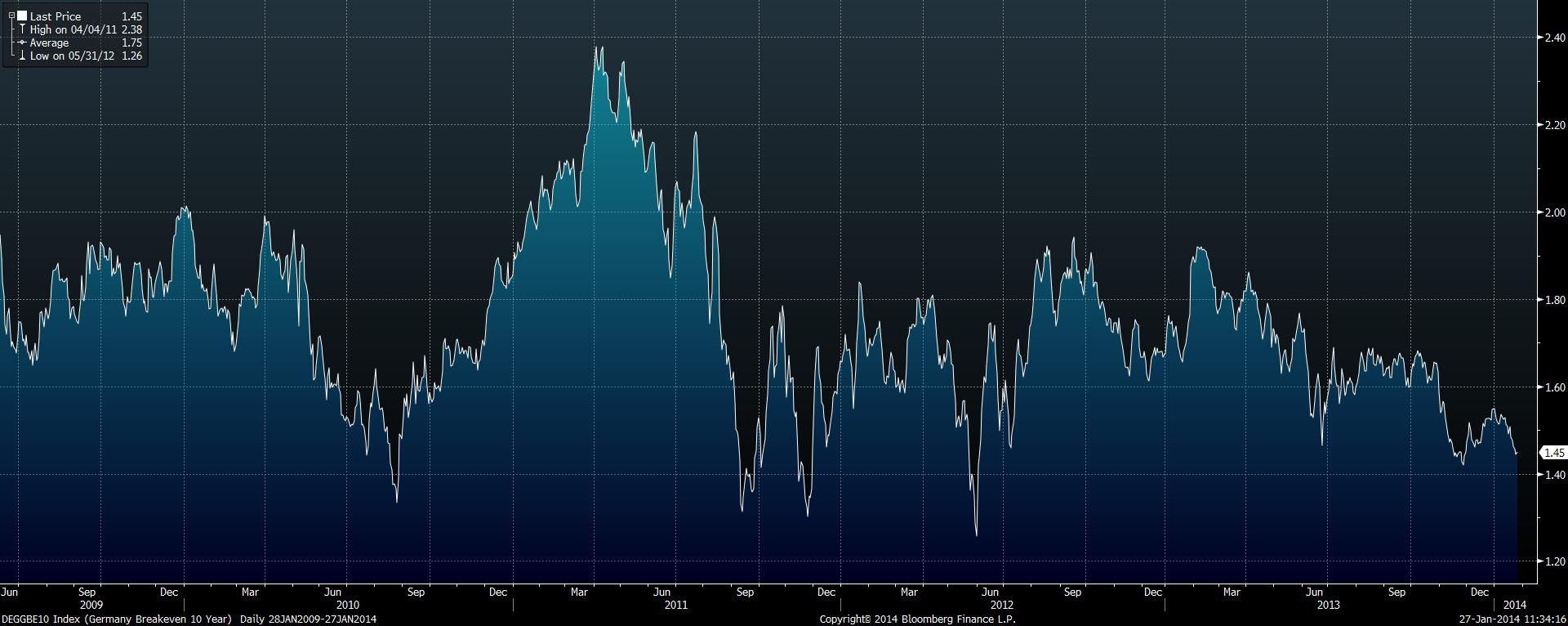
Many people especially here in Germany do think that we will see higher inflation going forward. I would not base my inflation expectations on subjective opinions but on observable market prices. Luckily we do have observable market prices for inflation: So called “inflation break even rates“, i.e the yield differences between nominal bonds and inflation linked bonds of the same issuer with the same maturity.

In order to adjust for inflation, one should always use those break even rates, as they are the best (and actually traded) proxies for inflation. Let’s look quickly at German Break even rates:

DEGGBE10 Index (Germany Breakeve 2014-01-27 11-34-09

So we can see that currently, the break even rate is very close to the actual assumed inflation rates for Thyssenkrupp and we do not need to adjust for this. However, when inflation rates would go up, we would need to adjust and the impact can be huge. For further information about inflation linked bonds, there is a lot of stuff available, for instance here.

Deflation put

There is however one “small” problem with the approach above: The price difference between inflation linked bonds and nominal bonds includes the scenario of deflation. Normal, EUR based inflation linked bonds will have a floor at 0% inflation, i.e. they don’t loose nominal value in a deflation scenario. German pension plans however have a floor at +1% inflation. If I would compare a German Inflation linked bond with a floor at 0% and one with a floor at 1%, the one with the 1% floor is clearly more valuable, which means that this put granted to the retirees is definitely worth something. Modelling inflation linked options is quite complex, so as a proxy I would use maybe a 2-3% top up for German pension plans in order to reflect this 1% “floor” granted to the retirees.

Common myth: Inflation component is not important as profits of the company and or nominal interest rates will increase with inflation

This is an argument I often hear: You don’t need to care about the inflation in pension liabilities, as the profit of the company will increase with inflation. A second argument is that if inlfation increases, interest rates will automatically go up and thus, offsetting the increase. Let’s tackle the issues one after another:

Company profits and inflation
Honestly, I think not many of us do really know how a period of increasing inflation looks like. In Germany for instance, the inflation rate was between 0-2% p.a. for the last 20 years, a real increase in inflation was experienced the last time around the date of the reunification in the late 80ties and early 90ties as this chart shows:

It should be clear from the past that not all company can simply pass inflation to customers and maintain (or even grow) profits. In my opinion, especially those companies with large pension liabilities have vulnerable business models, especially capital-intensive companies like Thyssen and Lufthansa. Software Companies like SAP for instance will be able to pass most of their cost increases to customers, but they don’t have an issue with pension liabilities anyway. Especially vulnerable in my opinion are utilities, where power prices in inflationary periods are often capped by regulators, whereas input costs often rise quickly

Inflation and interest rates

In the past, high inflation risks often went along with high interest rates, especially in the 70ties and 80ties. The relationship was mostly: Inflation spiked and central banks then had to increase interest rates in order to reduce economic activity and get inflation under control. This time however it might be different. Central banks all over the world have made it clear that the want higher inflation AND low interest rates in order to lower Sovereign debt burdens. It is not clear if they do achieve this, but I think it is also optimistic to assume automatically higher interest rates in the future if inflation picks up.

Quantifying inflation risk pragmatically:

If we look at all the points above, it should be clear that having a liability which will increase with increasing inflation is worse than having for instance a senior bond liability with fixed payments. Even if we use and adjust for current break even rates, there is always the risk that inflation increases above that, especially now, with the Central banks clearly targeting higher levels. As we have seen above, companies with a very strong competitive position and low capital intensity, we can assume that they will be able to earn their margins even under increased inflation. A company which is very asset intensive (i.e. depreciation will be too low in an inflationary scenario), will however get a “double whammy” via increasing pension liabilities.

My proposal to quantify inflation risk would be the following:

– company where inflation has no impact (or even positive) on profit: No adjustment necessary
– company where inflation impact is unclear: 5%-10% “risk adjustment”
– company where inflation impacts business negatively: 10%-20% “risk adjustment”

Those adjustments are very rough proxies for the amounts which would be calculated by a fully fledged risk model but I think as a rough indication this is better than nothing.

Summary:

So summing it up: In order to reflect inflation risks in a typical inflation linked DBO pension plan correctly, one should make the following adjustments for a prudent valuation:

1. Check if assumed inflation rate is close to relevant “Break even” inflation rates implied in traded inflation linked bonds. If not adjust with the difference multiplied with duration.
2. If there is a minimum inflation “guarantee”, further adjust with a 2-3% upwards adjustment for the liability
3. Determine if the underlying business is negatively effected from inflation. In doubt, use a 5%-10% mark up, if there is a clear negative relationship, use a 10%-20% mark up to reflect the uncertainty compared to a fixed liability

Again, I know that this are very rough proxies and you don’t need to do that. But for a prudent valuation, especially for companies with large pension liabilities, it would be very optimistic not to make adjustemnts for inflation risk.

Compagnie Du Bois Sauvage (BE0005576476])- See’s Candy in a Belgian wrapper ?

While researching Ackermans & Van Haaren, I stumbled over another smaller diversified Belgian holding company called Compagnie Du Bois Sauvage (CBS).

The company doesn’t look too exciting with the following “standard” metrics:

P/B 0.92
P/E 16.6 (mostly meaningless for Holdcos)
Div. Yield 3.3%
Market Cap 340 mn EUR

The company presents itself as a holding company, active in Real estate and strategic participation plus a so-called “treasury” division.

The strange name of the company (wild forest) is explained on the website as well as the origins.

However it is much more interesting what they are doing now, especially the strategic holdings. The company divides the participations into the following pillars:

-financial
-industrial
-food
-other

Financial:

This segment consists only out of 2 investments:

1) A 26.41 stake in a tiny Belgian Credit insurance company and

2) much more interesting a 12% stake in one of Germany’s oldest and most succesful private banks, Berenberg .


According to the CBS report, Berenberg has around 300 mn EUR equity and earned on average around 20% return on equity over the last 3 years, which is very very good. They seemed to have bought the stake in 2002 from an US shareholder.

I tried to reconcile the numbers in CBS annual report with the official annual report of Berenberg but it did not match. I think Berenberg reports only their bank, not the complete Group

Nevertheless a very interesting and high quality asset

Industrial

CBS discloses the following stakes:

– a 1.56% stake in listed Belgian metal group Umicore

– a 29% stake in listed Belgian automotive supplier Recticel

– 29% in an unlisted US plastics company called Noel

Nothing special here, very diversified but in my opinion without a clear focus or strategy.

Food – Neuhaus Chocolate & Pralines

This is in my opinion the “highlight” . The main company in this segment is Neuhaus, a famous Belgian chocolate manufacturer where CBS owns 100% of the company . According to Wikpedia, Neuhaus has actually invented the “praliné” as we know it.

Neuhaus was actually a separate listed company until 2006 and then taken private by CBS.

Out of curiosity, I did not follow my normal “Armchair investing” approach but did some real research. Neuhaus positions itself at the very high end of Chocolate and praline manufacturers. When i went into one of the biggest downtown department store in Munich, i was surprised that they actually charge 5 EUR for a 100 g chocolate bar and up to 75 EUR for a 1 Kilo representative praline selection. I bought myself a 250 gram pack for 17 EUR which looked like this:

I am not an expert chocolate, but someone else is, Warren Buffet. That is what he said about See’s Candy: (from 1998):

It is a good business. Think about it a little. Most people do not buy boxed chocolate to consume themselves, they buy them as gifts— somebody’s birthday or more likely it is a holiday. Valentine’s Day is the single biggest day of the year. Christmas is the biggest season by far. Women buy for Christmas and they plan ahead and buy over a two or three week period. Men buy on Valentine’s Day. They are driving home; we run ads on the Radio. Guilt, guilt, guilt—guys are veering off the highway right and left. They won’t dare go home without a box of Chocolates by the time we get through with them on our radio ads. So that Valentine’s Day is the biggest day.

Can you imagine going home on Valentine’s Day—our See’s Candy is now $11 a pound thanks to my brilliance. And let’s say there is candy available at $6 a pound. Do you really want to walk in on Valentine’s Day and hand—she has all these positive images of See’s Candy over the years—and say, “Honey, this year I took the low bid.” And hand her a box of candy. It just isn’t going to work. So in a sense, there is untapped pricing power—it is not price dependent.

Neuhaus is doing pretty much the same but with a twist: Their increase in sales seems to come to a large extent from Airport duty free stores. So instead of the Californian car driver you have the European business man or tourist but the principle is the same.

The biggest difference in my opinion is only the price. While See’s currently charges 18 USD per pound, Neuhaus actually gets away charging more than twice with 33 EUR (~40 USD).

It seems to be that for one, “Belgian Chocolate” allows them to charge premium prices. On a recent inland flight I quickly checked an Airport store in Munich, and indeed, Neuhaus together with Lindt was sold at very high prices at a premium location. The third brand was Feodora, the premium brand from Hachez, a privately owned German chocolate manufacturer.

Out of fun, I created a table of the developement of Neuhaus from the CBS annual report. The turn around and growth since acquisition is impressive:

Neuhaus 2003 2004 2005 2006 2007 2008 2009 2010 2011 2012
                     
Sales   64.52 70.88 83.9 96.25 102.25 105.7 119.9 133.47 149.27
Net   0.505 1.34 3.33 6.95 8.94 10.31 10.95 11.63 12.02
Equity   25.98 26.5 29.55 36.37 45.18 50.89 57.6 53.24 58.79
                     
Net margin   0.78% 1.89% 3.97% 7.22% 8.74% 9.75% 9.13% 8.71% 8.05%
ROE     5.1% 11.9% 21.1% 21.9% 21.5% 20.2% 21.0% 21.5%
                     
CAGR Sales     9.9% 18.4% 14.7% 6.2% 3.4% 13.4% 11.3% 11.8%
CAGR Earnings     165.3% 148.5% 108.7% 28.6% 15.3% 6.2% 6.2% 3.4%

Not only did they achieve a great turnaround, but Sales doubled and ROEs have been constantly at 21-22% p.a.since 2007. This resulted in a 10 times increase in earnings over this period.

If we look for instance to market leader Lindt from Switzerland, we can see that Lindt has a slight advantage in margins, but Neuhaus in growing more and has a better (and more stable) ROEs .

Lindt 2003 2004 2005 2006 2007 2008 2009 2010 2011 2012
                     
Sales p.s.   9,151 10,255 11,721 13,210 11,389 11,126 11,309 10,944 11,765
Net incom p.s.   684 788 947 1,123 1,158 851 1,061 1,084 1,198
Equity   3,638 4,421 5,224 6,195 6,519 7,168 7,410 7,095 7,695
                     
Net margin   7.47% 7.69% 8.08% 8.50% 10.16% 7.65% 9.38% 9.91% 10.19%
ROE     19.6% 19.6% 19.7% 18.2% 12.4% 14.6% 14.9% 16.2%
                     
CAGR Sales     12.1% 14.3% 12.7% -13.8% -2.3% 1.6% -3.2% 7.5%
CAGR Earnings     15.3% 20.2% 18.6% 3.1% -26.5% 24.6% 2.2% 10.5%

Don’t forget that the market is valuing Lindt at a 30x P/E, I think a 25x P/E for Neuhaus would not be unrealistic, as the business looks like a nice high ROE compounder.

In a M&A transaction, I could imagine even a higher multiple for such a premium brand from a strategic buyer.

Valuation:

Interestingly, CBS discloses NAVs on bi-annual basis, the last value being 270 EUR per share at June 30th 2013.

So we can easily use the template from the annual report and plug in own values:

What about a Holding Discount ?

I have written about how I look at Holding Comanies. In CBS case, I am neutral. I like that they are able to strike really good deals (Neuhaus, Behrenberg) and hold them for the long term. On the other hand, some of the activities look like trying to kill time. Positive: transparent and conservative NAV calculation. Overall I would not necessarily require a big discount here, maybe 10-15% or so.

Compared to GBL/Pargesa for instance we do not have a double holding structure and the main assets cannot be invested directly. So definitely a lower discount here. Compared to CIR, there is also only little leverage in the company.

SO let’s look at the sum of part valuation now:

% Value Comment
Neuhaus Chocolate 100.00% 300.00 PE 25(2012)
Behrenberg 12.00% 54.00 at 1.5 times book
Umicore 1.56% 60.53 At market
Recticel 28.89% 47.67 at market
Noel Group 29.37% 4.64 PE 10
Other   20.00 as disclosed
       
Codic Real Estate 23.81% 24.52 at book
other reals estate   60 as disclosed
cash etc.   20  
       
Sum   591.36  
Net debt   -80  
NAV   511.36  
       
shares our   1.6  
NAV per share   319.60  
Holding Discount   271.66 -15%
Upside   25.19% at EUR 217

What we see is that before applying the holding discount, the stock would have an upside of around 50% which would be OK for me. After applying the discount, the potential upside shrinks to 25%.

Other Info:

The guy behind CBS is Guy Paquot, a well-known Belgian investor. He owns close ~47% of the company.

According to this article, he comes from a rich family and was knighted in 2000 by the Belgian King. He stepped down in 2010 and is no official director anymore, but I guess he still influences the company to a large extent as the dominating shareholder

The Fortis situation

There is one dark chapter in CBOs history: As part of their activities they also invest into Belgian stocks. In 2008 however, they seemed to have received insider information about the upcoming nationalization of Fortis and were able to sell the stock before.

Because of this episode, the CEO actually was imprisoned for a few days and Guy Paquot came back from “retirement”.

It seems to be that one member of the supervisory board of CBS was also in the supervisory board of Fortis and passed the information. In 2008, it was speculated that the fine might be 40 mn or more.

The company settled the dispute finally in last November for a 8.5 mn EUR payment without committing to any wrong doing.

Stock price

Interestingly, the November settlement seems to have been some sort of catalyst, as the stock gained almost 30% in the aftermath.

The stock seems to have bounced off from the 2011 level of 230 EUR but overall I would say the chart looks ok.

Summary:

Compagnie du Bois Sauvage is an quite unusual stock. Among a strange combination of businesses, there is a prime asset hidden which I think is comparable to Buffet’s famous “See’s Candy” which accounts currently for 60% of the value of the company under my assumptions. If Neuhaus keeps growing at this pace for 2-3 more years, the percentage of Neuhaus could be even bigger.

My own valuation shows an upside of around 25% from current prices after a 15% holding discount which is too low for me to buy . So although I like the company and the two great assets (Neuhaus, Behrenberg), the current price is not attractive enough for me +. For me, A stock price of 185 UR would be required or maybe profits (and valuations) of the two prime assets increase enough to justify an investment.

P.S: I started looking at the company and writing this post already in November 2013, when the stock was around 190 EUR. This is the reason why the post is so long despite the missing upside.

« Older Entries Recent Entries »