Category Archives: Uncategorized

Special Situation: Celesio AG / McKesson take over – “Swimming with sharks”

DISCLAIMER: The securities discussed in this post are very risky and the author might have already bought some before publishing the post. The overall situation is tricky and not really recommended for “normal” investors due to the involvement of some well known capital market “sharks”.

Celesio, the German pharmaceutical wholesaler has received a takeover offer a few days ago from US giant McKEsson at 23 EUR per share under the condition that at least 75% of shareholders will tender their shares

A few facts/background:

– majority owner Haniel (also largest shareholder of Metro) needs money and committed to tender their controlling block of 50.01% for around 2 bn
– in the meantime however Elliott, the US Hedgefund acquired more than 25% and threatened yesterday to block the deal
– under German law, 75% is the threshold to establish a profit & Loss transfer agreement which gives full control to the acquirer as well as tax benefits

As a result, the share price of Celesio dipped slightly below 23 EUR after hitting 23.70 EUR earlier.

The offer
McKesson has actually created a dedicated website for the offers with all documents, some videos etc here including the detailed offer document.

The acceptance period runs until early January with a potential extension period until end of January. Similar to Vodafone/Kabel Deutschland, talks about the take over become public already several weeks before the official offer. I think this is clearly part of the game from the seller in order to get a good price.

Nevertheless I found it surprising that since the first announcements of the deal, McKesson’s share price surged and dropped when Elliott said that they want more. Elliott is even using this as their main argument according to this article:

The surge in McKesson’s value by $7.7 billion since early October, when reports on a takeover offer appeared, was a clear sign the Celesio acquisition offers high synergies for the U.S. group and is a bad deal for minority shareholders, Elliott said.

Celesio looks clearly expensive at 23 EUR. However even without operational synergies there is a lot of potential for improvement. Celesio pays ~150 mn interest on 2bn loans, a 7.5% interest charge. McKesson is able to refinance below 2%, this alone is more than 100 mn p.a. savings.

Elliott Management

Elliott Management is a well known US hedgefund ran by Paul Singer. They are most famous for their over a decade long fight with the Argentinian Government, where some months ago, the even went so far to seize the sailing ship of the Argentinian Naval forces.

In Germany, they were already active in two similar Deals, Demag Cranes and Kabel Deutschland. At Demag Cranes, they already cashed out with a nice profit (~+30%), after blocking the threshold at 90% which allows a complete squeeze out. At Kabel Deutschland, the hold 11%, again blocking the squeeze out which works only if the acquirer has more than 90%.

With Celesio they seem to slightly change the tactic by acquiring 25% and actually threatening to block the entire bid. However, one aspect remains the same: They involve themselves only when Anglo-Saxon bidders are in the game. I guess they don’t want to involve themselves with potential unpredictable players in “Local feuds” like in the Rhoen case.

Anyway, one thing is clear: Elliott is clearly not a player which gets pushed around easily. On the other hand, they are in to make money. This is the main difference to the Rhoen case, where some of the players (B. Braun) wanted to block the deal at any cost.

Simple “Valuation exercise”:

I would assume that the “undisturbed” Celesio share price in the months before the offer was around 17 EUR. So if the deal falls through, at the current price one would experience a loss of -25%.

If we assume that there will be no “top up”, than we can easily calculate the implied current probability that the deal will not happen based on a simple “binary” model:

x = (current price-offer price) / (undisturbed price – current price) = (22.80-23)/(17-22.80) ~ 3.4%

Now if we want to speculate on a top up, we have to make two assumptions: How likely is a top up and how large will it be ? In order to keep it simple, I would assume a 50/50 chance for a top up and as I like “round” numbers, I assume 5 EUR per share or a final offer at 28.

This leads us to the following expected value under those assumptions:

Exp. value Celsio share = (3.4% x 17) + (48.3% *23) + (48.3%*28)= 24.25 EUR or around 10.6% higher than the current share price.

Not a monster undervaluation but still a very attractive “bet” as the time horizon is rather short until the end of January.

A Twist: The Convertibles

Up until recently, Celesio had to struggle to refinance their debts. So they had to offer two convertibles in the past, each with an amount of 350 mn EUR which convert each into 17 mn extra shares (current total shares out: 170 mn).

The 2014 convertible will mature in 2014 nd is not a big issue with regard to the take over. However, the 2018 convertible is in my opinion much more interesting. First of all, the official strike price of 22.49 EUR will be adjusted down in case of a take over to compensate bondholders for the conversion premium paid at issuance.

Unfortunateley, I could not locate the full prospectus, only the 4 page summary from Celesio’s homepage. One 100 k EUR bond allows the holder to convert into 4.448 Celesio shares at the initial conversion price of 22.49 EUR per share.

But now it gets interesting: In the case of a “change of control” event, the conversion price is adjusted downwards based on the following formula:
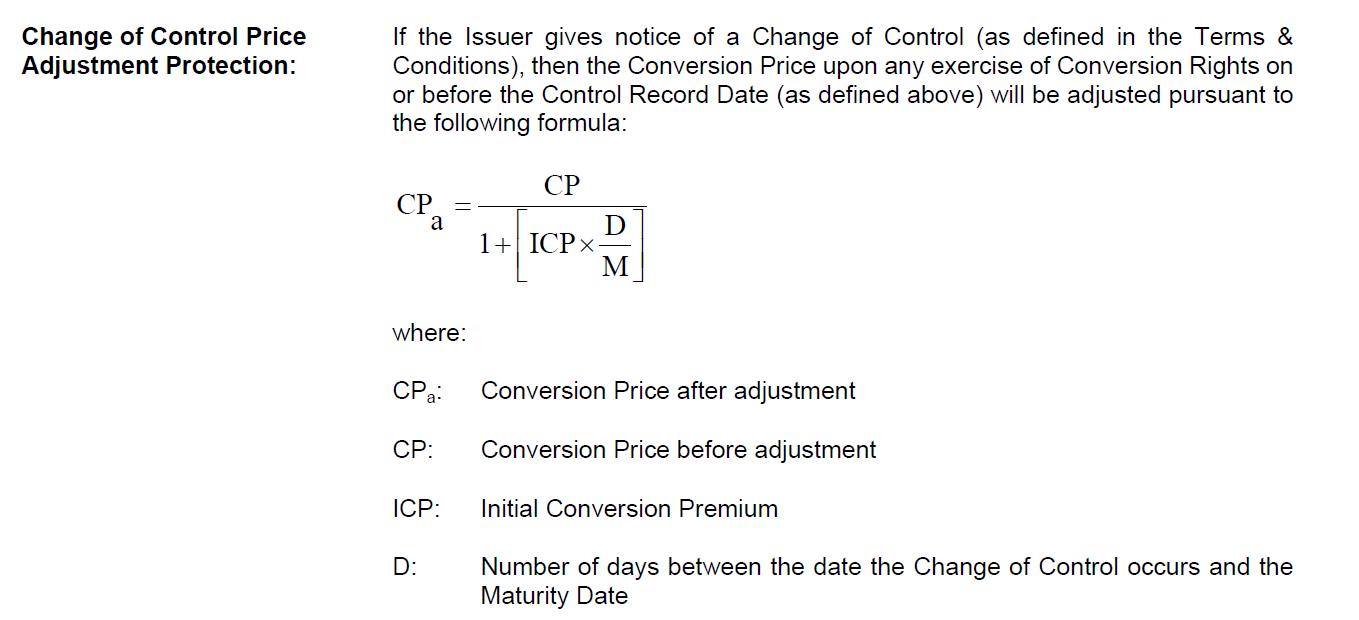
cls formel

This means that holders of the bonds now get more shares than before.

The “new” conversion price now would be now approx. 18.99 EUR, and the amount of shares accordingly 5.266 per 100k nominal. This in turn, multiplied with a share price of 23 EUR would mean a fiar value of the convertible of 121k or 121%, pretty much exactly where it is trading now.

In total, the 2018 convertible will be exchangeable into 19 mn shares, more than 10% of total outstanding shares at any time after the take over happens. However, this could turn out to be a big problem for McK. Any company doing such a takeover wants to get rid of minorities as quickly as possible and is therefore trying hard to squeeze out shareholders and delist the company.

With the 2018 convertible, this could be very difficult. Even if McK owns more than 95% of the shares, convertible holders could suddenly convert bonds into shares and then make a squeeze out impossible. The 2018 convertible therefore has a quite high “annoyance factor” for McK. In general, when a company has a more complicated capital structure, an “annoying” security can be a very good security to own.

In the case of the convertible, the only possibility for MCK to get rid of the convertible early, is the so-called “soft call feature”. This enables the issuer to call the bond, if the stock price is at or above 130% of the initial conversion price of 22.48. This would mean a stock price of around 29,20 EUR or an implict bond price of 154%.

EDIT: The soft call in the complete prospectus refers to the “applicable” conversion price. So in our case, after a change of control, it would be ~19 EUR and the call level would be around 24.70 EUR. This reduces the upside potential of the convertible, but it might increase the chances of a better offer overall.

That those thoughts are not totally without merit could be indicated via the disclosure int he offer documents that they seem to be already buying busily convertibles with the focus on the 2018 bond:

McKesson International Holdings IV S.à r.l., eine mit der Bieterin gemeinsam handelnde Person, hält 105 Anleihen 2014, welche zum regulären Wandlungspreis Wandlungsrechte in 233.437 Celesio Aktien gewähren, was 0,137% der derzeit ausgegebenen Celesio Aktien entspricht, und zum angepassten Wandlungspreis infolge eines angenommenen Kontrollwechsels am 17. Januar 2014 Wandlungsrechte in 242.494 Celesio Aktien gewähren,
was 0,143% der derzeit ausgegebenen Celesio Aktien entspricht, sowie 139 Anleihen 2018, welche zum regulären Wandlungspreis Wandlungsrechte in 618.327 Celesio Aktien gewähren, was 0,364% der derzeit ausgegebenen Celesio Aktien entspricht, und zum angepassten Wandlungspreis infolge eines angenommenen Kontrollwechsels am 17. Januar 2014 Wandlungsrechte in 730.042 Celesio Aktien gewähren, was 0,429% der derzeit ausgegebenen
Celesio Aktien entspricht.

Swimming with the Sharks

Why did I call this “Swimming with the sharks” in the headline ? Well, this is clearly not a small unknown company. We have Goldman Sachs (advisor McK) and Elliott in the game, both very very clever financial market players which i would consider as “sharks”.

The true “decision” tree ogf the players involved clearly includes a lot more branches with some of them resulting in negative payouts for “innocent bystanders”. So there is always the possibility that one ends up as “prey” in such situations, so be careful and don’t bet the house on any outcome.

So to summarize this quickly:

1. The Celesio share looks like “good value” if one believes in a certain upside due to the Elliott involvement and no dirty deals on the side
2. The 2018 convertible looks like the even more interesting part. In order to get rid of this bond, MCK will have to offer ~30% more than the current price which I think is very likely even if the Elliott trade doesn’t work out

In order to play both “games”, I will allocate 1.25% each for the portfolio, the stock and the 2018 convertible at current prices (22.80 EUR, 121%).

3 Years of Value & Opportunity

Sometime it is scary how fast time flows. 3 years have passed since the first post appeared on this blog.

According to the statistic tool of WordPress, in 2010, the blog had 310 “hits” which translates to around 20 per day. In 2013 this number has increased by the factor of 50.

This might be the right place to say a big “THANK YOU” to all readers and an even bigger “THANK YOU VERY MUCH” to everyone who has contributed either via comments and or EMails.

Top 10 posts this year

1. How to correctly calculate Enterprise Value
2. My 22 investments for 2013
3. Operating Cash Flow and interest expenses – (ThyssenKrupp vs. Kabel Deutschland, IFRS vs. US GAAP)
4. Risk free” rates and discount rates for DCF models
5. Kurzanalyse Prokon Genußrechte
6. TGS Nopec ( ISIN NO0003078800) – an “Outsider” Company Buffet would buy if he could ?
7. P/E, EV/EBITDA, EV/EBIT, P/FCF – When to use what ?
8. Berkshire Hathaway 2012 listed stocks performance
9. Piquadro SpA – Competitors, market analysis and strategies
10. Spin off watch: Osram Licht AG

Interestingly, the “general interest” posts generate a lot of traffic. My guess is that many business administration students are using Google instead of reading their books……

Why I (still) blog

For me, this form of writing is the single best way to focus and structure my investment ideas. As I can spend only a limited time per day on this and my “physical” record keeping abilities are quite limited, the blog enables me to effectively organise my research and quickly revisit each thought.

The second most important issue of blogging is feedback. I am a big believer in getting “challenging” feedback. Yes, there are also forums etc. but via the blog it is much easier for me to keep track of discussions. I am also very proud that the comments I get are on average of much much higher quality than the discussions in many investment forums.

How I do it

Sometimes I get asked how I have so much time for blogging. To me this is surprising, as I spend “only” around 1-1.5 hours (week ends included) per day on my private investments in total. For me, researching stocks and writing a blog post has become an almost seemless process. I mostly read electronic documents. For instance, when I was researching the Metso/Valmet Spin off, I make notes already into the blog. It then takes maybe 10-15 minutes to structure the notes into a blog post. So overall, the effort of writing the blog itself is not so big and only around 10-20% of my “private investment time”. However, I have to admit that I spend the rest of the day with somehow related finance topics 😉

Interestingly, the “structuring” part is also the part where I sometimes have to change my initial opinion. I guess this is some kind of “second level” thinking. Several times, I had a pretty solid opinion early on when looking into the stock, which then changes before actually releasing the post.

On going “professional”

Sometimes I get also asked, why I am not ging into “professional” investing. One of the big issues in my opinion is the institutional set up of many investment organisations. In many cases, time horizons of such institutions are rather short and analysts are forced to specialize within categories and sectors. This leads to the strange situation that even passionate investors often don’t really enjoy working in such environments, because more often than not Asset Managers are run by “business persons” which want to increase AuM before anything else.

I sometimes dream of setting up my own fund, however so far I did not have the courage to actually do so. I guess it is not easy to find enough investors for the kind of “go anywhere, invest in potentially everything” style I prefer without a “formal” track record.

Lessons learned (hopefully)

I am not sure of my investment approach has “evolved” but it has clearly changed since I started the blog. A few subjective observations:

– I trade a less than before. I am down from around 30-40 changes in portfolio constituents per year to 10-20. That doesn’t sound much but is effectively a doubling of the average holding period
– 4-5 years ago my portfolio would have been 97% German, now it is around 25%
– I used to focus mainly on price/tangible book value, today this is a rather secondary criteria
– looking at business models has become a much more important part of my analysis. I still don’t like to pay for growth but it prevented me from investing in some potential value traps
– “special situation” investing has become a bigger part of my portfolio

Personal highlights

Finally a few personal highlights from the last year:

1. The real high light was clearly my trip to Omaha to see Charlie and Warren live.

2. The biggest learning experience was clearly the IVG case. Although I lost money with that I think I gained a lot of insight for potential future distressed situations. Especially when to stay away….

3. My goal to establish and further develop my qualitative investment checklist has worked out very well. Having such a tool really adds a lot to the investment process.

4. Finally, Dart Group, my first “triple” while writing the blog was great fun and a great success for my “boring company” philosophy.

So before it is getting too boring, once again a big THANK YOU for reading and commenting and I am looking forward to the next 3 years.

Edit: I often get mails or comments lie “I think share xyz is undervalued, can you write a post about it”. I am very sorry, but usually I will not and cannot contribute a lot of meaningful answers. Unless it is a stock which I have analysed in the past, usually my own “pipeline” is so big that I do not have the time to look at each and every stock in a meaningful way. So unless it is connected in some way to my existing portfolio or there is a special “twist” or something, don’t expect much of an answer. I am not Jim Cramer or some simlar guy who has an opinion of each and every stock in the market.

Some links

If your have time for only one item this week, then read the latest memo from Howard Marks

Joel Greenblatt on value investing and patience

Very good interview with Marc Adreessen, one of the “pioneers” of the WWW

Good review about a new book called “”The Frackers: The Outrageous Inside Story of America’s New Billionaire Wildcatters””

Discovered by chance: Walter Schloss video on value investing (first 3 minutes).

Interesting article in the Ecominst on the Bitcoin Mining Industry

One more: Frenzel & Herzing with a new Vetropack analysis

Some Links

MUST READ: Great new blog from two young German guys. 2 comprehensive write ups: Sto AG and Hornbach AG

Congratulations ! The writer of the “Value Uncovered” blog got a full-time job at Yachtman because of his blog.

Gannon on Catering International, an interesting French company.

Good post from Nate why not every value investor should / could “go Buffet”.

Great post about the South Sea bubble in 1720. Nothing is new in finance.

A review of a new book about short selling. Interesting and very counter cyclical….

Short cuts: EGIS, Hornbach/Praktiker, Rhoen Klinikum, KPN

EGIS

This is from a broker report issued end of September by “Wood & Company”_

During the brief analysts’ conference call yesterday morning, Servier stressed two points: 1) regardless of the acceptance of the offer, Servier plans to delist the shares; and 2) Servier’s HUF 28,000/sh offer is final and will not be revised.
The minimum threshold to trigger a squeeze out under Hungarian regulations is 90%, which means that Servier needs acceptance from 79.63% of the outstanding free float, or 3.043m shares.
Regardless of the acceptance of the offer, Servier still intends to call an EGM to delist the shares from public trading, a step that requires a 75% majority of the votes cast; to block the delisting would require an absolute minimum of c.1.32m votes against, or c.35% of the free float.

Read more

Pharmstandard (US7171402065) – The Russian Job or interesting special situation with catalyst ?

A couple of weeks ago, when I analysed EGIS and other Eastern European Genric drug companies, I mentioned Pharmstandard OJSC as one of the big players in the interesting Russian Generics market.

A kept an eye on them mainly in order to gain a little bit more insight into the Russian market. But the story which developed over the last week is definitely woth sharing it.

Up until early July, everything looked great. Pharmstandard aggresively bought back shares in an amount of roughly 10% of their market cap. They communicated that they might use those shares to finance M&A transactions.

Then, in the beginning of July some strange news emerged (official press releases can be found here):

– first they stated that they want to do a spin-off of their OTC drug business
– then, on they same day they announced that they are in advanced talks on a potential M& A transaction
– then, still on the same day they announce that they will buy a company called “Bever Pharmaceutical” for 630 mn USD without describing the company at all.
– the bought company then again, will be included in the spin-off
– it is not clear if the spin-off would be listed or not or if GDR holders can legally get those spin-off shares
– then it came out, that one of Pharmstandard’s supervisory board members, Dr. Alexander Shuster is actually the owner of Bever and will become the second largest Pharmstandard shareholder via this transaction
– Nevertheless, a few days ago, a shareholder meeting approved the acquisition with the votes of the majority shareholders
– the next special shareholder meeting will be in September to decide on the spin off

Clearly, this story did not go well with investors. Both, the London listed GDRs as well as the Russian listed stocks got punished hard:

In my opinion, this clearly is not very shareholder friendly, but on the other hand, compared with what I have experienced in Italy (EMAK, Autostrada), this rather looks like an OK transaction at least with regard to the M&A transaction:

– they paid minority shareholders in cash via an open market share buy back
– they used pre “price drop” levels to determine the purchase price consideration

And, at least in Italy, buying into a stock AFTER such an event occured was usually an interesting entry point.

The special situation aspect: Potential buy back offer before spin off at 16.50 USD

Now it gets interesting. In their spin off presentation, they mention that there will be a buy back offer to shareholders before the spin off actually happens. In several articles (I did not found this on their website), a price of 16.50 USD per GDR was mentioned. According to the timeline, this should happen in November if everything works out.

So let’s do some quick math (EDIT: I wrote this yesterday…., today’s price is a lot higher):

If I buy today at 14.65 and get 16.50 in November, that’s a 12.7% return for 3 months. Not too bad. Clearly there is some downside, if the offer will not come and they spin offf without compensation for GDR holders. On the other hand, if the spin offf works out well, there could be significant upside on top of the 16,50 USD offer.

On top of that, I like the underlying business and I think the stock is cheap and undervalued (excluding the Corp Governance issues).

According to my model, the current Pharmstandard is worth far more. The company achieved on average over the last 6 years 20% net margins and 30% ROIC at a current valuation of PE/6, P/B 1.6 and EV/EBITDA at 5.5

Update: I started writing this post yesterday, when the stockprice was at 14.65 USD, today, it jumped already significantly to 15.39. For the time being I will remain on the sideline and watch.

Maybe there will be a opportunity for a odd-lot tender like Norislk 2 years ago. I would also consider adding a small stake if the price is at a ~10% discount to the offer prcie, so below 15 USD (up to 1% of the portfolio). So I will put in a limti order at 15 USD and wait how this interesting story developes.

Sold, rejected but not forgotten: Tracking 2nd level and 3rd Level investing mistakes

Some 15 months ago, I had a post about stocks I had either sold or not bought after analyzing them.

This time I want to update that list plus provide some “theoretical” background why I think this is an important part of any investment process.

Types of investment mistakes

Of course there are many mistakes to be made in investing. Nevertheless, for this exercise I would categorize “investment mistakes” into 3 general categories along the typical process of most “stock pickers”. The process normally looks something like this

A) Stock screening & quick analysis
B) Deeper Analysis
C) Buy decision (or not buy)
D) Sell at some point in time

At all stages, mistakes are easy to be made. Nevertheless I would argue that most analysis goes into what I would call Level I mistakes:

Level 1 mistake: Buying a stock which performs badly.

This is quite easy to identify, because if one looks at most investment reports, one will see the performance of the current portfolio with the bad performers “jumping out of the report”. I guess most of the efforts in many investment firms goes into finding out the reasons for those underperformers and then trying to improve.

A lot less effort usually goes in what I would call “level II” mistakes:

Level 2 mistake: Selling a stock which outperforms strongly after selling.

This is a little bit more tricky. There is a lot less literature of “when to sell” compared to “when to buy”. Once you have bought a stock, there should be already a fair amount of time and effort been made to analyse the stock. So in my opinion it makes a lot of sense to keep stocks on one’s radar screen even after selling. Nevertheless it is of course much more fun to look at new stocks and forgetting about the old stuff. Especially if sold stocks systematically outperform, one should check if one is not a prisoner to some well known investment biases

In my opinion, it also makes a lot of sense to systematically track the performance of sold stocks in order to find out if one could (and should) improve the investment process

Finally, there is a third systematic family of mistakes:

Level 3 mistake: Stocks analysed intensively but not bought

This is one of the advantages of blogging: Whenever I write a longer post, I already have invested quite some time on the specific stock. So it is quite easy for me to track those posts where I did for any reason not buy such a stock.

Again, I think one should look at this closely in order to identify potential biases etc. in one’s investment process.

From theory to practice: The last 17 months

So let’s look first at all the stocks I sold since the March 2012 post:

Stock Reason sold /not bought Date Perf Perf BM Delta
KPN Special situation expired 10.05.13 34.2% 3.3% -31.0%
IVG Conv ESUG 21.05.13 16.1% 1.1% -15.0%
Bouygues Portf. Mgt. 28.06.13 21.7% 7.1% -14.6%
Total Prod dissapointing CI 08.03.13 21.3% 7.1% -14.2%
Mapfre Autumn cleaning 31.10.12 30.1% 19.9% -10.2%
Dart Too expensive 18.07.13 7.1% 2.7% -4.3%
Total Prod dissapointing CI 10.04.13 12.1% 9.0% -3.2%
OMV Autumn cleaning 30.10.12 22.6% 19.5% -3.0%
Dart Too expensive 26.07.13 4.5% 2.8% -1.7%
Buzzi business model problems 23.05.13 2.8% 2.7% -0.1%
WMF too expensive 11.04.13 5.0% 8.1% 3.1%
Fortum Autumn cleaning 30.10.12 6.4% 19.5% 13.2%
Piquadro Sold because of business problems 08.08.12 2.7% 24.5% 21.8%
Nestle Sold because of Pfizer acquisition 23.04.12 11.8% 35.0% 23.3%
EVN Autumn cleaning 31.10.12 -9.9% 19.9% 29.8%
Praktiker Sold because of Anchorage 04.07.12 -81.3% 30.6% 111.9%
           
        avg 6.6%

Explanation: a negative number means that the stock has outperformed my BM since I sold it, a positive number means the Benchmark outperformed vs. the stock.

On (unweighted) average, the stocks I sold underperformed the benchmark, so this looks OK. This is clearly driven by the Praktiker bonds, where I am very happy that I sold them. On the other hand, I missed out some nice gains as well. With KPN for instance, I think I was a little bit too quick with the trigger finger. My “autumn cleaning” exercise was on average also positive. So this is a good encouragement to follow-up on this exercise.

Next come all the stocks I have analysed but not bought in the same format:

Stock Reason sold /not bought Date Perf Perf BM Delta
Reply Cashflow red flag 31.08.2012 140.6% 24.5% -116.1%
Banknordik forgot to follow up 26.11.2012 70.1% 19.5% -50.5%
Curanum not really interested 05.09.2012 66.7% 25.0% -41.7%
Severfield Too expensive stand alone 21.03.2013 47.7% 7.9% -39.8%
Walgreen M&A 04.07.2012 62.7% 30.6% -32.1%
Osram Target of 23 EUR not hit 08.07.2013 35.7% 6.1% -29.7%
M6 only short analysis, issue with CI 26.11.2012 43.0% 19.5% -23.5%
Cairo undecided 27.06.2012 58.1% 38.9% -19.2%
Halfords Negative momentum 06.06.2012 55.1% 40.5% -14.6%
Hankook could not buy privately 29.10.2012 31.0% 21.0% -10.0%
Astaldi too much debt 23.07.2013 11.2% 3.0% -8.2%
Porsche still don’t like them 29.11.2012 24.3% 17.7% -6.6%
CIR no margin of safety 17.07.2013 7.3% 4.0% -3.3%
EAC Watch only 29.07.2013 2.8% 2.6% -0.2%
Canal+ no real upside 19.09.2012 19.1% 19.6% 0.5%
Rallye leverage 25.01.2013 8.4% 9.3% 0.9%
Bongrain Doesn’t earn coc 26.11.2012 17.0% 19.5% 2.5%
Greek GDP linker   10.06.2013 -2.6% 3.7% 6.3%
Accell low FCF, insider selling 26.10.2012 12.3% 20.5% 8.1%
Solvac not cheap enough 13.12.2012 4.4% 14.9% 10.4%
Mr. Bricolage Too much debt 13.09.2012 9.4% 20.9% 11.5%
Viel Underlying busienss 18.12.2012 2.4% 14.0% 11.6%
Morgan Sindall no mean reversion potential 23.10.2012 1.0% 21.6% 20.6%
WSU because of US problems, not cheap 19.04.2012 10.6% 31.9% 21.2%
Maisons France Cycle 29.01.2013 -12.5% 9.4% 21.9%
Energiedienst Business model 04.02.2013 -12.3% 12.5% 24.8%
TNT Express Too expensive stand alone 21.11.2012 -5.2% 20.8% 26.0%
KHD insiders 30.07.2012 -0.7% 27.7% 28.4%
Fabasoft track record 25.06.2012 -2.7% 40.3% 43.0%
           
        avg -5.4%

Here unfortunately, the average doesn’t look so good. On average, the stocks I analysed but did not buy outperformed the BM as well. The most obvious miss is Reply SpA. However here, I still think that in the long run it pays to avoid companies with questionable accounting. In this case, clearly at least for now I was wrong to discard it.

A little bit more bothers me that 2 of my potential special situations, Osram and Severfield outperformed. Both were pretty clear-cut cases (Osram, classical spin-off, Severfield classical rights issue), but somehow I was lacking conviction to follow through on the idea. I think I have to be more careful to separate my careful market view and focus on quality from the special situation area.

Summary:

Looking at sold stocks and stocks rejected lat e in the investment process makes a lot of sense. In my case, I think selling looks OK, whereas I will have to work on my “special situation” investments.

MIKO BV – Quick comparison with Groupe Guillin SA (FR0000051831)

In my MIKO BV post a few days ago, Winter commented correctly, that the plastics division of MIKO looks similar to what a French company called Groupe Guillin SA is doing.

At a first glance, Group Guillin looks even more interesting with the following valuation metrics (in brackets MIKO):

P/B 1.0 [1.24]
P/E 6.8 [11.8]
P/S 0.3 [0.5]
EV/EBITDA 3.6 [5.5]

So Guillin does almost the same but is much cheaper. Cheaper is always better for value investors, isn’t it ?

Guillin looks also quite OK in my Boss model and even shows better free cashflow so what is not to like ? ROEs look Ok as well as this table shows:

ROE ROIC
31.12.2001 19.3% 9.6%
31.12.2002 27.0% 14.0%
31.12.2003 17.6% 12.6%
31.12.2004 12.0% 11.0%
30.12.2005 15.2% 10.0%
29.12.2006 10.4% 7.3%
31.12.2007 11.5% 8.4%
31.12.2008 7.0% 6.0%
31.12.2009 13.7% 10.4%
31.12.2010 13.4% 7.6%
30.12.2011 7.3% 5.3%
31.12.2012 13.4% na.

However, ROICs don’t look so great as Guillin especially since 2006, when they grew quite quickly after 3-4 years without growth but ROIC suffered significantly

Lets compare this with MIKO’s plastic segment numbers:

MIKO plastics          
  Assets Libailities Net invested assets NI ROIC/ROE
2007 29.3 5.6 23.7 2.40 10.1%
2008 35.1 4.5 30.6 2.16 7.1%
2009 32.4 4.35 28.05 5.17 18.4%
2010 39.4 6.1 33.3 4.55 13.7%
2011 42.9 5.7 37.2 4.04 10.9%
2012 46.7 6.7 40 4.12 10.3%

So we can clearly see that MIKO consistently generates significantly higher ROICs than Guillin (in some years 5-6% more) than Guillin. Guillin uses leverage to achieve OK ROEs, while Miko doesn’t use leverage. Also net margins are on average 2-4% higher for MIKO plastics than for Guillin.

So in my view, the MIKO plastics business looks much better quality than Guillin, despite the fact that the MIKO plastics division is only 15% of Guillins sales. So scale doesn’t seem to be the deciding factor, it looks like that MIKO has found a more profitable niche than the larger Groupe Guillin. As far as I understand, Guillin sells direct to supermarkets while MIKO’s clients in the plastics division are consumer product manufacturers.

I have been looking at Groupe Guillin actually quite often, but the low return on invested capital kept me away. Although one has to say that the stock performed quite well over the past years, also compared to MIKO:

So Guillin is clealry not a bad company, but in direct comparison I think MIKO has greater potential (and a better downside protection) than Guillin.

« Older Entries Recent Entries »