Category Archives: Accounting Tricks

Some fun with Enterprise Value – E.ON AG Decommissioning Liabilities

This is a follow-up to both, my recent post about EV/EBIT & Co as well as a discussion in a forum about how cheap German utility stocks really are.

German utility stocks are clearly in many lists for cheap stocks. Here is for instance a list of large utilities in Europe sorted by EV/EBIT:

Name Mkt Cap Curr EV/T12M EBITDA EV/T12M EBIT
       
ENDESA SA 23038.45 4.43 7.17
RWE AG 16827.67 3.06 7.27
E.ON SE 27849.92 4.89 7.64
PGE SA 8340.95 4.55 7.74
GDF SUEZ 41669.47 5.31 10.04
VERBUND AG 5739.31 4.93 10.07
EDF 49364.74 5.83 11.08
GAS NATURAL SDG SA 18052.44 6.91 11.26
DRAX GROUP PLC 3286.74 9.41 12.12
NATIONAL GRID PLC 34397.63 10.20 14.02
ENEL SPA 30805.4 6.22 14.94
A2A SPA 2562.72 7.52 15.16
ROMANDE ENERGIE HOLDING-REG 1066.69 9.56 18.64
SSE PLC 15811.63 12.01 18.76
IBERDROLA SA 29309.16 9.92 21.69
PUBLIC POWER CORP 2343.2 6.87 21.72

Apart from Endesa, EON and RWE really look like bargains. Even most “club Med” Italian utilities are trading at twice the EV/EBIT or Ev/EBITD levels than RWE and EON. A “mechanical” investor will say: I don’t care if they have issues, I will buy them because they are cheap.

However, there is a small problem: As many people know, following the Fukushima incident, the German Government decided in 2011 to speed up the exit from nuclear power and switch off the last nuclear power plant in 2011. Funnily enough, only in 2009, they decided to extend the licenses significantly.

Anyway, just switching of a nuclear power plant is not enough. Especially in a densely populated country like Germany, you don’t want to have those nuclear ruins everywhere. So the utilites are required to fully “decommission” the reactors and also all the nuclear waste. Decommissioning is expensive, for instance it is estimated for instance at currently 70 bn GBP for all UK nuclear power plant.

In order to avoid that utilities just go broke before they close their nuclear power plants, the are required to build up reserve accounts in their balance sheet. Let’s take a look into their 2012 annual report page 159:

eon nuclear

EON has 16 bn EUR of reserves on its balance sheet for the decommissioning of nuclear power plants. Those 16 bn are clearly already reserved in the balance sheet, but as they will be due in cash rather sooner than later, they should be clearly treated as debt and added to Enterprise value.

However, there is a second issue with them: For some reasons, they are allowed to discount those amounts with 5% p.a. This is around 2% higher than for pension liabilities which in my opinion is already quite “optimistic”. They do not offer any hint about the duration of those liabilities, but if we assume something like 10-15, just adjusting the discount rate to pension levels would increase those reserves by 3-5 bn and reduce book value by the same amount.

So all in all, net financial debt for EON more than doubles if we take into account a realistic value for the nuclear waste removal obligations.

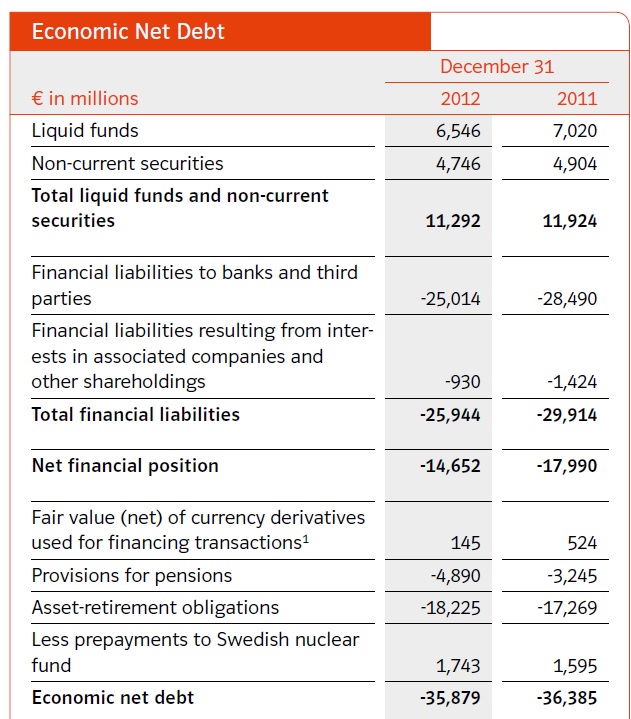
Interestingly enough, E.on presents its own “economic financial debt” calculation on page 45 of the annual report, including pensions etc.:

EON net debt

If we adjust the nuclear liabilities for the unrealistical discount rate, we get around 40 bn “economic” finanicial debt. So let’s look how EV/EBIT and EV/EBITDA change if we use those debt figures:

Before adjustment:

Enterprise Value of 48 bn (28 bn Equity, 3 bn minorities, 23.5 bn debt minus 6.8 bn cash)
EBITDA ~ 9.8 bn
EBIT ~6.3 bn

Adjusting for economic debt, we get an EV of 71 bn and the ratios change as follows

EV/EBITDA adj = 7.2 v. 4.9 unadj.
EV/EBIT adj = 11.3 vs. 7.6 unadj.

So adjusting for economical debt already eliminates most of the “undervaluation” compared to the peers. All things equal, a Verbund for instance which only produces “clean” power at the same valuation seems to be a much much safer bet than EON.

Summary:

Even quite useful metrics like EV/EBIT and EV/EBITDA can be misleading if a company has large other liabilities which turn out to be very similar to debt. If a company looks cheap under EV/EBITDA, always check if there are pensions, operating leases or in the case of utilities Decommissioning liabilities which are not captured by the standard formula.

In this case, the company evene presents its “true” debt, but it is still not adequately reflected in almost every investment database.

Finally a quick word on “mechanical” investment strategies: I cannot prove it, but I am pretty sure that a mechanical strategy based on EV which adjusts for “obvious” shortcomings like operating leases should perform even better than the published results from O’s et al. However It is almost impossible to backtest this.

Quick check: Astaldi SpA (ISIN IT0003261069)

Astaldi SPA was now mentioned by at least 2 commentators as an interesting stock, so let’s look at this Italian stock.

Looking at the “Normal” fundamentals, it seems clear why:

P/E 7.1 (2012)
P/B 1.0
P/S 0.2
EV/EBITDA 6.2
dvd. yield 3.1%

So at the first look, a single digit P/E and P/B of 1.0 look attractive.

On top of that, Astaldi has increased earnings each year in the last 10 years at an impressive rate:

EPS DIV ROE
31.12.2003 0.23 0.05 10.0%
31.12.2004 0.27 0.07 12.1%
30.12.2005 0.28 0.08 13.1%
29.12.2006 0.31 0.09 11.2%
31.12.2007 0.39 0.09 12.9%
31.12.2008 0.43 0.10 13.2%
31.12.2009 0.57 0.10 16.0%
31.12.2010 0.64 0.13 15.8%
30.12.2011 0.73 0.15 16.0%
31.12.2012 0.76 0.17 15.2%

Well, what is not to like ? Even my Boss Score says that they are attractive, indicating ~100% upside.

First, Astaldi is primarily a construction company. As a construction company, a large part of the balance sheet is either “work in progress” or “receivables”. The problem with that is that you never really know how at what stage profit will booked and if this is really earned or if there is some nasty surprise at the end. To illustrate this point, look at this table from page 179 of the 2012 annual report:

2012 2011 Change 2012 2011 2011+2012 In % of sales
– Revenue from sales and services 879,025.00 292,875.00 1,171,900.00 26%
– Plant maintenance services 12,544.00   12,544.00 0%
– Concessions construction and management phase 95,740.00 91,186.00 186,926.00 4%
– Changes in contract work in progress 1,330,781.00 1,881,223.00 3,212,004.00 70%
– Final inventories of assets and plant under construction 7,209.00 0.00 7,209.00 0%
Total 2,325,299.00 2,265,284.00 4,590,583.00

So this table shows that around 70% of Astaldi’s sales were unfinished projects accounted for as “percentage of completion”. This is the respective passage of their accounting principles (page 285):

Long-term contracts
Contract work in progress is recognised in accordance with the percentage of completion method, calculated by applying the cost to cost criterion.
285. This measurement reflects the best estimate of works performed at the reporting date. Assumptions, underlying measurements, are periodically updated. Any income statement effects deriving therefrom are accounted for in the year in which such update is made.

This is a big problem for me. I don’t know if their “best estimate” is cautious or aggressive. I have no evidence that they are doing anything wrong, but for my personal investment style, I do not like companies with a large share of “percentage of completion” business because that introduces a lot of uncertainty into the stated results.

The second problem I see here is the high amount of (gross) debt funding. Astaldi had around 1.25 bn EUR gross financial debt at the end of 2012. For construction companies, a combination of external debt with long term projects can be quite dangerous. Normally, one would expect that most of the projects would be funded via prepayments but Astaldi only manages to get around 400 mn EUR in prepayments.

The big risk here is that one big busted project or problems with one subsidiary can trigger loan covenants and then there is “game over” or at least a large dilutive capital increase.

Loan covenants:

Let’s look shortly at their loan covenants (page 223):

Covenants and negative pledges
The levels of financial covenants operating on all the committed loans the Group has taken out with banks are listed below:
(The present document is a translation from the Italian original, which remains the definitive version)
– Ratio between net financial position and equity attributable to owners of the parent: less than or equal to 1.60x at year end and 1.75x at half year end;
– Ratio between net financial position and gross operating profit: less than or equal to 3.50x at year end and 3.75x at half year end.

Lets do a quick calculation of the ratios in 2012 (based on their own “net financial debt calculations on page 32):

YE 2012: Net financial deb 812 mn, Equity 468 mn –> this would be already 1.73 times, so clearly above the threshold. Only if they include some “non current financial receivables” in an amount of 186 mn, the come down to 622/486 = 1.27 times.

In my opnion, their financial position looks clearly stretched. Maybe this is the reason why they had to issue a quite expensive 100 mn EUR convertible bond early this year. Issuing convertible bonds is ALWAYS a big warning sign that a company cannot fund its operations with “normal” debt.

For me, this is already a BIG RED FLAG. In my opinion, there is no margin of safety in a company with such a high debt load and such tight situation in terms of covenants.

Other more superficial observations after reading thorough the last annual report:

. unfocused concession portfolio (car parks, motorway, airports, hydroelectric plant, hospitals)
– comprehensive income in the last 4 years was always lower than stated eps

SIAS in comparison, my Italian “infrastructure” stock is a much easier story. Less debt, no “percentage of completion”, clear focus on motorway concessions.

Summary:

Despite the nominally cheap valuation, I don’t really like Astaldi. The high amount of “percentage of completion” assets combined with a rather large debt load make the stock quite risky in my eyes. If things work out well, there is clearly upside, however if one project goes wrong, the company will be in big trouble. So no real “Margin of safety” here in my opinion.

And no, I don’t think that concession business has a bright future. As an Italian company one has a clear competitive disadvantage with higher funding costs and in my opinion it is impossible to run so many different types of concessions in different countries really effectively. I am afraid that they will overpay and/or get the stuff the specialists don’t want.

IFRS 19 pensions “Voodoo accounting” – ThyssenKrupp edition

ThyssenKrupp issued their quarterly earnings today. Together with Lufthansa, Thyssen has one of the largest “pension holes” in the DAX index.

As we all know, from 2013, IFRS 19 requires to fully reflect pension liabilities “on balance”. Interestingly, in their Investor presentation, IFRS equity is not mentioned at all.

So one really has to go into the interim report to look what happened.

And again, at a first glance it doesn’t look so spectacular:

Shareholders Equity end of March is around 2.8 bn EUR, 0.77 bn less than stated for September 2012, in line with the losses. However when we look into the developement of the equity position of page 32 of the report, we can see that closing shareholders equity has actually been 7.6 bn in September 2012.

In contrast to Lufthansa, they hide their restatement in an “insignificant drop” of retained earning from March 2012 to September 2012 in an amount of ~4.2 bn EUR. Lufthansa had spread their restatement over 2 years. So there seems to be quite some leeway how to do this.

So to sum it up: Thyssen Krupp has lost ~ 4.8 bn of equity or -63% and management doesn’t even bother to disclose this to shareholders in their presentation. Well, who cares about equity anyway ?

One final remark: Thyssenkrupp uses 3,6% to discount the liabilities, which is quite high. Many other companies use 3.2% for EUR or less. As a proxy, one would multiply the difference times 15-20 in order to see what to add in percentage points to the pension liabilities.

So to scale this, we would for instance multiply 0.4%*15= 6%. With total pension liabilities of 8 bn EUR, we would need to deduct a further 500 mn EUR from equity in order to compare them with more conservative companies.

In any case, I think Thyssen will need to raise some equity capital pretty soon.

Voodoo IFRS Accounting: Lufthansa AG pension liabilities Q1 2013

Lufthansa AG, the large German airline company has a serious problem with pension liabilities. Some people even call it the “flying pension plan”. In the past, under IFRS, they could defer the recognition of higher pension liabilities over a very long-term via the so-called “corridor” method.

However in 2013, IFRS 19 changed this. Now, pension liabilities have to be fully recognized in equity via OCI (other comprehensive income).

This is what Lufthansa wrote in their 2012 annual report:

Change in accounting standard IAS 19 will lead to higher pension provisions
The Group runs defined benefit pension plans for staff in Germany and abroad, which are funded by external plan assets and by pension provisions for obligations in excess of these assets.
In the context of these defined benefit pension plans, the amendments to the accounting standard IAS 19, Employee Benefits, applicable as of 1 January 2013, mean that actuarial gains and losses from the revaluation of pension obligations and the corresponding plan assets are recognised immediately and in full in equity, without effect on profit and loss. One important effect of this retroactive application of the standard
will be that the balance of actuarial losses previously carried off- balance-sheet will be offset against equity at one stroke as of
1 January 2013. After accounting for taxes, this will reduce Group equity by EUR 3.5bn. The change in the accounting standard does not result in higher pension payments, however, nor does it establish an obligation to make additional contributions to fund assets.

When I read their Q1 2013 report, I was however really puzzled:

On the very first page the show that the equity ratio remained relatively constant (15.4% against 17.7% at year end). Based on the information above (3.5 bn pension off-balance sheet liability) and 8 bn equity, the equity ratio should have been dropping by almost a half.

Further on, they write the following in the quarterly report:

The revised version of IAS 19 Employee Benefits (revised in 2011, IAS 19R), application of which has been mandatory from 1 January 2013, had a substantial influence on the presentation of the assets and financial position in this interim report.
The revision caused pension obligations and other provisions under partial retirement and similar programmes to go up by a total of EUR 3.8bn as of 1 January 2013 compared with the financial statements for 2012.

On the same page the reiterate the almost unchanged equity:

Shareholders’ equity (including minority interests) fell by EUR 262m (– 5.4 per cent) to EUR 4.6bn as of the reporting date. The decline
is largely due to the negative after-tax result of EUR – 455m, offset by an increase of EUR 166m in neutral reserves from positive changes
in the market value of financial instruments. The equity ratio of 15.4 per cent was lower than at year-end 2012 (16.9 per cent).

So wtf happened ? How can you increase liabilities by 3.8 bn and equity remains unchanged ? Even if we look at my “beloved” OCI statement (page 23) we can see that OCI statement, we can see that OCI is in fact POSITIVE ?

Dark Side of IFRS Accounting: Restatements

Before it gets to exciting, let us introduce to an instrument from the “Dark side” of IFRS accounting: The so-called “Accounting Restatements”.

Definition:
An Accounting restatement means, that already “closed” accounting periods will be “opened up again” and the P/L will be retroactively changed. Usually this is done, when real errors (or fraud) are detected and the auditors force the restatements. In some special cases however, very creative CFOs use this tool to shift losses into the past and bury them in the hard to read (and understand) part of the accounts.

How to detect ?
Well you can either try to understand the “change in equity” portion of the balance sheet. Which is quite hard sometimes. Or you perform a quite simple check:

Just look at the equity of the last report (here annual report 2012) against the value of the current report. And surprise surprise:

In the annual report 2012 (which was only issued a few weeks ago), equity for 31.12.2012 was stated at 8.2 bn EUR. In the quarterly report issued now, equity for 31.12.2012 now suddenly has shrinked by 3.4 bn to 4.8 bn.

So just to summarize this:
Between issuing the annual report 2012 in Mid mArch and the quarterly report which was issued in the beginning of May, Lufthansa decided to change their accounts retroactively for a fact which was already well known since quite a long time.

This is not illegal,but in my opinion they could have explained that better that they used a restatement to book this retroactively.

Why did they do it ?
The reason is relatively clear in my opinion: In order to not put a spotlight on the fact that now almost 50% of the equity have disappeared. The strategy so far looks quite succesful:

The stock even outperformed the DAX.

What to do ?

One interpretation of this is that the capital market is so efficient and this has all been priced in already. The other interpretation would be that Lufthansa is trying to bury bad news into past results and this opens up a nice short selling opportunity if reality finally catches up with investors.

I tend two favour the second interpretation.

For a cpaital intensive busienss like airlines with no real moats, the book value (or replacement value) is not a bad proxy for the value of an airline. Lufthansa now “jumped” from around 0.8 times book to 1.6 times book.

Name P/B
DEUTSCHE LUFTHANSA-REG 1.61
GARUDA INDONESIA PERSERO TBK 1.31
INTL CONSOLIDATED AIRLINE-DI 1.31
MALAYSIAN AIRLINE SYSTEM BHD 1.25
SINGAPORE AIRLINES LTD 1.01
AEROFLOT-RUSSIAN AIRLINES 1.00
THAI AIRWAYS INTERNATIONAL 0.97
CATHAY PACIFIC AIRWAYS 0.96
AIR NEW ZEALAND LTD 0.93
AER LINGUS GROUP PLC 0.89
QANTAS AIRWAYS LTD 0.68
AIR FRANCE-KLM 0.63
SAS AB 0.44
DELTA AIR LINES INC na
 
Avg 1.00

Funny enough, the average of those 13 airline companies for P/B is exactly 1.0 but that is a coincidence. On the other hand, I don’t see a compelling reason why Lufthansa should trade signifcantly above book value.

Going forward, Lufthansa will be on my “short watch list”. I am tempted to bet that most analysts didn’t really understand what Lufthansa has done and P/B will most likely go towards the industry average.

Total Produce (IE00B1HDWM43) 2012 preliminary results – Disappointing

Total Produce is one of the core holdings since the beginnings of this blog. In the beginning, we analysed the stock mostly in German, nevertheless, we finally settled after some back and forth on a fair value range of 0.69-0.83 EUR per share based on a free cash flow analysis, assuming ~8 cent of “adjusted” free cash flow per share (adjusting esp. for minorities.

One of the issues with Total Produce were back then Balance sheet quality (lots of goodwill, leverage) and only average return on equity, which however was set off by a very cheap price, significantly below book value

In between 2 things happened:

1. The price of the stock increased nicely to around 0.61 EUR. resulting in an overall performance of +55% incl. Dividends.
2. The quality of earnings however deteriorated in my opinion.

I think I have to explain point 2 a little bit in more detail. If you read the 2012 premliminary results, everything looks great:

Revenue (1) up 11.2% to €2.8 billion

Adjusted EBITDA(1) up 17.8% to €70.4m

Adjusted EBITA (1) up 21.4% to €54.6m

Adjusted profit before tax (1) up 19.1% to €47.3m

Adjusted EPS (1) up 12.0% to 8.11 cent

Final dividend up 12.0% to 1.512 cent; total 2012 dividend up 10.0% to 2.079 cent
(1)
Key performance indicators are defined overleaf

So everything is up double digits, where is the problem ? Well, the problem could be the use of the word “adjusted” in most of the items presented.

If one flips to the next page of the report, we can already see that “unadjusted” EPS declined by -7.5% from 7.11 pence to 6.58 pence per share.

Where does that come from ?

The “explanation” reads as follows:

Adjusted earnings per share excludes acquisition related intangible asset amortization charges, acquisition related costs, exceptional items and related tax on such items.

On the one hand, one could say OK, acquisitions are not part of the operating business, let’s ignore that. However, Total produce does a lot of acquisitions, year after year. Most of their growth actually comes from acquisitions, organic growth seems to be quite limited.

Total Produce, year after year reports those “adjusted” earnings, whereas the “regular earnings” are always lower. Let’s look at the past 4 years:

2012 2011 2010 2009 Avg
“adjusted ” EPS 8.11 7.24 6.84 6.47  
EPS 6.58 7.11 5.25 3.7  
EPS/Adj. EPS 81.1% 98.2% 76.8% 57.2% 78.3%

So not surprisingly, we only see “upside” adjustments, on average the “real” EPS is only ~78% of the adjusted EPS.

But it gets worse. In my opinion, one of the most “underused” pieces of information about the quality of a companies’ accounts is the Comprehensive Income statment.

“Modern” IFRS accounting allows quite a lot of items to be booked directly into equity as those items are considered sort of non-operating as well. Usual suspects in this category are:

– pension revaluation
– fx effects of foreign subsidiaries
– revaluation of fixed assets

In my opinion, one has to look at all those items because all of them influence the value of the equity position. Let’s look again at the last 4 years:

2012 2011 2010 2009
EPS 6.58 7.11 5.25 3.7
EPS “Comprehensive” 5.15 4.21 5.39 7.34

2009 looks better based on comprehensive income, however especially 2011 and 2012 look bad from that perspective. This is mostly the result of pension charges. interestingly, in 2009, they booked a 3 mn EUR pension gain into comprehensive income, since then, Total Produce however had to book in total 30 mn EUR negative charge through comprehensive income.^The discount rates used to discount the liabilities at the end of 2012 are still relatively high at ~4.2% both for EUR and UK. So there will be more charges coming.

Many analysts will tell you that comprehensive income doesn’t matter, because it is not operational, but I have a different view. With regard to pension for instance, an increase in pension liabilities means that you will have higher cash outflows in the future and the shareholder will get less.

Free Cashflow

For 2012, Total Produce reports ~41 mn EUR Free cashflow. That’s about 12.5 pence per share or ~50% higher than in our base case scenario. Again, this has to be taken with a “grain of salt”.

Again, as in the first post about Total Produce, I would eliminate the working capital movement, especially as the improvement only came from higher payables and not a reduction of inventory or receivables.

If we do a quick “proxy” calc I would calculate the following Free Cash flow:

+ 38 mn EUR OpCF
– 13.5 maintanance capex (depreciation)
– 1.1 “net minority dividends
= 23.4 mn EUR or ~7.8 cents per share.

This is only slightly below the initial assumption of 8 cents per share but does not include the various payments for the acquisitions.

The problem I do have is that most of the free cash flow is now used for acquisitions, where I am not sure how “value added” that part is.

Summary:

In my opinion, Total Produce’s earnings quality deteriorated significantly. The “adjusted” numbers should be ignored, based on comprehensive income the company only earned ~5.15 pence for the shareholder and this is based on quite optimistic assumptions for the pension liabilities.

The company is using the majority of its free cash flow for acquisitions, where due to all those special effects, it is not clear to me if they earn really enough return. The priority seems to be to increase the size of the company. In my initial thesis, I was giving them extra credit for buying back shares but this seems to be no priority any more. Total value creation suffers quite significantly because of all the related expenses etd.

So I do not see much upside from here as the stock is now already close to my (slightly reduced) value range.

As a result, I will in a first step reduce my Total Produce position by 50%. I assume to have executed this end of last week at an average price of 0.61 EUR per share.

The other 50% are “on probation” so to say, I will look at the annual report and maybe 6M numbers in order to decide finally (or something better comes up).

Operating Cash Flow and interest expenses – (ThyssenKrupp vs. Kabel Deutschland, IFRS vs. US GAAP)

In my recent post to Kabel Deutschland, I made the following remark:

Interestingly, the “operating cashflow” does not include interest charges. In my opinion, interest charges are operating, as they have to be paid regularly and there is no discretion like dividends. So in my view Kabel Deutschland currently runs free cashflow negative and dividends are paid out from the increase in debt.

After some discussions, I was less sure about this myself so I thought it might be a good thing to look at this more closely.

Before jumping into “definitions” of how to calculate and report different cash flow definitions, one should take one step back and ask oneself:

What is “free Cash Flow” supposed to mean anyway ?

The current mantra for most “sophisticated” investors is that you should more or less forget earnings and concentrate on “free Cash flow” as this is the most important metric for determining the value of any (non financial) company.

“Free Cash Flow” in plain English should quantify the amount of money which is generated by a company over a certain period of time (usually 1 year) which can be used in a discretionary fashion to either grow the company, pay dividends, buy back shares etc.

In order to calculate this number, you normally start with operating cash flow, which in theory should contain all cashflows to operate the business on a going concern basis and then deduct cash out for normal Capex, i.e. investments required to ensure the “status quo” of the company.

Further one has to distinguish between two perspectives when deciding how to calculate Free Cash flow:

Free Cash flow to the firm vs. Free cashflow to equity

The single most difference between Firm/equity perspective is that in the “firm perspective” one assumes that the financing structure is discretionary. One wants to evaluate the whole value of the firm based on the firm wide discretionary cashflow.

However, with free cash flow to equity, I have to take the current financing structure as given and one has to calculate how much of discretionary cash flow is left for the shareholder. This of course implies, that interest charges are not discretionary for a shareholder but have to be subtracted from Free cash flow to equity.

This is especially important for highly leveraged companies where interest expenses can “eat away” a lot of discretionary cashflow.

The problem:

So far so good, where is the problem ? The problem is that different companies report cashflow differently.

Let’s look at Thyssenkrupp for instance:

thyssenkrupp opcf

They start with Net income and adjust for depreciation etc. but not for interest expense. Interest expense ist therefore shown within Operating Cashflow (net finance expense was 168mn, maybe they didn’t bother with -1.3 bn operating cashflow.

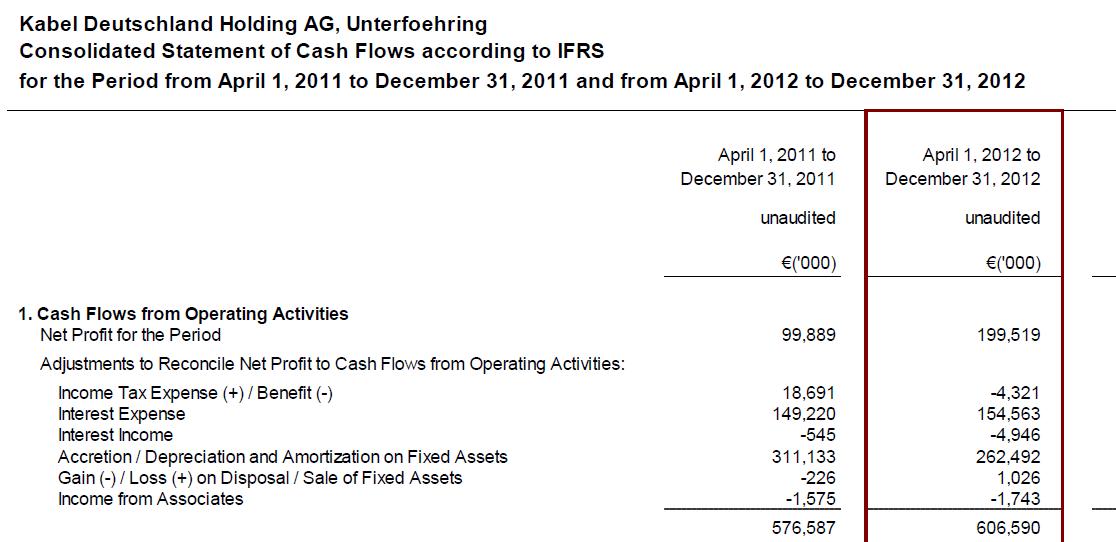
Now let’s look at the 9M Kabel Deutschland Cashflow report:

kabel op cf

We can see that other than Thyssen Krupp, Kabel Deutschland adds back interest expense to Operating CF.

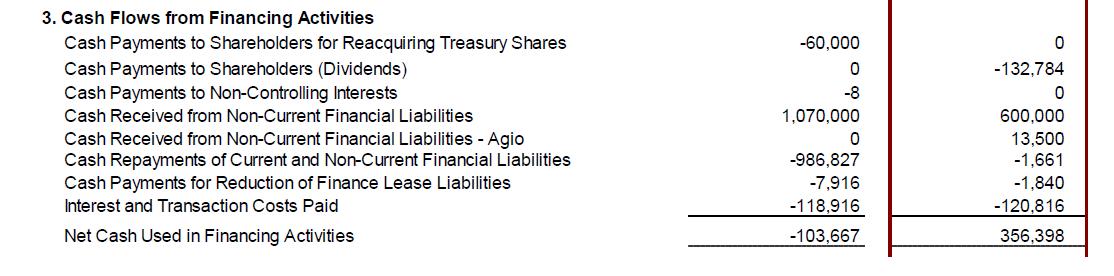
Later on, we can see interest expense under Financing Cashflow:

kabel financing cf

Accounting view

Under US GAAP it is clear: Interest expense belongs to the Operating cashflow statement. Under IFRS however a company can can choose between Operating and Investing Cashflow (see here, 7.15)

So we can see, there is nothing explictly wrong with Kabel Deutschland from a reporting point of view, they just have chosen to report interest expenses under Financing cashflow.

There is an interesting paper to be found here which makes the following observations:

We find that firms with greater likelihood of financial distress and a greater probability of default make OCF-increasing classification choices. We further show that firms accessing equity markets more frequently and those with greater contracting concerns are also more likely to make OCF-increasing classification choices. Firms with negative OCF are less likely to make OCF-increasing classification choices.

So that is no surprise that a PE “boot strapped” company like Kabel wants to show higher OCF and FCF and opts for Financing Cashflow.

What to do & Summary?

In my opinion, you have to make sure first that you compare apples to apples if you look at two different companies and compare free cashflows. Make sure that you treat this consistently. I am not sure if all the US investors which hold the largest stakes in Kabel know about this small but important reporting difference.

Secondly, I personally think that interest expenses always should be deducted from Operating Expenses and therefore Free Cash Flow in any equity valuation exercise.

Imagine for instance a company which rents its building against a company which takes out a loan to buy the exact same building. In the first building, you would subtract the rent clearly from operating profit, so why would you not subtract the interest on the mortgage for the second company ?

Hess AG (DEDE000A0N3EJ6) busted German IPO stock – Could the fraud have been easily detected ?

Just yesterday, Hess AG, a company which IPOed on the German stock exchange on October 25th 2012, announced that they fired both, their CEO and CFO because of alleged balance sheet manipulations.

The stock price directly crashed some 60% to 6 EUR (IPO price 15,50 EUR):

In some follow up news, the company reported that sales might have been inflated and the financial position might not be as good as stated in the IPO prospectus.

As a value investor, one wouldn’t invest in IPOs anyway.

The Hess AG IPO was priced at levels which one could only assume as “optimistic”, with a trailing P/E ratio of ~50. The price was justified with the supposed “growth” the company was showing in the past and the “story” of the “LED” based business model.

As usual, all parties involved in the IPO (Banks: Landesbank BaWü, Kempen, MM Warburg) will claim that they knew nothing and that you cannot protect against fraudulent management.

The auditors of course will claim the same, in the IPO prospectus they stated explicitly (in German) the follow:

Nicht Gegenstand unseres Auftrags ist die Pr¨ufung der Ausgangszahlen, einschließlich ihrer Anpassung an die Rechnungslegungsgrunds¨atze, Ausweis-,
Bilanzierungs- und Bewertungsmethoden der Gesellschaft sowie der in den Pro-Forma-Erl¨auterungen dargestellten Pro-Forma-Annahmen.

This says they explicitly didn’t check the underlying figures.

The big question of course is: Were there any red flags in the presented numbers ?

How do you “fake” sales anyway ? Well, this is quite simple. You have to organize some kind of “strawman” first, then sell the stuff to him/her and book the proceeds against receivebales. So whenever one sees a large increase in receivables, one should be extremely cautious.

In the case of Hess AG, one does not need to be a Rocket scientist to “smell the rat”. I have extracted the following working capital items from the balance sheet (page 64):

6M 2012 2011 2010 2009
 
Inventories 17.3 14.8 11.7 9.6
receivables 24.1 22 11.5 8.5
 
Payables 9.8 4 2.2 1.3
Net Working cap   32.8 21 16.8
         
“Sales”   68.3 55.7 52.4
 
Inv/sales   21.7% 21.0% 18.3%
Rec/Sales   32.2% 20.6% 16.2%
Payables/Sales   5.9% 3.9% 2.5%
 
NetWC/Sales   48.0% 37.7% 32.1%

So it is pretty easy to see, that receivables compared to sales almost doubled over 2 years. The increase in receivables almost exactly mirrors the actual increase in sales. It looks like that almost all the sales increase were actually generated by sales against receivables.

The next item to check is of course the cash flow statement. Here however we see something strange:

6M 2012 2011 2010 2009 Total
 
Op CF 3.4 -4.6 -1.4 3.6 1.0
inv CF -7.3 -7.9 -1.5 -6.9 -23.6
Fin CF 6.2 14.2 2.3 2.6 25.3

At first it looks that in total, operating CF over the last 3 1/2 years was positive and the company did just invest a lot. But how did they manage the Turnaround ?

In the IPO prospectus they say the following (page 89) about the operating cashflow:

Operativer Cashflow
Vergleich der Halbjahre endend zum 30. Juni 2012 und 2011
Der operative Cashflow erh¨ohte sich von TEUR -3.133 im ersten Halbjahr 2011 um TEUR 6.494 auf TEUR 3.361 im ersten Halbjahr 2012. Wesentliche den operativen Cashflow bestimmende Faktoren waren ein erheblicher Mittelzufluss aus der Position „Veränderungen der Forderungen aus Lieferungen und Leistungen und sonstigen Forderungen und Vermögenswerte’’ in Höhe von TEUR 8.130 gegenüber einem Mittelabfluss im ersten Halbjahr 2011 in Höhe von TEUR 638, der Rückgang des Mittelabflusses aus der Veränderung der Vorräte in Höhe von nur TEUR -652 gegen¨uber TEUR -3.043 im ersten Halbjahr 2011 sowie eine deutliche Erhöhung der Position Abschreibungen in Höhe von TEUR 2.086 gegen¨uber TEUR 1.255 im ersten Halbjahr 2011. Gegenl¨aufig verhielt sich die die Position „Veränderungen der Verbindlichkeiten aus Lieferungen und Leistungen und sonstiger Verbindlichkeiten’’, die zu einem deutlich erh¨ohten Mittelabfluss in Höhe von TEUR -7.976 im ersten Halbjahr 2012 gegen¨uber TEUR -1.719 im ersten Halbjahr 2011 f¨uhrte.

This statement clearly shows that there is something very fishy going on. In the table I extracted above, we can clearly see that there was a NEGATIVE effect from receivables and inventories in the first half year and an unexplained very POSITIVE effect from payable. So why do they state the exact OPPOSITE in their explanation of the cash flow statement ?

Explanation 1: They just mixed up the vocabulary (which would be already a reason to fire the CFO)

Explanation 2: They included other balance sheet item here in order to obscure the fact that they have inflated sales.

Explanation 3: The 6m 2012 cashflow statement is just fabricated and does not fit together with the (fabricated balance sheet)

Just for fun, let’s compare the balance sheet positions with the entries in the operating cashflow statement:

OP CF statement Balance sheet   calculated Op CF Delta stated
  6 M 2012 30.06.2012 31.12.2011    
           
Change in inventory -0.7 17.3 14.8 -2.5 -1.8
Change in receivables 8.1 24.1 22 -2.1 -10.2
Change in short term payables -8.0 9.8 4 5.8 13.8

We can clearly see that the 6m “flow” numbers have absolutely nothing to do with the delta of the respective balance sheet numbers.

At that point in time one could already stop and conclude that there is either total incompetency or already fraud. Even taking into account all the other short term balance sheet figures, one never gets to the stated cash flow numbers.

In my experience, strongly rising receivables combined with an incomprehensible or even wrong operating cashflow calculation are a very reliable “red flag”.

Summary:

Although it sounds like “Monday morning quarterbacking”, a relatively superficial analysis of HEss AG’s IPO prospectus would have discovered some serious issues with receivables and operating cash flows. Whe someone starts to doctor around with fake sales, one usually gets negative operating cashflows. If the cashflow statement then looks incomprehensible or wrong, actual fraud is quite likely.

In cases like Hess, “red flags” in that magnitude could even be a very good indicator for an interesting short opportunity. In cases like Reply, where the inconsistencies are on a smaller scale, it is rather a hint to stay away from investing.

Edit: If someone thinks that Hess is now a good investment, because it is so “cheap”, then forget it. Eevn if there is some “sound” business left in the company, first of all there is no proof that they ever earned money and secondly I will assume that there will be quite some legal action on that one.

Reply SpA part 3 – Strange cashflow –> RED FLAG ALERT

In the last two posts (part 1, part 2) about Reply, I mentioned that there was some questionable provisioning for overdue receivables and that free cash flow generation in general looks relatively weak.

So let’s look at a further example, if and how reliable Reply’s accounting is.

In 2009, Reply made an interesting deal, as stated in the 2009 annual report:

Acquisition of Motorola Research centre
In February 2009 Reply Group, through the subsidiary company Santer Reply S.p.A., finalized the acquisition of the Motorola research centre based in Turin.
The acquisition, accountable as a “net asset acquisition” was purchased by Reply for a symbolic amount of 1 Euro and comprised 339 employees, 20.6 million Euros in cash, 2.9 million Euros of assets and liabilities for 23.5 million Euros. Reply has committed to the operation on the basis of the research perspectives outlined at the time of acquisition and the agreements defined with the public administrations (Region and Ministry of Development).

Such agreements foresee that the Piedmont Region finance through a free grant a maximum of 10 million Euros on the condition that the Research centre carries out projects within the research and development of Machine to Machine (“M2M”) and that proof can be provided. Furthermore, the Ministero dello Sviluppo Economico (S.M.E.) has made a commitment to grant the Research centre a loan for a maximum of 15 million Euros of which 10 million a free grant for research and development projects similar to those agreed with the Piedmont Region.
In the last months the Board of directors of Reply Group and Santer Reply S.p.A have outlined and defined organizational strategies of the course of business of the Centre. More specifically costs related to research projects have been quantified and the financial resources necessary for such research projects and means of disbursement have been defined by the Public Administrations.

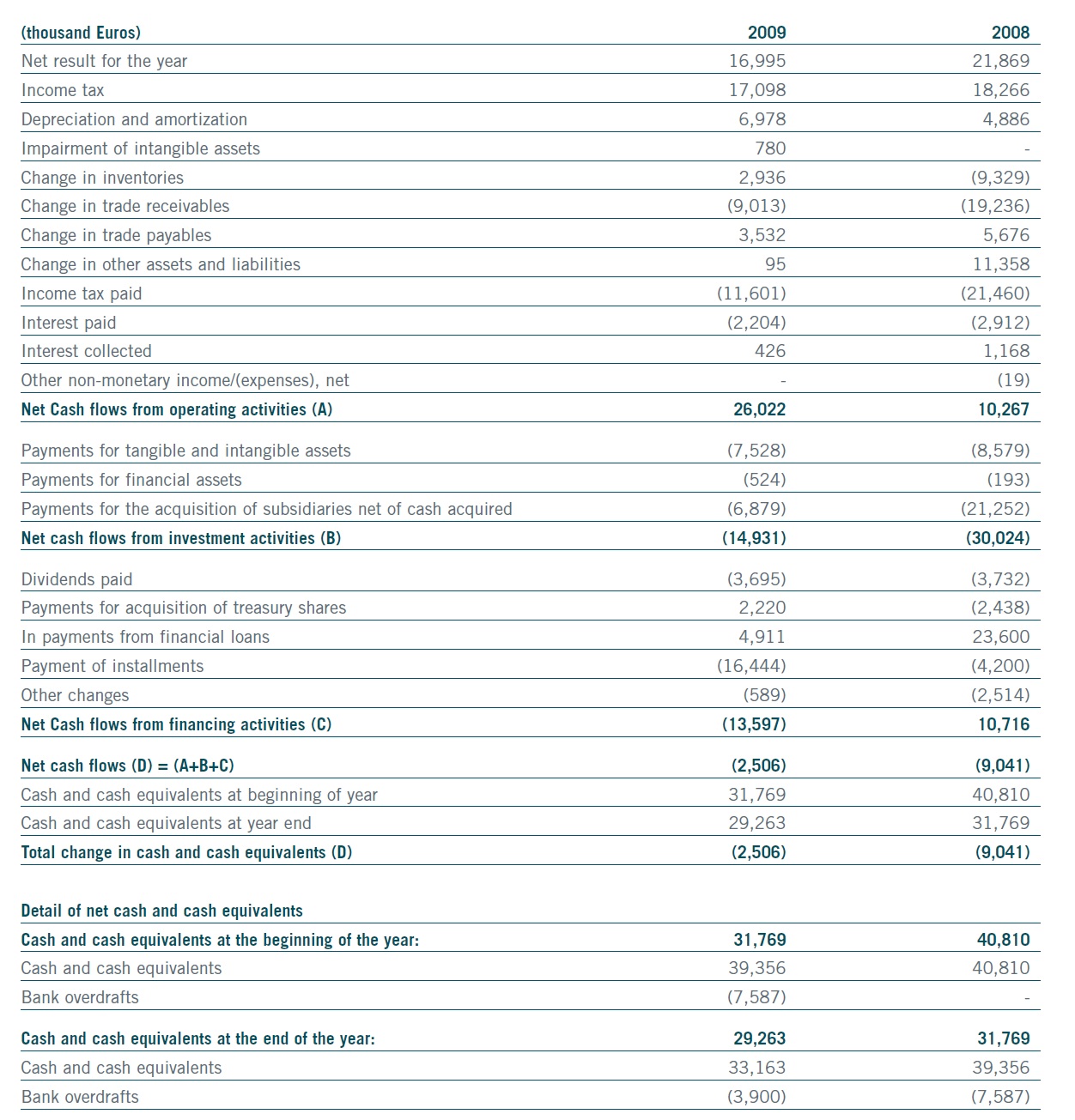
So they “bought” a company for 1 EUR which had 20.6 mn in cash. In theory, we should see this as a positive investing cashflow in the CF statement. Lets look at the 2009 statement:

Strangely, the stated “payments for the acquisition of subsidiaries net of cash received” is negative !! We know that they only paid 1 EUR, received 20 mn and didn’t do other big acquisitions in 2009.

I do not know where they actually booked the acquired 20 mn EUR liquidity, but this is very very strange.

The second part of the puzzle are the Government grants out of this deal.

In their notes, they state the following:

Government grants
Government grants are recognized in the financial statements when there is reasonable assurance that the company concerned will comply with the conditions for receiving such grants and that the grants themselves will be received. Government grants are recognized as income over the periods necessary to match them with the related costs which they are intended to compensate.

So what in theory should happen is the following:

-when they receive the money, the book a liability against the money (P&L neutral)
– then over time they reduce the liability by booking this release as profit

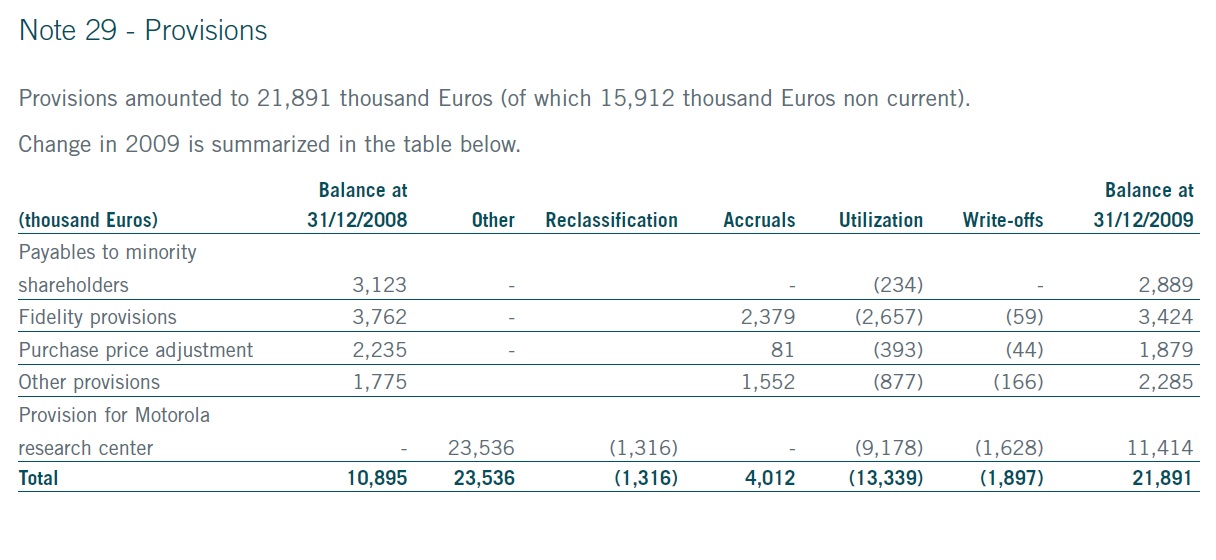
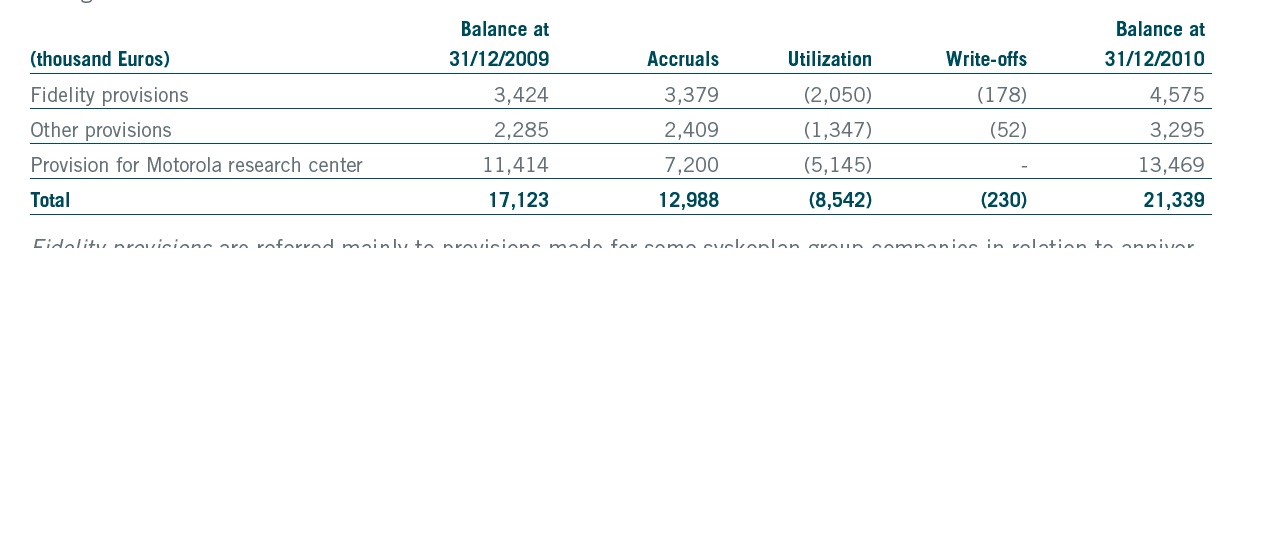
Based on Note 29, Reply booked already such a provision of ~23 mn EUR at the end of 2009, from where they used half of it again. I am not sure why,but again, where is the corresponding asset ? I would assume somewhere in other receivables (as they may not have received the Government money in 2009).

If one of the readers really understands what is going on here, then please help me.

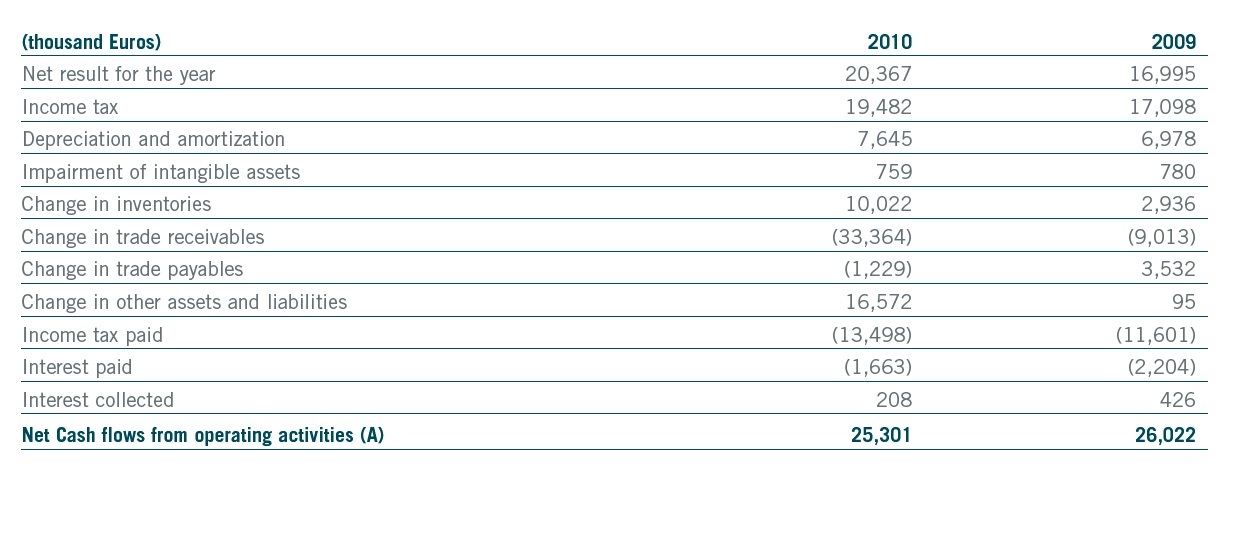
In 2010, the provisioning continues, it looks like the increase and use those provisions as they like to:

This might explain why the very unusual and unexplained line item “changes in other assets and liabilities” makes up 2/3 of Reply’s 2010 operating cashflow.

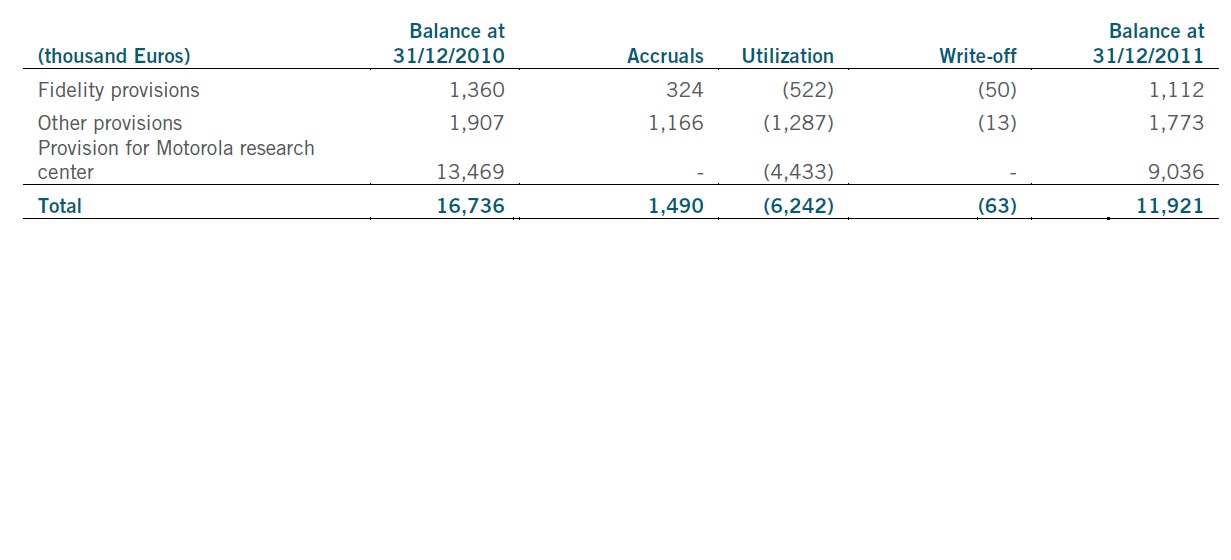
in 2011, the provision is still significant:

So what does that mean ?

In my opinion, there is poor visibility in the accounts and especially in the cash flow statements. We know now, that the Motorola transaction netted them around 40 mn EUR net cash, but didn’t show up in the investment cashflow. As it didn’t show up in financing cashflow neither, it has to be moved into operating cash.

As operating cash in total from 2009-2011 was only 55 mn EUR, basically a large amount of the operating cashflow in this period seems to be non-operating and coming from the acquired Motorola Research center.

At this point it is time to stop and summarize:

– at least to me, the accounting and cashflow treatment of the Motorola acquisition is not transparent
– together with the weak cash flow generation, large goodwill position and a large number of acquisitions this is A BIG RED FLAG

Maybe I am just not clever enough, but my philosophy to avoid companies with large intangibles and non-transparent accounting makes me stop here and not further investigate the company.

Dart Group – Follow up on fuel hedging and comprehensive income

As proposed in the last Dart Group post, I wanted to take a better look at the impacts on fuel hedging.

Quick summary (or spoiler): During writing the post, I got less and less sure of what to do with the fuel hedges, so the post got very long without a satisfying end. If you are not interested in the process and accounting details, the result is: I am not sure.

Let us start with a “accounting refresher” first.

Accounting for Cash flow hedges

Dart Group uses “cash flow hedges” for their fuel hedges. What does that mean ? Normally, any derivative financial instrument would be considered a “trading instrument” and would have to be marked-to-market directly through P&L.

If a company however wants to hedge a future cashflow (doesn’t matter if in- or outflow) one can apply a technique called “cash flow hedging” which requires basically two things

1) one is able to predict future cashflows with a reasonable accuracy
2) one uses a heging instrument which is “efficient” i.e. tracks the value of the hedged

If one achieves “cash flow hedging” treatment, then the hedge will treated in the balance sheet (under iFRS) the following way:

A) the value changes in the derivatives can be recorded under “OCI” (other comprehensive income)
b) in the future, when the cashflow actually happens, the corresponding hedging gain or loss will then be added or subtracted from the then realised spot price

This is what Dart Group is doing with its fuel hedging and as Wexboy commented fully aligned with accounting standards.

However my argument was that you shouldn’t ignore those movements in OCI but try to understand them and make adjustments if necessary. In order to understand this better, we have unfortunately step beck a little bit and ask the following question:

What is a hedge anyway and when is a hedge a speculation ?

In the case of Dart and airlines in general, this question is quite difficult to answer. In an ideal world as a company, you would like to pass on all your changes in costs directly to your customers and just earn a fixed fee on your products. As we all know, prices on tickets are relatively volatile, however many clients prefer to fix a price well before they start a trip in order to be able to control their budget.

An airline could also, if they were really really good speculators, create a big competitive advantage if they for example could hedge their fuel at low prices while the competitors have to buy much more expensive fuel on the spot markets if prices are rising. However, this is clearly speculation, not hedging as it could go the other way as well.

accounting wise however, one does not distinguish between “economic” hedging and what I call speculation.

So let’s look at Dart Group.

First step: READ THE ANNUAL REPORT

Before one starts to speculate how and what Dart is hedging, it makes sense to look at the annual report to find out what they are actually saying.

On Page 21 of the 2011 report they give us the following information:

2011 2010
Average hedged Price per ton $ 870 786
Percentage of estimated annual fuel requirement hedged for the next financial year 91% 90%

So we know now, that they have hedged ~90% of ALL fuel requirements according to this and we know the price.-

On page 67 we can look at fuel costs (in GBP):

2011 2010
Fuel Cost 122.8 95.3

On page 57 we can see the fair values of the fuel hedges, both an the asset and liability side:

2011 2010
Fair value Assets Forward jet fuel contracts 55.9 16.4
Fair value Liabilities Forward jet fuel contracts -17.8 -8.7
 
calc net Fair Value 38.1 7.7
Delta yoy 30.4

On page 58 we can see that in 2011, none of the fair value movements have been recorded in equity, we can also look at the total fair value movement of the ALL hedges (including currency) which were

2011 2010
Fair value Assets all hedges 59.4 21.7
Fair value Liabilities Forwardalll hedges -24.7 -9.7
     
calc net Fair Vlaue 34.7 12
Delta yoy 22.7

So basically, fuel hedges increased by ~ 30 mn GBP in vALue, FX hedges lost ~ 8 mn GBP

On page 61 they give us another interesting piece of information:

2011 2010
Impact on Profit and Loss 10% change in jet fuel prices 3.8 0.8
2011 2010
     
Profit for the year 17.3 15.6
Exchange differences on translating foreign operations 0 0
Effective portion of fair value movements in cash flow hedges 23 10.6
Net change in fair value of effective cash flow hedges transferred to profit -1.8 0.1
Taxation on components of other comprehensive income -5.2 -3
Other comprehensive income and expense for the period, net of taxation 16 7.7
Total comprehensive income for the period all attributable to owners of the parent 33.3 23.3

One important final piece of information:

Prepayments or “deferred income” stood a 177 mn GBP against trailing sales of 540 mn GBP.

So how to interpret those numbers ?

A) as the hedges seem to qualify almost completely as “cashflow hedge”, we can assume that they use “traditional hedges” like forwards or (tight) collars to hedge

B) IMPORTANT: Dart Group “hedges” 90% of next years fuel prices, but only 177/540 = 32% of (trailing) sales are prepaid. So one could argue that in order to “truly” hedge, Dart should only hedge a third of next year’s fuel consumption as for the rest, the final sale price of the tickets is still variable.

If the competitors don’t hedge, than Dart would have locked in potentially different fuel prices than the competition for 60% of next years fuel consumption and therefore run the risk of being uncompetitive if fuel prices fall.

So coming back to the initial question: What are we going to do with the change in value in OCI for dart Group ?

I have to say I am not sure anymore. I am oK with “ignoring” the part that is covered by deferred income but I honestly don’t know what to do with the part which is “speculation”.

I have quickly checked Ryanair’s latest statements and Easyjets last annual report.

While Ryanair similar to Dart seems to hedge 90% of next years fuel cost, Easyjet only hedges 65-85% of next years fuel charges and 45-65% of the costs in 2 years time.

Ryanair interestingly said that increasing fuel prices were responsible for a 29% profit decline. That sounds strange as they were supposed to be 90% hedged. Interestingly, fuel prices for Jet fuel decreased strongly in Q2, so the problem for Ryanair seem to have been locking in high fuel costs whereas some competitors were able to buy cheaper fuel in the spot market and compete better on ticket prices.

Bloomberg even compiles hedging ratios across companies:

Jet Fuel Hedging Positions for Europe-Based Airlines (Table)
2012-07-30 07:46:25.103 GMT

(Updates with Ryanair.)

By Rupert Rowling
July 30 (Bloomberg) — The following table shows the amount
of jet fuel consumption hedged by European airlines to guard
against price fluctuations.
Data is compiled mainly from company statements and is
updated as it becomes available. Hedges are for prices per
metric ton of jet fuel, unless otherwise stated.

*T
Company/ Percent Hedging Period Price
Disclosure Date Hedged
————— —— ————– —–

Ryanair Holdings Plc
7/30/12 90% July to Sept. 2012 $840
7/30/12 90% Oct. to Dec. 2012 $990
7/30/12 90% Jan. to March 2013 $998
7/30/12 90% April to June 2013 $985
7/30/12 90% July to Sept. 2013 $1,025
7/30/12 90% Oct. to Dec. 2013 $1,005
7/30/12 90% 2013 $1,000
7/30/12 50% Jan. to June 2014 $940

EasyJet Plc
7/25/12 85% Three Months to Sept. 2012 $983
7/25/12 79% Year to Sept. 2012 $964
7/25/12 77% Year to Sept. 2013 $985

Air Berlin Plc
5/15/12 82% April to June 2012 Not Given
5/15/12 92% July to Sept. 2012 Not Given
5/15/12 61% Oct. to Dec. 2012 Not Given

International Consolidated Airlines Group SA*
5/11/12 80% April to June 2012 Not Given
5/11/12 69% July to Sept. 2012 Not Given
5/11/12 55% Oct. to Dec. 2012 Not Given
5/11/12 55% 12-month forward Not Given

Vueling Airlines SA
5/10/12 76% 2012 $1,023
5/10/12 71% April to June 2012 $1,008
5/10/12 83% July to Sept. 2012 $1,035
5/10/12 74% Oct. to Dec. 2012 $1,042
5/10/12 28% 2013 $1,027

Air France-KLM Group
5/4/12 60% April to June 2012 $1,081
5/4/12 53% July to Sept. 2012 $1,081
5/4/12 50% Oct. to Dec. 2012 $1,078

SAS Group
5/3/12 50% April to June 2012 Not Given
5/3/12 49% July to Sept. 2012 Not Given
5/3/12 48% Oct. to Dec. 2012 Not Given
5/3/12 50% Jan. to March 2013 Not Given

Aer Lingus Group Plc**
3/29/12 62% 2012 $972
3/29/12 7% 2013 $991

Deutsche Lufthansa AG
3/15/12 74% 2012 $107/barrel
(Brent crude)

NOTES:
*Hedging breakeven for 2012 at $1,003 a ton, according to May 11
presentation.
**Aer Lingus figures as of Dec. 31

Summary:

To be honest, I am not sure what to do with the fair value movements in OCI. To simply ignore them and assume mean reversion would be very naive. The extent of the movements is just too large. However the impact of the fuel hedging is difficult to estimate as it depends on the behaviour of the competitors.

In general, a positive movement in fair value should be positive for the company and vice versa. nevertheless, the whole fuel hedging issue exposes Dart to quite substantial business risk, especially for the part which is not covered by deferred income.

However, this exercise made it clear to me that running airlines is a quite difficult business, especially in times of volatile fuel prices.

For the time being, I will stick with my half position and try to learn more about it.

One technical remark with regard to hedging:

In the “good old times”, fuel hedging could be done without cash collateral. A bank would happily “step in between” the airline and the futures market and only require cash at settlement of the contract.

As one of the consequences of the finanical crisis, every bank now requires cash collateral on a short term basis from the airlines for the fuel hedging contracts. For the airlines this means a significant increase in reuqired working capital. Lufthansa et al are lobbying strongly against this, but especially for smaller carriers this is a problem.

As a proxy I would use 25% of the notional as working capital requirement for fuel hedges. For Dart this would mean that 25% of around 150 mn GP or 40 mn GBP of Dart’s liquidity should be considered as “locked” for fuel hedging cash collateral.
A few thoughts on Free Cash Flow (and how easy it is to arbitrage this number)

For many Value Investors, “Free Cashflow” has become the most important “mantra” in order to decide if a stock is attractive or not. Especially in the area of technology stocks (Dell, Microsoft, Cisco, HP), the stated large free cashflows are or were the the major arguments from some investors why the invested in those stocks.

A few examples:

Dell: In February, David Einhorn disclosed a stake in DELL (which however he just sold again…), Katsenelson is a big fan of Xerox because of its large free cash flow and of course many many value investors love Cisco and Microsoft.

Let us quickly look at how Free Cashflow is defined (from investopedia):

Definition of ‘Free Cash Flow – FCF’
A measure of financial performance calculated as operating cash flow minus capital expenditures. Free cash flow (FCF) represents the cash that a company is able to generate after laying out the money required to maintain or expand its asset base. Free cash flow is important because it allows a company to pursue opportunities that enhance shareholder value. Without cash, it’s tough to develop new products, make acquisitions, pay dividends and reduce debt. FCF is calculated as:

EBIT(1-Tax Rate) + Depreciation & Amortization – Change in Net Working Capital – Capital Expenditure

It is important to notice that “Capital expenditure” only includes “direct” expenditure, like actually buying machinery etc.

Investopedia adds a pretty important point:

It is important to note that negative free cash flow is not bad in itself. If free cash flow is negative, it could be a sign that a company is making large investments. If these investments earn a high return, the strategy has the potential to pay off in the long

I think this is a point, many market pundits tend to ignore, but more on that later.

An even more important point is not mentioned in this definition: Free Cashflow does not include cash outflows for M&A activity

So let’s look at a simple example for a model company:

Base case:

EUR
EBIT (1-tax rate) 10
Depr 5
Change WC -1
Capex -3
   
   
Free Cashflow 11
   
   
Financing cashflow 0
 
 
Total cashflow 11

So our company shows a free cashflow of 11 EUR in this period and a similar total cashflow.

Case 1: Old School – Buying a new machine at year end with a loan for 15 EUR (I use year end in order not to “disturb” depreciation etc.)

We get the following result:

EUR
EBIT (1-tax rate) 10
Depr 5
Change WC -1
Capex -3
Machinery -15
 
Free Cashflow -4
 
Loan 15
Financing cashflow 15
 
 
Total cashflow 11

Aarrrg, negative free cashflow many investors would say, negative free cashflow, stay away from this stock !!!!

So a clever company might do one of the 2 following things:

Case 2: Classic FCF arbitrage: Operating leasing

In this case the company enters into an “Operating lease” contract at year end. The machine gets delivered as in a direct contract, but if the contract is structured correctly, neither capex nor loan show up in the balance sheet in that year (only the lease payments in subsequent periods)

EUR
EBIT (1-tax rate) 10
Depr 5
Change WC -1
Capex -3
Machinery 0
   
Free Cashflow 11
   
Loan 0
Financing cashflow 0
   
   
Total cashflow 11
 
Off balance sheet  
– machinery 15
– operating leasing liability -15

On a reported free cash flow basis, without adjustment, going forward, the company will look quite asset and capital efficient. However, this kind of FCF “arbitrage” will end under IFRS when operating leases will become “on balance”.

Case 3: M&A transaction

Now consider the following: For some unknown reason, one competitor is currently selling a subsidiary which only owns the brand new machine we wanted to buy and nothing else. The competitor is selling the company for the same price as the machine. Again we finance this through a loan.

The simplified CF statement looks the following:

EUR
EBIT (1-tax rate) 10
Depr 5
Change WC -1
Capex -3
Machinery 0
   
Free Cashflow 11
   
Acquisition -15
Loan 15
Financing cashflow 15
   
   
Total cashflow 11
   
Off balance sheet  
– machinery 0
– operating leasing liability 0

So “Heureka”, we have the machine on balance without impacting the Free cashflow and everyone is happy.

To be honest, this example is somehow unrealistic, but on the other hand this is exactly what is happening with many technology firms at the moment. Those companies show high free cashflow because they don’t spend a lot on investments but acquire new technologies vie M&A transactions.

If they would build this on their own, the cost would run negatively through free cashflow in contrast to the M&A expense.

There is a good post at Seeking Alpha which shows free cashflows over the last 5 years for 6 tech companies (RIMM, MSFT,DELL, NOK, AAPL, HPQ) without and including acquisitions.

For companies with a clearly declining core business like DELL and NOK, those M&A cash outs definitley have to be treated as mainenance Capex, but to be on the safe side, M&A for tech companies and pharmaceuticals should always be included in free cashflow.

This is exactly the reason why Jim Chanos has identified Hewlett Packard as the ulitmate Value Trap despite a trailing 25% FCF yield at current prices. HPQ acquisitions are not “growth investments” but “maintenance Capex” to counter their declining core business or to say it differently: The current reported “free cashflows” are more like liquidation cash flows.

Summary:

– Free cash flow can be a good indicator for the value of a company
– however one should be aware that there are many ways to “arbitrage” free cash flow
– I have only shown a few of them relating to investments but many others exist
– one should be especailly carefull to use FCF for companies which do a lot of acquisitions or use Operating leases extensively
– calculating free cash flow after acquisitions and changes in operating leases is a crude but good way to identify “problematic” companies
– some companies might be very good investments despite negative Free Cash Flows because they have good investment opportunities and finacne “conservatively”
– it will be interesting to see with what the financial industry will come up if Operating leases will come “on balance”. I have seen already attempts to structure leases as payables…..

« Older Entries Recent Entries »