Category Archives: Anlage Philosophie

When dividends matter (Hint: Mostly not at all)

Today I read an article in one of the major German Newspapers, Frankfurter Allgemeine, about the merits of investing in stocks.

I know that the year is still young, but this article (in German) might be easily the worst article of the year on stock investing.

They offer 3 “compelling” reasons why stocks are attractive:

– dividends are increasing
– stocks are still below all time high if you look at a pure price index (the old FAZ index)
– the dividend yield according to them is 2,9% and higher than 10 year Bunds (0,5%) or BBB bonds (1,5%)

They even recommend to buy stocks just before the dividend payment to collect the dividend and then sell. They finally show a calendar with all dividend dates of the major German stocks in order for the readers to be prepared.


Technicalities:

For some reason, the author doesn’t seem to know the existence of an “Ex-dividend” adjustment for stocks. I guess this guy also buys bonds the day before they pay the coupon or so. Including taxes and execution costs, I am pretty sure this kind of “dividend hopping” has negative expected value.

Anchoring bias

Secondly, it is interesting that you see such a nice example of an “anchoring bias” in a major newspaper. For investing in stocks it doesn’t matter if the stocks trade at an all time high or all time low. All that matters is if stocks are valued adequately in relation to their intrinsic value which in turn is determined by future profits and cash flows. With a “strategy” like that one mentioned, you will miss most bull markets and happily buy into bear markets. Congratulations !!!

Where is the problem with dividend yields ?

Well, before I further insult the writer of this article, the problem is that many people seem starting to think that somehow dividends are like “coupons”. This is clearly the side effect of the current low-interest rate environment.

There are also many statistics which point out that over a very long period of time, dividends have been a significant part of stock market returns.

However just buying stocks with high dividend yields is actually a loosing strategy as Dreman, O’Shaugnessey and others have shown. For me, the problem is two fold:

1. High current dividend yield stocks are often value traps

When companies get in fundamental trouble, they often try to preserve their “sacred” dividend until the bitter end. For some reason, canceling a dividend is been seen as the ultimate ratio before the real troubles begin. So it is quite common, especially in capital-intensive industries that struggling companies keep up their dividend despite an eroding business, as it could be seen with E.on, RWE or the banks. Sometimes you even see companies paying dividends and issuing dilutive shares at the same time just to keep up the illusion of a constant, “coupon like” dividend like Santander just recently.

Those long term returns mentioned above are actually much more the result of high growth, low dividend yield stocks which over a long-term grow so much that after 20 years or more, the dividend in relation to the original purchase price is then huge.

Especially these days, dividend yield is a very imperfect measure for shareholder returns anyway. Including share buy backs and looking at total shareholder return is the much superior strategy as for instance Mebane Faber has shown in his book.

2. Psychology: Yield hogs get slaughtered

A “yield hog” is someone who only looks at coupons or yields and not on total returns. If you buy a bond and the issuer does not go bankrupt, you get the coupon and the principal back. If you buy a stock, you might get your dividends (or not), but you never get your principal back. In contrast to a bond, you have to sell the stock to someone else in order to get your principal back. However there is clearly no guarantee that you will your principal back as “mr. market” might disagree on the value he wants to give you.

Psychologically, “Yield hogs” often cannot stand draw downs on the stock price and then get “slaughtered” when the panic sell in a bear market (often after doubling up on the way down). In some areas like insurance or pension funds, where you need to show a current yield, this “yield hog mentality” is basically baked into the business model and can be observed cycle by cycle.

So when do dividends add or indicate value ?

In my opinion, the only case where dividend yields are important if you invest in “deep value” cheap non-growing companies with a lot of cash flow and questionable capital allocation skills or dangerous environments. In such cases, having a paybacks via high dividends lowers the “risk duration” of an investment significantly.

In my portfolio for instance, Installux, Romgaz and Electrica are such candidates where I would not invest if they would just accumulate earnings. but be careful: i ti snot the dividend which makes them good investment but the undervalued nature of the stock. Admiral for instance, a company I really admire, would do much better fo its shareholders if they would buy back stock instead of paying 6-7% dividends. The long term compounded return would be much better without the tax on the dividend income.

As always, Warren Buffett has summarized it nicely several times why dividends are actually stupid for good companies.

Quick summary:

Investing in stocks because of the dividend yield is an extremely stupid way to invest. Either you will end up holding a lot of value traps and/or you will lose your nerves in the inevitable downturns.

Dividends should only been considered in context with the underlying business model and in combination with the capital allocation (reinvestment, share buy backs, debt levels), but never ever as a stand-alone investment criteria.

Dividends ARE NOT COUPONS and stocks are not “yield replacements” for bonds !!

Updates: Energiedienst (CH0039651184) & Vossloh (DE0007667107) voluntary tender offer

Energiedienst

My first transaction this year was to sell my shares in Energiedienst.

Looking at the Swiss Francs chart, where Energiedienst has its primary listing, this looks like genius timing:

However in Euro, it looks pretty stupid:

In Euro, the shares jumped from around 25,20 EUR to around 27 EUR at the time of writing, a upmove of around 7% against a loss in Swiss Francs of around -10%.

So what happened ? Well in case you were not on a Moon mission last week you might have heard about that Swiss Franc “thing”. The Swiss Franc increased around 17% against the Euro within a very short time frame. What we can see above is relatively easy: The stock price in Swiss Franc fell, but not enough to off set the CHF/EUR movement. This is very strange, especially in the case of Energiedienst.

Energiedienst operates (based on sales) around 85% of its business in Germany and only 15% in Switzerland. So even if we assume that the business in Switzerland is not negatively affected, the increase in EUR should have been theoretically only 0,15*17%= 2,6% in EUR and not +7%.

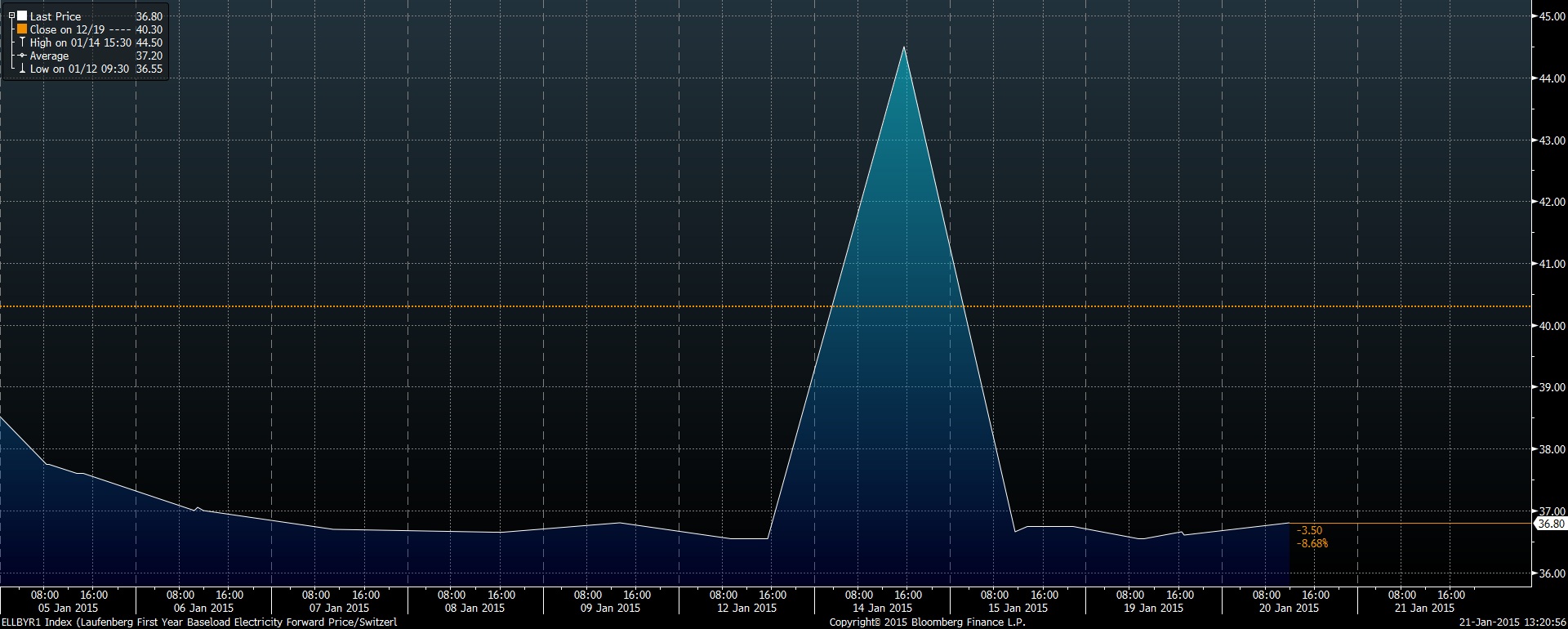
If we look at Swiss Power prices however, we see something interesting: With the exception of the one day, they directly adjusted in EUR terms as we can see here for instance in the Swiss 1 year forward electricity prices:

swiss power EUR

So in this case, electricity prices seem to be more efficient than stock prices, as there seems to be a very quick and liquid market to arbitrage away those currency differences quickly. Nevertheless I lost money by selling to early but in this case it was not my fault.

Vossloh

Back in September, I presented Vossloh as a potential fallen angel with activist involvement. This is what I wrote back then:

Based on today’s price of ~49 EUR this would mean a potential upside of 35-68%. However one should assume that this turn-around needs at least 3 years. For a turn around, I personally would require a higher return than for a normal “boring” value stock as there is clearly a risk that the turnaround does not work out as planned.

If I assume a target return of 20% p.a., i would need to be sure that the price of Vossloh is in 3 years at around 85 EUR. This is clearly at the very upper end of my target range. So I would either need to have more aggressive assumptions or I would need a lower entry price. As a value investor, I would not want to bet on growth or on a shorter time frame for the turn around, so the only alternative is to wait for a lower entry price.

Taking the midpoint of my range from above at 74, I would be a buyer at ~42 EUR per share but not before.

On November 7th, Vossloh actually hit the 42 EUR threshold but somehow I was not quick enough and passed to buy some shares. Since then the shares recovered nicely to around 54 EUR when yesterday, the following news hit the wires:

On 20 January 2015, KB Holding GmbH decided to make a voluntary public takeover offer to the shareholders of Vossloh Aktiengesellschaft, Vosslohstraße 4, 58791 Werdohl, Germany, for the acquisition of all ordinary bearer shares with no par value, each share representing a proportionate amount of EUR 2.84 in the share capital (the ‘Vossloh-Shares’).

KB Holding GmbH intends to offer the payment of a cash consideration per Vossloh-Share in the amount of the weighted average domestic stock exchange price during the last three months before the publication of this
announcement according to Sec. 10 para. 1 sent. 1 WpÜG pursuant to Sec. 5 para. 1 and 3 of the Regulation on the Content of the Offer Document, Consideration for Takeover Offers and Mandatory Offers and the Release from
the Obligation to Publish and Issue an Offer (WpÜG-Angebotsverordnung), as determined by the German Federal Financial Supervisory Authority (Bundesanstalt für Finanzdienstleistungsaufsicht, BaFin). This consideration is expected to be in a range between EUR 48 and 49 per Vossloh-Share and will be published immediately after being notified by BaFin.

KB Holding GmbH currently holds 29.99 percent of the shares in Vossloh Aktiengesellschaft.

The stock managed to gain some more and closed at around 56 EUR per share:

So the first question is: Why does he offer 49 EUR per share if the shares are trading already at 55 EUR ?

This one is pretty easy: Thiele was already owning 29,99%. In Germany, once you cross 30%, you have to make a mandatory offer at the trailing 90 “VWAP” stock price. My guess is that Thiele clearly wants to take control, but maybe not now and not at 55 EUR. So he used the occasion to come out with this lowball offer, because this releases him from any further mandatory offers and he is not forced to take more shares than he actually wants.

After the offer has expired and Thiele has crossed 30%, he only needs to disclose purchase once he crosses 50% and even then he does not need to make a mandatory offer as the voluntary offer releases him from making any subsequent offers.

Is the stock still attractive at that level ?

Well, we know now that Thiele clearly wants to take control. But we also know that he is a very shrewed operator with little interest in minority share holders. He controls the management of the company already (he actually hired the new CEO) as he ist already the strongest shareholder.

For anyone who followed the blog and the German Corporate law discussion, the biggest issue is the following: Under current law, Thiele could decide (or his CEO) to delist from the stock exchange. This is now possible in Germany without even getting any kind of shareholder approval. This would force many funds out of the stock as normally unlisted stocks are not permitted under most fund regulations. Even for hardcore hold outs this would mean low or no transparency etc. etc.

I have seen a recent study (Solventis, “Endspiele”) that since the change in law (or the change in interpretation), on average stocks lost around -25% following the announcement of a delisting.

Overall, at the current price the risk/reward ratio is in my opinion neutral. There is some room left with regard to a fair value and mean reversion, on the other hand one should be careful with regard to any minority unfriendly actions from Thiele & Co.

As a learning experience, I should maybe watch my watchlist a little bit closer in order not to miss such opportunities as in November.

Why buy and hold is great – if you are already an investment genius

When I did my 2014 review a few days ago I observed the following:

Interesting for me is the fact that 4 of the 5 top losers were new positions whereas only 2 of the 5 best stocks (Koc, Citizens) were bought in 2014.

This leads of course to the question if any of what I have done here over the past 4 years has added any value. The good thing is: It is relatively easy to test the hypothesis. I just took the old starting portfolio and calculated roughly what the return would have been with a simple buy and hold. Let’s have a look at the numbers:

Read more

FBD Holdings (ISIN IE0003290289) – A local Irish Insurance champion for sale ?

Again this turned out to be a quite long post as I am digging a little bit deeper into the balance sheet. Therefore a quick summary:

Although FBD Holdings, the Irish P&C company looks interesting, I will not invest. The company has a very impressive track record, but in my opinion the business model is not scalable as it doesn’t have any structural competitive advantages besides a loyal client base. Additionally, the company severely screwed up their asset allocation and will be faced with ultra low investment returns going forward unless they are increasing their investment risk significantly.

At current stock prices, the company is in my opinion pretty well priced, with only a relatively small upside in a good case and equally large downside in a more negative case.

Read more

And then there were 26 – Sold Energiedienst

A few days ago, I published my 28 stocks for 2015. Pretty soon after that, I already sold Sberbank.

Now I sold another stock, Energiedienst, the German/Swiss Hydro Power generator which I bought only last year.

The investment case for Energiedienst was pretty simple: Energiedienst as a hydro power generator is an “electricity price pure play” with a solid balance sheet. My expectation was that Energiedienst could profit in the mid-term if the conventional utility companies take capacity off the market, as running gas and coal powered power plants were loss making for E.On and RWE.

Read more

My 28 investments for 2015 (and maybe a few too many….)

As every year, I will do a short summary of my portfolio for 2015 with comments on each positions. One thing that I recognized is the fact that my portfolio now has 28 positions which is on the high-end of what is manageable. So I have to put a few of them on the watch list to do a deeper review in the coming weeks. New ideas have to replace an “old stock” in 2015.

1. Hornbach Baumarkt

One of my initial positions, family owned Hornbach is a slow and steady grower, their market share in Germany for instance increased from 8,7% in 2009 to 13% in 2013. The stock performance in the last year lacked a little bit as the market did not allow multiple expansion. Very limited downside in my opinion despite hard business. Hornbach could additionally profit from the end of the Baumax chain in Austria, similar to the boost in sales in Germany after Praktiker went bankrupt.

2. Miko

Belgian, family owned company providing Coffee workplace services and plastic packaging. Plastics division could profit from low oil prices. Slow and steady grower, doing small acquisitions along the way.

3. TFF Group

Another initial investment from 4 year ago. Family owned oak barrel manufacturer. Has grown well over the past year due to Asian demand for oak aged french wines and opportunistic acquisitions. Demand for French wine in China seems to hae stopped growing, but long term I think the company is attractive. Next year will be rather unspectacular.

4. Installux

Small French company specialized in aluminium appliances. surprisingly resilient. Despite the nice stock price appreciation in 2014 (+30%) still one of the cheapest quality stocks in Europe. Downside well protected via large net cash position.

5. Cranswick

Uk based “butcher”, producing pork and sausages with a dominant market position. Despite the problems of its biggest clients, Cranswick is still doing well although the stocks are a little bit on the expensive side. This is a stock I will have to review soon.

6. Gronlandsbanken

Gronlandsbanken is the only bank in Greenland and a long bet (or hedge against) Global warming. The ice is melting in Greenland which should contribute to ecominic activity, however a lot of that is commodity related. Stock pay an attractive dividend which looks very safe.

7. G. Perrier

French small cap, specialist for electric installations with a strong position in Nuclear maintenance. Good growth despite economic headwinds. Cheap (ex cash) depite attractive, capital light business model.

8. IGE & XAO

Small french software company, controlling the French market for electrical CAD software. Steady growth, highly attractive margins and still reasonably priced.

9. Thermador

Thermador is a French based construction supply distribution company. Distinct “outsider style” corporate culture. Despite headwinds in French economy still doing well. Reasonably priced.

10. Trilogiq

A French supplier mostly to the automobile industry. Capital light business model including some consulting. However issues in 2014 due to complete change of product offering and resulting disruptions. Despite lower profits still oK priced but I will need to thoroughly review the position next year.

11. Van Lanschot

Dutch base private bank, turn around story with new management. Some progress in 2014. Still well below book value but it needs to be seen if capital will produce adequate returns.

12. TGS Nopec

“Outsider style” seismic data company. Clearly influenced by the oil price but with strong competitive advantages against competitors due to “capital light” business model.

13. Admiral

“Outsider style” direct internet insurance. Uk base, large cost advantages but difficult part of the insurance cycle. Several growth projects on the way.

14. Bouvet

IT consulting company from Norway. Stock price hit hard by oil decline, Statoil is the largest client. Will need to check if investment case still valid as a 50% drop in oil prices and the potential impact on Norway’s economy was not part of my analysis.

15. KAS Bank NV

Specialist bank from the Netherlands. Cheap but good and safe dividend yield. Would profit significantly if interest rates would go up again.

16. Energiedienst

Swiss/German Hydroelectric utility. Still suffers from renewable energy driven chaos in German electricity market. Solid cash generation, defensive position. Could profit from restructuring of the large German utility groups, although electricity prices will stay low if oil and other fossil fuel stays as cheap as currently.

17. Koc Holding

Family owned conglomerate, dominating Turkey’s economy. Low oil price should benefit Koc in several ways.

18. Ashmore

Specialist Emerging Markets asset management company. 2014 was difficult year due to EM volatility. I am still positive as EM is basically the only part of the market where there is any yield left. CEO owns significant part of the company.

19. Sberbank

Biggest Russian bank. When I bought it, I did not expect that the conflict in Ukraine would escalate as much and of course I didn’t expect the oil price go down so fast. Will need to review the case asap.

20. Depfa 0% 2022 TRY

Combined Emerging market investment (Turkish Lira) and bet on Spread tightening for DEPFA.

21. Romgaz

First part of my bet on a Romanian recovery supported by the election if the new, ethnic German president. Extremely cheap producer and distributor of natural gas. Could profit from recent privatisation and efficiency gains, pays solid dividend.

22. Electrica

Part 2 of Romanian “bet”. Extremely cheap electric grid company. Guaranteed profit increase via investment program at guaranteed returns plus extra upside if efficiency gains could be achieved. On of my favourite long-term bets.

23. Drägerwerk Genüsse

Capital structure “arbitrage”. Price of Genußscheine still far below the fundamental value which should be 10x the Draeger Pref shares

24. DEPFA LT2 2015

Tier 2 bond with good yield and low risk. Will mature in 2015.

25. HT1 Funding

Still a “safe spread” subordinated bond with 5% yield until 2017 where it will be most likely called by Commerzbank.

26. MAN AG

“Squeeze out speculation” with guaranteed dividend.

27. NN Group

“Forced IPO” from ING Group. Still relatively cheap.

28. Citizen Financial

“Forced IPO” from RBS. Valuation below US peer group, could profit from higher interest rates.

My oil price forecast and a few (random) thoughts on oil and oil related stocks

My oil price forecast

To be honest, I have no fxxxing clue where oil will be tomorrow, in 1 month, 1 year or 10 year. The good news is: Absolutely nobody has a clue, too !! Yes, you can read now a lot of comments, interviews etc. of people who have suddenly turned into oil experts and predicting either a jump back to 100 USD/barrel or oil for free for the next 100 years.

I did some research and one of the very few analysts who was actually bearish on oil prices was a guy called Ed Morse from Citibank. I found comments from him in 2012, 2013 and beginning of 2014. But even he only predicted prices down to 75 USD/barrel.

So it is pretty fair to say that no one saw this coming. Therefore one should be extra careful on listening to people try to tell you what is happening next. They are all just guessing. And no, I am not interested in any Saudi/US/Russia conspiracy theories.

My personal opinion is that the current fall in prices could be a combination of additional supplies (indebted oil companies and governments have to pump more oil as prices fall to meet obligations) and momentum riding traders (hedge funds. But this is just an opinion, I have no prove for this.

Is a low oil price good for the economy ?

Although I have no clue where oil is going, I think it is still important trying to understand what this could potentially mean if oil prices remain low. Oil, in contrast to gold, silver or even iron ore is such an important factor in the global economy that it would be naive to believe that this has no impact.

Conventional wisdom is that low oil prices are good for the American consumer as he has more to spend on “stuff” and as a consequence for the US economy. But wait a minute ….wasn’t deflation the biggest “Enemy” of the recovery ? Then why should now deflation via the oil price suddenly be great news ? Is ther good deflation vs. bad deflation ?

I am not a macro guy, but I would say there are doubts if low oil prices are really good for indebted economies struggling with deflation. In the UK for instance, inflation already was at a 12 year low for November. Oil and gasoline taxes are important revenue bases in southern Europe as it is not easy to dodge those taxes.

One other thought: A lot of Oil money got recycled into the stock market. Norway is the biggest shareholder in most European stocks and increasing their stakes continuously. If the oil price stays that way, they clearly have less money to invest.

On oil (and related) companies

Clearly, most oil related companies are negatively effected by lower oil prices. There are business models with more exposure (e.g. oil rigs) and less (oil storage), but in general, the whole oil industry is not happy about a -50% drop in oil prices.

However they do look extremely cheap on a historical basis. But be very careful here. If you look at trailing P/Es or trailing EV/EBIT like the Alpha Architect blog did, be aware that those cheap trailing multiples are based on 110 USD/Barrel and not 55 USD.

Nevertheless, a stock which has just fallen 50% or more often looks irresistible for value investors. This is buying at a huge discount, right ? But just buying on a recent drop in prices is in my opinion “fast thinking”, the typical “catch a falling knife” reaction.

The “slow thinking” and real value investing would be to make sure that the VALUE (not the price !!) of such a company has remained constant.

The problem with this is the following: In order to justify an investment into oil related stocks based on historical profitability you have to assume 2 things at the same time:


1. the oil price has to go back up
2. oil related companies have to be able to earn their old margins again.

Those are basically two bets in one. Especially for capital-intensive companies, the second point does not automatically follow the first. If the oil cycle has actually turned for a longer period, than we will see a lot fewer investments going forward and anything related to Oil capex might be in trouble (and yes Siemens, you might think of directly writing of all of your nice Dresser Rand goodwill purchased at a PE of 32). A good example for instance for this effect are the Steel and shipping industry. All that capacity is not going away quickly and the companies are willing to operate at a loss as long as variable costs are lower than the price.

As a trader, you can clearly speculate on a rebound, as we are just seeing on a daily basis. As an investor, you should make sure that your chosen investments will experience “mean reversion”. For companies with a high capital intensity and lots of debt there a big risk that someone else will reap the benefits of the recovery after shareholders have been wiped out. I am pretty sure, Oaktree is already hiring energy experts by the dozen.

“Collateral damage”

Apart from oil related companies, one should be aware that problems could surface elsewhere. Banks who lend to oil companies are an obvious example. Oil traders or hedge funds who are long oil are another example, an early casualty was OW Bunker, a shipping fuel supplier from Denmark.

Less obvious issues could come up for instance at airlines. Yes, long-term they might benefit, but short-term they could run into a cash crunch due to their hedges. If an airline uses forwards they have to put up a lot of collateral to banking partner at the moment as their forwards are deeply underwater. If then competitors with less hedges then start reducing ticket prices early, this could get interesting.

In Germany, gasoline tax is around 40 bn per year or 4-5% of total tax revenues. In countries like Italy, that percentage is much higher (gasoline is much more expensive in Italy than Germany due to higher taxes…). Especially for those countries, the drop in tax revenues will hurt. I didn’t find hard numbers on that but my guess is that budgets in countries like Italy will not surprise to the upside if oil and gasoline prices stay low.

Potential opportunities

However there is also the chance of what I would call “positive collateral damage”. For instance companies in the oil sector or in oil economies which are not directly hit by the oil price like distributors etc.

Norway could be interesting too. I am suffering at the moment with Bouvet, but I do think that med term this could be interesting. The Norwegian Government has enough fire power to jump-start some supporting initiatives and Bouvet could profit as the Government is one of their biggest clients (Statoil too, I know….).

Turkey and the Lira have been hit badly by the Ruble crisis. I do not fully understand why. Turkey is a big oil importer and lower oil prices will most likely lower inflationary pressures. I guess this has to do with investors selling out local currency EM funds.

Other examples could be oil related distribution companies or infrastructure companies (oil storage, natural gas grids) who earn money based on volume independent of underlying prices. Or Oil tankers, but that is again another story.

Summary:

If oil remains at current levels, this would be clearly significant, both for the world economy and the stock market. I have no clue what oil will be doing, but it makes a lot of sense to think about potential impacts.

My advice at the moment would be:

– ignore oil price forecasts from people who didn’t see this coming (basically everyone)
– avoid anything which has a lot of leverage and is oil related unless you want to trade short-term
– make sure you understand what parts of your portfolio have direct/indirect oil exposure and in which direction and ask yourself if you are comfortable
– better look for “collateral damage” kind of investments (non oil companies in oil countries etc.)
– don’t rush, let your “slow thinking” part of the brain gain control

4 years of Value and Opportunity and still having fun (plus some advice on that)

Exactly 4 years ago the very first post appeared on the blog, outlining the rules and philosophy of the “virtual portfolio”.

The top 10 posts in 2014

1. How to correctly calculate Enterprise Value
2. P/E, EV/EBITDA, EV/EBIT, P/FCF – WHEN TO USE WHAT ?
3. OPERATING CASH FLOW AND INTEREST EXPENSES – (THYSSENKRUPP VS. KABEL DEUTSCHLAND, IFRS VS. US GAAP)
4. “RISK FREE” RATES AND DISCOUNT RATES FOR DCF MODELS
5. ADMIRAL PLC (ISIN GB00B02J6398) – SHORT CANDIDATE OR “OUTSIDER” COMPANY WITH A MOAT ?
6. MY 24 (BORING) INVESTMENTS FOR 2014
7. Emerging Markets: Sberbank ADRs (ISIN US80585Y3080)- Buying Russia in one stock
8. Banca Monte dei Paschi Siena (BMPS)- Another deeply discounted rights issue “Italo style”
9. The Dutch Job: Royal Imtech (NL0006055329) Deeply discounted rights issue – The “short opportunity of the century”
10. TGS Nopec ( ISIN NO0003078800) – an “Outsider” Company Buffet would buy if he could ?

The most interesting aspect of the Top 10 list is that 5 out of the 6 most popular posts are old, “general investing” posts. Especially the “Enterprise Value” post is attracting many many hits each day.

Personal blogging highlights 2014

First, I am quite happy with the new design of the blog. Although it actually did cost money (those WordPress guys are pretty smart…), I think it was well worth the “investment”.

The highlight of the year was clearly my journey into Emerging Markets. Although not all investments were succesful (Sistema, Sberbank ughhh…), it was a lot of fun (more on that later) and should be seen as an intellectual investment into the future. One thing that annoys me is that I started to look into China & Hongkong quite early but did not follow up.

Another highlight was the MIFA story. Although I didn’t make any money on this, it was still interesting to see that a look into the accounts can reveal so much. Yes, having winners in a portfolio is important, but avoiding losers is even better !!!

A final highlight just occurred yesterday. My E.ON Management disconnect post was explicitly mentioned in the print version if Germany’s most read weekly business paper, Wirtschaftswoche. Many thanks to the readers who told me about this.

And still having fun !!

1 year ago I had already written why and how I write the blog.

Personally, one of my fundamental beliefs is that one can only be succesful if one is enjoying (to a certain extent) what one is doing. This goes for work, personal life etc. Clearly some things have to be done and hard work is almost always necessary, but without having some fun it is very hard to keep something up until success kicks in eventually.

There is an amazing, less than 4 minute “TED talk” on what makes success to be found here and having fun is clearly one of the most important aspects:

One of the great things about investing is the fact that there is not a single way to success but many ways can lead to success. Value investing works, momentum works, activist investing, quant strategies etc. etc. So everyone should be able to find his own way of investing which is fun and still have good chances for long term succss. There is no need to do it exactly one way or the other.

So how can you make sure that you have fun in investing ?

The following points reflect both, my personal experience and observations I made over the years within the financial industry.

1. Make yourself independent of short-term returns.

One of the most gruesome things in investing is the fact that especially as an institutional fund manager you can have the best strategy but if you underperform over 3,6, or 12 months you will begin to lose money. Another bad year or 2 and your job is in danger. The impact on many fund managers is that at some point they lose all the fun they had in the beginning and just try to play it safe. This then leads to bad mid- and longterm performance and often is a kind of vicious circle. Many fund managers I know are actually not very happy in their job. And yes, that is one of the reasons why i never went “professional”.

Focusing on short-term returns often kills both, your long-term returns as well as the fun of doing it. The best and only way for institutional investors is in my opinion to continuously educate clients

As a private investor, I think the key is to invest only an amount which you can easily lose. If you need the money in 3 years to buy a house or you don’t have a buffer to pay for your broken down car DO NOT INVEST IN STOCKS. Get your personal finances in order, determine what you can have available long-term and then start to invest. I cannot guarantee you success that way but I guarantee this way you will feel much more relaxed about it. People often ask me if why I am not afraid to lose money in the stock market. The answer is: I only care long-term ,because short-term I don’t need the money. Oh yes, I forgot: DO NOT LEVERAGE UP STOCKS, because at some point in time your fun will be gone very quickly.

Another thing which helps me a lot is keeping a long-term performance record. Especially for a long-term strategy like value investing, where you easily can underperform several years, at least for me it is a great comfort to look at my now 15 year-long personal track record. A 15 year record does not change much if you underperform in a single year.

2. Establish a routine but be flexile within

success requires a couple of inputs. Work is one of them. This applies for investing too. Yes, there are stories about the guy who got rich by investing 10 thousand in a great startup but most of those stories are wrong and this is much more about playing the lottery than investing. If you want to become good and successful in investing you need to invest money and time.

For me the first trick to do this regularly and still having fun, is to have a daily routine. I usually work on my private investments first thing in the morning. I get up, have a quick (N)espresso and then start. The second trick is that within this routine I then do whatever I want. Although I have a long list of companies I want to research, I still keep for myself the possibility to do something completely different. When one morning I read for instance about the German candidate winning the Romanian election, I decided to ignore my to do list and look into Romanian stocks for the next couple of days.

Even within your normal job there is often some flexibility to do different things. Some very succesful companies allow employees to pursue “own”projects like Google and 3M but in my experience even in other companies it is both fun and potentially good for a career if you sometimes do things “outside the box”. You don’t have time for something like this ? Than just skip a few useless meetings, stay at your desk and think about something different.

3. Keep it simple

Both in private investments and work, just increasing complexity rarely adds value to the outcome. In private investing, adding to much stuff into ones “process” makes things difficult. Yes, checklists are great, quant models can help and understanding macro is important as well as managing the risk of the portfolio. But I found it easier (and much more fun) to look at investments one by one.

In a professional environment I often have the impression that complexity is used to justify fat management fees which for simpler models would be much harder to justify.

If you have to many inputs into the process, the actual decision-making becomes harder. Although simple doesn’t equal easy, it is clearly more fun in the long run.

4. Communicate with other investors regularily

Not everyone can call a genius like Charly Munger to test the newest investment idea, but in general it is not that hard to find like-minded investors and meet them for regular opinion exchanges or just a couple of beers. Communication via the web is great, but at least for me, sitting together with some investors, talking stocks and drinking a few beers is even better. You usually learn a lot and, the most important: it is fun. I do meet for instance with some local guys every 1-2 months and I am always looking forward to it. Often, after those meetings I am motivated to look things up that have been discussed which then leads to new idea etc.

So to summarize this shortly:

In order to have long-term fun in investing, those 4 point might help you:

1. Only invest money you can afford to lose
2. Establish a routine but within that do whatever you feel like doing
3. keep it simple
4. Socialise with other investors

Special situation “Quickie”: Flughafen Wien AG (ISIN AT0000911805) partial Tender offer

Just by chance I looked at Flughafen Wien these days where since a few weeks an interesting situation is playing out.

Although Flughafen Wien is owned 50% by the Government and cannot be taken over, an Australian based Infrastructure fund called IFM made a partial tender offer for up to 29,9% of the shares.

Initially, IFM offered 80 EUR per share with a minimum threshold of 20% acceptance.

A few days ago, after pressure from soem shareholders, IFM increased the offer to 82 EUR and waived the 20% minimum threshold.

If I understood correctly, the new final date to tender the shares is December 18th. The money then is being paid within 3 working days, so before year end according to the official offer.

IFM seems to have secured around 12% from 2 funds already (Silchester, Kairos).

IFM seems to be a “reputable” investor, there seems to be no relevant operational risks for the offer from a technical point of view as far as I can tell.

However, the stock doesn’t trade at 82 EUR but rather at around 79,20 EUR per share:

This implies that investors expect 2 things

a) that more than 29,9% will be offered
b) and that the share price will fall after the offer below the offer price

Now we can play around a little bit to see if this is something worth betting on. We could start for instance assuming that the stock directly drops to 70 EUR after the offer expires.

Then we can calculate at the current price of 79,2 EUR an implicit or “break even” acceptance ratio:

79,20 = X*82 + (1-x)*70 = 76,67%.

So if 76,67% of the offers get accepted, the remaining not accepted stocks can drop to 70 EUR before one is making a loss on the transaction.

If all tendered shares are accepted, the max. profit would be 2,8 EUR per share or +3,54% for a period of 2 weeks.

Worst case: All minority shareholders tender (The Austrian government will definitely not tender…), then the lowest possible acceptance rate is 29,9/50 = 59,8% and the price falls directly to the value before the ofer (~61,50 EUR). Then the maximum loss per share would be -5,44 EUR or -7,4%.. At a more realistic drop to 70 EUR, the downside would be 2,02 EUR or -2,6%. This would be a positive expected value if the assumption of 70 EUR as a post tender price is correct.

I do think that this is a nice liltle side bet, so I will invest 2,5% of the portfolio at 79,25% into this little “special situation” with a time horizon of 2 weeks

One important note here: There is clearly a downside here and I would not recommend this to anyone who doesn’t regularily do such things, as the “single bet” might be not super attractive. However if one runs such bets on a continous basis (as I do, like MAN, Sky etc.), over time one will make money even with a few loosing trades.

Electrica S.A. (ISIN US83367Y2072) – A deeply discounted infrastructure stock from Romania ?

Again, this has turned out to be a long post. So a quick “executive summary” upfront:

Electrica S.A. looks like an interesting play on infrastructure in Romania. The stock is attractive as
– the current valuation is cheap compared to grid companies in Spain, Portugal and Italy
– the underlying business (electrical grid monopoly) looks structurally attractive due to high guaranteed returns on investment
– there is good visibility on growth for the next 5 years
Overall, based on relatively conservative assumptions, an investor could expect to earn 17-21% p.a. in local currency over the next 5 years.

There are clearly lots of risks (regulatory, politically) but overall the risk/return profile looks good and the risks are less correlated to overall market risks.

DISCLOSURE: This is not an investment advice. Do your own research !!! The author may have already invested in the stock prior to publsihing the post.

When analyzing Romgaz I said this:

Why Romgaz ? Well that one is easy: This is the only Romanian stock you are able to invest if you don’t have access to the Bukarest Stock Exchange. There are no ETFs on Romania either.

Well, that was wrong, because another formerly Government owned Romanian company IPOed in June this year on the LSE, the grid operator Electrica.

Electrica – the business

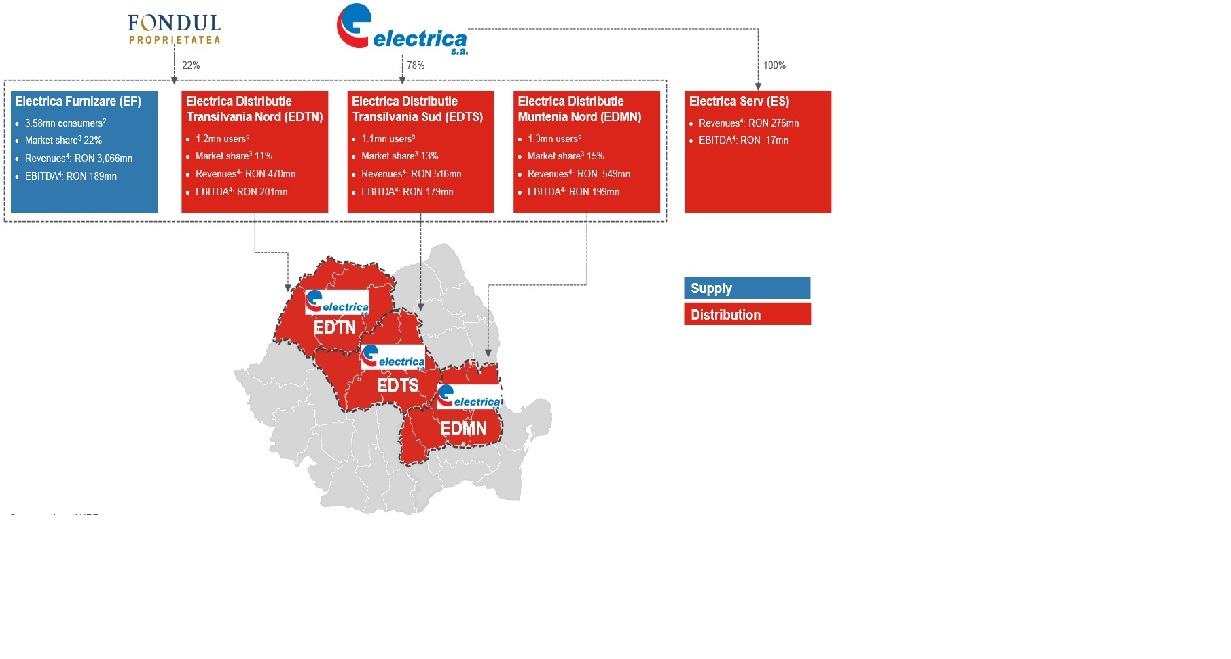
Electrica’s main business is owning and running the electrical grid in an area covering ~40% of Romania. Additionally, they are also an electricity supplier, however they do not generate any power. This graphic from the recent 9 month presentation shows how this looks on the map:
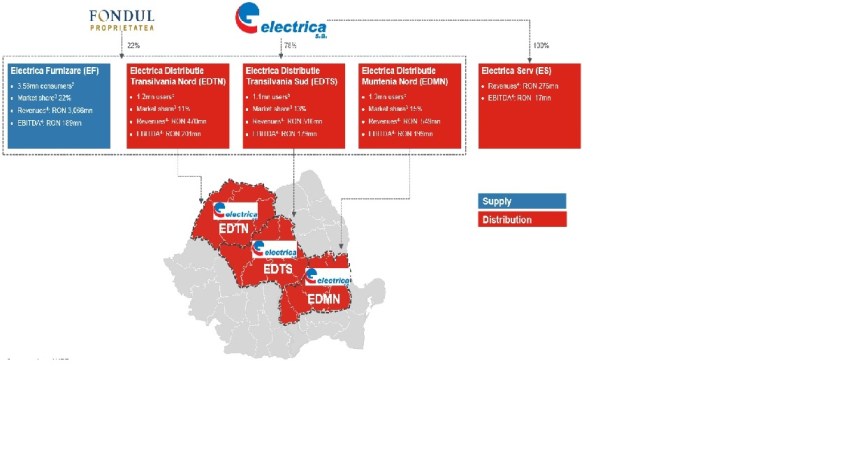
Electrica small

Similar to Romgaz, the IPO prospectus is a pretty interesting read, covering many aspects of the Romanian electricity market. Those were the major points that I extracted from reading the prospectus:

+ IPO proceeds went 100% to the company to fund future growth
+ significant potential for additional guaranteed investments
+ conservative balance sheet
+ efficiency gains possible (10% grid loss)
+ underlying growth potential
+ valuation ex cash VERY cheap for a grid company
+ potential M&A opportunities (ENEL assets)
+ EBRD as shareholder actively protecting minority rights
+ local regulation creates attractive “float”

– guaranteed return on regulated assets has been just lowered from 2014 peak (7,45% vs. 8,35% in 2014)
– business is partly electricity distribution, no pure “grid” play (no guarantees for distribution)
– limited experience with regulator (previous head of regulator convicted for bribery)
– some distressed subsidiaries (external grid maintenance)
– 22% minorities in all major subsidiaries

Electrical grid as a business

Building and maintaining an electrical grid is a very capital-intensive business. The electric grid is one of the most dominant monopolies available. There is competition on the generation and supply side, but there is always only one electric grid as this represents the archetypical network effect.

There is just no reason to build a second electrical grid and unlike as for instance telephone landlines, there is a pretty low risk that electricity could be distributed via an alternative way. This is one of the reasons that grids are almost always heavily regulated as the potential power to abuse this monopoly would be pretty high.

One additional features is the fact in many countries the grid was not designed to cope with locally generated renewable energy, so there is clearly a need for massive additional investments. Normally, a sector with large investment requirements is not that attractive, but if you combine this with stable yields and leverage potential, things can suddenly become very interesting in a low growth environment.

I had written 2 years ago that even Warren Buffett thinks utilities can be attractive, if the earnings are stable or even guaranteed, especially if you then can leverage up accordingly. Also the announced E.On spin-off ties to move grid and end-user supply into the good ship

Although there is always a risk that regulators run amok, at least for electrical grids the seem to be on the soft side as they know that a lot of capital is required to cope with the renewable energy revolution. As a consequence, the valuation of listed grid operators are the highest among the overall utility sector.

Let’s look at the valuations of 4 listed electric grid companies in Europe:

Name Mkt Cap (EUR) BEst P/E:2FY P/B ROE ROA Debt/capital
             
REDES ENERGETICAS NACIONAIS 1.352 12,2 1,2 11% 2,4% 70%
RED ELECTRICA CORPORACION SA 9.922 16,5 4,2 24% 5,8% 60%
TERNA SPA 7.811 14,6 2,5 17% 3,7% 71%
ELIA SYSTEM OPERATOR SA/NV 2.442 16,1 1,1 9% 3,3% 55%

It is interesting to see that despite being located in the more critical countries of the Eurozone (Portugal, Spain, Italy and Belgium) those companies enjoy quite rich valuations. ROAs are low single digits but due to the monopoly character of the business, it can easily be leveraged up between 50-70% of the total capital (and several times equity).

Romanian electricity market

This is an interesting quote from the IPO prospectus:

The average electricity consumption per capita in Romania is still significantly lower than the average electricity consumption in the 28 EU member states. In 2012, Romanian electricity consumption per capita was 2.3 MWh, whilst the average electricity consumption per capita in all the EU countries was 6.0 MWh and in the selected Central and Eastern European countries (excluding Romania) in the table above it was 4.3 MWh.
<

So assuming that Romania will catch up to a certain extent with the Eurozone, underlying growth in the electricity market should be strong. Romania has separated grid and power generation, however, at least in the case of Electrica, supply to end users is still part of the package.

The power market for end users is still highly regulated to a large degree but will be liberalized going forward. For Electrica’s grid business, this is irrelevant, but the supply business could be affected.

Electrica has a 25 year concession to operate the grid with an option to extend another 25 year. They can charge a fee to customers which guarantees them a certain pretax rate of return on assets if the meet minimum requirements set by the regulator. The base rate which they can charge is currently 7,45% for the next 4 years, higher rates seem to apply for “smart grid” investments.

One interesting specialty of the Romanian market is the existence of the “connection fee”. This is what they say in the IPO prospectus:

According to the law, the value of new connections to the electricity network is charged to the final users as a connection fee. The new connections to the electricity network are the property of the Group. The Group recognises the connection fee received as deferred revenue in the consolidated statement of financial position and subsequently records it as revenues on a systematic basis over the useful life of the asset.

The total amount they show as deferred revenue is 1,4 bn RON which is quite significant. For them, this is a very attractive “float” as it doesn’t carry interest and no covenants are attached. I assume that this also explains why they don’t use external debt as the investments are basically financed by the clients.

Valuation – simple version

Electrica has a market cap of 4 bn RON. Including IPO proceeds, the sit on 2,8 bn liquid assets, so the core business is valued at 1,2bn RON. With a run rate of 250 mn Earnings, this equals P/E of 4,8 ex cash. Assuming that a unlevered grid company in Romania could be worth 10 times earnings (still cheap compared to a highly levered Portuguese grid company at 11x earnings), the upside for the stock would be at least 30% based on current earnings.

Valuation including growth

Now comes the interesting part. Normally as a value investor I would assume zero growth. But in Electra’s case I would make a difference. Why ? Well, because:

1. They can invest (“compound”) at a guaranteed rate
2. The have already raised the money
3. The guaranteed rate can be charged irrespective of power prices or volume
4. There is no competition

The “only” risk that remains is the regulator. In order to model the profit growth, I have built a very simple model for the next 5 years using the information form the IPO prospectus:

I made the following (conservative) assumptions:

– supply business remains more or less constant despite significant growth yoy 2014
– I assume the losses from the “distressed” service subs will be phased out over 3 years
– they will distribute 85% of earnings as dividends
– they will invest according to plan at a blended guaranteed rate of 7,7%

Based on those assumptions, the profit after tax and minorities should double within 5 years. Assuming 8%% dividend payout (all of which can be funded by existing cash on operating cashflow), one can expect a return of 17-21% p.a. assuming an exit P/E multiple of 11-15.

Assuming exit multiples is of course already quite aggressive, on the other hand, if the price wouldn’t move, the assumed dividend yield of Electrica would be more than 10% in 2019. So some multiple expansion would not be unrealistic.

Addtitional (significant) upside could come via profit increases in the supply sector or opportunistic M&A as the ENEL grid seems to be for sale. My required rate for such an investment would be 10-15%, so at the current price Electrica looks attractive.

Other considerations

Stock price: In local currency, the stock price is only slightly above the IPO price of 11 RON:

Analysts: According to Bloomberg, a surprising number (8!) of analysts cover the stock. Their price target on average is around 14,6 RON, a potential upside of 30%.

Shareholders: During the IPO, the EBRD (European Developement Bank) acquired 8,6% of the shares. According to this article they are actively working to protect/ensure minority shareholder rights:

“Our participation demonstrates the EBRD’s commitment to supporting the government’s plans for increased privatisation of the energy sector,” Nandita Parshad, Power and Energy Director at the EBRD, said in a statement.

Parshad said the EBRD will work with Electrica to align its corporate governance with international standards: “This will provide additional comfort and confidence to potential future investors.”

The Romanian government still owns 49%.

Management: There is unfortunately not a lot of information on management. The CEO is an “Old timer”, joining the company in 1991. there seems to be some variable component in their companesation package but it is not clear how this looks like.

“Frontier” market: Despite being an EU member, Romanian stocks including Electra are considered “Frontier” stocks by MSCI, not even “Emerging”. That might make it more difficult for “established” funds to invest.

Summary:

As I have written in the Romgaz post, I find Romania fan interesting market in general especially with the lection of the new President. Electra is similar to Romgaz a privatization story. What I like about Electra is the fact that there is good visibility on growth.

The major risks are from the regulatory side, although I am quite optimistic that with the new president there will be even more of a “pro business” and “pro growth agenda”. Plus, the risks in this case in my opinion are relatively uncorrelated to other issues within my portfolio, so I think this could be a good diversifier.

With relative conservative assumptions and the guaranteed part of Electrica alone, one should expect between 17-21% return per annum over 5 years. If the non-guaranteed supply business improves or they are able to get other parts of the Romanian grid then the upside could be even higher.

I am pretty sure that not many investors will be interested in the stock as it seems to be both, too exotic and a strange mixture between “deep value” and growth, but for me it is the perfect stock as I don’t have to track any indices.

For the portfolio, I will buy a 2,5% position at current prices. This increases my “Romania bet” to 5% and total EM exposure to 13%. Time horizon is 5 years.

« Older Entries Recent Entries »