Category Archives: Bilanzanalyse

TGS Nopec ( ISIN NO0003078800) – an “Outsider” Company Buffet would buy if he could ?

Disclaimer: This is not an investment advice. The author will most likely own the stock already and sell it without telling anyone as well….

As the post is rather long, a short Elevator pitch:

– TGS Nopec is a potential “outsider” style oil services company with a distinctive and capital efficient business model
– currently cheap because of cyclical issues, negative sentiment for the oil and natural resources and top line decline yoy
– underlying business much less sensitive to oils price than the market believes and yoy top line decline is due to “outsider” behaviour

Read more

Some fun with Enterprise Value – E.ON AG Decommissioning Liabilities

This is a follow-up to both, my recent post about EV/EBIT & Co as well as a discussion in a forum about how cheap German utility stocks really are.

German utility stocks are clearly in many lists for cheap stocks. Here is for instance a list of large utilities in Europe sorted by EV/EBIT:

Name Mkt Cap Curr EV/T12M EBITDA EV/T12M EBIT
       
ENDESA SA 23038.45 4.43 7.17
RWE AG 16827.67 3.06 7.27
E.ON SE 27849.92 4.89 7.64
PGE SA 8340.95 4.55 7.74
GDF SUEZ 41669.47 5.31 10.04
VERBUND AG 5739.31 4.93 10.07
EDF 49364.74 5.83 11.08
GAS NATURAL SDG SA 18052.44 6.91 11.26
DRAX GROUP PLC 3286.74 9.41 12.12
NATIONAL GRID PLC 34397.63 10.20 14.02
ENEL SPA 30805.4 6.22 14.94
A2A SPA 2562.72 7.52 15.16
ROMANDE ENERGIE HOLDING-REG 1066.69 9.56 18.64
SSE PLC 15811.63 12.01 18.76
IBERDROLA SA 29309.16 9.92 21.69
PUBLIC POWER CORP 2343.2 6.87 21.72

Apart from Endesa, EON and RWE really look like bargains. Even most “club Med” Italian utilities are trading at twice the EV/EBIT or Ev/EBITD levels than RWE and EON. A “mechanical” investor will say: I don’t care if they have issues, I will buy them because they are cheap.

However, there is a small problem: As many people know, following the Fukushima incident, the German Government decided in 2011 to speed up the exit from nuclear power and switch off the last nuclear power plant in 2011. Funnily enough, only in 2009, they decided to extend the licenses significantly.

Anyway, just switching of a nuclear power plant is not enough. Especially in a densely populated country like Germany, you don’t want to have those nuclear ruins everywhere. So the utilites are required to fully “decommission” the reactors and also all the nuclear waste. Decommissioning is expensive, for instance it is estimated for instance at currently 70 bn GBP for all UK nuclear power plant.

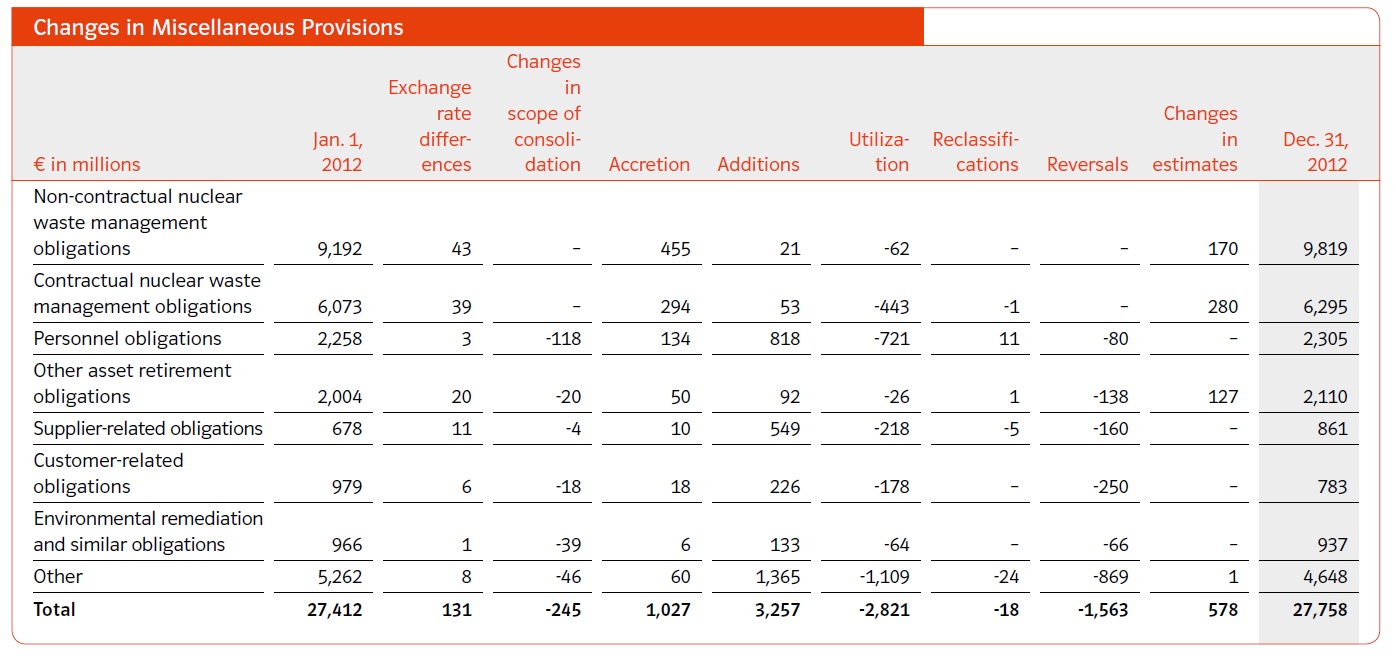
In order to avoid that utilities just go broke before they close their nuclear power plants, the are required to build up reserve accounts in their balance sheet. Let’s take a look into their 2012 annual report page 159:

eon nuclear

EON has 16 bn EUR of reserves on its balance sheet for the decommissioning of nuclear power plants. Those 16 bn are clearly already reserved in the balance sheet, but as they will be due in cash rather sooner than later, they should be clearly treated as debt and added to Enterprise value.

However, there is a second issue with them: For some reasons, they are allowed to discount those amounts with 5% p.a. This is around 2% higher than for pension liabilities which in my opinion is already quite “optimistic”. They do not offer any hint about the duration of those liabilities, but if we assume something like 10-15, just adjusting the discount rate to pension levels would increase those reserves by 3-5 bn and reduce book value by the same amount.

So all in all, net financial debt for EON more than doubles if we take into account a realistic value for the nuclear waste removal obligations.

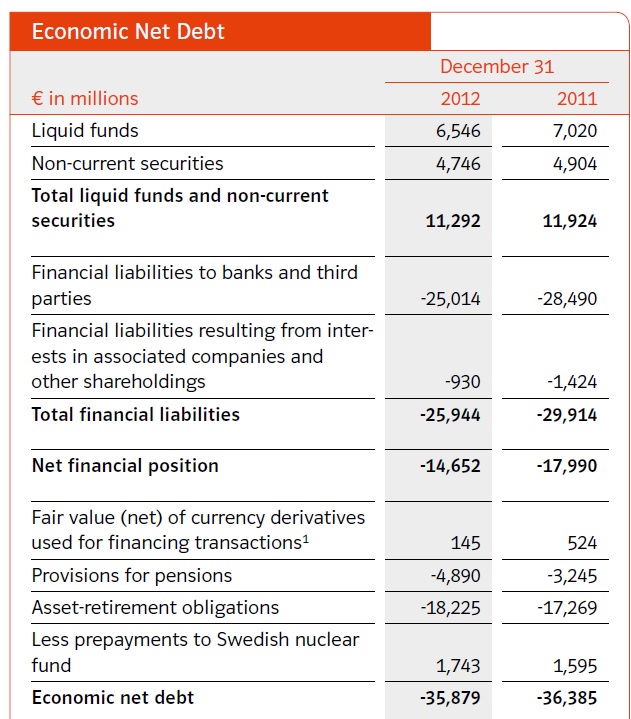
Interestingly enough, E.on presents its own “economic financial debt” calculation on page 45 of the annual report, including pensions etc.:

EON net debt

If we adjust the nuclear liabilities for the unrealistical discount rate, we get around 40 bn “economic” finanicial debt. So let’s look how EV/EBIT and EV/EBITDA change if we use those debt figures:

Before adjustment:

Enterprise Value of 48 bn (28 bn Equity, 3 bn minorities, 23.5 bn debt minus 6.8 bn cash)
EBITDA ~ 9.8 bn
EBIT ~6.3 bn

Adjusting for economic debt, we get an EV of 71 bn and the ratios change as follows

EV/EBITDA adj = 7.2 v. 4.9 unadj.
EV/EBIT adj = 11.3 vs. 7.6 unadj.

So adjusting for economical debt already eliminates most of the “undervaluation” compared to the peers. All things equal, a Verbund for instance which only produces “clean” power at the same valuation seems to be a much much safer bet than EON.

Summary:

Even quite useful metrics like EV/EBIT and EV/EBITDA can be misleading if a company has large other liabilities which turn out to be very similar to debt. If a company looks cheap under EV/EBITDA, always check if there are pensions, operating leases or in the case of utilities Decommissioning liabilities which are not captured by the standard formula.

In this case, the company evene presents its “true” debt, but it is still not adequately reflected in almost every investment database.

Finally a quick word on “mechanical” investment strategies: I cannot prove it, but I am pretty sure that a mechanical strategy based on EV which adjusts for “obvious” shortcomings like operating leases should perform even better than the published results from O’s et al. However It is almost impossible to backtest this.

P/E, EV/EBITDA, EV/EBIT, P/FCF – When to use what ?

This post was prompted by a minor change in the standard Bloomberg company description which I noticed over the last view months. If one uses the function “DES” Bloomberg provides on page 3 some standard ratios which are quite helpful in order to get a first view on a company. Within the screen there are 6 boxes, the upper left box showing currently the following ratios (example: National Oilwell Varco, NOV US):

Issue Data
~ Last Px USD/80.91
~ P/E 14.4
~ Dvd Ind Yld 1.3%
* P/B 1.60
~ P/S 1.5
~ Curr EV/T12M EBIT 8.6
~ Mkt Cap 34,637.6M
~ Curr EV 35,743.6M

Interestingly, a few weeks ago (??), one would get EV/EBITDA instead of EV/EBIT. I am not sure why they changed it, but it is a good starter in order to think about the differences between P/E, EV/EBITDA and EV/EBIT

The P/E ratio

The P/E ratio is clearly the most famous valuation ratio. A low P/E strategy still seems to work. In my opinion, the P/E ratio clearly has two major fundamental drawbacks as a “strong” criteria for me as a stock picker:

– it does not reflect net debt or net cash
– under IFRS, many items (Pensions, currency changes) are booked directly into equity. This is the reason why I prefer P/Comprehensive income

EV/EBITDA Ratio

The “classic” EV/EBITDA ratio is much better in capturing debt and net cash than the P/E. As I have explained in an earlier post, one should be careful with EV in certain cases (leases, pensions), but overall, EV is much better to compare highly leveraged companies with “conservative” companies

EBITDA, as the name says, is “Earnings before Interest, Taxes, Depriciation and Amortization”. Some people have called it “Earnings before everything else” but in theory, EBITDA should be a proxy for operating cashflow.

As I have written before, this metric has been used a lot by Private equity buyers in order to assess, how much debt could be pushed into a company unitl it chokes.

In the latest edition of O’Shaugnessey’s “What works on Wall Street”, EV/EBITDA is also one of the strongest single factors, much better than P/B and P/E.

The problem with EBITDA is that although it might approximate Operating Cashflow, it does not equal “free cashflow”. The “D” in EBITDA means depreciation. If you leave out depreciation, the effect will be that capital-intensive businesses which need a lot of capex (and depreciation) look suddenly quite good, although this cashflow never reaches the equity holder, because it is necessary to maintain the productive capital.

We can see this easily if we look at the DAX companies, sorted by EV/EBITDA:

EV/EBITDA T12M
Deutsche Lufthansa AG 3.26
RWE AG 3.51
K+S AG 4.33
Continental AG 4.78
E.ON SE 4.80
Deutsche Telekom AG 5.85
ThyssenKrupp AG 6.27
HeidelbergCement AG 6.82
Volkswagen AG 6.93
LANXESS AG 7.25
Bayerische Motoren Werke AG 7.26
Deutsche Post AG 8.19
Infineon Technologies AG 8.19
Fresenius SE & Co KGaA 8.74
BASF SE 8.82
Bayer AG 8.97
Linde AG 9.10
Merck KGaA 9.12
Fresenius Medical Care AG & Co KGaA 10.33
Siemens AG 11.05
Henkel AG & Co KGaA 11.46
Adidas AG 11.85
Daimler AG 11.86
Deutsche Boerse AG 13.64
SAP AG 13.93
Beiersdorf AG 15.59

The cheap stocks are those companies, which are REALLY capital-intensive. Clearly, RWE and EON need to continuously reinvest into their huge power stations or they will not be able to produce any electricity soon. On the other hand, Deutsch Börse is basically a market making software with some computers and a government license. Very few assets, small depreciation.

So the “difference” between low EV/EBITDA and HIGH EV/EBITDA is not necessarily “cheapness” but different levels of capital intensity

EV/EBIT

This is why many “professionals” prefer EV/EBIT to EV/EBITDA. EBIT already deduces depreciation and should therefore be a better proxy for Free cashflow than EBITDA.

Let’s look at the Dax companies sorted by EV/EBIT:

EV/T12M EBIT EV/EBITDA T12M P/E
SDF GY Equity 5.7 4.3 7.7
CON GY Equity 7.5 4.8 13.4
EOAN GY Equity 7.5 4.8 11.0
RWE GY Equity 7.9 3.5 22.4
FRE GY Equity 11.2 8.7 17.9
HEI GY Equity 11.2 6.8 34.2
TKA GY Equity 11.3 6.3 N.A.
DPW GY Equity 12.3 8.2 16.3
BAYN GY Equity 12.7 9.0 24.7
BAS GY Equity 13.0 8.8 14.9
FME GY Equity 13.4 10.3 19.8
HEN3 GY Equity 13.6 11.5 22.7
LXS GY Equity 13.6 7.3 24.5
BMW GY Equity 13.9 7.3 10.2
DTE GY Equity 14.3 5.8 N.A.
DB1 GY Equity 15.8 13.6 19.8
VOW3 GY Equity 16.0 6.9 10.4
SIE GY Equity 16.2 11.0 17.0
LHA GY Equity 16.2 3.3 8.7
MRK GY Equity 16.6 9.1 25.6
LIN GY Equity 16.7 9.1 19.4
SAP GY Equity 17.0 13.9 22.1
BEI GY Equity 18.3 15.6 32.2
ADS GY Equity 18.6 11.9 31.8
DAI GY Equity 19.2 11.9 8.5
IFX GY Equity 22.5 8.2 28.6
 
avg 13.9 8.5 19.3

I have added also EV/EBITDA and P/E in this table. It is interesting that P/Es look rather random when we sort by EV/EBIT. Especially Lufthansa looks now really expensive as well as Daimler and Infineon. On the other hand, a relatively expensive looking stock like Fresenius now looks rather cheap. A company like Beiersdorf looks expensive in any metric and th utilities look still cheap but not Deutsch TeleKom.

For the utility stocks for instance I think EV is too low, because one needs to add the liabilities for decommissioning the Nuclear plants to EV.

A quick word on Free Cash flow and P/Free cashflow ratio

As I have written earlier, one really has to be carefull with reported free cash flows. Cashflow statement are not really audited and it is quite easy to “massage” the categories. Free cash flow is clearly an important number to look at in a second step, but as a standard indicator it has very limited use in my opinion.

Some additional pitfalls

Using EV/EBITDA and EV/EBIT smoetimes can also be tricky. Among others are operating leases, pensions, certain prepayments etc. which can change EV dramatically. But there can also be issues on the EBIT/EBITDA side:

For instance, those are the stats for Statoil ASA, the Norwegian Oil company:

P/E 11.8
EV/EBITDA 2.2
EV/EBIT 3.3

From an EVEBit perspective, this clearly looks like a no brainer: we only pay 3 times EBIT for a rock solid oil and gas company. Well, but we might have forgotten one important thing: Between EBIT and Free cash flow we have still two other items: Interest and Taxes.

As Statoil doesn’t pay much interest (only 2% of EBIT) the issues is clearly taxes. Statoil is subject to special taxes, which on average amount to 75% of EBIT. There might be some leeway to shelter certain tax payments, but in a country like Norway the companies will have to pay most of those taxes in cash.

Interest and Taxes are especially important if one compares companies across different countries. All other things equal, companies in high tax rate countries with high taxes will trade at lower EV/EBIT and EV/EBITDA multiples than in low tax low-interest rate countries. So fo instacne the Swiss MArket Index trades at 16.7 x EBIT and 12.2 EBITDA significantly higher than the German index. At least part of that is due to the much lower tax rate in Switzerland and even lower interest rates.

So a comparison of peer companies across countries with very different tax rates ind interest rates should not solely be based on EV/EBIT or EV/EBITDA.

Other issues with EV/EBIT and EV/EBITDA – financial companies and financing business

EV measures usually don’t work well with financial companies and also companies which have a lot of financing business on their books. Originally, EV is meant to capture “real” leverage, i.e. debt issued to pay for machinery, inventory etc. Debt issued to fund for instance client purchases is referred to as “operating” leverage. It is a little bit a grey area. Clearly, one should prefer a company which sells only stuff against cash than financing it for several years. The financial crisis in 2008 has shown that such “operating” leverage quickly became “strategic” if the roll over doesn’t work. On the other hand, in normal times operating leverage could be potentially adjusted against EV as you have “extra assets”.

If one tries to compare financial companies vs. industrial companies though, P/E is clearly more useful, as financial companies per definition have much higher EVs than non-financial companies.

Price /Comprehensive income

This is a ratio which I use especially for financial companies. Comprehensive income inlcudes all kind of “value changes” which are booked directly against equity, such as changes in the value of pension libailities, value changes of financial assets including hedges, currency translations etc. Especially for financial companies, comprehensive income is a pretty good leading indicator although it is rarely used in my experience.

Summary:

In general, I would recommend to look at all “Popular” ratios in parallel, because it gives a better “multi dimensional” view on a company. For “Normal” company, in my opinion, EV/EBIT is the most significant ratio, followed by P/Comprehensive Income.

P/Es and Ev/EBITDA are clearly also helpful. The most interesting cases are those, where the different ratios are completely different. This is often an indicator for somthing “special” going on and potentially a stock to investigate further.

In any case, although I like EV/EBIT, one should always “look down” in the P/L to the real bottom line (comprehenive income) as good CFOs are quite creative in moving expenses “down” the chain where many people don’t bother to look any more.

Finally as a special service, an overview over the different ratios and when to use them:

Quick check: Astaldi SpA (ISIN IT0003261069)

Astaldi SPA was now mentioned by at least 2 commentators as an interesting stock, so let’s look at this Italian stock.

Looking at the “Normal” fundamentals, it seems clear why:

P/E 7.1 (2012)
P/B 1.0
P/S 0.2
EV/EBITDA 6.2
dvd. yield 3.1%

So at the first look, a single digit P/E and P/B of 1.0 look attractive.

On top of that, Astaldi has increased earnings each year in the last 10 years at an impressive rate:

EPS DIV ROE
31.12.2003 0.23 0.05 10.0%
31.12.2004 0.27 0.07 12.1%
30.12.2005 0.28 0.08 13.1%
29.12.2006 0.31 0.09 11.2%
31.12.2007 0.39 0.09 12.9%
31.12.2008 0.43 0.10 13.2%
31.12.2009 0.57 0.10 16.0%
31.12.2010 0.64 0.13 15.8%
30.12.2011 0.73 0.15 16.0%
31.12.2012 0.76 0.17 15.2%

Well, what is not to like ? Even my Boss Score says that they are attractive, indicating ~100% upside.

First, Astaldi is primarily a construction company. As a construction company, a large part of the balance sheet is either “work in progress” or “receivables”. The problem with that is that you never really know how at what stage profit will booked and if this is really earned or if there is some nasty surprise at the end. To illustrate this point, look at this table from page 179 of the 2012 annual report:

2012 2011 Change 2012 2011 2011+2012 In % of sales
– Revenue from sales and services 879,025.00 292,875.00 1,171,900.00 26%
– Plant maintenance services 12,544.00   12,544.00 0%
– Concessions construction and management phase 95,740.00 91,186.00 186,926.00 4%
– Changes in contract work in progress 1,330,781.00 1,881,223.00 3,212,004.00 70%
– Final inventories of assets and plant under construction 7,209.00 0.00 7,209.00 0%
Total 2,325,299.00 2,265,284.00 4,590,583.00

So this table shows that around 70% of Astaldi’s sales were unfinished projects accounted for as “percentage of completion”. This is the respective passage of their accounting principles (page 285):

Long-term contracts
Contract work in progress is recognised in accordance with the percentage of completion method, calculated by applying the cost to cost criterion.
285. This measurement reflects the best estimate of works performed at the reporting date. Assumptions, underlying measurements, are periodically updated. Any income statement effects deriving therefrom are accounted for in the year in which such update is made.

This is a big problem for me. I don’t know if their “best estimate” is cautious or aggressive. I have no evidence that they are doing anything wrong, but for my personal investment style, I do not like companies with a large share of “percentage of completion” business because that introduces a lot of uncertainty into the stated results.

The second problem I see here is the high amount of (gross) debt funding. Astaldi had around 1.25 bn EUR gross financial debt at the end of 2012. For construction companies, a combination of external debt with long term projects can be quite dangerous. Normally, one would expect that most of the projects would be funded via prepayments but Astaldi only manages to get around 400 mn EUR in prepayments.

The big risk here is that one big busted project or problems with one subsidiary can trigger loan covenants and then there is “game over” or at least a large dilutive capital increase.

Loan covenants:

Let’s look shortly at their loan covenants (page 223):

Covenants and negative pledges
The levels of financial covenants operating on all the committed loans the Group has taken out with banks are listed below:
(The present document is a translation from the Italian original, which remains the definitive version)
– Ratio between net financial position and equity attributable to owners of the parent: less than or equal to 1.60x at year end and 1.75x at half year end;
– Ratio between net financial position and gross operating profit: less than or equal to 3.50x at year end and 3.75x at half year end.

Lets do a quick calculation of the ratios in 2012 (based on their own “net financial debt calculations on page 32):

YE 2012: Net financial deb 812 mn, Equity 468 mn –> this would be already 1.73 times, so clearly above the threshold. Only if they include some “non current financial receivables” in an amount of 186 mn, the come down to 622/486 = 1.27 times.

In my opnion, their financial position looks clearly stretched. Maybe this is the reason why they had to issue a quite expensive 100 mn EUR convertible bond early this year. Issuing convertible bonds is ALWAYS a big warning sign that a company cannot fund its operations with “normal” debt.

For me, this is already a BIG RED FLAG. In my opinion, there is no margin of safety in a company with such a high debt load and such tight situation in terms of covenants.

Other more superficial observations after reading thorough the last annual report:

. unfocused concession portfolio (car parks, motorway, airports, hydroelectric plant, hospitals)
– comprehensive income in the last 4 years was always lower than stated eps

SIAS in comparison, my Italian “infrastructure” stock is a much easier story. Less debt, no “percentage of completion”, clear focus on motorway concessions.

Summary:

Despite the nominally cheap valuation, I don’t really like Astaldi. The high amount of “percentage of completion” assets combined with a rather large debt load make the stock quite risky in my eyes. If things work out well, there is clearly upside, however if one project goes wrong, the company will be in big trouble. So no real “Margin of safety” here in my opinion.

And no, I don’t think that concession business has a bright future. As an Italian company one has a clear competitive disadvantage with higher funding costs and in my opinion it is impossible to run so many different types of concessions in different countries really effectively. I am afraid that they will overpay and/or get the stuff the specialists don’t want.

Some more thoughts on EGIS

Following the first post two days ago, some more thoughts on EGIS:

Servier Group Diabetis drug scandal

One commentator mentioned, that Servier Group, the French parent is part of maybe the biggest pharmaceutical scandal in France ever. According to this article, at least 500 deaths are linked to a Diabetis drug of Servier.

Interestingly, already in 2011, EGIS denied having distributed or licensed this Drug from Servier. However they admitted, that they manufactured some of the ingredients and delivered them to Servier.

If Servier really gets fined heavily for this case, then in some aspect or another, EGIS will feel the impact. As we have seen, the internal business with Servier might be at risk.

Forinth/Hungarian interest rates

Standard CAPM tells you that you should use the risk free rate of the country a company is located as a basis to determine cost of capital. Although for EGIS this would clearly be a mistake as only 20% of their business is in Hungary. Nevertheless, I expect some tailwinds from the decrease of 10 year Hungarian Government yields from ~8.50% to 5% over the period of the last 12 months. This week, the Hungarian Central bank cut the short term rate for a 10th consecutive month.

If we compare for instance the performance of the Hungarian BUX Index for the last 12 months (+17%) against Italy (+34%), Spain (+34%), we can see that the Hungarian Index does not look extremely overvalued and with a level of 19000 would still have 50% upside to the ATH from 2007. So at some point in time there might be some kind of “catch up rally” for the Hungarian market as well.

Management/Reporting/Shareholder orientation

I cannot say anything about management so that’s neutral. Same for shareholder orientation. Ok, no buy backs or big dividends, but on the other side no negatives. Communciation is good. The annual reports. quarterly reports and analyst presentations are clear and easy to understand.

Other stuff

In March, EGIS and its US Partner Actavis settled a court case with AstraZeneca, which, according to some reports has a value of around 50 mn USD for EGIS starting in 2016.

Relative valuation

Lets look at the German generics company, Stada AG.

Stada Trades at the following multiples:

P/B 2.1
EV/EBITDA 10
P/E Trailing 19.5

ROE/ROCE have been a lot weaker in the past than EGIS, around 7% ROCE, and 8% ROE. Even if one considers that Stada is a potential take over target, I do not understand why Stada is trading roughly on 3 times the valuation of EGIS despite being less profitable over a long time period.

Looking at a more comprehensive list of generics companies, we can see that EGIS is by far the cheapest one. Only the Russian companies are at least comparable cheap. As EGIS does now a third of its business there, one should keep this in mind. Personally, I highly prefer to invest into a Non-Russian company doing in Russia than directly into a Russian company. C

Name Curr Adj Mkt Cap P/E Curr EV/T12M EBITDA Price/Sales FY2 P/FCF P/B
 
KRKA 1788.66 10.4 6.29 1.30 15.22 1.3
PHARMSTANDARD-CLS 1959.3 7.7 5.17 1.31 7.92 2.13
TEVA PHARMACEUTICAL IND LTD 25510.28 19.65 7.88 1.58 8.79 1.46
EGIS PHARMACEUTICALS PLC 562.52 7.82 3.75 1.04 8.23 0.85
HIKMA PHARMACEUTICALS PLC 2218.16 28.48 13.58 1.98 29.26 3.44
STADA ARZNEIMITTEL AG 2015.25 19.7 10.01 0.93 11.13 2.14
DEVA HOLDING AS 221.38 14.28 8.77   0 1.37
VEROPHARM 171.07 6.01 5.15 0.70 0 0.83

Absolute valuation

I think one doesn’t need to be to sophisticated here. A decent company like EGIS with a solid, non cyclical business should not trade at a P/E of 5 and P/B of 0.8. A fair price in my opinion, taking into account some issues from above should be a P/E of 10 or 1.5 times book, which would be still significantly below western peer companies.

Stock price

The stock price went up quite a bit since EGIS published quite positive 6m results a few days ago. Although one should mention that part of the positive development was driven by a positive FX result in the second quarter.

Summary:

EGIS combines some aspects which I personally find very attractive in “real” value stocks:

+ it is a very solid unspectacular business with solid returns over the cycle
+ the balance sheet is rock solid
+ valuation is extremely low both absolute and relative to peers
+ low valuation can be explained at least to a large extent by negative headline news which in EGIS case are not really justified

For me it looks a bit similar to Total Produce 2-3 years ago, where it was considered an Irish stock. If I have the choice, I actually prefer to invest in solid companies in troubled countries compared to more troubled companies in solid countries.

There is clealry some risks like

– Hungarian politics and tax risks
– court trial for Servier Group
– potentially bad/risky acquisitions

As a result, I will make EGIS a new HALF POSITION in the portfolio with 2.5% portfolio weight at a price of HUF 20.000 (*) per share..

DISCLAIMER: Please do your own research. The author might own the stock discussed already prior to posting it on the blog. Never follow blindly any tips, especially from internet sites. The information provided on this blog represents the subjective opinion of the author. Important issues might be interpreted wrong or even missing.

(*) It took me some time to finish the blog posts about EGIS. When I made my decision, the share traded at 20.000 HUF.

EGIS Pharamaceuticals PLC (ISIN HU0000053947) – Why is the stock so dirt cheap ?

Company description:

Egis Pharamaceuticals is a Hungarian based producer of Generic pharmaceuticals. Interestingly, according to their homepage, the company was founded in 1913 as a Swiss company. In 1993 it was privatised, in 1995 the majority was taken over by a French company Servier.

Valuation
Valuation based on traditional metrics looks cheap at a current price of ~ 20.000 HUfs

Market Cap ~540 mn EUR
P/B 0.8
P/E 7.5
P/S 1.0
Div. Yield: 1.3%

Taking into account ~5500 HUF net cash per share (~25% of market cap), the stock is ridiculously cheap:

EV/EBITDA: 3.0
EV/EBIT: 4.6
adj. P/E (trail 12 m): 5.5

Profitablity

On top of the cheap valuation, the company is consistently profitable, with double-digit margins:

NI margin ROE ROE cash adj
31.12.2002 9.2% 11.6% 12.7%
31.12.2003 7.0% 8.5% 8.7%
31.12.2004 8.1% 9.9% 10.2%
30.12.2005 11.9% 14.0% 14.0%
29.12.2006 15.2% 18.1% 18.5%
31.12.2007 6.5% 7.3% 7.9%
31.12.2008 11.0% 10.6% 11.6%
31.12.2009 11.8% 10.9% 12.2%
31.12.2010 14.1% 11.9% 12.5%
30.12.2011 10.5% 8.7% 9.7%
31.12.2012 14.0% 10.9% 13.6%
 
Avg 10.8% 11.1% 12.0%

Why is it so cheap ?

If a company looks so cheap, especially in today’s market environment, the first question is: Why ? So lets look at some obvious potential problems:

“Dictator discount”:
As a Hungarian company, one might think that a lot of investors are shunning Hungary because of the dictator like current government. In my portfolio, I experienced the unpredictability already once with Magyar Telekom. Although I managed to get out with a small profit, it was quite sobering to see how the company got punished by the Government via extra taxes, additional licences etc.

For Egis, this is clearly an issue. On top of price controls they are also subject to special taxes like Magyar Telekom. On the other hand they seem to be able to set off those special taxes against R&D expenses. This is from the last report:

Semi-annual drug price reductions, triggered by the price and reimbursement system that has been effective since October 2011 (the so-called blind bidding), strongly affected also this quarter, despite the fact that there was no further round at the beginning of the quarter. In addition to the blind bidding process, also the quarterly adjustment of reimbursement keys of medicines falling into the same INN category (so-called fixing) prevailed. However, price cuts focused on the blind bidding processes, consequently, the rate of price reductions effected on January 1, 2013 by Egis was negligible.
Payment obligation of drug producers on grounds of the reimbursements allocated to their drugs was raised to 20% from 12% as from July 1, 2011. In the second quarter, the total amount payable by the Company according to the turnover came to HUF 562mn. As from July 1, 2011 the rate of registration fee on medical representatives has been HUF 10mn/medrep/annum instead of HUF 5mn. On such grounds HUF 250mn payment obligation was accounted over the quarter.
In December 2012, the Parliament confirmed the R&D cost related deductibility option of payment obligations for an indefinite period of time. Accordingly, 90% of the payment obligations debiting the calendar year preceding the given year may be deducted, provided that the Company’s R&D expenses exceed 25% of reimbursement (proportionate to manufacturer’s price) paid on their products and that, within R&D spending, personnel
expenses remain above 3% of the same reimbursement amount. Pursuant to the rules of law lower rates of R&D expenses trigger lower deductions.
Entitlement to the deductibility option for the Company for the present financial year is judged on the basis of the R&D spending in the 2012/2013 financial year, consequently, the deduction allowance is accounted in the given business year while the financial settlement can be performed in the subsequent year. Taking into account the R&D expenses incurred in the second quarter of 2012/2013, 90% of the payment obligation, including also registration fee of medical representatives and surtax proportionate to reimbursement, occurring in the second quarter of the calendar year 2012, HUF 727mn were accounted as allowance.

That sounds complicated, but in the end, EGIS only paid an effective rate of 6% in the first 6 months. I am not sure how sustainable this is, the normal corporate tax rate in hungary would be 19%.

However, as a percentage of sales, Hungary doesn’t play such a big role anymore. In the current 6 month period, Sales in Hungary are 20% of total sales. In contrast, sales into Russia are now 1/3 of total sales and growing.

So to summarize the “dictator” discount theory: I don’t think this is justified. Rather it looks like that EGIS is benefiting from a very good treatment with regard to taxes at the moment, compared to companies like Magyar Telekom.

Cyclical business / easy to spot problems ahead:

For most pharmaceutical companies, patent expiry is the most obvious problems. If blockbusters expire their patents, then often profits fall off a cliff. With EGIS, this seems not a problem. As far as I understand, EGIS is mostly producing generics and not doing any R&D on own developments.

The majority share holders, Servier Group in France itself is a pharmaceutical company which does the original research. EGIS is then licensing some of their products.

So in the case of EGIS, I don’t see patent expiries as a big problem, nor is the generic business very cyclical.

Nevertheless, we do see some volatility in margins, especially in 2007 and 2011. What happened there ?

2011: If we look at 2011 vs. 2010, we can see that 2 factors contributed to the significantly lower margins:

– losses in associated companies (~-1.5% net margin)
– contribution to the National Hungarian National health fund (~3% of net margin)

So without those non-operative charges, EGIS would have shown solid ~14% net margins for 2011 as well

2007:
This looks a little bit strange. from 2006 to 2007, “material type costs” jumped significantly. According to their 2007 investor presentation, this was a result of unfavourable exchange rates (the Forint gained significantly in that period), price cuts in Hungary and a different product mix.

The USD/HUF FX effect might have been the strongest effect and this most likely explains the improving margins once the Forint became weaker again. Today, EGIS hedges ~70% of their USD exposure which should prevent most of that volatility.

So in both cases I think the problem was not a underlying cyclicality of the business model but rather a result of unfavourable exchange rates and regulation.

Dependence from major shareholders – related company transactions

The majority shareholder with around a 51% stake is Servier Group, a privately owned french pharmaceutical group with around 4 bn EUR turnover.

If we look into the last annual report unde point 24. related party transactions, we can see that between 15.20% of sales go to other Servier companies. This is not insignificant, but so far I don’t see an indication that this is not done at arm’s length.

In contrary, having a subsidiary with only a tax rate of 2% or so, if there were no minorities, I would let this company earn as much as possible in intra group transactions.

Balance sheet quality (operating leases, pensions, guarantees)

No problems here. I didn’t find any disclosure of leases and they only have a tiny pension liability. Nothing about guarantees either.

Free Cashflow conversion / low dividend / acquisition

Over the last 10 years, EGIS only showed Free Cashflow of around 400 HUF per share on average, only in the last 2 years, this went up to around 1400 HUF per share. Historically, EGIS paid only a mini dividend of 120 HUFs, so less than 0.5% dividend yield. One factor for the low free cash flow has been the fact that in the past EGIS booked purchases of fixed income securities as “investments” even if they were actually short term cash like securities. They changed that in 2011.

This year at least, sitting on 5500 HUFs net cash per share they doubled their dividend, nevertheless the 1.20% dividend yield looks small compared to for instance Magyars 14% plus dividend yield.

I am sure that the historically low dividend yield is one of the reasons why many investors avoid that stock. However if we look into the past, the money that EGIS reinvested actually led to decent growth. Over 15 years, sales in local currency more than quadrupled in line with profit. ROEs and ROIC always remained around 10-12% which is not fantastic but very solid.

Personally, I can live very well with a company which reinvests at 10-12% ROCE and not paying dividends, especially when it is so cheap as EGIS. I think such low dividend paying solid stocks are in fact one of the few “pockets” in the market where the valuations are OK because the “yield hogs” are not interested in them.

In the last few months, EGIS announced several times that they plan to use their cash on an acquisition in Russia. This is of course a risk factor, but I I understand correctly, they are going for manufacturing capacity and not for expensive goodwill type acquisitions. This is clearly a risk, on the other hand, the company is already very active in Russia for a long time and should know the market quite well.

From a free cash flow reporting perspective, acquisitions of course look a lot nicer than building you own, although the result is the same.

Preliminary summary:

So far, one can see that there are some factors why the stock trades at such low multiples. Most of those factors however are not a problem for me, so it definitely makes sense to take an even closer look in a coming post.

Quick update Gronlandsbanken (DK0010230630) – 9% Dividend yield & elections

Since the first post about Gronlandsbanken last year, the stock developed quite nicely so far, around +33%.

Part of that positive developement can be clearly attributed to the very positive 2012 annual report.

The first sentence of the report sets the tone:

Record Profits at The BANK of Greenland in 2012 – Return on Equity of 17.9% p.a.
Throughout the years of the financial crisis, The BANK of Greenland has managed a consistent series of fine results. Therefore, the bank is satisfied with the fact that the 2012 result was the best in the bank’s history. The profit on ordinary activities was DKr. 135 million – an increase of 72% as compared with 2011.

Earnings after tax were ~51 Kroner per share, resulting in a Trailing P/E of 12. Surprisingly for me, Gronlandsbanken decided to almost double the dividend from 30 Kroner to 55 Kroner, providing a “juicy” 8.8% dividend yield based on current share prices of 625 Kroners.

The report is again a very good summary of the situation in Greenland. They also mention the potential big projects and as a bank of course the recommend the following:

These major projects are a unique opportunity. It is crucial to take advantage of them.

Now comes the interesting part:

3 days ago, Greenland elected a new Government. And, surprise surprise, the opposition party did win, with Aleqa Hammond becoming the first woman to become prime minister.

In the press, the new Government is often cited as “Anti Mining”, in my opinion however they only difference is that they want to receive higher taxes and make sure local people get work too. For the mining companies, this means of course higher costs, but for local businesses (incl. Gronlandsbanken) this could mean that more money stays in the country which would be very good.

An additional interesting aspect was that the old government was against rare earth mining, because that stuff contains Uranium which was a no go for the old president.

There is also a quite recent article in the Economist which kind of confirms that view.

Summary:
So all in all I think the Bank is on good track and the nice dividend will maybe attract further investors. The change in Government should be good for local businesses going forward. I have therefore increased the stake by 1% of the portfolio (2000 Shares) up to a 2% position at a share price of ~630 Danish Kroners, representing the VWAP from March 8th to March 14th.

Operating Cash Flow and interest expenses – (ThyssenKrupp vs. Kabel Deutschland, IFRS vs. US GAAP)

In my recent post to Kabel Deutschland, I made the following remark:

Interestingly, the “operating cashflow” does not include interest charges. In my opinion, interest charges are operating, as they have to be paid regularly and there is no discretion like dividends. So in my view Kabel Deutschland currently runs free cashflow negative and dividends are paid out from the increase in debt.

After some discussions, I was less sure about this myself so I thought it might be a good thing to look at this more closely.

Before jumping into “definitions” of how to calculate and report different cash flow definitions, one should take one step back and ask oneself:

What is “free Cash Flow” supposed to mean anyway ?

The current mantra for most “sophisticated” investors is that you should more or less forget earnings and concentrate on “free Cash flow” as this is the most important metric for determining the value of any (non financial) company.

“Free Cash Flow” in plain English should quantify the amount of money which is generated by a company over a certain period of time (usually 1 year) which can be used in a discretionary fashion to either grow the company, pay dividends, buy back shares etc.

In order to calculate this number, you normally start with operating cash flow, which in theory should contain all cashflows to operate the business on a going concern basis and then deduct cash out for normal Capex, i.e. investments required to ensure the “status quo” of the company.

Further one has to distinguish between two perspectives when deciding how to calculate Free Cash flow:

Free Cash flow to the firm vs. Free cashflow to equity

The single most difference between Firm/equity perspective is that in the “firm perspective” one assumes that the financing structure is discretionary. One wants to evaluate the whole value of the firm based on the firm wide discretionary cashflow.

However, with free cash flow to equity, I have to take the current financing structure as given and one has to calculate how much of discretionary cash flow is left for the shareholder. This of course implies, that interest charges are not discretionary for a shareholder but have to be subtracted from Free cash flow to equity.

This is especially important for highly leveraged companies where interest expenses can “eat away” a lot of discretionary cashflow.

The problem:

So far so good, where is the problem ? The problem is that different companies report cashflow differently.

Let’s look at Thyssenkrupp for instance:

thyssenkrupp opcf

They start with Net income and adjust for depreciation etc. but not for interest expense. Interest expense ist therefore shown within Operating Cashflow (net finance expense was 168mn, maybe they didn’t bother with -1.3 bn operating cashflow.

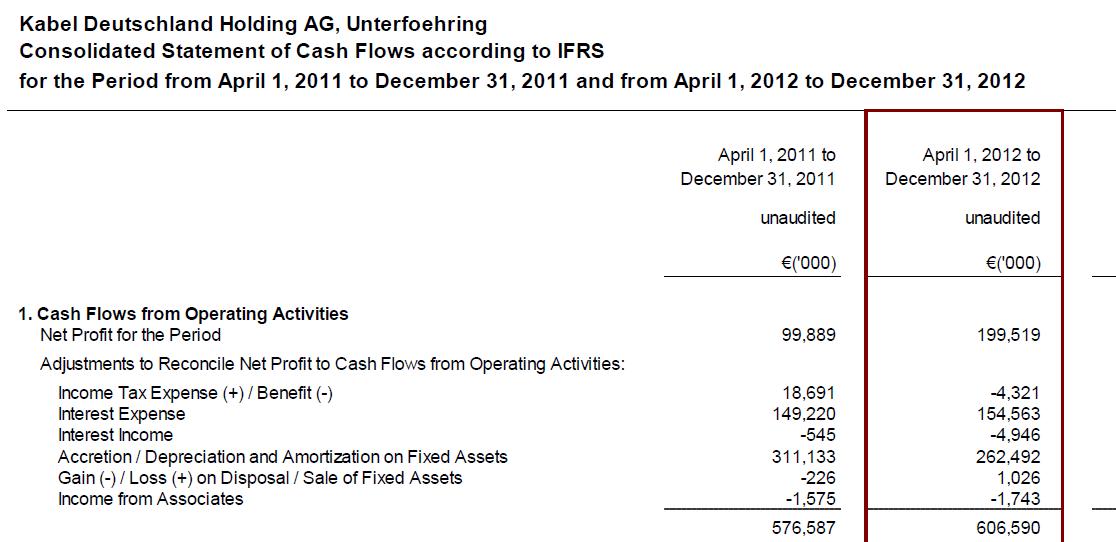
Now let’s look at the 9M Kabel Deutschland Cashflow report:

kabel op cf

We can see that other than Thyssen Krupp, Kabel Deutschland adds back interest expense to Operating CF.

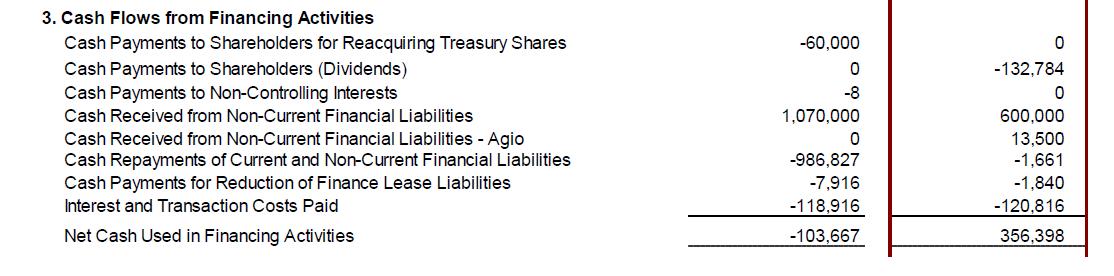
Later on, we can see interest expense under Financing Cashflow:

kabel financing cf

Accounting view

Under US GAAP it is clear: Interest expense belongs to the Operating cashflow statement. Under IFRS however a company can can choose between Operating and Investing Cashflow (see here, 7.15)

So we can see, there is nothing explictly wrong with Kabel Deutschland from a reporting point of view, they just have chosen to report interest expenses under Financing cashflow.

There is an interesting paper to be found here which makes the following observations:

We find that firms with greater likelihood of financial distress and a greater probability of default make OCF-increasing classification choices. We further show that firms accessing equity markets more frequently and those with greater contracting concerns are also more likely to make OCF-increasing classification choices. Firms with negative OCF are less likely to make OCF-increasing classification choices.

So that is no surprise that a PE “boot strapped” company like Kabel wants to show higher OCF and FCF and opts for Financing Cashflow.

What to do & Summary?

In my opinion, you have to make sure first that you compare apples to apples if you look at two different companies and compare free cashflows. Make sure that you treat this consistently. I am not sure if all the US investors which hold the largest stakes in Kabel know about this small but important reporting difference.

Secondly, I personally think that interest expenses always should be deducted from Operating Expenses and therefore Free Cash Flow in any equity valuation exercise.

Imagine for instance a company which rents its building against a company which takes out a loan to buy the exact same building. In the first building, you would subtract the rent clearly from operating profit, so why would you not subtract the interest on the mortgage for the second company ?

Following up an Maisons France Confort (ISIN FR0004159473) – Business model & Capital management

Last week, I ran Maisons France Confort through my checklist and found it quite interesting.

If we simply look at very basic profitability numbers, we can see that the numbers look almost too good to be true:

ROE NI margin Net debt per share
31.12.2002 27.1% 2.8% -1.46
31.12.2003 28.5% 3.1% -2.28
31.12.2004 34.5% 4.0% -4.74
30.12.2005 38.0% 4.6% -5.92
29.12.2006 39.1% 4.8% -7.33
31.12.2007 35.3% 4.8% -4.09
31.12.2008 24.3% 3.8% -4.44
31.12.2009 13.3% 2.9% -5.15
31.12.2010 16.7% 3.6% -6.98
30.12.2011 21.2% 3.9% -10.39
       
avg 27.8% 3.8%

The 10 years from 2002-2011 is a full cycle with boom and bust years, so achieving on average an ROE of 28% with a financially unlevered balance sheet is outstanding.

How do they do it ? The answer is (of course) effective capital management. I have used Bloomberg data for this but if we look at the last 6 years we can see that their capital management is really outstanding:

FY 2011 FY 2010 FY 2009 FY 2008 FY 2007 FY 2006
Goodwill 45.34 40.75 36.6 37.11 33.64 17.31
PPE 17.8 16.39 13.96 14.39 12.02 9.59
 
Inventory 21.74 20.8 24.23 24.14 21.17 7.95
Receivables 82.11 74.41 57 80.9 91.2 82.5
Prepayed expense 27.06 25.37 23.36 24.85 23.24 44.49
 
Accounts payable 96.9 81.88 70.95 93.26 92.58 80.06
Net Working capital 34.01 38.7 33.64 36.63 43.03 54.88
 
Revenue 583.91 443.06 395.84 499.62 482.97 424.98
Net income 22.68 15.83 11.51 18.9 23.19 20.2
 
PPE in % of sales 3.0% 3.7% 3.5% 2.9% 2.5% 2.3%
Net Working capital in % of sales 5.8% 8.7% 8.5% 7.3% 8.9% 12.9%
PPE+Net WC in % of sales 8.9% 12.4% 12.0% 10.2% 11.4% 15.2%

Running a business with only ~9% of “operating” net assets compared to sales is something you don’t see very often.

Let’s have a quick look at Kaufman & Broad, another French listed home and appartment builder:

FY 2011 FY 2010 FY 2009 FY 2008 FY 2007 FY 2006
Goodwill + int 151.52 150.82 150.5 149.71 149.81 69.96
PPE 5.88 5.99 5.93 7.27 9.47 8.87
 
Inventory 235.56 246.15 295.74 519.52 595.46 513.2
Receivables 305.67 203.33 203.77 296.26 405.7 309.13
Prepayed expense 141.26 159.48 139.43 158.64 147.39 122.14
 
Accounts payable 409.67 377.29 398.79 552.65 620.98 535.91
Net Working capital 272.82 231.67 240.15 421.77 527.57 408.56
 
Revenue 1,044.26 935.70 934.91 1,165.11 1,382.57 1,282.83
Net income 0 0 0 0 0 0
 
PPE in % of sales 0.6% 0.6% 0.6% 0.6% 0.7% 0.7%
Net Working capital in % of sales 26.1% 24.8% 25.7% 36.2% 38.2% 31.8%
PPE+Net WC in % of sales 26.7% 25.4% 26.3% 36.8% 38.8% 32.5%

Interestingly, Kaufman & Broad improved their capital management as well but they still need 3 times the operating net assets to generate roughly the same returns.

This of course shows in Profitability:

ROE NI margin Net debt per share
31.12.2002 21.4% 4.4% 5.90
31.12.2003 20.8% 4.5% 2.55
31.12.2004 20.1% 4.7% 3.46
30.12.2005 28.7% 5.9% 3.79
29.12.2006 33.5% 6.6% 4.64
31.12.2007 31.8% 6.1% 16.74
31.12.2008 4.6% 0.7% 19.90
31.12.2009 -31.1% -3.2% 12.46
31.12.2010 19.4% 1.9% 9.92
30.12.2011 37.7% 4.5% 7.69
       
avg 18.7% 3.6%

Despite a significant leverage, ROE are lower on average and due to the leverage much more volatile.

Maybe this is one of the reasons why Maisons has outperformed larger Kaufman by a wide margin over the last 10 years.

Just for fun, let’s also look at Helma AG, a small homebuilder in the currently booming German market:

FY 2011 FY 2010 FY 2009 FY 2008 FY 2007
Goodwill + int 2.21 2.19 1.85 1.63 1.51
PPE 16.31 14.57 14.89 15.48 13.79
           
Inventory 19.83 8.63 5.61 5.8 6.67
Receivables 10.59 6.33 4.27 3.47 2.92
Prepayed expense 8.85 5.76 3.11 2.98 2.72
           
Accounts payable 5.85 5.02 0.76 0.79 4.72
Net Working capital 33.42 15.7 12.23 11.46 7.59
           
Revenue 139.50 118.50 106.68 103.59 74.54
Net income 5.2 3.4 2.36 2.31 1.3
           
PPE in % of sales 11.7% 12.3% 14.0% 14.9% 18.5%
Net Working capital in % of sales 24.0% 13.2% 11.5% 11.1% 10.2%
PPE+Net WC in % of sales 35.6% 25.5% 25.4% 26.0% 28.7%

Interestingly, the operate roughly at the level at Kaufmann & Broad but nowhere near MFC’s level. Helma by the way actually seems to have jumped into property developement which might explain the increase in operating assets.

So compared to two other homebuilders, the business model of Maisons France looks extremely “lean” from a capital management point of view. The big question of course is why are they so much better ?

I think the big “trick” was already mentioned in the Ennismore summary from last week’s post:

Unlike many other markets, in France there is virtually no development risk for the company because land is purchased separately by the customer and the house will only be built once it is fully financed.

In their annual report, there is a hint how they operate:

Under Note 4.8 (receivables) we find the interesting information, that the receivables amount on their balance sheet is a net amount. So the roughly 80 mn receivables translate into 320 mn gross receivables against which they show something like 250 mn prepayments.

Those prepayments, which they seem able to get are basically an interest free float which explains in my opinion the superior ROE and ROIC metrics compared to the other builders.

Summary:

From a pure capital management perspective, Maisons France Confort seems to have a very good business model. they seem to generate a lot of interest rate free “float” which greatly reduces the required amount of net operating assets.

I am not sure if currently is the right time to invest as the stock has run up quite fast and french housing might be slow this year, but is definitely a very interesting company.

The big quesiton is: Is such a business sustainable without an obvious “moat” ? In my opinon yes, because creating such a business model is not something you can do from scratch. 3-5% margins are not overly attractive for many competitors. Howevr, in any case some deeper research into to this will be necessary anyway before a final investment.

Holding companies – Solvac SA (ISIN BE0003545531)

This is a quick follow-up on the Porsche SE post and the Holding company post.

Solvac SA (Had tip to reader G.) is the Belgian Holding company for 30% of the shares of Solvay SA, the Belgium based Chemical company. Majority shareholders of Solvac are the heirs of the founding Solvay family.

The holding company shares some interesting similarities with Porsche, for instance they hold also a 30% stake and account for the stake at equity.
Read more

« Older Entries Recent Entries »