Category Archives: Fundamentalanalyse

Guest post: Investment Theory: RoCE – some thoughts on a helpful, but sometimes misleading concept

I am happy to present one of the infrequent guest posts. This time a very interesting general post on RoCE (Return on Capital Employed) and Brand value by contributor Knud Hinkel.

Executive Summary:

The RoCE is an important ratio for value investors. However, as it regularly relies on balance sheet data, the concept is susceptible for at least two inconsistencies: (1) Items on balance sheet are not correctly reflected in the EBIT, and (2) items that contributed to EBIT are not reflected in the capital employed. My hypothesis is that the RoCEs of industries with significant self-created intangibles like consumer and software companies are subject to a systematic upward bias and this might light lead to a wrong judgment of (1) the underlying company performance, (2) acquisitions, and (3) the capital intensity of the business model.

Read more

Gaztransport & Technigaz (GTT.FP) – Wide Moat at a bargain price ?

Imagine you could invest into a company with the following characteristics:

– Global market leader with 70-90% market share (95% new built)
– Net margins after tax of 50% or more
– business protected by patents
– almost no capital requirement, negative working capital
– a potentially huge growth opportunity
– conservative balance sheet (no debt) and “OK” management
– at a very reasonable price (11x P/E, 7,8% dividend yield)

At a first glance, Gaztransport et Technigaz (GTT) from France seems to be the ideal cheap “moat company”. What do they do ?

Gaztransport is the global leader for “LNG containment systems”. LNG is liquified natural gas and is the predominant method to transport natural gas over long distances. In order to become liquid, natural gas has to be really cold,at least -162 degrees celsius. GTT’s technolgy is required to safely store and transport LNG on ships.

Problem Number 1

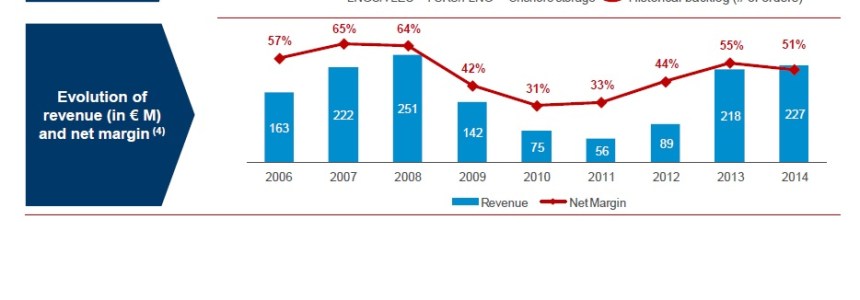
Before going into more details, it is pretty clear that GTT is an energy related company. But looking at this chart from their investor presentation we can clearly see what the real problem for GTT is:
gtt sales profit

Ultracyclical sales. We can see that within 4 years sales dropped -75% only to quadruple again in the next 4 years. Although the overall strength of the business model clearly shows in the fact that even after a -75% drop in sales, they still earned a 30% net margin.

So what do they actually do (The Moat) ?

Gaztransport has been IPOed in 2014 in France (although it was technically more a “carve out” as the company itself did not need any money. They have extremely good English language investor material, for instance the Q3 2015 report.

I try to summarize their businessin my own words:

– if you want to build ship to transport LNG, there are effectively only 2 technologies available to ensure that the LNG is contained safely, one of them is owned and patented by GTT. From inside it looks like this:

lng-containerment-tanks
– there is a relatively large moat with regard to technology. GTT has developed that technology over the last 50 years or so and it is superior to the only competitor (“Moss”), both in price (for the total ship) as well as in utility (ships are lighter, easier to maneuver, overall cost is cheaper)
GTT charges royalties, both, for the technology and “consulting” during the building of the ship. After the ship is finished, there are no royalties. Service is currently only a single digit percentage of sales
Sales therefore directly depend on the number of LNG tankers being build
So the future of GTT clearly depends on the future of LNG. More LNG means more ships and more money for GTT and vice versa.

The Moat vs. new competitors

There are potential new competitors, mostly the handful of Korean companies who actually build the ships. The Koreans for some time now try to develop or copy their own version of the technology. I assume that they clearly know how much money GTT makes with the patent and that they woul love to cut GTT out of the process.

GTT themselves think that the threat is not so big in the near future. The ship certification companies would need to approve first as well as the oil companies who are finally responsible for the LNG tankers and the administrators of any harbour or docking station.

So far in the 50 year history both, Moss and GTT have a 100% safety record with no accidents. The cost for GTT technology within the overall price of a LNG tanker is around 4-5% of the total constructon price. So the question is really why should any energy company take on the risk for a new unproved technology when the potential cost savings are pretty low ? LNG Tankers do carry the equivalent “firepower” of dozens of nuclear bombs, so risk aversion is pretty high especially in developed world harbours.

The LNG market

There is a lot of material on LNG but most of them are very optimistic, some links:

BG LNG Global market outlook
McKinsey LNG study

Again in my own words my thoughts on LNG:

– LNG is considered “clean fuel” compared to oil and coal and should benefit from climate issues
– Natural gas is abundant and in many cases cannot be transported via pipelines
– A lot of the natural gas comes from “stable” countries like Australia and the US and is therefore strategically interesting

But clearly, low energy prices take a toll on LNG as the liquification, transport and regsification are expensive. A year ago I looked at Seth Klarman’s investment Cheniere Energy and I was not convinced. However a lot of money has been now invested into liquification facilities especially in the US and Autralia, so it is not unlikely that the amount of LNG to be transported might rise as projected and the need for transport and storage increases.

So just some rosy LNG projections alone would not be enough to make GTT interesting for me.

The “carrot on the stick”: Bunker fuel

Big Ocean going ships burn a fuel called “bunker” which is extremely filthy:

As ships get bigger, the pollution is getting worse. The most staggering statistic of all is that just 16 of the world’s largest ships can produce as much lung-clogging sulphur pollution as all the world’s cars.
Because of their colossal engines, each as heavy as a small ship, these super-vessels use as much fuel as small power stations.
But, unlike power stations or cars, they can burn the cheapest, filthiest, high-sulphur fuel: the thick residues left behind in refineries after the lighter liquids have been taken. The stuff nobody on land is allowed to use.

In the meantime however, stricter requirements for ship fuel have been installed. Current caps are mostly effective in Europe and North America, but starting 2020, globally much tighter rules will come into effect.

There are several possible solutions to the problem:

– using cleaner fuel which is however more expensive and limited
– cleaning the exhaust with expensive technology
– use LNG as alternativ fuel

If LNG would become popular in the future, GTT’s technology would suddenly be required everywhwere, from every port and every big ship, which would mean much more steady business than in the past and a strong structural growth over many years.

However, at current prices this is far from a sure thing, so in any case as an investor I would not want to pay for this at the moment.

Click to access 213-35922_LR_bunkering_study_Final_for_web_tcm155-243482.pdf

Stock Price

For an energy stock, GTT has held up quite well since their IPO until late 2015 but then got hammered, howevr as we can see less than TGS for instance:

gtt chart


How to value GTT ?

The problem is the following: GTT is a cyclical company and we are most likely at or near the top of the cycle with regard to the “core” business. One could argue that with an overall size increase of the LNG tanker fleet, the replacement requirement increases but with an expected life of around 40 years, the replacement cycle  for the current fleet is a long way off in the future.

So using current profits and saying” Wow the stock is cheap” clearly doesn’t help. Comparing it for instance with a less cyclical stock like G. Perrier and saying: 11x PE is better than G. Perriers 15x PE is nonsense.

As I said before, I would not be willing to pay for the “Option” of LNG powered shipping so I need to come up with a way to value the company based on the cyclicality of earnings.

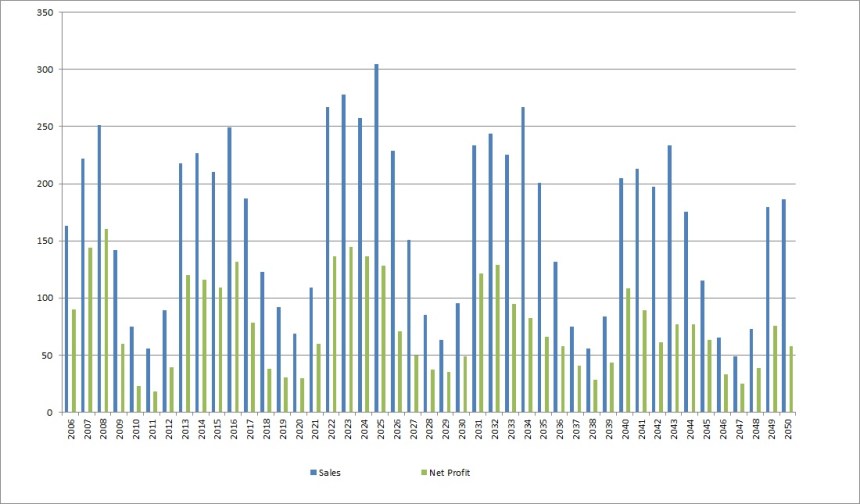
So what I did is that I tried to “simulate” future earnings with roughly the same kind of cyclicality that we have seen in the past 10 years. This is the resulting “Model” for the next 35 years:
gtt earnings

I have “modelled” somehow similar cycles as the current one, with the peaks increassing first and then trailing of somewhat in the future.

We can then discount this cyclical earnings stream by our “required rate of return” to see if GTT is a real bargain or not.

Under those assumptions my results were the following:

10% discount rate: 20,80 EUR per share

15% discount rate: 14,26 EUR per share

So now one could clearly challenge my “model” and tweak it somehow, but in general it looks like that GTT is not a bargain at current prices (34 EUR). To me it rather looks like that the current valuation already implies a certain value for the LNG ship fuel “option”. Therefore GTT at current prices is not interesting to me as an investment.

One important learning experience for me is that I guess one should value all cyclical stocks like this, i.e. really model the cycles and discount those cashflows instead of just looking at current multiples and say “wow that’s cheap”. I think I made that mistake to a certain extent with TGS Nopec.

Summary:

Overall, GTT is a very interesting, unique company. It combines a “wide moat” with regard to technology and patents with a very cyclical business.

Although the company looks cheap at current multiples, over the cycle there is more downside than upside at current prices in my opinion.

If LNG will become the dominant fuel for ships in general, than the investment case might change significantly to the upside but for me this is not given at current energy prices.

In the future, I will need to analyse and value cyclical companies the same way as I did here: With actually modelling cycles instead of (implicit) constant growth assumptions.


The Watch Series: Swatch (UHR.VX) part 2 – Capital allocation, Management & Valuation

It is time to finish the Swatch case. Let’s start with summarizing the first post on Swatch and the post on smart watches:

– I do believe that luxury watches have “staying power” and will not replaced or significantly impacted by smart watches as the main buyers are Emerging Market consumers and collectors
– If we accept that Swatch is in fact a luxury product company, there would be a clear valuation upside compared to other luxury companies
– However the lower range of their products (Swatch, Tissot, Rado, Hamilton etc.) clearly has problems which could become worse over time as the moat here is small to non-existent

So let’s look at some more aspects of how Swatch is run:

Capital allocation:

The company is run like a “family company”, very conservative and “Swiss” and a big contrast to Fossil. As mentioned in my post about the Hayek book, Hayek senior hated banks and Swatch therefore always kept a big cash buffer.

Read more

The “Watch Series” (5): Smart Watches vs. mechanical Swiss Watches (and Fitness trackers)

Management summary
In the short term, I don’t think that the Apple Watch is a big danger for Premium Swiss Watch brands. Why ?
– putting some gold on a mass-produced electronic gadget didn’t work for smart phones either
– the smart watch doesn’t have a killer app yet and we don’t see an overall smart watch boom
– the observed decline in Swiss watch exports seems to be mostly caused by overall weakness in Hong kong and Macau
– however lower or medium priced brands could be affected especially in the coming Christmas season

The short-term danger to Premium Watches is much more a further cooling of Chinese and Emerging Market demand. Mid to long-term there could be issues as the market seems to be in the early stages of significant technical changes

Before I jump into more details I have to make a confession: I am myself not an expert on watches. As a matter of fact, I haven’t worn a wrist watch for the last 25 years.
Read more

Buffett & Munger on Cost of Capital: Don’t listen to what they say but look at what they do

After bashing David Einhorn for his Consol Energy WACC assumption last week, by chance I read at the very good 25iq blog an article on how Buffett and Munger publicly speak about those things.

Indirectly, this is clearly a slap in my face because even the headline already says it all:


Why and how do Munger and Buffett “discount the future cash flows” at the 30-year U.S. Treasury Rate?

The post summarizes what Charlie and Warren have said over the years with regard to cost of capital and discounting. I try to summarize it as follows:

  • They seem to use the same discount rate for every investment, the 30 year Treasury rate
  • in a second step they then require a “margin of safety” against the price at offer
  • they estimate cash flows conservatively
  • Somehow Buffet seems to have a 10% hurdle nevertheless
  • Buffett compares potential new investment for instance with adding more to Wells Fargo

So if Buffett doesn’t use more elaborated methods why should any one else ? Was I wrong to beat up David Einhorn because he used a pretty low rate for Consol Energy ? Add to this Mungers famous quote “I’ve never heard an intelligent cost of capital discussion” and we seem to waste a lot of time here, right ?

Read more

Movado (MOV) – Is Fossil’s little cousin worth an investment ?

Movado is the second US-based company specializing in watches (see my previous posts on Fossil part 1 and part 2). The company has a quite interesting history. Cuban Refugee Gerry Grinberg founded the company in the 1960ties basically as a Swiss Watch importer. Later on they actually acquired the rights to the Movado brand with the iconic Museum Watch.

Read more

Fossil (FOSL) – Share buy backs & Management (part 2)

This is a follow-up to my first post on Fossil. The short summary:

Fossil has a good but not great business with some issues, among others the potential success of smart watches. The reason to dig deeper was the unusual combination of CEO/owner with zero salary and capital allocation with a focus on share buy backs.

Share buy backs

There is a great collection of articles on Teledyne and Henry Singleton “available at CS Investing. One absolute gem inside is a classification of stock buy backs in order of usefulness to shareholders from Hedge Fund Honcho Leon Cooperman:

Read more

Globo – lessons learned: Don’t outsource your research

Over the last few weeks, I discussed the Globo Plc case quite extensively with other investors. I think many people were attracted to it because it looked so cheap despite having a “sexy business”. Sometimes I was succesful in my efforts to talk people out of it, sometimes not.

And just to be clear: I don’t think that investors who owned Globo shares are stupid. As it seems for now, Globo has been a “pretty well-managed” fraud with a true core and very good actors as management. Everyone makes mistakes and the only sin is not to learn from them for the future.

What I found interesting is that some arguments in my discussions tend to show up almost each and every time in those situations, for instance also in the German-Chinese fraud cases I had written about. Most of the arguments circle around certain facts that because x, y or z is involved it cannot be a fraud, which often turns out to be not the case. So without wanting to insult anyone who I talked to or trying to be the “head teacher”, I just wanted to list some of the arguments I encountered multiple times in those discussions. Maybe they help in the next case, maybe not.

1. Famous investor xyz has a big position in the stock and they are well-known for in-depth due diligence and direct contact to managemnt

Everyone makes mistakes, even the most famous investors. Don’t outsource your due diligence to famous investors. You never know if the “famous investor” has deeply looked into the stock or just a (soon to be fired) junior associate.

2. I have actually talked to famous investor xyz with the big position about that stock and they seem to be really sure about it

Well, what would you expect if you talk to an investor who has a large position ? Will he tell you “I am not sure anymore and I will start selling next week” ? Most probably not. This is the famous “Don’t ask the barber if you need a haircut” situation. In situations like this it is much more helpful to talk with investors who don’t own the stock or who are even short. Everything else is just playing into the “Confirmation Bias” behaviour.

3. But they have an (well-known) audit company who checks the accounts

Many investors seem not to be aware what auditors actually do. Auditors are not responsible to uncover fraud. They are only responsible for checking the documents provided by the company for consistency. It is not the responsibility of the auditors to detect a “consistent fraud”. Don’t outsource due diligence to auditors, they don’t work for investors, only for the management of the company. Auditors get paid for the fees they generate, not for being right or wrong.

4. Reputable bank ABC has lent them money. They would not do this if there would be something wrong

Well, if this would be a general rule, we would have not had a financial crisis. In Globo’s case, significant “upfront fees” were involved with the loans. Anyone who has contacts with banks knows that once there are “juicy fees”, lending standards often become secondary. In most of the German-Chinese frauds, reputable banks extended loans as well. As with the famous investors, don’t outsource your research to others especially not banks !!

5. Reputable bank ABC has a “buy” rating on the stock

Sell side research is really the least reliable source of true information in capital markets. Most of the research is still driven by a desire to get business and most sell side researchers who are really good don’t work there very long.

6. I have spoken to management directly and they explained me this and that. They were really nice guys.

My experience is the following: If you really have large-scale fraud, the people running the scheme are often brilliant and charismatic. Otherwise they would have been detected much earlier. Direct involvement with those persons often doesn’t help, in contrast, one gets entangled by their “charisma” and accepts things which are simply not acceptable seen from a distance. Bernie Madoff seems to have been a very charming guy when you met him privately. The longer the fraud works, the more confident people get. I have read lot of books on frauds and in quite a lot of cases, the fraudsters at some point started to believe their own lies which made them even more convincing. At remember: As with driving a car, on average we are only average judges of people and character.


7. I have spoken to management and they gave me additional reassuring info which is not in the official reports

Well, this is a big RED FLAG. Management disclosing material non-public info to investors in “one-on-ones” is in my opinion a big problem. Any reputable management would never do this. As the recipient of this information, you feel privileged but on the other side: If they cheat the other investors by selectively disclosing stuff to you, then it is not a big step to cheat everyone.

8. They account aggressively because everyone in Tech does it

Well, no. Not everyone accounts aggressively, even within tech. As a value investor, the trick is to find those who run their business conservatively and stay away from aggressive ones.

9. It can’t be a fraud. I have seen the product, it is for real

Many frauds have a “real” core. Enron had some divisions which made money, even Bernie Madoff ran a “real” brokerage business as a front. Rarely, everything is totally made up. The question is not “do they have a real product” but “Do they have real sales and real profits”.

10. The company is so cheap, even when this one thing turns out to be fraud, the stock is still a bargain

Charlie Munger said something like this: “Cockroaches rarely travel alone”. Which means if there is one big problem that you can see, there are often many more problems that you don’t see. Once there is serious doubt with regard to integrity of the management, there is no margin of safety anymore.

11. They are financially unsophisticated, that’s why they did this and that one normally wouldn’t do

In Globo’s case it was the super-expensive loan and the potential bond, in the Chinese cases it was why they were selling new shares at a P/E of 4 or lower. When it comes to loans and new shares, one can be pretty sure that management is quite sophisticated. Especially when a company does a lot of M&A, uses a complex structure to avoid taxes and claims to do things like cash pooling, then unsophistication is a pretty unprobable explanation for strange and unlogical things. Underestimating the sophistication of a potential fraudster is not very sophisticated from an investor’s perspective.

Summary:

Most of the prinicipal issues which I see in cases like Globo can be summarized in 3 major points:

1. Don’t outsource due dilligence to 3rd parties (auditors, banks, other investors)
2. Don’t believe in what management says, especially when it is on a “privileged” basis.
3. Don’t underestimate potential fraudsters.

The best strategy to hopefully avoid such cases in my opinion is to fight the Confirmation Bias and search for opposing opinions wherever you can find them.

« Older Entries Recent Entries »