Category Archives: Fundamentalanalyse

Fossil Group (FOSL) – A great value stock with only temporary problems ? (part 1)

Fossil is a relatively well-known, US-based company which sells mostly watches and other accessories across the world, under its own brand but also under licenses from other famous labels (Michael Kors, Armani etc).

The stock has been hit hard in the last months and has lost more than 50% since its peak in 2012/2013. The Stock chart is a typical “falling knife”:

Fundamentally the stock looks very cheap, especially compared to historic profitability and growth:

Market cap: 2.660 mn USD (55 USD per share)
P/B 3,2
EV/EBIT 7,8
P/E Trailing 7,8
P/E est (2015) 10,7

10 year averages:
– P/E 17,7
– Profit margin 9,9%
– ROE 23%
– EPS growth 19,1%

So only looking at those historic numbers, Fossil looks like a high growth, capital light and highly profitable company at a bargain price. But as I have written before: Especially in an environment like now, cheap stocks are cheap for a reason.

Why is the stock cheap ?

There is a pretty decent Value Investor’s Club short thesis from late 2014 which lists a lot of the issues issues nicely. I would summarize it as follows:

1. The watch market in general is cooling down rom a high growth period
2. One of the main drivers, the Michael Kors brand (~1/4 of Fossil’s total sales) is having problems and the license agreement was expiring
3. The potential impact of Smart Watches.

I would personally add another fundamental issue which is:

4. Changes in the distribution structure & Social media branding

Let’s look Smart Watches first

Smart watches (and other wearables) are clearly a threat for established watch makers. It is hard to say if they will replace a significant share of traditional watches. With regard to Fossil one can make however the following observations:

a) Fossil is clearly NOT a first mover. They unveiled some first models in August and want to be on the market before Christmas but Sony ,Samsung, Motorola and of course Apple were much faster. Samsung now has 2 years experience and the new Gear S2 looks pretty good.

b) However the BIG question for Fossil is: If Smart Watches are succesful, will “Branding” work for Smart Watches the same way as for normal watches ? Fossil makes most of its money with branding, i.e. buying the stuff cheap in China, getting a license and putting a fancy name like Michael Kors on it and sell it expensively.

If you look at smartphones, branding for smartphones doesn’t really work. There was the Prada phone from LG but this seems to be not worked very well as I haven’t seen any new Prada phones since 2012. Most phones are sold under the name of the producer more like “regular” electronics. Why doesn’t branding work for smart phones ? I am not sure but I think it has to do with several factors such as rapid technological change. A brand like Samsung or Sony stands for technical excellence and people won’t pay more for a fancy name. If you want something fancy then you buy yourself maybe a Hermes Iphone case for 340 USD but not a Hermes branded phone.

I could imagine that Sports branding could work, as Smart Watches seem to focus on health and activity. For some reason however, adidas seems to have launched their first version of a smart watch already 2 years without the help of Fossil. So it seems that the Adidas license does not cover automatically all kind of watches.

Finally an interesting quote from the Michael Kors CEO with regard to slowing watch sales under the Michael Kors brand (from Bloomberg):

“A slowdown in our watch business, that has been significant and it happened very, very quickly. While I think many people think it is a result of the Apple Watch, it’s actually not. I think it is a result of the iPhone 6 where we did see some softening in our business when iPhone 6 was introduced. There’s clearly a younger customer, in particular, in America who is wearing watches less because they view the iPhone as something that they tell time with and watch becomes slightly less relevant.”
John D. Idol – Chairman, CEO, Michael Kors, Deutsche Bank db Access Global Consumer Conference, June 11, 2015

It could easily be that the Michael Cors CEO tries to blame the Iphone for the decline of his own brands but interesting nevertheless.

Changes in distribution & Social media branding

Historically,the distribution system of Fossil was clearly one of the competitive advantages. They did have own stores but most of their watches were sold in department stores like Macy’s or JC Penney plus Walmart. However as the department store format works less well, they have to adapt. They seem to do this by opening more and more own stores. They also clearly try to sell more online. However, as I experienced with Piquadro more than 3 years ago, moving from a more wholesale oriented model to a direct one is not easy.

Renting and running own stores is very different from delivering watches to a department store. It is riskier, you need more inventory and you need expertise in real estate.

Another threat is that the internet and social media seem to have lowered the barriers to entry. I had linked a few days ago to a story about Brandtech, the way some companies like Tesla use social media to create powerful brands.

If you go on Amazon and search for watches, the first page is dominated by “Daniel Wellington” watches. On the German site Amazon.de, the 20 most sold Watches are dominated either by super cheap no names below 10 EUR or Daniel Wellington. 6 of the 20 most sold watches are Daniel Wellington with an average price of 100 EUR, only 2 are Fossil watches. Amazon’s US top selling watches are interestingly allmost all very cheap models with Casio dominating the rankings.

Daniel Wellington is an only 4-year-old Swedish company which managed to go from zero to more than 200 mn USD sales in 4 years. The trick seems to be aggressive promotion via social media as outlined in the Brandtech article:

Tysander refuses to pay for traditional advertising, instead working with thousands of bloggers, celebrities, and other “influencers” worldwide. One of them, Blake Scott, 27, has been collaborating with Daniel Wellington for a little more than a year, sharing the watches with his 318,000 Instagram followers. “I first found out about Daniel Wellington via Instagram: Everyone outside the States was wearing one, and it seemed so cool,” he says. Soon after, someone from the brand reached out and said he wanted to give Scott a couple of watches to post on his feed. Eventually he negotiated a deal with the company, which paid a few hundred dollars for a multiweek campaign.

Other than that, they do exactly the same thing as Fossil:

Although DW bills itself as a Swedish company, the watches are manufactured in China, which is how the company keeps prices so low. The internal quartz movements—a battery and vibrating crystal to keep the time, essentially—come from Miyota, a Japanese supplier popular with lower-price brands, because their products are reliable and they always have a massive inventory. The rest of the components are made and assembled in Shenzhen, a manufacturing hub.


So clearly Fossil does not have anything like a moa
t, even the wholesale distribution network seems to be quite open for newcomers like Daniel Wellington. If you can build fresh brands as quickly as that, one also needs to think about how this changes the value of licenses of “famous” brands at least in the fashion category. One needs yet to see if Daniel Wellington is only a short-lived outlier or if more is to come.

What I like about the company

In general I found their annual reports pretty good and informative. If a company is in a situation like Fossil, with growth going away and cash flows still coming in, the danger is always that they do something stupid and/or incentives of management and shareholders are not aligned.

At Fossil however I found two statements which are quite impressive and indicate an above average management quality of the company.

This is a statemnt from the annual proxy statement about Kosta Kartsotis, Co-founder, CEO and 13% shareholder:

The Board believes that this structure is effective and best for the Company at this point in time for several reasons. Mr. Kartsotis joined the Company in 1988 and has been a director since 1990. He holds a significant number of shares of our Common Stock, and since 2005 he has refused all forms of compensation for his service as an executive officer, expressing his belief that his primary compensation is met by continuing to drive stock price growth.

Compared to this, Warren Buffett looks quite greedy in earning 100 K a year for being CEo. Mr. Kastsotis is basically working here for free. He has reduced his stake over time but in the last few years very little. Clearly without a salary he needs to sell some shares in order to get cash, but it would be quite easy for him to command a normal salary which could be at lest a mid single million USD number and no one could complain.

There was another great statement in the annual report on capital allocation and dividends:

Cash Dividend Policy.
We did not pay any cash dividends in fiscal years 2014, 2013 or 2012. We expect that for the foreseeable future, we will retain all available earnings generated by our operations for the development and growth of our business and for the repurchase of shares of our common stock

Fossil has bought back massive amounts of its own stocks in the last few years, around 1/3 of the outstanding shares have been bought back and they continue to buy more. Although part of thse stocks have been bought at 100 USD or more, I prefer this kind of capital allocation to doing stupid M&A transactions.


Summary part 1:

Fossil clearly has some fundamental issues to cope with. A general slow down in the industry combined with expiring license agreements has had direct and short-term negative effects on margins. The thread of smart watches adds further uncertainty. On top of that new competitors like Daniel Wellington seem to have no problems to enter the market and quickly gain market share.

Such a uncertain situation would normally be a clear reason NOT TO INVEST and stop researching as any margin of safety could quickly disappear.

On the other hand, Management seems to be properly incentivised and the capital allocation looks top notch. So I will digg a little deeper and try to come up with a valuation in a second post.

Vetoquinol SA – It’s a family affair

Vetoquinol is A French company specialized in “Animal health”, i.e. pharmaceuticals for animals. I came across the company more or less by random. The company went public in 2006 but the majority (~62%) is owned by the founding family, the current CEO is the 3rd generation of the founders. Some key figures:

Market Cap 450 mn EUR
P/B 1,6
P/E 16
EV/EBITDA 8
EV/EBIT 11
Operating Margin (11 year avg) 11,0%
ROCE (11 year avg): 10,8%
EPS CAGR 8 year +4,0%
Debt: ~ 3 EUR net cash per share

Read more

Value Investing Strategy: Cheap for a reason

Value investing is all about investing into stocks where the current price is “cheaper” than the underlying value.

The problem is clearly that although we know the price of the stock at any point in time, we can never be sure about the “true” value of a company as the future is uncertain.

So quite logically many value investors start searching for undervalued stocks within the group of “optically” cheap stocks. I often get emails like ” What do you think of stock xyz, it’s only trading at a P/E of 3 or P/B of 0,2 – isn’t this a great opportunity ?”. Isn’t it a great BARGAIN ?

Read more

Peyto Exploration & Development Corp – Canadian Cowboys or “Outsider” company ? (part 1)

A few days ago, I linked to a shareholder letter where the CEO of the Canadian NatGas Fracking company Peyto discussed his opinion on the book “The outsiders”.

As some readers might have noticed, I started to look into the energy sector some time ago. First reading some books (Exxon, The Frackers) and a quick look into Cheniere Energy, the NatGAs liquification play.

As I try to expand my knowledge in the energy sector and a CEO reading and discussing “The Outsiders” made me very curious, I started to read the CEO’s monthly letters (going back to December 2006). They are 2-3 pages reports which cover various topics. Although some things are repeated, the information content was extremely high.

I found myself reading report after report until I had read all 105 (!!) of them (you’ll find notes on the memo at the end of the post).. I found them fascinating for 3 main reasons:

Read more

Globo Plc – Value superstar or too good to be true ?

Management summary:

At a first glance, Globo PlC looks like a highly profitable, strong growing and incredible cheap software company suffering only from overall bad sentiment against anything which is related to Greece. A second short look however shows clearly that there are a lot of issues in their accounts (capitalization of expenses, revenue recognition) which in my opinion already raises a couple of red flags.

Additionally, some of their behaviour like taking on expensive loans despite a comfortable cash position does make no sense at all.

As for me, value investing is foremost about protecting the downside, Globe PlC is not something I am interested in as a potential investment and not worth additional analysis.

Among value investors, Globo PlC, a UK listed mobile phone software company is no stranger. Almost any screener will have Globo as one of the top investments.

null

Here are the current ratios which clearly look attractive:

Market cap 186 mn GBP
P/E 7
P/B 1,5
EV/EBITDA 4,3
ROE 22,2%
ROIC 19,3%
Operating margin 35%
yoy revenue growth +49%
yoy EPS growth +27%
Net cash 40 mn EUR

Read more

Quick check: John Deere (DE) – Great “cannibal” or cyclical trap ?

Looking at Berkshire’s portfolio is clealry a “must” for any value investor. Whenever they disclose a new stake it makes clearly a lot of sense to look at least briefly at what they are buying. Berkshire disclosed the John Deere position in late February this year. I assume this is a “Ted & Todd” stock. Looking at the track record of Berkshire’s public holdings, this is actually a good sign as Ted&Todd have beaten the “master” now several years in a row.

Looking quickly at Deere, it is not difficult to see some of the attractions:

+ relatively cheap (trailing P/E of 12,6, Stated EV/EBITDA of 5,5, EV EBIT 7)
+ organic growth, low Goodwill, good profitability in the past
+ good strategy /incentives in place
+ solid business model, significance of dealer network (quick repairs during harvest season…)
+ “Cannibal”, is massively buying back stocks

Especially the massive share buy backs are clearly a common theme for “Ted&Todd stocks”. Starting in 2014, Deer has reduced the sharecount constantly from around 495 mn shares to now ~344 mn shares.

However we can also see quickly a few “not so nice” things at Deere:

– pension /health liabilities (health – how to value ? 6bn uncovered. Very critical, healthcare sunk GM, not pension (EV multiples need to be adjusted for this)
– they do not cancel shares, held as “treasury”, why ?
– Financing business –> receivables & ROA most likely not “true”..
– lower sales but higher financing receivables ? Channel stuffing ?
– comprehensive income to net income volatility
– cyclical business. current profit margins still above historical average

Financing business

One of the most interesting aspects of John Deere is clearly the financing business. As other companies they offer financing, here mostly to dealers and not to the ultimate clients. A financing business is nothing else than an “in-house bank”, sharing much more characteristics with a financial than a corporate business, for instance requirement of continuous capital market access, default risk etc.

What I found especially interesting is the following: looking at Bloomberg, they already strip out automatically all the debt from the financing business when they show EV multiples. This could be OK if the debt is fully non-recourse however I am not so sure with Deere. Although they not explicitly guarantee the debt, there seems to be some “net worth maintenance” agreement in place which acts as a defacto guarantee for the debt.

An additional important point is the following: Deere shows very good profitability on capital in its “core” business. However, this is partly due to the fact that they show almost no receivables in the core segment. the receivables are indirectly shown in the financing business. To have the “true” ROIC or ROCE, one would need to add back several months of receivables to the core segment in my opinion.

Cyclical aspect: Corn prices

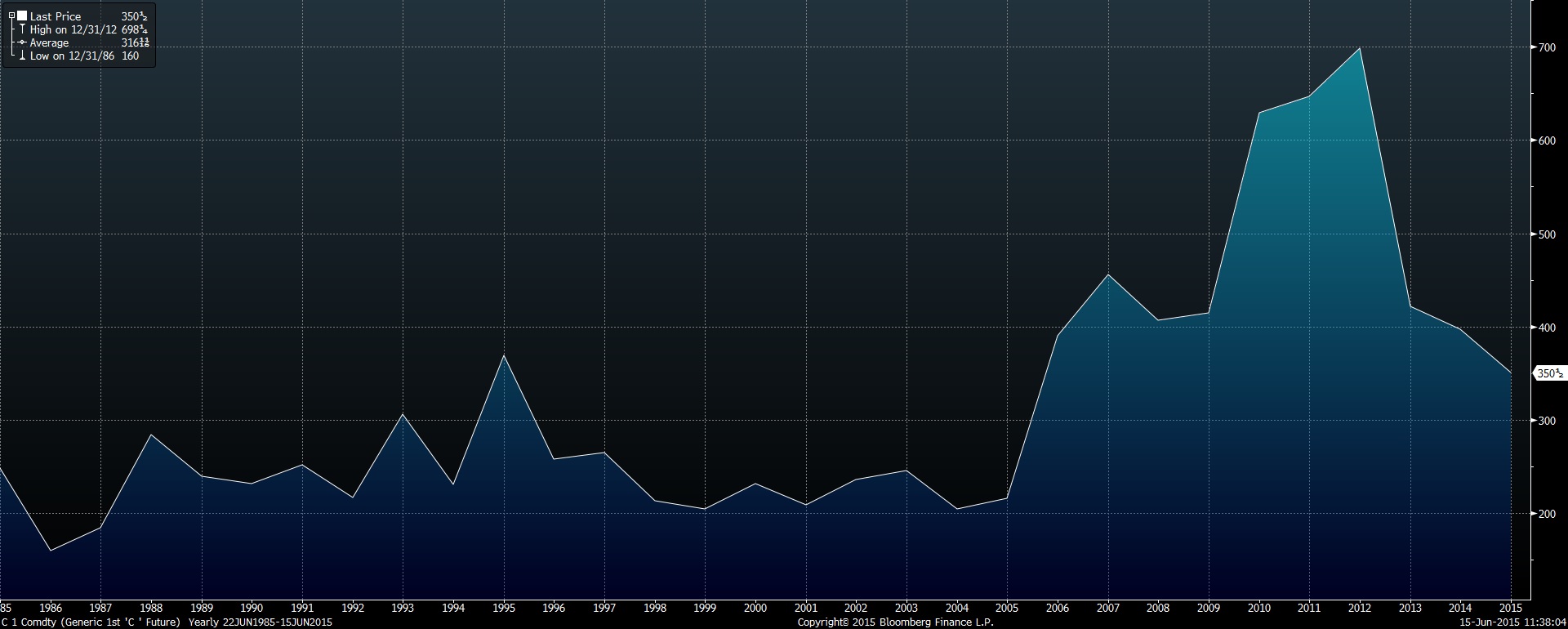
This is a 35 year chart of annual corn prices:

corn annual

We can clearly see that corn prices went up dramatically in around 2006 but are dropping since 2013 back to their historical levels. Demand for farm equipment is pretty easy to explain: If you make a lot of money on your harvest, you have money to spent for a new tractor (with a small time lag).

This is the 17 year history of Deere’s net margins:

Net margin
31.12.1998 7,52%
31.12.1999 2,08%
29.12.2000 3,76%
31.12.2001 -0,49%
31.12.2002 2,32%
31.12.2003 4,17%
31.12.2004 7,04%
30.12.2005 6,89%
29.12.2006 7,82%
31.12.2007 7,68%
31.12.2008 7,32%
31.12.2009 3,78%
31.12.2010 7,17%
30.12.2011 8,75%
31.12.2012 8,48%
31.12.2013 9,36%
31.12.2014 8,77%
Avg total 6,02%
Avg 2006-2014 7,68%
Avg. 1998-2005 4,16%

So it is quite interesting to see, that in the 7 years before the “price explosion” of corn, margins were quite volatile and around 4,2% on average. In the last 9 years however, the average jumped to 7,7% with 2014 being still above that “high price period” average.

Clearly, Deere doesn’t only sell to corn farmers, but many other agricultural prices have faced similar declines.

To be honest: I do not know enough if Deer can maybe keep the high margins they are enjoying currently, but to me at least the risk of margin mean reversion is pretty high for such a cyclical business.
Even if we assume mean reversion only to the overall average of ~6%, this would mean around 6 USD profit per share which seems to be currently also the analyst consensus.

Summary:

For me, despite a lot of positive aspects, John Deere is not an attractive investment at the moment. Despite being well run, the business is cyclical and has profited from high crop prices in the past. The balance sheet is not as clean as I like it and the valuation is not that cheap if we factor in pensions and the financing arm. Clearly the stock looks relatively cheap to other US stocks but the risks are significant. Maybe there is more if one diggs deeper (network moats via dealers etc.) but for the time being I will look at other stuff. At an estimated 2015 P/E of 16-17, there are many opportunities which look relatively speaking more attractive and where I can maybe gain a better “informational advantage” than for such a widely researched stock.

Edit: By the way, if someone has a view on the moat / brand value of John Deere I would be highly interested……

Why on earth is Seth Klarman investing 1,7 bn USD in Cheniere Energy (LNG) at 7x P/B ?

In my book review “The Frackers”, I mentioned one of the stories in the book was about Cheniere Energy:

Finally, there is a fascinating side story about the guy who is running Cheniere Energy, Charif Souki. His great idea was to import natural gas into the US and he raised several billion USD to build a huge gasification plant on the gulf coast. He clearly did not see fracking coming and his investment was worthless. Nevertheless, he was able to raise another few billion bucks and retool the facility in order to export natural gas.

This “double or nothing” gamble seems to have paid off. Seth Klarmann by the way, has just doubled its stake in Cheniere, making it their biggest public listed position at around 1,7 bn USD.

Seth Klarman

Seth Klarman is a famous value investor running Baupost Group a 25bn USD hedge fund. In contrast to Buffett, Klarman very seldom gives interviews and his fund commentaries are hard to get. Hi is considered to be the “heir” of Benjamin Graham and still sticking to the “cigar butt” approach of deep value investing. Two years ago in a Charlie Rose interview, Klarman made the following comment:

Baupost’s leading man says that he buys “cigar butts” at cheap prices. Warren Buffett used to also do this. The difference between the two legends is that Klarman stayed focused on cigar butts while Buffett’s process morphed into buying great companies at great prices and then into paying so-so prices for great companies.

Klarman does many things ordinary investors can’t do, like buying defaulted Lehman stuff etc. Not many of his investments are public and not all of his public investments are successes. Nevertheless it is clearly interesting to look more deeply into his biggest public position, Cheniere Energy.

Cheniere Energy

Cheniere’s stock chart shows the “unusual” history of the company:

Just as a side remark, somehow this chart reminds me of this funny animal:

Looking at Cheniere’s latest quarterly report, we can clearly see that Seth Klarman’s days as Graham style “net-net” investor seem to be over. Cheniere has currently around 7,5 bn net debt and 2,3 bn equity. Based on a market cap of around 17 bn USD, this is a P/B of roughly 7 times so hardly a bargain investment based on this metrics.

On top of that, the company never made a profit in its life as this table with EPS since 2004 clearly shows:

      EPS
02/21/2014 FY 13 12/13   -2,2
02/22/2013 FY 12 12/12   -1,6
02/24/2012 FY 11 12/11   -2,6
03/03/2011 FY 10 12/10   -2,3
02/26/2010 FY 09 12/09   -3,8
02/27/2009 FY 08 12/08   -6,0
02/27/2008 FY 07 12/07   -3,6
02/27/2007 FY 06 12/06   -1,5
03/13/2006 FY 05 12/05   -0,9
03/10/2005 FY 04 12/04   -0,6
N.A. FY 03 12/03   -0,4

So the question is clearly: What does Seth Klarman see to make this his biggest publicly disclosed investment ?

The best analysis I found was the one at Value Investor’s Club (accessible with guest login) from 2013, where the stock was trading at a third of the current price (Klarman bought between 60-70 USD). There is also a good article in Forbes from 2013 about the story behind Cheniere from 2013.

I try to summarize the case in a few bullet points:

– natural gas is very cheap in the US due to fracking and multiple times more expensive especially in Asia
– despite high costs, it is a pretty good business to liquify natural gas in the US and ship it to Asia in order to earn the spread
– Cheniere is in the process of finishing its first gasification plant by the end of the year 2015 and will then start to produce reliable cash flows as it has already contracted out its full production capacity for 20 years to major energy companies

The most important point is however the following quote from Forbes:

Cheniere’s Sabine Pass facility got its approval from the Department of Energy to export to any country in the world two years ago. It is so far the only facility to be cleared to export to countries that do not have a Free Trade Agreement with the U.S. And getting a non-FTA permit is a make-it-or-break-it approval for these projects, because there’s only one big gas-importing country (South Korea) with a free trade deal with the U.S. Unless a facility can export to the likes of Japan, China and India, the economics likely won’t support a multibillion-dollar build-out.

Cheniere had the luck to be the first to get this license. Later on, mostly due to the pressure of US based energy users, the US Government declined to issue further LNG “non FTA” export licenses for some time. According to Cheniere’s latest investor relation presentation, in 2014 two more “non FTA” licenses have been granted but Cheniere clearly has a head start.

Many more export facilities in the US would lead to higher prices in the US and to lower spreads compared to Asia, but for the time being, Cheniere’s primary LNG facility could be viewed as the typical “toll bridge” for US natural gas on its way to off shore destination as the other two licensed projects are still to be completed in several years time.

Cheniere itself is trying to further expand its current facility by 50% and they are projecting another site, but both projects have not yet received their license.

Valuation:

Replacement value

Despite buying at 7 times book, the question is: Could it be that Klarman is buying below replacement value ? I think it is unlikely. EV is around 25bn, stated book value of the assets is around 8 bn. Liquification facilities are not that hard to construct. all you have to do is to call someone like Bechtel and sign a turn-key project. Ok, you need the land and the permission, but overall this seems to be manageable in the US. So without going into more detail, we can assume that the current valuation of Cheniere is clearly above replacement value.

Valuation based on future cash flows

The VIC author estimates around 4-6 USD per share distributions for Cheniere’s shareholders going forward based on the first 4 trains of the initial liquification project. I have not double checked this but I will assume this number of being correct.

Reading through the roughly 15 pages of risk factors in Cheniere’s 2013 report, I would not call this a risk free business.There are still a lot of moving parts and operational risks even if the whole facility is up and running. Cheniere’s public bonds in the operational subsidiary trade at around 5,5% yield p.a. So discounting equity cash flows at the HoldCo level should be higher than that.

A) Existing facility and licence & contracted cash flows only

Cheniere has fixed contracts for 20 years. In the following table I have calculated NPS for the above mentioned EPS range and different discount rates, based on the assumption that one gets those earnings for 20 years and after that nothing (for instance any future earnings have to be applied to retire the debt):

eps/discount rate 4 5 6
6,50% 44,07 55,09 66,11
7,50% 40,78 50,69 60,83
8,50% 37,85 46,73 56,08
9,50% 35,25 43,17 51,81
10,50% 32,92 39,96 47,95
11,50% 30,84 37,05 44,46

We can clearly see, that the contracted amounts at the existing facility will not be enough to justify the current valuation of around 70 USD.

B) Existing facility, indefinite cashflows

This is the table with an indefinite stream of earnings at various discount rates:

eps 4 5 6
6,50% 61,54 76,92 92,31
7,50% 53,33 66,67 80,00
8,50% 47,06 58,82 70,59
9,50% 42,11 52,63 63,16
10,50% 38,10 47,62 57,14
11,50% 34,78 43,48 52,17

Even with an indefinite time horizon, Cheniere does not look like a “bargain stock”.

C) Existing facility + 50% capacity increase, contracted cash flows only

eps/discount rate 4 5 6
6,50% 66,11 82,64 99,17
7,50% 61,17 76,03 91,24
8,50% 56,78 70,10 84,12
9,50% 52,87 64,76 77,71
10,50% 49,39 59,93 71,92
11,50% 46,26 55,57 66,69

D) Existing facility +50% capacity increase, indefinite cash flows

eps 6 7,5 9
6,50% 92,31 115,38 138,46
7,50% 80,00 100,00 120,00
8,50% 70,59 88,24 105,88
9,50% 63,16 78,95 94,74
10,50% 57,14 71,43 85,71
11,50% 52,17 65,22 78,26

The 4 scenarios show relatively clearly that only with including future non-contracted cashflows and additional, not yet approved capacity, the stock looks interesting. In order to satisfy the return expectations of Klarman, which should be 15-20% p.a.based on his track record, he must assume further cash flows for instance from the second site Cheniere wants to contruct at some point in the future in Corpus Christi. Plus, there should be no dilution etc. from raising the rquired gigantic amounts of capital.

Maybe he is betting that the stock will trade like a bond if the company starts paing dividends ? Or is he leveraging the investment with addtional debt ?

In any case, he seems to be paying a lot for future, uncertain cash flows, which contradicts his “we still do cigar butts” statement. This is not that different from what Buffett is doing when he is paying rather expensive prices for great companies. At least for a guy with a portfolio size like Seth Klarman, the time of “cigar butt” investing seems to be over. Even he must feel th pressure that you cannot charge 2/20 for holding cash.

So to answer the question from the beginning:

Why on earth is Seth Klarman investing 1,7 bn USD in Cheniere Energy (LNG) at 7x P/B ?

I have no real idea but it might be the case that Klarman somehow need to put money at work and he expects this investment to be uncorrelated to general market as he has been quite pessimistic on equities for some time.

Summary:

For me, Cheniere at current prices is clearly one for the “too hard” pile. Klarman of course can spend a lot of money and time to fully analyze the energy markets etc. although as we know now, most energy experts have a hard time to make meaningful forcasts. But still it doesn’t look like a bargain and clearly no “cigar butt” or “net-net” kind of investment.

Funnily enough, analyzing Cheniere makes me much more confident in my Electrica investment. At least to me, the risk/return relationship there is some magnitudes better than for Cheniere. I think I will upgrade this to a full position over the next few days.

P.S.

Some other stories I found about Cheniere
http://www.alternet.org/fracking/how-powerful-friends-and-cozy-relationships-helped-cheniere-energy-cash-natural-gas-exports
http://www.octafinance.com/baupost-group-doubled-stake-cheniere-energy-still-bullish-us-lng/
http://www.mailtribune.com/article/20150125/Opinion/150129835

FBD Holdings (ISIN IE0003290289) – A local Irish Insurance champion for sale ?

Again this turned out to be a quite long post as I am digging a little bit deeper into the balance sheet. Therefore a quick summary:

Although FBD Holdings, the Irish P&C company looks interesting, I will not invest. The company has a very impressive track record, but in my opinion the business model is not scalable as it doesn’t have any structural competitive advantages besides a loyal client base. Additionally, the company severely screwed up their asset allocation and will be faced with ultra low investment returns going forward unless they are increasing their investment risk significantly.

At current stock prices, the company is in my opinion pretty well priced, with only a relatively small upside in a good case and equally large downside in a more negative case.

Read more

My oil price forecast and a few (random) thoughts on oil and oil related stocks

My oil price forecast

To be honest, I have no fxxxing clue where oil will be tomorrow, in 1 month, 1 year or 10 year. The good news is: Absolutely nobody has a clue, too !! Yes, you can read now a lot of comments, interviews etc. of people who have suddenly turned into oil experts and predicting either a jump back to 100 USD/barrel or oil for free for the next 100 years.

I did some research and one of the very few analysts who was actually bearish on oil prices was a guy called Ed Morse from Citibank. I found comments from him in 2012, 2013 and beginning of 2014. But even he only predicted prices down to 75 USD/barrel.

So it is pretty fair to say that no one saw this coming. Therefore one should be extra careful on listening to people try to tell you what is happening next. They are all just guessing. And no, I am not interested in any Saudi/US/Russia conspiracy theories.

My personal opinion is that the current fall in prices could be a combination of additional supplies (indebted oil companies and governments have to pump more oil as prices fall to meet obligations) and momentum riding traders (hedge funds. But this is just an opinion, I have no prove for this.

Is a low oil price good for the economy ?

Although I have no clue where oil is going, I think it is still important trying to understand what this could potentially mean if oil prices remain low. Oil, in contrast to gold, silver or even iron ore is such an important factor in the global economy that it would be naive to believe that this has no impact.

Conventional wisdom is that low oil prices are good for the American consumer as he has more to spend on “stuff” and as a consequence for the US economy. But wait a minute ….wasn’t deflation the biggest “Enemy” of the recovery ? Then why should now deflation via the oil price suddenly be great news ? Is ther good deflation vs. bad deflation ?

I am not a macro guy, but I would say there are doubts if low oil prices are really good for indebted economies struggling with deflation. In the UK for instance, inflation already was at a 12 year low for November. Oil and gasoline taxes are important revenue bases in southern Europe as it is not easy to dodge those taxes.

One other thought: A lot of Oil money got recycled into the stock market. Norway is the biggest shareholder in most European stocks and increasing their stakes continuously. If the oil price stays that way, they clearly have less money to invest.

On oil (and related) companies

Clearly, most oil related companies are negatively effected by lower oil prices. There are business models with more exposure (e.g. oil rigs) and less (oil storage), but in general, the whole oil industry is not happy about a -50% drop in oil prices.

However they do look extremely cheap on a historical basis. But be very careful here. If you look at trailing P/Es or trailing EV/EBIT like the Alpha Architect blog did, be aware that those cheap trailing multiples are based on 110 USD/Barrel and not 55 USD.

Nevertheless, a stock which has just fallen 50% or more often looks irresistible for value investors. This is buying at a huge discount, right ? But just buying on a recent drop in prices is in my opinion “fast thinking”, the typical “catch a falling knife” reaction.

The “slow thinking” and real value investing would be to make sure that the VALUE (not the price !!) of such a company has remained constant.

The problem with this is the following: In order to justify an investment into oil related stocks based on historical profitability you have to assume 2 things at the same time:


1. the oil price has to go back up
2. oil related companies have to be able to earn their old margins again.

Those are basically two bets in one. Especially for capital-intensive companies, the second point does not automatically follow the first. If the oil cycle has actually turned for a longer period, than we will see a lot fewer investments going forward and anything related to Oil capex might be in trouble (and yes Siemens, you might think of directly writing of all of your nice Dresser Rand goodwill purchased at a PE of 32). A good example for instance for this effect are the Steel and shipping industry. All that capacity is not going away quickly and the companies are willing to operate at a loss as long as variable costs are lower than the price.

As a trader, you can clearly speculate on a rebound, as we are just seeing on a daily basis. As an investor, you should make sure that your chosen investments will experience “mean reversion”. For companies with a high capital intensity and lots of debt there a big risk that someone else will reap the benefits of the recovery after shareholders have been wiped out. I am pretty sure, Oaktree is already hiring energy experts by the dozen.

“Collateral damage”

Apart from oil related companies, one should be aware that problems could surface elsewhere. Banks who lend to oil companies are an obvious example. Oil traders or hedge funds who are long oil are another example, an early casualty was OW Bunker, a shipping fuel supplier from Denmark.

Less obvious issues could come up for instance at airlines. Yes, long-term they might benefit, but short-term they could run into a cash crunch due to their hedges. If an airline uses forwards they have to put up a lot of collateral to banking partner at the moment as their forwards are deeply underwater. If then competitors with less hedges then start reducing ticket prices early, this could get interesting.

In Germany, gasoline tax is around 40 bn per year or 4-5% of total tax revenues. In countries like Italy, that percentage is much higher (gasoline is much more expensive in Italy than Germany due to higher taxes…). Especially for those countries, the drop in tax revenues will hurt. I didn’t find hard numbers on that but my guess is that budgets in countries like Italy will not surprise to the upside if oil and gasoline prices stay low.

Potential opportunities

However there is also the chance of what I would call “positive collateral damage”. For instance companies in the oil sector or in oil economies which are not directly hit by the oil price like distributors etc.

Norway could be interesting too. I am suffering at the moment with Bouvet, but I do think that med term this could be interesting. The Norwegian Government has enough fire power to jump-start some supporting initiatives and Bouvet could profit as the Government is one of their biggest clients (Statoil too, I know….).

Turkey and the Lira have been hit badly by the Ruble crisis. I do not fully understand why. Turkey is a big oil importer and lower oil prices will most likely lower inflationary pressures. I guess this has to do with investors selling out local currency EM funds.

Other examples could be oil related distribution companies or infrastructure companies (oil storage, natural gas grids) who earn money based on volume independent of underlying prices. Or Oil tankers, but that is again another story.

Summary:

If oil remains at current levels, this would be clearly significant, both for the world economy and the stock market. I have no clue what oil will be doing, but it makes a lot of sense to think about potential impacts.

My advice at the moment would be:

– ignore oil price forecasts from people who didn’t see this coming (basically everyone)
– avoid anything which has a lot of leverage and is oil related unless you want to trade short-term
– make sure you understand what parts of your portfolio have direct/indirect oil exposure and in which direction and ask yourself if you are comfortable
– better look for “collateral damage” kind of investments (non oil companies in oil countries etc.)
– don’t rush, let your “slow thinking” part of the brain gain control

Tesco Plc (ISIN GB0008847096) – Potential value investment or turnaround gamble ?

For a very long time, Tesco, the UK supermarekt chain could do no wrong. They grew nicely year after year and margins, returns on capital etc. were in a league on its own compared to other supermarket chains.

In the 20 years leading up to 2007 for instance, the Tesco share price increased 15 fold, resulting in an annual gain of ~ 16,3% vs. ~7,0% for the FTSE 100.

In the last few years however, Tesco’s star faded. Profit warning was followed by profit warning. In 2013, after exiting the US business and the China venture, many thought that the worst was behind them. But now in 2014, the problems seem to have just begun with further sales declines in the UK markets and lately with an accounting scandal forcing the Chairman stepping down

Over the last few years I looked from time to time into Tesco. I usually don’t like retailers that much, but with Tesco the simple reason was always “Buffett is owning it”. I have to admit that for me the fact that Buffett is owning something creates an urgent need to look at those companies.

Anyway,
Warren Buffett admitted defeat and sold out a few weeks ago, after buying a large stake as late as in 2012, calling the whole episode as a “great mistake”.

Nevertheless, such a rapidly falling stock price of a “blue chip” company still lures many value investors. Among others, Vitaly Katsenelson came out with a “pro Tesco” article just a few days ago.

I would summarize his arguments as follows:

It is a good time to buy Tesco NOW because:
– the news is all negative
– there is an natural upper limit of discounter market share in the UK close to the level where it is today in the UK (~7%)
– Tesco is still twice as large as the nearest competitor and 10 times bigger as Aldi and Lidl
– US grocers have countered Walmart in the US succesfully, so will Tesco in the UK
– Tesco sits on a lot of prime real estate
– Tesco has a 50% market share in online groceries in UK
– the discovered accounting issue is not so bad, as part of if happened in past years
– there is a lot of hidden value in Tesco’s real estate
– Tesco has subsidiaries (loyalty cards, Asia) which are valuable, it could be a sum of parts play
– the 7,5 bn GBP debt load is not an issue because the company is “asset rich”
– at an assumed “fair”operating margin of 5%, Tesco would be a “steal” at 6x P/E

Overall, the pitch is well written and seems to be quite convincing.

However at a second look, the Tesco story seems less convincing. Regarding Katsenelson himself, I wonder why he didn’t explictly mention his article from 1 year ago, where he recommended to buy Tesco right back then, at a price of around 3,60 GBP with virtually the same arguments. Since then, the stock lost a -54% if you followed his advice.

But let’s look at some of his arguments:

There is an natural upper limit of discounter market share

Katsenelson claims that the current discounter market share of around 7% is a “natural limit”. He doesn’t link to any proof and only mentions the limited success some US chains to support this. However if you look at the “Motherland” of hard discounting, Germany, you can see that this argument is pure nonsense. Although German shoppers might be a little special, a market share of 44% for diacounters in 2014 clearly shows that there is a lot of room for discounters in the UK, even if the never get to German levels.

Tesco is still twice as large as the nearest competitor and 10 times bigger as Aldi and Lidl

Well, that’s true for the UK but not for the Europe. Lidl had total sales of 75 bn EUR in Europe, only slightly less than Tesco’s total sales. Aldi doesn’t issue consolidated sales figures but is only slightly smaller than Lidl. What Kastenelson however completely misses is the following: Aldi and Lidl offer only a very limited choice, usually several hundred products compared to 10.000 or more in a large supermarket. So you don’t have the choice of 10 different sorts of orange juice, there is only one and the same goes for other categories-

The result of this limited choice is a a massive scale effect. Even with less total sales, sales per single product at Aldi & Lidl might be already higher in the UK than at Tesco. And sales per single products are essential because this gives negotiation power with the suplier.

There is a lot of value in Tesco’s real estate

This is the same argument one hears all the time for struggling retail companies. They just need to sell their precious reals estate and everything will be OK. The problem with this kind of approach is that real estate for a retailer is not some kind of “extra asset” which comes on top, but real estate is an essential production factor. Selling real estate for a retailer normally means a “sale-and-lease” back and is nothing more than taking on more debt.

I have written about one case, Praktiker in Germany, where the sale-and-.lease-back finally killed the company, the same happened with Karstadt/Arcandor. Tesco by the way, seems to have been quite active in more or less intransparent sale-and-lease back transactions in the past, as this FT Alphaville article outlines. There is also a pretty good post at Motley Fool with regard to the assumed “real estate treasure” and the following quote nails it down:

The supermarkets’ race-for-space is over. Forget the news that Tesco is planning to build houses on some of its now unneeded landbank — that’s it’s a sideshow in the grand scheme of things.

The real story to focus on is those aircraft-hangar-like Extra stores that Tesco is currently padding out with Giraffe restaurants, gyms, children’s play areas and suchlike. This seems little more than a holding strategy, while the company decides what to do with the stores in the new consumer-is-the-destination world, where ‘destination stores’ already seem so last decade.

Analysts at Cazenove have painted a grim — but I think realistic — picture of the way Tesco’s UK property valuation is heading:

“The gap between the performance of large out-of-town stores and convenience stores continues to widen … This has direct and strong implications for the property valuation of the Extra stores (45% of the UK space). The company says that its UK real estate is worth £20bn based on the extrapolation of past sale and lease-back transactions to the entire estate. We believe it is likely worth less than half that value — the book value of UK land and buildings is £9.3bn and the alternative use value towards which several out of town stores are converging is a fraction of the book value”.

Whatever the final outcome will be, but buying a highly indebted retailer because of the assumed value of the real estate has never really worked. If Tesco doesn’t earn enough on the real estate they occupy, who else will do this ? From my experience, when a retailer’s main attraction is the value of its real estate, then you should better run.

US grocers have countered Walmart in the US succesfully, so will Tesco in the UK

Again, Katsenelson looks at the US and compares Aldi & Lidl to Walmart in the US. I think this is a big mistake. If we look again to Germany, one can see that traditional grocers and supermarkets NEVER recovered fully from the attack of the discounters. Just a few weeks ago, one of the German supermarket pioneers, Tengelmann, sold its remaining “classical” super markets to rival Edeka. Operating margins for normal supermarkets, even for the really big ones are more in the 2-3% area maybe half of that what UK supermarkets like Tesco still achieve. Aldi and Lidl are privately owned long term players who clearly are prepared to sacrifice profit for a long time in order to gain market share.

Summary:

It could easily be that we see a mighty rebound in Tesco, maybe even after I post this and I will look like an idiot. However in the medium and long term, I think many of the popular arguments for Tesco as a value investment (real estate etc.) are pretty useless and some of the arguments (i.e. “natural maximum market share” of discounters) are just plain wrong.

If you define a value investment as an investment where the probability of a loss is very small, than clearly Tesco with its highly leveraged balance sheet is not a value investment. On balance debt, off balance debt, a big pension deficit adds to Tesco’s pretty weak balance sheet. Just recently, Tesco was downgraded to BBB- from S&P. Below this level, refinancing will be difficult and much more expensive and subjct to capital market problems.

As an investor you will only make money with Tesco in the long run if they manage a real turn-around. How likely is that ? I have no idea and so I will better stay away from Tesco. In my opinion this is much more a turn-around gamble than a potential value investment.

« Older Entries Recent Entries »