Category Archives: Fundamentalanalyse

Quick check: Astaldi SpA (ISIN IT0003261069)

Astaldi SPA was now mentioned by at least 2 commentators as an interesting stock, so let’s look at this Italian stock.

Looking at the “Normal” fundamentals, it seems clear why:

P/E 7.1 (2012)
P/B 1.0
P/S 0.2
EV/EBITDA 6.2
dvd. yield 3.1%

So at the first look, a single digit P/E and P/B of 1.0 look attractive.

On top of that, Astaldi has increased earnings each year in the last 10 years at an impressive rate:

EPS DIV ROE
31.12.2003 0.23 0.05 10.0%
31.12.2004 0.27 0.07 12.1%
30.12.2005 0.28 0.08 13.1%
29.12.2006 0.31 0.09 11.2%
31.12.2007 0.39 0.09 12.9%
31.12.2008 0.43 0.10 13.2%
31.12.2009 0.57 0.10 16.0%
31.12.2010 0.64 0.13 15.8%
30.12.2011 0.73 0.15 16.0%
31.12.2012 0.76 0.17 15.2%

Well, what is not to like ? Even my Boss Score says that they are attractive, indicating ~100% upside.

First, Astaldi is primarily a construction company. As a construction company, a large part of the balance sheet is either “work in progress” or “receivables”. The problem with that is that you never really know how at what stage profit will booked and if this is really earned or if there is some nasty surprise at the end. To illustrate this point, look at this table from page 179 of the 2012 annual report:

2012 2011 Change 2012 2011 2011+2012 In % of sales
– Revenue from sales and services 879,025.00 292,875.00 1,171,900.00 26%
– Plant maintenance services 12,544.00   12,544.00 0%
– Concessions construction and management phase 95,740.00 91,186.00 186,926.00 4%
– Changes in contract work in progress 1,330,781.00 1,881,223.00 3,212,004.00 70%
– Final inventories of assets and plant under construction 7,209.00 0.00 7,209.00 0%
Total 2,325,299.00 2,265,284.00 4,590,583.00

So this table shows that around 70% of Astaldi’s sales were unfinished projects accounted for as “percentage of completion”. This is the respective passage of their accounting principles (page 285):

Long-term contracts
Contract work in progress is recognised in accordance with the percentage of completion method, calculated by applying the cost to cost criterion.
285. This measurement reflects the best estimate of works performed at the reporting date. Assumptions, underlying measurements, are periodically updated. Any income statement effects deriving therefrom are accounted for in the year in which such update is made.

This is a big problem for me. I don’t know if their “best estimate” is cautious or aggressive. I have no evidence that they are doing anything wrong, but for my personal investment style, I do not like companies with a large share of “percentage of completion” business because that introduces a lot of uncertainty into the stated results.

The second problem I see here is the high amount of (gross) debt funding. Astaldi had around 1.25 bn EUR gross financial debt at the end of 2012. For construction companies, a combination of external debt with long term projects can be quite dangerous. Normally, one would expect that most of the projects would be funded via prepayments but Astaldi only manages to get around 400 mn EUR in prepayments.

The big risk here is that one big busted project or problems with one subsidiary can trigger loan covenants and then there is “game over” or at least a large dilutive capital increase.

Loan covenants:

Let’s look shortly at their loan covenants (page 223):

Covenants and negative pledges
The levels of financial covenants operating on all the committed loans the Group has taken out with banks are listed below:
(The present document is a translation from the Italian original, which remains the definitive version)
– Ratio between net financial position and equity attributable to owners of the parent: less than or equal to 1.60x at year end and 1.75x at half year end;
– Ratio between net financial position and gross operating profit: less than or equal to 3.50x at year end and 3.75x at half year end.

Lets do a quick calculation of the ratios in 2012 (based on their own “net financial debt calculations on page 32):

YE 2012: Net financial deb 812 mn, Equity 468 mn –> this would be already 1.73 times, so clearly above the threshold. Only if they include some “non current financial receivables” in an amount of 186 mn, the come down to 622/486 = 1.27 times.

In my opnion, their financial position looks clearly stretched. Maybe this is the reason why they had to issue a quite expensive 100 mn EUR convertible bond early this year. Issuing convertible bonds is ALWAYS a big warning sign that a company cannot fund its operations with “normal” debt.

For me, this is already a BIG RED FLAG. In my opinion, there is no margin of safety in a company with such a high debt load and such tight situation in terms of covenants.

Other more superficial observations after reading thorough the last annual report:

. unfocused concession portfolio (car parks, motorway, airports, hydroelectric plant, hospitals)
– comprehensive income in the last 4 years was always lower than stated eps

SIAS in comparison, my Italian “infrastructure” stock is a much easier story. Less debt, no “percentage of completion”, clear focus on motorway concessions.

Summary:

Despite the nominally cheap valuation, I don’t really like Astaldi. The high amount of “percentage of completion” assets combined with a rather large debt load make the stock quite risky in my eyes. If things work out well, there is clearly upside, however if one project goes wrong, the company will be in big trouble. So no real “Margin of safety” here in my opinion.

And no, I don’t think that concession business has a bright future. As an Italian company one has a clear competitive disadvantage with higher funding costs and in my opinion it is impossible to run so many different types of concessions in different countries really effectively. I am afraid that they will overpay and/or get the stuff the specialists don’t want.

Some more thoughts on generic drug companies / EGIS & Krka

A few days ago, I introduced EGIS as one of my new positions (part 1, part 2).

At that point in time I did not spend so much time on the generic drug business in general. However I think its makes a lot of sense to look at this a little bit more closely as it seems to be quite interesting. As this collection is mostly a reminder to myself, I will start with a summary and then have the details afterwards:

Summary:
The generic drug secor seems to be in a secular tailwind which might explain the nice margins for the sector as a whole. I personally do not believe fully in the “common knowledge” that company size is key, as the large players look less profitable. Finally, the market in Russia, EGIS biggest single market, seems to be a great opportunity although the risks are clearly there as well.

General business model generics:

The general business model for generic drug companies is in theory quite simple: You have to copy expired patented drugs as quickly as possible and then try to sell them either as

a) the cheapest alternative
b) as a “generic brand”

So in order to be succesful, one has either to be a trusted brand (see all the Ratiopharm adverts in Germany) or the cheapest one. As we all now, advertising has significant effects of scale, so for a small player to become a trusted brand is quite difficult. Low cost in contrast is in theory easier to achieve as a smaller player. As generic companies have to produce a lot of different products, I would assume that it is possible to become cost efficient in some drugs if one concentrates on those which have maybe a similar prodcution process.

Clearly, distribution plays a role as well. A generic drug company has to get into pharmacies. Usually, large pharmaceutical wholesalers (Celesio etc.) try to control that part of the supply chain. A big Generic company may have advantages here as well.

Interestingly, at least some of the big players do not have better margins than EGIS. Teva for instance has on average around 13% NI margin and 11% ROCE vs. EGIS 11.9% net margin and 12% ROCE for the last 15 years. So at least in hard numbers the size advantage does not look so significant. Maybe big players like Teva are not so interested in small markets like Serbia, Bulgaria and Romania ? Also some of the big US players (Actavis) are a lot less profitable than the smaller players.

Additionally, I think many people greatly mistake size and competitive advantage. Size can be a competitive advantage in some cases, but often, “diseconomics” of scale dominate, especially in companies which are the results of frequent mergers. This leaves a lot of room for smaller, more agile players to gain ground.

A further difference in business models is the fact, that some generic companies actually produce the so-called Active pharmaceutical Ingredients (API) themselves like for instance EGIS. other, like Stada buy them and only “mix” the drugs. Maybe this is the reason why Stada scores so badly both in margins and ROCE against EGIS ?

“Pay for delay”
An even more interesting business model has developed for some generic companies in the last years, the so-called “pay for delay” market. Here, R&D pharamaceuticals pay directly to Generics companies to delay their start of production and distribution. This almost seems to good to be true: You get paid for doing nothing. As often, things which are too good to be true will go away quickly. In this case, both in the US and Europe courts have already indicated that they consider this practice as illegal to a large extent.

Secular tailwind

The generic drug business has a strong secular tailwind. Medical costs skyrocket in most countries. One of the “quick fixes” for Governments is to make life easier for generics and harder for patented drugs in order to drive down costs for drugs.

Clearly, in many countries also Generic drug makers suffer, such as in EGIS home market Hungary. However, I think they can adapt better than “research companies” who need to invest a lot more into the development of new drugs.

All in all, it is better to invest into a sector with secular tailwinds than in a distressed sector.

Special Case Russia

Russia is currently the biggest single market for EGIS and the main driver for growth. The major driver here seems to be a Government led program established in 2009 to increase the supply of medication to Russian people significantly until 2020. Part of that program is also to increase the percentage of domestically manufactured drugs. So it might make some sense for EGIS to find a local partner or m&A target. Nevertheless, this will of course be risky. Stada for instance tried to take over Russia’s Pharmstandard, but ultimately failed to do so.

“Biosimilar” generics
This seems to be a big “buzz word” in generics at the moment. Biotech drugs cannot be as easily copied as “normal” drugs. Generics companies will have to invest a lot more money and effort into producing socalled “biosimilar” drugs. EGIS has already ligned up a deal with a Korean Biotech company, but as far as I understand it is only a distribution deal. Clearly an area to watch.

Krka (ISIN SI0031102120)- Slovenian Generics company

Krka is another Eastern European generic company based in Slovenia. It is nominally more expensive than EGIS, but it is more profitable as well. It might even be a “special situatioN” as the Slovenian Government which currently control the company, might be forced to sell their stake.

More to come on Krka….

Interesting Interview with the EGIS CFO 2 years ago:

Click to access Finance-EE-02-2011-PharmaInterview.pdf

When the business cycle goes down, public budgets go into the red and governments need to cut spending. This significantly affects the health sector as a major area of public spending. Thus, through the reimbursement system, a macro-economic crisis hits the pharmaceutical business usually with a delay of approximately two years.

Finally a big link dump from where I have compiled my “knowledge” above:

http://www.bostonglobe.com/business/2013/06/17/supreme-court-rules-pay-delay-generic-drug-deals-can-illegal/hACmkw0e8i00KLmJn90cSN/story.html

Click to access newport-deals.pdf

http://www.alvogen.com/Company/Strategy2016/
http://gabi-journal.net/the-generic-pharmaceutical-industry-moving-beyond-incremental-innovation-towards-re-innovation.html
http://www.economist.com/node/14742621
http://www.reuters.com/article/2011/12/21/us-actavis-generic-drugs-idUSTRE7BK1BQ20111221
http://www.nytimes.com/2012/12/04/business/generic-drug-makers-facing-squeeze-on-revenue.html?pagewanted=all&_r=0
http://www.ft.com/intl/cms/s/0/75224ab8-e8ef-11e0-ac9c-00144feab49a.html#axzz2VVMtjZCi

http://beta.fool.com/pharmteam/2013/05/02/generics/33156/

http://www.statista.com/statistics/205057/percent-of-generic-prescriptions-dispensed-by-corporation/

http://finance.yahoo.com/news/global-opportunity-generic-drug-players-152200943.html

http://jnci.oxfordjournals.org/content/93/24/1838.full
http://198.170.119.137/gen-geneurope.htm
http://blogs.terrapinn.com/total-biopharma/2012/11/21/big-generic-medicines-market-central-eastern-europe/

Click to access EFPIA%20Figures%202012%20Final.pdf

Russia

http://expo.rusmedserv.com/articl2.html

Click to access Zasimova%20final%20netti.pdf

http://de.slideshare.net/Shepherd12/russia-pharmaceutical-market-summary
http://pharma.about.com/od/Sales_and_Marketing/a/Pharmaceutical-Companies-Test-Opportunities-In-Russia.htm
http://www.reuters.com/article/2012/03/14/us-stada-russia-idUSBRE82D17R20120314

Click to access 0895_0895.pdf

Some more thoughts on EGIS

Following the first post two days ago, some more thoughts on EGIS:

Servier Group Diabetis drug scandal

One commentator mentioned, that Servier Group, the French parent is part of maybe the biggest pharmaceutical scandal in France ever. According to this article, at least 500 deaths are linked to a Diabetis drug of Servier.

Interestingly, already in 2011, EGIS denied having distributed or licensed this Drug from Servier. However they admitted, that they manufactured some of the ingredients and delivered them to Servier.

If Servier really gets fined heavily for this case, then in some aspect or another, EGIS will feel the impact. As we have seen, the internal business with Servier might be at risk.

Forinth/Hungarian interest rates

Standard CAPM tells you that you should use the risk free rate of the country a company is located as a basis to determine cost of capital. Although for EGIS this would clearly be a mistake as only 20% of their business is in Hungary. Nevertheless, I expect some tailwinds from the decrease of 10 year Hungarian Government yields from ~8.50% to 5% over the period of the last 12 months. This week, the Hungarian Central bank cut the short term rate for a 10th consecutive month.

If we compare for instance the performance of the Hungarian BUX Index for the last 12 months (+17%) against Italy (+34%), Spain (+34%), we can see that the Hungarian Index does not look extremely overvalued and with a level of 19000 would still have 50% upside to the ATH from 2007. So at some point in time there might be some kind of “catch up rally” for the Hungarian market as well.

Management/Reporting/Shareholder orientation

I cannot say anything about management so that’s neutral. Same for shareholder orientation. Ok, no buy backs or big dividends, but on the other side no negatives. Communciation is good. The annual reports. quarterly reports and analyst presentations are clear and easy to understand.

Other stuff

In March, EGIS and its US Partner Actavis settled a court case with AstraZeneca, which, according to some reports has a value of around 50 mn USD for EGIS starting in 2016.

Relative valuation

Lets look at the German generics company, Stada AG.

Stada Trades at the following multiples:

P/B 2.1
EV/EBITDA 10
P/E Trailing 19.5

ROE/ROCE have been a lot weaker in the past than EGIS, around 7% ROCE, and 8% ROE. Even if one considers that Stada is a potential take over target, I do not understand why Stada is trading roughly on 3 times the valuation of EGIS despite being less profitable over a long time period.

Looking at a more comprehensive list of generics companies, we can see that EGIS is by far the cheapest one. Only the Russian companies are at least comparable cheap. As EGIS does now a third of its business there, one should keep this in mind. Personally, I highly prefer to invest into a Non-Russian company doing in Russia than directly into a Russian company. C

Name Curr Adj Mkt Cap P/E Curr EV/T12M EBITDA Price/Sales FY2 P/FCF P/B
 
KRKA 1788.66 10.4 6.29 1.30 15.22 1.3
PHARMSTANDARD-CLS 1959.3 7.7 5.17 1.31 7.92 2.13
TEVA PHARMACEUTICAL IND LTD 25510.28 19.65 7.88 1.58 8.79 1.46
EGIS PHARMACEUTICALS PLC 562.52 7.82 3.75 1.04 8.23 0.85
HIKMA PHARMACEUTICALS PLC 2218.16 28.48 13.58 1.98 29.26 3.44
STADA ARZNEIMITTEL AG 2015.25 19.7 10.01 0.93 11.13 2.14
DEVA HOLDING AS 221.38 14.28 8.77   0 1.37
VEROPHARM 171.07 6.01 5.15 0.70 0 0.83

Absolute valuation

I think one doesn’t need to be to sophisticated here. A decent company like EGIS with a solid, non cyclical business should not trade at a P/E of 5 and P/B of 0.8. A fair price in my opinion, taking into account some issues from above should be a P/E of 10 or 1.5 times book, which would be still significantly below western peer companies.

Stock price

The stock price went up quite a bit since EGIS published quite positive 6m results a few days ago. Although one should mention that part of the positive development was driven by a positive FX result in the second quarter.

Summary:

EGIS combines some aspects which I personally find very attractive in “real” value stocks:

+ it is a very solid unspectacular business with solid returns over the cycle
+ the balance sheet is rock solid
+ valuation is extremely low both absolute and relative to peers
+ low valuation can be explained at least to a large extent by negative headline news which in EGIS case are not really justified

For me it looks a bit similar to Total Produce 2-3 years ago, where it was considered an Irish stock. If I have the choice, I actually prefer to invest in solid companies in troubled countries compared to more troubled companies in solid countries.

There is clealry some risks like

– Hungarian politics and tax risks
– court trial for Servier Group
– potentially bad/risky acquisitions

As a result, I will make EGIS a new HALF POSITION in the portfolio with 2.5% portfolio weight at a price of HUF 20.000 (*) per share..

DISCLAIMER: Please do your own research. The author might own the stock discussed already prior to posting it on the blog. Never follow blindly any tips, especially from internet sites. The information provided on this blog represents the subjective opinion of the author. Important issues might be interpreted wrong or even missing.

(*) It took me some time to finish the blog posts about EGIS. When I made my decision, the share traded at 20.000 HUF.

EGIS Pharamaceuticals PLC (ISIN HU0000053947) – Why is the stock so dirt cheap ?

Company description:

Egis Pharamaceuticals is a Hungarian based producer of Generic pharmaceuticals. Interestingly, according to their homepage, the company was founded in 1913 as a Swiss company. In 1993 it was privatised, in 1995 the majority was taken over by a French company Servier.

Valuation
Valuation based on traditional metrics looks cheap at a current price of ~ 20.000 HUfs

Market Cap ~540 mn EUR
P/B 0.8
P/E 7.5
P/S 1.0
Div. Yield: 1.3%

Taking into account ~5500 HUF net cash per share (~25% of market cap), the stock is ridiculously cheap:

EV/EBITDA: 3.0
EV/EBIT: 4.6
adj. P/E (trail 12 m): 5.5

Profitablity

On top of the cheap valuation, the company is consistently profitable, with double-digit margins:

NI margin ROE ROE cash adj
31.12.2002 9.2% 11.6% 12.7%
31.12.2003 7.0% 8.5% 8.7%
31.12.2004 8.1% 9.9% 10.2%
30.12.2005 11.9% 14.0% 14.0%
29.12.2006 15.2% 18.1% 18.5%
31.12.2007 6.5% 7.3% 7.9%
31.12.2008 11.0% 10.6% 11.6%
31.12.2009 11.8% 10.9% 12.2%
31.12.2010 14.1% 11.9% 12.5%
30.12.2011 10.5% 8.7% 9.7%
31.12.2012 14.0% 10.9% 13.6%
 
Avg 10.8% 11.1% 12.0%

Why is it so cheap ?

If a company looks so cheap, especially in today’s market environment, the first question is: Why ? So lets look at some obvious potential problems:

“Dictator discount”:
As a Hungarian company, one might think that a lot of investors are shunning Hungary because of the dictator like current government. In my portfolio, I experienced the unpredictability already once with Magyar Telekom. Although I managed to get out with a small profit, it was quite sobering to see how the company got punished by the Government via extra taxes, additional licences etc.

For Egis, this is clearly an issue. On top of price controls they are also subject to special taxes like Magyar Telekom. On the other hand they seem to be able to set off those special taxes against R&D expenses. This is from the last report:

Semi-annual drug price reductions, triggered by the price and reimbursement system that has been effective since October 2011 (the so-called blind bidding), strongly affected also this quarter, despite the fact that there was no further round at the beginning of the quarter. In addition to the blind bidding process, also the quarterly adjustment of reimbursement keys of medicines falling into the same INN category (so-called fixing) prevailed. However, price cuts focused on the blind bidding processes, consequently, the rate of price reductions effected on January 1, 2013 by Egis was negligible.
Payment obligation of drug producers on grounds of the reimbursements allocated to their drugs was raised to 20% from 12% as from July 1, 2011. In the second quarter, the total amount payable by the Company according to the turnover came to HUF 562mn. As from July 1, 2011 the rate of registration fee on medical representatives has been HUF 10mn/medrep/annum instead of HUF 5mn. On such grounds HUF 250mn payment obligation was accounted over the quarter.
In December 2012, the Parliament confirmed the R&D cost related deductibility option of payment obligations for an indefinite period of time. Accordingly, 90% of the payment obligations debiting the calendar year preceding the given year may be deducted, provided that the Company’s R&D expenses exceed 25% of reimbursement (proportionate to manufacturer’s price) paid on their products and that, within R&D spending, personnel
expenses remain above 3% of the same reimbursement amount. Pursuant to the rules of law lower rates of R&D expenses trigger lower deductions.
Entitlement to the deductibility option for the Company for the present financial year is judged on the basis of the R&D spending in the 2012/2013 financial year, consequently, the deduction allowance is accounted in the given business year while the financial settlement can be performed in the subsequent year. Taking into account the R&D expenses incurred in the second quarter of 2012/2013, 90% of the payment obligation, including also registration fee of medical representatives and surtax proportionate to reimbursement, occurring in the second quarter of the calendar year 2012, HUF 727mn were accounted as allowance.

That sounds complicated, but in the end, EGIS only paid an effective rate of 6% in the first 6 months. I am not sure how sustainable this is, the normal corporate tax rate in hungary would be 19%.

However, as a percentage of sales, Hungary doesn’t play such a big role anymore. In the current 6 month period, Sales in Hungary are 20% of total sales. In contrast, sales into Russia are now 1/3 of total sales and growing.

So to summarize the “dictator” discount theory: I don’t think this is justified. Rather it looks like that EGIS is benefiting from a very good treatment with regard to taxes at the moment, compared to companies like Magyar Telekom.

Cyclical business / easy to spot problems ahead:

For most pharmaceutical companies, patent expiry is the most obvious problems. If blockbusters expire their patents, then often profits fall off a cliff. With EGIS, this seems not a problem. As far as I understand, EGIS is mostly producing generics and not doing any R&D on own developments.

The majority share holders, Servier Group in France itself is a pharmaceutical company which does the original research. EGIS is then licensing some of their products.

So in the case of EGIS, I don’t see patent expiries as a big problem, nor is the generic business very cyclical.

Nevertheless, we do see some volatility in margins, especially in 2007 and 2011. What happened there ?

2011: If we look at 2011 vs. 2010, we can see that 2 factors contributed to the significantly lower margins:

– losses in associated companies (~-1.5% net margin)
– contribution to the National Hungarian National health fund (~3% of net margin)

So without those non-operative charges, EGIS would have shown solid ~14% net margins for 2011 as well

2007:
This looks a little bit strange. from 2006 to 2007, “material type costs” jumped significantly. According to their 2007 investor presentation, this was a result of unfavourable exchange rates (the Forint gained significantly in that period), price cuts in Hungary and a different product mix.

The USD/HUF FX effect might have been the strongest effect and this most likely explains the improving margins once the Forint became weaker again. Today, EGIS hedges ~70% of their USD exposure which should prevent most of that volatility.

So in both cases I think the problem was not a underlying cyclicality of the business model but rather a result of unfavourable exchange rates and regulation.

Dependence from major shareholders – related company transactions

The majority shareholder with around a 51% stake is Servier Group, a privately owned french pharmaceutical group with around 4 bn EUR turnover.

If we look into the last annual report unde point 24. related party transactions, we can see that between 15.20% of sales go to other Servier companies. This is not insignificant, but so far I don’t see an indication that this is not done at arm’s length.

In contrary, having a subsidiary with only a tax rate of 2% or so, if there were no minorities, I would let this company earn as much as possible in intra group transactions.

Balance sheet quality (operating leases, pensions, guarantees)

No problems here. I didn’t find any disclosure of leases and they only have a tiny pension liability. Nothing about guarantees either.

Free Cashflow conversion / low dividend / acquisition

Over the last 10 years, EGIS only showed Free Cashflow of around 400 HUF per share on average, only in the last 2 years, this went up to around 1400 HUF per share. Historically, EGIS paid only a mini dividend of 120 HUFs, so less than 0.5% dividend yield. One factor for the low free cash flow has been the fact that in the past EGIS booked purchases of fixed income securities as “investments” even if they were actually short term cash like securities. They changed that in 2011.

This year at least, sitting on 5500 HUFs net cash per share they doubled their dividend, nevertheless the 1.20% dividend yield looks small compared to for instance Magyars 14% plus dividend yield.

I am sure that the historically low dividend yield is one of the reasons why many investors avoid that stock. However if we look into the past, the money that EGIS reinvested actually led to decent growth. Over 15 years, sales in local currency more than quadrupled in line with profit. ROEs and ROIC always remained around 10-12% which is not fantastic but very solid.

Personally, I can live very well with a company which reinvests at 10-12% ROCE and not paying dividends, especially when it is so cheap as EGIS. I think such low dividend paying solid stocks are in fact one of the few “pockets” in the market where the valuations are OK because the “yield hogs” are not interested in them.

In the last few months, EGIS announced several times that they plan to use their cash on an acquisition in Russia. This is of course a risk factor, but I I understand correctly, they are going for manufacturing capacity and not for expensive goodwill type acquisitions. This is clearly a risk, on the other hand, the company is already very active in Russia for a long time and should know the market quite well.

From a free cash flow reporting perspective, acquisitions of course look a lot nicer than building you own, although the result is the same.

Preliminary summary:

So far, one can see that there are some factors why the stock trades at such low multiples. Most of those factors however are not a problem for me, so it definitely makes sense to take an even closer look in a coming post.

Quick updates: Sol SpA, AS Creation, Vetropack

Sol SpA

Sol came out with a “preliminary annual” already end of March. The numbers were not really surprising.

Sales were up 4.9%, EBITDA was up +1.4%, however net result was down -6.8%. I find this surprisingly good especially considering the tough environment for the mostly Italien based industrial gas business.

Most interesting is this part of the statement:

In comparison to 2011, the sales increased slightly in Italy (+0.2%) but much more abroad (+10.8%), which represents 46.8% of the total turnover. The home-care business, in which the Group operates through VIVISOL, marked a growth of 10.9% (sales equal to € 264.9 ml), while the technical gases business increased of 1.3% (sales equal to € 344.9 ml).

I think this is also the reason why the share price is doing quite well at the moment, despite the overall EPS decrease.

AS Creation

Also last week, AS Creation came out with its annual report for 2012. Numbers were ok (EPS 2.67 EUR per share against 1.69 EUR last year. Dividend will be increased to 1.20 EUR.

This is all quite positive, however the shares are now not cheap anymore. With a trailing P/E of 16 and the German economy running on full steam, there seems to be quite a lot of positive expectations for the Russian JV priced in.

AS Creation is one of the stocks where I have to check in more detail if there is still a real “margin of safety” at this level. (Edit: Interestingly, in Bloomberg they show a wrong EPS number for 2012. Here the EPS is 3.22 EUR, this makes the stock look cheaper)

The stock price has great momentum and is on its way to challenge the ATH from 2007 at around 50 EUR:

Vetropack

Last but not least, Vetropack came out with their 2012 report some days ago. Although EPS wass up strongly at 197 CHF per share, operating profit was down. The reason for this was a sale of non used real estate. Vetropack invested significantly more in 2012 than 2011, the question will be if this results in more growth.

In 2012, positive developements in some countires were off set mainly through negative developements in Switzerland and high energy costs.

I still like Vetropack as a very boring, extremely defensive (indirect) consumer play, again one has to monitor if the capital is allocated efficiently. At the moment a solid “hold” position.

The stock price is stagnating clearly, also compared for instance vs. Italian competitor Zignano:

Vetropack is trading at a discount (EV/EBITDA) both to Zignano and Vidrala, the 2 European peers which, in my opnion should be theother way round.

Value Investor or Value Pretender ?

There was a very nice post over at beyondproxy about the varieties of value investors.

The top 10 characteristics to spot the so called “Value Pretenders” from beyondproxy were the following:

Reason #10: You invest based on chart patterns,
Reason #9: You assume multiple expansion in your investment theses
Reason #8: You try to figure out how a company will do vis-à-vis quarterly EPS estimates
Reason #7: You base your decisions on analyst recommendations
Reason #6: You use P/E to Growth (PEG) as a key valuation metric
Reason #5: You use EBITDA as a measure of cash flow
Reason #4: You would worry about your portfolio if the market closed for a year.
Reason #3: You make investment decisions based on the activity or tips of others
Reason #2: Your investment process centers on the market opportunity.
Reason #1: Your investment theses do not reference the stock price

David Merkel at the Aleph blog has (as always) a very good reply to all the 10 points which I strongly support.

As I think this topic is quite interesting and funny, I tried to come up with some of my own characteristics which, in my opinion, could help to detect “Value Pretenders”:

My Top 10 list for detecting value pretenders would be the following:

10. Portfolio turnaround of 50% or more p.a.
“True value investments” are almost never short term bets. Sometimes if you are lucky, value gets realised more quickly but on average those ideas need at least 3-5 years for full potential.

9. Buy and sell decisions because of macro events or macro expectations
As a value investor, you have to be a fundamental investor and analyse on a company level. Macro expectations play a certain role but should never ever be the basis of a buy and sell decision as no one is able to really and consistently to predict them. In contrary, negative macro events are .sometimes very fertile hunting grounds for fundamental investors

8. Investment process does not include reading several annual reports per company in detail
As a fundamental investor, there is no replacement for reading the “original” source of information.

7. Investments in companies with questionable / aggressive accounting
As a value investor, you first thought should be: Can I lose money with this. Whenever a company looks cheap but accounting is questionable, there is no real margin of safety. Conservative accounting and integrity of the persons involved is key.

6. Investor does not discuss risks and weaknesses in detail
Again, the main point in value investing is not loosing. There is never a sure thing, every investment can go belly up. But as a value investor you should be able to identify and price in at least all the obvious risks. And communicate them.

5. Investor does not have a (to a certain extent) structured investment process or a very complicated one
A structured investment process is no guarantee for success, most asset managers pretend to have one. However, if the process is to complicated, with lots of committees and stuff, it is not a positive sign as responsibilities get diluted. No real proces at all is also a waring sign, although for the rare genius (WB) this might work. For pure mortals no process means the big risk of being vulnerable to all kind of behavioural biases.

4. Performance record consistently shows higher draw downs in negative periods than the market
Clearly, even the best value portfolio can underperform in a bad market. However if one sees this more than once, the portfolio is most likely not a “value portfolio” but a high beta portfolio of low quality stocks.

3. Investor offers you redemption on a daily basis
One of the big issues with investors is the tendency to second guess the investment manager. A value investor should “protect” his investors from their animal instincts and align their expectations with his investment style. Joel Greenblatt had a great article on this as he showed how individuals underperformed the Magic Formula by a wide margin because of jumping in and out of the strategy. For me, offering a daily redeemable investment vehicle (mutual fund) and claiming to be a value investor does not go well together.

2. Investor can tell you a great “story” for every stock he owns
On the one hand, any value investor should be able to lay out his investment thesis in a few simple sentences. Anything which is too complicated to explain is most likely not a good investment. On the other hand, “story stocks”, especially those touting some new invention or change in business strategy etc. are mostly never good investments. Good investments often don’t have “catchy” stories but rather are simply good and reliable businesses.

1. Investor uses only last year’s earnings / book value / cashflow plus projections as basis for an investment
This is one of the worst mistakes one can make. One year numbers are to a certain extent more or less meaningless. This is also one of the main reasons why I am very sceptical of “statistical value” strategies where people try to “data mine” investments. Clearly one can use this as a starting point for further analysis, but every company is the sum of its past and looking only at one year is like judging a book purely by its cover.

Finally a few words in general: there is clearly more than one way to success in investing and also more than one way to do “value” investing”. But at the core of value investing are in my opinion:

A) detailed fundamental analysis
B) protection of the downside
C) long time horizon
D) patience

IVG – Now what ?

IVG is one of my special situation investments, I had detailed posts about them here:

Introduction (German)
“Good news” (German)
Capital Increase
Capital Structure considerations
Balance sheet analysis

My overall thesis could be summarised as follows:

IVG is clearly in troubled water, so the shares and the Hybrid bonds are extremely risky, however the senior convertible which has a put in early 2014 has a good chance of being repaid. My main argument was and is that IVG is quite big and an outright default would have too bad consequences for the banks and hedge funds wer not yet involved. Even in the downside case, I would still come up with a recovery for the Hybrid in the 90ties due to the amount of underlying equity and hybrid debt.

Last week however, IVG came out with another worse than expected annual result for 2012.

The “bomb” however was this statement:

As the company would like to explain the financing concept being developed to the shareholders and to allow them to decide on specific measures, where appropriate, the 2013 Annual General Meeting will be postponed from 16 May 2013 to presumably the end of July 2013.

Well, clearly postponing the Annual Meeting is ALWAYS a bad sign. So all the listed IVG securities got of course hammered:

The stock lost around 2/3 of its value:

as well as the Hybrid bond:

The convertible lost almost half of its value before rebounding, resulting in a loss of 1/3:

So to look at the only positive aspect. At least the Senior bond outperformed against the subordinated capital tranches as one would expect in such cases. As reader JM commented, the activity in the convertible prior to the announcement looks very very suspicious and smells of insider trading.

Updated liquidation analysis

First of all, let’s update the liquidation analysis from 2012:

Summary valuation of Assets

In the first step, I think it makes sense to use the same assumptions as last time, to make the numbers comparable. In the following table we see the asset “model” updated based on the 2012 report.

2011 Adj. Val 2012 Adj.Val Comment
Intangibles 251 0 253 0 100% write off
Inv. Property 3,964 3,398 3,654 2,920 scaled to 7% yield
PPE 157 118 190 143 25% discount
Financial Assets 189 142 174 131 25% discount
equity part 95 71 84 63 25% discount
DTA 404 0 336 0 100% write off
Receivables 60 45     25% discount
   
Inventory 1,025 513 996 498 50% discount
Receivables 179 134 190 143 25% discount
Cash 238 238 142 142 0% discount
   
AFS 341 256 58 44 25% discount
Asset Management 275   318 1.5% of AUM
Marekt value caverns 163   140 50% of disclosed adj.
         
Total 6,903 5,351   4,540

In second step we can then determine, how much assets are available for which debtor class. In the case of an insolvency, collateralized lenders get paid first, then senior lenders then hybrid and then equity.

Based on the 2012 numbers, i would calculate the following liquidation values:

  2012
Adjusted NAV   4540
-Bank loans   -3837
Remaining   703
Other senior liabilities    
  -Derivatives -84
  – Tax -77
  – pension -34
  – other financial -17
  – other liabilities -218
  – Convertible -400
  Total senior unsecured -830
     
  Coverage 84.70%

So this means that senior creditors would get under my assumptions still around 85% of nominal. This is slightly worse than last year but still quite positive and should limit the downside.

Of course, I did not consider additional costs of winding such a company up, on the other hand I didn’t put for instance a business value on the cavern business. However it is also clear that in a liquidation, both Hybrid and shareholders get a big fat “donut” as recovery.

What next ?

In such situations, it usually makes sense to listen to the analyst call in order to see what Management is actually saying. Fortunately, the call is easily accessible via their website. By the way: The used app for the audio file is really shitty…..

The most interesting section of the management comments is the fact that the 0.7 bn EUR 2013 maturity doesn’t seem to be a problem at all, as this is a 50% LTV loan.

From the Q&A, I found the following points most interesting:

– Squaire: Relative slow increase in occupancy. They need 90% occupancy to really exit which seems to need time, at least until 2014
– Caverns: Demand from utility side has shrinked, “NAV adjustment” at risk
– IFRS 13: There seem to be some issues in order to reflect transactional costs in the current valuations. They mentioned 100 mn EUR as potential (negative) impact.
– LTV target: They mentioned 55% as a goal, from around 71% today, with the intermediate step of 60-65% (my remark: with ~4 bn Bank, 5% LTV is 200 mn EUR.)
– no plan to sell fund management (would have been one option to generate equity)
– no mention of hedge funds as holders of the bank debt
– the “gherkin fund” has an indirect 44 mn EUR risk for IVG

In general, they were very vague about refinancing. They mentioned Rothshild being an advisor which is not the best news for existing investors. The whole call was with that respect a deja vue similar to the Praktiker call almost 2 years ago.

My expectation is the following:

Current equity holders will suffer one way or the other. My guess is that a new convertible will be part of any refinancing package. I could easily imagine somthing like pledging the fund business to a new investor, similar to the “Max Bahr” pledge at Praktiker.

In the process, they will come up with some “voluntary” contribution of Hybrid and Convertible holders which in my opinion will not work. I still belive that the Convertible will be paid in full in 2014, but the next few months can be very volatile.

Lessons learned:

I think I made one real mistake here: When I researched utilities earlier this year, especially Energiedienst, it should have been clear that the gas cavern business will not be so good going forward as in the past. As my thesis on the IVG bond implied a stable gas cavern business, I should have reviewed the case back then.

On the other hand it is interesting to see that a very broad research focus could yield quite interesting “cross results”.

Summery:

I think there is no urgent need to sell as Convertible holder. The asset base is still high enough to support a relatively high worst case recovery for the senior unsecured creditors.

Nevertheless, one should prepare oneself for a quite bumpy rest of the year with some “Praktiker style” attempts t bail in bond holders. All in all I still expect full repayment in MArch 2014 with a high probability. However, because of the problems in the utility sector, the stabilizing effect of the cavern business has weakened significantly and the investment is riskier than before.

For the portfolio, I will hold the bonds for the time being.

DISCLAIMER: As always, DO YOUR OWN RESEARCH !!!! This is by no means an investment recommendation for anyone. Don’t trust anyone with tipps etc.

Total Produce (IE00B1HDWM43) 2012 preliminary results – Disappointing

Total Produce is one of the core holdings since the beginnings of this blog. In the beginning, we analysed the stock mostly in German, nevertheless, we finally settled after some back and forth on a fair value range of 0.69-0.83 EUR per share based on a free cash flow analysis, assuming ~8 cent of “adjusted” free cash flow per share (adjusting esp. for minorities.

One of the issues with Total Produce were back then Balance sheet quality (lots of goodwill, leverage) and only average return on equity, which however was set off by a very cheap price, significantly below book value

In between 2 things happened:

1. The price of the stock increased nicely to around 0.61 EUR. resulting in an overall performance of +55% incl. Dividends.
2. The quality of earnings however deteriorated in my opinion.

I think I have to explain point 2 a little bit in more detail. If you read the 2012 premliminary results, everything looks great:

Revenue (1) up 11.2% to €2.8 billion

Adjusted EBITDA(1) up 17.8% to €70.4m

Adjusted EBITA (1) up 21.4% to €54.6m

Adjusted profit before tax (1) up 19.1% to €47.3m

Adjusted EPS (1) up 12.0% to 8.11 cent

Final dividend up 12.0% to 1.512 cent; total 2012 dividend up 10.0% to 2.079 cent
(1)
Key performance indicators are defined overleaf

So everything is up double digits, where is the problem ? Well, the problem could be the use of the word “adjusted” in most of the items presented.

If one flips to the next page of the report, we can already see that “unadjusted” EPS declined by -7.5% from 7.11 pence to 6.58 pence per share.

Where does that come from ?

The “explanation” reads as follows:

Adjusted earnings per share excludes acquisition related intangible asset amortization charges, acquisition related costs, exceptional items and related tax on such items.

On the one hand, one could say OK, acquisitions are not part of the operating business, let’s ignore that. However, Total produce does a lot of acquisitions, year after year. Most of their growth actually comes from acquisitions, organic growth seems to be quite limited.

Total Produce, year after year reports those “adjusted” earnings, whereas the “regular earnings” are always lower. Let’s look at the past 4 years:

2012 2011 2010 2009 Avg
“adjusted ” EPS 8.11 7.24 6.84 6.47  
EPS 6.58 7.11 5.25 3.7  
EPS/Adj. EPS 81.1% 98.2% 76.8% 57.2% 78.3%

So not surprisingly, we only see “upside” adjustments, on average the “real” EPS is only ~78% of the adjusted EPS.

But it gets worse. In my opinion, one of the most “underused” pieces of information about the quality of a companies’ accounts is the Comprehensive Income statment.

“Modern” IFRS accounting allows quite a lot of items to be booked directly into equity as those items are considered sort of non-operating as well. Usual suspects in this category are:

– pension revaluation
– fx effects of foreign subsidiaries
– revaluation of fixed assets

In my opinion, one has to look at all those items because all of them influence the value of the equity position. Let’s look again at the last 4 years:

2012 2011 2010 2009
EPS 6.58 7.11 5.25 3.7
EPS “Comprehensive” 5.15 4.21 5.39 7.34

2009 looks better based on comprehensive income, however especially 2011 and 2012 look bad from that perspective. This is mostly the result of pension charges. interestingly, in 2009, they booked a 3 mn EUR pension gain into comprehensive income, since then, Total Produce however had to book in total 30 mn EUR negative charge through comprehensive income.^The discount rates used to discount the liabilities at the end of 2012 are still relatively high at ~4.2% both for EUR and UK. So there will be more charges coming.

Many analysts will tell you that comprehensive income doesn’t matter, because it is not operational, but I have a different view. With regard to pension for instance, an increase in pension liabilities means that you will have higher cash outflows in the future and the shareholder will get less.

Free Cashflow

For 2012, Total Produce reports ~41 mn EUR Free cashflow. That’s about 12.5 pence per share or ~50% higher than in our base case scenario. Again, this has to be taken with a “grain of salt”.

Again, as in the first post about Total Produce, I would eliminate the working capital movement, especially as the improvement only came from higher payables and not a reduction of inventory or receivables.

If we do a quick “proxy” calc I would calculate the following Free Cash flow:

+ 38 mn EUR OpCF
– 13.5 maintanance capex (depreciation)
– 1.1 “net minority dividends
= 23.4 mn EUR or ~7.8 cents per share.

This is only slightly below the initial assumption of 8 cents per share but does not include the various payments for the acquisitions.

The problem I do have is that most of the free cash flow is now used for acquisitions, where I am not sure how “value added” that part is.

Summary:

In my opinion, Total Produce’s earnings quality deteriorated significantly. The “adjusted” numbers should be ignored, based on comprehensive income the company only earned ~5.15 pence for the shareholder and this is based on quite optimistic assumptions for the pension liabilities.

The company is using the majority of its free cash flow for acquisitions, where due to all those special effects, it is not clear to me if they earn really enough return. The priority seems to be to increase the size of the company. In my initial thesis, I was giving them extra credit for buying back shares but this seems to be no priority any more. Total value creation suffers quite significantly because of all the related expenses etd.

So I do not see much upside from here as the stock is now already close to my (slightly reduced) value range.

As a result, I will in a first step reduce my Total Produce position by 50%. I assume to have executed this end of last week at an average price of 0.61 EUR per share.

The other 50% are “on probation” so to say, I will look at the annual report and maybe 6M numbers in order to decide finally (or something better comes up).

Imploding Dutch stock of the week: Royal Imtech (ISIN NL0006055329)

After KPN and TNT Express, we highly welcome another Dutch company with an imploding stock price, Royal Imtech.

The company:

Royal Imtech seems to be active mostly in everything which on can install into buildings, such as heating, securities, electrical equipments etc. although the company profile on its website sounds like a perfect score at “bullshit bingo”:

Imtech offers added value with integrated and multidisciplinary total solutions that lead to better business processes and more efficiency for customers and the customers they, in their turn, serve. Imtech also offers solutions that contribute towards a sustainable society – for example, in the areas of energy, the environment, water and traffic.

Nevertheless, until recently (November 2011) Imtech was highly coveted by analysts as “clean tech” super star , with a 100% buy rating and price targets of 30 EUR per share and more.

The problem

In beginning of February, Imtech came out with a “bombshell” press release.

Not only did they have to postpone their earnings release, but they also indicated that they have a loss of min. 100 mn EUR in their fast growing Polish business. The press release contains this “gem” of potential accounting fraud:

The Board of Management has also determined that a promissory note and pledged accounts related to the Adventure World Warsaw project – amounting to around 200 million euro – that had been recognised in the half-yearly 2012 financial statements under cash and cash equivalents must, according to IFRS, be reclassified under current financial assets. Most of this amount was recognised as an advance payment under work in progress for the four projects concerned. This advance payment was considerably higher than the incurred costs. As stated above, the advance payments have not become available to Imtech. The effect of this is incorporated in the expected write-off of at least 100 million euro

This potential fraud leads to another problem: As net cash is part of their loan covenants, the company already indicates that all of a sudden, they are now in breach with their loan covenants:

The consequence of the expected write-off will be that, when its 2012 financial statements are drawn-up, Imtech will no longer fulfil its covenants with lenders – average ratios of 3.0 maximum for net debt/EBITDA and 4.0 minimum for interest coverage. As a result Imtech will begin consultations with its lenders. Imtech has retained Rabobank as its financial advisor for these consultations.

The share price fell of course like a stone following this announcements:

One interesting aspect about Imtech is the fact that some rumours about aggressive accounting were circulating already late last year. Of course management denied all allegations at that time.

Interestingly, Imtech had already a quite high short interest at that time, almost 10% of the market cap was short at the end of the year. Thanks to the new regulations about short disclosure one could see that the “smart money” like Dan Loeb’s Third Point is short the share.

Why bother at all ?

One of the reasons I looked at Imtech is that based on many metrics, Imtech looked like a great stock and even more now at the current price levels. I am sure, Imtech will show up now on many “value screens”. Even in my BOSS model, Imtech looks quite compelling.

If we look at some measures, Imtech really looks like a great company:

EPS DIV ROE ROIC
31.12.2002 0.61 0.42 17.4% 21.9%
31.12.2003 0.57 0.36 14.5% 41.7%
31.12.2004 0.58 0.36 12.5% 17.1%
30.12.2005 0.69 0.36 18.4% 18.6%
29.12.2006 0.86 0.36 21.9% 19.5%
31.12.2007 1.17 0.36 26.4% 21.4%
31.12.2008 1.46 0.47 29.7% 18.3%
31.12.2009 1.62 0.59 28.2% 16.3%
31.12.2010 1.70 0.64 21.4% #WERT!
30.12.2011 1.72 0.65 17.3% 11.4%

One can see growing earnings, growing dividends, nice free cashflow and double digit ROIC and ROEs. So what is not to like ?

The big question

So the question is: Is Imtech a great company which has just facing a bump on its road to further success or is there a real problem with the company ?

There are some examples of great companies with similar problems, for instance Hugo Boss AG, the German luxury Group. In 2002, they detected fraud in their US subsidiary (“channel stuffing”) and had to restate their 2001 balance sheet significantly. I just found this research note from Commerzbank in 2002 where they downgraded the stock from 16 to 9 EUR per share. Looking back, this would have been the perfect entry point for Hugo Boss. The stock since then performed ~30 p.a. until now (a 15-bagger so to say) against 7.7% of the CDAX.

However with Imtech, I have some doubts due to the following reasons:

Acquisitions:
Imtech more or less looks like a typical “roll up”. On the “acquisitions” page of their homepage one can see that they have done like 10–15 acquisitions per year. With roll ups, it is very difficult to asses the reported numbers of such a company because of the large leeway available for accounting for acquisition. Even cash flows can be “massaged” quite significantly as we have seen many times before.
As a result, Imtech carries significant goodwill. This in itself is not necessarily a problem, but together with significant accounting problems, this might become a problem quite soon.

Type of fraud
As mentioned above, this fraud was not “only” about faking sales but also about faking on-balance sheet cash. As we know now, Imtech has quite tight credit covenants. So in my opinion this implies that the fraud has some connection to the whole group and is not only a result of some renegade employees in a subsidiary. Imtech seemed to have general problems with cash and fulfilling its covenants before.

Summary:

In theory, Imtech could be a great company which had bad luck with management in a subsidiary. This would be a good entry point to buy a great business at rock bottom prices.

However, at least in my opinion, the history of the company as a “roll up” as well as the type of fraud makes me cautious. So for the time being this will be just sit back and watch what is going to happen (and trying to learn more…).

Maybe if they really go the way of a big rights issue as indicated in this Bloomberg story might be an interesting entry point, but only if the issues regarding the fraud have been clarified in the meantime and the business is viable. Otherwise, the good parts of the business will most likely go to the creditors and the shareholders might get nothing (but the blues).

Energiedienst Holding AG (ISIN CH0039651184) and German electricity prices

I started my small 2013 utilites project with E.On 2 weeks ago. Instead of working through the list of German utilities I wanted to focus on Swiss listed Energiedienst Holding AG first.

Energiedienst is a slightly unusual stock. It is listed on the Swiss stock exchange, but its balance sheet is in EUR. The company basically runs a number of big Hydro power plants along the Rhine River plus some smaller Hydro Power plants in Southern Germany and Switzerland as this map shows:

Market cap: 1.3 bn Swiss Francs
P/B 1.1
P/E 12.0
EV/EBITDA 7.1
Dividend yield 2.3%

From a simple valuation point of view, Energiedienst does not look overly attractive, however one should mention that they do have net cash which is quite uncommon for utilities.

The company is majority owned by German ENBW (67%) plus a company called “Services Industriels de Genève (SIG)” which bought a 15% stake in 2011 from ENBW (remark: ENBW itself is in quite big trouble because of the Nuclear exit in Germany).

Business model

In addition to the Hydro plants, Energiedienst owns a distribution network with around 750 tsd clients in Switzerland and Southwestern Germany. The focus is clearly Germany with more than 80% of sales there. Energiedienst produces around 25% of its energy itself, the rest is bought in the market.

The interesting point is that their own electricity production is almost 100% Hydro power. Hydro power, in contrast to power from fossil fuel, is more or less a pure fixed cost business. You build the hydro plant, depreciate and that’s it. If electricity prices go up, you earn more, if they go down you earn less. You don’t have to worry about oil or coal prices. On the flip side, hydro power depends on the amount of water available, so in dry years you can produce less or more in wet years which introduces some uncertainty.

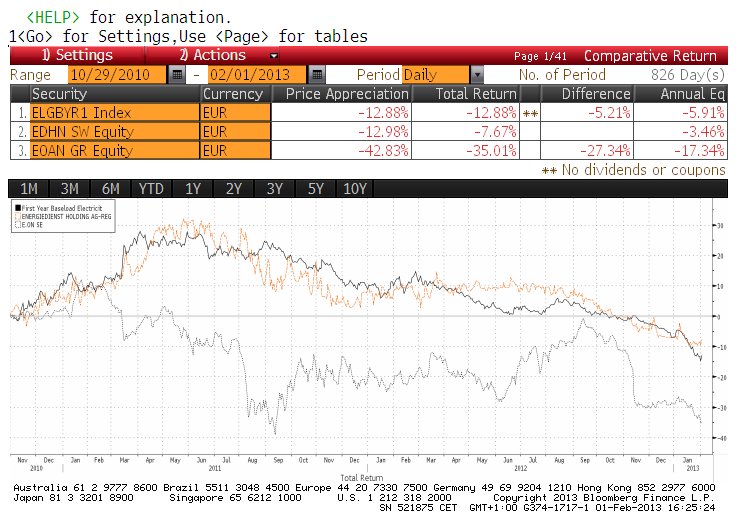
But in any case, a Hydro Power “pure play” is more or less a “bet” on electricity prices. In order to check this theory, I let’s look at EDHN’s share price (in EUR) against 1 year forward prices for German electricity (as a comparison, I plotted E.on as well):

edhn eon 12m strom

I find it fascinating that over the past 2.5 years, Energiedienst more or less directly followed German power prices. We can see that E.on is much more volatile and most likely exposed to general stock market fluctuations.

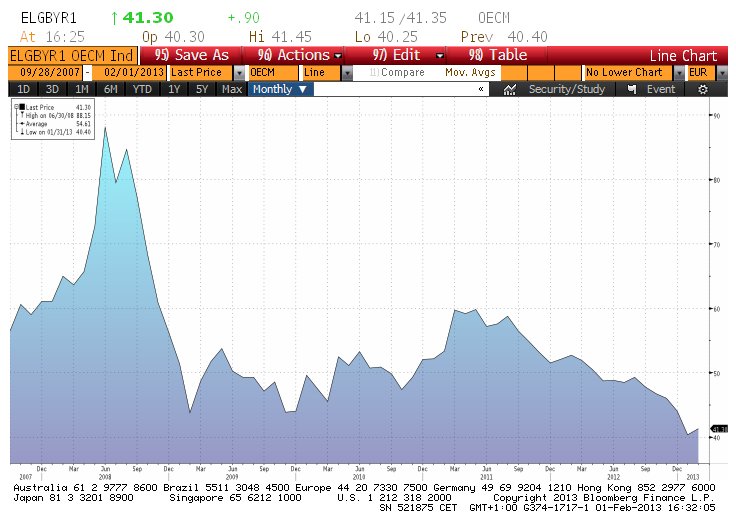
Just for the complete picture a history of German wholesale electricity prices since 2007:

electricity since 2007

It is interesting to see that German power prices seem to be at the lowest level since the beginning of this time series in 2007. After the surprise phase out of nuclear power after Fukushima and the corresponding propaganda from E.on & Co, one might have expected exploding electricity prices. But it looks like that the new supply of alternative energy plus maybe reduction in consumption led to a dramatic decrease in electricity prices.

Digging deeper, I found for instance this German publication from 2011 which confirms the point, that the subsidized renewable energy will lower electricity prices in general. So for a renewable hydro player like Energiedienst, the subsidies to solar and wind have the “perverse” effect of lowering the profit of this very cheap type of electricity significantly.

The “trick” is that the electricity distributors have to buy the renewable electricity at fixed subsidized prices, but have to sell it at current market prices into the German electricity exchanges. The difference then gets charged to consumers. According to the paper, the electricity price clears at the level of the most expensive supplier. The mechanism for the renewable providers however introduces practically a big source of potentially extremely cheap electricity as it gets sold at market prices no matter how low they might be and “unelastic” to the actual demand.

Due to the low interest rates, subsidized wind parks and solar plants are still attractive investments despite the price for electricity being at multi year lows and demand being rather weak.

So the low prices are not a result of low demand, but mostly of subsidized renewable energy which will be sold as long as the price is higher than zero.

Zero hedge just had a post in its usual style, claiming that the falling energy prices are a harbinger for falling stock prices. That is correct for utilities but other than that it is just a result of the mechanism described above.

Summary:

The current system for renewable energy in Germany (selling renewable electricity into the market at any price with the consumer paying the difference) is hell for “traditional” utilities including hydro power.

The German utilities have maybe underestimated the extent of renewable production, otherwise they could have done the exactly same thing themselves. Now howver, the are in a kind of “death grip” between having to run their expensive black coal and gas plants for peaks and the articificially low electricity prices. Combined with unfavourable natural gas delivery contracts, especially for E.on the air will remain quite thin.

So unless something changes significantly, German utilities (including Energiedienst) will need a long long time to adjust capacity and change their business models.

Warren Buffet seems to be much more clever: If you can’t beat them, join them. I think this is the reason why his US utility is investing so much into Solar and Wind.

« Older Entries Recent Entries »