Category Archives: Anlage Philosophie

Arcadis NV (ISIN NL0006237562) – One deal too many ?

Arcadis is a stock which popped up in my “BOSS score model” which I still use regularly to find ideas. It is a Dutch based Design, Consulting & Engineering company with global reach and a diversified business. Historically, they have consistently produced ROE’s of 20% and grown nicely.

Some key figures:
Market cap 1,7 bn EUR
P/B 1,7
P/E 19,5 (2014), 11,6 (2015 est)
EV/EBITDA 10,4

The company trades at a ~20% discount to Peers like AF AB, Ricardo or SWECO.

What I did like about Arcadis at “first sight”:

+ consulting is capital light business
+ potential growth areas like infrastructure, water, urbanization
+ ROIC as relevant measure for compensation
+ organic growth as target for compensation
+ well-regarded in the industry

What I didn’t like so much:

– large project exposure
– China / EM Exposure (26%)
– Utility exposure (22%)
– big M&A transactions in 2014
– annual report focuses on adjusted numbers
– debt significantly increased, far above target

Hyder Consulting acquisition in 2014

In 2014, Arcadis did several larger acquisitions, the largest one being the UK listed Engineering company Hyder Coonsulting Plc. After the first bid, a Japanese bidder emerged and at the end they had to pay around 300 mn GBP for a company that earned around 6 mn GBP in 2014. This really looked expensive and is maybe one of the reasons why EPS in the first 6 months 2015 fell from 0,77 EUR to 0,70 EUR per share.

Looking into historic annual reports one can see that there was little organic growth for many years (page 15) and growth was driven by acquisitions:
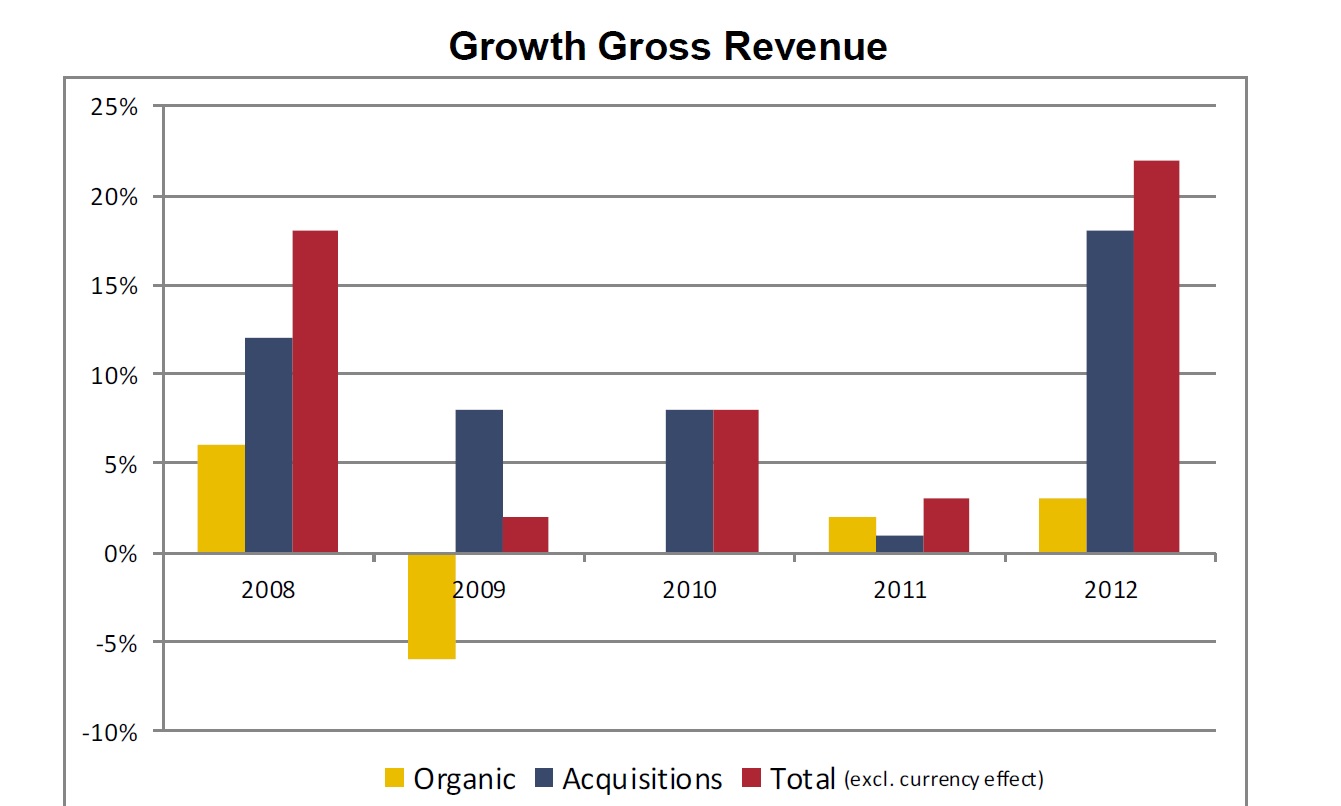
arcadis

Arcadis looks pretty much like your typical “roll up”, gobbling up competitors one after the other. However with the Hyder deal, it looks like that they made maybe “one deal too many”. Debt is now clearly above their own targets and business is not doing well. They acquired Hyder for their Asian presence which maybe looked like a good idea last year.

Management incentives: The reality test

When I did read the annual report 2014, I really like the fact that management seems to be incentivized on ROIC and organic growth. However, this is the score card they presented with their half-year numbers:
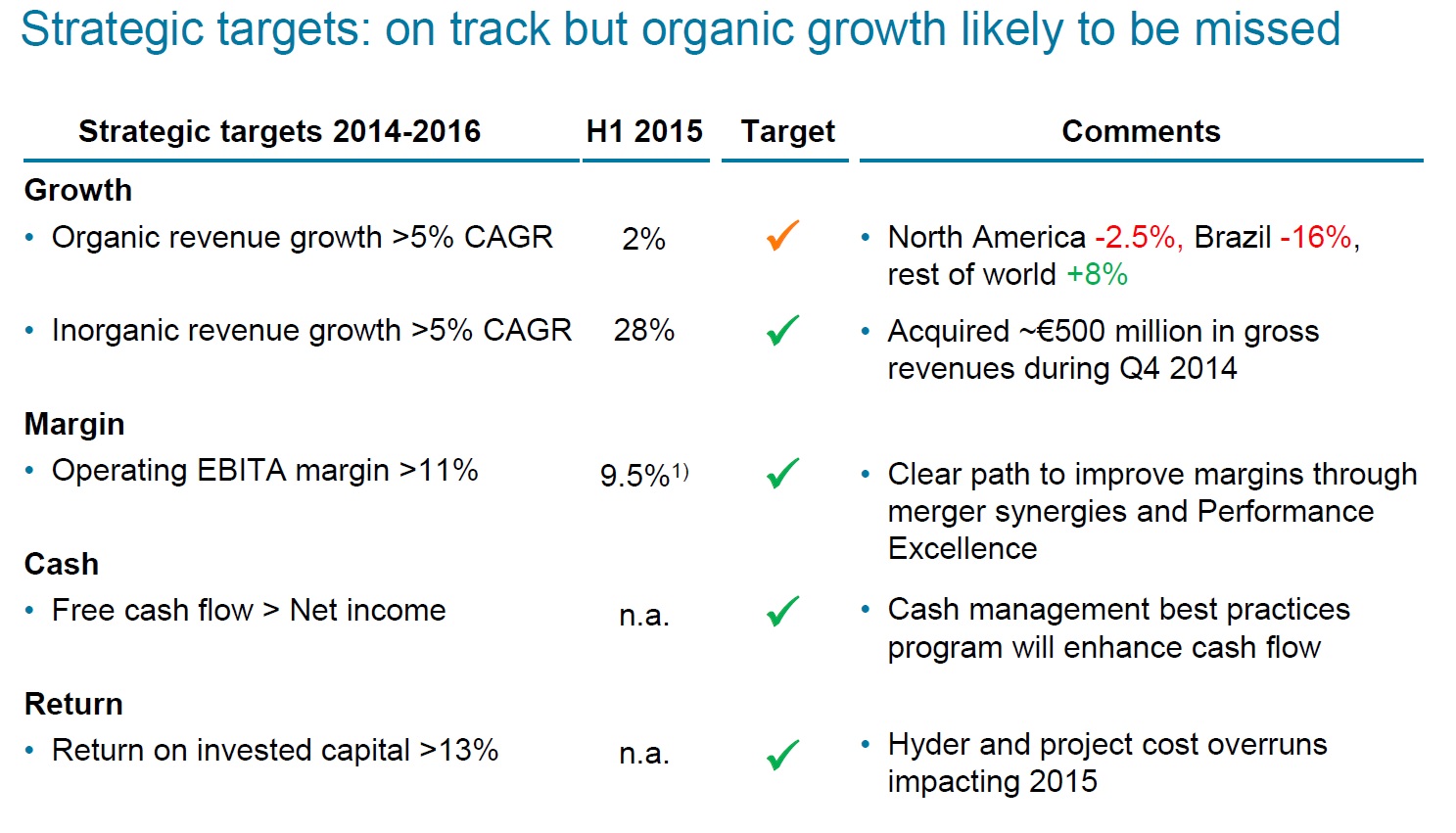
arcad sct

At first sight the source card looks, great, everything green, only organic growth “orange”. A closer look actually shows that the only target they hit was actually external growth which in itself is a pretty stupid target. All the other targets were either misses or not available.

This slide alone to me indicates that management doesn’t take its stated goals that serious. Yes, on paper it looks great but such a “target achievment assessment” is clearly a joke.

Summary:

Although the “roll up” strategy seems to have worked for some time, in my opinion there is the risk that the 2014 acquisition spree was maybe too much. If they can make the acquistions work, the stock would be relatively cheap, but combined with the current debt load the stock is now much riskier than it was in the past. Bilfinger is a good example how a seemingly working “buy and build” strategy can implode over night.

It is also a good lesson in checking if a compensation system which looks good on paper is actually implmented and followed or if management just adjusts everything to look good despite not achieving the targets.

So I will watch this from the sidelines although I like the business and industry in general.

New investment: TGV Partners Fund ( ISIN DE000A0RAAW6)

Full Disclosure:
This is not investment advice or advertisement. Do your own research. The fund manager did not ask me to write this post, it was the sole decision of the author. The author is personally and with real money invested in the fund and knows the fund manager for many years. The author will get a symbolic “liquid commission” for any new investors coming through the blog which will be disclosed at the end of the post.

In March I already wrote a “prequel” to a potential new fund investment, listing the requirements I see for giving money to another investment manager. Now I have done it.

The fund is called “TGV Partners Fund” managed/ sub-advised by “MSA Capital”. The website of the fund and more information can be found here, the website of the sub-advisor can be found here: MSA Capital.

Back then I listed the following criteria which were important to me in order to trust part of my money to someone else::

1. The manager has to be trust worthy
2. The manager should have most of or even better all his money in the fund
3. the manager has a different skill set than oneself or just better skills or access to different assets
4. The manager should still be “hungry”
5. The fund manager is not only in for the money
6. The investment vehicle should be a “fair” structure

So let’s check the TGV Partners fund against it:

1. The manager has to be trust worthy
Well, I have an unfair advantage here as I have done “due diligence” on Mathias Saggau the fund advisor/manager for the last 8 years or so, constantly exchanging ideas and talking about everything (and drinking some cold beers together…). Mathias himself has a very good “credo” to ultimately decide if he invests into a company. He asks himself the question: “Would I trust my wallet for safekeeping to the CEO ?”. If there is the slightest doubt, he will not invest. Period. Would I trust my Mathias with my wallet ? Yes, absolutely.

2. The manager should have most of or even better all his money in the fund
That’s the case, Mathias invests all of his money in the fund alongside his clients.

3. the manager has a different skill set than oneself or just better skills or access to different assets
The thing I admire most is his ability to really dig really deeply into to companies and industries. I think he is very good in judging if there are competitive advantages in the long run. His deep research combined with a long time horizon allows him to have very high convictions and run a concentrated portfolio. Personally, I think I can pretty well identify what doesn’t work, but I am less able to identify what actually works, so I do think it makes sense to “outsource” some money to someone who has this skill. We do have some overlaps but I can live with this …..

He is also connected to other great investors via the “Investmentgesellschaft für Langfristige Investoren TGV” which contains an enormous amount of investment wisdom. I know all the people there personally as well and had the privilege to attend some of their events such as the 2 day conference in Omaha before the annual meeting of Berkshire.Rob Vinal from RV Capital works under the same “roof” and with a similar structure.

4. The manager should still be “hungry”
He is just starting the fund and will “work his but off” to succeed. I know that he is thinking about stocks most of the time, including weekends…..

5. The fund manager is not only in for the money
I know that Mathias has transformed his hobby into his job. He is an absolute “stock maniac” in the most positive sense.

6. The investment vehicle should be a “fair” structure
The TGV structure is a rarely used structure, sometimes it is called the “German Hedge Fund structure” even though it is open for public investors and similar to a Sicav. One of the key features is that the fund’s interesting share class is open only on a quarterly basis. Many investors might feel uncomfortable with this. But if you run a concentrated portfolio with potential illiquid stocks, you definitely don’t want someone to call and ask for his money back the next day, especially in bad market environment. Also as an long term investor, investor you want to make sure that the manager doesn’t have to dump his shares cheaply just because another investor gets nervous because this hurts all investors. I also know the main seed investor personally and he is in for the long-term. It also helps enormously NOT to see daily movements in the value of investments.

The TGV structure allows more flexibility than normal funds, especially with regard to instruments (shorts, derivatives) and more importantly, more concentrated portfolios. One of the major disadvantages for the fund manager is the fact that this structure is much harder to sell to investors such as fund-of-funds because of the unfamiliarity and lack of instant liquidity. As an investor I find this positive because you can be pretty sure that if someone choses this structure, he will not be in for pure “asset gathering” but for performance.

Portfolio & Investment style

The portfolio composition as of 30.06.2015 can be found here. The largest position is Google with a 15% weight followed by National Oilwell Varco (11%) Distribution NOW (9%) and Verisign (7%). As one can easily see by looking at some of the stocks (Amazon, Morning Star etc,) this is clearly no Graham style “deep value” portfolio. I would describe his investment style as “Munger meets the 21st century with a contrarian angle” kind of investing which means using the underlying framework of competitive advantages (“Moat”) and good management but transporting it into relatively new sectors such as software or internet related companies. As Mathias is still in a relatively early stage of his carreer I expect that his investment style and “circle of competence” will further evolve and he will become even better than he is now.

For any further information I can only recommend the freshly published shareholder letter (Englisch, German). He discusses his philosophy and three specific stocks: Admiral, Amazon and TGS Nopec.

Let’s talk about “commissions”
Normally I don’t take any kick backs etc. for recommending something on my blog. But in this case and based on my special relationship with Mathias, I had to make an exception. The deal is the following: For every new investor who mentions my blog before (or after) investing with him, I will receive one “Kölsch” (0,2l) at a bar of my choice in Mathias hometown, independent of the amount invested.

Just to be clear: Mathias has to pay this out of his own pockets (not from the fund) and neither Mathias nor I will receive or pay any other “commissions”.

Portfolio transaction:

For the portfolio, I assume I have bought a 4% position at the price of 30.06.2015. As this is a “special” position, it does not count towards my 1 transaction per month limit.

Value Investing Strategy: Cheap for a reason

Value investing is all about investing into stocks where the current price is “cheaper” than the underlying value.

The problem is clearly that although we know the price of the stock at any point in time, we can never be sure about the “true” value of a company as the future is uncertain.

So quite logically many value investors start searching for undervalued stocks within the group of “optically” cheap stocks. I often get emails like ” What do you think of stock xyz, it’s only trading at a P/E of 3 or P/B of 0,2 – isn’t this a great opportunity ?”. Isn’t it a great BARGAIN ?

Read more

Peyto Exploration & Development Corp – Canadian Cowboys or “Outsider” company ? (part 1)

A few days ago, I linked to a shareholder letter where the CEO of the Canadian NatGas Fracking company Peyto discussed his opinion on the book “The outsiders”.

As some readers might have noticed, I started to look into the energy sector some time ago. First reading some books (Exxon, The Frackers) and a quick look into Cheniere Energy, the NatGAs liquification play.

As I try to expand my knowledge in the energy sector and a CEO reading and discussing “The Outsiders” made me very curious, I started to read the CEO’s monthly letters (going back to December 2006). They are 2-3 pages reports which cover various topics. Although some things are repeated, the information content was extremely high.

I found myself reading report after report until I had read all 105 (!!) of them (you’ll find notes on the memo at the end of the post).. I found them fascinating for 3 main reasons:

Read more

Deutsche Pfandbriefbank AG “forced IPO” – “Superbad” or interesting special situation ?

Management summary:

Oh my god, a bank again…. But Deutsche Pfandbriefbank is actually a pretty simple case: As a “forced IPO” of the good part of Hypo Real Estate, the bank is comparable cheap (P/B ~0,61) against its main peer Aareal bank (P/B 1,0). In my opinion, the risk is limited despite the recent HETA losses as the German Government has absorbed all of the really bad stuff in the bad bank. Similar to cases like Citizen’s, NN Group and Lloyd’s, PBB offers an interesting and mostly uncorrelated risk/return profile for patient investors provided that valuation multiples normalize at some point in time. Positive surprises like M&A are potentially on the table as well.

DISCLOSURE: THIS IS NOT INVESTMENT ADVISE. Do your own research. The author might have bought shares already.

Read more

My 8 word investing philosophy: Be patient, think independently and protect the downside

Morgan Housel from Motley Fool (one of the best financial writers in my opinion) had a great post on short investing philosophies. Boiling down rather complex “animals” like a whole philosophy on the one hand is a little bit dangerous, on the other hand, a good philosophy like a good red wine based gravy gets better and better the more you reduce it. I did write down my general investment rules here but it is much more a description than a (short )philosophy. Before moving to my own short version, I liked those 3 statements best:

Eddy Elfenbein, blogger, Crossing Wall Street: “Be patient and ignore fads. Focus on value. Never panic.”

Barry Ritholtz, Bloomberg: “Keep it simple, do less, and manage your stupidity.”

Bryan Hinmon, Motley Fool Asset Management: “Own compounders. Buy smart. Be patient.”

So my own statement doesn’t look that innovative: Be patient, think independently and protect the downside Actually this statement is the combination of 3 very basic principles: 1. Be patient The most important of all: Think long-term, invest long-term and let the “Magic of compounding” work for you. Cancel out the noise like quarterly earnings, monthly macro statistics or weekly employment figures. Don’t trade in and out of stocks frequently, this will save costs and nerves. Don’t market time. Make sure you don’t need the money you invest elsewhere. I am still in the learning phase which regard to this but achieving true patience is maybe the ultimate “black belt” of investing. 2. Think independently I would say that trying to think independently is the fundamental character trait which then helps to prevent of falling for fads, manias and panics. The hard thing is to actually to do it. For me it helps enormously NOT to read broker research but focus on original information first (annual reports, balance sheets, original press releases) and then read comments etc. later when researching an investment. Also reducing the amount of input can help. Don’t look at real-time price changes and ignore “real-time news”. Twitter is not a good investment advisor. Do read financial news with a time lag. I read the FT for instance more often than not with a 1 week time lag and annual report often several month after they were released. Avoid “Hot stocks” and “crowded trades” as a matter of principle. 3. Protect the downside No one can avoid losses, even Warren Buffett makes the occasional mistake (Tesco). However you can try to minimize this risk by doing a good Due diligence and focus on what can go wrong first. Try to “kill the investment” first and then look at the potential upside. If there is any doubt on the validity of the business model or of the industry make sure you understand it better than everyone else before investing. If there is any doubt with regard to the financials and/or integrity of management, stay away. As Charlie Munger said it “Stay out of trouble”. If you estimate the upside, stay conservative. For me this also means not being to concentrated on single positions. Anyway, I can only recommend any reader trying to come up with a short “philosophy statement” as well, it is definitely a very god exercise.

Performance review Q2 2015 – Comment “Great ideas vs. great execution”

Performance Q2 2015 / YTD

Compared to the first quarter, the second quarter was in relative terms much better than the first quarter. The Benchmark (Eurostoxx50 (25%), Eurostoxx small 200 (25%), DAX (30%),MDAX (20%)) actually lost -5,8% in the second quarter, whereas the portfolio remained almost unchanged with -0,1%. YTD the score is now 13,2% for the benchmark vs. 11,4% for the portfolio.

For me, the second quarter is a good feedback that the portfolio strategy is working. I expect to underperform in a strong bull market like we had in the first quarter, but then to outperform in weak or sideways markets. The monthly returns show clearly that the portfolio is less volatile and only relatively loosely correlated to the benchmarks:

Start Bench Portfolio Perf BM Perf Portf. Delta
Jan 15 9.977,26 189,81 8,3% 3,4% -4,9%
Feb 15 10.696,03 200,55 7,2% 5,7% -1,5%
Mrz 15 11.078,60 204,69 3,6% 2,1% -1,5%
Apr 15 10.847,76 206,98 -2,1% 1,1% 3,2%
Mai 15 10.871,99 208,60 0,2% 0,8% 0,6%
Jun 15 10.434,47 204,44 -4,0% -2,0% 2,0%

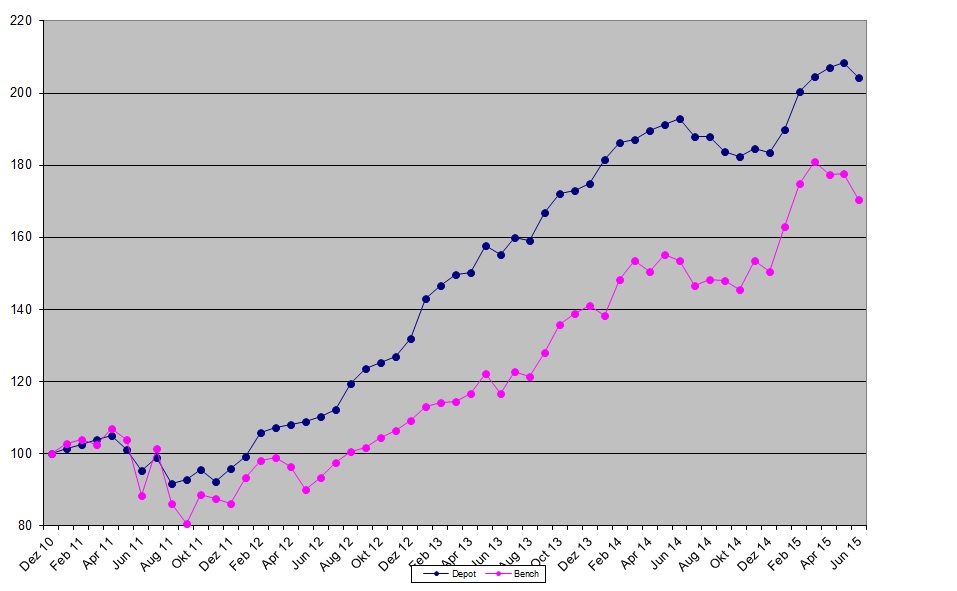
As I have mentioned before, time lags play a role here as well, especially for the lower liquidity small caps. Since inception, the portfolio is up 104,4% vs. 63,2% against the benchmark. Graphically, this looks like this:

vop performance

Within the quarter, outperformers were Van Lanschot (+24,1%), Citizen’s (+13,1%). Lloyds Banking (+8,9%). Losers (not adjusted for dividend) were G. Perrier (-8,6%), Thermador (-7,9%) and Draeger (-6,9%).

Portfolio and transactions

I am actually quite proud of sticking to my 1 transaction per month goal in the second quarter. Overall I did 3 transactions:

The purchase of Lloyd’s Banking, the BMPS “trade” and finally Gagfah a few days ago.

The current portfolio can be found as always if you click the current portfolio page. Most noteworthy “aggregate” changes is that “opportunity investments” went up from 22% to 28% of the portfolio and “pure cash” went down from 15,5% to around 11%.

Comment: “Great ideas vs. great execution”

One of the most remarkable stories for me in the last 3 months was the following: In April, “Bond King” Bill Gross came out with a call that the 10 Year Bund Future is the short of a life time. A day or so later the Bund Future started to drop significantly and Bill’s call should have played played out wonderfully. But then something strange happened: The value of Bill Gross’ fund actually fell and he had to admit that he did not actually implement a simple short but a more complex strategy which backfired and he actually lost money.

So let’s take a step back and look at what has happened here: The best bond investor of all times has a great idea and even has timing right but fails to implement it in order to profit from it.

So clearly, just having a great idea does not automatically lead to great results. In addition, one has to implement it well. Other examples of bad execution: John Hussman with his market timing strategy who suddenly changed the strategy in 2009 and did not go back into stocks again, or Michael Burry, the guy from “The Big Short” who was right on subprime but who couldn’t convince his investors to keep their money in his fund.

These days I often hear from fellow investors: I don’t have any great ideas at the moment. If you look around in financial media and service providers, very often the focus is on idea generation. The more ideas the better. There is a lot less literature etc. on how to execute ideas.

If you look at Warren Buffett, it is clear that he is the master of implementation and execution. His success in my opinion relies to a large extent on only two factors:

1. Buy and hold
2. Permanent capital / safe leverage

Especially now in his later years, he is not the great genius stock picker anymore that he was in the past but he has structured Berkshire in the way that he still creates a lot of value even by buying “mediocre” assets like wind farms or solar power plants.

So why I am telling this ? In my opinion, just having great ideas is not enough. Implementation is maybe even more important. I would even argue that average ideas and great implementation works better over time than great ideas and mediocre implementation. As a private investor, it is clearly not possible to set up a reinsurance company but on the other hand there are a lot of simple things one can do to better implement ideas:

1. Don’t act (too) emotionally or spontaneous
2. Try to come up with a strategy or “game plan” for each investment, containing among others:
– target holding period
– targets when to buy more or sell down (based on fundamental data, ratios and/or stock prices)
3. Try to come up with a strategy for your portfolio: What do you want to achieve and especially HOW do you want to achieve it ?
4. Make sure the money you invest in risky assets is as permanent as possible. Do have a personal financial plan and buffers to make sure that you are never forced to sell

Since I started the blog, I made many mistakes and bad execution is clearly one of them.

Some good ideas in my blog which I didn’t implement well were for instance:

– Prada short: Too early, not patient enough
– G. Perrrier long: Started with a half position did not manage to increase position
– Sberbank: Did not cope with volatility, sold out at the worst time
– generally selling to early, not recognizing that fundamentals have improved (example Dart Group)

In other cases, good implementation saved me from an otherwise bad idea for instance when I got out of Praktiker bonds pretty early before the real xxxx hit the fan because I had predefined the condition where I would sell.

Just by chance i came across this article which wants to point out how the Apple watch will “revolutionize” investing. The “1 million dollar” quote is this one:

Another key area of focus is cutting the distance or time between investment research and action.

Vaed described the challenge of remembering a stock after reading an article or watching CNN. “But if you have a plug-in available on your browser that lets you act right away, that’s valuable.”

And that’s why E-Trade created such a browser trading tool on Google Chrome, after discovering it was the browser of choice among its clients.

I don’t want to sound arrogant but this is clearly a recipe for very very bad implementation. I actually do think that a longer period of time between research and action is benefitial for almost any investor. . For a value investor I don’t see any benefit of a mobile value investing app or similar bxxxsxxx.

So as a summary my advice would be: Although it doesn’t look as sexy as generating new ideas, the management of existing ideas or the “execution” is at least equally important. Try to take your time and work on this especially in a time right now where new ideas are harder to find. I think now is a good time to build the “foundation” for good execution.

Quick update Bilfinger

I looked at Bilfinger for the first time in August 2014, after the price dropped almost 50% from its peak some months before. I resisted again in November 2014.

Again as a reminder my comment from the first post:

– some of the many acquisitions could lead to further write downs, especially if a new CEO comes in and goes for the “kitchen sink” approach
– especially the energy business has some structural problems
– fundamentally the company is cheap but not super cheap
– often, when the bad news start to hit, the really bad news only comes out later like for instance Royal Imtech, which was in a very similar business. I don’t think that we will see actual fraud issues at Bilfinger, but who knows ?

So now the new CEO came in on June 1st. And surprise surprise, the 6th profit warning within a year if I have counted correctly.
Read more

Driverless cars + Uber –> Death of Car Insurance ?

As this became a long post, a quick management summary upfront:

The case for 100% self driving cars without accidents is not so clear for me
1. Based on current facts, the Google car doesn’t seem a lot better than human drivers
2. From other areas (Airplanes, chess) we can learn that a human-machine combination is often better than a “machine” alone
3. Driving cars is also an emotional experience, many people might not fully sacrifice this
4. Some innovations take longer than one thinks, especially if they take away freedom from consumers
5. A gradual decrease of claims could actually be positive for car insurers over an extended period of time

Additionally, I don’t see a combination of driverless cars with a service like Uber replacing private cars anytime soon. There are a lot of practical issues with renting out private cars to complete strangers. However, taxi driver might not be a job with a big future either.

So from my perspective, as shareholder of a car insurer like Admiral there is no reason to panic, however for traditional insurers this might be one more nail in their coffin.

Read more

« Older Entries Recent Entries »