Category Archives: Capital Structure Arbitrage

Groundhog day: Another BMPS (ISIN IT0005092165) deeply discounted rights issue “Italian style”

Health warning: Do not try to trade in such situations unless you know exactly what you are doing. This is not investment advise, do your own research.

Almost exactly 1 year ago, I already looked at last year’s deeply discounted rights issue of struggling Italian Bank BMPS. Well, the same time in the year again and of course, BMPS is again in the market…. somehow this reminds me of this great movie:
Read more

Special situation: Citizens Financial Group (CFG) – Another interesting “forced IPO” ?

Summary:
The recently IPOed US bank Citizens Financial Group looks like a typical “forced IPO” from a troubled regulated financial conglomerate, similar to Voya & NN Group /ING. The current valuation shortly after the IPO would imply a decent upside (~50%) even if Citizens only manages to become an “average” US regional bank.

Citizen Financial Group went public on September 24th . The story of the US-based lender is similar to the NN Group IPO in which I have already invested.

In this case, parent company Royal Bank of Scotland (RBS), which has been bailed out by the UK government following the financial crisis, is forced to concentrate on its UK business. RBS then decided to ged rid of its US business via an IPO instead of a direct sale to another buyer. It seems to be that there were quite some interested buyers.

Very similar to ING and NN Group, RBS has time until 2016 to sell down the whole stake. That this is not easy was clearly shown as RBS had to price the IPO at 21,50 USD per share, below the inital range of 23-25 USD.

Compared to other regional US banks, the valuation based on book value (and tangible book value) looks attractive:

Name Price/ Book Price/ Tangible Book ROE Current
CITIZENS FINANCIAL GROUP 0,65 1,00 -15,82
REGIONS FINANCIAL CORP 0,79 1,14 7,19
ZIONS BANCORPORATION 0,87 1,05 5,66
SUNTRUST BANKS INC 0,91 1,41 6,38
HUDSON CITY BANCORP INC 0,98 1,01 3,92
KEYCORP 1,07 1,21 8,87
COMERICA INC 1,08 1,19 7,56
FIFTH THIRD BANCORP 1,12 1,35 13,39
NEW YORK COMMUNITY BANCORP 1,17 2,02 8,35
BB&T CORP 1,20 1,82 8,00
HUNTINGTON BANCSHARES INC 1,29 1,44 10,92
M & T BANK CORP 1,37 2,02 10,76
FIRST REPUBLIC BANK/CA 1,73 1,84 13,66
CULLEN/FROST BANKERS INC 1,82 2,43 9,66
SVB FINANCIAL GROUP 1,98 1,98 11,37
SIGNATURE BANK 2,43 2,43 13,26
Average 1,28 1,58 7,70

If we just assume an average multiple, there would be a 50% upside based on tangible book and a 100% upside based on total book value. The problem is of course: in order to reach this multiple you have to earn the average return on equity.

Looking into the IPO filings, we can clearly see that things didn’t work that well in the past. “Normalized” earnings were around 650 mn USD in the past or ~2-3% ROE which clearly would not justify a valuation at book value. Due to the low-interest rate environment, revenues decreased and in 2013, most likely to prepare the IPO, they made a massive goodwill impairment of around 4 bn USD in 2013.

Banks as investments

As there is no shortage of material against banking and the associated risks and evil spirit, I want to outline instead what I do like about banking and this situation:

– Traditional banking in my opinion is a solid and good business if run conservatively and responsibly. Many value investors would never invest in a bank, but I have no problem with this (Mr. Buffet neither as we all know)
– Traditional banking (and Citizens is a traditional bank) profits from higher interest rates. It is easier to put margins on the loan if the nominal rate is higher. So owning a bank is quite a good interest rate hedge
– mid size banks used to have a disadvantage over the large banks, especially with regard to funding. With all the new regulation aimed at the mega banks, I think there is a much better “equal level” playing field. I like good & cheap mid-sized banks.
– I could imagine that being on its own feet, Citizen’s management can react better to local challenges and develop its business than being part of a nationalized UK banking group under constant pressure. The “spin-off effect” could be at work here. Many of the directors have purchased shares directly after the IPO. The CEO owns shares in the amount of 6 mn USD.
– Citizen does have scale on a regional level which in my opinion is quite important (see page 152 of the S1 document) in order to achieve good ROEs
– the region where they are active (North east, New England) had less issues with the housing bubble, so theoretically loan quality should be OK. Most of their business is by the way in so called “recourse states” which adds to the incentive of actually paying back personal loans

Stock overhang

RBS still owns ~66% after the IPO and a subsequent share repurchase. 2016 is not that far in the future and placing another 10 bn of shares will not be a walk in the park, but on the other hand a lot of this could be reflected already in the share price. For me it is always interesting to see when typically sell-side analysts apply a discount due to “stock overhang”. As an “intrinsic” value investor, those situations are one of the clearest situations for market inefficiencies as the intrinsic value of a company does not change because of this.

Similar to ING, I think RBS did sell the first part cheaply in order to then (hopefully) sell into positive momentum. ING for instance managed to sell Voya down from over 60% to now 32% within 1 year and the stock still outperformed the indices.

My assumption is that RBS will not sell below tangible book value which is around the current stock price. If they sell below, they will lose available capital at RBS and therefore weaken their capital base and ratios. So a scenario where RBS sells down to very low levels far below the IPO price is in my opinion not realistic.

Valuation

I am clearly not in the position to judge if CFG is an “above average” bank. However, I think one can attach a high probability to the outcome that CFG will be an average bank. The nice thing about this is that there is significant upside already to the “average case”.

Therefore I would make the following, simplified case:

I assume that there is a 50% probability that within 3 years, CFG will be an “average” bank and trade at an average valuation. Conservatively I ignore goodwill and assume a target price of 1,6x current tangible book value in 3 years which would be ~ 40 USD per share.

To keep things simple, I further assume that there is a 25% chance that they will do really well and a 25% chance that they screw up. In the downside case, I will assume a 50% loss, in the upside case I will assume a valuation at 2x tangible book or around 50 USD.

So my “expected” value in 3 years time would be (0,5*40)+(0,25*11,5)+(0,25*50)= 35,4 USD. Based on the current price of around 22,80 USD, this gives me a potential annual return of ~15,4% which looks attractive to me for such a “special situation” investment.

Summary:

Citizens Financial “forced IPO” looks very similar to ING’s NN Group and Voya IPOs. I think this could be very attractive as even the assumption of Citizens becoming an “average ROE US regional bank” has significant upside. Despite or because of the assumed “stock overhang”, the mid-term risk/relationship looks attractive although, but similar to NN Group, one should not expect a quick win here.

I will therefore invest 2,5% of the portfolio into Citizens at current prices of around 22,80 USD.

P.S.: This will be my first US stock since a long time. I don’t have anything against US stocks, but often I do not find any kind of “edge”. In this case, I do have the feeling that banks are still highly unpopular as investments in general and that there is a good chance for some market inefficiency, even in the highly efficient US market.

Exotic securities: Gabriel Finance 2% 2016 Evonik Exchangeable (ISIN DE000A1HTR04)- Free options anyone ?

Background / Evonik

Evonik is a German specialty chemical company with a total market cap of ~12 bn EUR. The company went public in 2013, however the majority is still Government owned via RAG (“Ruhrkohle AG”), the German coal mining “run off” company.

Private Equity shop CVC bought a 25% stake in Evonik in 2008. At the end of 2013, CVC issued a 350 mn “exchangeable” bond which exchanges into EVONIK shares if certain thresholds are hit.

The “exchangeable”

Just for clarification: An “exchangeable” bond is a “convertible” bond which is NOT issued by the company of the underlying shares but by someone else. But let’s look at the bonds:

Volume: 350 mn EUR
Maturity: 26.11.2016
Coupon: 2% (semi-annual)
Denomination: 100 K EUR (so not for retail investors…)
Exchange ratio (Nominal/number of share): 2.821,8774 shares per 100 k
Strike price/break even: 35,437 EUR
Stock price “cap”: 130% (Gabriel can call the bond if the share price hits 130% of the exercise price)

So far the structure is fairly typical for a normal “convertible/exchangeable” bond:

– as long as the stock stays below the “strike” one will get back the nominal amount (plus coupons)
– if the stock rises above the strike, one can exchange the bond into the shares and realize the upside which equals a call option on Evonik
– however the upside is “capped” at around 130% of the strike which is similar to a “short call” option on top of the long call

Technically, the bond can now be evaluated by calculating the value of the long call option minus the value of the short call and add this to the “Pure” bond value, which is the nominal plus the coupons discounted back at the “risk adjusted” rate.

The NPV of the long option is around 2,6% of the bond nominal, the short call is worth around -0,5% under standard settings. So this would add almost 100 bps p.a. in option value to the bond. As the bond itself trades around 98%, together with the 2% coupon it looks like that the buyer gets a juicy 3% yield plus a free option on Evonik, so almost a “no brainer” trade in the current interest rate enironment (2 year swaps are at 0,25% p.a.).

The “exotic” feature: The “short put”

But not so fast. CVC has built in something which makes this bond “exotic”: The issuing entity, Gabriel Finance has no additional support from CVC. The issuing entity owns the shares and the shares are pledged to the bondholders, so far so good. But what happens if the stock of Evonik falls below the assumed exchange ratio ? For this case, they have allocated an additional amount of shares to the bond holders, in this case the same amount of shares as are actually the underlying of the bond.

However, even this additional amount of shares might be insufficient if the shares would fall further. We can easily calculate the share price at which the original shares and the additional shares are not sufficient anymore to cover the principal:

“break even” = 350 mn / (original shares + additional shares) = 17,70 EUR er Evonik share.

So what happens if the share price drops below 17,70 EUR ? Well, the bondholders will not get the principal back but whatever the pledged shares are worth at that point in time. (Remark: I did not find out is there is the risk of an insolvency procedure or not)

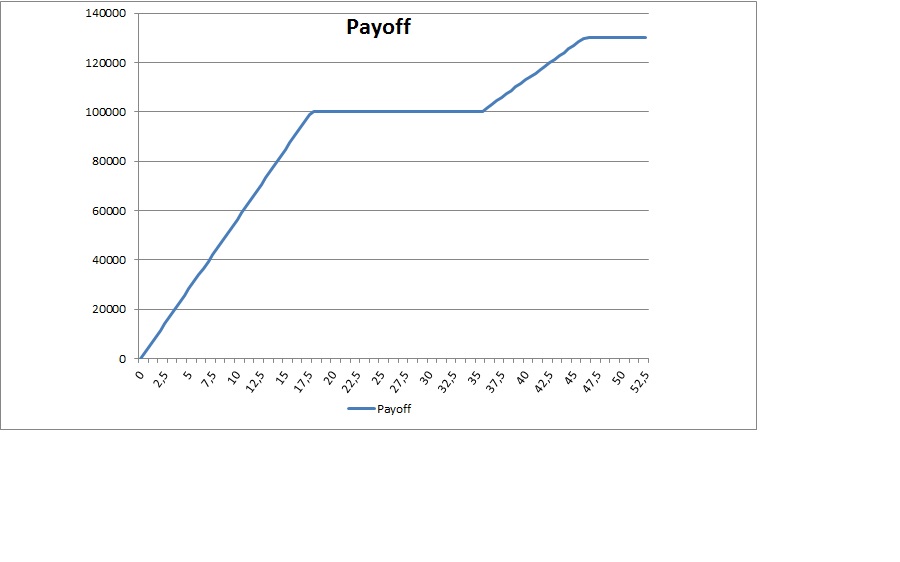
With a normal exchangeable, the issuing entity would have to make up the shortfall with any other asset they own but in this case, there is none. It is maybe easier to understand if we look at the final payout of the bond in relation to the then prevailing Evonik share price which I graphed using Excel:
gabriel payoff

In order to correctly value the whole “option package”, we will therefore need to

+ add the value of the long call
– subtract the value of the short call
– subtract the value of the put option.

Beware of the Skew

Valueing long dated stock options is a tricky thing. The major input clearly is the volatility of the underlying stock which has a major impact on the value of the option. The volatility to use depends on a couple of things, among others how far the option is out-of-the money.

In our case, the following effect is important: If you have both, a put and a call option for the same stock with the same “distance” to the current price, the put option is usually more expensive than a similar call which means you have to pay a higher volatility. Nobody knows really why this is so but it is a fact and is called the “Volatility skew”.

Finally, another “exotic feature” needs attention: The mechanics explained above mean, that in th positive case, you are long around 2821 shares per bond in th upside case. However, once you hit the downside trigger at 17,70, you are suddenly short 2×2821 shares.

So you need to buy twice as many puts at 17,70 EUR than you could sell calls on the upper end (that’s also the reason why in the Excel graph above, the slope in the downside case is much steeper than in the upside case).

Valueing the whole “package”

So in order to find out how attractive this bond is we need to calculate the “option adjusted” yield of the bond by adding/subtracting the option values to the purchase price and then calculate the yield with the 2% coupon (implied volatility for short call and short puts +6% vs. long call):

EUR In % of Nominal
Purchase price 98000,00 98,0%
minus long call -2624,35 -2,6%
Plus short call 1608,47 1,6%
Plus short put (2x) 5643,76 5,6%
“Option adjusted” Purchase price 102627,88 102,6%

Based on the adjusted purchase price of ~102,6%, this results in an annualized yield of ~0,78% p.a., which is ~0,5% above swap but hardly super attractive.

Summary:

Unfortunately, the Gabriel/Evonik exchangeable is not the nice 2% carry plus free option trade I was hoping for in the beginning. Depending on the assumptions with regard to volatility, the bond actually looks like fairly and efficiently priced. For a pure bond fund who can invest into the bond on a fully hedged basis, this still has some spread left, but if you want to achieve “stock like” returns, then the risk/return profile is not overly attractive.

Clearly my assumptions with regard to volatility are debatable and you could price the short options cheaper, but with options I prefer to make mistakes by being too conservative on the short side. On top of that, as I have mentioned a couple of times, I am not comfortable with German law for bonds and unfortunately this one is issued under German law which makes it relatively easy to change important features of the bond such as coupons and maturities.

Even if one is really bullish on Evonik, buying the underlying stock would be the better choice in my opinion, so for the time being the Gabriel/Evonik exchangeable is not interesting for me, especially as I don’t like the “Black Swan” exposure via the short put.

MIFA Bond (ISIN DE000A1X25B5) – Distressed debt & Restructuring “German Style”

I had covered the case of MIFA several times in the last few months (part 1, part 2, update, update 2).

Over the week-end, finally some news emerged with details about the restructuring.

If I understood the filing correctly, the following will happen:

1. Existing shareholders will be diluted 1:100
2. Bondholders will accept a “haircut” of 60% plus the coupon will be reduced to 1% (from 7,5%) and the maturity will be extended to 2021 (from 2018)
3. Hero cycles will inject (up to) 15mn EUR via a capital increase
4. Bondholders will get 10% of the new company for the 15 mn haircut and a subscription right for additional shares

Interestingly, the advisor nominated by the bondholders also made a press release. Some additional info from this release:

– the advisor estimated a recovery rate of only 15% for bondholders in the case of bankruptcy
– technically, bondholders will own 91% of MIFA equity before Hero cycle invests
– bondholders get subscriptions right and could, if they want to invest new money, own up to 30% of MIFA including those shares they get via the debt equity swap

As some details are still missing (price of new shares) etc., it is hard to correctly say how much the bonds are worth and if bondholders were treated fairly compared to Hero. However current prices at ~38% seem to imply most of the upside.

My 5 cents on this

For me, the following aspects of this whole episode are interesting:

– How can be the recovery rate of bond issued twelve months ago only be 15% ? Where did the 21,5 mn EUR disappear ? In my opinion, MIFA was a fraudulent company for quite some time and was already insolvent when they issued the bonds.

– Will there be any law suits by bondholders ? Why did Hero take the risk and didn’t wait for insolvency ? Are there any special provisions for Hero to back out if law suits come up ?

“Senior bonds” under German law should not be treated and priced as senior bonds. As this example shows, one can “haircut” bond holders under German law (“Schuldverschreibungsgesetz”) without even going into bankruptcy procedures. German Bonds are much more similar to potentially perpetual, deeply subordinated bonds or “Genußschein” than a senior bond under international law. Any covenants written into the prospectus are worth nothing as it is so simple to just restructure the bonds.

such a restructuring can be decided with only a small percentage of the bondholders. Only 28% of the MIFA bondholders were present when the advisor, who can commit to binding changes, was elected. So in theory, 14% of the bondholders can decide what happens to the remaining 86% of the bondholders with very little chance for any “hold outs”. Maybe Greece and Argentina should issue their future bonds simply under German law. Tha would make life much easier for them.

. why does the MIFA share (1% of the future company) trade at 80 cents or 6 mn EUR market cap ? Do shareholders think that the company is worth 600 mn EUR ? This is a clear “short zo zero” situation if one could actually borrow the shares

– one could argue that the restructuring makes sense because MIFA will be able to continue to operate and now jobs are lost. However I think it would be naive to believe that Hero will operate MIFA they way they worked before. Hero wants the brands and the distribution, not the production. I am pretty sure that they will not guarantee a lot of jobs.

– but at least, the order that existing equity gets wiped out before the senior bonds still holds, even under German law. I had some serious doubts about this.

The most important lesson: As I have written before, new corporate bonds under German law should be avoided at all cost. Especially the “Mittelstandsanleihen” are in principal similar 20 EUR bills issued at 100 EUR with a tiny little option to receive 100 EUR. The “lipstick on this pig” is the high coupon. But German investors seem to buy anything with a high coupon these days anyway. No surprise maybe if you have to pay for holding 2 year treasuries at the time of writing.

Alstom SA (ISIN FR0010220475) – an interesting potential “sum of parts” play after the GE deal ?

Profitlich & Schmidlin (“P&S”) had a post a week ago (in German) on how they view the current situation at Alstom.

A short refresher: Both, General Electric and Siemens wanted to take over Alstom and/or parts of it. At the end, GE prevailed, however they failed to take over Alstom completely. Instead, they purchase the Grid, Renewables and Power businesses, leaving the Transport business at Alstom.

In order to make it more “interesting” and to please the French Government, GE and Alstom will form 3 Joint Ventures of which Alstom will buy a 50% share each. Plus Alstom will buy a transport related business from GE for 600 mn EUR. Additionally, Alstom seems to have a put option for these JV back to General Electric with a floor of 2,5 bn EUR.

So in theory, one could now use the information given for instance in the GE press release and calculate a prospective “sum of the parts” valuation for Alstom after the deal and this is how P&S have done it:

No op Assets  
Net cash 4.122
London Metro loan 364
Transmash 700
Pension, others -620
Total 4.566
Per share 14,78

On top of those ~15 EUR per share “extra assets” they add the 2,5 bn EUR for the JVs, which results in around 22,87 EUR per share for all those non-transport assets. With a “fair value” of the transport business of ~11 EUR per share they come up with their target value of 34 EUR per share, which would mean a nice +30% upside potential based on the current share price of 26 EUR.

My 5 cents on this

First of all I find it great that P&S share their investment case via their blog. This is definitely a good thing. And clearly, as with everything, it is their opinion and not everyone will agree with this. My opinion differs from theirs, but that does not mean that they are wrong or vice versa.

Before jumping into the details, I would just want to refer back to some earlier stuff I have written about holding companies. The question is: will investors really apply a “full valuation” to the operating business plus all the “extra assets” or will they discount the extra assets, especially the JVs and the other non-consolidated assets. I think it is more prudent to apply a discount to the extra assets. Unless there is clear evidence that those assets get liquidated, I think it is too optimistic to assign full value to those assets.

A second big issue is that at the moment no one knows exactly how much of the liabilities will get transferred to GE. Especially with regard to operating leases (nominal ~830 mn EUR), litigation liabilities (528 mn EUR) and pension liabilites (gross 5,2 bn) there is no definitive answer how much will be transferred to GE and what remains at Alstom. In a sum of part calculation, any of those remaining liabilities will have to be deducted from the extra assets as they are economically equivalent to debt.

Net cash position

Let’s start with that one. In their annual report, Alstom provides us with EUR -3.041 as net cash at March 31st 2014. GE stated that the whole transaction will generate a 7,3 bn net cash outflow for them which is an equivalent inflow for Alstom.

So theoretically we could calculate -3.041 + 7.300 = 4259 mn EUR net cash for Alstom. However there are several caveats to this:

transaction costs: A transaction like this easily swallows up a large amount of costs for lawyers, consultants bankers etc. I would assume between 100-300 mn cash costs for Alstom before closing, with an expected value of -200
mark to market debt: Although any financial assets under IFRS are marked-to-market, debt is still accounted for at cost. If Alstom would really want to buy back their bonds to shorten the balance sheet, they would have to pay market value which is ~350 mn higher than book value. So net debt has to be adjusted for this.

So for my calculation, net cash would be 4.259-200-350 = 3.709 mn net cash after closing of the deal

Transmashholding

Transmashholding is a 25% stake alstom holds in a Russian transport equipment manufacturer. P&S value this company 10x average 2012/2013 earnings at 700 mn EUR which is around 90% higher than book value. I would value this asset significantly lower because

– according to Bloomberg, the majority of the profit is “extraordinary profit”
– if we value them based on operating income (EBIT) with the same averaging, we would get on average 2800 mn Rubels EBIT p.a. (which is around 60 mn EUR p.a.) and assuming 10 times EV/EBIT we get 600 mn EUR EV. Minus ~10 bn RUB or 200 mn debt, the equity would be worth 400 mn, 25% of Alstom then would be 100 mn EUR.

Other liabilities

As I said before, we how much of the liabilities go to GE. My own assumption would be that all the critical ones (Litigation, Pension deficit, operating leases) are divided proportionally to the total amount of liabilities for the transport segment. According to the segment report in the annual report, transport had ~28% of all liabilities of Alstom. My default assumption therefore is that 28% of all “debt like” liabilities remain at Alstom as part of the transport business

Discount to extra assets

Finally, I would argue that especially as this complicated deal will only close in mid 2015, it would be quite optimistic to assume zero discount on the future cash inflow, JV assets etc etc. So I would actually discount those assets to be on the safe side with between 10-20% at the current status, as a compromise I will use 15% both, for net cash and the JVs. Just as a reminder: I am not sure if anyone remembers the planned GE – Honeywell merger in 2001. This looked like a done deal for a long time before the deal actually fell through. The deal might be very likely but there is always the risk of a deal stopper and one has to adjust for this in my opinion.

Bringing it all together & Summary:

So this would be my version of the “extra asset” calculation:

MMI
Net cash 03/2014 -3.041
+ Cash proceeds GE 7.300
– mtm bonds -350
– deal cost -200
   
Net cash adj 3.709
+ London Metro 364
+ Transmash 100
+ JVs 2.500
   
Total “extra assets” 6.673
– 15% discount JV&Cash -931
Discounted extra assets 5.742
   
– “pension others” from P&S -620
– 28% of Litigation liab -148
– 28% of operating leases -210
– 28% of pension underfunding -217
   
Adjusted “extra” assets 4.547
per share 14,71

With my rather cautious approach, i would value the potential extra assets after the deal ~ 8 EUR per share lower as P&S. Together with their valuation of the Transport business od ~11-12 EUR, the current Alstom price at 26 EUR looks fair with no big upside.

Clearly, any of my assumptions could (and should) be challenged as well. Transmash could be worth a lot more and maybe all the liabilities go to GE. On the other hand, one should not forget that the deal is not done yet. I am for instance not sure how happy the potential clients are and if I read correctly, they need approval of 32 national regulators for this deal. Plus, the French Government will be heavily involved in Alstom going forward which might lower the prospects of aggressive share repurchases and increase the risk for “strategic” acquisitions.

Alstom has proposed more detailed information in November before an extraordinary shareholder meeting. For me, at the moment Alstom is not a buy. This might change especially if most of the liabilities would be assumed by GE, then the Alstom “stub” could be really interesting. In the mean time, the stock however is “watch only”.

Banca Monte dei Paschi Siena (BMPS)- Another deeply discounted rights issue “Italo style”

Capital Raising in Italy is always worth looking into. Not always as an investment, but almost always in order to see interesting and unusal things. I didn’t have BMPS on my active radar screen, but reader Benny_m pointed out this interesting situation.

Banca Monte dei Paschi Siena, the over 600 year old Italian bank has been in trouble for quite some time. After receiving a government bailout, they were forced to do a large capital increase which they priced in the beginning of last week.

The big problem was that they have to issue 5 bn EUR based on a market cap of around 2,9 bn.

After a reverse 1:10 share split in April, BMPS shares traded at around 25 EUR before the announcement. In true “Italian job” style, BMPS did a subscription rights issue with 214 new shares per 5 old shares at 1 EUR per share, in theory a discount of more than 95%.

The intention here was relatively clear: The large discount should lead to a “valuable” subscription right which should prevent the market from just letting the subscription right expire. What one often sees, such as in the Unicredit case is the following:

– the old investors sell partly already before the capital increase in order to raise some cash for the new shares
– within the subscription right trading period, there will be pressure on the subscription right price as many investors will try to do a “operation blanche”, meaning seling enough subscription rights to fund the exercise of the remaininng rights. This often results in a certain discount for the subscription rights

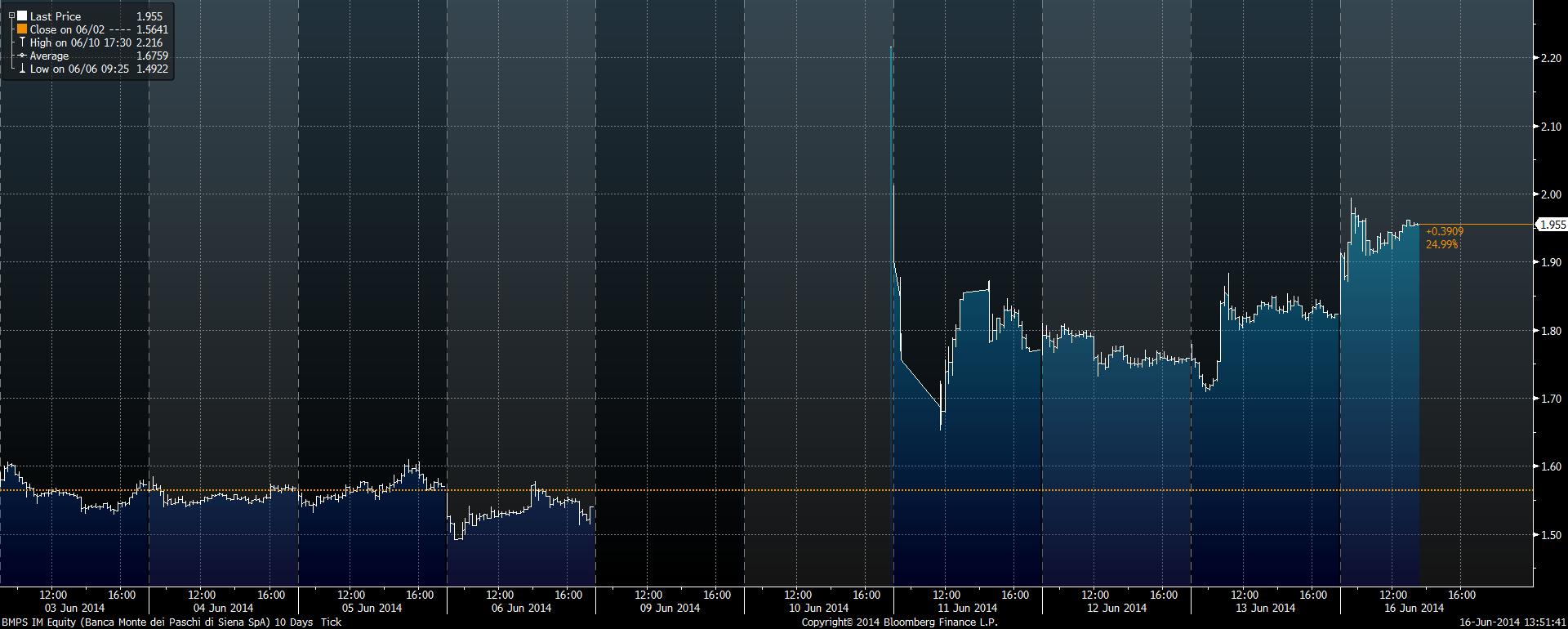
In BMPS’s case, the first strange thing ist the price of the underlying stock:

BMPS IM Equity (Banca Monte dei  2014-06-16 13-51-34

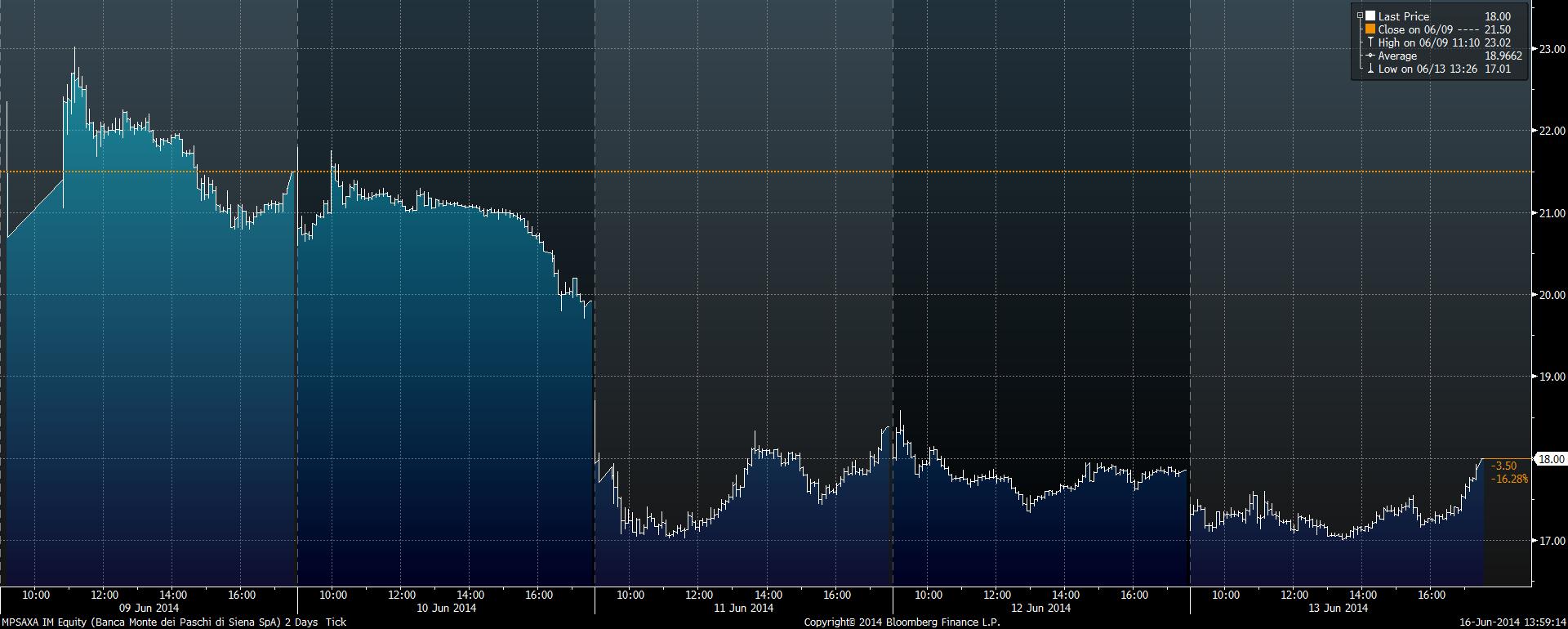
Adjusted for the subscription right, the stock gained more than 20% since the start of the subscription right trading period and it didn’t drop before, quite in contrast, the stock is up ~80% YTD. As a result of course, the subscription right should increase in value. But this is how the subscription rights have performed since they started trading:

MPSAXA IM Equity (Banca Monte de 2014-06-16 13-59-10

It is not unusual that the subscription rights trade at a certain discount, as the “arbitrage deal”, shorting stocks and going long the subscription right is not always easy to implement.

At the current price however, the discount is enormous::

At 1,95 EUR per share, the subscription right should be worth (214/5)* (1,95-1,00)= 40,66 EUR against the current price of 18 EUR, a discount of more than 50%. The most I have seen so far was 10-15%. So is this the best arbitrage situation of the century ?

Not so fast.

First, it seems not to be possible to short the shares, at least not for retail investors. Secondly, different to other subscription right situations, the subscription right are trading extremely liquid. Since the start of trading on June 9th, around 560 mn EUR in subscription rights have been traded, roughly twice the value of the ordinary shares. The trading in the ordinary shares themselves however is also intersting, trading volume since June 9th has been higher than the market cap.

Thirdly, for a retail investors, the banks ususally require a very early notice of exercise. So one cannot wait until the trading period and decide if to exercise or not, some banks require 1 week advance notice or more. My own bank, Consors told me that I would need to advice them until June 19th 10 AM, which is pretty OK but prevents me from buying on the last day.

In general, in such a situation like this the question would be: What is the mispriced asset, the subscription right or the shares themselves ? Coming from the subscription right perspective, the implicit share price would be 1+ (18/((214/5)*1,95-1)))= 1,44 EUR. This is roughly where BMPS traded a week before the capital increase.

For me it is pretty hard to say which is now the “fair” price, the traded stock price at 1,95, the implict price from the rights at 1,44 or somewhere in between. As the rights almost always trade at a discount, even in non-Italian cases, one could argue that there might be some 10-15% upside in buying the shares via the rights. On the other hand, I find the Italian stock market rather overheated at the moment and the outstanding BMPS shares are quite easy to manipulate higher due to the low market cap of the “rump shares” at around 200-250 mn EUR.

The “sure thing” would be to short the Stock at 1,96 EUR, but that doens’t seem to be possible.

Summary:

Again, this “Italian right” capital raising creates a unique situation, this time with a price for the subscription right totally disconnected from the share price.

Nevertheless I am not quite sure at the moment what to to with this. One strategy would be to buy the subscription right now and then sell the new shares as quickly as possible, but it looks like that this is exactly what the “masterminds” behind this deal have actually want investors to do. They don’t care about the share price, they just want to bring in 5 bn EUR in fresh money and an ultra cheap subscription right is the best way to ensure an exercise. In this case we should expect a significant drop in the share price once the new shares become tradable. So for the time being am sitting on the sidelines and watch this with (great) interest as it is hard for me to “handicap” this special situation at the moment.

Update: Portugal Telecom & Oi Merger & Oi capital increase

DISCLAIMER: The stock discussed is again very risky and not a typical “value stock”. Please do your own homework and never commit large amounts of your capital to such investments. The author might buy or sell the shares without giving advance notice. Do your wn homework !!

Last year I had a mini series (part 1, part 2, part 3) about the merger between Portugal Telecom and the Brazilian Oi. My initial idea was a long PTC / short OI deal as the mechanics of the merger seemed to imply a signifcant dilution for OI shareholders.

Interestingly, since I wrote the first post in October 2013, both shares lost siginficantly, however Oi with around -37% more than double than PTC with -15%.

Oi is now in the process of preparing the planned capital increase and it looks that they did push through the share offering though there have been some hickups along the way.

Just as a quick reminder:

Oi was supposed to do a big capital increase first before then the company gets merged with PTC.

Oi seems to have priced the new shares aggresively at the bottom of the expected range:

Grupo Oi SA, Brazil’s largest fixed-line telephone carrier, priced an offering of preferred shares at 2 reais each, at the bottom of the indicative range set by bankers, sources said on Monday.

So at current prices with PTC at ~3 EUR and OI common shares at 2,50 Reais (or ~0,81 EUR) PTC sharesholders will receive “new shares” of OI at the value of 2,2911 Euros plus 0,6330 “CorpCo” shares which should equal common shares. So at 3 EUR there seems to be a small discount but I think this is hardly exploitable as an arbitrage situation.

For me, the current situation is an interesting combination of a special situation (capital increase regardless of price) and Emerging Markets exposure.

However, much more interesting for me is that aspect:

It is pretty clear that Oi wanted to raise a defined amount without really caring about the share price. This looks similar to EMAK and Unicredit in Italy 2 years ago. This is one of the rare cases where we clearly have a seller who does not care about the price but just wants to raise a fixed amount of money.

The “special-special” aspect of this one are the following feature:

1. We do not have subscription rights despite the massive amount of new shares
2. We have the additional complexity of the subsequent PTC merger

In such a situation, it is extremely hard to come up with a solid valuation of the business. Both, OI and PTC look very cheap on a trailing EV/EBITDA basis but honestly, i did not try to figure out how the combined entity will look like. Oi minorities clealry got screwed by this transaction whereas PTC shareholders had been protected to a certain extent.

The good part of the this capital raising is that the entity will have some fresh cash which will allow them to operate for some time. Although there is clearly the risk of further dilutions if they want to bid for instance for additional businesses in Brazil.

Summary:

For me, the Oi capital increase looks very similar to situations like EMAK and Unicredit, where the companies issued new shares regardless of price. This increases the possibility that the price has been pushed significantly below fair value. Buying PTC now looks like an interesting way to get exposure to the merged entity at a depressed price. I will therefore invest a 1% position into PTC at current prices (3 EUR) for my “special situation” bucket.

Quick MIFA update – How to “play” covenants

Disclosure: No position, for educational purposes only.

2 weeks ago I had a quick look at the troubles at MIFA, the German bicycle manufacturer.

The official version was that they had a short term problem with their accounting but no liquidity issues. This was the last paragraph of their press release in MArch:

MIFA expects to break even at the after-tax level in the first quarter of 2014. It will not be possible for the company to issue a reliable guidance concerning the full 2014 financial year until the preparation of the annual financial statements has been completed. The company has sufficient liquidity for its operating business.

So it was quite surprising that the company today, MIFA announced the following:

– The CEO is now gone forever
– they did a “sale-lease back” of their real estate to the local Government, raising 5,7 mn EUR

So to a certain extent they do seem to have liquidity issues, otherwise they would not sell their “last shirt” for cash. The more interesting part for me is the fact that “sale-lease back” is economically nothing else than a “secured loan” on the real estate.

Looking into the bond prospectus, the outstanding bond includes a so-called “Negative Pledge” covenant:

Negativverpflichtung:
Der Emittent verpflichtet sich, solange Schuldverschreibungen ausstehen, jedoch nur bis zu dem Zeitpunkt, an dem alle Beträge an Kapital und Zinsen, die gemäß den Schuldverschreibungen
zu zahlen sind, der Zahlstelle zur Verfügung gestellt worden sind, keine Grundpfandrechte, Pfandrechte oder sonstige dingliche Sicherungsrechte (jedes solches Sicherungsrecht ein “Sicherungsrecht”) in Bezug auf ihren gesamten Geschäftsbetrieb oder ihr gesamtes Vermögen oder ihre Einkünfte, jeweils gegenwärtig oder zukünftig, oder Teile davon zur Sicherung von anderen Kapitalmarktverbindlichkeiten oder zur Sicherung einer vom Emittenten oder einer seiner Tochterunternehmen gewährten Garantie oder Freistellung bezüglich einer Kapitalmarktverbindlichkeit einer anderen Person zu bestellen, ohne gleichzeitig für alle unter den Schuldverschreibungen zahlbaren Beträge dasselbe Sicherungsrecht zu bestellen oder für alle unter den Schuldverschreibungen zahlbaren Beträge solch ein anderes Sicherungsrecht zu bestellen, das von einer unabhängigen, international anerkannten Wirtschaftsprüfungsgesellschaft als gleichwertig anerkannt wird. Dies gilt vorbehaltlich bestimmter Ausnahmen.
“Kapitalmarktverbindlichkeit” bezeichnet jede Verbindlichkeit aus Schuldverschreibungen oder ähnliche verbriefte Schuldtitel oder aus Schuldscheindarlehen oder aus dafür übernommenen Garantien und/oder Gewährleistungen.

The covenants do actually prevent them to take out a typical German “Schuldscheindarlehen” against their real estate. Interestingly, an economically equivalent sale-lease back (which will be booked as financial liability) doesn’t seem to violate this covenant.

Should for some reason, MIFA go bankrupt, the recovery for the bondholders will be significantly lower than before as the real estate now belongs to someone else and will not be part of any liquidation proceeds.

I find it interesting how easy it is to circumvent such covenants with economically equivalent transaction. A reason more to stay as far away as possible from German corporate bonds in general and the so-called “Mittelstandsanleihen”. There is no “seniority” of those senior bonds, those instruments are clearly “junior” capital for German corporates. Nevertheless, bondholders seemed to like it:

It will be interesting to see if today’s bounce in the bond price is similar to what happened at Praktiker when they announced their first “rescue” and the bond price doubled from 40% to 80% before then collapsing to close to zero. Or maybe the Indians are already on their way with big suitcases full of frsh money. Who knows ? But a lot to learn for bond investors.

Portugal Telecom & OI merger – another PIIGS stock transformation ?

It seems like that many PIIGS companies with significant international business operations try to transform their companies in some way or another in order to get rid of the “PIIGS” discount. Basically a first mover was Hellenic Botteling, which delisted in Greece and relisted as Swiss based company in the UK market in 2012. A second, very succesful attempt was made by Autogrill, spinning off the international business.

Now, a few days ago, Portugal Telecom (PTC), the Portuguese TelCo with a large Brazilian subsidiary, came up with a potential new way:

They want to merge with the Brazilian TelCo OI and effectively become a Brazilian Telecom company with a Portuguese subsidiary.

This alone is in my opinion already an interesting special situation. But it gets even more interesting. The structure of the merger is quite complicated, but in general, there will be a merger plus capital increase.

For Portugal Telecom shareholders, it looks like the following:

Each Oi common share will be exchanged for 1 share in CorpCo, and each Oi preferred share will be swapped for 0.9211 CorpCo stock. Each Portugal Telecom share will be the equivalent of 2.2911 euros in CorpCo shares to be issued at the price of the capital hike, plus 0.6330 CorpCo shares.

So on a first look, this looks interesting for Portugal Telecom shareholders. The lower the price of the capital increase, the higher the share in the combined company. Clever Hedge funds might even be able to construct a short OI long PTC trade. Although there is a corridor where either PTC or OI can step back from the transaction if prices would move too strongly in one or the other direction.

Some figures / ratios:

PTC:
Market cap 3.1 bn EUR
P/E 7.4
P/B 1.5
EV/EBITDA 5.5

OI:
Market Cap 6.5 bn BRL (~2.1 bn EUR)
P/E 11
P/B 0.6
EV/EBITDA 4.5

Both companies carry significant debt.

The share prices of both companies reacted at first positively, but in the recent days, OI shares dropped quite significantly and PTC is back to where it was before (after hitting +30% in the first day):

This might be the reaction to the large cash capital increase undertaken by OI in the course of the deal:

As part of the merger, Oi proposes to undertake a cash capital increase of a minimum of R$ 7.0 billion (Euro 2.3 billion), and with a target of R$ 8.0 billion (Euro 2.7 billion) to improve the balance sheet flexibility of CorpCo. Shareholders of Telemar Participações S.A. (“Tpart”) and an investment vehicle managed by Banco BTG Pactual S.A. (“BTG Pactual”), will subscribe approximately R$ 2.0 billion (Euro 0.7 billion) of the cash capital increase

So from an OI shareholder point of view, one could argue that this exercise is somehow quite dilutive.

For some PTC shareholders, the problem might be that the suddenly do not hold a Portuguese/European stock but a Brazilian one. According to the official announcement, the new stock will be listed in Brazil, US and on NYSE Euronext, so technically it should be not a problem for shareholders.

On the “plus side” for this transaction one could argue with the following points

+ A Portuguese company with a potential “PIIGS” discount will be “transformed” into a potential BRIC growth story.
+ The valuation of the overall group might improve as well, as the OI pref shares will cease to exist
+ As PTC shareholder, there is an additional opportunity with regard to the OI share capital increase. The lower the price for the new shares, the higher will be the percentage in the new company
+ it is very likely that the deal will go through. The CEO of both companies is the same guy and regulators will have no reason to object
+ part of the synergies (i.e. lower refinancing costs) might be relatively easy to achieve.

On the other hand, there are also some clear issues:

– Brazil itself is not in the “sweet spot” anymore
– OI itself is struggling. Being only the number 4 mobile operator, especially ROA and ROE is far below the competition
– in the presentation, the CEO committed to pay 500 mn BRL p.a. in dividends. Including the new shares, this will result in a much lower dividend yield going forward from the current 7-8%. As they want to grow, this makes sense, but for some investors this could be an issue
– debt will be relatively high, further capital increase in combination with acquisitions are not unlikely

At the moment, I need to dig a little bit more deeply into this, but in order to keep me motivated and interested, I take a 0.5 % position at current prices (3.40 EUR per share) in Portugal Telecom for my “special situation” bucket.

DISCLAIMER: As always, do your own research. This is not meant to be any kind of investment advise. When publishing this, the author will most likely own the stock already. Do not blindly follow any tips etc. Use your own brain. The author will also most likely sell the stock before posting this on his website.

Friday night IVG Bombshell

Friday night, 8 pm seems to be a good time to land a real bombshell. IVG distributed an Adhoc notice with some update information about the upcoming restructuring.

Among other stuff, the comment on potential recovery rates in a liquidation. This is the German original:

ergäbe folgende Befriedigungsquoten: ca. 96% bis ca. 100% für Objektfinanzierungen (Carve out debt), ca. 86% bis ca. 89% für den syndizierten Kredit von 2009 (Syn Loan II), ca. 46% bis ca. 55% für den syndizierten Kredit von 2007 (Syn Loan I) und ca. 27% bis ca. 41% für die Wandelanleihe. Die Gläubiger der Hybridanleihe und die Aktionäre der Gesellschaft würden in diesen Fällen voraussichtlich jeweils keine Befriedigung erhalten.

So nada/niente/rien for Hybrid and Equity and only 27%-41% for the convertible. This is significantly below the latest trade of around 58% as of today.

After all, my summary from May seems to be spot on:

the likelihood of IVG “surviving” long term in my opinion is very small or even zero. So equity and hybrid should be avoided

I am really glad that I sold out:

Overall, for the portfolio I would for the time being sell down the position at current rates and eat the loss. I am pretty sure that I am too early but as I know that I am a rather bad short term speculator, I want to play this safe.

This is by no means over yet but it doesn’t look good.

Interestingly, Third Avenue seemed to have bought into IVG earlier this year. That’s what they say in their last shareholder letter:

Our analysis determined that the IVG Convertible Bond swere most likely the “fulcrum” security in the capital structure. In other words, holders of the IVG Convertible Bonds are likely to participate in a debt-for-equity restructuring, and the subordinated securities(preferred and common) would retain little or no value. IVG Convertible Bonds mature in 2017, but holders have an option to put the bonds to the company in 2014. The Fund purchased approximately 5% of the outstanding IVG Convertible Bonds at an average cost of sixty-eight cents on the dollar. As a larger holder,we anticipate having a seat at the table with the company

Man, that sounds really stupid. Even I had found out that the “fulcrum” security were the loans. it seems to be that Marty Whitman’s successors got a little bit sloppy.

So let’s get some Popcorn and watch what will happen on Monday.

« Older Entries Recent Entries »