Category Archives: Investment-Gurus

Berkshire Hathaway 2012 listed stocks performance

I hope everyone has now read the 2012 annual Berkshire Letter which came out last week.

Among other stufff, Warren Buffet complained a little bit that he didn’t beat the S&P 500 based on the increase in Book Value at Berkshire.

Just for fun, I hacked in Berkshire portfolio.

In a first step I looked at all the disclosed positions above 1 bn USD.

2012 perfomance P/E P/B EV/EBIT EV/EBITDA Beta Volume
American Express 23.57% 14.7 3.8 16.1 8.9 1.05 8,715
Coca Cola 6.51% 19.6 5.3 16.6 14.0 0.72 14,500
Conoco Philips 9.20% 9.5 1.5 6.5 4.4 0.98 1,399
Direct TV 17.31% 10.8 #N/A N/A 9.0 6.2 0.89 1,154
IBM 4.17% 13.7 12.4 11.6 9.4 0.91 13,048
Moody’s 51.86% 16.6 29.1 10.3 9.5 1.31 1,430
Munich Re 54.71% 8.1 1.0 #N/A N/A #N/A N/A 0.94 3,599
Philips 66 50.41% #N/A N/A 2.0 10.8 8.5 1.16 1,097
POSCO 1.19% 8.3 0.7 9.0 6.4 1.01 1,295
Procter & Gamble 5.18% 19.4 3.2 14.4 11.9 0.64 3,563
Sanofi 34.20% 20.0 1.7 13.2 6.9 0.76 2,438
Tesco -8.20% 10.8 1.7 10.4 7.2 0.72 2,268
US Bancorp 20.96% 11.9 1.9 #N/A N/A #N/A N/A 1.09 2,493
Walmart 16.97% 14.6 3.2 10.3 7.9 0.59 3,741
Wells Fargo 27.37% 10.7 1.3 #N/A N/A #N/A N/A 1.15 15,592
 
Total / Avg 17.56% 14.27 5.0 13.4 10.1 0.92 76,332

To add some value, I have added some valuation metrics and aggregated the performance based on year end values. Although this is not the 100% correct way to do this, we can see that the listed stock portfolio outperformed the S&P Total return index (+14.1%) by a margin of almost 3.5%. A very respectable outperformance for a 75 bn USD portfolio. One can also see that the Beta of the portfolio is clearly below 1, so the outperformance really looks like alpha. (EDIT: I do not know which Index Buffet used for his 16%, I took S&P 500 total return performance from Bloomberg).

From simple valuation metrics, the portfolio of course looks quite expensive. P/E of 14.4 is in line with the S&P 500, but it looks like that Berkshire doesn’t consider P/B as a meaningful metric for listed stocks anymore. Also, the average EV/EBIT of 13 and EV/EBITDA of 10 is far above I would be prepared to pay.

In a second step, I added all the stock positions which were disclosed by Berkshire plus anything available on Bloomberg with a value of more than 200 mn USD.

2012 perfomance P/E P/B EV/EBIT EV/EBITDA Beta Volume
American Express 23.57% 14.7 3.78 16.05 8.88 1.05 8,715
Coca Cola 6.51% 19.6 5.33 16.55 13.98 0.72 14,500
Conoco Philips 9.20% 9.5 1.47 6.54 4.38 0.98 1,399
Direct TV 17.31% 10.8 #N/A N/A 9.03 6.16 0.89 1,154
IBM 4.17% 13.7 12.41 11.56 9.41 0.91 13,048
Moody’s 51.86% 16.6 29.11 10.29 9.48 1.31 1,430
Munich Re 54.71% 8.1 0.96 #N/A N/A #N/A N/A 0.94 3,599
Philips 66 50.41% #N/A N/A 1.98 10.82 8.52 1.16 1,097
POSCO 1.19% 8.3 0.70 8.96 6.36 1.01 1,295
Procter & Gamble 5.18% 19.4 3.21 14.44 11.88 0.64 3,563
Sanofi 34.20% 20.0 1.74 13.22 6.88 0.76 2,438
Tesco -8.20% 10.8 1.74 10.40 7.15 0.72 2,268
US Bancorp 20.96% 11.9 1.86 #N/A N/A #N/A N/A 1.09 2,493
Walmart 16.97% 14.6 3.21 10.27 7.86 0.59 3,741
Wells Fargo 27.37% 10.7 1.33 #N/A N/A #N/A N/A 1.15 15,592
               
Davita 45.80% 19.4 3.33 14.95 11.94 0.80 1,830
Swiss Re 49.31% 6.8 0.92 #N/A N/A #N/A N/A 1.15 909
Washington Post 1.20% 17.6 1.16 9.27 4.52 0.81 704
General Motors 37.40% 9.3 1.47 #N/A N/A 1.31 1.19 697
M&T Bank 31.99% 13.7 1.43 #N/A N/A #N/A N/A 1.07 558
BonY Mellon 30.69% 12.2 0.92 #N/A N/A #N/A N/A 1.28 544
Costco 26.15% 24.8 3.50 13.49 10.21 0.75 444
USG 166.24% #N/A N/A 502.76 48.17 18.47 2.14 472
Viacom 16.92% 14.5 4.21 9.25 8.70 1.16 459
Precision Castparts 12.83% 20.3 2.92 15.23 13.93 0.92 374
Mondelez 6.24% 12.7 1.58 9.46 7.81 0.62 366
National Oilwell -0.76% 11.5 1.43 8.19 6.96 1.51 357
Deere 11.80% 11.2 4.67 8.22 6.75 1.14 355
Wabco 43.46% 14.4 6.48 12.46 10.07 1.72 281
General Dynamics 6.04% 10.6 2.10 30.15 17.28 0.97 262
Visa 47.56% 24.6 4.68 18.01 17.09 0.98 250
Torchmark 18.82% 11.2 1.25 #N/A N/A #N/A N/A 0.97 245
Mastercard 29.89% 23.9 9.38 14.04 13.27 1.00 214


Total / Avg 19.57% 14.4 7.6 13.6 10.1 0.94 85,653

A few observations here:

I do not understand, why DaVita was not included in the shareholder’s letter with a market value of 1.8 bn. Maybe they have forgotten this position ?

Secondly, including those additional ~10 bn of stocks increases the total performance of the total portfolio by an incredible 2%.

In a third step, I calculated the performance of what I would call the “Non Buffet” Portfolio, taking Direct TV from the annual letter and eliminating Swiss Re and Washington Post from the < 1bn list.

2012 perfomance P/E P/B EV/EBIT EV/EBITDA Beta Volume
               
Direct TV 17.31% 10.8 #N/A N/A 9.03 6.16 0.89 1,154
Davita 45.80% 19.4 3.33 14.95 11.94 0.80 1,830
General Motors 37.40% 9.3 1.47 #N/A N/A 1.31 1.19 697
M&T Bank 31.99% 13.7 1.43 #N/A N/A #N/A N/A 1.07 558
BonY Mellon 30.69% 12.2 0.92 #N/A N/A #N/A N/A 1.28 544
Costco 26.15% 24.8 3.50 13.49 10.21 0.75 444
USG 166.24% #N/A N/A 502.76 48.17 18.47 2.14 472
Viacom 16.92% 14.5 4.21 9.25 8.70 1.16 459
Precision Castparts 12.83% 20.3 2.92 15.23 13.93 0.92 374
Mondelez 6.24% 12.7 1.58 9.46 7.81 0.62 366
National Oilwell -0.76% 11.5 1.43 8.19 6.96 1.51 357
Deere 11.80% 11.2 4.67 8.22 6.75 1.14 355
Wabco 43.46% 14.4 6.48 12.46 10.07 1.72 281
General Dynamics 6.04% 10.6 2.10 30.15 17.28 0.97 262
Visa 47.56% 24.6 4.68 18.01 17.09 0.98 250
Torchmark 18.82% 11.2 1.25 #N/A N/A #N/A N/A 0.97 245
Mastercard 29.89% 23.9 9.38 14.04 13.27 1.00 214
               
               
Total / Avg 34.97% 15.2 33.6 15.3 9.9 1.07 8,862

And here we can see that Weschler and Combs really “shot out the lights”. 35% performance for 2012 is a fxxxing fantastic result. Ok, Beta is slightly above 1 but at least for 2012 the did a outstanding job. No wonder Buffet said that in his annual letter:

Todd Combs and Ted Weschler, our new investment managers, have proved to be smart, models of integrity, helpful to Berkshire in many ways beyond portfolio management, and a perfect cultural fit. We hit the jackpot with these two. In 2012 each outperformed the S&P 500 by double-digit margins. They left me in the dust as well.

So even if some of the smaller stocks are “Warren & Charlie” stocks as well, Weschler and Combs showed them how its done at least with a smaller portfolio. Maybe the smaller size of the portfolio is the reason ?

Summary:

Once again, the portfolio of listed stocks of Berkshire outperformed the S&P 500 by a nice margin. However it seems to be that Buffet’s “elephants” don’t have a chance against the smaller holdings of Weschler and Combs. Nevertheless, for the “lazy” value investor, copying the Berkshire portfolio looks still like a winning strategy.

Copying the “small” Berkshire stocks however looks like the absolute killer strategy.

Utility companies – The Warren Buffet perspective

In 2012, I sold my two utility stocks EVN and Fortum because I realised that I didn’t really understand the business model. I looked a little bit more general into utilities here, but with no real results. However,at least in Europe, the utility sector looks like one of the few remaining “cheap” sector.

If you don’t know a lot about a sector but need to start somewhere,it is always a good idea to look ifWarren Buffet has something to say about it

Although mostly his well-known consumer good investments like Coca Cola and Gilette are mentioned, Buffet runs a quite sizable utility operation called MidAmerican Energy.

Starting with the Berkshire 2011 annual report, let us look how the “sage” describes the business:

We have two very large businesses, BNSF and MidAmerican Energy, that have important common characteristics distinguishing them from our many other businesses. Consequently, we assign them their own sector in this letter and also split out their combined financial statistics in our GAAP balance sheet and income statement.
A key characteristic of both companies is the huge investment they have in very long-lived, regulated assets, with these partially funded by large amounts of long-term debt that is not guaranteed by Berkshire. Our credit is not needed: Both businesses have earning power that even under terrible business conditions amply covers their interest requirements.

So let’s note here first: Buffet uses “large amounts” of debt for his utility company.

Just below we find the following statement:

At MidAmerican, meanwhile, two key factors ensure its ability to service debt under all circumstances: The stability of earnings that is inherent in our exclusively offering an essential service and a diversity of earnings streams, which shield it from the actions of any single regulatory body.

I would argue he second point is interesting: Diversification in utilities works across regulators, not necessarily geographic location.

What I found extremely interesting is that Buffet is allocating a lot of capital to the utility sector. Out of the 19 bn USD Capex in Berkies operating businesses from 2009-2011, MidAmerican Capex summed up to ~9 bn USD, so almost half of Berkies total Capex.

One can assume that Buffet is not making all share investment decisions nowadays, but I think capital allocation to operating companies will be still made by him personally.

Buffet seems also quite interested in renewable energy, as the following comment from the annual report shows:

MidAmerican will have 3,316 megawatts of wind generation in operation by the end of 2012, far more than any other regulated electric utility in the country. The total amount that we have invested or committed to wind is a staggering $6 billion. We can make this sort of investment because MidAmerican retains all of its earnings, unlike other utilities that generally pay out most of what they earn. In addition, late last year we took on two solar projects – one 100%-owned in California and the other 49%-owned in Arizona – that will cost about $3 billion to construct. Many more wind and solar projects will almost certainly follow.

Here, he also mentions that he doesn’t extract any dividends out of his utility group. He considers it a growth opportunity rather than a cash cow. I think this is also worth keeping in mind, as many investors would judge utility stocks mainly by dividend yield.

From the 2009 report we learn the following:

Our regulated electric utilities, offering monopoly service in most cases, operate in a symbiotic manner with the customers in their service areas, with those users depending on us to provide first-class service and invest for their future needs. Permitting and construction periods for generation and major transmission facilities stretch way out, so it is incumbent on us to be far-sighted. We, in turn, look to our utilities’ regulators (acting on behalf of our customers) to allow us an appropriate return on the huge amounts of capital we must deploy to meet future needs. We shouldn’t expect our regulators to live up to their end of the bargain unless we live up to ours.

This is as clear as it gets. Utilities are a “natural” monopoly. If you play by the rules (at least in the US), you are guaranteed a decent return.

In the same report Buffet once more explains why he is suddenly more interested in utilities:

In earlier days, Charlie and I shunned capital-intensive businesses such as public utilities. Indeed, the best businesses by far for owners continue to be those that have high returns on capital and that require little incremental investment to grow. We are fortunate to own a number of such businesses, and we would love to buy more. Anticipating, however, that Berkshire will generate ever-increasing amounts of cash, we are today quite
willing to enter businesses that regularly require large capital expenditures.

From the 2008 report, this sentence is reinforcing Buffets strategy:

Indeed, MidAmerican has not paid a dividend since Berkshire bought into the company in early 2000. Its earnings have instead been reinvested to develop the utility systems our customers require and deserve. In exchange, we have been allowed to earn a fair return on the huge sums we have invested. It’s a great partnership for all concerned.

On acquisition of utilities, we can also find his thoughts in that report:

In the regulated utility field there are no large family owned businesses. Here, Berkshire hopes to be the “buyer of choice” of regulators. It is they, rather than selling shareholders, who judge the fitness of purchasers when transactions are proposed.

There is no hiding your history when you stand before these regulators. They can – and do – call their counterparts in other states where you operate and ask how you have behaved in respect to all aspects of the business, including a willingness to commit adequate equity capital.

When MidAmerican proposed its purchase of PacifiCorp in 2005, regulators in the six new states we would be serving immediately checked our record in Iowa. They also carefully evaluated our financing plans and capabilities. We passed this examination, just as we expect to pass future ones.

So being nice and trustworthy to the regulator is what counts in this business.

Finally let’s look at some “hard numbers” from MidAmerican, in order to be able to compare this to other utilities. I will use the MidAmerican 2011 annual report for this.

  2011 2010 2009 2008
Total Assets   47.7 45.7 44.7 41.4
Shareholders Equity   14.1 13.2 12.6 10.2
total financial debt   17.8 18.2 19.3 18.2
Sales   11.2 11.1 11.2 12.7
EBIT   2.684 2.502 2.465 2.828
Net Income   1.331 1.238 1.157 1.85
Int. Exp   1.196 1.225 1.257 1.333
Op. CF   3.220 2.759 3.572 2.587
Capex   2.684 2.593 3.413 3.937
 
ROE   9.8% 9.6% 10.2%  
NI margin   11.9% 11.2% 10.3% 14.6%
EBIT Margin   24.0% 22.5% 22.0% 22.3%
Debt/equity   126.2% 137.9% 153.5% 178.4%
EBIT/Int exp   2.24 2.04 1.96 2.12
ROA   2.9% 2.7% 2.7%

We can clearly see that this is low ROA business. Only the significant leverage allows Buffet to have ~10% ROE on average. Additionally, he seems to provide some “contingent” capital to MidAmercian, i.e. to promise a capital contribution of 2 bn USD if required. I think this keeps down the cost of debt without explicitly guaranteeing it. MidAmerican has a credit rating of “only” A- against Berkshire’s AA+. Also one can see that he reduced leverage over the last few years since taking over MidAmerican.

Nevertheless he seems to prefer this vs. returning cash to shareholders. Interesting.

So let’s quickly summarize Warren Buffet’s perspective on utilities as far as I understood it:

– he only started to invest into utilities relatively lately because he needs something where to invest his growing cashflows from the other operations
– he prefers regulated utility business, diversified over different regulators
– he invests a lot of money into renewable energy
– he uses significant leverage to achieve 10% ROE
– he is not looking at the busienss as a cash cow but a long term growth business and therefore does not extract any dividends

Underrated special situation – Deep-discounted rights issues

In many books which deal more or less explicitly with “special situation” investing, for instance Joel Greenblatt’s “You can be a stock market genius” or seth Klarman’s “Margin of safety”, many so-called “Corporate actions” are mentioned as interesting value investing opportunities.
Some of the most well know corporate actions which might yield good investment opportunities are:

– Spin offs
– tender offers /Mergers
– distressed / bankruptcy 

However one type of corporate action which is rarely mentioned are rights issues and especially “deeply discounted” rights issues.

Let us quickly look at how a rights issue is defined according to Wikipedia:

A rights issue is an issue of rights to buy additional securities in a company made to the company’s existing security holders. When the rights are for equity securities, such as shares, in a public company, it is a way to raise capital under a seasoned equity offering. Rights issues are sometimes carried out as a shelf offering. With the issued rights, existing security-holders have the privilege to buy a specified number of new securities from the firm at a specified price within a specified time.[1] In a public company, a rights issue is a form of public offering (different from most other types of public offering, where shares are issued to the general public).

So we can break this down into 2 separate steps:

1. Existing shareholders get a “Right” to buy new shares at a specific price
2. However the shareholders do not have to subscribe the new shares. Instead they can simply choose to not subscribe or sell the subscription rights

Before we move on, Let’s look to the two alternative ways to raise equity without rights issues:

A) Direct Sale of new shares without rights issues
This is usually possible only up to a certain amount of the total equity. In Germany for instance a company can issue max. 10% of new equity without being forced to give rights to existing shareholders. In any case this has to be approved by the AGM.

B) (Deferred) Issuance of new shares via a Convertible bond
Many companies prefer convertible bonds to direct issues. I don’t know why but I guess it is less a stigma than new equity although new equity is only created when the share price is at or above the exercise price at maturity. So for the issuing company, it is more a cash raising exercise than an equity raising exercise. Usually, the same limits apply to convertible debt than for straight equity.

So if a company needs more new equity, the only other feasible alternative is a rights issue. But even within rights issues, one can usually distinguish between 3 different kinds of rights issues depending on the issue price:

1) “Normal” rights issue with a relatively small discount
Usually, a company will issue the new shares at a discount to the old shares in order to “Motivate” existing shareholders to take up the offer. If they do not participate, their ownership interest will be diluted. Usually “better” companies try to use smaller discounts, high discount would signal some sort of distress

2) Atypical rights issue with a premium
This is something one sees sometimes especially with distressed companies, where a strategic buyer is already lined up but wants to avoid paying a larger take over premium to existing shareholders

3) Finally the “deeply” discounted rights issue

Often, if a company does not have a majority shareholder, the amount of required capital is relatively high and there is some urgency, then companies offer the new shares at a very large discount to the previous share price.

But exactly why are “deeply discounted” rights issues an interesting special situation ?

After all this theory, lets move to an example I have already covered in the blog, the January 2012 rights issue of Unicredit In this case:

– Unicredit did not have a controlling shareholder. One of the major shareholders, the Lybian SWF even was not able to transact at that time
– the amount to be raised was huge (7.5 bn EUR)
– it was urgent as regulators made a lot of pressure

As discussed, in the case of Unicredit, before the actual issuance at the time of communication the stock price was around 6.50 EUR, the theoretical price of the subscription right was around 3.10 EUR. However even before the subscription right was issued, the stock fell by 50 %. At the worst day, one day before the subscription rights were actually split off, the share fell (including the right) almost down to the exercise price without any additional news on the first day of subscription right trading.

But why did this happen ? In my opinion there is an easy answer: Forced selling

Many of the initial Unicredit Investors did not want to participate or did not have the money to participate in the rights issue. As the subscription right was quite valuable, a simple “non-exercise” was not the answer. As history shows, selling the subscription right in the trading period always leads to a discount even against the underlying shares, in this case some investors thought it is more clever to sell the shares before, including the subscription rights. Sow what we saw is a big wave of unwilling or unable investors which wanted to avoid subscribing and paying for new shares which created an interesting “forced selling” special situation.

Summary: In my opinion, deeply discounted rights issues can create interesting “special situation” investment opportunities. Similar to Spin offs, not every discounted rights issue is a great investment, but some situations can indeed be interesting. On top of this, those situations often are not really correlated to market movements and play out in a relatively short time frame.

Leveraging Investment returns if you are not Warren Buffet and you do not own an Insurance company

This post was inspired by an interesting paper which explores how much of WBs success is attributable to leverage.

The authors calculate that Buffet applied (mostly through his insurance float and debt a leverage ratio of between 1.4:1 to 1.6:1 over the life of Berkshire.I would speculate that this might be even higher if one factors in his sales of S&P puts and CDS protection.

However, for the ordinary investor it is quite difficult to gain access to cheap insurance float and the AAA funding cost Warren Buffet enjoys.

So what are the alternatives for “normal” investors ?

Read more

How to correctly calculate Enterprise Value

After all that heavy macro stuff, back to the nitty-gritty world of fundamental analysis.

Let’s have a look at Enterprise Value, which as concept is gaining more and more attention, among others famous “Screening guru” O’Shaughnessy has identified Enterprise value as the most dominant single factor in his new book. Also a lot of the best Bloggers like Geoff Gannon and Greenbackd prefer EV/EBITDA

Interestingly many people seem to just use and accept the “standard” Enterprise value calculation.

How to calculate standard Enterprise Value

Investopedia has the “normal” definition of Enterprise Value:

Definition of ‘Enterprise Value – EV’
A measure of a company’s value, often used as an alternative to straightforward market capitalization. Enterprise value is calculated as market cap plus debt, minority interest and preferred shares, minus total cash and cash equivalents.

Investopedia also offers an interpretation

Investopedia explains ‘Enterprise Value – EV’
Think of enterprise value as the theoretical takeover price. In the event of a buyout, an acquirer would have to take on the company’s debt, but would pocket its cash. EV differs significantly from simple market capitalization in several ways, and many consider it to be a more accurate representation of a firm’s value. The value of a firm’s debt, for example, would need to be paid by the buyer when taking over a company, thus EV provides a much more accurate takeover valuation because it includes debt in its value calculation.

So this is a good hint how to understand Enterprise Value: It originates from take-over valuation, most prominently from Private Equity investors or “old style” corporate raiders.

How to UNDERSTAND Enterprise Value

The private equity / Raider business in principle is relatively easy: You buy a company (or achieve full control) and then in a first step you extract all existing cash and/or assetswhich are not necessary to run the business from the company. In a second step, the corporate raider will then put as much debt onto the target company’s balance sheet and let it pay out as a dividend or capital reduction.

The more the Raider can get out quickly either as excess cash or as a “dividend recap” (short form for a debt financed dividend) the higher the return on investment.

The first important aspect: Excess cash OR excess assets

As I have written above, a raider of course likes best plain cash lying around. On the other hand, the raider will happily sell anything which is not really required to run a business and pocket this cash as well. However mechanical screeners will only capture cash on the balance sheet, not any “extra assets”.

A good example is my portfolio company SIAS. Their EV/EBITDA decreased strongly because the “exchanged” their extra asset in the form of a South American minority stake into cash. Another “extra Asset” company would be EVN with its Verbund stake.

Including the Verbund stake, EVN looks quite expensive at EV/EBITDA 8.3 (EV ~ 4 bn, EBITDA ~ 500 mn) against 5-6 EV/EBITDA at RWE and EON. However if we deduct the “extra asset” of 25% Verbund (~1.6 bn EUR) from the 4 bn EV, we suddenly end up with an EV/EBITDA of <5, a lot cheaper for this very conservatively run utility company.

In my experience, it is much more interesting to find companies with extra assets which don't show up as cash on the balance sheet. This was mentioned before as favorite technique of value legend Peter Cundill.

Next step: What to add to Enterprise Value

So its pretty clear that the less debt a company has the more a PE/raider will be willing to pay.

But it is also important to understand, how the capacity to put debt into a company is determined. Especially in the US, the debt will be put into the target in the form of corporate bonds. In order to sell them, you need to have a rating.

The lower the rating the more expensive the debt. In practice, raiders will try to achieve a BB rating as this is usually the “sweet spot” before bond spreads go up dramatically.

Rating agencies have relatively simple ratios to determine maximum debt loads within a certain rating category, however the most important point is this one:

Rating companies add additional items to determine debt capacity which are:

pension deficits or unfunded pension liabilities
– financial and operating leases (capitalised)
– any other known fixed payment obligations (cartel fines, guarantees etc.).

Economically, those items are very similar to financial debt which is usually included in the EV calculations, as they represent fixed payment obligations which sometimes (like pensions) even rank more senior than debt.

It is therefore no wonder that with a “standard” EV/EBITDA screener, often UK retail companies with huge (underwater) operating lease and pension commitments show up as “cheap” and then people are surprised that they go bankrupt soon (Game Group anyone ?).

Special case: prepayments

Prepayments are an interesting feature of some business models, among other for instance at Dart Group.

Normally, a company produces its goods first and then sells them again receivables until cash is then finally collected. In the case of prepayments, cash comes first in against a payable and the good gets produced at a later stage and then delivered with no further cash inflow to the customer. If the prepayments do not carry any formal restrictions, the company in theory can use the cash for whatever it wants. So for instance if a company can finance inventory out of payables, the prepayment cash could be used to finance even machinery or to reduce financial debt. So to make a long story short: cash from prepayments without formal restrictions should be considered “free cash” and deducted from enterprise value.

How to calculate Enterprise Value correctly:

So now we have all ingredients to correctly calculate Enterprise Value:

a. Equity Market cap
PLUS
b. Financial debt (long + short term)
PLUS
c. minorities, preferred
PLUS
d. financial leases and operating leases
PLUS
e. pension deficit or unfunded pension liabilities
PLUS
f. any other fixed liability which has to be repaid independently of the business success

MINUS
g. cash or cash equivalents
MINUS
h. “extra assets”, assets not required to run the business

Of course, EBITDA has to be adjusted as well in order to make usefull comparisons.

Basically we have to add back leasing expenses and pension expenses to EBITDA in order to compare the ratio against other companies.

Summary:

Standard screening EV/EBITDA does omit various relevant elements of an “economical” Enterprise value. Adjusting it for relevant items will prevent an investor to end up with relativ obvious value traps.

I am willing to bet that a back test on the adjusted EV/EBITDA ratios would generate even better results than the “standard” EV/EBITDA calculations.

Book Review: O’Shaughnessy – What works on Wall Street (4th edition)

A first remark: I haven’t read the previous editions and I am a maybe biased active value investor 😉

For many years, O’Shaughnessy’s book “What works on Wall Street” has been the Bible of many quantitative value investors who wanted to avoid analysing single companies and prefer an automated startegy to select stocks.

The book starts with some chapters loosely summarizing current behavioural finance knowledge which implies that human selection is inferior to automated systems.

For the large quatitative part of the book which follows, he seems to have used a new data set on US equities which wasn’t available before which is going back to 1926. He clearly lays out the methodology, with the major features being

– avoiding illiquid small caps

equal weighting of stocks in the portfolio (we’ll come to that one later !!!)

– reinvesting dividends

– enhanced rebalancing (not only on July 1st per year but the average of 12 annually rebalanced portfolios starting each month of the year)

– no transaction costs assumed

He then uses his data to run many different strategies. Some of the most interesting results for me were:

– small caps outperform large caps and indices pretty consistently by 1-2% p.a.

– low P/E stocks (cheapest decile) outperform by almost 5% p.a., interestingly with a lower beta

– low EV/EBITDA works even better as single factor model (5,5% p.a. out-performance)

– low Price/Cash Flow works, but “only” around 3.5% p.a. out-performance. Price to free cashflow and Price to operating cashflow work slightly better but not as good as EV/EBITDA

– the “old favourite” price to sales does not really work well (only 1.5% p.a.)

– Price to book: DOES NOT WORK for the cheapest decile !!!!

– Dividend yield DOES NOT WORK

– however stock buy back yield works with ~3% p.a. excess return

– Stock buy back yield and dividend yield work better, 3.3% p.a.excess return

– certain accounting ratios work also well, such as low accruals (2.8%), Asset to Equity, asset turnover etc.

– composite accounting ratios (4 factors) work even better, close to 5% p.a.

– composite ratio with only the 25 best stocks scores even better (7% p.a. out performance)

– composite Value factor (P/B, P/E, P/S, EBITDA/EV, P/CF) with 5.8% p.a. out-performance

– Earnings changes, profit margins and ROE DO NOT WORK

– Price momentum (6 and 12 months) works, with 2-3% p.a.

combining value and price momentum works best, some strategies yielding 10% p.a. excess returns or more

Comments:

I don’t want to sound arrogant, but from earlier discussions I knew that O’S favoured the P/S ratio in the prior editions. I always thought that this doesn’t make any sense because then you end up with a portfolio of supermarket stocks and wholesale companies.

It is also not surprising that P/B doesn’t work if you don’t adjust for debt. So no wonder, EV/EBITDA does a much better job. But this is something many active value investors know without having to go through 90 years of data.

For any active investor it is also no surprise that it is better to look a various factors as single factors can always be influenced by certain special effects. So welcome to the club, Mr. O’S !!!

Maybe in his 5th edition, O’S then starts to look at the historical developments, who knows ?

For me, the relevance of price momentum is still difficult to really understand but I am willing to learn !!!!

Conceptual issue: Equal weighted performance

I have one big conceptual issue with the whole book: as described in the beginning, O’S just briefly notices that he uses equal weighted portfolios. He doesn’t test if this alone has an impact on the performance of the strategies.

Some recent papers indicate that equal weighted portfolios themselves create significant out-performance vs. market cap weighted indices.

So we do not know for sure, how much of the out-performance of O’S strategies is due to his equal weight assumption as he benchmarks against a market cap index and not against an equal weight index.

Summary

O’S book is of course a interesting read. Many of the newer combined strategies make intuitive more sense than some of the older strategies. He also correctly states that strategies work only long term and you have to avoid market timing at all costs !!!

Many investors will underestimate what it means to invest in a mechanical strategy which underperforms for 3 or more consecutive years.

Unfortunately, the conceptual issue with the equal weighted portfolio takes away a lot of my personal “trust” into those mechanical strategies.

For me the key take aways are:

1. Any more or less fully invested value startegy with some basic analysis will perform quite well against the general market

2. Also the most famous mechanical models can become outdated

3. DO NOT TRY TO TIME THE MARKET

4. Price momentum should not be ignored

Argentina or how to adjust for Nationalization risk (Cresud edition)

And now to something completely different…

The story of the seizure of YPF, the Argentinian subsidiary of Repsol was on the news everywhere.

Accounting “Uber-guru” Aswath Damodaran had a great piece up yesterday about how to reflect Sovereign risk. He openly admits, not to have though too much about this issue before.

He brings up several possibilities to reflect this risk in intrinsic valuation, which are:

Option 1- Use a “higher required return or discount rate”:
Option 2: Reduce your “expected cash flows for risk of nationalization:

Option 3: Deal with the nationalization risk separately from your valuation: Since it is so difficult to adjust discount rates and cash flows for nationalization risk (or any other discrete risk), here is my preferred option.
Step 1: Value the company using conventional discounted cash flow models, with no increment in the discount rate or haircutting of the cash flows. The value that you get from the model will be your “going concern” value.
Step 2: Bring in the concerns you have about nationalization into two numbers: a probability that the firm will be nationalized and the proceeds that you will get if you are nationalized.
Value of operating assets = Value of assets from DCF (1 – Probability of nationalization) + Value of assets if nationalized (Probability of nationalization)

Intuitively I would also prefer option 3).

So let’s look at a real world example: Cresud

Cresud is an Argentinian company which according to Bloomberg

purchases and leases farms in Argentina’s Pampas region, and produces agricultural products. The Company cultivates grains including wheat, corn, soybeans, and sunflowers, raises beef and dairy cattle, and produces milk.

As one of the few “pure” agricultural plays and has traded ADRs, Cresud is a favourite of some very well known value investors like Fairfax and Monish Pabrai.

Now we can see what Damodoran described in “real world action”:

One US ADR reperesents 10 Argentinian shares.

As of yesterday, the US ADRs were traded at 10.90 USD, which would be 1.09 USD per share. The Argentinian shares were traded at 6 Argentinian Pesos which translate at the current rate of 4.40 ARS/USD into a price of 1.36 USD per share. A discount of around -25% for the foreign shares compared to the local shares.

If we look at the historical spread graph, we see that with the exception of the panic in 2008, the ADRs tracked the stock pretty well, so the current divergence definitley reflects Nationalization risk.

I have no idea if Cresud is in danger of being nationalised and if it is an interesting “special situation”, but it is still interesting to see how this one will turn out.

Quick check: Vivendi SA – Seth Klarman “Cigar butt”

I hate to admit it, but I am somehow a Seth Klarman “groupie” after reading his “margin of Safety” a couple of years ago.

So when ever Baupost reveals a new position, I stop everything else and try to find out why they did it (see my Microsoft analysis).

So I was quite surprised that Klarman now invested in Vivendi, the French media company.

In the hedge fund’s 2011 annual letter, they disclosed buys in private companies and mentioned recent purchases in Europe, without giving any names. The letter mentioned an expansion of the London office, as the hedge fund has been finding value due to large selling in Europe.

However, we have just discovered that Baupost’s largest disclosed equity holding (at least at the time of the purchase) was Vivendi SA (EPA:VIV) (VIV FP). The purchase was recently disclosed in Vivendi’s 2011 annual report.

Baupost owned 25.5 million shares as of February 29th, 2012; then worth close to $530 million using a ratio of 1.3:1 for euros to dollars. The $550million figure comes from looking at where Vivendi’s shares traded in 2011 and early 2012.

In the back of my mind I have always booked Vivendi as just another shitty media stock who spends all the money on stuopid acquisitions, however Klarman sticks to his strategy of buying cheap and struggling companies instead of “beautiful expensive” companies.

One of the reasons why they bought Vivendi are relatively clear: Vivendi generated a ton of free cashflow over the last few years. Some of this cashflow made it as dividend to investors, but most of this (plus some) went into acquisitions.

Lets look at some historical data:

EPS BV BV tang. FCF/Share Dvd net Debt/share
2002 -21.43 13.09 -19.68 0.49 1.15 11.55
2003 -1.07 11.13 -16.47 2.18 1.15 10.55
2004 2.57 14.40 -2.16 2.92 0.00 4.55
2005 2.66 16.27 0.50 2.14 0.60 3.25
2006 3.50 17.23 2.13 2.43 1.00 3.53
2007 2.26 17.47 -0.84 2.81 1.20 4.41
2008 2.23 19.34 -6.73 2.81 1.30 7.00
2009 0.69 17.92 -8.17 3.53 1.40 7.69
2010 1.78 19.44 -6.85 2.46 1.40 6.52
2011 2.16 15.61 -9.95 2.43 1.40 9.57
             
Sum/Delta       24.20 10.60 -1.98

From a free cashflow perspective, Vivendi generated an impressive 2,40 EUR free cashflow per year. Howver, less than half of it was distributed as dividend and a small amoutn was used to reduce debt.

Tangible book as one could expect for a media company is negative, but for a media company I would accept it to a certain extent. Debt is relatively high, but even including the debt load, the total valuation is quite low at 3.7 EV/EBITDA.

The share price looks really really ugly:

So based on yesterday’s post about momentum, this would be a clear “no” or better “non”.

Some more interesting points:

1. Vivendi does not have a majority owner

2. A couple of their subsidiaries are listed. That makes an interesting “sum of parts”:
– 61% in Activision are worth around 6.5 bn
– 53% of Maroc Telecom are worth around 5 bn EUR
A very simplistic comparison with Vivendi’s total marekt cap of 14 bn shows a maybe interesting situation.

3. Acquisitions:
– Vivdendi paid almost 8 bn EUR in 2011 for the 40% they did not own in its French Telecom subsidiary. However, after Iliad SA launched its aggressive enntrance into the French mobile market this amount was most likely much to high.

– in parallel, Vivendi is bidding for EMI and has bought several other companies, like a tv station for 350 mn EUR last year.

One has also to keep in mind that Klarman is managing around 25 bn USD, so the Vivendi position is for him a 2% postion, similar to News Corp, HP and BP. And not all of his invetsments are winners, despite the “Margin of Safety”.

I am howver not sure if the Iliad scenario was included in his “Margin of Safety” considerations.

Nevertheless it is very interesting situation as this is basically his first major contintental European Investment (despite a 5 mn EUR stake in a samll fFrench company named Chargeurs SA).

For the time being I nevertheless prefer to watch this from the outside as for me Vivendi is still a company which generates a lot of free cashflow but spends most of it for stupid acquisitions.

James Montier on record profit margins

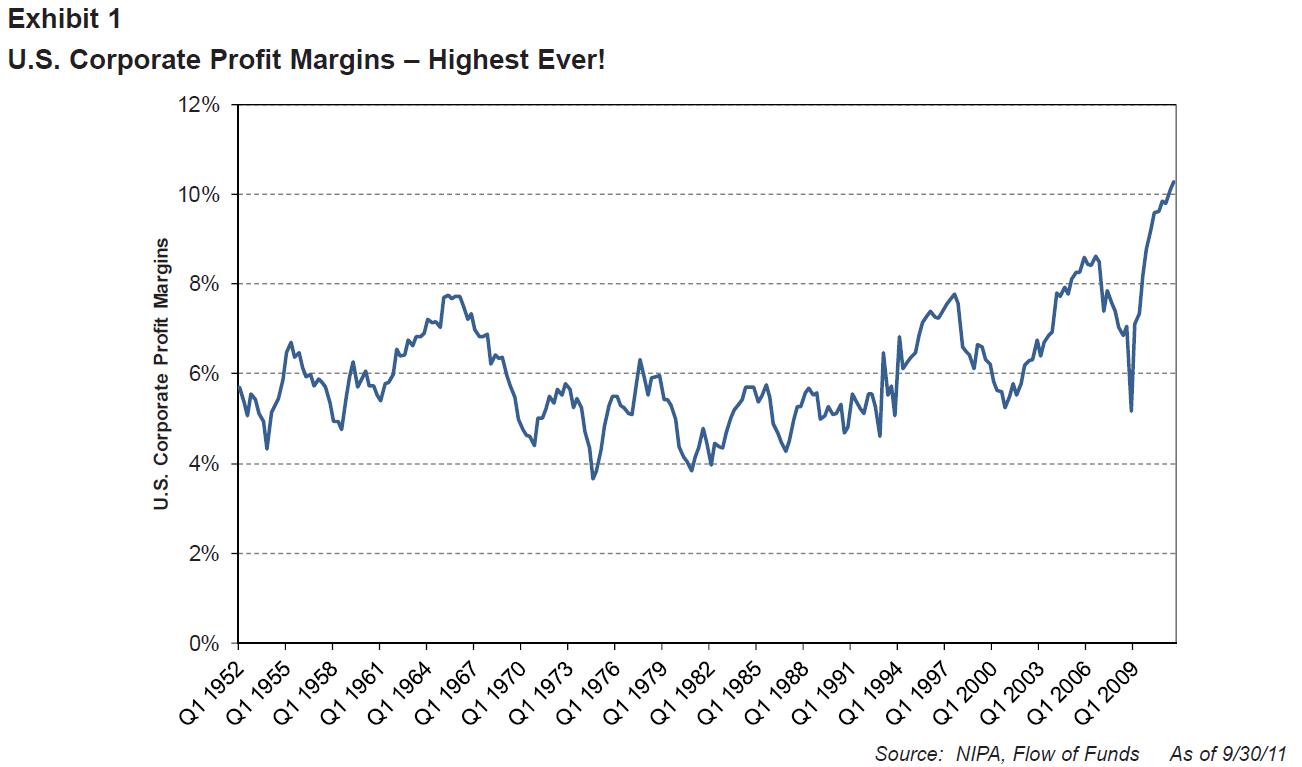
James Montier has issued a very interesting reasearch piece on why profit margins are so high.

This is something which is also bugging me all the time. The Chart on page 2 is especially interesting:

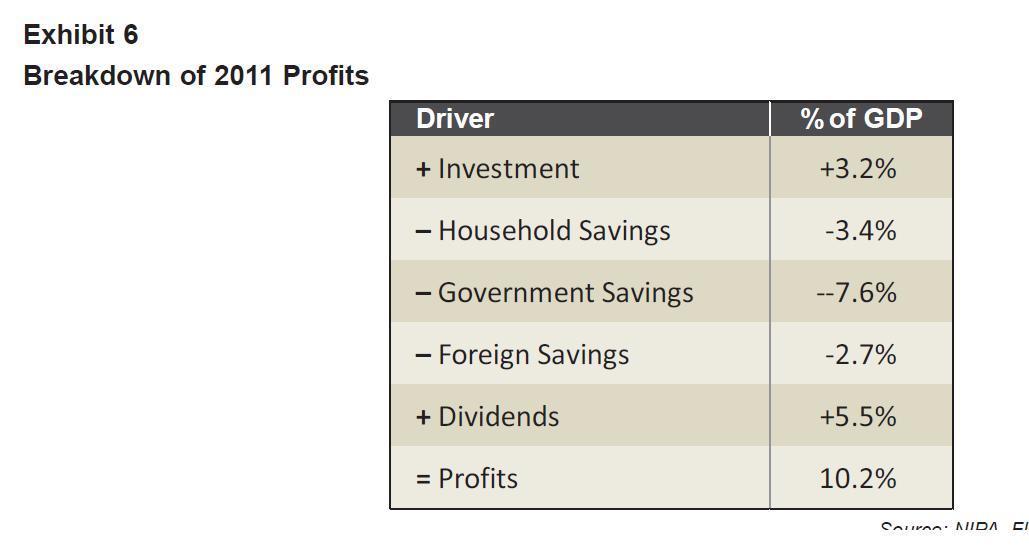
He then continues deriving the sources of profit margins and comes to an interesting conclusion: That the increase in Government spending is the major source of current margins !!!

This is quite interesting. In practice, I think his theory has some minor issues, for instance he implies that US corporate profits are only produced within the US, which for many big companies (Apple, McDonalds) is clearly an oversimplification.

If I look at companies like Volkswagen for instance, a lot of the high margins come from the booming BRIC countries, however also those times will end.

I also find it intersting to think about how his theory works in practice. If one looks at Apple for example, one could clearly see that one part of the high margins are also low production costs in Asia which means lost jobs and higher unemployment (and lower wages) in the US.

However, as the unemployed (and other US citizens) get direct and indirect paymants from the government, in theory this enables them to buy Iphones without having a job. So indirectly the US Government pays for Iphones.

Another point which is missing in Montier’s model are the current low interst rates. Based on average debt ratios, this might add a point or two in corporate profit margins as well.

As always, one has to be careful not to fall into the “confirmation bias” trap, but I find it highly likely that current record profit margins are driven by a unique combination of high Government spending, low interest rates and booming BRIC countries which most likely will not last.

“Risk free” rates and discount rates for DCF models

In the discussion to the Piquadro valuation, I quickly mentioned that the concept of “risk free” rates is a difficult concept at the moment.

Let’s have a quick look at the “academical” world:

CAPM

If we look at the CAPM (no matter if one beliefs this or not) we can see that the risk free rate of return plays an important role there. First, it is the basis return on needs to achieve with any investment, secondly it also influences the equity risk premium.

Risk free rate of return

The definition of the risk free rate itself is quite “fishy”. Investopedia for example states:

Investopedia explains ‘Risk-Free Rate Of Return’
In theory, the risk-free rate is the minimum return an investor expects for any investment because he or she will not accept additional risk unless the potential rate of return is greater than the risk-free rate.

In practice, however, the risk-free rate does not exist because even the safest investments carry a very small amount of risk. Thus, the interest rate on a three-month U.S. Treasury bill is often used as the risk-free rate.

This is of course not really applicable for any serious long term investor. Damodaran has a nice paper about “risk free rates” here.

His major points are as follows:

The first is that there can be no default risk. Essentially, this rules out any security issued by a private firm, since even the largest and safest firms have some measure of default risk. The only securities that have a chance of being risk free are government securities, not because governments are better run than corporations, but because they control the printing of currency. At least in nominal terms, they should be able to fulfill their promises. Even this assumption, straightforward though it might seem, does not always hold up, especially when governments refuse to honor claims made by previous regimes and when they borrow in currencies other than their own.

So this is important: No default risk !!! So it is wrong for instance to use current yields of Italian Govies for valueing Italian stocks, as considerable default risk is embedded in current spreads. The “country” risk could/should be embedded into the equity risk premium, not into the risk free rate. A hypothetical Italian company with 100% of its business in Germany for example, should only get a very small country risk charge if any.

A second point is the following:

There is a second condition that riskless securities need to fulfill that is often forgotten. For an investment to have an actual return equal to its expected return, there can be no reinvestment risk.

In theory, one should discount annual cash flows with the respective annual risk free rates. With a flat yield curve, this is not so important but for steep yield curves the differences can be significant. However in practice Damodaran recommends using the duration of the cash flows of the analysed investment as proxy for the risk free rate. As the best proxy if we don’t want to do this, he recommends the 10 year rate.

For the EUR, he recommends specifically the following:

Since none of these governments technically control the Euro money supply, there is some default risk in all of them. However, the market clearly sees more default risk in the Greek and Portuguese government bonds than it does in the German and French issues. To get a riskfree rate in Euros, we use the lowest of the 10-year government Euro bond rates as the riskfree rate; in October 2008, the German 10-year Euro bond rate of 3.81% would then have been the riskfree rate.

With regards to currencies he says this:

Summarizing, the risk free rate used to come up with expected returns should be measured consistently with the cash flows are measured. Thus, if cash flows are estimated in nominal US dollar terms, the risk free rate will be the US Treasury bond rate. This will remain the case, whether the company being analyzed is a Brazilian, Indian or Russian company. While this may seem illogical, given the higher risk in these countries, the riskfree rate is not the vehicle for conveying concerns about this risk. This also implies that it is not where a project or firm is domiciled that determines the choice of a risk free rate, but the currency in which the cash flows on the project or firm are estimated.

The most common mistake with currencies is usually to use current exchange rates for future cashflows which then results in a preference for projects in countires wiht high nomnal rates.

About Inflation, he is not really clear in my opinion. He argues basically, inflation does not matter because we get the same result if we use yields of inlfation linked bonds combined with inflation adjusted growth rates.

Especially the current situation, where we see negative real yields in many markets, one could argue about his appoach. A negative real yield means for an investor, that the “risk free” nominal asset would have a guaranteed loss in real purchasing power over the investement horizon.

Consider for instance the UK: 10 year gilts run at 2.158% yield, this would be the proxy for the risk free rate. Current inflation runs at 5%, UK 10 year implied inflation from inflation linked bonds is around 3%.

So if I would use the 10 year gilt as proxy as the risk free rate, I woul dalready accept a loss of -1% p.a. in real terms p.a. or almost -3% p.a. based on current inflation rates.

I think this topic might justify even a doctorate thesis, but in my opinion, one could go the following pragamatic way:

Proxy for risk free rate: Higher of 10 year risk free Govie Yield in currency or inflation ).

So in the case of the risk free rate for an Italian company I would compare:

a) 10 year risk free EUR rate = 10 year bunds = 1.89%
b) Inflation: Currently =3.4%

I would the use the higher of the two rates, 3.4 %. This would be a pragmatic way to avoid unnecessary country risk premium and still make sure, the risk free rate does not imply a guaranteed loss in real terms.

« Older Entries Recent Entries »