KAS Bank NV (NL0000362648) – Specialist banking opportunity ?

DISCLAIMER:
This is not meant to be an investment advice. Please do your own work. The author might have bought or sold the stock already prior any discussion. Don’t trust ANYONE with stock tipps or other easy ways to make money.

In general I try to stay away as far as possible from banks. However KAS Bank NV (NL0000362648) might be interesting.

KAS Bank itself describes its business as follows:

KAS BANK N.V. is the independent European specialist in securities services and risk control and reporting services for professional clients in the pensions and securities industry.

KAS BANK pursues a ‘pure play’ strategy, underlining the bank’s absolute neutrality and independence. A low risk profile is integral to its services and is reflected in the quality of its balance sheet and its high solvency ratio.

So this is important why it is technically a “bank” effectively it is a sort of service company with a banking license.

Based on traditional metrics the company looks relatively cheap although technically all the banks are cheap.

MArket Cap: 100 mn EUR
P/B: 0.6
P/S: 0.2
P/E Trailing 10.0
Div. Yield 7.2%

Before diving into the details one should always ask the question: Why might KAS Bank be an interesting investment ? My thesis (which will then have to be tested) is the following:

+ Service based business model should show less volatility than credit based bank models
+ as client base etc. is Netherlands and Germany fundamental fall out from EUR crisis should be low
+ stock price might have been punished by overall issues with banking industry
+ business should be cash generative increased cap. requirements should be not a big problem
+ no risk of dilutive capital increases
+ small market cap and low analyst coverage might further nake stock unattractive

Earnings history & volatility

As a financial stock with mark to market accounting KAS bank doesnt look that good in my “boss” model but this is to be expected for any financial stock with mtm assets and liabilities.

If we look at 5 year figures provided by KAS Bank we can clearly see that the overall results were less stable than I would have assumed:

2007 2008 2009 2010 2011
net asset value 14.19 11.49 13.27 12.83 11.36
basic earnings per share 3.41 -2.7 1.69 1.27 0.7
dividend 2.6 0.45 0.73 0.73 0.5

On the plus side they paid a dividend each year however earnings were quite volatile with a big loss in 2008 caused by impairments.

Looking into the 2008 annual report one quickly sees the following comment:

Impairment losses on loans, including Lehman and one Madoff-related investment, bonds and equities in the available-for-sale portfolio, goodwill and two exceptional charges reduced the net result for 2008 by €58.7 million.

On a gross basis those impairment charges were ~5 EUR per share so quite significant. Further on they give more details on the losses:

As a result of this exercise, the bank has recognised impairment losses on loans and advances totalling €35.3 million (2007: nil). This item is made up of impairment losses on receivables in respect of securities lending positions with Lehmann Brothers Inc as client (€9.6 million) and in respect of an investment indirectly caught up in the serious fraud case involving Bernard L. Madoff Investment Securities LLC (€11.8 million). The rest of
the impairment losses (€13.9 million) relates to loans and advances to clients who are expected to be unable to repay their loans in full and, based on objective evidence, in connection with which the securities provided as collateral have fallen sharply in value.
Available-for-sale investments
The portfolio of available-for-sale investments is made up of shares and bonds and, with regard to both, there is objective evidence of impairment losses of €21.9 million (2007: €1.5 million) and €11.0 million (2007: nil), respectively. The difference between the cost and the current fair value has been transferred from the revaluation reserve to the income statement.
Intangible assets
The deterioration in market conditions has led the bank to make a downward adjustment in the future profit projections for the subsidiary in Germany acquired 1 July 2008, involving the recognition of an impairment loss of €5.2 million in respect of goodwill. This goodwill impairment loss is not allowable against tax.
Other equipment
In connection with the vacating of leased premises in 2007, all the previously capitalised costs of alterations to the building, totalling €3.2 million, were written off.

So all in all it was a combination of different financial crisis related write-offs which caused those impairments. We can clearly see that the business model includes at least some credit risk so its not a “Pure” service function. Going forward I guess the whole industry has learned from the “Lehman moment”.

Business model

At this point it makes sense to look at how the business model of a custodian looks like. Simply speaking a custodian manages the technical aspects of a security portfolio. The custodian executes trades records and receives interest coupons and dividends on behalf of the investor and sometimes offers “add on services” like reporting accounting cash management securities lending programs etc.

Some more background of the custodian business can be found for instance here or for a real deep dive this 100 page + overview of the industry.

In general one could asay that the custodian business is an interesting growing business however it is not clear if specialists or universal banks will profit most. Personally I think that after the crisis a specialist with “untarnished” reputation might have a certain reputation advantage.

In principle one can simplify the custodian business into 2 parts:

1. Transaction and service fees
2. Spread on “float”

The first part is relatively easy and is depending on the size of the administrated portfolios and the frequency of transactions. The second part is more difficult.

Custodians are a typical “float” business. If we look at KAS Bank’s 2011 accounts we can see at first a huge amount of leverage:

We have 5.2 bn EUR of liabilities against only 170 mn equity. However if we look at the funding side we see the following split:

Of the ~5 bn EUR financial liabilities around 0.5 bn are deposits from other banks so called “wholesale” funding. 4.5 bn are from non banks. Of the non-bank money again 0.7 bn are time deposits and 3.8 bn are “demand deposits”.

The non-bank demand deposit is the interesting part. Although this amount is fluctuating significantly a large part of this is “float”. usually every day some of the securities either pay interest dividend or mature. So KAS bank has a constant cash inflow from its client portfolios. Only few clients manage those cash flows on a day-to-day basis. Normally they only act if a certain amount accrues.

Custodian banks sometimes offer interest for those accounts at usually well below market rates. In normal times the custodians than invest those funds into the “normal” money market and earn a nice spread.

However at the moment, with short term interest rates at zero this “spread” is almost zero to. So for custodian banks the “float” part of the business is at its worst point in the cycle. KAS Bank (as many others) even took this further in investing part of the float into a security portfolio which at times can produce some mtm changes as we all know.

Looking at the pure “net interest result” without derivatives we can clearly see that KAS Bank could generate even in 2008 around 30 mn net interest result whereas in 2011 this amount dropped to 20 mn EUR pre tax.

Net commission income at the moment is around ~70 mn EUR this used to be ~90 mn EUR p.a. in the good days.

So we can see that both pillars are at the moment at a depressed status. Another interesting aspect is that custodians scale quite well. More transactions do not require a lot of more expenses if the infrastructure is in place. So if business (and interest rates) pick up profits will increase over proportionally.

Potential “Moat”

Custodian business in principle is a kind of “commodity” business. However there are some significant switching costs associated with changing custodians especially with more complex institutions like pension funds and insurance companies.

Within total costs for managing financial assets custodian fees are a relatively small cost block however in the overall process the custodian is very important.

So many institutions will think twice before changing an existing custodian relationship because any cost advantage will not be very big compared to the potential hassle.

I would call this a “weak” moat.

Current developement:

KAS Bank doesn’t issue quarterly reports only short “trading updates”. The Q1 update was Ok in line with 2011. However they mention a special positive effect of 4 mn EUR:

The half year report is scheduled for end of August in a couple of days

Non-operating result in Q1 2012 comes to €2.0 million and is chiefly attributable to the revaluation of a number of perpetual loans from banks. The proceeds of the planned sale of the shareholding in LCH.Clearnet will contribute €4.3 million net to the result in 2012.

So this seems to be a realization of a “Hidden asset”.

Dividend policy:

The stated dividend policy seems to be quite shareholder friendly:

Dividend policy
In accordance with the dividend policy discussed with the General Meeting of Shareholders, our target is to distribute 60-80% of the net result, where the profit permits and unless prevented by exceptional circumstances.

Shareholders

Interestingly KAS Bank does not have a dominating shareholder. LArge shareholders according to the annual reports are:

5% holdings
The following institutions have given notification of holdings of 5% or more in KAS BANK pursuant to the Financial Supervision Act and the Decree on Disclosure of Control and Major Holdings in Listed Companies.
– Delta Lloyd N.V. 12.2%
– APG Algemene Pensioen Groep N.V. 8.8%
– Delta Deelnemingen Fonds N.V. 8.6%
– ING Groep N.V. 7.9%
– All Capital Holding B.V. 5.3%
– KAS BANK N.V. 5.1%

Historically ING held more than double the current amount and sold down half of their stake in 2007 and 2008.

Some smaller positions are held by funds the only known value investor is Sparinvest with a 0.17% share. However the seem to have a “Poison Pill” in place for unfriendly take overs. So this limits any take over (and short term catalyst) “fantasies to a certain extent.

The stock is followed only by a few Dutch analysts 4 of 5 analysts have a buy rating with target prices between 10-13 EUR per share.

Management:

Management owns smaller positions in the stock and some options but compared to salaries (which ar Ok by the way) stock exposure of management is relatively small.

Balance Sheet quality

Overall balance sheet quality seems to be Ok. intangibles are ~14 mn EUR or less then 10% of equity. Disclosure for the AFS portfolio could be better. They only publish rating categories with the disclaimer

* No sovereign exposure on the PIIGS countries

So there would be some room for improvement.

Valuation

For me KAS bank is one of the few financial institutions where I would see a good “reversion to the mean” opportunity. They currently trade at an approximated “normalised” bottom of the cycle P/E of 7 and P/B of 0.6.

Average EPS over the last 14 years was 1.74. If we assume that conservatively They can achieve the 1.75 at some point in time in the future and a “fair P/E would be 10 then the share could be worth ~17,50 EUR. Average Price/Book over the last 14 years was about 1.2 so this would imply a double on current P/B of 0.6 if things return to “Normal” for KAS Bank.

Looking at the two profit pillars one could come up with the following valuation approach:

1. Pretax income on “float” ~25 mn EUR over a cycle
2. Fee income trading income etc. 100 mn EUR p.a. over a cycle
Minus 100 mn cost would be 25 mn EUR pre tax or ~ 20 mn EUR p.a. post tax of annual profit

Discounted by 10% this would again give us a value around double the current market price.

So from a valuation point of view I would say that KAS Bank should be worth double before any growth and excluding any future catastrophes.

Stock Price

The stock chart looks relatively ugly:

From a momentum point of view one shouldn’t touch the stock. In contrast to most other banks the stock didn’t rebound at all in the past few weeks. This might reflect that KAS Bank has not a lot of PIIGS exposure. Positively one could say that at least based on the last few months the stock price has found a floor at around 7 EUR.

Personally I think that KAS Bank now has reached a “fundamental” floor so in this case i will again ignore stock price “momentum” to a certain extent.

Interestingly, Beta to the AEX is only 0.62, which fits very well into my “low vol” strategy. What is very strange but interesting is the fact that Kas Bank is not really correlated to anything. Just for fun I looked at the 1 year correlations against the Dutch Index the Stoxx Banking index and ING:

SX7E↑ KA INGA AEX
SX7E 1.00 0.27 0.86 0.83
INGA 0.86 0.28 1.00 0.89
AEX 0.83 0.32 0.89 1.00
KA 0.27 1.00 0.28 0.32

Although this is not the most important decision point for me, the low correlation of KAS Bank makes it very attractive from a portfolio risk point of view.

Summary:

KAS Bank for me looks like a very interesting opportunity within the banking sector due to the following reasons:

+ attractive specialist business model (custodian)
+ cheap valuation even based on current “bottom of the cycle” earnings
+ valuation depressed because of overall hostility against banks
+ low or no analyst coverage
+ reversion to the mean speculation a lot less risky than with normal banks as virtually no risk of dilution (even Basel III standards are met by a wide margin)
+ potential upside ~100% over the next 3-5 years plus dividends+ low correlation / beta good portfolio diversifier

For the portfolio I will start as usual with a half position (2.5%) and then decide after the half year report if I want to increase.
New Series: Strange stocks – Part 1: Swiss National Bank (SNB) and Banque National de Belgique (BNB)

Before Nate at Oddball “discovers” all the <2off the radar" European stocks I thought that I start a series about stocks which are in my opinion are strange or uncommon. A little competition in this area might not hurt…

IMPORTANT: Most of those stocks will not be really investments. This is “just for fun” mostly. So if you are looking for “actionable ideas with a catalyst” you might consider skipping this series. If you are however more liek a “stock collector” feel free to read and comment.

In the internet there is often a lively debate about the fact that the US Fed is in principle privately owned. I don’t want to touch this now as this pretty quickly goes into the racist or religious direction.

So lets look at two other National banks. Not many people know that both the Swiss National Bank (ISIN CH0001319265) and the Belgium National Bank (BE0003008019) are both listed stock companies.

Swiss National Bank (ISIN CH0001319265)

The SNB has 100 thsd shares outstanding giving it a market cap of ~100 mn “Swissies”. Not a lot for a bank who can print one of the hardest currencies in the world and is holding 400 bn CHF foreign reserves ? To make things more interesting, the SNB had a profit of 6.5 bn CHF (!!!) in the first 6 month of the year. So ist his a P/E 0.01 investment ?

Not so fast there are some details to consider.

1. Shareholders do not really have rights as most of the normal shareholder’s rights are capped through a special Swiss law

2. The same law also fixes the maximum dividend amount at 15 CHF. Any profit above goes to the Government

So effectively we do have a perpetual Swiss Frank Bond with a yield of around ~1.5 % at current prices, which for CHF is not unattractive.

As the stock basically trades in line with interest rates the long decline in rates actually led to a very nice and steady performance over the last 10-15 years:

For some strange reason a German professor is the largest private shareholder of SNB with almost 5.6% which caused some raised eyebrows in Switzerland. According to the Economist only ~53% are held by Swiss Government entities.

Summary: If you are bullish on the Swissie it could be a good hedge to buy SNB shares. additionally it might be just fun to be shareholder of the Swiss Nationalbank. If you have some spare time the annual meeting might be good entertainment. However it clearly does not fit into my portfolio.

Belgium National Bank (BE0003008019)

The Belgium National bank is also a listed company. Interestingly tiny weak Belgium National Bank has a market cap of 900 mn EUR ~8 times that of “Mighty” SNB. How comes ?

This might have something to do with the following developement of dividends since 1998:

Dvd/share
31.12.1998 58.67
31.12.1999 59.16
29.12.2000 59.87
31.12.2001 61.47
31.12.2002 63.00
31.12.2003 64.13
31.12.2004 65.33
30.12.2005 66.67
29.12.2006 68.47
31.12.2007 70.00
31.12.2008 72.00
31.12.2009 75.00
31.12.2010 126.48
30.12.2011 166.12

So clearly the BNB is paying out a lot more than the SNB having a nice yield of around 6.2%. The “Mechanics” of the dividend are published unfortunately only in Dutch or French.

If I understood correctly the dividend is determined the following way:

1. A guarantee dividend of EUR 1.5 per share
2. Additionally the National Bank reserves a part of the profit which prevents that all profit is distributed to the Government. The yield on this reserve is then distributed to the shareholders.

In the latest shareholder presentation there are some slides regarding this reserves and average yields etc.

I didn’t fully understand the mechanism but it looks like that BNB shareholders were one of the beneficiaries of expanding central bank balance sheets.

Summary: Although i don’t fully understand the mechanism the BNB profit distribution mechanism looks quite interesting. I am not sure if this is an investment right now but something to keep on the radar screen maybe as an alternative to long term bonds with in implicit Financial crisis option. The stock actually would qualify for the “Exotic security” category as well.

Portfolio updates & ManU short

Draeger Genußscheine

After the dramatic increase in the Draeger Genußscheine, the portfolio weight of this position increased to aropund 11%. As 10% is my maximum treshold, I will sell down to 10% of portfolio weight from today on.

Manchester United short

Manchester United is now avaliable to short at Interactive Brokers. Therefore I will start with a 1% portfolio weight short position as of today as discussed in the post.

On the third trading day, the stock showed already a similar pattern to Facebook after the IPO, with the banks supportiung now at 13,40 USD after the IPO price didn’t hold.

Rebalancing: Total Produce, Hornbach, Vetropack

Due to differences in performance and paid out , some of my core holdings dropped significantly below the 5% target thresholds, among others:

– Total Produce (~4.2%(
– Hornbach (~4.5%)
– Vetropack (4.16%)

For those 3 companies, I will add to a full 5% over the next days depending on volume.

DISCLAIMER

By the way, please do not forget that I might own or buy or sell the mentioned securities privatley and read the disclaimer.

Why is Michael Kors (KORS) so succesful ?

In this post I identified Michael Kors as a “Tier 2” luxury stock with a really high valuation which might be an interesting stock to short based on my underlying thesis.

So justa few days later, Michael Kors reported a blow out performance, among oters:

Sales including licensing revenue rose 71 percent to $414.9 million in the first quarter ended June 30, driven by comparable-store sales and shops within department stores, the company said.

Retail net sales rose 76 percent to $215 million in the quarter, driven by a 37 percent increase in sales at stores open for at least a year, or comparable-store sales. The company opened 76 stores from the same period last year and operated 253 retail stores as of June 30.
First-quarter net income more than doubled to $68.6 million, or 34 cents a share, from $24.1 million, or 13 cents a year earlier.

First-quarter net income more than doubled to $68.6 million, or 34 cents a share, from $24.1 million, or 13 cents a year earlier.

So a doubling net income, 76% sales growth and a 37% yoy same store sales growth is really amazing if we look at how other upscale retailers do.

Interestingly enough, Michael Kors is not yet present in Asia, despite having the shares listed in Hongkong.

So the question is clear: Why is Michael Kors so successful (at the moment) ?

I guess one of the reasons is hs involvement in the US “Project Runway” designer casting show as a judge. However, the 10th series seems not to be too successful right now with viewers down 25%.

Kors’ Fashion is often described as the “Jet Set style”, whatever that means. His bio is not without bumps, for instance he went bankrupt in 1993 according to this article.

Michael Kor watches and jewelry are actually made by Fossil, which seems to have its own problems.

But still, why are they so successful ? I browsed around a little bit and among others I found statements

here:

What is the deal with the Michael Kors watch phenomenon? Everywhere I look there’s another small wrist encircled by an oversized gold Kors disc. Beauty PRs and fashion assistants absolutely love them, as do twenty-something city girls. “Girls that work in the city who want a Rolex. They might not know who Michael Kors is but they know they like shiny things,” tweeted @WhistlesPR in reply to my ‘who’s buying all the Kors watches’ tweet. “It’s chunky and looks expensive but it’s waaay cheaper than my dream Rolex! It has that magpie effect on everyone who clocks it,” confirmed @saraheangus.

With prices for Kors watches hovering around the £250 mark, they’re an easy entry-level accessory to buy into if you’re not in a position to spend £600+ on the bag or shoes. Clearly, plenty of people aren’t; according to the New York Times, sales of Kors watches went up 142% in the first quarter of this year. And good news for Mr Kors, his customers don’t just settle for one.

If one googles around, it seem to be really the relatively cheap watches which are extremely popular at the moment.

Balance sheet

Looking in the 2011/2012 annual report one can see that comparable sales growth per store have been 39% last year and even 48% the year before.

A quick check of the annual report showed nothing unusual in the accounts. Free cashflow generated is positive but relatively low due to large investments and the high growth rate. That’s normal. Also, goodwill is low and almost no financial debt.

Operating lease liabilities are around~ 560 mn and increasing due to the new stores.

Summary:

I am not sure why Michael Kors is so successful at the moment. This might be just a consumer fad which according to Jim Chanos might be a good short opportunity. On the other hand, the accounts look OK and currently in a “new normal” world, people pay up for growth.

So for the time being I will sit on the sideline and watch.

Some thoughts on utility stocks (Fortum, EVN)

In my portfolio, I have 2 utility stocks, Fortum OY from Finland and EVN AG from Austria. Both are part of the portfolio since the beginning.

The idea behind those two investments were the following:

1. utility stocks in general looked cheap and relatively save at that point in time
2. both, EVN and Fortum had a large share of non-carbon electricity generation capacity. “Fossil fuel” burners were expected to suffer as they need to pay more for the carbon emissions in the future
3. both companies are located in countries which are not directly impacted from the EUR crisis, so the risk of special taxes etc. should have been low

So far the investment thesis didn’t really work out.

First, the utility index underperformed with -8% the corresponding full index (Stoxx Europe 600) by a whopping 11%.

Second, both EVN and Fortum managed to underperform the utility index. EVN by -3.7%, Fortum by a dramatic 30.4% (including dividends)

If we look at the index constituents, we can see some interesting things:

Perf. 12/2010 –
   
DRAX GROUP PLC 41.2%
NATIONAL GRID PL 37.8%
UNITED UTILITIES 36.1%
SEVERN TRENT 34.5%
PENNON GRP PLC 28.7%
SSE PLC 18.2%
CENTRICA PLC 5.7%
ENAGAS SA -3.5%
RED ELECTRICA -11.6%
SNAM SPA -12.4%
TERNA SPA -12.8%
GAS NATURAL SDG -13.9%
ENEL GREEN POWER -20.7%
EDP -22.6%
E.ON AG -22.8%
GDF SUEZ -27.3%
ENDESA -29.8%
RWE AG -34.2%
ENEL SPA -34.3%
FORTUM OYJ -37.1%
VERBUND AG -42.2%
SUEZ ENVIRONNEME -42.6%
EDF -46.3%
IBERDROLA SA -47.0%
VEOLIA ENVIRONNE -62.8%

Frist thing to notice: “Renewables” really did badly, Mostly Iberdrola, Verbund and Fortum but also Enel Green Power. UK utilities did best. At least peripheral utilities did underperform as well, however French utilities were the worst (EDF, Suez, Veolia).

If we exclude UK and go for “EURO” utilities, the picture looks relatively speaking better, with a total return of -23.82%, this index performed really badly, EVN here (although not in the index) looks like a clear outperformer. Fortum still doesn’t look that good…

Perf. 12/2010-
   
ENAGAS SA -3.45%
RED ELECTRICA -11.56%
SNAM SPA -12.37%
TERNA SPA -12.85%
GAS NATURAL SDG -13.85%
ENEL GREEN POWER -20.37%
EDP -22.64%
E.ON AG -22.93%
GDF SUEZ -27.49%
ENDESA -29.75%
RWE AG -34.24%
ENEL SPA -34.39%
FORTUM OYJ -37.06%
VERBUND AG -42.23%
SUEZ ENVIRONNEME -42.67%
EDF -46.34%
IBERDROLA SA -46.95%
VEOLIA ENVIRONNE -62.76%

So looking back, what happened, especially to Fortum ?

– first of all, the Finish government introduced a special tax for Fortum although they didn’t need to. Bad luck
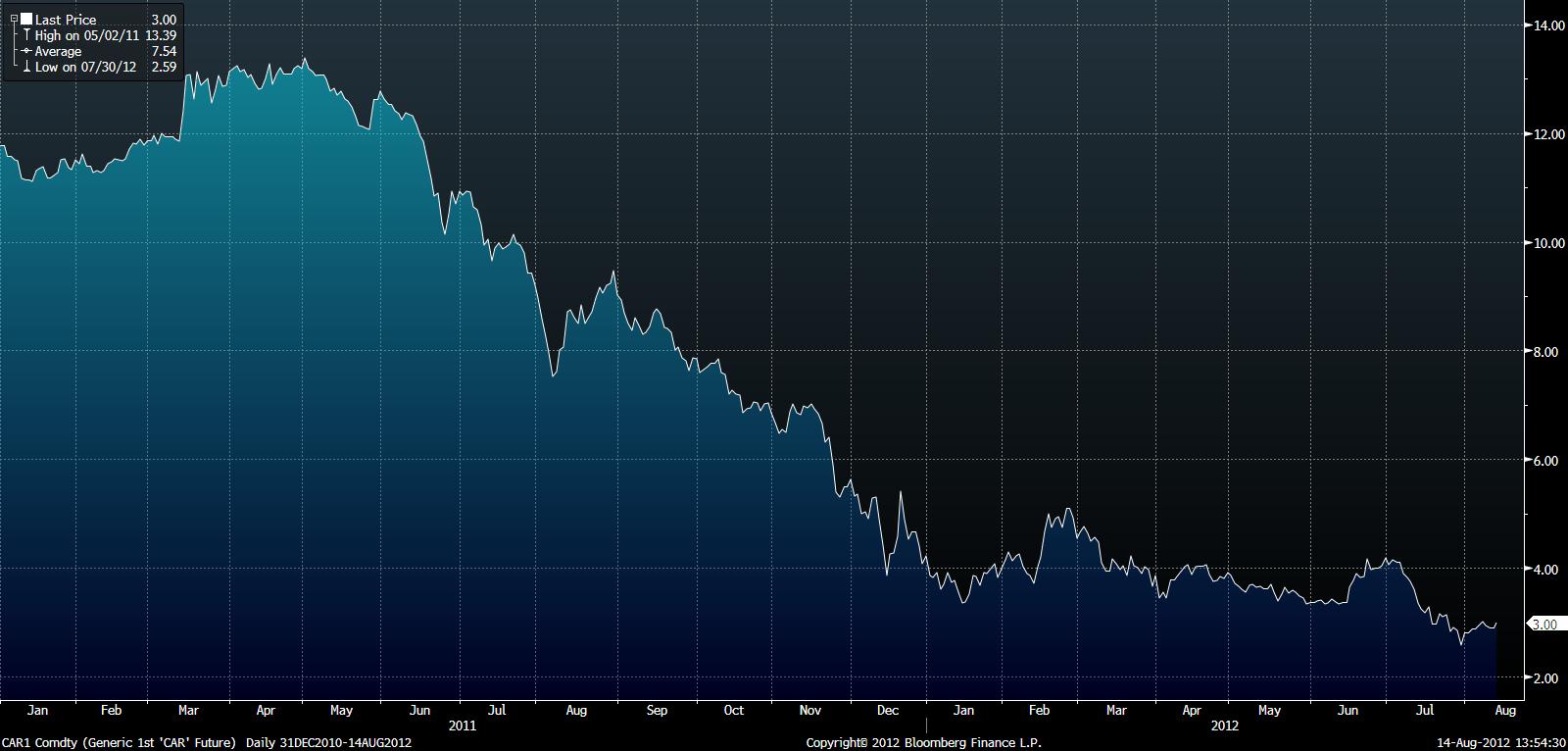
– secondly and more importantly, the price for carbon emission rights fell dramatically. As the following chart shows, CER prices fell a dramatic -75% from mid 2011 until now.

So the “Built in” (and as we know now “priced in”) competitive advantage of renewable power generators against “conventional” generators seems to have narrowed. Interestingly, the big divergence between Index and renewables opened up only in the last few months.

Additionally, the business model of electricity genrators in general seems to have eroded somehow, as it seems to be that they are on the worng side of the current political debates. Maybe not without their own fault.

If we look at the performance numbers above, we can see a second interesting detail:

Gas utilities (apart from the French) and grid operators do a lot better than electricity generators. The top 5 performers are either gas utilities (Enagas, Gas Natural) or Grid operators (Red, Snam, Terna).

A quick look on relative valuation shows that Fortum is still relatively expensive, as well as EVN, although EVN should be treated differently:

Name BEst P/E EV/BE EBITDA Curr Yr  
 
RWE AG 8.11 4.37 6.40%
EDF 8.07 4.80 6.28%
HERA SPA 10.49 5.16 2.12%
ENBW ENERGIE BADEN-WUERTTEMB 15.98 5.54 3.27%
GAS NATURAL SDG SA 7.68 5.67 2.58%
IBERDROLA SA 6.76 6.02 3.45%
GDF SUEZ 12.15 6.10 4.18%
E.ON AG 8.82 6.21 7.19%
REDES ENERGETICAS NACIONAIS 7.29 6.55 10.11%
A2A SPA 6.65 6.75 7.00%
ENAGAS SA 9.28 7.27 7.48%
ROMANDE ENERGIE HOLDING-REG 14.26 7.44 8.93%
ENERGIEDIENST HOLDING AG-REG 15.36 7.91 7.66%
FLUXYS BELGIUM 18.23 8.34 8.95%
FORTUM OYJ 10.16 8.36 6.21%
EVN AG 9.01 8.60 8.44%
SNAM SPA 11.73 8.74 7.75%
VERBUND AG 13.66 8.87 8.29%

So looking back, it was not a good idea to buy the “Carbon story” although I was lucky to a certain extent with EVN. However going forward I still have to find out what I am going to do. At the moment, Gas Natural does look quite attractive.

I think the Carbon Emission Right (CERs) might also be an interesting area to look at.

more to come…..

Boss Score Harvest part 5: – L.D.C. SA (ISIN FR0000053829)

In the fifth part of analysing the results of my Boss Score model, i want to look at the French company L.D.C. SA next.

The reason is not that LDC has the best score, but it is relativley comparable two 3 other companies I have analysed so far, Cranswick and French companies Tipiak & Toupargel.

According to Bloomberg,

L.D.C. SA processes and sells a wide range of specialty poultry products ranging from fresh prepackaged chicken to more elaborate prepared dishes. Those products are sold under brand names including “Loue,” “Bresse,” “Landes” and “Le Gaulois.”

So will French chicken be a good fit to British Pork ? Let’s look at traditional fundamentals:

Market Cap 690 mn EUR
P/E Trailing 12.2
P/B 1.1
P/S 0.2
EV/EBITDA 4.2
Debt/Assets 9.5%
ROE 9.5%
ROC 8.1%
Dividend yield 2.1%

At a first glance, relatively unspectacular. Not overly cheap but not expensive. EV/EBITDA looks attractive, almost no debt is normally a good sign. Market cap a little high but still ok.

What makes the company score quite well in my model is the very constant Comprehensive income yield on equity. This 10 year history:

12M EPS BV/share Div
31.12.2002 4.19 33.50 1.15
31.12.2003 4.11 36.05 1.23
31.12.2004 5.48 42.288 1.15
30.12.2005 5.76 47.4188 1.25
29.12.2006 5.30 51.8404 1.25
31.12.2007 6.63 56.4853 1.25
31.12.2008 5.29 60.7223 1.50
31.12.2009 7.83 67.144 1.30
31.12.2010 5.9 71.1595 1.93
30.12.2011 6.97 75.8072 1.80

creates an average 11.5% CI Yield on Equity with only a 3.2% standard deviation.

Looking at some further metrics we can see that unlike Tipiak and Toupargel, LDC is growling nicely however margins have been eroding somehow since 2009:

Sales p.s. NI margin  
31.12.2002 191.7 2.19% 10.69%
31.12.2003 186.4 2.21% 10.63%
31.12.2004 170.8 3.21% 19.07%
30.12.2005 193.2 2.98% 14.00%
29.12.2006 195.0 2.72% 11.43%
31.12.2007 226.8 2.92% 10.88%
31.12.2008 242.1 2.18% 9.36%
31.12.2009 256.6 3.05% 12.39%
31.12.2010 315.5 1.87% 7.69%
30.12.2011 342.7 2.03% 8.95%
       
avg   2.54% 11.51%

The stock chart shows a very boring but steady developement since 2004:

Beta to the French CAC40 is an incredibly low 0.46. 10 Year performance for the stock is 7.53% p.a. against 4.11 for the CAC

Business model:

Other than Cranswick, LDC is actually producing a significant part of their own poultry as we can read on their website:

Supply
The acquisition of Group Huttepain enabled the LDC Group to become closer to its farmers and make sure that they felt closer to the upstream part of the business. The companies belonging to Group Huttepain operate in cereal collection, feed manufacture and poultry farming (chicken, turkey and duck). This live poultry represents 55% of the group’s entire supply.

So as a first thesis compared to Cranswick I would argue that

– LDC should be more capital intensive
– more exposed to cost pressure (animal feeds)

than Cranswick.

So let’s have a quick look at some capital metrics:

Cranswick LDC
  2010/2011 2011
Sales 758.3 2,774.0
NI 35.3 56.7
NI in % 4.7% 2.0%
 
Inventory 35.7 178.3
Receivables 78.7 343
Trade liabil- -84.9 -308
 
Net WC 29.5 213.3
In % of sales 3.9% 7.7%
 
PPE 123.3 421.6
in % of sales 16.3% 15.2%
Goodwill 127.8 164.1
 
Net WC+ PPE in % of sales 20.2% 22.9%
     
Net WC +PPE+GW in % of sales 37.0% 28.8%


Inventory / Sales 4.7% 6.4%
 
Depr. 12.44 80.9
Depr /Sales 1.6% 2.9%

So we can see that Cranswick is better in working capital management, whereas LDC has slightly less PPE than Cranwick. interestingly, LDC deprecates a lot faster than Cranswick, almost a fifth of their PPE whereas Cranswick deprecates a tenth of PPE.

This faster depreciation explains 1.3 % of the Margin difference.

Some other notable differences are:

– LDC has to spend ~22% of sales on salaries vs. 13% at Cranswick, so LDC’s business model is clearly more labour intensive.

Due to the significant depreciation, LDC’s Cashflow before investments is around 2.3 times net income compared to Cranswick’s 1.2 times. However LDC is investing back all the depreciation plus some into the business. This explains the tripling of sales over the last 10-12 years, however at a decreasing rate of return on capital.

Similar to Cranswick they move strongly into processed and packaged food.

Looking at the English language annual comments, the processed food part seems to be in difficulties (same as Tipiak and Toupargel), whereas the Poultry business itself seems to run quite well. Representing around 20% of sales, the convenience food actually produced a loss.

Unfortunately, they do not publish segment numbers, so we do not know how much capital is used by the convenience segment. However my assumption would be that the “pure” poultry business looks a lot better stand alone and might be comparable to Cranswick’s.

management & Shareholder structure

The company is majority owned by a couple of families, with the executive board recruiting only members form the different families. This is not necessarily bad, but implies that there will be no real change going forward.

Value Shop Sparinvest has a little position as well.

Summary:

LDC SA is a very steady company with a rock solid business model. Unfortunately,the convenience food business seems to be in some kind of trouble. Stand alone, the company looks interesting as a very defensive “Boss” investment, but in comparison to Cranswick it looks like the inferior business.

The company seems to “overinvest” especially looking at the diminishing returns on capital in the past few years.

For the time being, I will not invest but put it on my watch list. If they manage to turn around the convenience segment, I might consider an investment.

Weekly links

In case you need a name for your soon to be founded hedge fund, try the HedgefundNameGenerator

Second part of the Ibersol analysis from Stephan at Simple Value

Well structured analysis of Bank Of Ireland’s H1 results from Philip O’Sullivan. Could be used as a template for other banks as well.

Good overview of the current “craze” for dividend stocks

Deep thoughts from David Merkel about complexity in financial companies. This guy knows his stuff.

Manchester United IPO (MANU) – Prime short target ?

After unseccusfully trying Hongkong and Singapore, ManU Ipoed today on the US stock exchange. The IPO price was significantly below the initial range:

The IPO priced at $14, below the $16-20 range the club’s bankers had been seeking. It valued the 19-times English champions at only $2.3 billion and shaved as much as $100 million off the proceeds expected for the team and its owners.

Of course, the public shares have almost no voring rights and dividends should not be expected.

For anyone interested in stocks and football, the F-1 listing prospectus is really fun reading and should not be missed.

Valuation is relatively difficult to determine, but somewhere in the 20-25 EV/EBITDA range based on 2011 figures. Naturally, Manu has been pumped full with high yielding debt from its P/E owners and has additional “goodies” such as 140 mn USD “purchase obligations” etc.

Interestingly they file under the “Emerging Growth” company rule, which allows corporate governance similar to my beloved Italian highway operators….

A quick look at other listed Football clubs:

By the way, Porto could be bought for only 5 mn EUR…..

Yes, ManU is a great Football club, but they cannot and will not defy gravity. So prime short candidate if borrowing is available. It is not yet oin the Interactive Broker US short list, but as soon as it is there, I wil establish a position.

Bad research example: FT’s John Dizard and the Greek GDP linker

I was quite surprised that my old Greek GDP warrant post got hit a lot in the last few days.

By coincidence I just saw that on Monday, a guy called John Dizard recommended the GDP linker as a “great bet on Greek long-term growth”.

You have to register in order to read the article online, but although its almost a half page in the print FFm supplement, the essence is the following:

– the Argentinian linkers were a great deal
– the Greek linkers are cheap (30 cents)

In my opinion, he makes some plain wrong statements like:

“The Greek GDP warrants could begin to pay out in 2015, based on the country having experienced a minimal recovery by then”

.

As I have mentioned in the post, Greece needs to hit the 2011 nominal GDP (in EUR) by 2014, to get any payout in 2015. In 2012, I think Greece is running at around -7%. So Greek needs nominal increases in GDP by at least north of 3.5% both in 2013 and 2014 to hit this trigger. I am not sure if this could be called a “minimal” recovery.

I am not sure what happens if Greece leaves the EUR, but I would assume that the Linkers would only pay if EUR GDP is triggered, not “new Drachma” GDP.

He then goes on and says the following:

“Right now they trade at about 32 or 33 cents, which means that is what you pay for the possibility of receiving one euro in 2015”.

Again, no points. The 33 cents represent the chance that you get any cash flow over the next 30 years. I am pretty sure that Mr. Dizard never really to bothered reading the prospectus, he will be busy writing his next “analysis”.

Finally he quotes a trader who says “the discount rate on future payments is just to high”. This is of course bullshit as well. Normal “non optional” Greek Government bonds trade at 20% yield p.a. If one discounts the cashlofs without taking the options into account, one ends up with a “bond equivalent” value of 3.28%. So you are paying at 33 cent an option premium” of 10% for the bond equivalent market value which is not cheap in my opinion.

Summary: So maybe it turns out that the Greek linker is a good investment. But if it does, it is certainly not for the reasons this genius has identified. My advice would be for people who want to speculate on Greece’s future to buy the GGBs instead. At 15% of nominal, they have enough “optionality” and upside in the good case. Or you buy shares like OPAP if you want to mitigate the Sovereign default risk. Optionality wherever you look.

Edit: At least the article moved the price up by 10-15% for the linker. This is the advantage of writing for the FT.

Draeger Genußscheine (ISIN DE0005550719) Update

No real news but a very interesting developement at my largest portfolio position, Draeger Genußscheine.

As a refresher: The “Genußscheine” include the right to receive 10 times the dividend of the pref shares (DRW3, ISIN DE0005550636). I started the position as a long Genußschein / Short pref shares “carry trade”. I decided to cover the short when Drager issued a EUR 210 offer and keep the Genußscheine as this put a floor under the price.

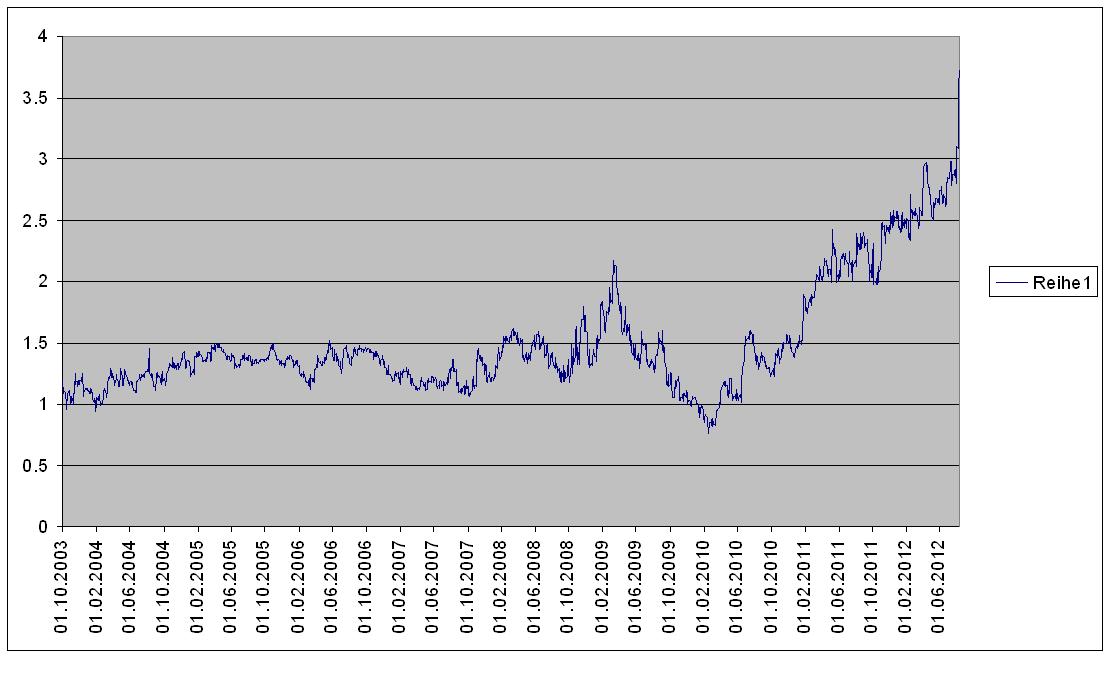
Now, in the last view days one can see something interesting happening: The Pref shares trade lower while the Genußscheine jumped.

If we look at the 10 year history of price of the Genußscheine divided by price of the prefs , we can see that the relation has increased significantly to a 10 year high at currently around 3.7 times.

I didn’t find any real news, however in some internet boards there is a speculation that either Draeger might increase the dividend or even come out with a higher offer. I am not sure about that if they will really do something.

Back then I wrote the following:

For the patient investor, I think the Genußscheine will be still an intersting medium term investment. For the portfolio I will hold them unless I find something better, there is no need to sell.

I think this is the same lesson as from the AIRE KGaA example as well as with the Bertelsmann Genußschein: If someone really wants to have a company or a certain share class / security , it usually pays off to wait and not jump on the first offer.

In the past, I often used to sell at the first offer, being happy to make a nice gain quickly. But as those two example show (so far), the risk /return relationship of just doing nothing and wait further seems to be quite good.

The only “problem” now is that the position is currently 10.2% of the portfolio. a ~10% is kind of the maximum I can stand for a single position, I will have to decide to sell if the Genußschein moves further.

« Older Entries Recent Entries »