My 27 investments for 2016

Over the years I found it quite helpful to list my current investments at the end of each year and try to explain (to myself) the investment case in a few sentences.

Former posts can to be found here:
My 28 investments for 2015
My 24 investments for 2014
My 22 investments for 2013

Compared to last year, Sberbank, Gronlandsbanken, Cranswick, Trilogiq, KAS bank and Energiedienst were sold, the Depfa LT2 matured. New positions bought in 2015 are Aggreko, Partners Fund, Lloyds Banking, Gagfah, Pfandbriefbank and Greenlight Re. With 27 stocks, the portfolio is still maybe a little bit too diversified, my preference would be to have not more than 25 positions. Interestingly, only 5 stocks of the 2013 list are still in the portfolio, so there has been some turn around.

Read more

Greenlight Re (GLRE): Poor man’s Berkshire or interesting bet on a David Einhorn Comeback ?

Management Summary:

Greenlight Re is an interesting special situation in my opinion combining 2 bets in one stock:

1. It is a bet that David Einhorn will come back after his worst year ever and 4 years of underperformance
2. Greenlight Re, the Reinsurance company whose investments he manages “mean reverts” at least closer to its historical price book ratio.

This “bet” should be relatively uncorrelated to the overall market and due to the construction of the investment mandate, Einhorn can charge only half of the performance fee for some time.

Disclaimer: This is not investment advise. DO YOUR OWN RESEARCH !!!

Read more

Some links

Muddy Waters is short Casino and thinks parent Rallye is worth zero. Good that I filtered Rallye out quickly. Last year, Rallye was still presented as a “value investment” (Never buy a story)

The Brooklyn Investor takes a look at Ametech, a stock held by Lou Simpson

A hard value investing lesson from the Oil & Gas sector

The big Fintech bubble already shows some weakness

John Hempton’s (Bronte) somehow sceptical November report

Finally a video of a lecture from “deep value” guru Peter Cundill (2005)

.

Time flies !! 5 years of Value & Opportunity

Almost exactly 5 years ago the first post (still in German) went online.

Those anniversaries are always a good occasion to step back a little bit and reflect what happened and what changed.

Big “Thank you” to all readers !!!

First of all, I want to say “Thank you” to all my readers. Especially for those who comment on a regular basis because this feedback is really important. It is like having a really sophisticated investment committee to which I have to “Pitch” my ideas where any weak point will be highlighted directly. Also a big “thank you” to all readers who send me Emails. Actually I feel more motivated than ever to continue with this “hobby”, so let’s look forward to the next 5 years !!!

Read more

Investment strategy: It’s hard to find the winners but maybe easier to identify (and avoid) losers ?

By coincidence, I read the following posts on the same evening:

Why indexing beats stock picking

39% Of Stocks Have A Negative Lifetime Total Return

Picking winners is hard

The Bloomberg article refers to a paper which can be summarized as follows:

But it is much harder to explain why most active equity managers fail to keep up with the benchmark index, a shortcoming that implies these investment professionals are doing something that systematically leads to underperformance.

The answer, we believe, lies in the fact that the best performing stocks in a broad index perform much better than the other stocks in the index, most of which perform relatively badly. That means average index returns depend heavily on the relatively small set of winners.

Read more

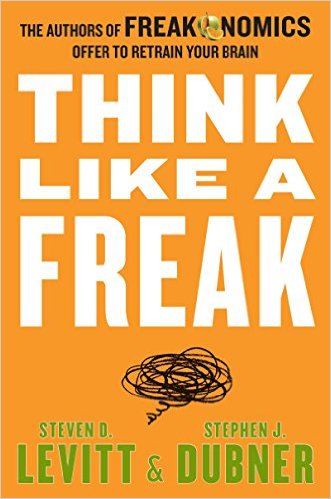
Book review: “Think like a Freak” (Levitt/Dubner)

think like a freak


“Think like a Freak” is not an explicit  finance book. I had read both predecessor books and I liked the original “Freakonomics” a lot, the second book not so much.

For those who haven’t read them: The Freakonomics books look at how every day life and real life problems can be explained by economic variables like incentives etc. often with very surprising and not really obvious connections.

The third book in my opinion is very good. They want to encourage readers to “think like a Freak”. This means among other things, trying not to tackle big problems head on but trying to solve little problems that might then have large effects or do things differently. And mostly the way to solve those problems is very unique.

One example for instance was David Lee Roth (the singer of Van Halen) who was famous for demanding a very detailed list of things for his concerts, among others a bowl of Smarties but without the brown ones.

The reason for this seems not to have been pure vanity but a test if the people organizing the concert halls actually had also read the other stuff, especially with regard to the technical equipment. So the first thing he did when he arrived at any stage was to check the Smarties bowl. If the brown ones were still in, they directly went to checking all the equipment really thoroughly, in order to make sure that everything really worked. If the brown Smarties were out, they just made a standard test and saved a lot of time and effort.

Interestingly, I actually could make a connection to investing when I read the book.

I do think that value investing is actually very similar to “Invest as a freak”. As a value investor, you don’t really care about the big problems like “will the stock market go up or down”, “what will GDP growth be” etc. Rather you concentrate on “small” problems, looking at company by company without caring so much about the “big picture”.

I think it is also important for an investor to develop some kind of “brown Smarties” test similar to David Lee Roth. For me for instance this is the comprehensive income line. If I see something strange there I know I have to be really really carefull when I further analyze the stock.

Anyway, even without making the connection to Value Investing, “Think like a Freak” is a very entertaining book. HIGHLY RECOMMENDED !!!


The “Watch Series”: Hengdeli Group (ISIN KYG450481083) – Chinese market leader in watch retailing

No analysis of Swatch (part 1 and part 2) would be complete without a look at Hong Kong listed company Hengdeli.

Hengdeli claims to be the largest luxury watch retailer in the world and sells mostly in Hong Kong and Mainland China. According to several sources, Hengdeli has a 35% market share in selling Swiss Watches in China, so they are of course important for Swatch. How important they are, shows another fact. According to the 2014 annual report, Hengedeli’s largest supplier is responsible for 71% (!!!) of all watches sold. The two largest suppliers account for 88% of all watches sold.

Read more

Some links

Funny conversation between “legendary raiders” Carl Icahn and Boone Pickens

Red Corner looks at a potential interesting distribution company, Brammer Plc

Good reminder: Turn-arounds rarely turn around (Aeropostale)

Interview with Marathon Investment Management (h/t valueinvestingworld)

Why outdated technologies have such long lives

A good list of investment books from the Aleph Blog. Especially the risk books are rather unusal ones.

Interesting post on Renewable/Green Energy projects and funding costs

The Watch Series: Swatch (UHR.VX) part 2 – Capital allocation, Management & Valuation

It is time to finish the Swatch case. Let’s start with summarizing the first post on Swatch and the post on smart watches:

– I do believe that luxury watches have “staying power” and will not replaced or significantly impacted by smart watches as the main buyers are Emerging Market consumers and collectors
– If we accept that Swatch is in fact a luxury product company, there would be a clear valuation upside compared to other luxury companies
– However the lower range of their products (Swatch, Tissot, Rado, Hamilton etc.) clearly has problems which could become worse over time as the moat here is small to non-existent

So let’s look at some more aspects of how Swatch is run:

Capital allocation:

The company is run like a “family company”, very conservative and “Swiss” and a big contrast to Fossil. As mentioned in my post about the Hayek book, Hayek senior hated banks and Swatch therefore always kept a big cash buffer.

Read more

Romania update: Electrica (great !!). Romgaz (so so) & new Prime Minister

Romania new Prime Minister

A few days ago, following the fatal fire in a Bucharest nightclub, prime minister Ponta surprisingly resigned following massive protests on the streets.

Interestingly, instead of quick new elections, a “technocrat” Government was nominated, lead by a former EU commission member.

He has nominated young and independent experts for the key portfolios of the economy, justice, foreign office and health.

Ciolos selected Anca Paliu Dragu, an economic analyst at the European Commission, to take over the Finance Ministry and Cristina Guseth, chief of Freedom House Romania, as Justice Minister.

On the other hand, experienced diplomat Lazar Comanescu was proposed as Foreign Affairs Minister, while Mihnea Motoc, Romania’s ambassador to Britain, was nominated as Defence Minister.

The Economy Minister will be businessman Costin Borc, and sociologist Vasile Dancu will have the role of Minister of Regional Development.

Political commentators saw the proposed government as pro-reform.

Up until now there was a political deadlock between the newly elected president Johannes and Socialist Ponta.

It reminds me a little bit of Mario Monti’s technocrat government in Italy which came into power after Berlusconi was forced out in 2011. Most of the Italian reforms were made in that short period of time. Before and after, not much has happened there. So from an outside view I would consider this whole episode as a step into the right direction.

Now to my 2 Romanian holdings:

Romgaz

Romgaz released 9 month numbers already some days ago. The good news was that the presentation looks more professional than before, the bad news is that sales and profits went down by slightly more than -10% against 9M 2014. Additionally they had exceptional write-offs on receivables and exploration assets.

Interestingly, margins remained pretty stable, helped by the underlying price increases that will bring the local prices up to market prices over several years.

They also made a regulatory filing which already contains a detailed projection for the 2015 profits and dividends. Based on that projection, the 2015 profit will be 1.032 mn Lei or ~ 2,67 Lei per share, significantly lower than the ~3,60 lei for 2014.  However in my opinion, this sounds worse than it actually is. It seems to be that current Nat Gas consumption in Romania has declined, I honestly don’t know why. But as the local Nat Gas prices at the moment are still very low and supposed to rise, that means that the gas which has stayed in the ground and not sold is getting more valuable. So I think the issue of the lower sales volume has only a limited effect on the value of the company as those reserves then can be sold higher in the future. So my initial valuation of Romgaz from a year ago is still valid.

The share price clearly has suffered but less than other energy stocks. Interestingly, Fondul Propritatea dumped 4% of Romgaz a few days prior to the release which, looking back now seems to have been “very fortunate” for them.

Anyway, for me Romgaz is still in the early phase of the investment period and for me there is no reason to change anything

Electrica

Electrica also released Q3 numbers a couple of days ago. In contrast to Romgaz, Electrica’s numbers were excellent. The 9 month profit is already higher than the total 2015 profit I estimated last year in my initial case. The increase came exclusively from the distribution side which is very positive.

Additionally, Fondul Propritatae seems to have reopened negotiations on the minority stakes in the three operating companies. If Electrica could buy them at a valuation close to their own stock, this could create a lot of value for shareholders.

Overall, I think Electrica is one of my “highest conviction” ideas, the stock is extremely cheap and developing much better than I thought. It might take time until this get reflected in the stock price but I don’t have any reason to hurry.

One interesting detail: One of the supervisory board members had to resign because he became the new energy minister. Maybe this helps a little bit for better relationships with the regulator….


« Older Entries Recent Entries »