Monthly Archives: August 2012

Additional thoughts about Mapfre SA (ISIN

Thursday’s post about Mapfre outlined the general idea behind the investment.

With this post I want to add some more details to the case

Time horizon & type of investment

Just to make it clear: I do not expect a quick solution to the EUR problems. So the time horizon for this investment should be at least 2-3 years (or even 3-5 years). The type of investment is what I would call a “sum of part” value investment with a contrarian aspect for the Spanish business

Insurance valuation

Some investors use “tangible book” as most appropriate vluation basis, for instance Bruce Berkowitz in his AIG case.

In my opinion “tangible book value” is only a very very crude meassure. The big problem with Insurance companies is the fact that not only the value of the assets are hard to value but also liabilities, esp. insurance reserves are by no means “fixed”.

Currently, this is most obvious for life insurance contracts with guarantees, where under normal GAAP, liabilities remain “at cost” whereas assets are marked to market. This had the perverse effect that after the big decline in interest rates, life insurers showed nice profits on their bond holdings, but the liabilities are severly under water. As the “gearing” of reserves to quity in life insurance is usually around 20 times, one can easily calculate how quickly any “tangible book” disappears if reserves would be marked to market.

With insurance, it is a little bit like cable television (and my unsuccessful Kabel Deutschland short): If no one cares (and especially the regulator), you can run the business without “real capital”.

Coming back to “tangible book”: Real mtm tangible book would be a helpful measure, but even industry or company insiders are not able to calculate this. So one should better take accounting tangible book value for insurers with extreme care…..

Spain is not Greece ?

A few quick thoughts: In my opinion, Spain is not Greece because of 3 major structural issues:

A) Spain didn’t have a spending problem before the crisis hit. So their problems are clearly a result of the crisis, not a structural (and maybe cultural) deficiency like in Greece.

B) Again, I would like to link to Ibex Salad which gives a more balanced outside view on what is happening in Spain. In my opinion, especially the developments in regard to exports show that a lot of positive things are happening in SPain below the “surface”. This will take time but it is not so hopeless like in Greece.

c) And one should not forget that Spain is the country with the highest population growth rate in Western Europe (apart from Luxembourg).

Capital increase

As one commentator rightly pointed out, MAPFRE did several right issues in the last few years:

2011: 77.2 mn shares at 2.466
2010. 94.4 mn shares at 2.008
11/2009: 63.63 mn shares at 2.58
03/2009: 124.8 mn shares at 1.41
11/2008 68.6 m shares at 2.21

One could indeed ask why they pay relatively high dividends and in parallel issue new stock. This is surely one of the reasons which negatively impacted the shares in the past. The only “excuse” is that they really managed to grow in this period while many others had to increase capital just to maintain their business.

Overall investment case:

Just in order to illustrate the “drivers” of Mapfre’s valuation a little bit better, I created a quick and dirty valuation metrics to show what impacts I expect both, for the Spanish and the International business:

Spain      
LatAm/Int   bad status quo Good
  bad 1.56 2.08 2.59
  Status quo 2.51 3.03 3.55
  Good 3.44 3.96 4.47

What this should show is that the developement in Spain is less relevant than the international developement. If LatAm continuous to perform well, the MArgin of Safety is quite high, no matter what happens in Spain.

EDIT: For some reason, the price of Mapfre now jumped at over 1,67. So I only got 1/5 of my planned allocation so far. Based on my learning experience with April SA, i will not increase my 1.50 EUR limit.

Weekly links

Collection of Charly Munger’s shareholder letters 1983-2009 (via My investing notebook)

Dark pools and broken markets, the next book on my reading list. Thereafter, I will read that one.

Comprehensive list of great accounting books from the “Grumpies”

Very good commentary on the current status in high yield bond markets

Part 3 of a very comprehensive analysis of the Chinese real estate markets from Chovanec.

Idea generation: Shorting Luxury stocks

This is an idea which I am contemplating for some time.

Coneventional stock market wisdom says: Chinese / Asians love luxury goods, therefore this is the safest bet to buy Luxury stocks who sell to the Chinese consumer.

As a result, many luxury companies had great runs intheir stock price, for instance:

LVMH

Boss

or Ralph Lauren

However up until now, I did not really no where a “catalyst” would come from. So switch to the brilliant John Hampton at Bronte who really nails it down with Richemont, the Swiss luxury group:

Swiss Watch exports have been increasing, as the Chinese really dig expensive watches:

It is the Rococo stuff that is winning. The Federation of the Swiss Watch Industry publish export data from Switzerland (not sales to end consumers). June data shows a 4.1 percent reduction in volume, a 21.7 increase in value. The average price of a watch is going up sharply. This has been the case for years. The Federation published this graph which shows that (relatively accurate) electronic watches have been flat in value for years – but that mechanical movements (inaccurate but reassuringly expensive) have gone skyward:

Although exports to Hong kong are still increasing strongly, sales seem to have stalled:

There are several data sources I watch to keep tabs on spending by Chinese elite. The Swiss Watch data is obvious.

Exports to Hong Kong in June were up 21.2 percent. It was about the same in May (but the monthly data has disappeared from the web). It was about the same every other month this year. They keep upping the exports to Hong Kong.

But Hong Kong also has sales tax data which comes from the sales tax receipts. There is in the data a series for “Jewellery, watches, clocks and valuable gifts” by both value and volume. The value series – relatively flattering, has monthly sales (versus previous corresponding period) for the last six months as:

+18.3%
+14.1%
+18.4%
+15.1%
+2.9%
+3.1%
Sales growth stopped. However exports to Hong Kong kept up (note that 21.2 percent figure above).

John Hempton is not a guy who would short such a share because of date, he needs a real reason and this is the following:

have a theory given to me by a China watcher. The theory – it turned bad sharply with the ouster of Bo Xilai and now the murder charge on his wife Gu Kailai. Gu Kailai is going to have a hard time avoiding a mobile execution unit. This changes the stakes and it is structural. A half million dollar watch no longer says “look at me”. It says “look at me, I am a kleptocrat”. Thoughts of that beautiful Van Cleef and Arpels hair clip become the last thing that runs through your brain before the bullet.

And he can prove his theory with the example Brazil in the 80ties and 90ties:

We know what a completely collapsed luxury good market looks like. Brazilians like a bit of bling. But in the late 1980s and into the 1990s the kidnapping rate in Brazil went skyward. (There is an horrific documentary about that called Manda Bala which translates “send a bullet”.) After kidnapping became a major industry (particularly in São Paulo) carrying a $3000 handbag no longer said “look at me”, it said “kidnap me”.

Two other data points in the recent weeks show that maybe the Chinese consumer might be (for any reason) a little biut more cautious:

– Sales at Sand’s Chinese casinos disappointed strongly

– and even McDonalds announced that same store sales in China fell

For me, such company news are much more reliable than any Chinese Government statistics.

Let’s quickly look at Richemont:

The stock price ist still below its 2008 highs:

The stock doesn’t look so expensive either:

Trailing P/E 16,6
P/B 2.8
P/S 2.9
EV/EBITDA 9

is not that expensive for a stock with a 17% profit margin and 20% ROIC, a very conservative balance sheet with no goodwill and net cash. Even mean reversion would support current levels. 10 year average net margin is 20%, only 10 year average ROIC is “only” around 10%.

A much more interesting short candidate might be Boss.

Boss is more expensive

Trailing P/E 17.3
P/B 11.9
P/S 2.4
EV/EBITDA 11.5

and 10 year avg. profit margin is 8.6% against current 13%.

Still, I would prefer to short luxury shares with aggressive accounting, but I have to dig a little bit deeper for this.

And do not forget: Luxury sales in Europe are bad anyway and as Coach shows, even the US is not “an island” with regard to luxury sales.

Summary:

I guess shorting Luxury stocks might be an interesting idea at some point in time. I wouldn’t short Richemont, as this is really one of the rock solid companies, but other candidates might be more interesting. Preferably with aggressive accounting and US / Europe exposure.

Mapfre SA (ISIN ES0124244E34) – LatAm “pearl” hidden under PIIGS cover?

Mapfre SA is THE Spanish Insurance company.

The stock used to be a “star performer” in the past, but suffered from the PIIGS crisis and is now back at 2009 lows:

As many financial companies based in the PIIGS countries, the stock looks relatively cheap:

Market Cap: 4.6 bn EUR
P/E trailing 5.4
P/B 0.65 (Tangible 2x)
P/S 0.2
Dividend Yield 10.4%

Well known problems include:
– ~50% of the premium income is from Spain (market leader with 20% market share)
– of course large PIIGS exposure (~8 bn EUR in Spanish Govies alone)
– Tangible book still lower then stock price (Tangible book is the main criteria used by many insurance investors like Berkowitz)
– Spain is “toast” anyway (current genreally accepted wisdom)
– Troubled bank Bankia is 15% shareholder of Mapfre (and cooperation partner)
– Mapfre has a majority shareholder, take over is highly unlikely

However if one looks more closely at Mapfre, some very interesting points can be identified:

+ Mapfre is mostly a Property and Casualty insurer, which means that the underlying insurance business is not directly affected from the financial crisis

An interesting fact about motor insurance and crisis: When times are bad, people tend to drive less miles with their car and use public transport more often or stay at home. This means that fewer accidents happen and insurers have to pay less claims. A pretty countercyclical business.”

+ Mapfre has something, most other insures don’t: Strong growth !!! Even in the first 6 months 2012, premiums increased more than 10% yoy, despite decreases in the Spanish home market

+ this leads us to the second point: Mapfre’s Business is increasingly international. In the first 6 months in 2011, the split of Spain/Non-spain was 50/50, it is now 30% Spain and 70% international.

+ Mapfre is market leader or in the top 3 in most Latin american countries, most notable they have 20% market share in Brazil and 10% in Mexico.

+ using market multiples, the Brazilian and Mexican subsidiary could be worth more than Mapfre’s market cap

Margin of Safety ?

The big question for anyone who wants to be a “Value Investor” is the question: Is there a margin of safety, or more precise, if there is a haircut in Spain, will I lose money ?

In my opinion, the possibility to lose money PERMANENTLY is relatively small even in a haircut scenario medium and long term due to the following facts:

1. Mapfre is the Spanish market leader an Insurance regulation is complex. So if Spain would really haircut its bonds, I would assume that the regulation would be adjusted so that Mapfre will not need to use a lot of new capital. So dilution risk is relatively low comapred to banks.

2. In contrast to the banks, an insurer is normally not forced to sell “underwater” assets, as the policy holders cannot easily demand their money back.

3. Even in the case of a capital requirement, Mapfre could sell minority shares in its LatAm subsidiaries to rich locals (Carlos Slim anyone ?) and easily raise money, one needs only to look at EDP from Portugal.

4. Especially in its home market and in its major LatAm operation, Mapfre has a strong “Moat” due to established sales channels and economics of scale

So yes, this will definitely be a very volatile future for Mapfre, but I am pretty sure that they will survive even a Spanish Haircut despite the relatively high “gearing” towards Spanish Sovereign bonds.

One of the short term risks will be that they might cut their very generous dividend at some point in time like Telefonica, but as in the case of Telefonica, this might be already included in the current stock price.

Sum of part Valuation:

I will do this very “quick and dirty”, just to show the potential:

Spanish business:

There is one “pure play” Spanish competitor with a similar business mix, Grupo Catalana Occidente (ISIN ES0116920333). Their comps look as follows:

P/S 0.4
P/B 1.0
P/E trailing 6.4

If we use P/S as the simplest multiple, Mapfre’s domestic business based on 2011 premiums of 7.8 bn EUR would be worth 3.1 bn EUR
International business:

For Brazil, Mexico Chile and Colombia (the most attractive LatAm countries) , I would use a P/S multiple of 1.0, for all the other Lat Ams a multiple of 0.5 which results in 5.9 bn EUR market value of the LatAm ops.

For 2 bn “international” premiums (US, Turkey, Portugal) I would use a 0.4 premium multiple, adding a further 0.8 bn EUR

From the 4.2 bn other international businesses, I would value the attractive Assistance business with a multiple of 1, the rest with a 0.4 multiple. This adds another 2 bn .

This results in a total sum of part value (before liabilities) of 11.8 bn EUR. I have identified around 2.5 bn EUR financial liabilities at a quick glance, so this would result in a business value of 9.3 bn EUR or ~3.20 EUR per share based on current multiples for the Spanish business, without taking into account market leadership etc.

LT2 Bond

As an alternative to the stock, Mapfre has also an interesting LT2 bond outstanding (ISIN ES0224244063). The bond has a 30 NC 10 structure, which means that for the first 10 years since issuance (until 2017) it pays a fixed coupon and then changes into a floating rate.

LT2 means that coupons could be deferred but are cumulative.

The bond has a 5.921% fixed coupon and trades around 60%, which would translate into a 19% yield p.a. if Mapfre calls in 2017. YTM would be 9.4%.

Summary:

MApfre SA is an interesting way to speculate on a Spanish recovery. The long term Margin of Safety comes from the value of the LatAm business which is profitable and still growing strongly. Although it is not likely at the moment, a sale or spin off of the LatAm subsidiaries could unlock the “real” value of the stock.

As the stock will be very volatile going forward, I will “scale in” for the portfolio over the next 10 days up to an 2.5% position (0.25% per day) with a limit of 1.50 EUR per share.

Performance review July 2012 & comments

Portfolio Performance in July 2012 was a positve +1.8%, resulting the YTD performance of 16.9%. The Benchmark performed signficantly better in August with +4.4%, resulting in an YTD performance of 13%.

Bench Portfolio Perf BM Perf. Portf. Portf-BM
2010 6,394 100      
2011 5,510 95.95 -13.8% -4.1% 9.8%
           
Jan 12 5,972 99.27 8.4% 3.5% -4.9%
Feb 12 6,275 105.90 5.1% 6.7% 1.6%
Mrz 12 6,330 107.22 0.9% 1.2% 0.4%
Apr 12 6,168 108.02 0.8% -2.6% -3.3%
Mai 12 5,750 108.90 -6.8% 0.8% 7.5%
Jun 12 5,969 110.17 3.8% 1.2% -2.6%
Jul 12 6,229 112.15 4.4% 1.8% -2.6%
           
YTD 12 6,229 112.15 13.0% 16.9% 3.8%
           
Since inception 6,229 112.15 -2.6% 12.1% 14.7%

This underperformance in such a period is not a surprise, as currently the portfolio carries a 21% cash allocation and many “low beta” stocks which only react very slowly (if at all) to short term market movements. So the “Draghi” effetc which moved the markets was almost not present in the portfolio.

For fun, I added the beta of my stock positions relatively to the respective main country indices in the overview of the portfolio as of July 31st:

Name Weight Perf. Incl. Div Beta
Hornbach Baumarkt 4.8% 4.23% 0.62
Fortum OYJ 3.6% -27.25% 0.77
AS Creation Tapeten 4.0% 3.02% 0.53
BUZZI UNICEM SPA-RSP 4.9% -10.97% 0.97
EVN 2.8% -11.61% 0.63
WMF VZ 4.0% 43.76% 0.60
Tonnellerie Frere Paris 5.1% 15.25% 0.39
Vetropack 4.5% 1.16% 0.85
Total Produce 4.2% 5.43% 0.45
OMV AG 2.2% -11.45% 0.94
Piquadro 1.3% -2.25% 0.63
SIAS 5.8% 14.46% 0.86
Installux 2.9% -4.71% 0.63
Poujoulat 0.7% 3.41% 0.70
Dart Group 2.8% 13.42% 0.71
Cranswick 2.7% 9.43% 0.59
April SA 3.2% 3.05% 0.76
       
Drägerwerk Genüsse D 8.6% 46.40%  
IVG Wandler 2.2% 8.29%  
DEPFA LT2 2015 2.8% 21.02%  
HT1 Funding 4.2% 7.03%  
EMAK SPA 5.1% 16.94% 0.42
DJE Real Estate 0.6% -2.72%  
       
Short: Kabel Deutschland -2.2% -28.24%  


Short: Kabel Deutschland -2.2% -28.24%  
       
Short Ishares FTSE MIB -2.3% 6.43%  
Terminverkauf CHF EUR 0.2% 4.42%  
       
Tagesgeldkonto 2% 21.3%    
       
Summe 97.8%    
       
Value 50.1%    
Opportunity 21.3%    
Short -4.3%    
Cash 21.3%  

I am quite surprised that overall beta is so low, avarage weighted Beta of the stock portfolio is only 0.66. Interesting to see that my “low fundamental volatility” investment style translates into a “low market volatility” portfolio.

Portfolio activity:

As mentioned before, I sold the Praktiker bonds and accepted the AIRE KGaA buyout offer. I did not yet record the proposed cash top up from the buyer, which would add ~0.4% of portfolio performance. I will only record it when cash is in the bank account.

Other than that, I recorded coupon payments for HT1 and dividends for Poujoulat and Hornbach as well as a special payment for the remaining DJE Real estate fund units.

Ongoing “programs” are further small purchases of Installux and Poujoulat as well as sales of the DJE real estate fund. I hope the position will be gone by next month.

Market commentary:

The major event was of course the “Draghi Statement” which moved markets significantly higher after a relatively weak start in July. In my opinion, the main purpose of this statement was to avoid another “summer disaster” when “Club Med” is on holiday and evil hedge funds try to exploit the absence of the Club Med financial sector.

So far it has worked but of course it could be only a “dead cat bounce”. Fundamentally, if one ignores the sensationalist mainstream press, there seem to be encouraging signs especially in the Spanish economy. The excellent “IBEX salad” blog has just pointed out the new Export record for Spain achieved in May 2012. So beneath the real estate and banking mess, the industrial sector seems to improve. So maybe this was then really “just” a normal real estate bubble deflating and not the “greek illness”. So maybe Spain is more Irish then Greek then ?

It is interesting to see that almost all of the US “moMo” stocks seem to be faltering, most recently Chipotle and Starbucks. Unfortunately I did not have the courage to short them. However shorting only on valuation is a quite difficult business and in a “no growth” environment, “real growth” stocks are in very short supply.

Outlook:

After continuously extending my Boss database, I will try to analyse more “BOSS” stocks in the next few weeks. My target would be at least one company per week. Let’s see how that works out.

Market wise I do not have a strong opinion at the moment. Although sentiment is relatively negative, overall stock market levels are not really cheap like the were in 2003 or 2009. As I am not a fan of market timing anyway, I will continue to look for undervalued single stocks and invest without really caring too much about macro events, provided that the business model looks stable enough.

Dart Group – Follow up on fuel hedging and comprehensive income

As proposed in the last Dart Group post, I wanted to take a better look at the impacts on fuel hedging.

Quick summary (or spoiler): During writing the post, I got less and less sure of what to do with the fuel hedges, so the post got very long without a satisfying end. If you are not interested in the process and accounting details, the result is: I am not sure.

Let us start with a “accounting refresher” first.

Accounting for Cash flow hedges

Dart Group uses “cash flow hedges” for their fuel hedges. What does that mean ? Normally, any derivative financial instrument would be considered a “trading instrument” and would have to be marked-to-market directly through P&L.

If a company however wants to hedge a future cashflow (doesn’t matter if in- or outflow) one can apply a technique called “cash flow hedging” which requires basically two things

1) one is able to predict future cashflows with a reasonable accuracy
2) one uses a heging instrument which is “efficient” i.e. tracks the value of the hedged

If one achieves “cash flow hedging” treatment, then the hedge will treated in the balance sheet (under iFRS) the following way:

A) the value changes in the derivatives can be recorded under “OCI” (other comprehensive income)
b) in the future, when the cashflow actually happens, the corresponding hedging gain or loss will then be added or subtracted from the then realised spot price

This is what Dart Group is doing with its fuel hedging and as Wexboy commented fully aligned with accounting standards.

However my argument was that you shouldn’t ignore those movements in OCI but try to understand them and make adjustments if necessary. In order to understand this better, we have unfortunately step beck a little bit and ask the following question:

What is a hedge anyway and when is a hedge a speculation ?

In the case of Dart and airlines in general, this question is quite difficult to answer. In an ideal world as a company, you would like to pass on all your changes in costs directly to your customers and just earn a fixed fee on your products. As we all know, prices on tickets are relatively volatile, however many clients prefer to fix a price well before they start a trip in order to be able to control their budget.

An airline could also, if they were really really good speculators, create a big competitive advantage if they for example could hedge their fuel at low prices while the competitors have to buy much more expensive fuel on the spot markets if prices are rising. However, this is clearly speculation, not hedging as it could go the other way as well.

accounting wise however, one does not distinguish between “economic” hedging and what I call speculation.

So let’s look at Dart Group.

First step: READ THE ANNUAL REPORT

Before one starts to speculate how and what Dart is hedging, it makes sense to look at the annual report to find out what they are actually saying.

On Page 21 of the 2011 report they give us the following information:

2011 2010
Average hedged Price per ton $ 870 786
Percentage of estimated annual fuel requirement hedged for the next financial year 91% 90%

So we know now, that they have hedged ~90% of ALL fuel requirements according to this and we know the price.-

On page 67 we can look at fuel costs (in GBP):

2011 2010
Fuel Cost 122.8 95.3

On page 57 we can see the fair values of the fuel hedges, both an the asset and liability side:

2011 2010
Fair value Assets Forward jet fuel contracts 55.9 16.4
Fair value Liabilities Forward jet fuel contracts -17.8 -8.7
 
calc net Fair Value 38.1 7.7
Delta yoy 30.4

On page 58 we can see that in 2011, none of the fair value movements have been recorded in equity, we can also look at the total fair value movement of the ALL hedges (including currency) which were

2011 2010
Fair value Assets all hedges 59.4 21.7
Fair value Liabilities Forwardalll hedges -24.7 -9.7
     
calc net Fair Vlaue 34.7 12
Delta yoy 22.7

So basically, fuel hedges increased by ~ 30 mn GBP in vALue, FX hedges lost ~ 8 mn GBP

On page 61 they give us another interesting piece of information:

2011 2010
Impact on Profit and Loss 10% change in jet fuel prices 3.8 0.8
2011 2010
     
Profit for the year 17.3 15.6
Exchange differences on translating foreign operations 0 0
Effective portion of fair value movements in cash flow hedges 23 10.6
Net change in fair value of effective cash flow hedges transferred to profit -1.8 0.1
Taxation on components of other comprehensive income -5.2 -3
Other comprehensive income and expense for the period, net of taxation 16 7.7
Total comprehensive income for the period all attributable to owners of the parent 33.3 23.3

One important final piece of information:

Prepayments or “deferred income” stood a 177 mn GBP against trailing sales of 540 mn GBP.

So how to interpret those numbers ?

A) as the hedges seem to qualify almost completely as “cashflow hedge”, we can assume that they use “traditional hedges” like forwards or (tight) collars to hedge

B) IMPORTANT: Dart Group “hedges” 90% of next years fuel prices, but only 177/540 = 32% of (trailing) sales are prepaid. So one could argue that in order to “truly” hedge, Dart should only hedge a third of next year’s fuel consumption as for the rest, the final sale price of the tickets is still variable.

If the competitors don’t hedge, than Dart would have locked in potentially different fuel prices than the competition for 60% of next years fuel consumption and therefore run the risk of being uncompetitive if fuel prices fall.

So coming back to the initial question: What are we going to do with the change in value in OCI for dart Group ?

I have to say I am not sure anymore. I am oK with “ignoring” the part that is covered by deferred income but I honestly don’t know what to do with the part which is “speculation”.

I have quickly checked Ryanair’s latest statements and Easyjets last annual report.

While Ryanair similar to Dart seems to hedge 90% of next years fuel cost, Easyjet only hedges 65-85% of next years fuel charges and 45-65% of the costs in 2 years time.

Ryanair interestingly said that increasing fuel prices were responsible for a 29% profit decline. That sounds strange as they were supposed to be 90% hedged. Interestingly, fuel prices for Jet fuel decreased strongly in Q2, so the problem for Ryanair seem to have been locking in high fuel costs whereas some competitors were able to buy cheaper fuel in the spot market and compete better on ticket prices.

Bloomberg even compiles hedging ratios across companies:

Jet Fuel Hedging Positions for Europe-Based Airlines (Table)
2012-07-30 07:46:25.103 GMT

(Updates with Ryanair.)

By Rupert Rowling
July 30 (Bloomberg) — The following table shows the amount
of jet fuel consumption hedged by European airlines to guard
against price fluctuations.
Data is compiled mainly from company statements and is
updated as it becomes available. Hedges are for prices per
metric ton of jet fuel, unless otherwise stated.

*T
Company/ Percent Hedging Period Price
Disclosure Date Hedged
————— —— ————– —–

Ryanair Holdings Plc
7/30/12 90% July to Sept. 2012 $840
7/30/12 90% Oct. to Dec. 2012 $990
7/30/12 90% Jan. to March 2013 $998
7/30/12 90% April to June 2013 $985
7/30/12 90% July to Sept. 2013 $1,025
7/30/12 90% Oct. to Dec. 2013 $1,005
7/30/12 90% 2013 $1,000
7/30/12 50% Jan. to June 2014 $940

EasyJet Plc
7/25/12 85% Three Months to Sept. 2012 $983
7/25/12 79% Year to Sept. 2012 $964
7/25/12 77% Year to Sept. 2013 $985

Air Berlin Plc
5/15/12 82% April to June 2012 Not Given
5/15/12 92% July to Sept. 2012 Not Given
5/15/12 61% Oct. to Dec. 2012 Not Given

International Consolidated Airlines Group SA*
5/11/12 80% April to June 2012 Not Given
5/11/12 69% July to Sept. 2012 Not Given
5/11/12 55% Oct. to Dec. 2012 Not Given
5/11/12 55% 12-month forward Not Given

Vueling Airlines SA
5/10/12 76% 2012 $1,023
5/10/12 71% April to June 2012 $1,008
5/10/12 83% July to Sept. 2012 $1,035
5/10/12 74% Oct. to Dec. 2012 $1,042
5/10/12 28% 2013 $1,027

Air France-KLM Group
5/4/12 60% April to June 2012 $1,081
5/4/12 53% July to Sept. 2012 $1,081
5/4/12 50% Oct. to Dec. 2012 $1,078

SAS Group
5/3/12 50% April to June 2012 Not Given
5/3/12 49% July to Sept. 2012 Not Given
5/3/12 48% Oct. to Dec. 2012 Not Given
5/3/12 50% Jan. to March 2013 Not Given

Aer Lingus Group Plc**
3/29/12 62% 2012 $972
3/29/12 7% 2013 $991

Deutsche Lufthansa AG
3/15/12 74% 2012 $107/barrel
(Brent crude)

NOTES:
*Hedging breakeven for 2012 at $1,003 a ton, according to May 11
presentation.
**Aer Lingus figures as of Dec. 31

Summary:

To be honest, I am not sure what to do with the fair value movements in OCI. To simply ignore them and assume mean reversion would be very naive. The extent of the movements is just too large. However the impact of the fuel hedging is difficult to estimate as it depends on the behaviour of the competitors.

In general, a positive movement in fair value should be positive for the company and vice versa. nevertheless, the whole fuel hedging issue exposes Dart to quite substantial business risk, especially for the part which is not covered by deferred income.

However, this exercise made it clear to me that running airlines is a quite difficult business, especially in times of volatile fuel prices.

For the time being, I will stick with my half position and try to learn more about it.

One technical remark with regard to hedging:

In the “good old times”, fuel hedging could be done without cash collateral. A bank would happily “step in between” the airline and the futures market and only require cash at settlement of the contract.

As one of the consequences of the finanical crisis, every bank now requires cash collateral on a short term basis from the airlines for the fuel hedging contracts. For the airlines this means a significant increase in reuqired working capital. Lufthansa et al are lobbying strongly against this, but especially for smaller carriers this is a problem.

As a proxy I would use 25% of the notional as working capital requirement for fuel hedges. For Dart this would mean that 25% of around 150 mn GP or 40 mn GBP of Dart’s liquidity should be considered as “locked” for fuel hedging cash collateral.

Quick check: KHD Humboldt Wedag (ISIN DE0006578008)

Several readers already mentioned KHD Humboldt Wedag as a potential “special situation” investment, so it might make sense to quickly check it out.

KHD Humboldt Wedag

KHD is planning and constructing cement plants world wide. The company has a quite interesting past. It used to be part of the big “Deutz” Group of companies but was sold.

In the meantime, the company has been taken over and then spun off again in some sort of form. The mastermind behing those transactions is financier Michael J. Smith. This guy himself seems to be a very interesting investor himself as this Seekingalpha post shows.

There is a very good Thread on Wallstreet Online covering the history of the company for the last 7 years or so.

The business itself is highly cyclical. If I look at how cement companies themselves are struggeling to even earn a small profit because of a large over capacity in the indutry, I am not sure how many new cement plants will be actually built in the coming years. Sales dropped 50% from 2009 to 2011. One could describe this as “extremely late cyclical”.

KHD is since a long time a favourit among “net net “investors as they carry a large cash balance on their balance sheet. However, cashflows are extremely volatile.In 2011, operating cashflow was around -80 mn EUR.

Again in Q1 2012 the comapny showed shrinking sales and a large net cash outflow of around -20 mn EUR reulting in a loss for the first quarter, although the orderbook seems to have improved. I have however no idea how the orderbook actually transforms into sales and profits.

In early 2011, KHD executed a capital increase for around 20% of the company to bring on board a Chinese company. At least for me it was not clear why they did it. Officially they said to increase their “footprint” in China. if one looks at the order intake in 2011, this cooperation didn’t really show any results, at least not in the line for China.

Some weeks, Paul Desmarais, the guy behind the “Canandian Berkshire” Power Cooperation has revealed a 3% position. Another activist investor, Sterling Strategic Value is on board with 12%.

In the invitation to the annual shareholders meeting, Michael J Smith was proposed to enter the supervisory board as the boss. Although the first news seems to be interesting, the second part, MJS returning might not be the best news for the uninformed minority investor.

Just a few day’s ago, the annual shareholder’s meeting was postponed due to “technical reasons”, although some investoirs seem to have received a surprise dividend therafter.

For me, KHD at the moment is something I would not invest into due to the following reason:
– I have no idea about the goals of the parties involved (MJS, Chinese guys).
– the business is extremely cyclical and at the moment fully depending on Emerging markets
– I have no idea how much of the cash is really “free” and what is needed to finance new projects
– I would rather prefer to buy cheap cement companies, because they will proft earlier from a revival in cement sales
– I do not have any (good) experience with activist campaigns, I am not sure that I have the nerves for that

Overall, I do not think that I can gain any “edge” in this situation and it is clearly outside my core competencies. In such cases I will rather pass however it might be a good learning experience following the further “proceedings” from the outside.

For the record, some special situations which I try to avoid:

– merger arbitrage (to many pros)
– distressed debt (complex, dirty stuff going on)
– activist campaigns (insider)

Wexboy’s Summer Challenge – send him your favourite stock idea

Very good idea from the excellent Wexboy blog:

Send your favourite idea to him and he will analyse the stock and post it on his blog. Only very few “restrictions” apply:

– Should be accessible to the average reader – basically any company (or fund) listed on a developed market exchange (doesn’t exclude emerging market stocks if they’re listed in London/NYC, for example)

– Favourite‘s a flexible idea – might be the latest stock you bought, the most interesting/unusual, the cheapest, the least risky, the stock with the most upside potential, etc…

– You should have some skin in the game – please disclose what % of your portfolio is in this stock

– Stocks that can be bought & held for a few years are definitely preferable – so no ‘quick trades‘, or (specifically) event-driven ideas

I will be doing my own review/valuation of all stocks submitted. Remember, like most readers, I’m interested in great investments, not speculations… And I use a value perspective. This is not to suggest that I’m averse to a good growth story – I love ‘em, I just don’t want to pay too much for them!

I hesitate to call any stock in my portfolio as best idea, nevertheless I will participate with German DIY chain Hornbach Baumarkt AG (ISISN DE0006084403). Although I have analysed the stock extensively in German language, I was always to lazy to wwrte a detailed analysis in English. Maybe Wexboy will do that for me 😉

Some highligts of Hornbach:

+ honest, long term oriented management (majority family owned) with clear strategy
+ conservative balance sheet, replacement value significantly above book value
+ still cheap (P/B 0.96, PE 10)
+ only limited impact of internet on business model
+ special short/medium term growth opportunity if largest competitor Praktiker defaults
+ 5% weighting in my model portfolio (max. allowed before price appriciation, similar in private portfolio)

Some reasons why stock is cheap:

– complicated legal structure (both, holding and operating company are listed)
– low liquidity, low or almost no analyst coverage
– very competitive business
– no short term catalysts

As Wexboy wants as many ideas as possible, I would highly recommend all readers to send their proposals to him.

A few thoughts on Free Cash Flow (and how easy it is to arbitrage this number)

For many Value Investors, “Free Cashflow” has become the most important “mantra” in order to decide if a stock is attractive or not. Especially in the area of technology stocks (Dell, Microsoft, Cisco, HP), the stated large free cashflows are or were the the major arguments from some investors why the invested in those stocks.

A few examples:

Dell: In February, David Einhorn disclosed a stake in DELL (which however he just sold again…), Katsenelson is a big fan of Xerox because of its large free cash flow and of course many many value investors love Cisco and Microsoft.

Let us quickly look at how Free Cashflow is defined (from investopedia):

Definition of ‘Free Cash Flow – FCF’
A measure of financial performance calculated as operating cash flow minus capital expenditures. Free cash flow (FCF) represents the cash that a company is able to generate after laying out the money required to maintain or expand its asset base. Free cash flow is important because it allows a company to pursue opportunities that enhance shareholder value. Without cash, it’s tough to develop new products, make acquisitions, pay dividends and reduce debt. FCF is calculated as:

EBIT(1-Tax Rate) + Depreciation & Amortization – Change in Net Working Capital – Capital Expenditure

It is important to notice that “Capital expenditure” only includes “direct” expenditure, like actually buying machinery etc.

Investopedia adds a pretty important point:

It is important to note that negative free cash flow is not bad in itself. If free cash flow is negative, it could be a sign that a company is making large investments. If these investments earn a high return, the strategy has the potential to pay off in the long

I think this is a point, many market pundits tend to ignore, but more on that later.

An even more important point is not mentioned in this definition: Free Cashflow does not include cash outflows for M&A activity

So let’s look at a simple example for a model company:

Base case:

EUR
EBIT (1-tax rate) 10
Depr 5
Change WC -1
Capex -3
   
   
Free Cashflow 11
   
   
Financing cashflow 0
 
 
Total cashflow 11

So our company shows a free cashflow of 11 EUR in this period and a similar total cashflow.

Case 1: Old School – Buying a new machine at year end with a loan for 15 EUR (I use year end in order not to “disturb” depreciation etc.)

We get the following result:

EUR
EBIT (1-tax rate) 10
Depr 5
Change WC -1
Capex -3
Machinery -15
 
Free Cashflow -4
 
Loan 15
Financing cashflow 15
 
 
Total cashflow 11

Aarrrg, negative free cashflow many investors would say, negative free cashflow, stay away from this stock !!!!

So a clever company might do one of the 2 following things:

Case 2: Classic FCF arbitrage: Operating leasing

In this case the company enters into an “Operating lease” contract at year end. The machine gets delivered as in a direct contract, but if the contract is structured correctly, neither capex nor loan show up in the balance sheet in that year (only the lease payments in subsequent periods)

EUR
EBIT (1-tax rate) 10
Depr 5
Change WC -1
Capex -3
Machinery 0
   
Free Cashflow 11
   
Loan 0
Financing cashflow 0
   
   
Total cashflow 11
 
Off balance sheet  
– machinery 15
– operating leasing liability -15

On a reported free cash flow basis, without adjustment, going forward, the company will look quite asset and capital efficient. However, this kind of FCF “arbitrage” will end under IFRS when operating leases will become “on balance”.

Case 3: M&A transaction

Now consider the following: For some unknown reason, one competitor is currently selling a subsidiary which only owns the brand new machine we wanted to buy and nothing else. The competitor is selling the company for the same price as the machine. Again we finance this through a loan.

The simplified CF statement looks the following:

EUR
EBIT (1-tax rate) 10
Depr 5
Change WC -1
Capex -3
Machinery 0
   
Free Cashflow 11
   
Acquisition -15
Loan 15
Financing cashflow 15
   
   
Total cashflow 11
   
Off balance sheet  
– machinery 0
– operating leasing liability 0

So “Heureka”, we have the machine on balance without impacting the Free cashflow and everyone is happy.

To be honest, this example is somehow unrealistic, but on the other hand this is exactly what is happening with many technology firms at the moment. Those companies show high free cashflow because they don’t spend a lot on investments but acquire new technologies vie M&A transactions.

If they would build this on their own, the cost would run negatively through free cashflow in contrast to the M&A expense.

There is a good post at Seeking Alpha which shows free cashflows over the last 5 years for 6 tech companies (RIMM, MSFT,DELL, NOK, AAPL, HPQ) without and including acquisitions.

For companies with a clearly declining core business like DELL and NOK, those M&A cash outs definitley have to be treated as mainenance Capex, but to be on the safe side, M&A for tech companies and pharmaceuticals should always be included in free cashflow.

This is exactly the reason why Jim Chanos has identified Hewlett Packard as the ulitmate Value Trap despite a trailing 25% FCF yield at current prices. HPQ acquisitions are not “growth investments” but “maintenance Capex” to counter their declining core business or to say it differently: The current reported “free cashflows” are more like liquidation cash flows.

Summary:

– Free cash flow can be a good indicator for the value of a company
– however one should be aware that there are many ways to “arbitrage” free cash flow
– I have only shown a few of them relating to investments but many others exist
– one should be especailly carefull to use FCF for companies which do a lot of acquisitions or use Operating leases extensively
– calculating free cash flow after acquisitions and changes in operating leases is a crude but good way to identify “problematic” companies
– some companies might be very good investments despite negative Free Cash Flows because they have good investment opportunities and finacne “conservatively”
– it will be interesting to see with what the financial industry will come up if Operating leases will come “on balance”. I have seen already attempts to structure leases as payables…..

Why comprehensive income matters – Dart Group Plc

I have mentioned a couple of times that in my opinion, the so-called “comprehensive income” is a much better indicator for shareholder wealth created than net income or earnings per share.

In my experience, almost no one cares to look at what happens after the net income line. Usually, comprehensive income is stated on a separate page anyway.

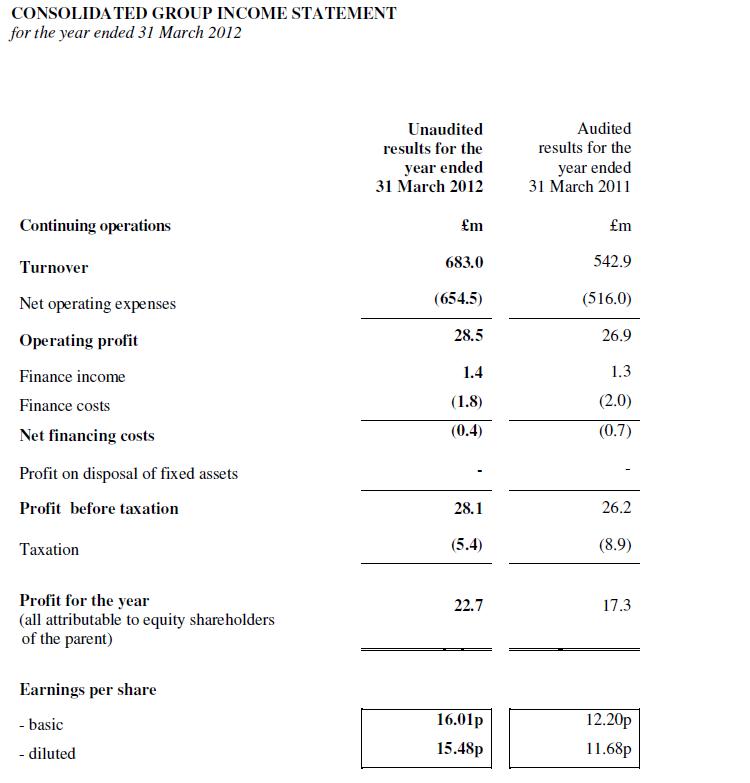
A good example to turn this into an interesting practical exercise is the most recent preliminary annual report from Dart Group, one of my Portfolio holdings

The first thought is of course “Yippie yeah”, a really significant earnings increase, P&E of 4 etc etc.

Richard Beddard at the excellent Interactive Investor blog even says the following:

The highest earnings yield ever calculated by the Human Screen is 35%. It’s so high, he’s wondering if air line and road-haulier Dart has bust his value yard-stick.

Highlights

Adjusted operating profit up 9%
Adjusted return on tangible assets: 4%
Net profit of £23m compared to net cash flow of £95m (£48m after net capital expenditure)
Net cash after approximate capitalised lease obligations of £125m is £34m, 5% of tangible assets
Per-share dividend up 7%

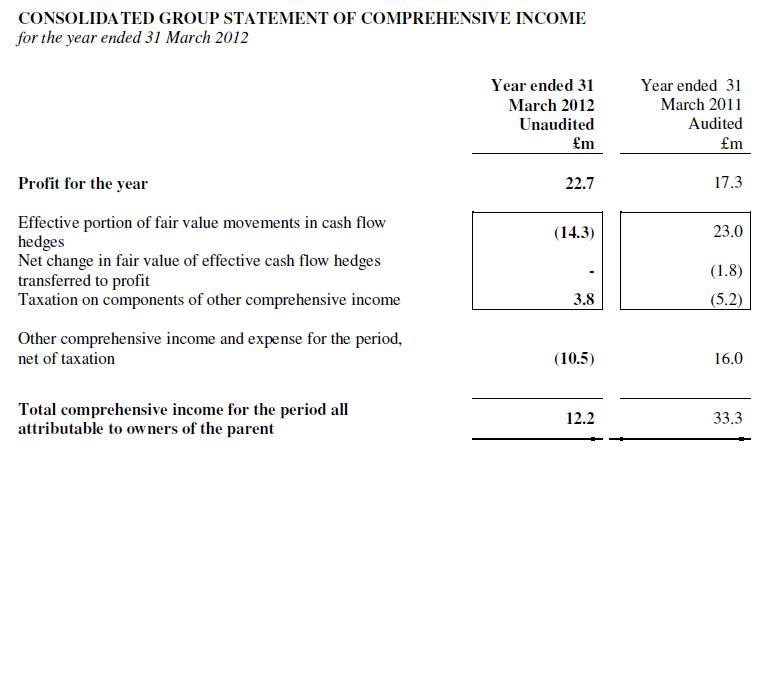
Not so fast. I guess that Richard stopped at page 9 of the interim report and didn’t bother to read that strange stuff at page 10 which looks as follows:

So we have additional items which significantly decreased shareholders equity but didn’t need to be recorded in normal earnings but comprehensive income. In this case we are looking at fuel hedges.

Items which can be recorded in comprehensive income are:

– Unrealized holding gains and losses on available for sale securities ( a trick often used by banks and other financials)

– Effective portion of gain or loss on derivative instruments (cash-flow hedge);

– Foreign currency translation adjustments (i.e. change in value of a foreign subsidiaries net asset value)

– Minimum pension liability adjustments.

Normally people would argue that those items are “non operating” and therefore not or less relevant. However, as it affects shareholder value, in my opinion it is very important to look at those item to determine real value creation for the shareholder.

Coming back to Dart Group: The fuel hedging is an essential part of the business model. Fuel costs are around 20% of sales and cannot be passed directly too customers, especially for the prepaid part. I will have a separate post on how to interpret the fuel hedges but for now the important point is:

The result of the fuel hedges should be treated as part of the normal business of Dart Group.

Therefore real 2011/2012 earnings for Dart are rather around 9 pence per share and not the 16 pence recorded in the income statement. Still cheap (PE of 9) but not “busting any value yardstick”.

Summary:

Any value investor interested in the total value creation of a company for shareholders should include all items of the comprehensive income statement into his valuation. Many companies are very good in shifting all unpleasant stuff into this section. Especially for financial companies, recorded earnings are more or less meaningless without the items in comprehensive income. Also fuel hedges for airlines or other fuel cost eexposed companies should be viewed as relevant.

« Older Entries Recent Entries »