Category Archives: English

Not aMUSEd: The UK “Portal Pain Basket” (Mony Group, Autotrader & Rightmove)

Disclaimer: This is not investment advice. PLEASE DO YOUR OWN RESEARCH

I actually started to write this post before the newest hype about “Muse”, the new AI Agent from META, really went mainstream. I decided to leave the old part and then update it instead of completely changing it.

As my DCC investment ends its “natural life” and I have begun to unwind it, I decided to have a look at a group of beaten up UK stocks that one could summarize as “Comparison portals” or “Two sided online market places”: : Mony Group (Insurance), Autotrader (cars) and Rightmove (real estate).

As the post became quite long, I also picked a track to keep you entertained while your LLM assistant is summarizing the post for you:

Green Day – Basket Case

Green Day – Basket Case [Official Music Video] (4K Upgrade)

Here a quick summary for each company: 

Mony Group SE

Mony Group, the former Moneysupermarket Group is a UK focused comparison portal where people go to compare quotes for Insurance policies, loans, broadband tariffs, electricity contracts. in addition they offer a referral shopping app/system that offers Cashbacks (discounts).

This is from the 6M Investor presentation with the distribution of sales::
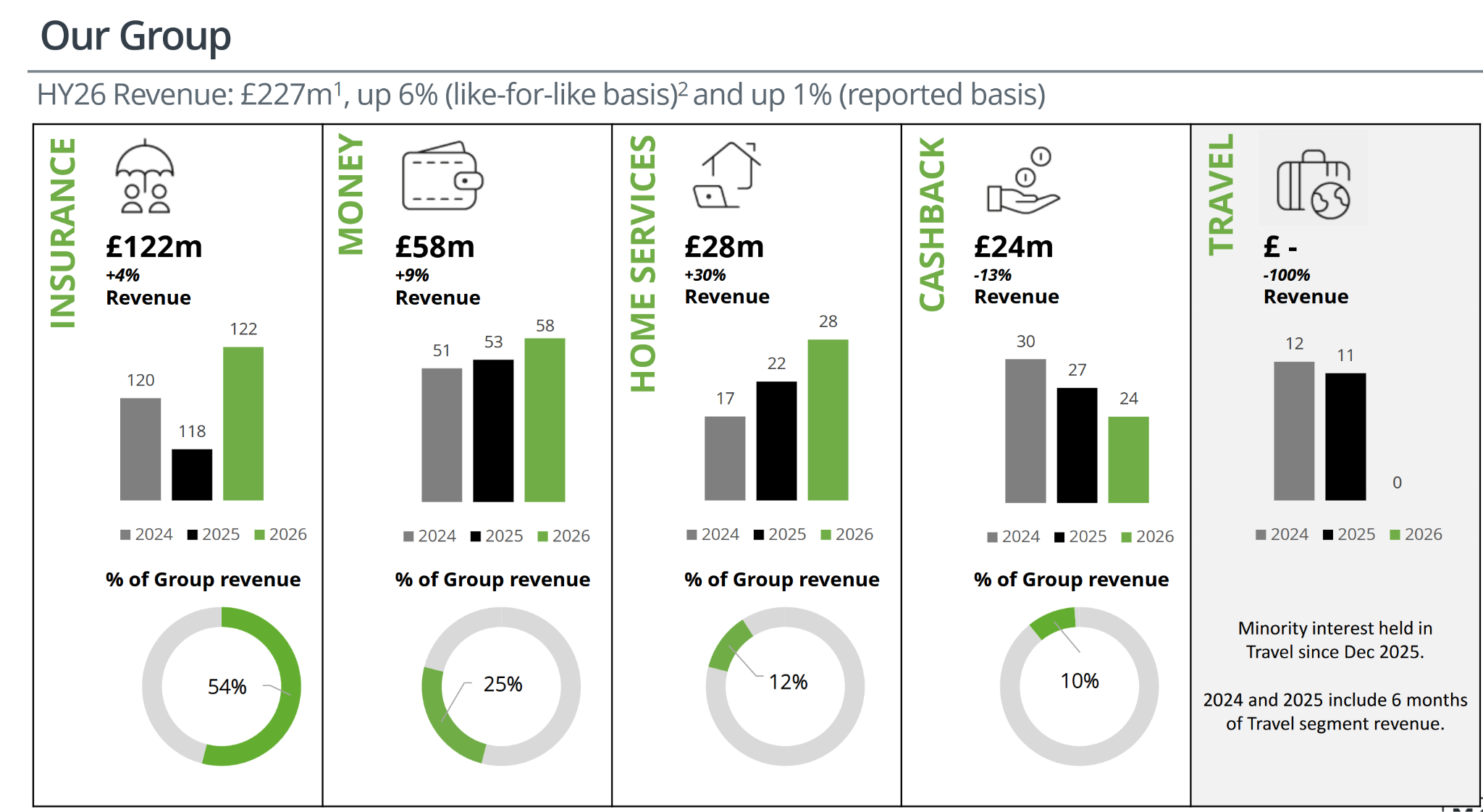
We can see that insurance is over half and that they have disinvested travel related offerings in 2025.

This TIKR Screenshot shows us that Mony’s stock was not a very good investment over the past 10 years:
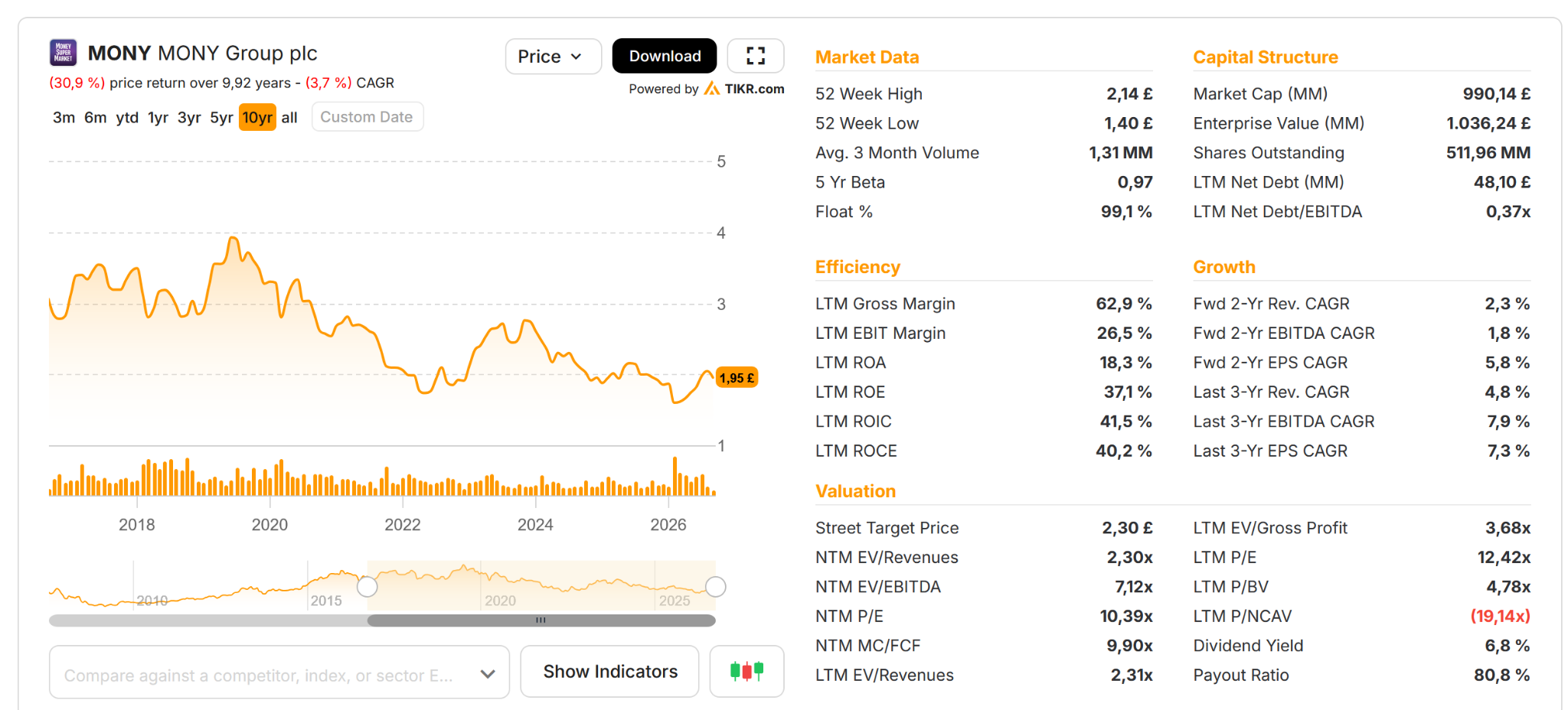
However the share price seems to have stabilized to a certain extent and the stock is cheap. The business as such is very profitable and has been growing low single digits for the past 3 years or so.

Other than the next two companies, Mony is only the number two comparison portal in the UK, pretty far behind a site called “Compare the Market” but bigger than “go.Compare” and “Confused” which used to belong to Admiral.

One important detail is that Italian Marketplace company Moltiply (former Mutui Online) is the largest shareholder with ~12% and they have been adding as recently as in June 2026.

Multiply has been collecting comparison marketplaces steadily, like Verivox in Germany or the non-UK sites from Admiral.

Autotrader

Autotrader is THE leading UK online car portal where both auto dealers and private customers are buying and selling mostly used cars. It used to be a print magazine but successfully transformed into THE dominant online market place in the UK.

It is supposed to have a market share of 75-80% in the UK. Over the last 10 years, it has not done much especially after it got hit by “SAASocalypse” fears:
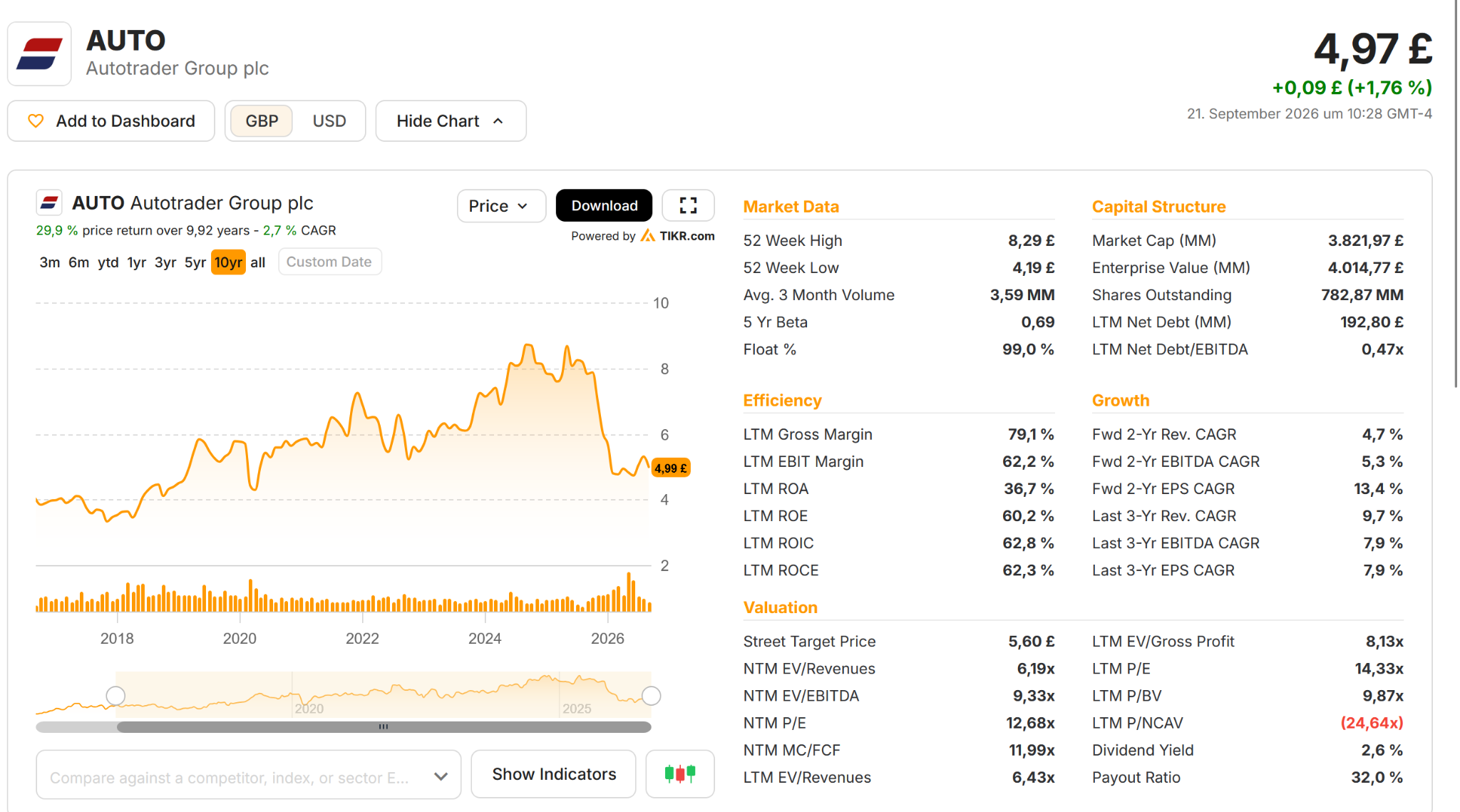
The stock is a little bit more expensive than Money Group, but almost absurdly profitable.

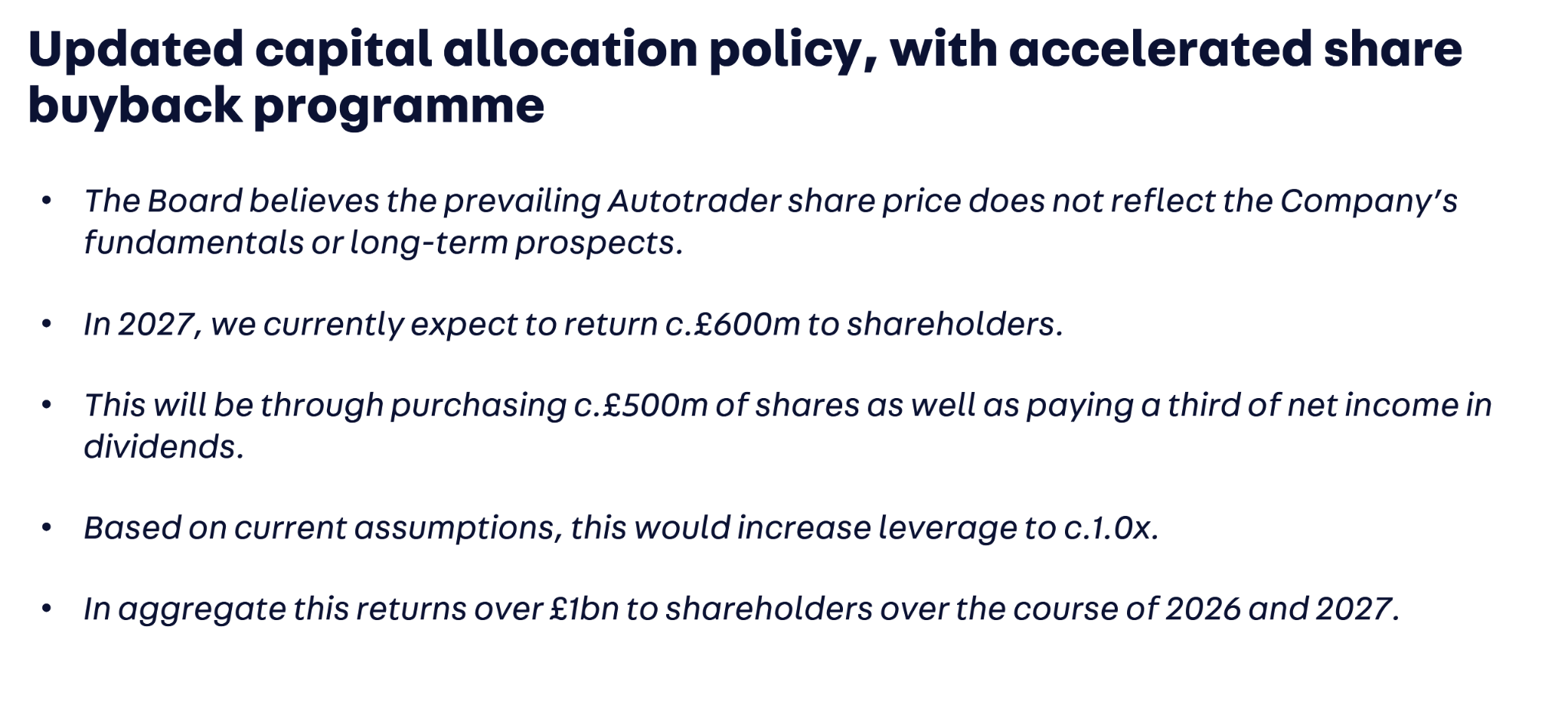
What is worth mentioning is that Autotrader has already started and committed to a massive share repurchase program:
One additional threat for Autotrade is that Amazon seems to be going for a piece of Autotraders cake and wants to enter the market still in 2026.

In the US, where Amazon is already in the market, success so far seems to be mixed at best. It reminds me a little bit about the auto tire business where Amazon started some years ago but didn’t succeed either.

Rightmove

What Autotrader is to cars, Rightmove is to real estate with the only exception that Brits are really obsessed about real estate. Almost any (friendly) Brit I know is using far too much time scrolling through right move listings.

Rightmove is the most profitable of the three and also the most expensive at 15x next year P/E.
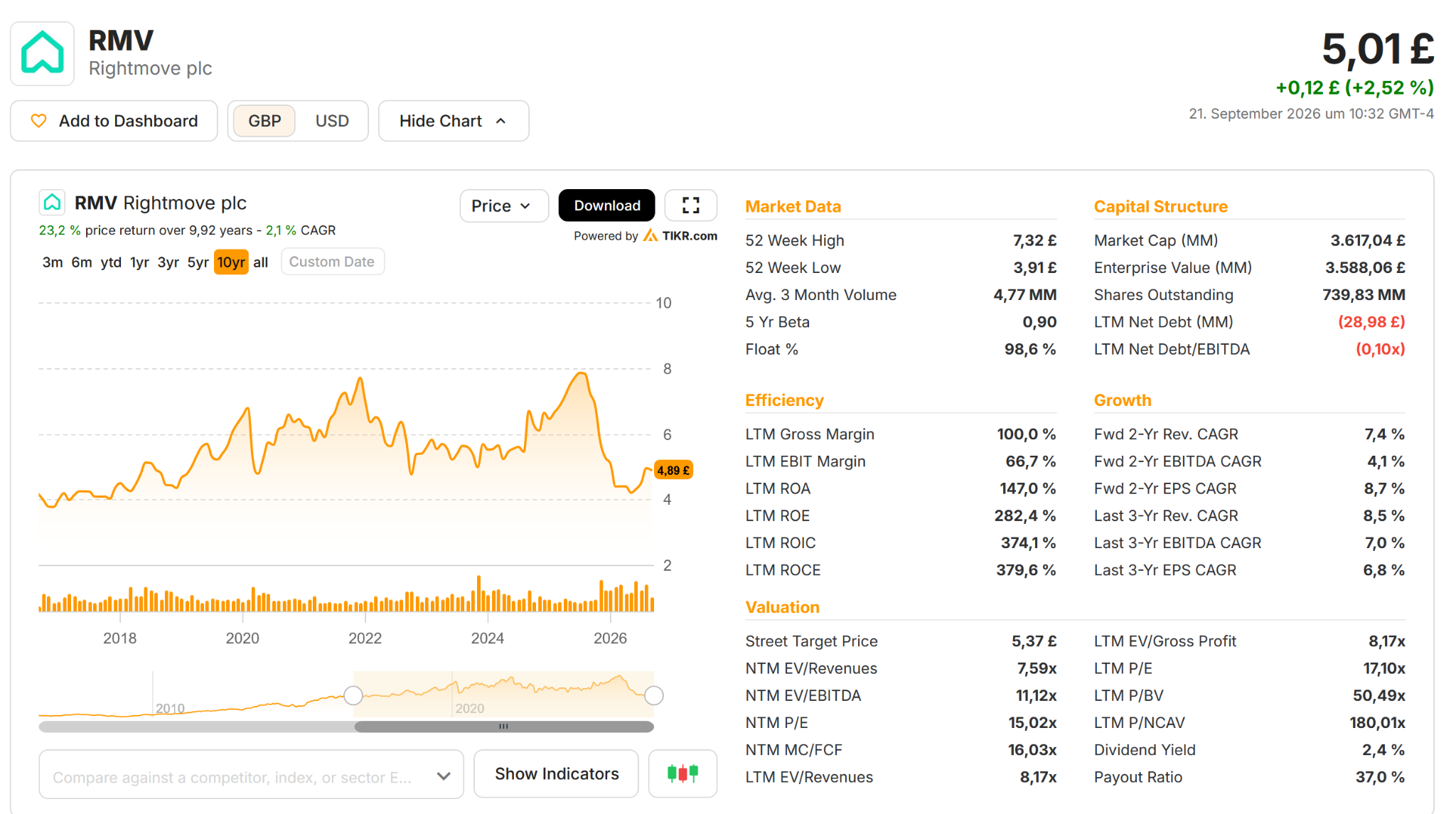
In 2024, REA, the “rightmove of Australia” tried to take over Rightmove at a final offer of 7,80 GBP/share but wasn’t successful.

Interestingly, earnings are up between 20-30% depending on which line you look at since then, but the stock is trading at a deep discount to that take-over bid.

The AI Threat:

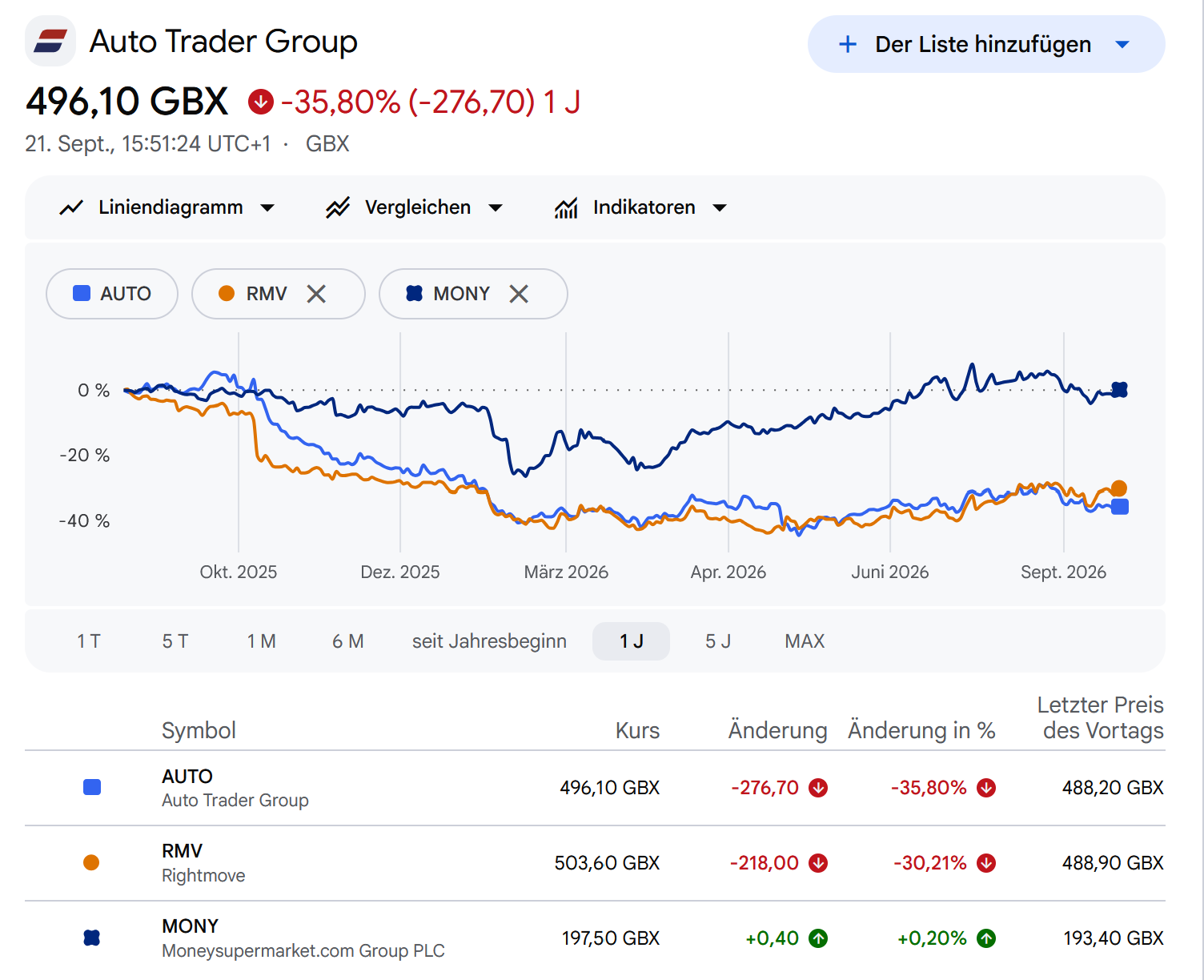
Looking at 1 year charts we can see that especially Autotrader and Rightmove were hit by AI fears, Moneysupermarket a little bit less so:
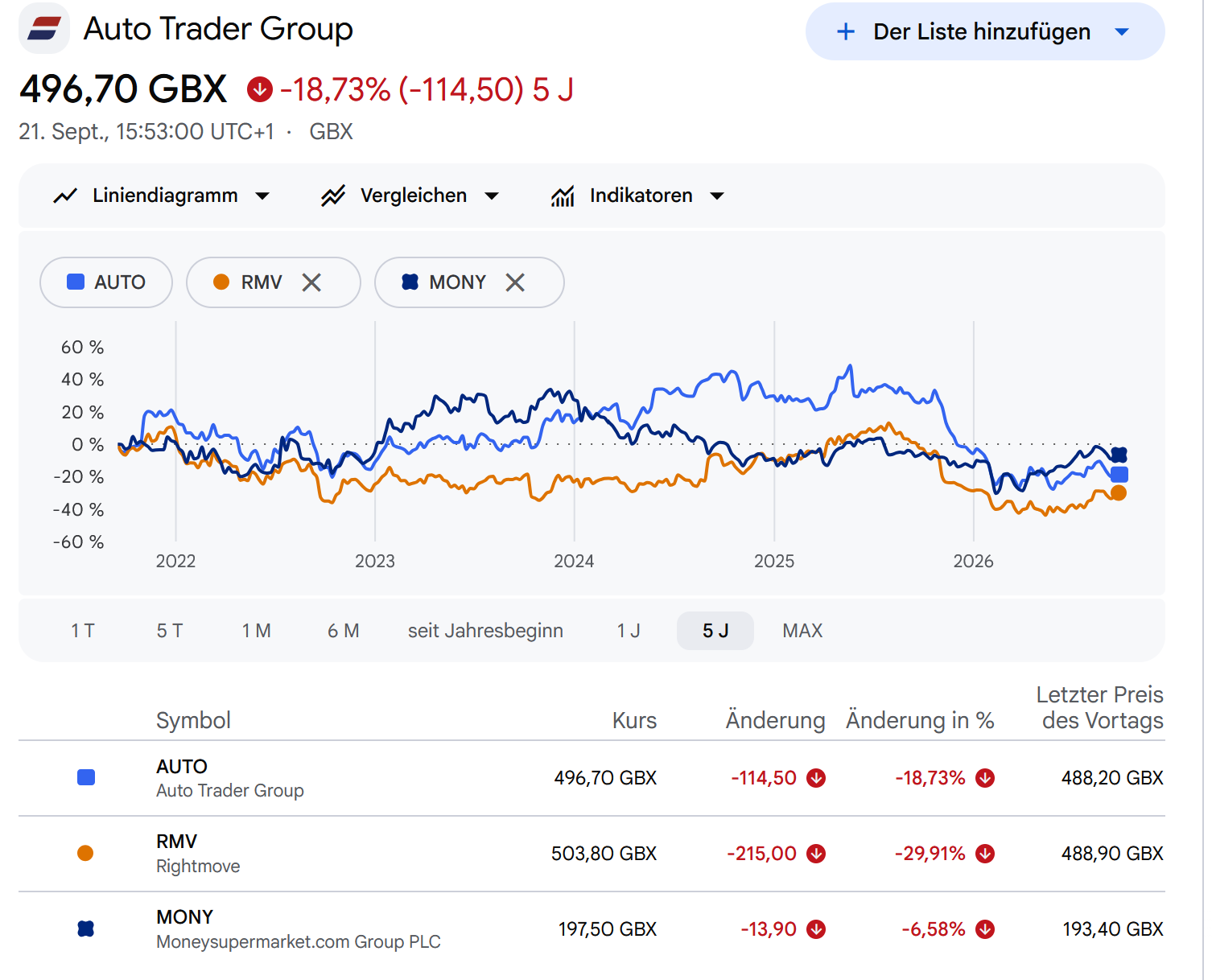
The 5 year chart shows that Moneysupermarket started to struggle earlier, in 2024:
While we are having fun with charts, we can compare Autotrader and Rightmove with Sage, the listed UK Accounting Software company:
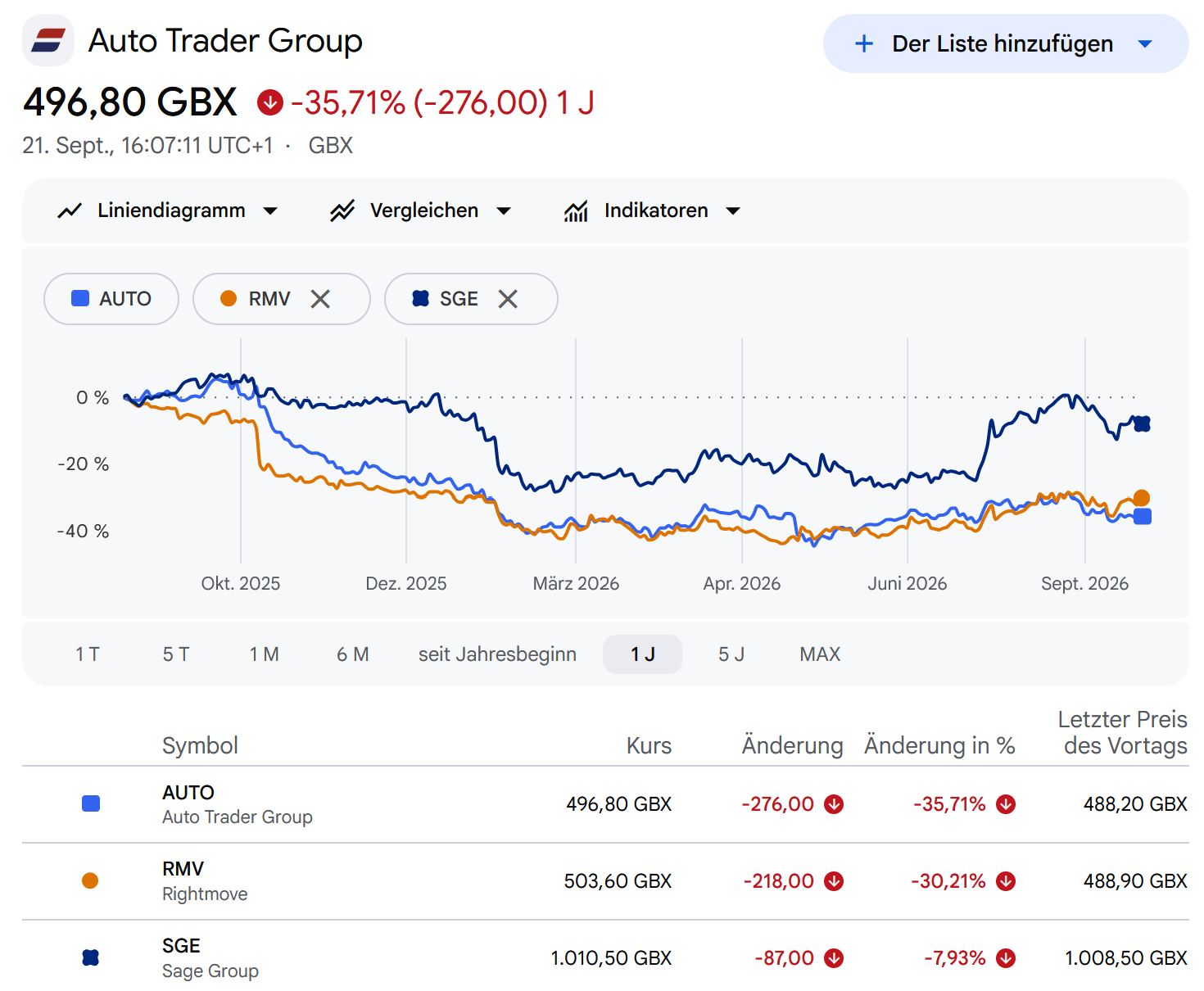
Interestingly, Sage has recovered most of its losses in the last 12 months, wile Autotrader and Rightmove so far have not.

Now to our last Chart comparison. This time Rightmove with Scout24 from Germany and REA from Australia which shows that across geographies, the stock market is really sceptical vs. portals and that this is not only a UK thing:
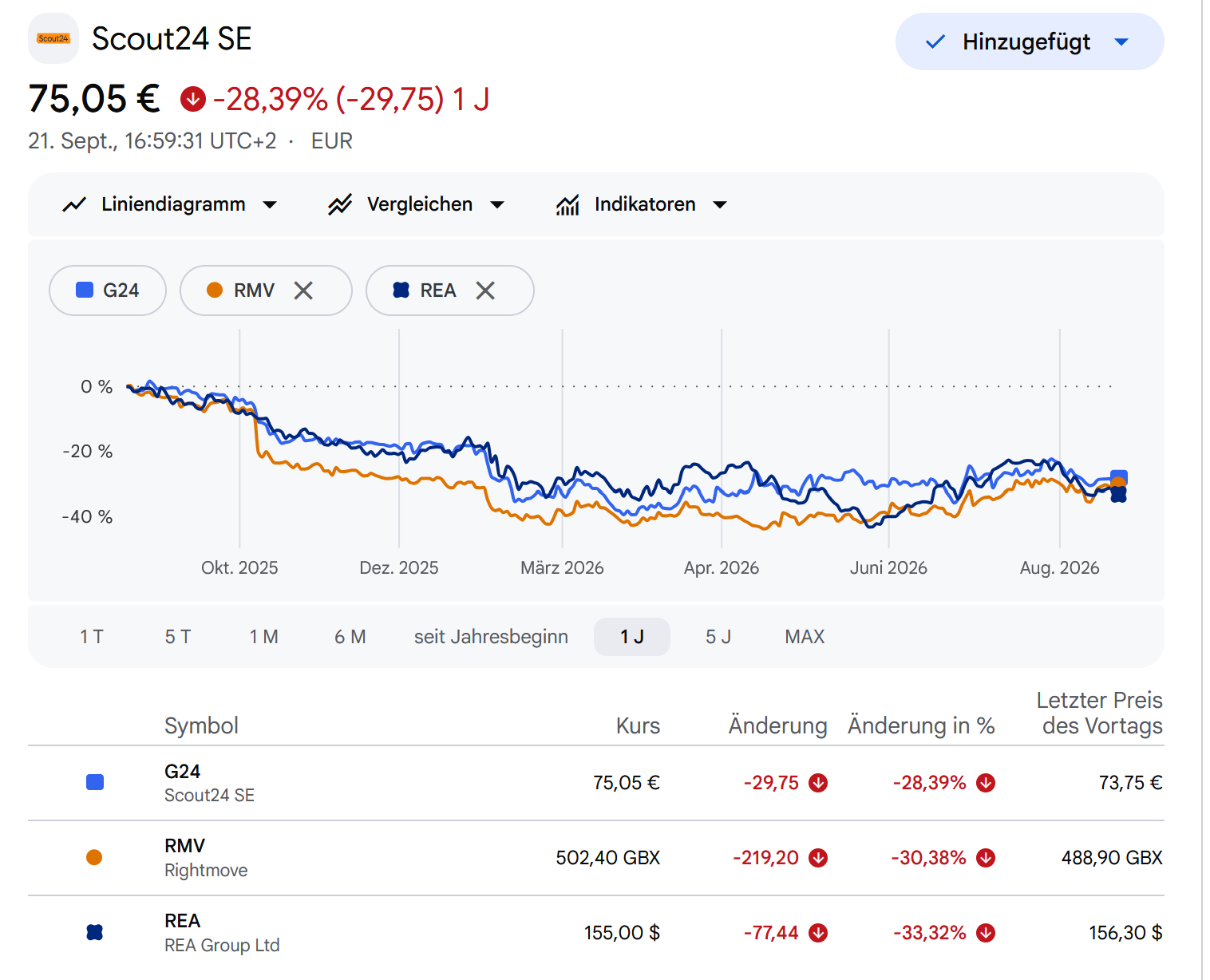
So the Billion Dollar question here is clearly: Will AI (and especially agents) disrupt the “Two sided marketplace” model and if yes, how fast will this happen ?

Clearly, Vibe coding a new AutoTrader or Rightmove or Moneysupermarket is not so hard. However that leaves you with the main task:

  • how to you motivate, both, corporate and retail clients to move over to the new “platform” quickly ?

Or, will people just go to their favorite chatbot and type in: Please look for a new house and buy it for me ?

In my opinion, the audience of the current platforms could be quite sticky, especially in the case of Rightmove, which to my understanding is only partially about buying a new house and partially just entertainment.

And yes, there will be people going directly through agents but an agent in order to deliver the same result as a good comparison site/market place would need to have the same infrastructure, i.e. connections to companies in order to get the required updated information and access to actually do the transactions.

Not aMUSEd – the Update

Now while I was writing the above and also starting to build my positions slowly, the share prices of all three stocks (and its peers) started to go down pretty dramatically, as this chart shows:
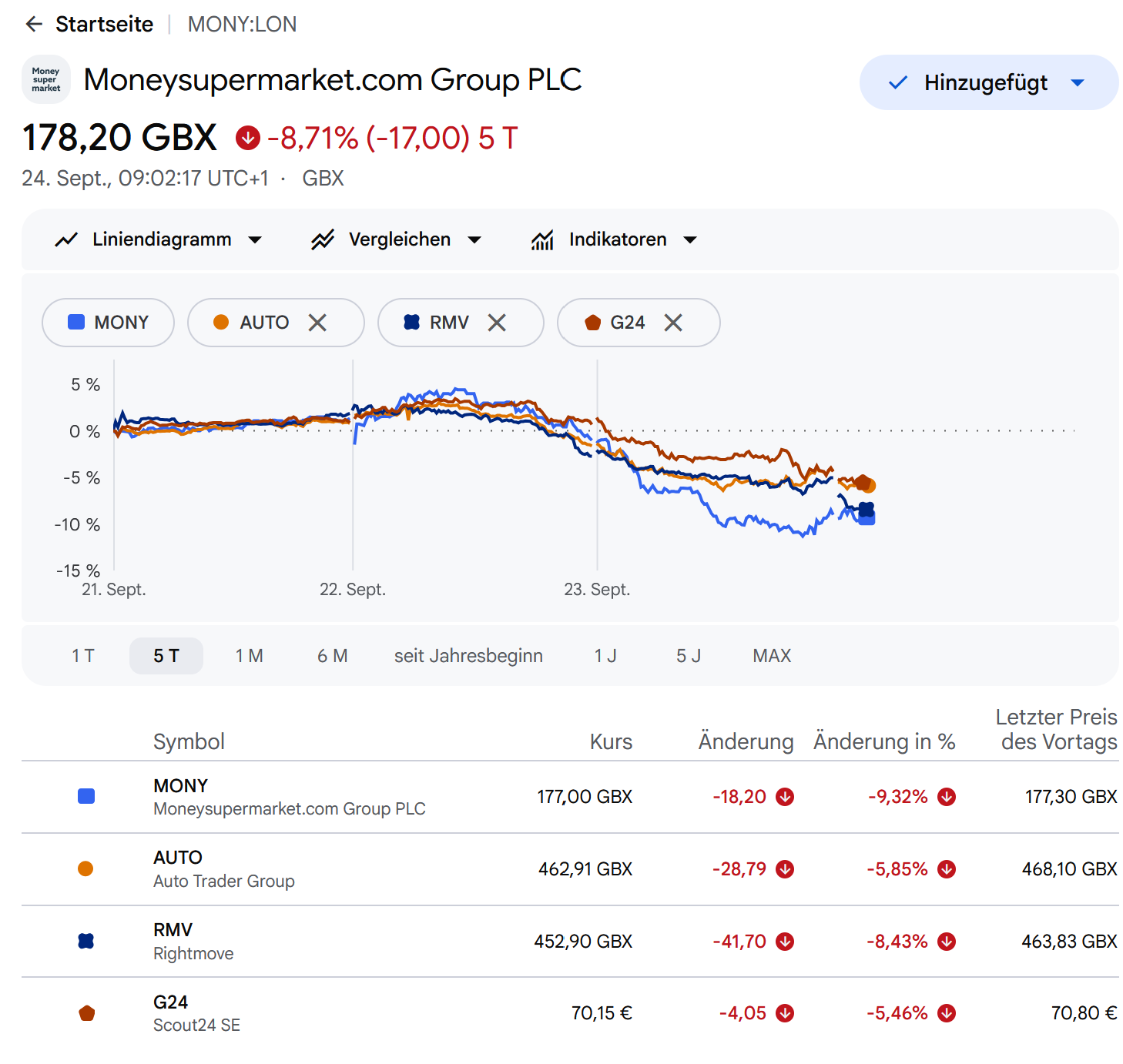
There was no individual news for those companies but rather the sudden “insight” that Meta’s launch and early success of its Agentic App “Muse” will be a problem for everyone who currently lives from comparing things online. 

Muse is currently only available in the US and has shot up to the number 1 downloaded App over there. 

In the past few days, among other stocks, also travel related “aggregator” stocks went down significantly because of this:
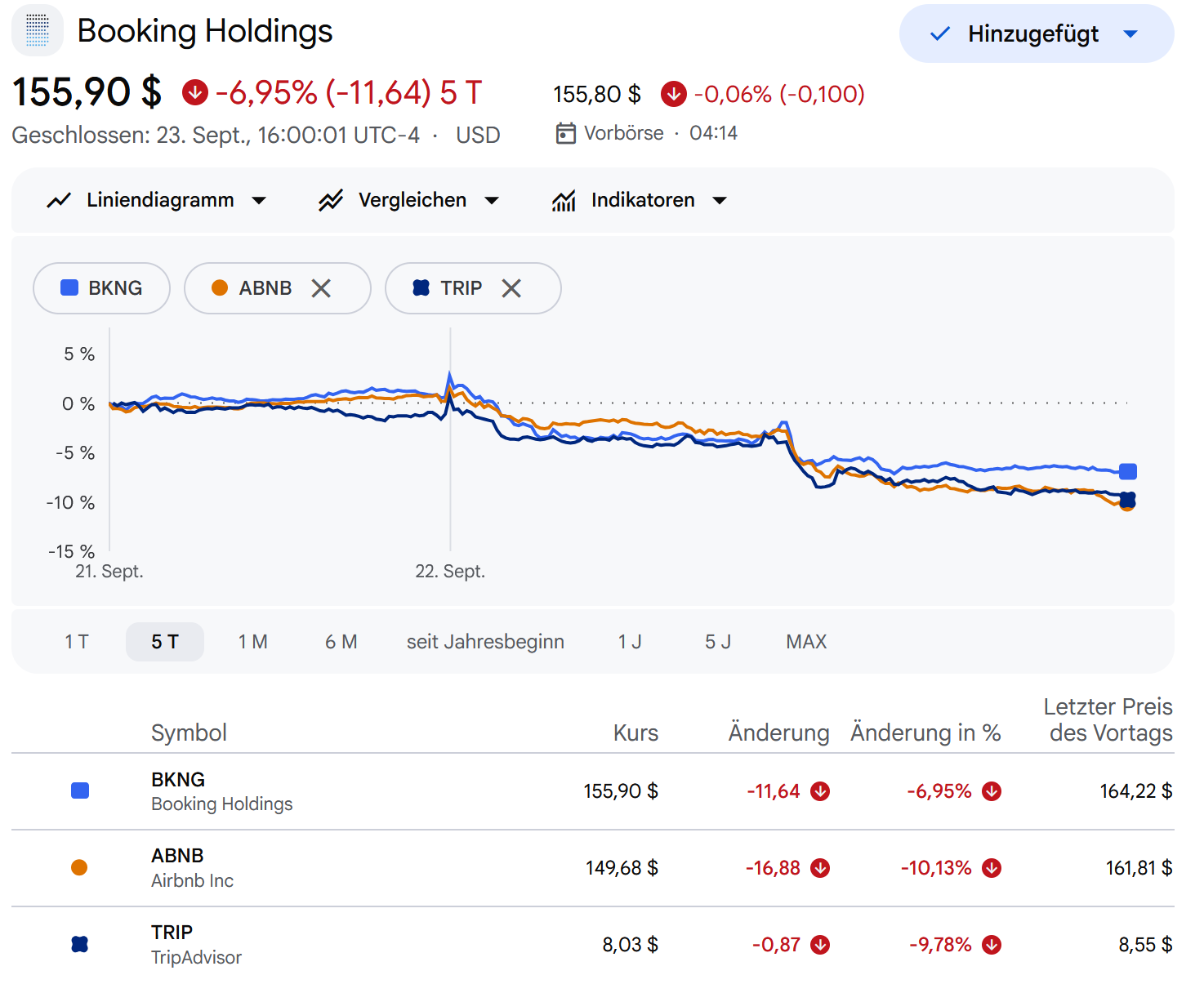
The question is clearly: How real is that fear of (short term) disruption ?

I think it makes sense to look at a few “hurdles” for the agentic take-over:

  1. Consumer behaviour US vs. RoW

If we look at Mony Group for instance whose main product is insurance comparison: In the UK, more than 80% of insurance policies are closed/renewed through comparison portals. In the US, this business model is quasi non-existent.

To my understanding, Americans might maybe call one other carrier if they feel that their insurance contract is too expensive, but they would never make the effort to compare their insurance portfolio on a regular basis.

In the UK, this is normal, the same here in Germany. Normally, your favourite portal will know all your relevant details and will actively send you better offers before the old contracts expire. One click and you have cheaper insurance.

So for any active comparison portal user, there is very little to gain by using an AI agent, rather the opposite. And this is before the fact that insurance comparison is a regulated business (as insurance is).

  1. Real time capabilities of LLMs

One thing where at least I struggle a lot with LLMs is to make sure that they really use real time information and not some stale training data. Not sure how they solve it with agents, but I guess that that might still be an issue. Especially if you are looking for a used car or a flat to rent, you need to be really quick for the good deals.

Most portals already offer some kind of “alarm” function for interesting objects. I am not sure if and how AI agents can make sure to have access to the newest offers.

  1. Anti-agent measures 

The most interesting aspect in my opinion will be to see if and to what extent the existing owners of “comparison inventory” will allow AI agents onto their platform. Amazon for instance, has already blocked Muse, which is no surprise as Amaon’s Ad model would be jeopardized. 

Amazon is also smart enough, not to let Meta access its inventory and also its ship infrastructure. 

That’s maybe another point here: At least in the business world, Meta is not your partner of choice. Noone likes them, no one trusts them.

So we could go on and on, but I do not think and especially in “comparison crazy” UK, that AI Agents will be a super fast disruptive force that will make the incubents worthless over night.

But, and this is a big BUT: The stock market could act as this is the case for quite some time.

Whenever the overall AI narrative looks good and AI stocks go up, these stocks, that are perceived as AI losers will go down. No matter if the fundamentals shows something or not.

KPI overview:
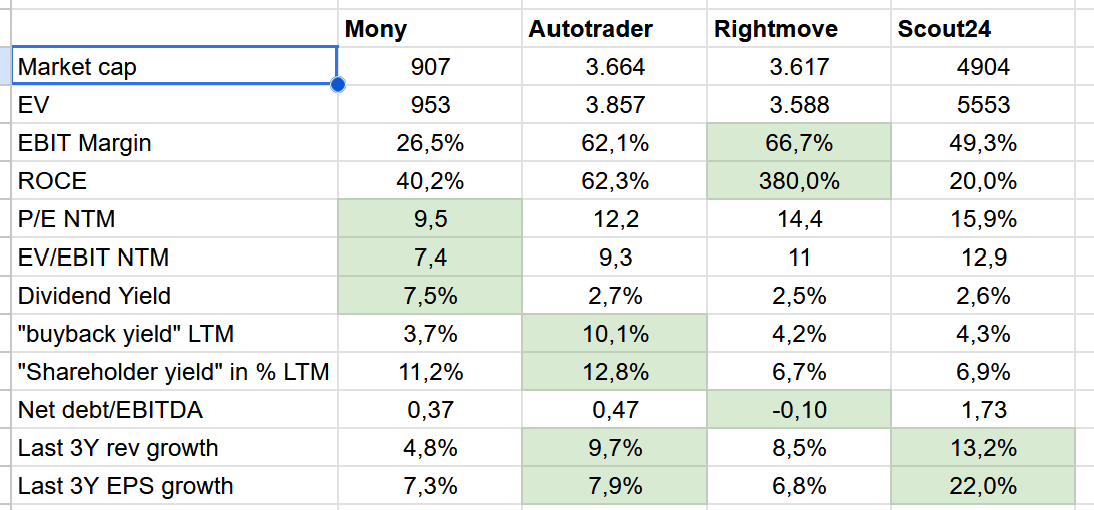
Here is a quick overview of some KPIs that I looked at, including German real estate portal Scout24 which is similar to Rightmove.

We can see that Mony is really cheap, whereas Rightmove is clearly the most profitable. Autotrader is in between with the biggest “buyback yield”.

Scout 24 is clearly more expensive, most likely because growth has been higher than for the UK players, but that is also a risk if AI Agent adoption happens faster than I assume. For this reason and because I wanted UK exposure, I didn’t include them in the basket (yet).

Multiple compression

For all 3 stocks, valuation multiples have been compressed significantly. Let’s look at Autotrader first, which was only listed in 2015:
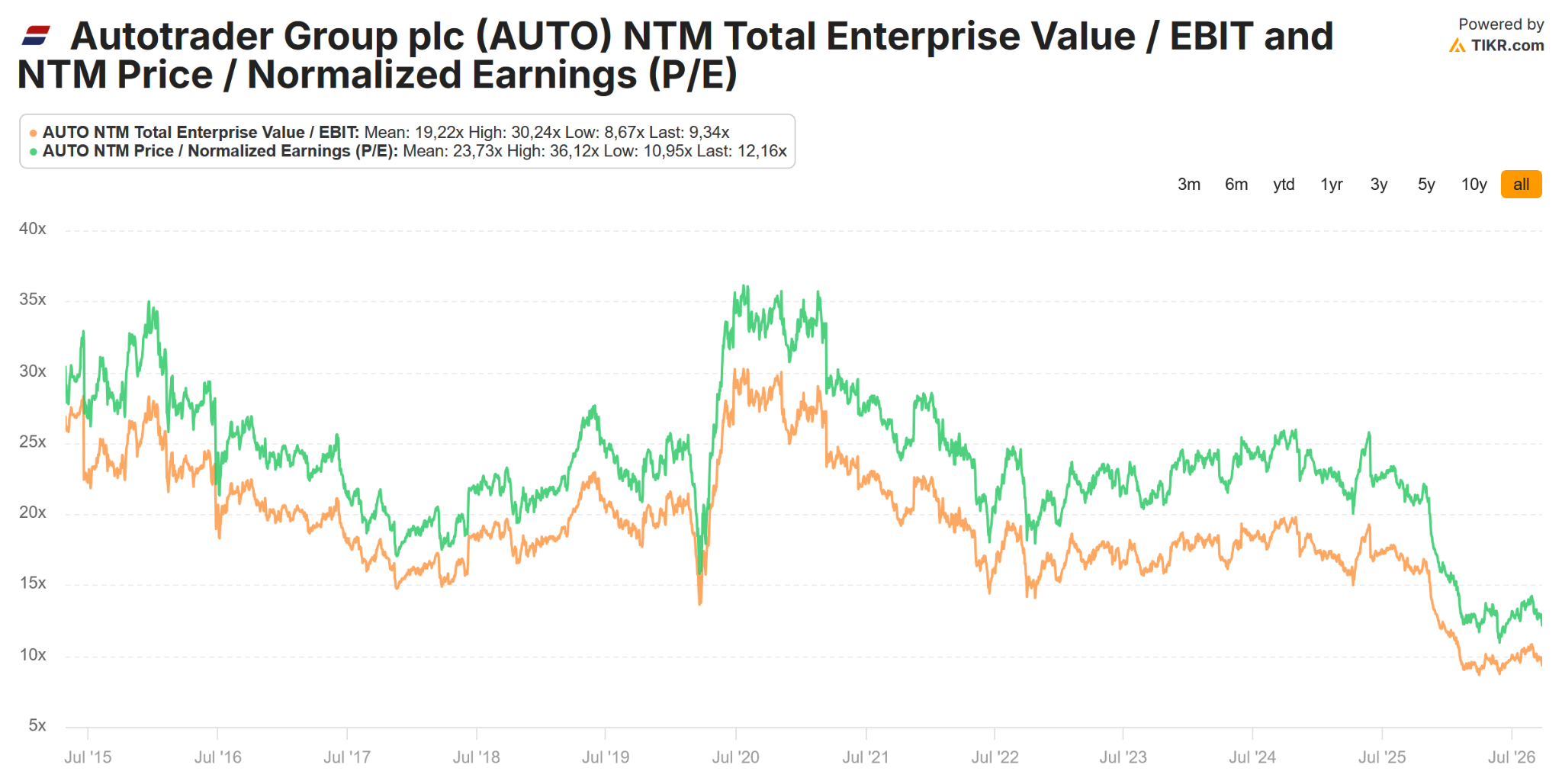
The P/E and EV/EBIT multiples are at absolute lows and at around1/2 of the historical mean.

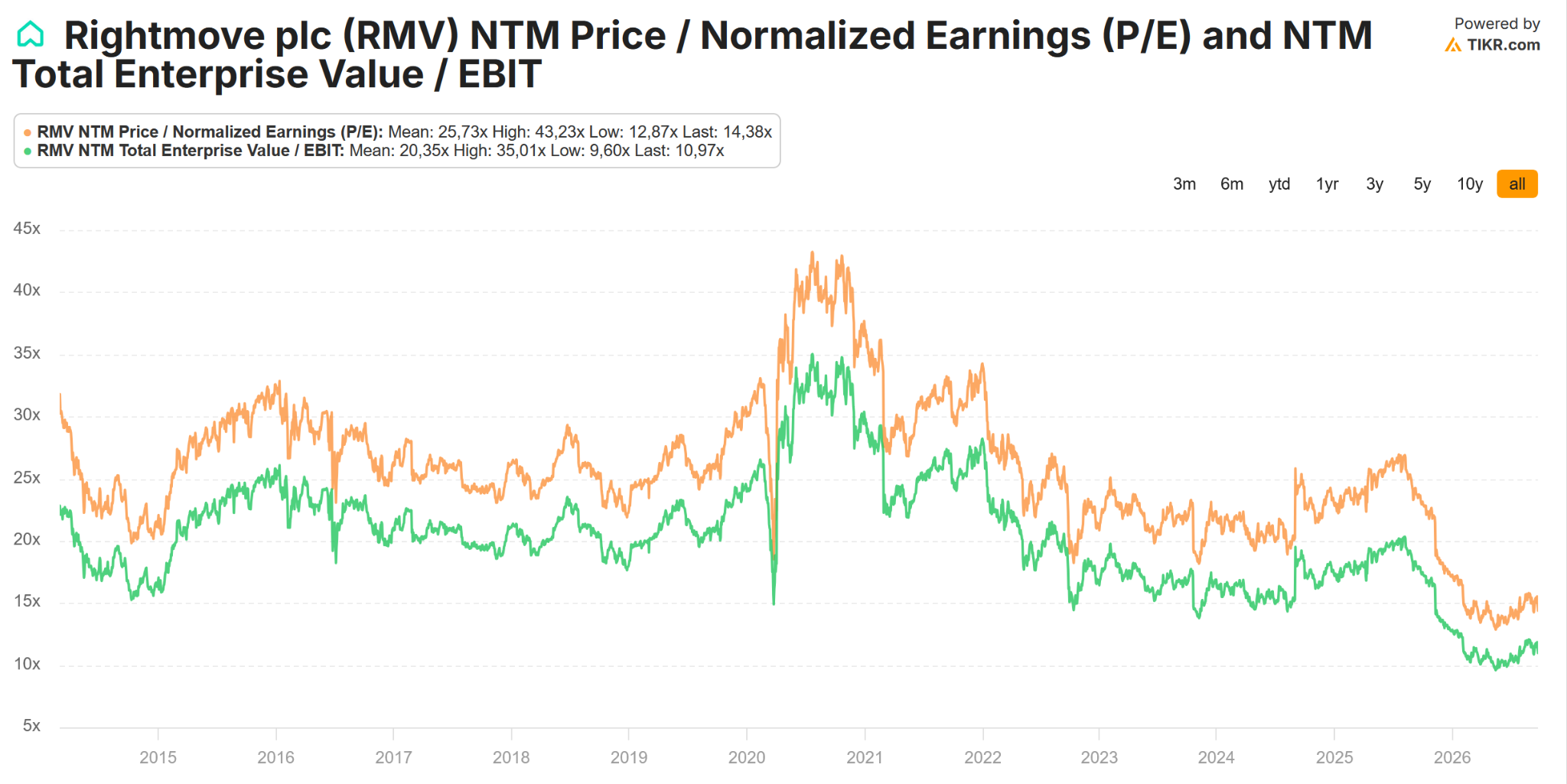
For Rightmove, this looks very similar:
Money was never that expensive but is also now historically cheap:
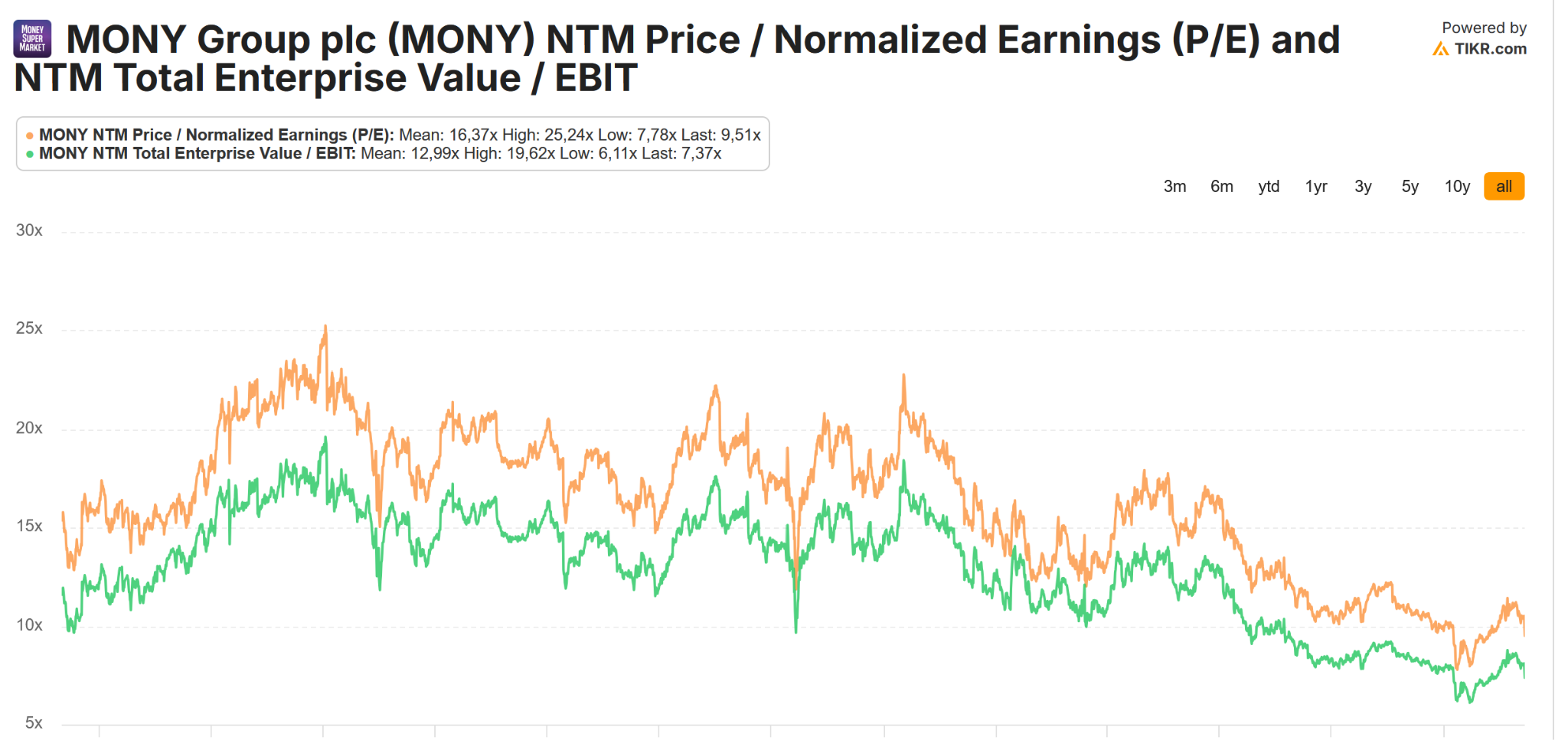
While “mean reversion” is not a good investment case as such in a disruptive environment, it clearly shows that the stocks are at least cheap compared to historical valuations. Not that long ago, investors thought that a P/E of 30x is fair for Rightmove.

The Basket:

As a start, I allocated to each UK stock (Mony, Autotrader, Rightmove) 1% of the portfolio, making it a 3% position overall. As purchase price I assume an average price at ~5% above today’s closing price each.

I will need to decide going forward if I either increase the size per stock a little or add maybe a few other UK stocks to the basket. We’ll see. At the moment I might go to 1,5% per stock and have overall maybe 5 UK stocks in that basket.

My time horizon for this trade is  15-18 months and I am looking for an upside of 30-50% in total (including dividends) if some normalization kicks in.

As the performance of my “basket trades” so far was rather mixed (Freedom Energy basket was OK, freedom insulation less so), please wish me luck on this one.

Summary:

Investing into comparison portals aka 2 sided market places at the moment is clearly a “pain trade”. The risk of getting punched in the face short term is quite high.

On the other hand, many of these businesses are extremely high quality and as cheap as they have been for the last 10 or 15 years

For the UK players, based on what we have seen in other areas, the probability of M&A action is not zero and I am also convinced that especially for the UK, the fear of a quick take over through AI agents (Muse) is overblown.

Wexboy’s Summer Challenge – send him your favourite stock idea

Very good idea from the excellent Wexboy blog:

Send your favourite idea to him and he will analyse the stock and post it on his blog. Only very few “restrictions” apply:

– Should be accessible to the average reader – basically any company (or fund) listed on a developed market exchange (doesn’t exclude emerging market stocks if they’re listed in London/NYC, for example)

– Favourite‘s a flexible idea – might be the latest stock you bought, the most interesting/unusual, the cheapest, the least risky, the stock with the most upside potential, etc…

– You should have some skin in the game – please disclose what % of your portfolio is in this stock

– Stocks that can be bought & held for a few years are definitely preferable – so no ‘quick trades‘, or (specifically) event-driven ideas

I will be doing my own review/valuation of all stocks submitted. Remember, like most readers, I’m interested in great investments, not speculations… And I use a value perspective. This is not to suggest that I’m averse to a good growth story – I love ‘em, I just don’t want to pay too much for them!

I hesitate to call any stock in my portfolio as best idea, nevertheless I will participate with German DIY chain Hornbach Baumarkt AG (ISISN DE0006084403). Although I have analysed the stock extensively in German language, I was always to lazy to wwrte a detailed analysis in English. Maybe Wexboy will do that for me 😉

Some highligts of Hornbach:

+ honest, long term oriented management (majority family owned) with clear strategy
+ conservative balance sheet, replacement value significantly above book value
+ still cheap (P/B 0.96, PE 10)
+ only limited impact of internet on business model
+ special short/medium term growth opportunity if largest competitor Praktiker defaults
+ 5% weighting in my model portfolio (max. allowed before price appriciation, similar in private portfolio)

Some reasons why stock is cheap:

– complicated legal structure (both, holding and operating company are listed)
– low liquidity, low or almost no analyst coverage
– very competitive business
– no short term catalysts

As Wexboy wants as many ideas as possible, I would highly recommend all readers to send their proposals to him.

Core Value WMF AG – Hidden “Mittelstand” Champion – Part 1

WMF AG is one of the “core value” stocks, I have only mentioned briefly. WMF was founded over 150 years ago (wikipedia). The company is well known for generations in Germany for producing excellent kitchen supplements, especially cooking pots and pans, cuttlery and other “kitchen helpers”. Additionally they started at some time in the sixties to produce coffee makers, especially for the professional area like restaurant, company cafeterias etc.
Read more

Book Review: Joel Greenblatt -You can be a stock market genius

This is one of the books I always wanted to read but never managed to:

When Joel Greenblatt published this book in 1997,he had a tremendous run as manager of Gotham capital.

The book is aimed towards the “average” investor and makes the case for investing in special situations.

The best special situation he recommends are spinoffs, when a usually large company is spinning off a part of its business in the form of stocks which are simply distributed to the owner of the large company. As the owner of the large company don’t really want this stock, this creates an investing opportunity, especially if the management of the spin off is incentivised correctly.

He touches a couple of other special situations (merger securities, recaps, reorganisations, companies emerging from bankruptcy), which should be well known to people having read “Margin of safety” or other value oriented books.

The case studies in the book are good, it is interesting to see that Greenblatt invests even in highly indebted companies if they are “special”.

For a European investor in our time howver, the book contains only partly directly actionable advise, as spinoffs are avery rare breed today. However it is still a very good books which shows that “special situation” investing can lead to great investment results.

Summary: I think the book is a good start for anyone who wants to have an “easy to read” entry into the world of special situation investing, although the focus of the book might not be easily applicable in current times.

Vetropack – Business model, Peer Group

After yesterday’s starting post for Vetropack, I would like to add some additional thoughts.

Business model & possible moat:
Vetrpopack basiscally produces glass bottles for beer, juice and softdrink companies. With all those beverages, usually both, the brewing and botteling part is done locally. Beverages esp. in glass containers are ussually difficult and expensive to ship, so especially the big breweries and soft drink companies produce everything locally.

The same applies for the glass containers themnselves , which are relatively cheap but expensive and difficult to transport. So somehow similar to a cement plant, someone with a local glass bottle production has a local natural cost advantage (“moat”) to competitors from geographically remote regions. The major difference to cement plants being the lower cyclicality of the business.

Peer Companies

I found the following companies which could be considered “peers” i.e. companies manufacturing glass packaging:

Vidrala SpA (Spain, glass bottles, very similar to Vetropack)
Gerresheimer (Germany, glass and plasticv bottles, more focused on pharmaceutical containers)
Zignago Vetro SpA (Italy, glass bottles)

Based on “simple” valuation ratios, the results look interesting:

Tkr & Exch Mkt Cap P/E P/B P/S EV/EBITDA T12M Net D/E LF
             
 
VET SW 650.8 10.40 1.23 0.80 4.46 0.00
VID SM 418.1 10.49 1.84 1.08 6.33 76.20
GXI GR 913.4 17.59 1.81 0.86 6.38 69.45
ZV IM 373.6 11.03 3.51 1.41 6.40 69.86

Although the P/Es are quite similar, all the other peers carry a significant amount of debt. This results in a singificantly lower EV/EBITDA multiple for Vetropack compared to its much more highly levered peers, which interestingly all trade around 6.4x EV/EBITDA.

EV/EBITDA is often used as a “proxy” for a private company valueation (Gabelli). Under this metric, Vertropack would be significantly undervalued compared to its Peers.

For me its not clear why the most solid company of the peer group should have the lowest relative valueation, in my opnion this should actually imply a premium.

Portfolio Management
As mentioned in the first post, Vetropack has currently a weight of 2.9%. As the cash balance in the portfolio is currently at the low end of the target (10%), I will either need to decrease another position or fund the increase through a short position.

My initial idea to create a pair trade between Vetropack and Gerresheimer (short) does not work to well. Correlations between the peer companies are extremely low (Vetropack against Gerresheimer for instance 0,24 for the last 12 months).

So before increasing the Vetropack position I will have to reduce other positions first.

Magix Sixes – Quick Check UPM-Kymmene OYJ (ISIN FI0009005987)

One stock which has been popping in and out of the Magic Sixes Screen several times is the Finish Paper Company UPM Kymmene.

Current “simple” value metrics are (stock price 8,30 EUR):

P/B 0.60
P/E Trailing 2010 5.4
Dividend Yield: 6,65%

Market Cap is 4.4 bn, there are no majority shareholders. The stock is fairly liquid.

Some standard quick qualitiy checks:

Tangible Equity: Tangible book value per share is 10,86 EUR (YE 2010), which represents ~80% of book value, so no issues here
Debt: Net debt per share is relatively high at ~7.1 EUR per share, however with ~2.5 EUR trailing 12M EBITDA per share, total EV/EBITDA at ~6.8 looks OK.
Free cashflow: Free cashflow is positive as far as I can look back (1999).

If I find a stock interesting, I try to do a quick check of historical earnings quality and cashflow usage based on Bloomberg numbers:

Year Earnings Dividends Free Cashflow Debt per share
2001 1.93 0.75 1.62 10.52
2002 1.06 0.75 1.67 10.53
2003 0.61 0.75 1.26 10.21
2004 1.76 0.75 0.70 9.58
2005 0.50 0.75 0.31 9.62
2006 0.65 0.75 1.11 7.92
2007 0.16 0.75 0.37 7.96
2008 -0.35 0.40 0.14 9.12
2009 0.33 0.45 1.97 7.74
2010 1.08 0.55 1.43 7.14
Total 7.73 6.65 10.57  
In % of Earnings   86.1% 136.8%

In this case, the result looks quite good. UPM seems to generate much higher free cashflows than earnings (137%). Also 86% of Earnings have been distributed to shareholders via dividends and the company has significantly reduced debt until 2010.

First summary after this “Quick check”: From a “semi mechanical” point of view, the stock might be a interesting Contrarian investment, so it makes sense to more deeply research the company.

Magic Sixes – Quick Check Iren SpA (ISIN IT0003027817)

One of the companies which recently appeared in the Magic Sixes Screening (P/B < 0.6, P/E 6%) is another Italian Company named Iren Spa.

Based on “simple” criteria, the Share seems to be really cheap:

P/B 0.58
P/E 4.59
Div. Yield 9,15% (!!)

The description of the business in Bloomberg reads as follows:

IREN S.p.A. generates, distributes, and sells electricity and district heating. The Company manages natural gas distribution networks, markets and sells natural gas and electricity, and manages water services.

Based on available data, the bulk of the business seems to be energy distribution, geographically 100% of the business is done in Italy.

Market Cap is around ~ 1bn EUR– There doesn’t seem to be a single majority shareholder.

The company was IPOed almost exactly 11 years ago at 2,70 EUR. Even taking into account dividends, the performance from the initial IPO was around -6% p.a., which is better than the Italian BM index (9% p.a.).

However, the first thing I usually check is the debt load and free cashflows.

Currently, they have around 2.14 EUR per share net debt per share, which results in an enterprise value of ~3,50 EUR per Share. Based on trailing 12M EBITDA of 0,43 EUR, this results in 12M trailing EV/EBITDA of 8,8x, which for a Italian utility seems to be quite rich.

Based on Bloomberg, free cashflow has been negative for every single year since IPO.

Last but not least, only 0,42 EUR of the 1.42 EUR book value is “tangible”. One would have to check, if certain infrastructure licenses are included in the intangible part.

However at this point I can already stop summarize:

For me, the combination of a large debt pile, negative free cashflows and a significant portion of non-tangible book value makes Iren SpA more or less uninvestible. Based on the pure financials without any further analysis there doens’t seem to exist any Margin of Safety despite qualifying as “Magic Sixes” stock. For the time being, Iren will not be analyzed further as there seem to be more attractive “targets”.

Best Ideas Summaries Part 1: Draegerwerk Participation Rights (ISIN DE0005550719)

One of my best investment ideas at the moment are the Dragerwerk “Genußscheine Serie D” (ISIN DE0005550719)

Draegerwerk produces medical devices, safety and aerospace equipment. Draegerwerk has managed to achieve a remarkable turnaround which resulted in a very strong performance of the shares

They have a fairly complicted capital structure, with normal voting shares, preferred shares and participation rights.

The most liquid securities are the Non-Voting Preferred Shares which trade at the following multiples:

Price/Book 2,2
Price/Sales 0.61
Trailing PE 15.3
EV/EBITDA 6.1
Dividend Yield 1.48%

They are up YTD 34.2%, making them the 4th best perfomer in the German Top 100 HDAX.

The numbers above don’t look too compelling, so what’s the deal here ?

So now let’s look at the “Genußscheine”: Draegerwerke has issued 3 different series, the most liquid beeing the “D series” (ISIN DE0005550719).

In contrast to “regular” German style particpation rights which are more like a subordinated bond, they have some special features:

– they don’t have a fixed coupon or nominal value
– instead they simply pay 10 times the dividend of the Preferred Shares
– they cannot be called or cancelled. In the initial terms the only way to redeem them by the issuer was to exchange them into 10 Preferred shares
– in the case of a capital increase holders will be “compensated” for dilution in the form of cash (no new participation rights)

The last point raised some issue when Draegerwerk issed new shares in 2010 in order to pay for an acquisition (50% of an existing Joint venture with Siemens). in my opinion they paid out the fair amount, however with a 9 month delay.

To sum up the situation: The so called “Genußschein” is very similar to a preferred share, the main difference being that it pays 10 times the dividend.

Now the “Genußschein” currently trades at around 160 EUR which is roughly 2.0 times the price of a preferred share.

Or put it differently, through the Genußschein one could gain exposure to Draeger at the following multiples:

Price/Book 0.44
Price/Sales 0.12
Trailing PE 3.1
EV/EBITDA 1.2
Dividend Yield 7.5%

Now this looks like a value investment to me. There are two ways to play this:

1. Outright Ivestment
2. Relative Value long / short

For the Blog Portfolio, I have combined the long position in the “Genuscheine” with a short Position in the Preferred Shares in order to establish a “market neutral” position while harvesting the positive carry of 8 preffered dividends (short 2 shares /dividends, long 10 dividends).

As one could see, the are not perfectly correlated, so a long short position requires some “buffer” for diverging prices:

Over the medium term, the Genußscheine should perform better than the Preferred shares, especially if Drager further raises the dividend. If I were the CFO or Treasurer of Draeger I would be desperate to buy back the Genußscheine at the current level, so we could see some tender offer going forward.

Summary: Although the Dragerwerk Genußscheine are not called shares, they offer the same Exposure to Draegerwerk than the widely held Preferred Shares at a 80% discount. A long Genußschein / short Preferred share position offers a interesing risk / return profile with a nice carry.

« Older Entries