Category Archives: Anlage Philosophie

Performance review February 2014 – Comment “Is small still beautiful ?”

Performance review:

In February, the portfolio performed +2,7%, which is -2,5% lower than the Benchmark (25% Eurostoxx 50, 25% Eurostoxx small, 30% DAX and 20% MDAX). YTD, the portfolio is up +6,5% vs. 3,2% for the Benchmark.

Main contributors for February were G. Perrier with +22,5%, TGS Nopec with +16,9%, SIAS with +10,4% and IGE & XAO +7,1%. Major looser was Cranswick with -5% (in EUR) and Vetropack (-2,8%).

Portfolio transactions

If I look at my transactions in February, I almost feel like a high frequency trader: I sold the final Rhoen Klinikum position as well as EMAK and SOL. I increased positions in MIKO and TGS Nopec and finally I invested in 3 (!!!!) new stocks: Energiedienst, Koc Holding and Ashmore. Cash is now at 13,5%.

The current portfolio can be found here.

Comment: “Is small still beautiful ?”

2014 again showed the usual pattern in the past few years: Small and Midcaps outperform everything else by a wide margin. This is how the constituents of my own benchmark performed YTD:

Perf. YTD
Eurostoxx50 (Perf.Ind) (25%) 1,51%
Eurostoxx small 200 (25) 8,06%
DAX (30%) 1,46%
MDAX (20%) 1,91%

So European small caps seem to be THE hot asset class. A long time ago, when I went to university (early nineties), I still remember when the finance professor talked about efficient markets. He didn’t believe in them and one of the example quoted was the famous “small cap” effect, the “fact” that small caps over the long run perform better than large caps.

Looking at most markets today, the history speaks for itself. Just look at the Charts:

S&P 500 vs. Russel 2000

or even more drastic: Dax vs. MDAX

Back to the “old times”: When I started to work for a financial institution in the mid nineties, one of my job was to monitor and explain the performance of a German small/mid cap fund. Every Quarter or so, I had to explain why again the fund had underperformed the DAX by a wide margin and the fund was finally closed end of 1999. Just to give an indication how badly Midcaps performed in this period: From the end of 1994 until end of 1999, the DAX performed ~26,4% p.a. against the MDAX with 10,6%, an underperformance of -16,4% p.a., or in absolute terms +221,96% against 65,55%. No matter what academia would say, the decision makers were tired of looking stupid and pulled the plug.

Consensus at that time was that in the age of globalization, the big international companies would be the stars and the small companies would be crushed. We all know how this story ended.

Let’s look at some more recent numbers: Since the end of 2009, the MDAX has performed 21,5% p.a. vs. 12,4% p.a. for the Dax. The French Small&Mid Cap index has performed 13,9% p.a. vs. 5,95% for the CAC in the same period. So again, many “asset allocators” are faced with a situation, where the logical thing to do is to allocate as much as possible into the much better performing asset class.

However, this past performance is only one side of the medal. Let’s again look back and look at something else this time: Valuation

When my employer at the end of the nineties decided to pull the plug of the small/midcap fund, the DAX was trading at a P/E of 32 vs. the MDAX at 16. Interstingly enough, the situation now is just the inverse: The MDAX now trades at 28 times earnings against the DAX at around 16 times. The situation looks similar in other markets. The Russel 22000 for instance trades at ~50 times 2013 earnings against 17x for the S&P 500. Of course, profits in small and midcaps could continue to grow much faster than in large caps, but at current valuation levels they have to grow much faster than for large caps in order to justify their valuation.

There seems to be so much money flowing into small caps at the moment that even the weak companies enjoy their day in the sun. So what to do now ? Chase the few remaining “cheap” small caps and hope that they get pushed up by the momentum ? Or exit completely ? I don’t know, but for instance European small caps have almost completely disappeared in my BOSS score database from the “attractive” bucket. The few remaining ones are rather “deep value” cases.

In any case, one should be very careful with small caps going forward. Based on current valuations, profits at most small cap companies (Europe and US) would have to increase really strongly in order to be able to produce additional outperformance in the next few years. There might be a few remaining opportunities, but overall “the air is getting thinner”. We will see how this plays out, but experience shows that multiple expanions will stop at some level and then usually reverse quite drastically and for long time periods. So be careful with small caps. Maybe “big is beautiful” might come again….

Emerging Markets series part 2: Koc Holding ADRs (US49989A1097) – the best of Turkey in one stock ?

As this is a long post, a short summary in the beginning:

– despite the bad headline news, for me Turkey is one of the more attractive Emerging Markets, as valuations are moderate and most problems are clearly visible
Koc Holding, the holding company of the KOC family offers an interesting opportunity to invest in a portfolio of Turkish companies with dominant market positions
– further, Koc Holding seems to be a professionally managed company with good capital allocation and very good long-term track record
– nevertheless, stand-alone the investment is clearly very risky at least in the short-term and should be part of a broader EM strategy

Turkey background: Lots of problems

Turkey is clearly the Emerging market country with the most obvious issues at the moment. The decline of the Lira triggered a massive interest increase by the Turkish National Bank, which clearly is not really a tailwind for the local economy. When people now speak about emerging markets, they usually distinguish between those who are still OK like China, Mexico and the Philippines and those who have problems (Turkey, Indonesia, India etc.).

Personally, in my experience in such situations, this distinction is most often wrong. Like in the beginning of the Euro crisis, when people for instance thought that Spain is OK, usually all countries in such a “bucket” have problems and the only difference is that the problems surface quicker in some countries than in the other.

That’s why I somehow like Turkey, the current problems are clearly on the table:

– Declining Turkish Lira
– Political issues with Erdogan/Gülen
– Protests and fights in Istanbul
– current account deficit
– war/conflicts in neighbouring countries
– Kurdish minority
– FX loans from companies

Expectations are low, you hardly find anyone who is positive, the consensus view is: “It will get much worse before it gets any better”.

Honestly, I do not have a magic crystal ball to look into the future, but experience shows that once the problems are on the table, the possibility of those issues already being priced in into the stock market are quite high.

From my point of view there are also a lot of positives for Turkey

– strategic well positioned between Europe and Middle East
– no resource course, people have to work in order to get richer
– young, growing population
– main beneficiary if political situation in neighbouring countries improves
– a depreciating currency automatically improves the competitive position. During the Euro crisis, almost everyone said it would be much easier for the “club Med” if they were not in the Euro.

Just as a reminder the map of Turkey and its “friendly neighbours”:

How to invest

There are clearly several aspects to consider. Corporate governance and shareholder rights in Turkey for sure are not at levels as in Anglo-Saxon or Northern European markets. Without a local account in Turkey, it is hard to trade Turkish stocks. So either one invests into a Turkey ETF, which has the disadvantage of a rather high banking exposure (~40 percent of the main indices) or one needs to focus on the stocks traded outside Turkey. To my knowledge, only 3 stocks are traded more or less liquid outside Turkey which are:

– Turkcell (largest Mobile operator)
– Anadolou Efes (Beer)
– KOC Holding, a conglomerate

As I am not so bullish on mobile carriers (see Whatsapp), and Anadolou Efes looked a little bit too hard for me after some merger activities, I looked a little bit more into Koc Holding.

Koc Holding

Koc Holding is the Holding company of the Koc Family of various subsidiaries mostly operating in Turkey. The Koc family directly and indirectly controls ~78% of the shares, leaving a free float of only 22%.

The company looks relatively cheap, but we should not forget that interest rates in Turkey are at around 10% (at 8,10 TRY per share):

P/E 7,7
P/B 1.1
Div. Yield 2.3%
Market Cap ~ 7 bn EUR

The interesting thing about Koc is that almost all subsidiaries are listed subsidiaries. For some reason, a lot of the Koc companies are JVs with foreign companies where Koc “only” owns around 40%. I tried to compile the list of listed subsidiaries. Additionally, I added net cash at holding level and the non-listed companies at book in order to come up with a “sum of part” calculation:

Company Percentage Koc MV EUR mn P/E
Arcelik 40,5% 1.048,0 13,2
Tofas 37,6% 645,5 12,1
Turk Traktor 37,5% 366,7 10,6
aygaz 40,7% 334,6 12,2
Otokar 44,7% 173,4 12,3
Tat gida 43,7% 41,6 106,9
Marmaris 36,8% 7,7 62,0
Altinyunus 30,0% 6,8 282,8
Ford Oto 41,0% 912,7 10,6
Tupras 51,0% 1.623,6 8,1
Yapi Kredi Bank 41,4% 1.536,8 6,1
Yapi Koray 10,7% 1,5 #N/A N/A
Yapi Tipi 4,5% 1,4 #N/A N/A
       
Sum unlisted   602,56  
Net cash Holding   580,00  
       
Sum of part   7.882,81  
Market Cap Koc Holding   6.718,39  
“Discount”   14,8%

We can see, that around 86% of the total value is invested in observable, listed companies. Additionally, we can see that the “discount” is currently ~15% to the sum of part. This is not much compared to other holding companies, but we come to this later. Another important point is that financials (Yapi Bank) are only 20% of the overall value, so a lot less than in the Turkish stock index. The overall low P/E of Koc is clearly driven by Yapi Kredit and Tupras, also something which one should be aware of.

The major businesses:

Tupras is basically a refinery. Normally not a very attractive business, unless you are the ONLY refinery in a country. Tofas and Ford Oto are both car manufacturing JVs, Tofas with Fiat and Ford Oto of course with Ford. Together, they have around 20% market share in Turkey, but much more interesting, around 50% of the production is being exported. So they should make up a lot of lower domestic demand by exporting more.

Arcelik is a “white goods” household manufacturer (among others with the Beko brand) which has also significant export business. Turk tractor has 50% market share in tractors in Turkey plus a 50% export share. Yapi Kredi finally is Turkey’s 4th largest bank and a JV with Unicredit. It has average profitability compared to its peers.

All in all, Koc claims to generate 10% of Turkey’s GDP, which at least in my opinion is the highest concentration I am aware of in any country for a single Group.

So at a first glance, Koc Holding seems to be a very good way to invest into the Turkish economy with an underweight in financials and an overweight in market leading companies with a significant export share.

Qualitative assessment / other considerations:

When I looked into the 2012 annual report and also into the available investor information , I was genuinely surprised how good the material is.

Koc 2012 annual report is a must read for anyone interested in the Turkish economy although Koc clearly is subjectively maybe more optimistic. At the time of writing, Koc just issued their preliminary 2013 earnings and the results look surprisingly robust (+15% including gain on Insurance co sale, unchanged excluding)

In my opinion, Koc has many aspects which are lacking even in most developed markets companies:

– Clear targets: Grow above Turkish GDP and create shareholder value, IRR hurdle of 15%
– clear dividend policy (20% of Earnings)
– Some businesses profit from Lira weakness (50% of cars and tractors are exported, Beko white goods etc.)

I also liked how they explained their strategy: Expand into other sectors only in the home market, expand internationally only in sectors where they have significant experience int he home market

What kind of Holding company is Koc ?

I do think that Koc is actually a value adding Holdco. I make this subjective assessment on 3 major observations based on their excellent, regularly updated investor information :

First, they are not shying away from selling subsidiaries if the consider them as not good enough, such as the very well-timed sale of their insurance subsidiary at the peak in 2013 and several other subsidiaries in the last years

Secondly, especially for a Turkish company, I was very surprised how clearly they formulate their strategy. They have clear IRR target and also a clear strategy where and when to invest.

And thirdly, their track record is surprisingly good. Over the last 20 years, total return for Koc Holding was 33.8% p.a. in local currency. This translates into 7.9% p.a. in EUR or 8.6% in USD. It is slightly lower than the S&P 500 (9.5% USD) and DAX (8,4% EUR), but we need to consider that:

– Koc is currently trading 50% below their peak valuation in June 2013 (whereas both, DAX and S&P trade at all-time-highs
– in the last 20 years, Koc had to withstand, among other issues a hyperinflationary environment which culminated in a new currency in 2005 which had exactly 6 zeros less than the old one

For me, this is a quite convincing track record in generating and maintaining shareholder value in the long run. much better than anything I have seen in other “Club Med” countries.

Koc and Erdogan:

Following the protests in Istanbul, there were some stories that the Koc family took position against Erdogan. As a kind of revenge, then Erdogan sent special tax auditors to Tupras. However, as this very nuanced article points out, this could have been it already.

I am clearly no expert here, but the fact that the Koc family, among others, survived 3 military coups, the second world war and hyperinflation, the probability is maybe relatively high that they survive the current episode, but risks are clearly there.

Stock Price

Looking at the stock price, one has to look at the stock price in hard currency:

We are clearly not at the lowest level but still around -50% off the peak from June last year. Funny, how optimistic people seem to have been only 8 months ago…..

Valuation:

Koc currently trades at an P/E of around 7,7x 2013 earnings. Without the insurance sale, this would rather be like 9 times but still cheap.

In my opinion, under normal circumstances, a company like Koc with a lot of market leading subsidiaries and a great track record could trade easily at 10-15 times P/E. If we assume that the Lira will make back at least some of its decline (maybe 10-15%), we could see a potential upside without assuming any growth over 3 years 35%-100%. If we assume some growth, Koc could be more than a double, especially compared to current valuations elsewhere in Southern Europe.

Summary:

In total, I think KoC Holding is clearly a risky but interesting stock in an interesting market. The combination of a good long term track record and a diversified group of well positiioned local companies reduces the individual risk to a certain extent, although the political issues between the Koc family and Erdogan have to be kept in mind.

At the current valuation, the upside is large enough so I do not need to try to time the market and will establish a 2.5% position in KOC Holding ADRs at current prices (USD 18,20 per ADR) for the portfolio.

Short term, the stock price could (and most likely will) go lower than the current level, when “risk off” mentality returns to the market.

A final warning: This stock is clearly more volatile than my average stock picks and should be seen as part of a more diversified “excursion” into Emerging markets. I plan to invest at least into 4-6 different EM companies with a total portfolio weight of 10-15%, the start was already made with a first Ashmore position earlier this week.

In parallel, I am also selling down most of my last Italian positions in order to derisk this part of the portfolio, as the valuations (and risk return relationships) for Italian stocks have become mediocre at best as people have become very optimistic.

My five (Value) cents on Whatsapp: Network effect meets Lollapalooza

No breaking news here, the acquisition of Whatsapp by Facebook for 19 bn USD has been widely commented already many times.

Some of the more notable comments were:

Damodaran looks at it from a value and trading perspective and sees only merit as a trade

John Hempton feels “out of tune with the time” about the deal becasue the Facebook stock didn’t fall after the announcement

Henry Blodget has a slightly more positive take on the deal

What those comments have in common is that they all look at Whatsapp as another social media app like Twitter, Tumblr etc. In my opinion and my experience, Whatsapp IS NOT a social media app, at least not intentionally.

Whatsapp is so successful because it offers two big advantages for users:

– its cheaper than traditional SMS
– it is also much easier to use (nicer smileys, you can look if someone is online, easily send pictures etc.)

In my opinion, Whatsapp only “accidentally” became something like a “social media” platform as it allowed group communication more easily und unobserved compared to Facebook. If you use facebook nowerdays, efficient communication among friends is not that easy any more with all those crappy “likes”, advertising etc.

Back to Whatsapp “roots” as an SMS killer: There was an interesting article on Bloomberg.com about the amounts lost by mobile carriers due to Whatsapp & Co with the following estimates:

Free social-messaging applications like WhatsApp cost phone providers around the world — from Vodafone Group Plc (VOD) to America Movil SAB (AMXL) and Verizon Communications Corp. — $32.5 billion in texting fees in 2013, according to research from Ovum Ltd. That figure is projected to reach $54 billion by 2016.

So instead of thinking about a “social media app” one could also think of Whatsapp as a “Mobile communication company” which concentrates on a very specific part of the value chain of mobile phone carriers.

After the initial euphoria, mobile telecommunication has not turned out as such a great business as one would have thought. The high capital required for licences, tower infrastructure, retail outlets etc. plus the regulation has turned the business pretty much into a commodity business. As in many commodity business like car insurance etc., the carriers tried to discount their main offer as low as possible and then charge all different extra stuff, especially SMS. There was for instance a “scandal” in Germany, when providers let people especially kids, send SMS although the prepaid money was already used up. Many parents then were surprised when they then got extra bills or had to load unexpected high amounts in order to get the phone working again.

So one can imagine how quickly especially kids or poorer people with limited prepaid budgets (but a data plan included) adopted a free service like Whatsapp. This also applies to generally poorer countries where mobile phone expenses use up significantly higher shares of total budgets than for instance in Germany or the US.

Compared to the full value chain of mobile carriers, a texting app requires almost no infrastructure, no retail outlets etc. You can easily rent cloud processing capacity for very small money from Amazon on a variable basis and scale up if you need more.

Similar cases: Mobile phone contract resellers

A very similar business model is that of the classical mobile phone contract “reseller”. Freenet AG for instance, a German mobile phone “reseller” managed to get a 3 bn market cap just by reselling plans from existing mobile phone Providers.

Compared to moble phone carriers, this business is clearly attractive as one doesn’t need to buy the licences ec. Compared to Whatsapp however, the business model looks rather shitty as you need to advertise constantly, prefund the phones, maintain a retail outlet etc. And remember: This 3 bn market cap has been achieved with “only” 8.5 mn clients in one country. If Whatsapp for instance would decide to go into reselling, they could make live difficult for those guys as well.

No cashburn

What I found also very interesting is the fact, that Whatsapp didn’t burn a lot of cash. According to some articles, Sequoia capital only injected 58 mn UD in total “outside” capital. So this is another big difference to many other internet or social media companies: very little “cash burn”. I guess one reason is that they didn’t need to make a lot of advertising. As the reputation of mobile phone companies is bad enough, their service was just such a “No brainer” or “killer app” for many that it went “viral” without spending any money on advertising. I am not sure if they have to pay to Google or Apple for the app stores, but overall, distribution cost seemed to have been quasi non-existent.

Moat /network effect

In another comment on Slate about the Whatsapp deal, the author says the following:

The different pricing schemes they come up with are just different ways of trying to maximize the value they extract from consumers. In a world without WhatsApp, selling SMS separately from data is the best way to do that. Then along comes WhatsApp to exploit a hole in the pricing system. But if WhatsApp gets big enough, then carrier strategy is going to change. You stop selling separate SMS plans and just have a take-it-or-leave-it overall package. And then suddenly WhatsApp isn’t doing anything.

I can clearly not look into the future but there are some obvious mistakes in that argument for instance:

1. Big companies hate to cannibalize itself. Whatsapp is already big enough but they haven’t done anything because more often than not, it is “easier” being cannibalized by someone else than by a guy or a division within the own organization
2. Anyone using Whatsapp will not go back using SMS again. Only few people prefer to live in the stone age if they have a choice
3. Although it was easy and cheap for Whatsapp to get to this stage, it is not as cheap and easy for any potential competitor to achieve critical mass. Absent any further technological break through, the “network effect” of the established leader will make it extremely expensive for any competitor to “scale up” in this business. In a sector where the network effect is so string, the “barrier to entry” increases tremendously if there is a dominating player with a large market share.

Especially the last point is important in my opinion. As long as this segment is growing, it makes a lot of sense for Whatsapp to provide this service as cheap as possible in order to avoid making it attractive for other competitors. Especially as it doesn’t seem to cost a lot of money to run it for a couple of hundred million people, they have a lot of time to actually increase profits.

Oh, and by the way, forget about that shitty Blackberry messenger app, this won’t save them (see number 3 above).

Lollapalooza effect

Warren BuffetT‘s “sidekick” Charlie Munger has coined this term. I copy the definition from this blog post:

The lollapalooza effect is what happens when you have more than one bias/incentive acting at the same time. It means the confluence of several themes heading in the same direction to produce a given result which can either be positive or negative. And, as it becomes hugely powerful, it also becomes a major driver of human misjudgment.

The current confluence of at least 4 important “streams” that are mobile communicication, faster internet, smartphones and Mobile micro payment is a good example of such an effect. On a single basis, a “product” like Whatsapp would not even exist. With my old Nokia 6110, I could only send sms and take calls. With my first “multimedia” phone (a Siemens Benq…what was that again ?) I could only surf some specialised web sites chosen by the mobile carrier at a horrendous cost and slow spead. But now, with full and fast internet access, easy to navigate touch screens, app stores and a cheap internet data plans, a couple of guys in SFC can create a product at a cost of 60 mn USD which is used by 450 mn people globally after only 5 years.

Valuing companies in such an environment is indeed very difficult as anything could happen, both to the positive and the negative side. I think we should prepare for much more “killer apps” coming out of this Lollapalooza environment which have the capacity to challenge or even destroy other established business models. And I do not mean only print magazines, Nintendo DS or alarm clocks.

What about the 19 bn USD paid ?

If we look at the Bloomberg article above and i we consider Whatsapp as a mobile communication company, one could make the following calculation:

If messaging really lowers mobile carriers revenues by 56 bn uSD globally in 2016, one could argue (among many other scenarios) in the following way:

– if Whatsapp is responsible for 20% of this, then their “damage” or cost saved for the mobile client is 10.8 bn annual
– if Whatsapp manages to charge 25% of the saved amount at some time, this would mean around 2.7 bn USD p.a.
– as the costs seem to be low (they don’t need to buy licences etc.), a net profit margin of 60% might not be unreasonable

So all in all we would expect under those (maybe too optimistic assumptions) around 1.6 bn in profits. Going back to professor Damodaran, this would be still lower than to justify the paid value:

Whatever the model, though, you would still have to generate at least $2.2 billion in after-tax income from advertising to Whatsapp users to break even.

but still, Whatsapp could turn out to be quite a valuable asset. This does not even include the possibility that Whatsapp moves further along the mobile communciation value chain, like actually handling all communication including calls and “degrading” carriers to exchangeable capacity providers which would be one option.

Now how about Facebook ?

First a short disclosure: I have never owned and will never own Facebook shares, that is on my “too hard pile”.

But overall, I am not sure that Facebook is the best fit for Whatsapp. Facebook didn’t get mobile unless a few months ago and I am not sure if they will get it now. For me, Google would have been a much better fit or even Microsoft or Apple. But again, who knows ? The biggest danger for Whatsapp in my opinion would be indeed if facebook would force a connection with their services or something similar as, in my opinion, Whatsapp IS NOT a social media app but a mobile communication platform with the potential to take out an even larger share of mobile carrier’s revenue in the future.

Summary:

Many people see the 19 bn Whatsapp purchase as a sure sign for a top in the social media hype. Although it might turnout as such, in my opinion Whatsapp itself is a very interesting mobile communication business with the potential to further shaka up this business.

Due to the network effect, Whatsapp has created a huge barrier to entry for any competitor, supported by the fact that they still offer this at basically no cost. The pricing power of Whatsapp in my opinion is much bigger than “social media” as customers clearly understand the savings against traditional mobile carrier charges. Going forward, Whatsapp seems to be well positioned to move even further into the territory of mobile carriers, resellers etc.

The price paid by Facebook clearly looks very rich, but looking at mobile carriers and the implied profit potential rather that social media businesses, it might not be unreasonable. It remains to be seen however what Facebook is doing with this acquisition.

If Whatsapp would be a listed company, I might even forget my traditional value metrics and buy it, maybe not at 19 bn but still, at a “non-value” valuation.

Portfolio Management: EMAK, Sol SpA, Rhoen & Concentrating ideas

As many other investors, I think it is currently much more difficult to find new convincing ideas. On the other hand, many of my portfolio stocks performed very well and are now near or past my inititial target. Let’s look first at some of the portfolio stocks:

Rhoen Klinikum

As I have said before, once the share price of Rhoen approaches the initial bid price of 22,50 EUR, I will sell this “special situation” investment which I did last week with an overall return of +32%. Clearly, it would be tempting to “ride” the current momentum, but honestly, I do not know why investors are suddenly so “hot” about the stock.

Fundemantally, at least in my opinion, Rhoen is now fairly valued. Compared to the initial deal, the “rest Rhoen” has to prove if they are a valid company. Sure, it looks like that the party is just getting started but still, the risk/return profile was a lot better at 15 EUR ……

EMAK

I also sold out the remaining EMAK stake. Unfortunately, EMAK did not profit so much from the “January effect” as much as I hoped. As with Rhoen, the “special situation” status has now expired somewhat and long term, EMAK is for me only an “average” company at an “average” price, so no reason to hold it further. I sold yesterday at around 0.85 EUR per share with a total profit of +89% for the whole position.

Sol Spa

Finally, I sold out of Sol Spa last week at well at a price of ~6,10 EUR per share, netting a 55% gain over a holding period of around 14 months. Sol Spa was a hard stock for me to hold. Although I really like the company, the stock price advanced much qicker than the business. Since I looked at them back in April 2012, clealry the health care business continued to grow, but the traditional gas business has to struggle much harder than i thought. The profit declined both, in 2012 and 9m 2013, but the share price still increased by 50%.

At a current P/E of 19, P/B of 1.5 and EV/EBIT of 14, I think the risk/return relationship is not exciting any more. Again, I will most likely regret this in the short term, but mid- to longterm, I cannot justify the investment.

What now ?

The above mentioned transactions generate ~9% additional cash. As I do not have any investible new ideas available, should I just let the cash lie around until I find something better ? Well, thankfully I still have room in my already existing portfolio positions. For two of the stocks I do have a very positive opinion:

TGS Nopec

TGS Nopex has issued surprisingly good Q4 numbers plus they announced a new stock buy back. So a good opportunity to upgrade this to a full (5%) position which I did at around 177,5 NOK per share

MIKO

As I have written before, I expect MIKO to significantly improve profitability for 2013. Therefore I increased the stake in February at a price of around 68,20 EUR per share to increase the stake from around 3.5% to 4.2% of the portfolio. Unfortunetly, there is not enough trading to make it a full position yet.

That still leaves me, even after the new Energiedienst position, with around 19% in cash which suspicously looks like market timing but is not or only indirectly. It is just hard these days to find good stocks at cheap prices. But I am working hard on new (or old) ideas. Further candidates for a potential postion increases are Van Lanschott and Trilogiq.

Energiedienst Holding (CH0039651184) revisited

Almost exactly one year ago, I looked at Energiedienst Holding, the Swiss/German Hydropower utility.

That was my summary from last time:

The current system for renewable energy in Germany (selling renewable electricity into the market at any price with the consumer paying the difference) is hell for “traditional” utilities including hydro power.

The German utilities have maybe underestimated the extent of renewable production, otherwise they could have done the exactly same thing themselves. Now however, the are in a kind of “death grip” between having to run their expensive black coal and gas plants for peaks and the artificially low electricity prices. Combined with unfavourable natural gas delivery contracts, especially for E.on the air will remain quite thin.

So unless something changes significantly, German utilities (including Energiedienst) will need a long long time to adjust capacity and change their business models.

So the first questions is of course: Did something change ?

Well, firstly, the stock price of Energiedienst dropped a further -25% form around 38 CHF to currently around 29 CHF. So just from the pure valuation point of view, the stock clearly looks cheaper:

P/B 0.86
P/E 12
EV/EBIT 12
EV/EBITDA 7
Div. Yield 5.1%.

Energiedienst released preliminary numbers for 2013 today. At a first look, it doesn’t look pretty. EPS came in at 1.99 EUR per share, the third consecutive decline since the peak at 2.70 EUR in 2010.

Looking further into their preliminary numbers, I was especially surprised by this:

  2013 2012 change in %
EBIT in Mio. € 79 99 -20%
EBIT Segment Deutschland in Mio. € 53 56 -6%
EBIT Segment Schweiz in Mio. € 27 43 -38%

Profit in Germany was only slightly lower, but we see a big drop in Switzerland which is surprising. In the text they mention that they took a special charge for long-term electricity purchases in the first half-year so one can assume that this has to do with the Swiss business. So not surprisingly, Free Cash Flow looks better than earning:

  2013 2012 change in %
Free Cash Flow in Mio € 79 83 -5%
Bruttoinvestitionen in Mio. € 44 57 -23%

This results in a total net cash balance of 146 mn EUR at year-end or 4.40 EUR per share which is almost 20% of the current market cap. So “cash adjusted” P/E is around 10. Additionally, they announced some kind of strategy change and review, however without any real details

OK, so we do have a relatively cheap but declining business, why bother ?

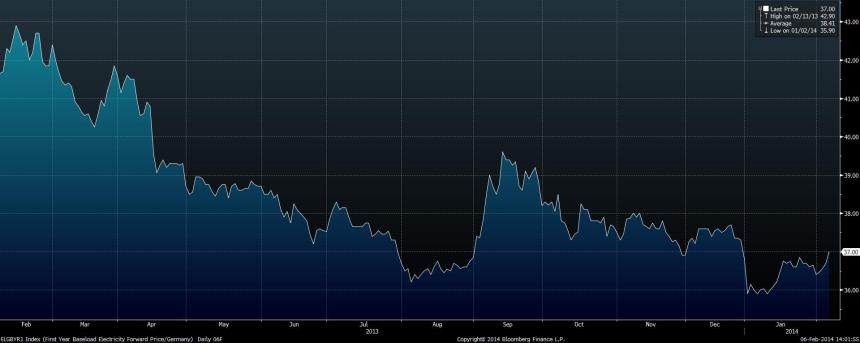
First, at least to me it looks that Electricity prices have at least for now stopped their free fall as those two charts show:

I am clearly not an expert on electricity prices, but with the currently mild winter (or no winter at all), I would have expected a further drop but that doesn’t seem to happen at least for now.

Political environment

Since last year, again some things have changed. We have now the “GroKo” in Germany, the coalition between the two large parties, conservative (CDU) and Social democrats (SPD). Interestingly, the boss of the junior party SPD, Sigmar Gabriel, has taken over the responsibility for Energy.

As I described a year ago, under the current system, mostly retail clients have to pay a surcharge in order subsidize above-market prices offered to the owners of solar and wind power plants. Many large companies are not subject to this “tax”.

The surcharge is increasing every year, both because of lower wholesale prices and additional capacity. However, pressure is building up against this system from many sides. Clearly, the established utilities are fighting against this as hard as they can and threaten to switch of expensive gas-fired power plants which are essential for net stability. But now, also the EU commission started to look into the exceptions for large companies already in December.

Also the core voters of the SPD are mostly lower-income recipients which are most effected by increasing electricity prices along rising rents. So Sigmar Gabriel, the SPD energy minister has to do something in order to stop further retail price increases or he will have no chance of winning the next election. Some ideas were already floated, mostly a limitation of future renewable capacity and lower rebates in the future. The concept drew a lot of critic from all side, although some parts, especially the requirement for direct marketing of renewable power doesn’t seem to be that bad.

In parallel, the bankruptcy of wind energy “pioneers” like Prokon shows that even under current high transfer payments, the big boom in new renewable energy seems to be mostly over and I guess investors will be much more careful in the future.

On top of that, the big utilities are taking out a lot of conventional capacity in Germany, party also in order to increase the pressure on the politicians.

So without being an expert in those issues, it looks like that the “tide might be turning” at some point in time in the future with regard to electricity prices or at least that they are not falling that much more. But this is clearly my own opinion and cannot be supported by a stringent theory or facts.

But why Energiedienst ?

As I have written before, the big traditional utilities like RWE, EON etc. have a lot of other problems, like too much debt, nuclear liabilities, pensions, problematic foreign subsidiaries etc. Even Verbund, thy Austrian Hydro Power utility has a lot of issues with Italian and other foreign investments. Energiedienst, on the other hand does not have those additional issues.

Energiedienst still looks more expensive than its peers:

Name P/E EV/T12M EBIT EV/EBITDA T12M P/B Dvd 12M Yld – Net Net D/E LF
             
ENERGIEDIENST HOLDING AG-REG 11,8 10,2 5,9 0,8 5,2 -7,8
VERBUND AG 9,4 9,8 4,8 1,1 3,8 70,5
RWE AG 108,3 7,2 3,0 1,5 7,4 77,9
MAINOVA AG 15,4 50,5 23,3 2,3 2,4 76,4
E.ON SE 12,2 8,2   0,7 8,3 45,2
ENBW ENERGIE BADEN-WUERTTEMB 51,0 13,0 6,1 1,4 3,1 43,0
LECHWERKE AG 21,7 21,6 14,7 3,1 2,8 -55,8

They do not jump out of this comparison table as the “super cheap” utility. But if we look at Lechwerke in comparison, a comparable, regional, Hydropower utility in Bavaria owned by RWE, sometimes quality is honored with very rich valuations.

In my opinion, the quality of Energiedienst, especially in comparison to EON, RWE & Co is not reflected in the share price. Clearly they suffer as well from current electricity prices and they are not a growth stock, on the other hand, as a hydropower generator without variable input cost, they will benefit the most from increasing prices.

The downside at the current level is in my opinion relatively protected, unless they do something really stupid with their net cash. This is in my opinion the key issue to watch going forward. Energiedienst will generate a lot of cash as reinvestment requirements will be rather limited. If they owuld actually start ti buy back shares, this couldbe a nice surprise but there is no indication that they willdo so.

I am aware that buying a German utility stock now is a pretty contrarian play and many people will say EON and RWE are cheaper and could more speculative upside or not to invest in utilities at all. My focus however is more on the downside, where I think Energiedienst is much better protected than the big, indebted players. So overall, I think the “full” risk/return relationship of Energiedienst is better.

Summary:

An investment into Energiedienst is clearly a bet on constant or higher electricity prices based on potential political changes, so it is rather a “special situation” investment with regard to potential regulatory changes from the current, unsustainable status quo. What I like about this bet is that to a large extent this will be driven by political actions which will be either uncorrelated or even negatively correlated to the overall economic situation and hence, to the rest of my portfolio.

My return target over 3 years would be the annual dividend of currently 5% plus a stock price increase of ~30% which would indicate a target P/E of 13-14 at current Earnings (ex then cumulated cash).

So for the portfolio, I will initiate a 2.5% position for the “special situation” bucket at ~29.50 CHF / 24.50 EUR per share.

Compagnie Du Bois Sauvage & Ackermans Van Haaren update

A friendly reader has sent me a recent research report from KBC about Belgian holding companies, including “sum of parts” valuations for both holdings I looked at, Cie Bois Sauvage and Ackermans & Van Haaren. Just for fun, I wanted to compare my valuations with those valuation:

Cie Bois Sauvage

Here is the comparison table:

Prt Value Comment KBC Valuation
Neuhaus Chocolate 100,00% 300,0 PE 25 265,0
Behrenberg 12,00% 54,0 at 1.5 times book 63,0
Umicore 1,56% 60,5 At market 59,0
Recticel 28,89% 53,4 at market 51,0
Noel Group 29,37% 4,6 PE 10 12,8
Other   20,0 as disclosed 26,7
         
Codic Real Estate 23,81% 24,5 at book 23,1
other reals estate   60,0 as disclosed 66,8
cash etc.   20,0   11,5
         
Sum   597,1   578,9
Net debt   -80,0   -61
NAV   517,1   517,9
         
shares our   1,6   1,6
NAV per share   323,2   323,7

Strangely enoungh, the final valuation per share differs only marginally, despite some divergences, most notably did they value Neuhaus 40 mn lower than I did. Interestingly they have a target price of “only” 235 EUR and consider it as a “hold” position.

Ackermans & Van Haaren

Value Method KBC  
DEME 550 Implicit val. Takeover 995  
Van Laere 26 0.75 book 44  
rent-a-port 5 at book 9  
Maatschappi 20 At book 28  
Sipef 130 market cap 482 137  
Delen 522 1.5 book 970  
van Breda 336 1.2 book 470  
Extensa 80 0.8 book 187 Extensa + Leasinnv
Leaseinvest 108 Traded 0  
Financiere duval 40 at book 45  
AnimaCare 40 2x book 21  
MAx Green 70 10x Earnings 10  
Telemanod 30 10x Earnings 9  
Sofinim 255 75% of NAV minus cash 362  
GIB     41  
Other     39 Belfimas
         
Net cash holding 148 Q3 -93  
         
         
Total 2360   3274

Here we can see that they came out clearly much higher than I did. Especially the private banks were valued much more richly at 1.44 bn vs my 850 mn. I think that this could be a little bit aggressive. The other big difference is DEME/CFE. Where I used the initial valuation before the merger, they use the current market value, which is clearly better. This is partly off set by the lower cash balance where I used the balance before the transaction.

Interestingly again, they apply a discount to the NAV, however in Ackerman’s case only -20% vs the -30% at Cie Bois Sauvage. Their target price is 86 EUR and they rate the stock surprisingly as a buy despite an upside of less than 10%.

Overall it is interesting to see their valuation, but honestly I am not overly impressed and it does not change anything in my conclusions.

Performance review January 2014 – “Taking responsibility”

Performance:

January was a very good month for the portfolio. The portfolio gained 3.68% vs. -1.86% for the benchmark (New benchmark since 1.1.2014: Eurostoxx 200 Small 25%, Eurostoxx50 25%, Dax 30% MDAX 20%).
Major positive contributors were April SA (+12,8%), Cranswick (+10.2%), Installux (+9.6%), Draeger Genußscheine (+8,0%) and Hornbach (+7.1%). Overall, the portfolio benefited from a January small cap effect more than anything else.

Portfolio transactions:

As discussed, I sold the entire Celesio position. Additionally, I started to sell down a quarter of Rhoen at around 21.95 Eur. On the sell list as well is the remaining stake in EMAK. Unfortunately the January effect did not help the EMAK share a lot.

Cash is currently at 15.6% of the portfolio. The portfolio as of January 31st can be found here.

Comment: Taking responsibility

Currently, two complete former management boards of two infamous German banks are standing trial. In both cases, HypoReal Estate and BayernLB, the boards made large acquisitions just before the financial crisis (Depfa, Hypo Alpe Adria) which turned out to be disastrous and sank both banks.

Of course, both boards and CEOs do not see themselves responsible for what happened. Hypo Real Estate’s former boss Funke blames the former German Finacne Minister Steinbrück for everything, the BayernLB CEO Kemmer blames of course the financial crisis for everything.

Taking credit personally for success and blaming others for failure seems to be common today in most management boards. As an investor however this kind of behaviour is very dangerous in many ways. In order to compound wealth long-term, investors need to avoid mistakes much more than trying to pick the next Apple or Google.

Blaming others for bad investments is in my opinion a sure way NOT to compound well in the long run. Blaming others and not oneself increase the risk that the same mistakes are made over and over again. Clearly, luck plays a big role in investing as well, but in the long run skill and especially the avoidance of “Unforced error” will dominate luck.

A good example is the current Prokon “scandal”. Many people now are blaming the German authorities that they didn’t step in and closed the scheme long ago. No, it was not the fault of the investors, which ignored all the warnings, it was the fault of others. Thinking like this leaves the door wide open for the next Ponzi scheme and then the next and the next etc.

If I make a (big) loss with an investment, my first question always is: What did I do wrong ? What did I miss ? Did I ignore facts or did a fall into a behavioural trap ? Unlike a CEO, the only person I can possibly fool is myself, so no need to blame the financial crisis, incompetent politicians, bad weather etc.

The same goes for greate investments. One should also ask oneself: What part was luck and what was skill ? History is full of failed investors which made one lucky trade and then lost it all because the thought that they actually knew what they were doing. The Celesio trade is a good example. Yes, I made a quick nice profit, but my initial assumptions were wrong. So instead of thinking: Hey, merger arbitrage is easy, I should ask myself if this is really a game I should play in the future as I do not seem to have better insights than anyone else.

So to make the long story short: For long term investment success, it is far better to take the opposite strategy of a typical Bank CEO: Take full personal responsibility for failures and only partial credit for success. I will almost guarantee that this will lead to a much better outcome than the typical “Bank CEO” approach for your personal portfolio.

Random thoughts on Emerging Markets, Contrarian investing and Circle of competence

Since I have started the blog, I have been actively avoiding (or even shorting) anything which has significant Emerging markets exposure. This was quite a controversial strategy as for the last few years, investing in Emerging markets or companies with high Emerging market exposure was considered to be one of “THE” no-brainers in investing, along with commodities and residential real estate. Who doesn’t remember the famous “cleanest dirty shirt” slogan from Pimco’s El Erian ?

The momentum of Emerging markets carried them over the Eurozone crisis up until the end of 2012. Interestingly, even after first warning signs emerged like falling commodity prices, free-falling orders for companies like Caterpilar, the Batista bankruptcy etc. last year, the story of the “Emerging market consumer” and the swift transformation from investment led economies into happy consumer countries seemed to be still alive.

Now however, at least in the public perception, people are surprised that the infamous “decoupling” of the BRICs & Co was (as always) more wishful thinking than anything else. Interestingly again, the mood quickly turns from “no brainer” to “full panic”. On the other hand, European stocks, which 2 years ago were seen as total disaster, are touted as the most promising asset class despite being now much more expensive than 2 years ago.

As a contrarian investor, this is the time when one should pay attention and prepare oneself. On the one side, current sentiment tells me that I should become more careful with my high percentage of European stocks, on the other hand, I think it will be a good time trying to expand my circle of competence and start to look more into stocks with Emerging Markets exposure.

However, as a contrarian investor, one should be aware that one is always too early, both in the way in and the way out. This is basically the opposite side of the momentum investor. Psychologically, in my experience, most stock investors seek “instant” gratification. If you buy a new stock, you want the stock go up directly in order to have positive feedback on your thesis. Very few people can stomach declining share prices especially for new investments. In institutional environments there is a very high implicit pressure to invest into stocks with positive momentum as this increases the likelihood to look good in the short-term and this is all that counts, even in many so-called “value investing” outfits.

Back to Emerging markets: The truth is, I know very little about Emerging markets. I have documented one attempt with Pharmstandard as a special situation, where I was clearly luck to get out in time. So one clearly needs to have some sort of strategy.

In principal, there are various ways to gain exposure to Emerging markets:

1. diversified funds/ETFs of Emerging market stocks
2. single emerging markets stocks which are traded on accessible stock exchanges
3. Companies in developed markets with significant EM exposure

Personally, I think it makes most sense to extend the circle of competence in little steps. So investing in a company based for instance in China, where I have no clue how the market works and which is active in an industry where I don not have a lot of experience might be a very bad idea or the equivalent of pure gambling. One should also avoid obvious “compromised” sectors like German listed Chinese companies as the likelihood of systematic fraud is too high in my opinion.

The diversified approach has also big problems. In many markets, for instance Turkey, banks have a huge weight in the indices. As banks are the most vulnerable companies in a real crisis, index investing often turns out to be a suboptimal approach.

This leaves in my opinion two alternatives:

A) Invest in EM companies where I know the sector / business very well
B) Invest in developed market companies with significant EM exposure

Strategy B) in the current stage is relatively difficult, as especially in the consumer and automobile sector, people seem not to believe in any crisis or downturn. Yes, companies like Adidas, Yum or Volkswagen have underperformed the DAX this year, but they are not cheap.

Strategy A) has the drawback that often only a few companies are easily available to invest. In Turkey for instance, there is only a handful companies traded outside Turkey and one might not easily find traded ones in the prefered sectors.

One important caveat: In my experience, both booms and busts take longer to play out as everyone thinks. So there is absolutely no hurry to fully jump into EM stocks now. On the other hand it is very unrealistic to actually identify the low point. So once a certain investment is identified which is attractive, one should buy without trying to time the market.

In any case, for the rest 2014 I will try to look at the one or another company with significant EM exposure instead of chasing the few remaining undervalued European or American stocks. I might even start positions in some and prepare for a lot of pain, both for missing a continuing rally in Europe and for losses in new investments. But that is what contrarian investing is all about.

Celesio Merger arbitrage “Post mortem”

So roughly 10 days after the first failed attempt, Haniel today announced that they have an agreement with both, McKesson and Elliott and that Haniel will sell for 23,50 EUR per share to McKesson.

What happened in between ? Elliott, after the failed attempt further increased its stake to 32% (including convertibles).

In a second step, Elliott sold its stake for an undisclosed price to Haniel, which then in turn sold the 75% plus stake to McKesson at the initial 23,50 EUR.

This structure achieved the following goals:

– Elliott got more than 23,50 EUR
– McKesson does not have to pay more than 23,50 EUR

The “Looser” is clearly Haniel, which will have proceeds lower than 23,50 EUR per share. A friend of mine argued that most likely Haniel paid 24,50 EUR which would roughly equal the initial 23 EUR per share. If this is that case, then we would have the paradox outcome, that the majority owner got the lowest price, the minority a little bit more and the Hedgefund the most.

This is something to keep in mind for potential future merger arbitrage deals: The minority shareholders might not get the same deal as the activist shareholder, at least in the cases where a majority shareholder is selling. In this case, the minority holders got a 50 cent better price than the initial bid, but I could imagine scenarios where there is also the risk of a lower bid.

Interestingly, the stocks jumped today over 25 EUR, I guess some people are already speculating on a compensation payment following the Profit & loss transfer agreement which is the logical next step after the purchase.

Personally, I don’t think that there is a lot of upside, but who knows ? In any case, I think Elliott played that one pretty well for themselves. In any case, this is a hard blow to JP Morgan as M&A advisor to Haniel.

There could be open questions if the whole deal could be interpreted as “acting in concert” between Elliott, Haniel and McKesson. In this case, the bid for all shareholders would need to be increased to the price paid from Haniel to Elliott. I have no idea how likely that is and would not bet on this either.

Annual Performance Review 2013

Performance:

Performance for the month December was +1.2% vs. +1.3% for the benchmark, an underperfomrance of -0.1%. For the year, this resulted in +32.8% vs. +29.0% for the Benchmark (50% Eurstoxx 50, 30% Dax, 20% MDAX), an outperfomance of +3.8%.

Since inception (1.1.2011), the score is now +75.0% for the portfolio (20.5% p.a.) vs. 40.7% (10.4% p.a.) for the Benchmark.
Read more

« Older Entries Recent Entries »