Category Archives: Bilanzanalyse

Vetoquinol SA – It’s a family affair

Vetoquinol is A French company specialized in “Animal health”, i.e. pharmaceuticals for animals. I came across the company more or less by random. The company went public in 2006 but the majority (~62%) is owned by the founding family, the current CEO is the 3rd generation of the founders. Some key figures:

Market Cap 450 mn EUR
P/B 1,6
P/E 16
EV/EBITDA 8
EV/EBIT 11
Operating Margin (11 year avg) 11,0%
ROCE (11 year avg): 10,8%
EPS CAGR 8 year +4,0%
Debt: ~ 3 EUR net cash per share

Read more

Globo Plc – Value superstar or too good to be true ?

Management summary:

At a first glance, Globo PlC looks like a highly profitable, strong growing and incredible cheap software company suffering only from overall bad sentiment against anything which is related to Greece. A second short look however shows clearly that there are a lot of issues in their accounts (capitalization of expenses, revenue recognition) which in my opinion already raises a couple of red flags.

Additionally, some of their behaviour like taking on expensive loans despite a comfortable cash position does make no sense at all.

As for me, value investing is foremost about protecting the downside, Globe PlC is not something I am interested in as a potential investment and not worth additional analysis.

Among value investors, Globo PlC, a UK listed mobile phone software company is no stranger. Almost any screener will have Globo as one of the top investments.

null

Here are the current ratios which clearly look attractive:

Market cap 186 mn GBP
P/E 7
P/B 1,5
EV/EBITDA 4,3
ROE 22,2%
ROIC 19,3%
Operating margin 35%
yoy revenue growth +49%
yoy EPS growth +27%
Net cash 40 mn EUR

Read more

Update Altamir SA: No “CEO self service vehicle” but still the same fees

A few days ago, I looked briefly at Altamir, the French listed Private Equity vehicle which invests exclusively into APAX funds.

This is what I wrote about the CEO and largest shareholder Maurice Tchenio based on how I understood the fee structure:

So the “privilege” of a shareholder to invest into APX via Altamir is purchased quite expensively. This also puts the CEO investment a little bit in perspective. Yes, he has invested around 100 mn of his own money into Altamir, but in 2014, the management fees and profit share netted him close to 30 mn EUR direct, whereas the proportional profit of his share position was “only” 15 mn EUR.

Last week I got a very friendly Email from Altamir’s IR with the offer to explain the fee schedule in more detail. As a follow up they did send me a nice memo with all the details.

In a Nutshell, Tchenio only receives around 2,5 mn EUR from two sources:

– he is entitled to ~22,5% of the “carry” on the old direct investments

– plus he keeps 5% of the adivisory fee paid to the general partner for the direct investments

As the IR pointed out, Tchenio earns more in dividends on the stock than on those fees, so the alignement between him and shareholders is better then I have assumed before.

Just to recap how the fees and carried interest are structured a short list based on 2014

Fees/costs: 17 mn EUR thereof

– 6,8 mn EUR fund level fees

– 1,9 mn EUR HoldCo cost

– 8,4 mn EUR fees charged by the GP (inlc. 1,4 mn VAT), 95% passed on to APAX

Carried interest: 13 mn EUR thereof

– 4,3 mn APAX fund level

– 8,5 mn direct investments, therof Mr Tchenio as former APAX partner 1,9 mn EUR

Having clarified this, this still leaves the issue that 17 mn cost for a 600 mn portfolio is quite a lot. The almost 3% fee includes ~30% listed stocks (Altran, Albioma, GFI) and cash.

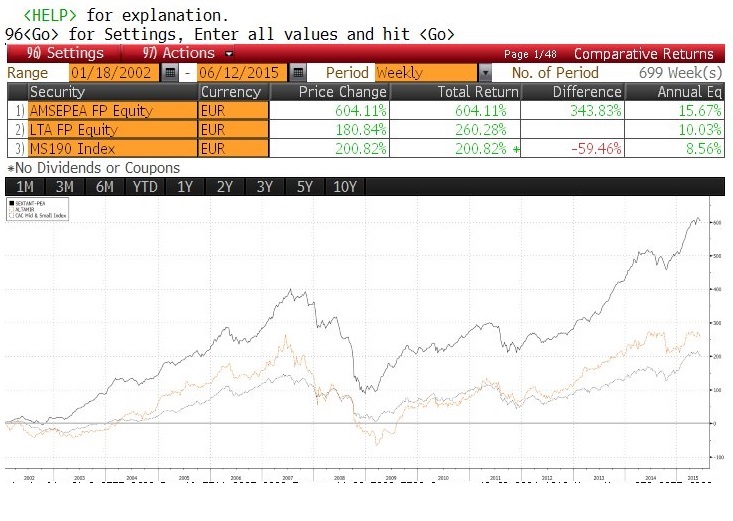
As an investor, I could replicate those stocks much cheaper than what Altamir is offering, or alternatively I could invest in a French based value fund like for instance Amiral. This is a comparison chart between the CAC Small&MidCap index, Altamir and the Amiral Sextant PEA, a smallcap value fund since 2002:

alta3

The lowest line is the index and we can see that Altamir has beaten the index by around +1,5% p.a. However the Amiral fund has beaten Altamir by a large margin despite charging also around 2% fees and a 15% performance fee. Although this is clearly no apples-to-apples comparison it clearly shows that Altamir’s perfomance is not that stellar (after fees).

Summary:

So my assumption that Mr. Tchenio is pocketing a large amount of the fees was clearly wrong. Nevertheless, at least for a “non tax advantaged” investor like me, Altamir doesn’t really offer any value. The fees are much to high and justify a discount. If the right dicount is 30% or less could be discussed but paying 3% + carry on 30% listed stocks is not a real value proposition and will always lead to a discount epsecially on cash and listed companies. Again, if the discount would widen more, it would be maybe worth an investment but for now, I think I can find better investments, especially in France.

Altamir SA (ISIN FR0000053837) – French PE at an attractive discount or CEO “self-service” vehicle ?

Altamir is a French holding company whose main purpose is to invest into private equity funds. Such a structure is called in general “listed private equity”.

To be more specific, this is what they state as the company strategy:

Altamir invests exclusively with Apax Partners, in three ways:

In the funds managed by Apax Partners France:

€200m to €280m committed to Apax France VIII;

In the funds advised by Apax Partners LLP: €60m in Apax VIII LP;

Occasionally, in direct co-investment with the funds managed and/or advised by Apax Partners France and Apax Partners LLP

As investing in only one Private Equity fund company is a quite special arrangement, one asks oneself only one question: Why ? Well, this is explained in the annual report:

Apax Partners was founded in 1972 by Maurice Tchenio in France and Ronald Cohen in the UK. In 1976, they teamed up with Alan Patricof in the United States, bringing the independent entities together under a single banner, Apax Partners, with a single investment strategy and similar corporate cultures, and applying the rigorous standards of international best practices. In 1999, Apax Partners began to merge its various domestic entities into a single structure (Apax Partners LLP), with the exception of the French entity, and reoriented its mid-market investment strategy towards larger transactions (enterprise values between €1bn and €5bn). Apax Partners France opted to remain independent and conserve its mid-market positioning, targeting companies between €100m and €1bn. There are currently no cross-shareholdings or legal relationships between Altamir on the one hand and Apax Partners MidMarket and Apax Partners LLP on the other, nor between Apax Partners Midmarket and Apax Partners LLP

This closes the circle: Maurice Tchenio is the CEO of Altamir and was the founder of Apax Partners in France.

Tchenio retired from Apax only in 2010, so for quite some time he was running Altamir in parallel to being actually part of Apax himself. Maybe to provide stable funding to APAX France ? i don’t know.

So why could this be interesting ?

Looking at Altamir, there were some very positive aspects to be found:

+ CEO owns 26%, is buying (2009: 22%)

+ transparent documentation, reporting. Quarterly NAVs, detailed asset lists

+ French Midcap PE is attractive

+ discount vs. NAV (~30%, 11,20 EUR vs. ~16 EUR NAV). The discount is relatively high compared to other listed P/E stocks (currently on average ~10-15%)

+ no double leverage, net cash

+ paying dividends

+ valuation of unlisted assets relatively conservative, sales prices always higher than last valuation

+ the legal structure seems to be tax efficient for long-term holders (no tax on dividends for French shareholders if one commits to hold > 5 years)

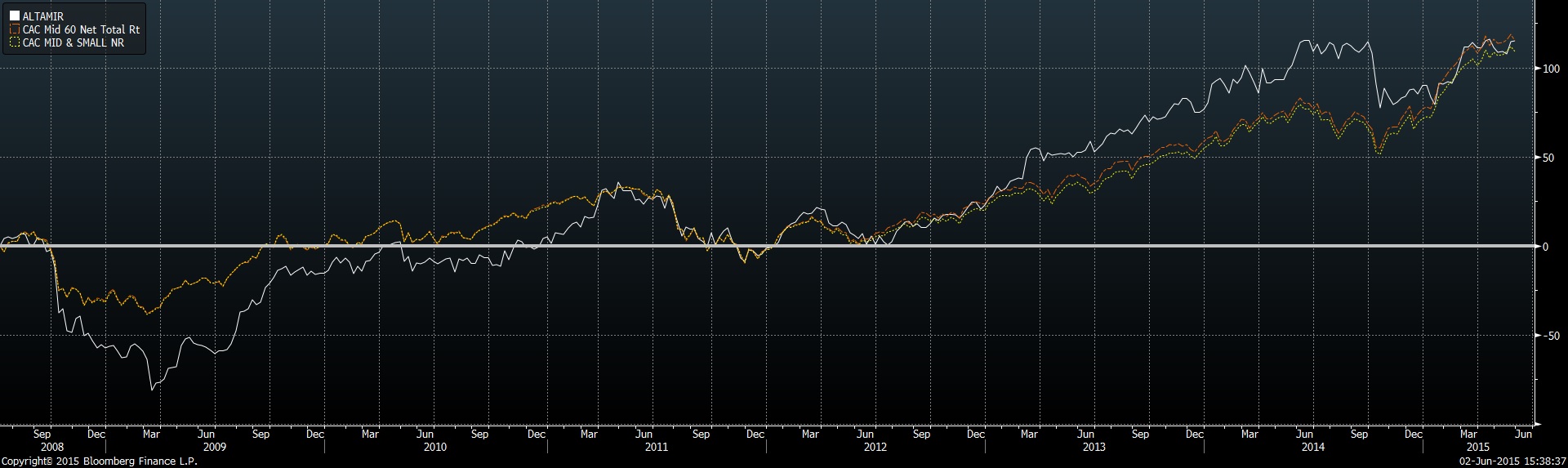
+ track record is pretty OK as we can see in the chart: They did manage to outperform the CAC Mid& Samll cap index since inception based on their stock price, although only at a relatively small margin:

altamir vs cac mid

Actually, those points, especially the “juicy discount” in connection with the large CEO share holding makes this quite interesting

However, the most important thing in looking at such vehicles is the question: How much cost do they add and how much aligned are the interests of management and shareholders ?

And this is where things get a little bit messy. According to the annual report, direct fees are around 17 mn EUR or 2,9% of NAV. This includes in my understanding also the underlying APAX funds. This is not cheap but most likely “in line” with other “fund of fund” PE structures. But the real “fun” starts with the following issue:

The Company has issued Class B shares that entitle their holders to carried interest equal to 18% of adjusted net statutory income, as defined in §25.2 of the Articles of Association. In addition, a sum equal to 2% calculated on the same basis is due to the general partner. Remuneration of the Class B shareholders and the general partner is considered to be payable as soon as an adjusted net income has been earned. Remuneration of these shares and the shares themselves are considered a debt under the analysis criteria of IAS 32.
The remuneration payable to the Class B shareholders and the general partner is calculated taking unrealised capital gains and losses into account and is recognised in the income statement. The debt is recognised as a liability on the balance sheet. Under the Articles of Association, unrealised capital gains are not taken into account in the amounts paid to Class B shareholders and the general partner.

So this is in fact a 18% “carried interest” of the general partner (i.e. the CEO) on any realized profits of the company. So for 2014 for instance, 87 mn EUR of realzed income “shrink” to 57 mn EUR shareholder income as first the management fee gets deducted and then further 18% profit share.

So the “privilege” of a shareholder to invest into APX via Altamir is purchased quite expensively. This also puts the CEO investment a little bit in perspective. Yes, he has invested around 100 mn of his own money into Altamir, but in 2014, the management fees and profit share netted him close to 30 mn EUR direct, whereas the proportional profit of his share position was “only” 15 mn EUR.

Ok, maybe being the Ex Founder of APAX France opens the door to invest into APAX, but charging “3% and 18%” for this privilege (all in) looks quite expensive and explains some of the discount.

Activist angle:

The whole fee issue might also explain why French asset manager Moneta seems to have started in 2012 and “activist campaign” against altamir, see here and here.

They seemed to have pushed for a run-off of the company but so far only succeeded in pressuring to pay a higher dividend than before (increase from 0,10 EUR 2012 to currently 0,50 EUR).

According to Moneta’s homage, they are still active. To me it looks like that the increase in the CEO’s share position has much more to do with control than with actually believing that the shares are undervalued, but of course this could be wrong.

Summary:

In principle, a listed PE vehicle specializing in French mid-market Private Equity could be interesting if the discount is significant. At Altamir however, as I have described above, the structure takes out a lot of money and one needs significant Alpha over time to break even compared to a “do it yourself” portfolio of French small and midcaps.

Tha activist involvement is interesting, but I don’t know enough about French Governance rules to assess the chances of a fundamental change.

So for the time being no investment, however if for some reason (market stress), the discount becomes really large I might be revisiting the case.

AerCap Holdings N.V. part 2 – Less tangible at a second glance

So after my first look into David Einhorn’s long pick AerCap last week, I want to follow up with some more detailed analyis in a second step.

By the way, a big “thank you” for all the qualified comments and Emails I got already after the first post, that’s the best return on investment on a blog post I can get !!!

The book value story growth

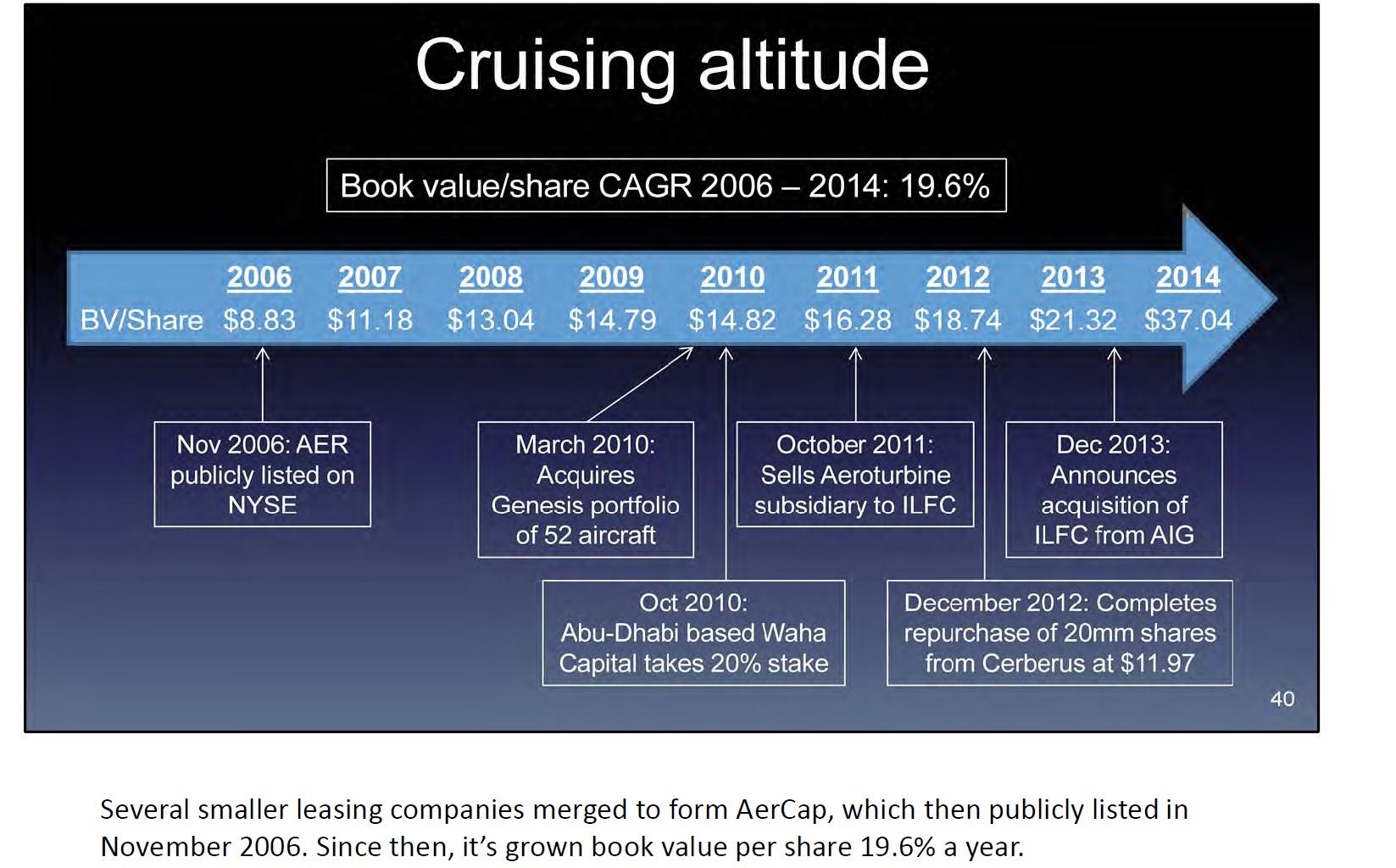
This was for me one of the core slides of Einhorn’s deck:

aercap

I mean you don’t have to be a genius to understand this: A company which trades near book value and compounds 20% p.a. is pretty much a no brainer. However, if I look at the developement of book values for financial companies, I always look at both, stated and tangible book value per share.

In AerCap’s case, the comparison looks interesting:

BV per share TBV share
2006 8,83 8,3493
2007 11,18 10,6041
2008 13,04 12,4083
2009 14,79 14,3448
2010 14,82 14,3798
2011 15,26 15,0608
2012 18,72 18,5592
2013 21,32 21,2334
2014 37,04 16,174
     
CAGR 19,6% 8,6%
CAGR 2006-2013 13,4% 14,3%

This table shows two things: Before the ILFC transaction, stated book values and tangible book values were pretty much the same and compounding around 13% p.a. Still pretty good but clearly not 20%. In 2014 however, with the ILFC deal something interesting happened: The book value per share doubled but tangible book value dropped.

The ILFC deal

So this is the right time to look into the ILFC deal. The two main questions for me are:

a) why did the book value per share increase so much ?
b) why did tangible book value per share actually decrease ?

This is how AerCap presents what and how they paid for ILFC:

Aercap2

So AerCap paid the majority of the purchase with own shares, 97,56 mn shares valued at 46,49 USD. Issuing new shares always has an impact on book value per share if the issue price is different from the book value. Let’s look at an example:

We have a company which has issued 100 Shares at 50 EUR book value per share and 100 EUR market value (P/B =2). So the total market value is 10.000, total book value is 5000. If the company now issues another 100 Shares at 100 EUR market value, we have 200 shares outstanding and 5000+10000 = 15.000 EUR total book value. Divided by 200 stocks we now have 75 EUR book value per share or a 50% increase in book value per share for the old shareholders. So issuing shares above book value increases book value per share automatically.

In AerCap’s case, it worked more or less the same way: AerCap had ~113 mn shares outstanding with a book value of around 21,30 USD per share. So issuing 97,56 mn share at a steep premium at 46,49 of course increased book value per share dramatically. The transaction alone would have increased the book value to ((113*21,30)+(97,56*46,49))/(113+97,56)= 32,97 USD per share or an increase of ~50%.

So how is this to be interpreted ? Well, clearly it was a smart move from AerCaps management to pay with its owns shares at such a nice price. On the other hand, one should clearly not mistake this a a recurring kind of thing. I would not use the historic 20% p.a. increase in ROE as expectation for the future but rather something like 13% or so in the past.

Intangibles

After looking into how much and in what form AerCap was paying, let’s look now what they actually got:

aercap3

Yes, they got a lot of planes and debt. Interestingly they assumed more debt than book value of the planes. Altogether they did get a lot of intangible assets. All in, AerCap bought 4,6 bn intangibles which is around 80 mn more than equity created through the new shares. So at the end of the day, one could argue that the new shares have been exchanged more or less 1:1 against intangible assets.

The largest part of this is a 4 bn USD position called “Maintenance rights intangible” which for me is something new. This is what they say in their 20-F filing:

Maintenance rights intangible and lease premium, net
The maintenance rights intangible asset arose from the application of the acquisition method of accounting to aircraft and leases which were acquired in the ILFC Transaction, and represented the fair value of our contractual aircraft return rights under our leases at the Closing Date. The maintenance rights intangible asset represents the fair value of our contractual aircraft return right under our leases to receive the aircraft in a specified maintenance condition at the end of the lease (EOL contracts) or our right to an aircraft in better maintenance condition by virtue of our obligation to contribute towards the cost of the
maintenance events performed by the lessee either through reimbursement of maintenance deposit rents held (MR contracts), or through a lessor contribution to the lessee. The maintenance rights intangible arose from the application of the acquisition method of accounting to aircraft and leases which were acquired in the ILFC Transaction, and represented the fair value of our contractual aircraft return rights under our leases at the Closing Date. The maintenance rights represented the difference between the specified maintenance return condition in our leases and the actual physical condition of our aircraft at the Closing Date.

For EOL contracts, maintenance rights expense is recognized upon lease termination, to the extent the lease end cash compensation paid to us is less than the maintenance rights intangible asset. Maintenance rights expense is included in Leasing expenses in our Consolidated Income Statement. To the extent the lease end cash compensation paid to us is more than the maintenance rights intangible asset, revenue is recognized in Lease revenue in our Consolidated Income Statement, upon lease termination. For MR contracts, maintenance rights expense is recognized at the time the lessee provides us with an invoice for reimbursement relating to the cost of a qualifying maintenance event that relates to pre-acquisition usage.

The lease premium represents the value of an acquired lease where the contractual rent payments are above the market rate. We amortize the lease premium on a straight-line bases over the term of the lease as a reduction of Lease revenue.

This sounds quite complicated and for some reason part of the sentences seem to have been duplicated. If I understand correctly, they assume that the underlying value of the aircraft is higher than the book value of the acquired planes. To be honest: I do not have any clue if this is justified or not.

However, as those intangibles are significant (more than 50% of book value), the case gets a lot less interesting for me. Intangibles created via M&A activity are in my experience always difficult, especially if it is esoteric stuff like this. It’s also a big change to the past of AerCap. Historically, they were carrying very little intangibles.

Funding cost & ROE

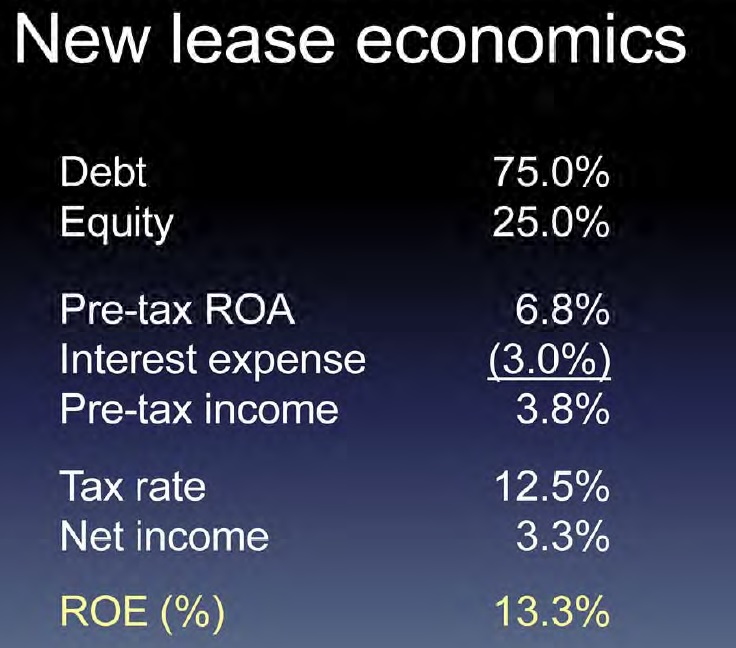
This was Einhorn’s prospective ROE calculation:

aercap roe

One of the key assumptions is a 3% funding cost. So let’s do a reality check and look at the expected pricing of AerCaps new bond issue. This is from Bloomberg:

Aercap $750m TLB Talk L+275, 99.75, 0.75%; Due April 30
By Krista Giovacco
(Bloomberg) — Commits due April 30 by 12pm ET.
Borrower: Flying Fortress Holdings LLC, a subsidiary of AerCap Holdings and International Lease Finance Corp., largest independent aircraft lessor
$750m TLB due 2020 (5 yr extended)
Price Talk: L+275
OID: 99.75
Libor Floor: 0.75%
Call: 101 SC (6 mos)
Fin. Covenants: Max LTV test
Existing Ratings: Ba2/BB+ (corp.); Ba1/BBB-, RR2 (TLB)

So AerCap is funding at a spread of 2,75% vs. LIBOR. With the 10 year USD LIBOR at 2,00%, funding would be way more expensive than the 3% assumed by Einhorn. Maybe the fund floating rate, but then the whole company would rather be a bet against rising interest rates than anything else. On a “like for like” basis without structural interest rate risk, I don’t think AerCap will generate a double-digit ROE at current spreads.

Business case & competitive environment

Within the comments of the first post, some people argued that the company is not a financing company but that the access to Aircraft is the value driver. Buying cheap aircraft from manufacturers and then selling (or leasing) them with a mark-up to clients then looks like some kind of Aircraft trading business.

For me however there is one big problem with such a business model. Retailing or wholesaling any merchandise is then most attractive as a business when 3 criteria are met:

– there are a lot of suppliers
– there are a lot of clients
– you can create a competitive advantage via physical distribution networks

In AerCap’s case, the biggest problem is clearly that there are not that many suppliers but only 2, Boeing and Airbus. Both don’t have much incentive to let any intermediary become too large so they will most likely encourage competition between Aircraft buyers.

Secondly, as far as I understand, there is no physical distribution network etc. behind AerCap’s business. So entering the market and competing with AerCap in the future doesn’t look so difficult for anyone with access to cheap capital.

Clearly, as in any opaque trading business, an extremely smart trader can always make money but it is important to understand that at least in my understanding there are no LONG TERM competitive advantages besides the purchase order flow from ILFC.

That the barrier to entry the business is not that high is proven by no other than Steven Udvar-Hazy the initial founder of ILFC and his new company Air Lease.

IPO’ed in 2010 and now the company is already a 4 bn USD market company 5 years later. Interestingly, AIG sued Air Lease in 2012 because they

were able “to effectively steal a business,” and reap a windfall at the expense of ILFC, the world’s second-largest aircraft lessor by fleet size. It described how some employees, while still working at ILFC, downloaded confidential files and allegedly diverted deals with certain ILFC customers to Air Lease, before leaving to join that firm. The companies are in the business of buying aircraft and leasing them to commercial airlines all over the world.

So to me it’s not clear what AerCap actually bought. It seems the “secret sauce” of ILFC seems to have been transferred to competitor Air Lease already. Interestingly, the lawsuit was settled a few days ago at a sum of 72 mn USD. I found that quote from Udvar-Hazy interesting:

“I want to make it clear that there is no secret sauce in the aircraft leasing business,” Hazy told analysts on a conference call. “ALC’s success is a result of a strong management team with extensive experience and solid industry relationships.”

Summary:

My problem with AerCap is the following: The financial part of the company, which I feel that I can judge to a certain extent, does not look attractive but rather risky to me. The Aircraft “buying and trading” segment on the other hand seems to be the more attractive part but for me too hard to judge in a reasonable way.

So for the time being, this is clearly not an investment for me. To look further into AerCap, two things need to happen: First they need to regain their investment grade rating and funding cost will need to drop to the 3% that Einhorn is assuming and secondly, there should be a clear impact on the share price from a potential sale from AIG.

In the current market environment clearly anything can happen and a multiple expansion could bring nice profits but personally, in a direct comparison I prefer the LLoyd’s case.

AerCap Holdings NV (ISIN NL0000687663) – How good is Einhorn’s new favourite ?

A friend forwarded me the latest presentation from “guru” David Einhorn where his main long pick was AerCap, an Airplane leasing company.

To shortly summarize the “Long case”:

– AerCap is cheap (P/E 9)
– they made a great deal taking over IFLC, the airplane leasing division of AIG which is several times AerCap’s original size
– they have great management which is incentivized along shareholders
– The business is a simple and secure “spread business”
– major risks are according to Einhorn mostly the credit risk of the airlines and residual value risk of the planes

There are also quite obvious reasons why Aercap is cheap and trades at lower multiples than its peers:

– share overhang: AIG accepted new AerCap shares as part of the purchase price and owns 45,6%. They want to sell and the lock up is expiring
– following the IFLC/AIG transaction, the company was downgraded to “Non-investment grade” or “junk” and has therefore relatively high funding costs compared for instance to GE as main competitor

What kind of business are we talking about?

Well, Airplane leasing is essentially a “special purpose lending business” without an official bank license, one could also say it is a “shadow bank”. What Aercap essentially does is to loan an airplane to an airline.

In order to make any money at all, they have to be cheaper than the simple alternative which would be the airline gets a loan from a bank and buys the airplane directly. As Airlines are notoriously unprofitable and often thinly capitalized, they often need to pay pretty high spreads even if they borrow money on a collateralized basis.

As any lessor funds the plane mostly with debt, the cost of debt is one important factor to make money compared to competitors. It is therefore no big surprise that GE with its AA+ Rating is the biggest Airplane leasing company in the world and that ILFC thrived while AIG was still AAA and had comparably low funding cost.

Airplane buying is tricky business

A second aspect is also clearly buying power. Planes have to be ordered many years in advance and the two big manufacturers want to be sure that they are getting paid. I assume a reliable bulk buyer gets better access to the most sought after planes and maybe even better prices. Prices for planes at least in my experience are notoriously intransparent. Nobody pays the official list prices anyway. I found this interesting article in the WSJ from 2012.

When Airbus and Boeing Co. announce orders at the Farnborough International Airshow this week, they will value the deals based on the planes’ catalog prices—which no one pays. Airline executives, when pressed for details, will probably say they got “a great deal.” But actual terms will remain guarded like nuclear launch codes.
The aviation industry’s code of silence on pricing is notable in this era of information overload. Thousands of people world-wide are involved in airplane purchases, yet few numbers spill out. That yields much mystery and speculation.

Discounts are large:

But there are ways to estimate the range of discounts. An analysis of public data by The Wall Street Journal and interviews with numerous industry officials yielded this: Discounts seem to vary between roughly 20% and 60%, with an average around 45%. Savvy buyers don’t pay more than half the sticker price, industry veterans say. But deal specifics differ greatly.

But no one wants to talk about it:

One reason for the secrecy surrounding all this, say industry officials, is psychology: Less-experienced plane buyers like to think they got a bargain and don’t want to be embarrassed if they overpaid. The safest approach then is silence. More-seasoned plane buyers also know that bragging about discount specifics would anger Airbus, Boeing or other producers and hurt the chances of striking a sweetheart deal again.

Clearly, as a large “quasi broker”, Airline leasing companies seem wo have a chance to make some money in such a intransparent market. But it is really hard to pin down real numbers. It reminds me a little bit about how you buy kitchens in Germany where the system is pretty much the same. Everyone gets a discount, but no one knows what the “true” price looks like.

But this also leads to a problem:

With the current funding costs, AerCap would not be competitive in the long run. Let’s take as a proxy the 10 year CDS spread as a proxy for funding costs and compare them across airlines and competitors (more than 50% of AerCaps outstanding debt is unsecured):

10 year senior CDS Rating
     
AerCap 215 BB+
     
     
Clients    
Air France 96  
Singapore Airlines 105 A+
Southwest 109  
Lufthansa 195 BBB-
Thai Airways 240  
Delta 256 BB
Emirates 257  
Jet Blue 362 B
     
Competitors    
GE Capital 72 AA+
Air Lease 175 BBB-
ICBC 194 A
CIT 229 BB-

So purely from the funding cost perspective, AerCap at the moment has a problem. Someone like Air France could easily fund a loan for an airplane cheaper than AerCap, so cutting out the middle man is basically a no brainer and even the smaller competitors could easily under price AerCap when they bid for leasing deals. On top of that, a lot of non-traditional players like pension funds and insurance companies want some piece of the action, as the return on investments on those leases are significantly higher than anything comparable. Even Asset managers have entered this market and have created specific funds for instance Investec.

AerCap does have a positive rating outlook, so there is a perspective for lower funding costs. Just to give an indication of how important this rating upgrade is: On average, 10 year BB financial isuers pay 2,4% p.a. more than BBB financial issuers at the moment. The jump from BB+ to BBB- will not be that big but it would increase the investor universe a lot for AerCaps bonds.

The biggest risk for AerCap

So although I am clearly no match for David Einhorn (*), I would argue that the biggest risk for AerCap is not the residual value of the planes or the credit quality of the Airlines but quite simply the refinancing risk. AerCap has to fund a significant amount going forward and if for some reasons, spreads move against them, they will be screwed. Just a quick reminder what happened to ILFC in 2011:

Credit-default swaps on the company climbed this month as global stocks tumbled and speculative-grade debt issuance all but evaporated. The cost reached as high as 663 basis points on Aug. 11, according to CMA, which is owned by CME Group Inc. and compiles prices quoted by dealers in the privately negotiated market. The contracts have held at prices that imply ILFC’s debt should be rated B2, according to Moody’s Corp.’s capital markets group.

However if they manage to to get an investment grade rating and lower their funding cost, then it could be an interesting investment as funding is cheap and they do have access to a lot of new and sought after aircraft. Again, borrowing from Warren Buffett, with any leveraged company, management is extremely important.

And one should clearly compare AerCaps valuation and risk/return to banks and not to the currently much higher valued corporates. AerCap is much more similar to a bank than anything else. This general valuation disconnect seems to be also one of major reason why GE announced the massive reorganization just 2 weeks ago. However, as far as I understood tehy will keep the leasing business as this is unregulated.

Summary:

Although I slightly disagree with the risk assessment of Einhorn’s case, I still think AerCap could be an interesting case and is worth to dig deeper. I don not have a problem investing into financial companies and I do like those “share overhang” situations. However, I will need to dig deeper and especially try to figure out how good AerCap’s management really is.

(*) I did disagree with David Einhorn already once with Dutch Insurer Delta LLyod which was Einhorn’s long pick of the year 2011. Overall in this case I would put the score of MMI vs. Einhorn at 1:0 as Delta LLoyd did not outperform.

Update: TGS Nopec Annual Report 2014 and Q1 2015

TGS Nopec is one of my larger position which I bought back in November 2013 when oil (WTI) was still trading at ~100 US and the world looked great for oil and oil service companies.

In the meantime, as we all now, the oil price fell substantially since 2014 and especially oil service companies were hit hard. In contrast to other oil service companies however, TGS share price has decoupled from oil to a large extent as we can see in the chart:

This is especially interesting as 2008/2009 for instance, TGS lost almost -70% when oil crashed back then. Almost always when I discussed TGS with other investors, the argument was like this: TGS is a great company but the price has to fall at least -50% or more as it did in the past. Well, for now they are holding up pretty well.

2014 annual report

Anyway, the 2014 annual report can be found here

I would recommend anyone to read the annual report, at least the one page letter of the CEO, which in very clear words describes how TGS operates.

The highlights from my side:

– EPS dropped significantly from 2,59 USD to 2,09 USD per share
– however there were several negative one time effects included (around 65 mn USD or 60-65 cents per share).
– interestingly they make no effort to adjust those one time effects. You won’t find adjusted numbers anywhere in the report. I like this VERY MUCH.
– Operating cashflow actually increased by 10%
– Operationally, the Americas were doing very well in 2014. Asia was growing strongly but deeply negative
– payroll costs increased by ~10% in 2014
– they are still committed to invest counter-cyclical into new data by taking advantage of low charter rates for ships

Overall, they way TGS operates, 2015 will not look good from a P&L perspective, as they expense a lot of their investments and sales might take a little bit longer than usual. However if the past is any guidance for the future, in 2-3 years time the investments will then turn into nice profits down the road.

Q1 2015 update

A few days ago, even before the official Q1 report, TGS issued a Q1 update press release. They reduced significantly the expected net revenues for 2015 as E&P companeis are delaying their projects. Additionally, they announced a significant cost cutting program:

The Cost Reduction Program will position the company for the more challenging seismic market caused by the significant drop in oil price. A key element of this program is a reduction of more than 10% of TGS’ global workforce effective from April. Restructuring charges of approximately USD 4 million will be booked in Q2 as a result of this Program. The company expects annual cost savings of approximately USD 10 million as a result of the Cost Reduction Program.

Interestingly, this 10% reduction seems to off set the salary increase in 2014. At first, the market seemed to be shocked and the stock lost around -20% intraday but since then things have recovered. Maybe the recommendation change from Goldman has lifted the stock. This is what Goldman wrote last week (via Bloomberg):

(Bloomberg) — Offshore seismic market set for structural changes as oil producers rationalize costs, optimize upstream portfolios and concentrate on efficiency, Goldman says in note dated yday.
Goldman: multi-client segment has strongest outlook; data acquisition will continue to face challenges with at least six vessels needed to leave market to achieve balance
TGS raised to buy vs sell, is best-positioned in new oil order; co.’s library has highest N. America exposure which should remain most attractive onshore area
Strong financial position can sustain div.; selloff post 1Q creates buying opportunity

So it seems that this time, TGS does get better credit for their countercyclical business model than in 2008/2009. Maybe investors have learned actually a little bit since then ?.

In any case, from my side, TGS is a clear long-term core investment. Although the industry is very difficult, TGS is very good company with strong competitive advantages. Oil companies must replace their reserves,the demand for seismic data is not going away. Maybe it gets postponed a little bit ut they don’t have a choice. Without replacing reserves, atraditional E&P will not valued as going concern but as a run-off which much lower multiples.

Even with the reduced forecasts, TGS is still very profitable and who know what opportunities show up if some of the competitors get deeper into problems.

Lloyds Banking Group (ISIN GB0008706128) – A potential interesting special situation within UK Banking (part 1) ?

Quick “Management summary”:

Within the large UK banking peers, only Lloyds banking Group offers a “pure play” Uk opportunity. There are a lot of negatives around UK banking in general and Lloyds specifically, but overall nothing which would “kill” the investment at this stage. Potentially, the current selling of the UK government and the visible turn around could present an attractive entry point for a turn around situation with kind of “catalyst” if Government at some point is finished and profit increases ex fines.

Following my Aldermore post a few days ago, I decided to have a closer look into the listed UK banks as the UK market looks structurally more interesting than most European ones. Overall valuations are pretty moderate. This is a table based on the most recent financial year:

<

Name P/B P/TB Leverage NIM Pers. Exp P/E
HSBC HOLDINGS PLC 0,88 1,03 13,17 2,08% 33,25% 12,5
BARCLAYS PLC 0,77 0,90 22,03 0,00% 43,52% #N/A N/A
ROYAL BANK OF SCOTLAND GROUP 0,71 0,82 17,46 1,83% 38,00% 101,2
STANDARD CHARTERED PLC 0,90 1,01 15,53 2,15% 37,02% 16,5
LLOYDS BANKING GROUP PLC 1,19 1,30 17,13 1,33% 28,40% 51,7

Looking at the list of banks, lets look quickly at the different players.

1. HSBC

HSBC is by far the biggest player with the clear target to be one of the biggest players globaly, offering all services from investment banking to private banking, etc. Their UK business is a rather small part of the company, the biggest part of the business comes from Asia. Historically, HSBC has always been trading at least at 2x book value. The company has been involved in many scandals, the problems of the Swiss subsidiary and the secret bank account of the CEO are only the latest example. Overall, HSBC is much more a play on Asia than anything else.

2. Barclays

Barclay’s is in its core an investment bank with some retail businesses attached. They took over large parts of Lehman following the financial crisis. Barclay’s has significant revenues from card processing and African operations. As with HSBC, UK retail is not their main focus.

3. Royal Bank of Scotland

The creation of “Fred the Shred”, had to be bailed out by the British Government in 2008. The Government still owns more than 60%. Among others, RBS is obliged to dispose US subsidiary Citizen’s which I own as a “special situation”. RBS is (still) a full service bank, including investment banking and wealth management. RBS is still in the middle of restructurings, for instance just a few days ago they announced to drastically shrink Non-UK investment banking.

4. Standard Chartered

Although Standard Charteres is UK listed, it basically does not do any business in the UK. It is an international commercial bank active mostly in Asia and Africa. The CEO has been recently replaced and the share price has recovered. Historically, as HSBC, Standard Chartered used to trade at much higher mutiples.

5. Lloyds Banking Group

After the disastrous HBOS acquisition in 2008, Lloyds had to be bailed out by the British government. the Government still owns 23% and is in the process of selling down. As part of the reorganization, Lloyd’s IPOed TSB and scaled back the international business. Lloyd’s is an almost “pure play” UK bank with the largest share in UK business of all the players. After the spin-off of TSB, they still have on average ~20% market share which to my knowledge is pretty unique for a private bank in a Western country.

So LLoyd’s in principle is the only interesting “play” to invest into UK banking. But is it worth the effort to dig deeper ?

As always, the first step is: Try to kill the investment case

This is the list I came up with after reading the 2014 annual report plus some “well known facts” about banks:

1. Lloyds had to pay massive fines, among others for misselling PPI insurance, Libor fixing etc and there is more to come
2. The UK Government still owns ~23% and is selling
3. Uk banking is very unpopular in the public’s mind which is bad for business
4. UK bank levy has been extended
5. 3 officers get 21 mn in 2014 despite tiny profit, bonus for”underlying profit”
6. huge pension plan (funded, derisked)
7. UK housing is overheated
8. In the next financial crisis, all banks will crash again
9. Valuation is high compared to “peers”
10. They only pay a tiny dividend
11. Risk of UK election outcome and UK exit
12. The banking business model is dead

1. Fines/PPI

This is a quote form the annual report:

PPI
The Group increased the provision for expected PPI costs by a further £700 million in the fourth quarter. This brings the amount provided in 2014 to £2,200 million (2013: £3,050 million), and the total amount provided to £12,025 million. Total costs incurred in the fourth quarter were £700 million and as at 31 December 2014, £2,549 million or 21 per cent of the total provision, remained unutilised.

So they do have still a 2 bn GBP provision for additional claims. Overall, the PPI episode was clearly a major issue for them. But on the other hand, there is some reason to believe that we have seen the peak. I am no expert in this, but if the provision would be enough, we could see rapidly increasing earnings over the next 1-3 years. Reading through the annual report, it looks like that they should not expect any US fines and also most FX/Libor related fines should be closed. But there clearly remains a risk.

2. Government stake / selling

In December, the UK Government decided to “dribble” the stocks into the market and against a one time big sale. A few days ago they released that they had sold 1% down. This constant selling is of course not good for the shareprice. The “break even” for the Government seems to be 73,6 pence, so one could expect that they are constantly in the market for the time being. This is clearly bad for traders but not necessarily for long term investors.

Looking at the chart, it seems that there is a “lid on the price” at around 80 pence since more than a year:

Forced sellers or in this case sellers who don’t want to maximise their long term return are often moving prices into “non-effecient” areas. As we value investors know, price is not equal value. So the classic “share overhang we have here might be a reason to actually look deeper into the value of the stock as there is a good chance that without those sales, the share price could be higher.

3. Bad reputation

Banking in general and UK banks in particular are maybe one of the most hated companies at the moment. As I have written, many small players try to take advantage of this like Aldermore, Handelsbanken or Virgin Money. Plus, the UK banks lose most law suits as judges mostly side with the plaintifs. The question clearly is if this will hurt the big players all over and long term or if there will be winners and losers for the big players. My personal opinion is that LLoyds as a focused UK player is in a better position to turn around the image than for instance RBS, HSBC or Barclays who have other problems to solve. I will look at this later but in my opinion the main victims will be the “weaker” players, not Lloyds Bank.

Bad reputation on the other side can be interesting for an investor. When no one wants to touch a stock, it is usually more likely a value investment than if everyone is talking on cocktail parties on how great a company does.

4. UK Bank levy

As a direct result of the bad reputation, the UK government had introduced a bank tax (“levy”) as a percentage point of the full balance sheet after the financial crisis. Currently it is ~0,21% for the whole balance sheet amount, a very significant expense especially for banks which have a lot of non-Uk business (Standard Chartered, HSBC). There is clearly a risk that a socialist UK Government will keep or even increase the tax. On the other hand, corporate taxes in the uk went down a lot which kind of off sets this issue compared to non-UK peers.

5. Large bonuses 2014

Especially the CEO, Antonio Horta-Osorio made around 11 mn GBP in 2014 which caused some uproar in the UK press. However most of that was a result of a 3 year plan which vested this year. On the other hand, he turned down a bonus of 2 mn in 2012 and received most of his bonus in stocks which he pledged not to sell until the government is out. As management plays a big role at banks, I will need to look deeper into the CEO at a later stage. Comapring older annual rpeorts, they have dropped their initial target from 2012 to earn 12-15% ROE in the long term.

6. Large pension plan

To be honest, Lloyd’s pension plan is not only huge but GIGANTIC. The current DBO liability is 38 bn GBP not much less than the total core equity position. The bad news: The discount rate the use with 3,67% is pretty high, on the other hand, they have derisked the plan early. of the 38 bn assets, only 5 bn are equity. Additionally, they seemed to have actively closed a large part of the interest rate risk in 2014. This is the statement from the annual report:

The asset‑liability matching strategy currently mitigates approximately 89 per cent (2013: 54 per cent) of the interest rate volatility and 94 per cent (2013: 71 per cent) of the inflation rate volatility of the liabilities.

This was very fortunate or clever timing and might have spared them a couple of billions over the last few months. For pension plans, this is clearly best in class with regard to ALM. Nevertheless a big pension plan like this will eat up a lot of capital and risk bearing capacity for the company and is clearly a big negative factor.

7. UK housing is overheated

I am not an expert in UK housing, but my assumption is that they are better prepared than last time.

8. In the next financial crisis, all banks will crash again

As I have mentioned before, I do think the banking sector overall is much more stable than in 2007. the next crisis will come from somewhere else and the major victims will be other players.

9. Valuation is high compared to “peers”

Yes, at first sight it looks expensive, but in my opinion, Lloyds is already 1-2 years ahead compared for instance with RBS. The have cleaned up the organization and the portfolio

10. They only pay a tiny dividend

Compared to the 6% of HSBC, Lloyd’s tiny dividend looks ridiculous. However this could change quickly and Lloyds could become interesting for dividend investors.

11. Risk of UK election outcome and UK exit

Valid concern, however I tend to ignore such macro stuff. Rather I think it could be an additional explanation for a low valuation.

12. The banking business model is dead

Nope, I do think the “traditional” banking model is here to stay, at least for the banks who do it right.

Summary:

Overall, I would not “kill” the Llyods investment case at this stage. The biggest issue for me is the gargantuan pension plan. Although it seems to be well-managed, it is still HUGE. In a next step, I will need to come up with a valuation or some idea about potential returns for Lloyds and have a closelook at management.

As a side remark: I do see that someone like Handelsbanken could capture market share, especially from guys like RBS or Barclays. A funny side note: Handelsbanken doesn’t even appear as competitor for Lloyds in their 2014 strategy update

Handelsbanken (part 3) – where is the upside & valuation

As this turned out to be again a pretty long post, a quick “management summary” in the beginning:

1. I do think that Handelsbanken’s UK business represents a significant opportunity for long-term growth
2. Additionally, I think that well run banks are a good opportunity as banks are in general disliked and overall risks in banking have been greatly reduced
3. However, at current valuation levels, Handelsbanken is too expensive. I would be a buyer at around 350 SEK per share or ~-15% below current prices

After trying to “kill” the Handelsbanken investment case last week, now in my third post I will look at the potential upside.

From my side, there are 2 potential “catalysts” which COULD imply future upside, which are:

1. Significant growth potential in UK and Netherlands
2. (Relative) revaluation of the banking sector in the medium term

1. Significant growth potential in UK and Netherlands

If you read the Handelsbanken annual reports over the last few years, it is not exactly a secret that they have great success in the UK. This is a table I compiled from the annual reports which shows the development of the UK branches:

Branches Operating profit Total OP UK/total
2009 62 177 13727 1.29%
2010 83 417 14770 2.82%
2011 104 639 16563 3.86%
2012 133 1006 17108 5.88%
2013 161 1173 18088 6.48%
2014 178 1652 19212 8.60%

Since the end of the financial crisis in 200, Handelsbanken managed to increase operating profit in the UK 10 times and the UK business reached almost 9% of total operating profits in 2014.

Despite a higher cost/income ratio in the UK (~55%) vs the home market in Sweden (~33%), profitability as measured by ROE is already at the same level. Opening bank branches is clearly a cost factor, so one should expect cost income ratios to even go down in the UK over time.

Gross margins in the UK are clearly higher than in Sweden. In my opinion, this has two possible explanations: First, overall interest rates are higher in the UK which makes it easier to charge more. Secondly, most of the competitors (Barclay’s, HSBC, Lloyd’s, TSB) have large legacy portfolios and need to earn margins on new business.

The big question is: can Handelsbanken continue to grow and how big could this become ? One clear driver of the growth is that UK customers are fed up with their local banks. Most of them needed bail outs (RBS, Lloyds, TSB), damaged their reputation by aggressively selling questionable products and/or tax evasion etc. (HSBC’s Gulliver with his Swiss bank account as a last example).

Handelsbanken’s market share in UK so far is tiny. I tried to collect some numbers. In this 2011 report for instance, Handelsbanken didn’t even show up. This is how market shares for instance looked for personal account:

Normally, as in many industries, size does have advantages also in retail banking. Advertising for instance are expenses which scale well. In the UK however banks with large market shares face strong headwinds as outlined in this article. Interestingly, Lloyd’s with its leading market share has a cost-income-ratio of currently around 67% and this number has improved a lot over the last year. So it’s quite interesting to see that the “dwarf” Handelsbanken is already much more efficient than the big guys.

Overall, without having examined the UK market in more detail, I do think there is room for Handelsbanken to expand and reinvest capital at attractive rates for some time.

Personally, I like the organic growth of Handelsbanken a lot. In general I find that especially in the early stages, organic growth is often undervalued. Stock investors prefer often fast growth via acquisitions. You can book a lot of accounting special effects etc. and increase EPS per share much quicker. As we have seen often however, the risk of M&A deals is a lot higher and more often than not, those deals backfire and sometimes even sink the acquirer.

In the UK for instance, recently spun-off TSB has already been approached by Spanish Bank Sabadell for a potential take over a few days ago. This is of course a quick way to add a lot of branches but also a much more risky one.

Netherlands:

Netherlands for Handelsbanken is a comparable small market. with currently 20 branches (up from 18 in 2013), the business grew by ~17%. In principle, I think the situation could be similar to the UK. a lot of the dutch banks have big legacy issues and need to earn margins. However at the moment I would look at the Netherlands as an option and not as something to actually take into account when valuing Handelsbanken.

2. (Relative) revaluation of the banking sector in the medium term

I have quickly touched this topic in the two other posts already. Banks are generally considered as “bad investments” by most participants in the stock market. This is clearly justified if we look back the last 10 years or even longer. Whereas a company like Nestle is considered a safe and promising investment at a P/E of around 23, banks are considered a pure gamble even when the trade at fractions of those multiples.

For me, this is both, a lesson in how to look at historical data and a potentially big structural investment opportunity. Let me explain why.

The main arguments against banks is that they are highly leveraged and too risky. The risk is both individual and systemic (Lehman scenario). In my opinion, the systemic risk component has been greatly reduced by what happened since the financial crisis. A lot of mechanisms have been created to prevent a second event like the run that happened in 2008/2009. For me the most important are:

– collateralization of derivatives
– bank resolution systems both national (e.g. SOFFIN) and on international level
– clear commitment and mandates of central banks
– significant increase in capital requirements internationally

For current shareholders of large legacy banks, this is not very funny at the moment. Whereas most non-banks pay dividends and buy back shares like crazy, banks have to raise capital and postpone dividends in order to shore up their capital. And clearly, in many of the mega-banks, there is plenty of toxic waste on the balance sheet to justify low valuations.

On the other hand, this creates in my opinion great opportunities for players like Handelsbanken which have little toxic waste on their balance sheet and are run efficiently. The systemic risk for those players has become a lot smaller as a potential bankruptcy of one of the old mega-banks will most likely have only little effects on other banks in the future.

The individual risk of a classic and disciplined lending bank in my opinion is relatively limited if it is run by the right people. I do not think that a conservatively run bank is riskier than any other business. I know this is a somehow controversial standpoint but to me, a standard banking business model looks a lot less complex than for instance a multi national branded consumer goods company. For me this kind of blind distrust in the banking business model creates a very interesting opportunity.

Yes, banking in general will be much more dull in the future, but als a lot safer.

The second issue I want to touch quickly is the issue of historical data. Yes, historically, banks look like terrible investments because many of them have been wiped out in the financial crisis. I cannot prove it statistically, but I think banks are also the reason why suddenly low P/E and low P/B strategies seemed to have stopped working. The now favored metric by many “data miners”, the EV has the advantage that it automatically filters out any financial company. But looking into the rear view mirror is not always the best way to make investment decisions. If you would have been a stock investor after WW II, you might not have ever invested into German or Japanese shares because they have been wiped out. But a World War luckily does not happen every 5-10 years and neither does a full-blown financial crisis.

I think that there is a good chance that due to the pressure of capital markets, in the future, returns for banks could be relatively a lot better than they have in the past, assuming that the basic banking model is here to stay. The market will squeeze banks so much that those who remain will earn good ROEs again at some point in the future. And good banks will earn very good ROEs.

Valuation exercise

There are many ways to evaluate companies. I prefer simple ones. For banks, I consider ROE and P/B as the most important factors which drive long-term returns, so a valuation model should focus on those metrics.

To have a starting point, I make the following assumptions:

– ROE will improve to 15% over 5 years (from currently 12,4%) and will stay there (15 year average is 16,5%)
– P/B will remain constant at 2,1 (15 year average is 1,7)
– Divdend payout will be 25% and handelsbanken will be able to reinvest at the above assumed ROEs

The following table translates this into a simple IRR calculation:

Current Price book 2,1                    
ROE 15%                    
                       
ROI 7,1%                    


    1 2 3 4 5 6 7 8 9 10
Book Value 200 218,8 240,1 264,4 292,1 323,9 360,4 400,9 446,0 496,2 552,0
ROE 12,5% 13% 13,50% 14% 14,50% 15% 15% 15% 15% 15% 15%
EPS 25 28,44 32,41 37,01 42,36 48,59 54,05 60,13 66,90 74,43 82,80
Implicit P/E 16,8 16,2 15,6 15,0 14,5 14,0 14,0 14,0 14,0 14,0 14,0
Retention ratio 75% 0,75 0,75 0,75 0,75 0,75 0,75 0,75 0,75 0,75 0,75 0,75
Dividend   7,1 8,1 9,3 10,6 12,1 13,5 15,0 16,7 18,6 20,7
Target Price   459,4 504,2 555,2 613,5 680,2 756,8 841,9 936,6 1.042,0 1.159,2
                       
NPV CFs -409 7,1 8,1 9,3 10,6 12,1 13,5 15,0 16,7 18,6 1.179,9
                       
IRR 12,9%                  

Under those assumptions, Handelsbanken would be trading at 1.160 in 10 years time and returning me 12,9% p.a.

Now comes the interesting part: If I would want to see my 15% p.a. which I normally require, I would need to change assumptions. First I could move the purchase price down from 409 SEK. In my model, I could pay 342 SEks per share and get my 15% annual return. I could also increase my P/B multiple to 2,6 to get my 15% or I could increase the ROE to 21% after year 6 to get 15%. To be honest, both, the multiple expansion and the ROE increase seem much to aggressive to me.

So the question clearly is: Is 12,9% potential return enough or should I insist on 15% ? With the 10 year government rate in Sweden at 1%, the 12,9% would indicate a potential equity premium of 11,9% which is far more than one would normally expect from the market. On the other hand, no one knows what long-term interest rates will be in 10 years time, so betting fully on today’s low rates is also not the best solution.

This return is also driven by the assumption that Handelsbanken can continue to reinvest 75% of their profits at attractive ROEs. In Handelsbanken’s case, I don’t think that this is unrealistic. However if they could for instance only reinvest 60% and pay out the rest in dividends, then the expected return would drop to 10,7% p.a.

Anyway, for now, I would not feel comfortable investing at the current stock price level.

Summary:

At the end of this mini-series, it has become relatively clear to me that Svenska Handelsbanken is really a great company, a true “Outsider” in regard to its business model and culture. Additionally, I do think that they have good growth opportunities in UK, which allows them to reinvest capital for some time to come attractive ROE’s.

In general, I believe than well run banks are one of the few potential bargains left in the market as investors hate them and do not see the greatly improved fundamentals of the financial “plumbing”.

Nevertheless, I do think that Handelsbanken does not fulfill my return requirements as the current price seems to have priced in some of this growth already. Unfortunately i was very slow in discovering Handelsbanken., as I could have bought them at an attractive only a few months ago. Nevertheless, I will keep them as my prime candidate on my watch list. I would love to add this “Outsider company” to my long-term value portfolio.

But again, patience is important. another positive aspect of this exercise is that I know now much better than before what I am looking for when I analyze a bank.

Svenska Handelsbanken vs. Deutsche Bank – what to look for when investing in banks

Many value investors are of the opinion that banks are not investable. Either because they say the business is too complex or because they think banks are doomed anyway. Maybe due to the overall low valuations of banks, I get regularly requests on writing about how to value bank,s so at least some people seem to be interested. The greatest value investor of all obviously has no problems with investing into banks. Wells Fargo is the biggest position of Buffett at around 26 bn USD and he holds various other bank assets like the Bank of America Warrants.

A few days ago, a good friend recommended me to look at Handelsbanken from Sweden as an example how a well run bank should look like.
Read more

« Older Entries Recent Entries »