Category Archives: Uncategorized

Distressed debt: Quick update IVG convertible – insolvency plan released

As a former IVG convertible investor, I still follow what is happening there in order to learn how this “new” German bankruptcy process works.

Yesterday, IVG came out with their “insolvency plan”. Some of the detail sare:

– not surprisingly, shareholders and Hybrids get fully wiped out
– they actually plan to delist the stock
– part of the secured loans (Syn loan II) experience no hair cut at all and receive even interest
– the other part (Syn loan I, LBBW loan) AND the convertible get shares in the “NEwCo”
– The convertible holders will get 20% of NewCo which, without giving details is calculated as a 68% recovery

What I find especially interesting is the fact that the convertible still trades at around 75%:

What that means is that convertible holders think that the stock they will receive is worth a lot more than 68% even if it comes in a non-listed form and will be hard to sell.

This in fact means that in theory, under a completely “fair” insolvency proceeding, something could have been left for the Hybrid holders. Under the current insolvency regime, however it seems to be really possible to kick out subordinated holders even if the asset value would imply some recovery as the hybrid holders are not a creditor group.

For me, this doesn’t look fair. It is a clear invitation to distressed debt funds to look at German companies with significant hybrid debt, force them into bankruptcy and kick out the hybrid holders at zero.

Maybe this is also the reason why they want to delist the stock, so that the “True” recovery does not become public directly after the debt/equity swap.

Some links

Steve Romick’s FPA Q4 comment including some very good remarks about the overall valuation levels

Rare interview with Paul Singer (Elliott Capital) on EM and other global topics

Interesting article about someof the “secret sauce” of US retailer Costco

Jim Chanos is shorting companies which buy back stocks

Companies going to the WEF in Davos are loosers

Finally, Prokon, the issuer of the Genußscheine I looked at 2 years ago went bankrupt. Not really a surprise, it is always the same sad story.

How to value IFRS 19 pension liabilities – Part 1: Introduction & Discount Rates

I have written already a few times about pension liabilities,for instance here and here.

With IFRS 1, pension liabilities have become a bigger topic, as now pension liabilities are “on balance sheet” and changes are recorded in the comprehensive income statement. As I have already written, for some companies this had quite drastic effects, like Lufthansa and ThyssenKrupp which saw large parts of their equity disappear.

As I had a lot discussions about pension liabilities lately, I think it is a good idea trying to summarize some important issues for analyzing pension liabilities.

However one cautious remark: I am not a pension actuary. There might be incorrect or too simplified statements later on and I will not dive into the details of pension modelling. I will try to come up with simplified approaches in order to better understand and value pension liabilities.

How are these pension liabilities created ?

Most companies have some sort of pension program for their employees. Fundamentally, there are 2 different ways to offer pension benefits:

1) Defined contribution plans
Here, the company only promises to invest (directly or indirectly) a certain amount on behalf of the employee on a regular basis. The employee retains the risk of the investment outcome. In those cases, there is no pension liability recorded.

2) Defined benefit plans / obligations (DBO)
In these cases, the employer promises the employee a certain payment per month after he has retired, depending on certain factors such as length of employment, salary, inflation etc. The risk of not being able to pay this is retained by the employer, the company has therefore to book a liability for the estimated (and discounted) potential cash outflows in the future. One might ask, why any employer is choosing this model anyway. There are two reasons. First, for instance in Germany, only DBO plans are tax-deductible. Secondly, DBO plan allows the company two retain the money in the company. Defined contribution plans have to be invested into “external” assets.

Funded vs. unfunded DBOs

In many jurisdictions, the employer can either set up a dedicated fund and invest into financial assets which hopefully cover future obligations, or he can keep the money in the company and fund operational assets.

Accounting wise, the liabilities are in both cases the same, but for funded plans, only the net amount (liabilities – fair value of assets) has to be shown on the balance sheet. Fro more “gory” accounting details, KPMG has a comprehensive guide here.

What are pensions liabilities economically ?

I have written about that before: Pension liabilities are economically senior debt. Why ? Not paying out due amounts for pensions will cause a bankruptcy filing in many jurisdiction. There is no legal way to delay or lower payments, a lesson which was learned the hard way for instance at General Motors. In many jurisdictions, unfunded pension liabilities do not have priority on assets, so one should assume that they are “pari passu” to senior debt, adding them to Enterprise Value.

In jurisdictions like the UK, where pension trustees can claim payments if there is a deficit, one could argue that pension liabilities are “more senior” than senior debt which is quite important as we see later.

So where is the problem ?

If a company issues a senior bond, we know exactly how much money the company has to pay both, in interest and principal. With pension, it is very different. We can only estimate future payments, as the amount paid out depends on a couple of assumptions such as:

– how will salaries develop for active employees (pension contributions are usually a percentage of monthly salaries)
– how long will active employees work for the company ?
– how long will pensioners actually live ?
– what inflation will we experience (in most plans, payouts are linked to inflation) ?

So in a first step, a clever actuary has to estimate those parameters and then, in a second step he/she will generate a future cashflow pattern. Finally, in a third step, the actuary or accountant will then discount those payments using a certain rate to come up with the net present value which is the required value.

Despite that there is no clear rule how to set many of the parameters, there is one big issue with those liabilities: The are really long term. Depending on the plan and the participants, payments will have to be made 50 years or more into the future. So slight changes in parameters, especially for inflation and discount rates will have a large effect on the value of the liability.

Discount rates – technical aspects & Yield curves

IFRS requires to discount the projected outflows with a single “high-grade corporate bond rate”. In practice, most companies use the yields of available, long term AA rated corporate bonds.

Discounting with a single yield however is only a proxy and works best for “bullet maturity” cash flows. Pension liabilities do not have a bullet maturity, but look much more like an amortizing loan. For such cash flows, the correct way is to use appropriate zero yields from a full yield curve. In practice one would bootstrap zero yields from the yield curve on an annual basis and the discount the annual cash flows with the respective rate.

If the interest rate curve is flat, there is not a big difference in this approach. If the yield curve however is steep, there can be a BIG DIFFERENCE.

Lets look at the following example, extracted from the 2012/2103 ThyssenKrupp annual report. I took the projected cash outflows of Thyssenkrupp for the first 10 years and discounted them with both, the official discount rate and an assumed zero curve (year 5-10 were anonly given as a total):

Cashout IFRS rate Zero rates AA NPV stated NPV zero
2013/2014 -546 3.5% 0.25% -527.54 -544.64
2014/2015 -526 3.5% 0.45% -491.03 -521.30
2015/2016 -528 3.5% 0.69% -476.23 -517.22
2016/2017 -520 3.5% 1.03% -453.15 -499.12
2017/2018 -517 3.5% 1.24% -435.30 -486.10
2018/2019 -498 3.5% 1.6% -405.45 -453.12
2019/2020 -498 3.5% 1.8% -391.74 -439.89
2020/2021 -498 3.5% 2.01% -378.49 -425.05
2022/2023 -498 3.5% 2.21% -365.69 -409.39
2023/2024 -498 3.5% 2.43% -353.33 -392.02
           
Total -5129     -4,278 -4,688
Difference:         -409.91
in%         9.58%

So for those first 10 years, the NPV based on the simple approach is -9.5% lower (and the liability underestimated) than using the correct approach with zero yields. This is clearly a necessary adjustment to be made. The adjustment is of course subject to yield curve steepness and cash flow profile, but as a rule of thumb, a general 10% upwards adjustment might not be unreasonable in any case.

Key take away: If the yield curve is steep as it is now, with a 0% floor on the short end, one should adjust pension liabilities upward no matter what one assumes as the final discount rate. Currently, a 10% general upwards adjustment for the yield curve effect looks like an appropriate adjustment. If interest rise on the long end but stay at 0% in the short, even larger adjustments are justified.

In the next post I will take a deeper look on which discount rates to use anyway and inflation.

Some links

Must read: Howard Marks on skill, luck and inefficient markets

Deep value investing: Buying a house in Detrait for 500 USD

Great interview on Japanese economic myths

Technical but interesting story, how a 95% market share software program (Quark XPress) was killed by the competing product.

Interestingly, packaging seems to be as important as branding. Another argument that Brand does not equal Moat.

Finally a new and promising value investment blog: Odd lot Investing. Great post about compound and decay rates for instance.

Celesio – why merger arbitrage is hard business

Let’s start with a few quotes from yesterday’s post:

a) It is almost 100% assured that the bid goes through, there is now a “floor” under the stock price at 23,50 EUR

and

I have written above that this was a “Low risk” bet. In reality, I do not know if it was high risk and I was very very lucky or if it was indeed low risk. In statistics, one would call this a “beta error”, assuming that one was right but in reality the probabilities were very different. For me the best way to handle this is to do only small “bets”, keep track of assumptions and outcomes. Systematic “beta errors” in investing in my opinion are very dangerous as this will inevitable lead to some disastrous outcomes in the long run (Bill Miller).

Very rarely, one gets such a direct feedback from the market. McKesson said yesterday around 7 pm that they did not reach the 75% threshold and dropped the bid.

So this was clearly no a low risk M&A arbitrage situation but a high risk one and I was very very lucky to exit just in time.

McKesson themselves seems to be surprised as well:

“This is fresh news to us. We obviously had the support of the management team, we had the support of the family, which obviously was a significant holder, we had the support of Elliott, which was one of the vocal players in this process,” he said. “The best I can speculate is that people either forgot the tender date or they somehow believed that there is more on the other side of this.”

Let’s quickly check the facts:

In their 9th notification, dated January 9th, 2 pm, McKesson reported the following:

As of the Notification Reference Date, based on the regular conversion price, the aggregate number of Celesio-Shares held by the Bidder and/or persons acting jointly with it plus the number of Celesio-Shares for which the Takeover Offer has been accepted plus the number of voting Celesio-Shares which can be acquired through instruments pursuant to section 25a WpHG amounts to 106,213,544 Celesio-Shares; this corresponds to approximately 62.44% of the currently issued share capital and the currently existing voting rights in Celesio. In relation to the acceptance threshold in section 13.1 of the offer document the aggregate number amounts to 107,617,021 Celesio-Shares, which corresponds to approximately 52.94% of the share capital and the voting rights in Celesio on a fully diluted basis.

This was a significant increase against the 44,88% (fully diluted) a day before.

How much did Elliott own ?

This is from their official “recection” notice as of December 23rd:

Elliott Associates, L.P. and Elliott International, L.P. together with affiliated entities (“Elliott”), which own or have an interest economically equivalent to over 25% of Celesio AG (1)
(1) Calculated in accordance with Section 25a of the German Securities Trading Act (Wertpapierhandelsgesetz/WpHG), in connection with Sections 21, 22 and 25 WpHG

Elliott did report surpassing the 25% threshold in late November 2013.

If I read this correctly, they owned 25.1% on a non-diluted basis.

So let’s do quickly the math with what we have available:

  Undiluted Diluted
McK 107,617,021 62.44% 52.94%
Elliott 42,803,603 25.16% 21.06%
Total   87.60% 74.00%
       
Celesio      
Shares undiluted 170,100,000    
Shares diluted 203,281,113  

So this is interesting: Even with Elliott tendering its full stake, McK was still short 1% to their threshold on a diluted basis.

Could it be that this whole thing was just an accident ? No super-clever play by Elliott but rather a stuoid one ? Were other people assuming like myself that the offer period would be extended ? I don’t know, but I think it would have been better if MCK had said something about the offer period.

Looking back at the Rhoen chart after the first bid failed, one can expect the stock price to be very very volatile:

Anyway, I will watch this from the side line and will be extra carefull with the next M&A arbitrage situation….

Ackermans & Van Haaren – Mini Berkshire from Belgium ?

Ackerman’s and Van Haaren is a diversified Belgian company which was on my research pile for quite some time. Bloomberg describes the company as follows:

Ackermans & van Haaren NV is an industrial holding company. The Company’s holdings are in the contracting-dredging environmental services, financial services, staffing services, and private equity investing.

Looking onto their participations overview on the (very informative) homepage, one can easily see that this is a quite diversified company. From oil palms in Asia (SIPEF) to old age homes, port service companies, real estate investments and an Indian cement company are among the 30 or more participations.

The largest investments are however a 78.75% Stakes in Delen Investments and Private Bank J. van Breda and a 50% stake in DEME, a marine engineering Group.

The DEME stake itself shows that Ackermans is rather an active holding company. This year they surprised everyone by striking a deal with Vinci and traded their 50% stake in DEME (valued at 550 mn EUR) with a 60% stake in CFE, the listed Belgian company which owns the other 50% of DEME.

The stock itself is not really cheap:

P/B ~ 1.3
P/E 2013 ~15
Market cap: 2.8 bn

The stock gained nicely in 2013 and is trading at an ATH:

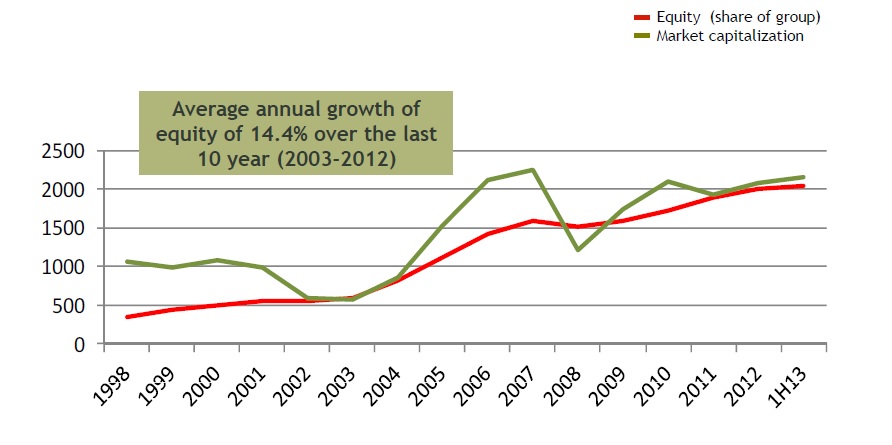
Why did I call them a potential “Mini Berkshire” in the beginning ? Well, that’s what they are showing in their latest Q3 presentation:

avh cagr

14.4% CAGR of book value is not bad over the last 10 years. Just for fun, I calculated Berkshires 10 Year CAGR from 2003-2012 based on the disclosure in the latest letter to shareholders:

Berkshire  
   
2003 21%
2004 10.5%
2005 6.4%
2006 18.4%
2007 11%
2008 -9.6%
2009 19.8%
2010 13%
2011 4.6%
2012 14.4%
   
10 year CAGR 10.60%

So at least for the last 10 years, AvH has clearly outperformed Buffet by almost 4% p.a. which is really a lot.

Step 1: “Quick and Dirty” sum of parts

When I look at a company like AvH, i generally try to do a quick and dirty “sum of part” analysis first. AvH makes it quite simple by providing a net cash figure at holding level which is required as the consolidated accounts include non-recourse debt as well.

The only thing I was not sure was the fact that the holding segment borrowed money from the private equity part in an amount of 120 mn EUR. I decided to play it save and deduct it from the private equity NAV.

So this is the “quick and dirty” result:

Value Method
DEME 550 Implicit valuation takeover
Van Laere 26 0.75 book
rent-a-port 5 at book
Maatschappi 20 At book
Sipef 130 market cap 482
Delen 522 1.5 book
van Breda 336 1.2 book
Extensa 80 0.8 book
Leaseinvest 108 Traded
Financiere duval 40 at book
AnimaCare 40 2x book
MAx Green 70 10x Earnings
Telemanod 30 10x Earnings
Sofinim 255 75% of NAV minus cash to holding
     
Net cash holding 148 Q3
     
     
Total 2,361

The result of this exercise is higher than stated book equity of around 2.05 bn EUR, but on the other hand, significantly lower than the 2.8 bn market value.

If I haven’t made a big mistake, then even if some of the holdings like Delen are worth more than I assumed, AvH looks as it is trading at a premium. Although I think the company is a good one and can create value, I would not want to pay a premium, so one can stop at this point and move on.

Summar:

Ackermans & Van Haaren seems to be an interesting company with diverse holdings and a good culture and some very good and interesting businesses. The track record over the last 10 Years looks impressive and is better than Berkshire. Nevertheless, the stock looks overvalued from a sum of parts point of view, offering no margin of safety.

Value and Opportunity “Design poll”

Dear readers,

a few weeks ago, I changed the design of the blog. I got mixed feedback since the change. Some did welcome it, some complained about the colors, some have problems reading it on mobile devices.

Personally, I like the colors of the new layout but I think the posts get too big on my screen. The old design was much more compact.

So it would be great if you could take a few seconds to answer the following 5 questions. Many thanks in advance !!!

Some links

10 interesting stocks for 2014 from moatology (I don’t know a single one of them….)

Frenzel & Herzing with the second part of their STo AG valuation

A nice “best book” list for 2013 from Farnam Street

Very interesting story about th movie “A wonderful life” and the guy behind the Bankers anonymous blog

Value Investing France with a (too) short summary of 2013

Jim Chanos, last bear standing, thinks it is a good time to raise fresh money for his short fund.

Finally, the free Winter issue of Grant’s interest rate observer (via Canadian Value)

My 24 (boring) investments for 2014

December is always a good time to look at the portfolio and revisit the initial investment case in order to decide if all the investments are still “on track”. I did sort out a few already some weeks ago, so this is kind of “double checking” on the ones I decided to keep.

Warning: Almost all of my 24 positions are pretty boring. So anyone looking for “hot tips” might skip this post. As most reader might know, I prefer rather “boring” stocks. In order add a little excitment, I added the company logos this time….. 😉

Before jumping into the stocks, looking back at last year’s 22 for 2013, 14 of last year’s selection are still “in”. This is in line with my goal to have an average holding period of at least 2-3 years for the normal value stocks. The number of stocks has grown by 2 but this is well within my range of 20-30 positions I am targeting. I am not a big fan of extremely concentrated portfolios.

1. Hornbach Baumarkt

A stock which is in the portfolio since the beginning. Had to fight several headwinds in 2013 like bad weather in the all important first half-year, a (now bankrupt) competitor who was selling for cash flow (Praktiker) and of course the internet. Nevertheless in my opinion a very good, ultra solid long-term holding. Could surprise to the upside next year.

2. Miko BV

Plastics packaging and Coffee distribution. Strange combination, but again ultra solid and cheap stock with relatively good growth over the years. Could surprise to the upside because of lower input costs (Coffee.

3. TFF Group (formerly Tonnellerie Francois Freres)

Despite the good performance still a very attractive French stock. Typical, family run solid and long-term oriented business. As one of the biggest Oak barrel manufacturers, TFF did clearly profit from rich people in BRIC countries buying expensive French wines and Whisky. They did take over the number 2 producer Radoux some time ago and seem to harvest the benefits now. A “luxury stock in hiding” so to say.

4. Vetropack

Swiss based, ultra solid producer of glass bottles. Currently struggling both, with high energy prices and low growth in some of its main markets, esp. Eastern Europe. Nevertheless a solid position. Some potential upside via a new thinner but equally solid type of glass bottle which might even replace PET bottles.

5. Installux

Very cheap and unspectacular French aluminium parts manufacturer with large cash pile. Surprisingly resilient business despite the weak home market. More like a “deep value” stock. 4.3% dividend yield.

6. Poujoulat

Another unspectacular French small cap, specialist for chimneys of all sorts. Large top line growth via entrance into wood pellet business, however large depreciation reduced overall margins. If margins recover, stock could have a lot of upside.

7. Cranswick

UK-based “pork centric” food group. Again, nothing spectacular but very solid performance. Still cheap compared to the quality of the business

8. April SA

French based insurance broker / specialist insurer. Currently struggling with French health care regulation. Nevertheless still one of the most attractive business models for financials.

9. Sol Spa

Technical gases and healthcare related gas business. Very well run, good growth in the Healthcare sector. True strength not shown in the numbers due to large upfront write-offs. Long term holding.

10. Gronlandsbanken

Basically only bank in Greenland with high margins and good return. Potential upside if rare earth mining projects and other natural resources projects get started. Potential “Global warming” beneficiary. 8.3% dividend yield makes waiting easy.

11. G. Perrier

Interesting French specialist for electrical installations. Growing business especially in the nuclear power area. Barriers for competitors due to certification requirements.

12. IGE & XAO

French based software specialist for electrical CAD. Quasi monopoly in France. Good margins and good growth plus large cash pile. Shareholder structure might make some “corporate action” possible.

13. Thermador

Very interesting French home building and improvement supplier company . Unique “outsider style” business model and corporate culture. Currently struggling a little due to low domestic French demand but very good company at an attractive price. 4.6% dividend yield.

14. Trilogiq

French production optimisation company. Based on Japanese production philosophy, company provides solution and know how to optimise production. Active mostly in the car industry. Net cash, good margins and still cheap.

15. Van Lanshot

One of the leading Dutch Private banks. Did make some strategic mistakes in the past. Now with CEO trying to focus on “traditional” private banking. If turnaround is succesful and “normal” private banking margins can be achieved, stock has good potential. Additional tailwind because of tax crack down on Swiss private banks.

16. TGS Nopec

Seismic data company with an “outsider style” business model. Doesn’t own ships, was very disciplined in “Underwriting” explorations in the past. Currently more competition from struggling “traditional” competitors with ships and oil companies. If business stays “normal” significant upside. 5.6% dividend yield and share buybacks.

17. KAS Bank

Dutch bank, specialising in securities services. Due to low-interest rates, profitability under pressure. Will benefit if short-term rates start to rise. In the meantime, 6.7% dividend yield “sweetens” the wait.

18. SIAS SpA

Italian toll road operator. Very cheap infrastructure asset, “under leveraged”. Paid large special dividend but also reinvested in additional toll roads. If traffic in Italy stabilizes, stock has good upside.

19. Draegerwerk Genußscheine

Capital structure arbitrage. One Genußschein is equal to 10 preference shares but trades only at a multiple of 4-5 times. Patience required.

20. Depfa LT2 2015

Lower tier 2 bond of nationalised Depfa bank. At the current price solid 7% expected return p.a. until maturity 2015 with relatively low risk.

21. Commerzbank HT1 Funding

Tier 1 Commerzbank bond with a twist: Coupon is guaranteed by a third-party. At the current yield level of around 7% still a good “hold” until I have better ideas.

22. Rhoen Klinikum

I bought the stock after the first failed take over attempt. Now it looks like that the sale of the majority of the business to Fresenius will be cleared. To be sold if my price target of EUR 22.50 is hit.

23. MAN SE

Another special situation, betting on Volkswagen having to pay more than the 83 EUR compensation initially proposed after implementing a profit and loss transfer agreement.

24. Celesio stock /Convertible 2018

Newest addition to the portfolio. Speculation that acquirer Mckesson will have to pay more than the 23 EUR offer due to Elliott (Paul Singer) blocking position.

Current Watchlist:

1. Valmet, Metso Spin off January 2014
2. Portugal Telecom: Merger with Brazilian OI in 2014
3. Maisons France: Potential “outsider style” company in tough market.

« Older Entries Recent Entries »