Some thoughts on utility stocks (Fortum, EVN)

In my portfolio, I have 2 utility stocks, Fortum OY from Finland and EVN AG from Austria. Both are part of the portfolio since the beginning.

The idea behind those two investments were the following:

1. utility stocks in general looked cheap and relatively save at that point in time
2. both, EVN and Fortum had a large share of non-carbon electricity generation capacity. “Fossil fuel” burners were expected to suffer as they need to pay more for the carbon emissions in the future
3. both companies are located in countries which are not directly impacted from the EUR crisis, so the risk of special taxes etc. should have been low

So far the investment thesis didn’t really work out.

First, the utility index underperformed with -8% the corresponding full index (Stoxx Europe 600) by a whopping 11%.

Second, both EVN and Fortum managed to underperform the utility index. EVN by -3.7%, Fortum by a dramatic 30.4% (including dividends)

If we look at the index constituents, we can see some interesting things:

Perf. 12/2010 –
   
DRAX GROUP PLC 41.2%
NATIONAL GRID PL 37.8%
UNITED UTILITIES 36.1%
SEVERN TRENT 34.5%
PENNON GRP PLC 28.7%
SSE PLC 18.2%
CENTRICA PLC 5.7%
ENAGAS SA -3.5%
RED ELECTRICA -11.6%
SNAM SPA -12.4%
TERNA SPA -12.8%
GAS NATURAL SDG -13.9%
ENEL GREEN POWER -20.7%
EDP -22.6%
E.ON AG -22.8%
GDF SUEZ -27.3%
ENDESA -29.8%
RWE AG -34.2%
ENEL SPA -34.3%
FORTUM OYJ -37.1%
VERBUND AG -42.2%
SUEZ ENVIRONNEME -42.6%
EDF -46.3%
IBERDROLA SA -47.0%
VEOLIA ENVIRONNE -62.8%

Frist thing to notice: “Renewables” really did badly, Mostly Iberdrola, Verbund and Fortum but also Enel Green Power. UK utilities did best. At least peripheral utilities did underperform as well, however French utilities were the worst (EDF, Suez, Veolia).

If we exclude UK and go for “EURO” utilities, the picture looks relatively speaking better, with a total return of -23.82%, this index performed really badly, EVN here (although not in the index) looks like a clear outperformer. Fortum still doesn’t look that good…

Perf. 12/2010-
   
ENAGAS SA -3.45%
RED ELECTRICA -11.56%
SNAM SPA -12.37%
TERNA SPA -12.85%
GAS NATURAL SDG -13.85%
ENEL GREEN POWER -20.37%
EDP -22.64%
E.ON AG -22.93%
GDF SUEZ -27.49%
ENDESA -29.75%
RWE AG -34.24%
ENEL SPA -34.39%
FORTUM OYJ -37.06%
VERBUND AG -42.23%
SUEZ ENVIRONNEME -42.67%
EDF -46.34%
IBERDROLA SA -46.95%
VEOLIA ENVIRONNE -62.76%

So looking back, what happened, especially to Fortum ?

– first of all, the Finish government introduced a special tax for Fortum although they didn’t need to. Bad luck
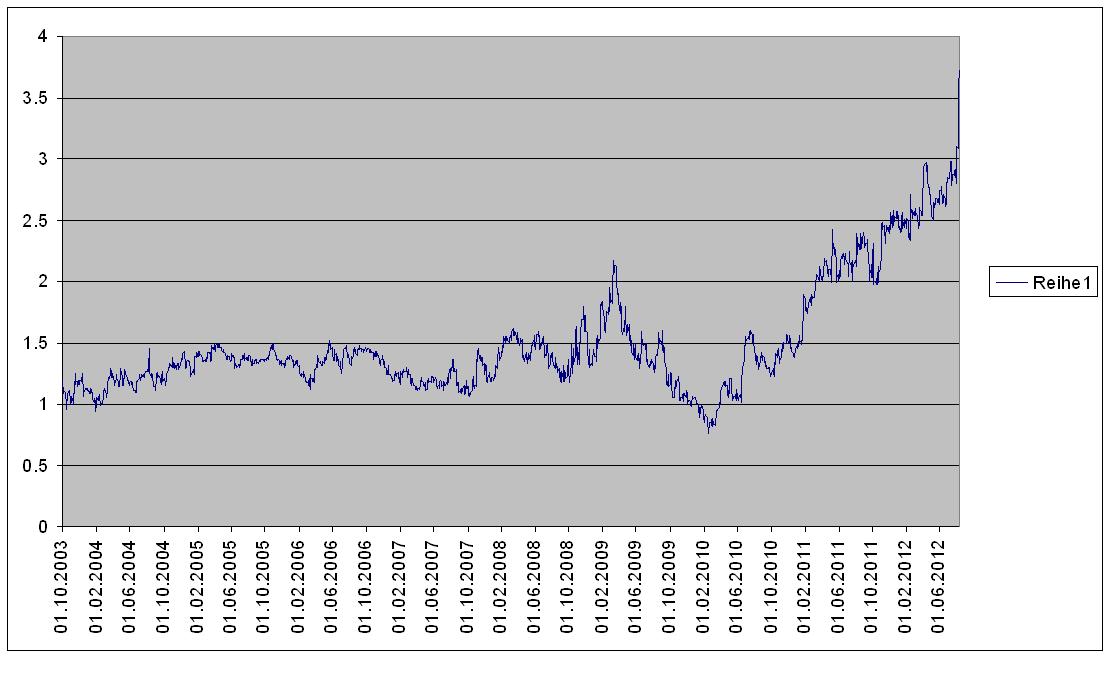
– secondly and more importantly, the price for carbon emission rights fell dramatically. As the following chart shows, CER prices fell a dramatic -75% from mid 2011 until now.
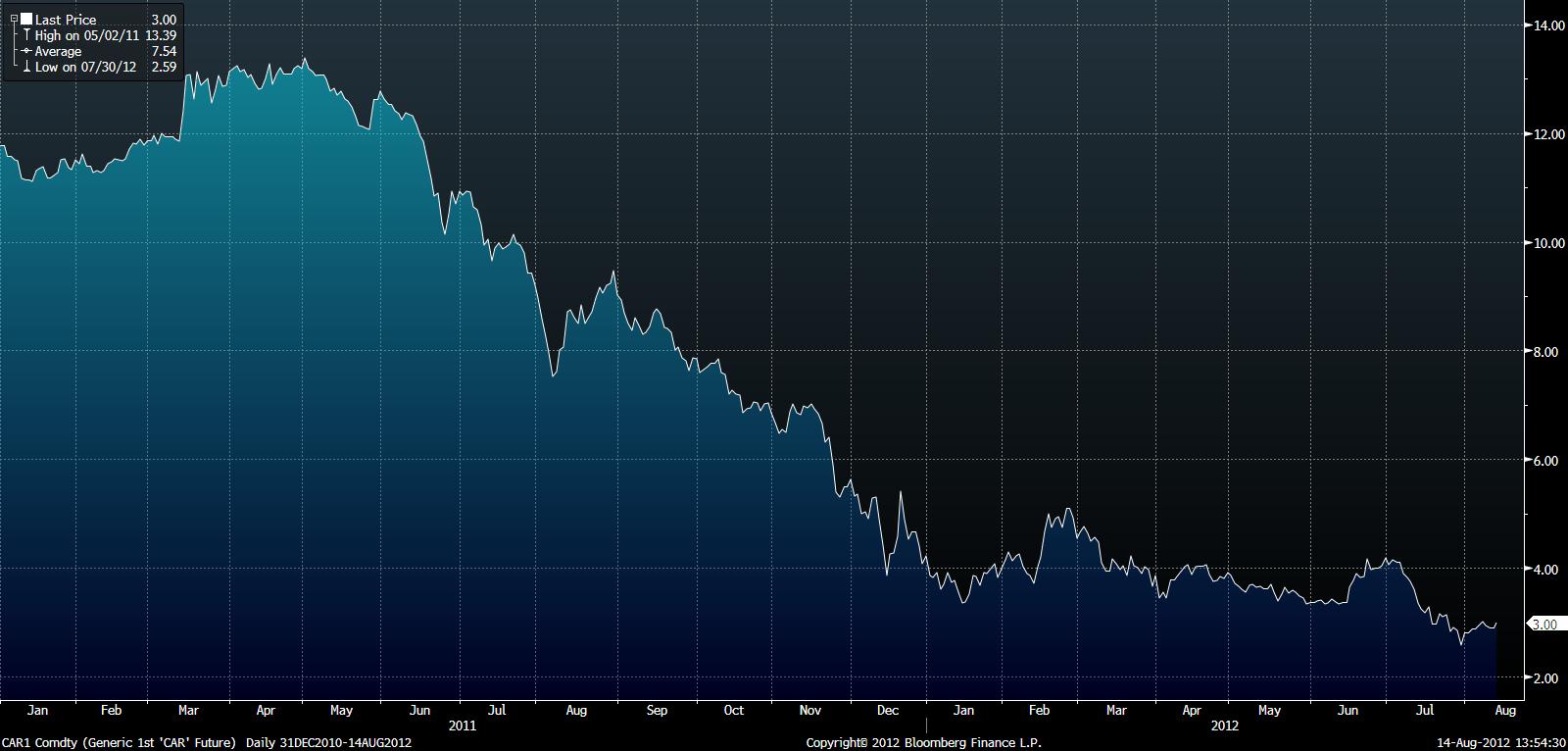
So the “Built in” (and as we know now “priced in”) competitive advantage of renewable power generators against “conventional” generators seems to have narrowed. Interestingly, the big divergence between Index and renewables opened up only in the last few months.

Additionally, the business model of electricity genrators in general seems to have eroded somehow, as it seems to be that they are on the worng side of the current political debates. Maybe not without their own fault.

If we look at the performance numbers above, we can see a second interesting detail:

Gas utilities (apart from the French) and grid operators do a lot better than electricity generators. The top 5 performers are either gas utilities (Enagas, Gas Natural) or Grid operators (Red, Snam, Terna).

A quick look on relative valuation shows that Fortum is still relatively expensive, as well as EVN, although EVN should be treated differently:

Name BEst P/E EV/BE EBITDA Curr Yr  
 
RWE AG 8.11 4.37 6.40%
EDF 8.07 4.80 6.28%
HERA SPA 10.49 5.16 2.12%
ENBW ENERGIE BADEN-WUERTTEMB 15.98 5.54 3.27%
GAS NATURAL SDG SA 7.68 5.67 2.58%
IBERDROLA SA 6.76 6.02 3.45%
GDF SUEZ 12.15 6.10 4.18%
E.ON AG 8.82 6.21 7.19%
REDES ENERGETICAS NACIONAIS 7.29 6.55 10.11%
A2A SPA 6.65 6.75 7.00%
ENAGAS SA 9.28 7.27 7.48%
ROMANDE ENERGIE HOLDING-REG 14.26 7.44 8.93%
ENERGIEDIENST HOLDING AG-REG 15.36 7.91 7.66%
FLUXYS BELGIUM 18.23 8.34 8.95%
FORTUM OYJ 10.16 8.36 6.21%
EVN AG 9.01 8.60 8.44%
SNAM SPA 11.73 8.74 7.75%
VERBUND AG 13.66 8.87 8.29%

So looking back, it was not a good idea to buy the “Carbon story” although I was lucky to a certain extent with EVN. However going forward I still have to find out what I am going to do. At the moment, Gas Natural does look quite attractive.

I think the Carbon Emission Right (CERs) might also be an interesting area to look at.

more to come…..

Boss Score Harvest part 5: – L.D.C. SA (ISIN FR0000053829)

In the fifth part of analysing the results of my Boss Score model, i want to look at the French company L.D.C. SA next.

The reason is not that LDC has the best score, but it is relativley comparable two 3 other companies I have analysed so far, Cranswick and French companies Tipiak & Toupargel.

According to Bloomberg,

L.D.C. SA processes and sells a wide range of specialty poultry products ranging from fresh prepackaged chicken to more elaborate prepared dishes. Those products are sold under brand names including “Loue,” “Bresse,” “Landes” and “Le Gaulois.”

So will French chicken be a good fit to British Pork ? Let’s look at traditional fundamentals:

Market Cap 690 mn EUR
P/E Trailing 12.2
P/B 1.1
P/S 0.2
EV/EBITDA 4.2
Debt/Assets 9.5%
ROE 9.5%
ROC 8.1%
Dividend yield 2.1%

At a first glance, relatively unspectacular. Not overly cheap but not expensive. EV/EBITDA looks attractive, almost no debt is normally a good sign. Market cap a little high but still ok.

What makes the company score quite well in my model is the very constant Comprehensive income yield on equity. This 10 year history:

12M EPS BV/share Div
31.12.2002 4.19 33.50 1.15
31.12.2003 4.11 36.05 1.23
31.12.2004 5.48 42.288 1.15
30.12.2005 5.76 47.4188 1.25
29.12.2006 5.30 51.8404 1.25
31.12.2007 6.63 56.4853 1.25
31.12.2008 5.29 60.7223 1.50
31.12.2009 7.83 67.144 1.30
31.12.2010 5.9 71.1595 1.93
30.12.2011 6.97 75.8072 1.80

creates an average 11.5% CI Yield on Equity with only a 3.2% standard deviation.

Looking at some further metrics we can see that unlike Tipiak and Toupargel, LDC is growling nicely however margins have been eroding somehow since 2009:

Sales p.s. NI margin  
31.12.2002 191.7 2.19% 10.69%
31.12.2003 186.4 2.21% 10.63%
31.12.2004 170.8 3.21% 19.07%
30.12.2005 193.2 2.98% 14.00%
29.12.2006 195.0 2.72% 11.43%
31.12.2007 226.8 2.92% 10.88%
31.12.2008 242.1 2.18% 9.36%
31.12.2009 256.6 3.05% 12.39%
31.12.2010 315.5 1.87% 7.69%
30.12.2011 342.7 2.03% 8.95%
       
avg   2.54% 11.51%

The stock chart shows a very boring but steady developement since 2004:

Beta to the French CAC40 is an incredibly low 0.46. 10 Year performance for the stock is 7.53% p.a. against 4.11 for the CAC

Business model:

Other than Cranswick, LDC is actually producing a significant part of their own poultry as we can read on their website:

Supply
The acquisition of Group Huttepain enabled the LDC Group to become closer to its farmers and make sure that they felt closer to the upstream part of the business. The companies belonging to Group Huttepain operate in cereal collection, feed manufacture and poultry farming (chicken, turkey and duck). This live poultry represents 55% of the group’s entire supply.

So as a first thesis compared to Cranswick I would argue that

– LDC should be more capital intensive
– more exposed to cost pressure (animal feeds)

than Cranswick.

So let’s have a quick look at some capital metrics:

Cranswick LDC
  2010/2011 2011
Sales 758.3 2,774.0
NI 35.3 56.7
NI in % 4.7% 2.0%
 
Inventory 35.7 178.3
Receivables 78.7 343
Trade liabil- -84.9 -308
 
Net WC 29.5 213.3
In % of sales 3.9% 7.7%
 
PPE 123.3 421.6
in % of sales 16.3% 15.2%
Goodwill 127.8 164.1
 
Net WC+ PPE in % of sales 20.2% 22.9%
     
Net WC +PPE+GW in % of sales 37.0% 28.8%


Inventory / Sales 4.7% 6.4%
 
Depr. 12.44 80.9
Depr /Sales 1.6% 2.9%

So we can see that Cranswick is better in working capital management, whereas LDC has slightly less PPE than Cranwick. interestingly, LDC deprecates a lot faster than Cranswick, almost a fifth of their PPE whereas Cranswick deprecates a tenth of PPE.

This faster depreciation explains 1.3 % of the Margin difference.

Some other notable differences are:

– LDC has to spend ~22% of sales on salaries vs. 13% at Cranswick, so LDC’s business model is clearly more labour intensive.

Due to the significant depreciation, LDC’s Cashflow before investments is around 2.3 times net income compared to Cranswick’s 1.2 times. However LDC is investing back all the depreciation plus some into the business. This explains the tripling of sales over the last 10-12 years, however at a decreasing rate of return on capital.

Similar to Cranswick they move strongly into processed and packaged food.

Looking at the English language annual comments, the processed food part seems to be in difficulties (same as Tipiak and Toupargel), whereas the Poultry business itself seems to run quite well. Representing around 20% of sales, the convenience food actually produced a loss.

Unfortunately, they do not publish segment numbers, so we do not know how much capital is used by the convenience segment. However my assumption would be that the “pure” poultry business looks a lot better stand alone and might be comparable to Cranswick’s.

management & Shareholder structure

The company is majority owned by a couple of families, with the executive board recruiting only members form the different families. This is not necessarily bad, but implies that there will be no real change going forward.

Value Shop Sparinvest has a little position as well.

Summary:

LDC SA is a very steady company with a rock solid business model. Unfortunately,the convenience food business seems to be in some kind of trouble. Stand alone, the company looks interesting as a very defensive “Boss” investment, but in comparison to Cranswick it looks like the inferior business.

The company seems to “overinvest” especially looking at the diminishing returns on capital in the past few years.

For the time being, I will not invest but put it on my watch list. If they manage to turn around the convenience segment, I might consider an investment.

Weekly links

In case you need a name for your soon to be founded hedge fund, try the HedgefundNameGenerator

Second part of the Ibersol analysis from Stephan at Simple Value

Well structured analysis of Bank Of Ireland’s H1 results from Philip O’Sullivan. Could be used as a template for other banks as well.

Good overview of the current “craze” for dividend stocks

Deep thoughts from David Merkel about complexity in financial companies. This guy knows his stuff.

Manchester United IPO (MANU) – Prime short target ?

After unseccusfully trying Hongkong and Singapore, ManU Ipoed today on the US stock exchange. The IPO price was significantly below the initial range:

The IPO priced at $14, below the $16-20 range the club’s bankers had been seeking. It valued the 19-times English champions at only $2.3 billion and shaved as much as $100 million off the proceeds expected for the team and its owners.

Of course, the public shares have almost no voring rights and dividends should not be expected.

For anyone interested in stocks and football, the F-1 listing prospectus is really fun reading and should not be missed.

Valuation is relatively difficult to determine, but somewhere in the 20-25 EV/EBITDA range based on 2011 figures. Naturally, Manu has been pumped full with high yielding debt from its P/E owners and has additional “goodies” such as 140 mn USD “purchase obligations” etc.

Interestingly they file under the “Emerging Growth” company rule, which allows corporate governance similar to my beloved Italian highway operators….

A quick look at other listed Football clubs:

By the way, Porto could be bought for only 5 mn EUR…..

Yes, ManU is a great Football club, but they cannot and will not defy gravity. So prime short candidate if borrowing is available. It is not yet oin the Interactive Broker US short list, but as soon as it is there, I wil establish a position.

Bad research example: FT’s John Dizard and the Greek GDP linker

I was quite surprised that my old Greek GDP warrant post got hit a lot in the last few days.

By coincidence I just saw that on Monday, a guy called John Dizard recommended the GDP linker as a “great bet on Greek long-term growth”.

You have to register in order to read the article online, but although its almost a half page in the print FFm supplement, the essence is the following:

– the Argentinian linkers were a great deal
– the Greek linkers are cheap (30 cents)

In my opinion, he makes some plain wrong statements like:

“The Greek GDP warrants could begin to pay out in 2015, based on the country having experienced a minimal recovery by then”

.

As I have mentioned in the post, Greece needs to hit the 2011 nominal GDP (in EUR) by 2014, to get any payout in 2015. In 2012, I think Greece is running at around -7%. So Greek needs nominal increases in GDP by at least north of 3.5% both in 2013 and 2014 to hit this trigger. I am not sure if this could be called a “minimal” recovery.

I am not sure what happens if Greece leaves the EUR, but I would assume that the Linkers would only pay if EUR GDP is triggered, not “new Drachma” GDP.

He then goes on and says the following:

“Right now they trade at about 32 or 33 cents, which means that is what you pay for the possibility of receiving one euro in 2015”.

Again, no points. The 33 cents represent the chance that you get any cash flow over the next 30 years. I am pretty sure that Mr. Dizard never really to bothered reading the prospectus, he will be busy writing his next “analysis”.

Finally he quotes a trader who says “the discount rate on future payments is just to high”. This is of course bullshit as well. Normal “non optional” Greek Government bonds trade at 20% yield p.a. If one discounts the cashlofs without taking the options into account, one ends up with a “bond equivalent” value of 3.28%. So you are paying at 33 cent an option premium” of 10% for the bond equivalent market value which is not cheap in my opinion.

Summary: So maybe it turns out that the Greek linker is a good investment. But if it does, it is certainly not for the reasons this genius has identified. My advice would be for people who want to speculate on Greece’s future to buy the GGBs instead. At 15% of nominal, they have enough “optionality” and upside in the good case. Or you buy shares like OPAP if you want to mitigate the Sovereign default risk. Optionality wherever you look.

Edit: At least the article moved the price up by 10-15% for the linker. This is the advantage of writing for the FT.

Draeger Genußscheine (ISIN DE0005550719) Update

No real news but a very interesting developement at my largest portfolio position, Draeger Genußscheine.

As a refresher: The “Genußscheine” include the right to receive 10 times the dividend of the pref shares (DRW3, ISIN DE0005550636). I started the position as a long Genußschein / Short pref shares “carry trade”. I decided to cover the short when Drager issued a EUR 210 offer and keep the Genußscheine as this put a floor under the price.

Now, in the last view days one can see something interesting happening: The Pref shares trade lower while the Genußscheine jumped.

If we look at the 10 year history of price of the Genußscheine divided by price of the prefs , we can see that the relation has increased significantly to a 10 year high at currently around 3.7 times.

I didn’t find any real news, however in some internet boards there is a speculation that either Draeger might increase the dividend or even come out with a higher offer. I am not sure about that if they will really do something.

Back then I wrote the following:

For the patient investor, I think the Genußscheine will be still an intersting medium term investment. For the portfolio I will hold them unless I find something better, there is no need to sell.

I think this is the same lesson as from the AIRE KGaA example as well as with the Bertelsmann Genußschein: If someone really wants to have a company or a certain share class / security , it usually pays off to wait and not jump on the first offer.

In the past, I often used to sell at the first offer, being happy to make a nice gain quickly. But as those two example show (so far), the risk /return relationship of just doing nothing and wait further seems to be quite good.

The only “problem” now is that the position is currently 10.2% of the portfolio. a ~10% is kind of the maximum I can stand for a single position, I will have to decide to sell if the Genußschein moves further.

Piquadro update – SELL

While I am looking at luxury companies which I could short, one should not forget that Piquadro, which I would call also a “Tier 2” brand, has issued its quarterly report just yesterday.

Unfortunately, Piquadro matches my “short thesis” quite well, with sales down significantly in its indirect channels and only relatively limited grwoth in the direct channel. Working capital increased which is a result of the increasing direct operated stores. In general, invested capital increased significantly, financed by additional debt.

So the change in the distribution model seems to be not a swift one as the Italian indirect sales really seem to melt away.

Time to go back to my initial investment thesis and valuation exercise.

My conservative case implied a 16% EBITDA margin. In the current quarter, we are at 1.77/11.3 = 15,67%, so optimistically we are within the conservative case regarding EBITDA Margin.

However if we look at the valuation grid that I used, we can clearly see that 2% growth was my worst case scenario for the conservative case:

Growth 2% 3% 4% 5% 6%
Discount            
  7% 2.06 2.57 3.43 5.14 10.28
  8% 1.71 2.06 2.57 3.43 5.14
  9% 1.47 1.71 2.06 2.57 3.43
  10% 1.29 1.47 1.71 2.06 2.57
  11% 1.14 1.29 1.47 1.71 2.06
  12% 1.03 1.14 1.29 1.47 1.71

In reality, EBITDA decreased by -29% vs. Q1 2011 and operating CF became negative. I have to admit, that looking back I kind of ignored that running own stores worldwide is a very different business model than selling wholesale in Italy.

As a consequence, I will sell down Piquadro from tomorrow on, as my initial thesis (international sales compensate domestic sales) clearly doesn’t play out.

There might be some takeover / going private speculation (the Samsonite CEO mentioned that they might be interested in Italian luggage makers after TUMI has become too expensive), but I am not willing to speculate on this.

Shorting Luxury stocks – Follow up

So shorting luxury stocks is not easy. I mentioned Bronte’s Richemont short in the previous post. Howver, Richemont issued very strong numbers with no slow down detectable. The same seems to be true for Prada:

Italian fashion house Prada SpA (1913.HK), which competes with Louis Vuitton (LVMH.PA) and PPR’s (PRTP.PA) Gucci, posted a 36.5 percent jump in first-half revenue, buoyed by strong growth in Asia, with sales driven mainly by its Prada and Miu Miu brands.

Revenue for the six months ended in July rose to 1.55 billion euros ($1.9 billion), the Milan-based maker of luxury bags and clothing said on Monday.

John Hempton reacted pretty quickly but seems to be confused.

One alternative explanation of Richemonts numbers comes from the WSJ:

“China’s outbound tourism industry has boomed in recent years, helped in part by the allure of luxury goods overseas.”

So with a relatively cheap Euro, Chines Mainlanders might not fly to Hongkong but straight to Europe to shop for their Richemont Watches and Hermes bags. Just on the week end I was astonished by the long queue of Asians on the Munich Airport waiting for their sales tax refund.

My current thesis for shorting luxury stocks is the following:

– the ultimate top level luxury brands like Hermes etc. will suffer less from a slow down as the very rich will keep on spending, no matter what
– tier 2 brands, those who get bought by the upper middle class will suffer more as those guys will have to cut back quicker and harder in a crisis
– companies who expanded their own sales network rapidly in the last few a lot will get hit harder than companies which don’t run own outlets.

So the focus should be on “tier 2” luxury brands with a lot of retail exposure (operating leases) and weak balance sheets. Preferrably, store growth should have slowed done already, or maby some store closings should have already happened.

So lets look at a list of luxury/high end retailers. For fun I included Nike, Adidas and Piquadro as well to look how they compare:

Name
Tier 1
PRADA S.P.A.
CHRISTIAN DIOR
HERMES INTERNATIONAL
LVMH MOET HENNESSY LOUIS VUI
PPR
BURBERRY GROUP PLC
TIFFANY & CO
SALVATORE FERRAGAMO SPA
CIE FINANCIERE RICHEMON-BR A
Tier 2
PIQUADRO SPA
BRUNELLO CUCINELLI SPA
ADIDAS AG
NIKE INC -CL B
SAMSONITE INTERNATIONAL SA
TUMI HOLDINGS INC
TOD’S SPA
RALPH LAUREN CORP
COACH INC
MICHAEL KORS HOLDINGS LTD
HUGO BOSS AG -ORD

The Tier 1 /Tier 2 classification is a totally subjective classification from my side.

So to add some “meat” to this, lets look at some “raw” valuation metrics:

Name EV/EBITDA 2012 P/E P/B P/FCF
Tier 1        
PRADA S.P.A. 15.5 34.7 8.3 65.9
CHRISTIAN DIOR 6.1 15.1 2.2 9.8
HERMES INTERNATIONAL 19.7 39.0 10.0 40.5
LVMH MOET HENNESSY LOUIS VUI 10.5 19.0 2.8 30.7
PPR 9.8 15.2 1.4 24.8
BURBERRY GROUP PLC 10.4 21.9 6.7  
TIFFANY & CO 8.4 15.7 3.0  
SALVATORE FERRAGAMO SPA 12.8 34.3 13.2 34.7
CIE FINANCIERE RICHEMON-BR A 9.6 17.4 3.0 26.4
Tier 2        
PIQUADRO SPA 5.5 9.0 2.7 10.9
BRUNELLO CUCINELLI SPA 17.3 34.3 19.1 67.4
ADIDAS AG 8.9 16.6 2.3 17.3
NIKE INC -CL B 11.3 20.0 4.2 33.6
SAMSONITE INTERNATIONAL SA 8.1 26.3 2.6 85.3
TUMI HOLDINGS INC 21.2 42.7 43.9  
TOD’S SPA 9.1 17.4 3.4 26.4
RALPH LAUREN CORP 9.9 20.8 3.8 22.7
COACH INC 8.4 15.5 7.9 16.0
MICHAEL KORS HOLDINGS LTD 19.9 38.0 18.1  
HUGO BOSS AG -ORD 10.9 17.4 11.9 29.8

One can see clearly that in the “Tier 1” category, Prada and Hermes stand out in terms of valuation, but also they are outstanding premium brands.

In “Tier 2”, especially the new IPOs, TUMI, Michael Kors and Brunello look expensive, especially I highly doubt that those brands are even close to the long term value of a Hermes or Prada brand.

Some additional infos in the next table:

table.tableizer-table {border: 1px solid #CCC; font-family: Arial, Helvetica, sans-serif; font-size: 12px;} .tableizer-table td {padding: 4px; margin: 3px; border: 1px solid #ccc;}
.tableizer-table th {background-color: #104E8B; color: #FFF; font-weight: bold;}

Name Future Minimum Operating Lease Obligations LF Revenue T12M Lease/revenue Debt/EBITDA LF
Tier 1        
PRADA S.P.A. 1,318,771,727.17 2,212,724,598.94 59.6% 0.5
CHRISTIAN DIOR 4,499,997,166.86 23,185,601,928.23 19.4% 1.4
HERMES INTERNATIONAL   2,465,950,626.43   0.0
LVMH MOET HENNESSY LOUIS VUI   22,261,439,383.88   1.3
PPR   9,599,553,313.27   2.8
BURBERRY GROUP PLC 640,300,032.00 1,857,200,000.00 34.5%  
TIFFANY & CO   2,327,788,295.92   1.0
SALVATORE FERRAGAMO SPA   856,156,635.81   0.6
CIE FINANCIERE RICHEMON-BR A 1,194,736,463.41 7,644,616,343.90 15.6% 0.4
Tier 2        
PIQUADRO SPA   55,621,116.76   0.9
BRUNELLO CUCINELLI SPA   210,603,043.70   1.4
ADIDAS AG   12,125,170,682.01   1.2
NIKE INC -CL B 1,386,834,706.54 15,181,364,342.46 9.1% 0.1
SAMSONITE INTERNATIONAL SA 129,442,413.07 976,677,821.80 13.3% 0.0
TUMI HOLDINGS INC 0.00 228,242,106.47   4.5
TOD’S SPA 250,946,920.20 775,643,994.46 32.4% 0.3
RALPH LAUREN CORP 1,227,233,677.46 4,301,242,776.32 28.5% 0.2
COACH INC   3,010,310,037.06   0.0
MICHAEL KORS HOLDINGS LTD 335,036,357.76 770,199,265.10 43.5% 0.0
HUGO BOSS AG -ORD   1,867,480,409.77   0.8

I tried to gather some data regarding debt and leases. Although I have not filled all the blanks, it looks like TUMI has quite a lot of debt, whereas Michael Kors has some serious lease obligations.

So those two might be interesting short candidates. Although for Tumi, Short interest is already ~37% of float…

To be continued….

Additional thoughts about Mapfre SA (ISIN

Thursday’s post about Mapfre outlined the general idea behind the investment.

With this post I want to add some more details to the case

Time horizon & type of investment

Just to make it clear: I do not expect a quick solution to the EUR problems. So the time horizon for this investment should be at least 2-3 years (or even 3-5 years). The type of investment is what I would call a “sum of part” value investment with a contrarian aspect for the Spanish business

Insurance valuation

Some investors use “tangible book” as most appropriate vluation basis, for instance Bruce Berkowitz in his AIG case.

In my opinion “tangible book value” is only a very very crude meassure. The big problem with Insurance companies is the fact that not only the value of the assets are hard to value but also liabilities, esp. insurance reserves are by no means “fixed”.

Currently, this is most obvious for life insurance contracts with guarantees, where under normal GAAP, liabilities remain “at cost” whereas assets are marked to market. This had the perverse effect that after the big decline in interest rates, life insurers showed nice profits on their bond holdings, but the liabilities are severly under water. As the “gearing” of reserves to quity in life insurance is usually around 20 times, one can easily calculate how quickly any “tangible book” disappears if reserves would be marked to market.

With insurance, it is a little bit like cable television (and my unsuccessful Kabel Deutschland short): If no one cares (and especially the regulator), you can run the business without “real capital”.

Coming back to “tangible book”: Real mtm tangible book would be a helpful measure, but even industry or company insiders are not able to calculate this. So one should better take accounting tangible book value for insurers with extreme care…..

Spain is not Greece ?

A few quick thoughts: In my opinion, Spain is not Greece because of 3 major structural issues:

A) Spain didn’t have a spending problem before the crisis hit. So their problems are clearly a result of the crisis, not a structural (and maybe cultural) deficiency like in Greece.

B) Again, I would like to link to Ibex Salad which gives a more balanced outside view on what is happening in Spain. In my opinion, especially the developments in regard to exports show that a lot of positive things are happening in SPain below the “surface”. This will take time but it is not so hopeless like in Greece.

c) And one should not forget that Spain is the country with the highest population growth rate in Western Europe (apart from Luxembourg).

Capital increase

As one commentator rightly pointed out, MAPFRE did several right issues in the last few years:

2011: 77.2 mn shares at 2.466
2010. 94.4 mn shares at 2.008
11/2009: 63.63 mn shares at 2.58
03/2009: 124.8 mn shares at 1.41
11/2008 68.6 m shares at 2.21

One could indeed ask why they pay relatively high dividends and in parallel issue new stock. This is surely one of the reasons which negatively impacted the shares in the past. The only “excuse” is that they really managed to grow in this period while many others had to increase capital just to maintain their business.

Overall investment case:

Just in order to illustrate the “drivers” of Mapfre’s valuation a little bit better, I created a quick and dirty valuation metrics to show what impacts I expect both, for the Spanish and the International business:

Spain      
LatAm/Int   bad status quo Good
  bad 1.56 2.08 2.59
  Status quo 2.51 3.03 3.55
  Good 3.44 3.96 4.47

What this should show is that the developement in Spain is less relevant than the international developement. If LatAm continuous to perform well, the MArgin of Safety is quite high, no matter what happens in Spain.

EDIT: For some reason, the price of Mapfre now jumped at over 1,67. So I only got 1/5 of my planned allocation so far. Based on my learning experience with April SA, i will not increase my 1.50 EUR limit.

Weekly links

Collection of Charly Munger’s shareholder letters 1983-2009 (via My investing notebook)

Dark pools and broken markets, the next book on my reading list. Thereafter, I will read that one.

Comprehensive list of great accounting books from the “Grumpies”

Very good commentary on the current status in high yield bond markets

Part 3 of a very comprehensive analysis of the Chinese real estate markets from Chovanec.

« Older Entries Recent Entries »