Performance 2015
2015 is now in the books. For the full year, the portfolio gained 14,13% (including dividends, excluding taxes) vs. 12,47% for my Benchmark (Eurostoxx50 (Perf.Ind) (25%), Eurostoxx small 200 (25%), DAX (30%), MDAX (20%)). With +1,7% the relative performance was very small but nevertheless positive. However if we look at the monthly returns for 2015, we can clearly see that for most of the year I was trailing the benchmark:
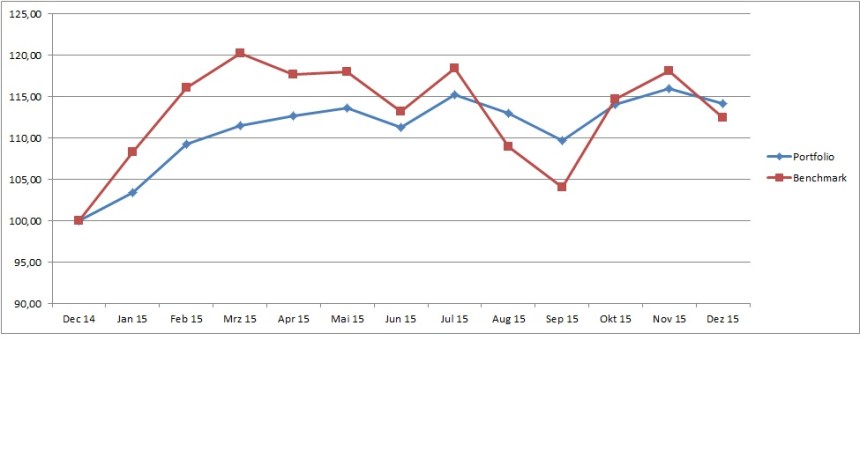
After trailing the benchmark almost -9% in the beginning of the year, the pull back in autumn brought the portfolio back above the benchmark for the year, overall the outperformance for 2015 is clearly in the “not significant” range of outcomes.
The top performers in 2015 were (incl. dividends, in EUR):
TFF Group (+54,3%)
Miko (46,1%)
Admiral (43,3%)
NN Group (37,9%)
Gagfah (30,0%)
Van Lanschott (29,4%)
Bouvet (28,5%)
IGE & XAO (26,6%)
The major detractors were:
Romgaz (-16,7%)
Depfa TRY Zero (-16,7%)
Koc Group (-15,3%)
TGS Nopec (-13,9%)
If you had asked me end of 2014 which stocks would have been my favourites in 2015, only Admiral would have been in my list. I clearly did not expect Stocks like Miko and TFF perform so strongly. This is also one of the reasons why for me too much concentration wil lmost likely not be value enhancing.
The 2015 performance was OK, although compared to the overall performance of European small and Midcaps it was not spectacular. Actually for anyone investing in the European small and midcap area, 2015 was an extremely good year. The German MDAX increased around 23%, the SDAX around 27% and the tech oriented TecDax even 34%. Also the French CAC 90 small index gained 30% and the Italian Star index around +40%. So you will see some European funds posting spectacular results for 2015 if they invested mostly in those markets. However many of those markets are now very expensive, trading at trailing P/Es of high 20ies to high 30ies. It remains to be seen if they can hold those valuations in 2016, I am somehow sceptical. I think in those markets too much growth is priced in already into many of the stocks.
My “adventure” with Emerging markets clearly was negative for the 2015 performance. If I would have stuck to my “core competency”, European small and Midcaps, I would have certainly performed a lot better. In the long run however, I do think that there is a pretty good chance that this pays off as those markets will come back at some point in time. Es with the European stocks, I think it is very important to get familiar with those markets already when they go down. I do think it is unrealistic assuming to be able to enter any such market at the bottom. There will always be some pain in the beginning when you extend your circle of competence.
Portfolio transactions in 2015:
The current portfolio can be found as always on the portfolio page of the blog.
Stocks bought in 2015:
Lloyds Banking Group
Pfandbriefbank
Greenlight Re
Gagfah
Partners Fund
Aggreko
Stocks sold in 2015
Energiedienst
Cranswick
Kas Bank
Trilogiq
Gronlandsbanken
Depfa LT2 (maturity)
Interestingly, 4 out of 6 new stocks were special situations and one of my new value picks was a fund. So I only found one “core value” stock in 2015. Of the sold ones, Cranswick was clearly a mistake. Though it now looks very expensive, I clearly should have captured more of the positive momentum as the stock increased another +40% since I sold it. This has cost me around 2% of portfolio performance.
5 year performance review 2011-2015
|
Bench |
Portfolio |
Perf BM |
Perf. Portf. |
Portf-BM |
| 2010 |
6.394 |
100 |
|
|
|
| 2011 |
5.510 |
95,95 |
-13,8% |
-4,1% |
9,8% |
| 2012 |
6.973 |
131,81 |
26,6% |
37,4% |
10,8% |
| 2013 |
9.017 |
175,04 |
29,3% |
32,8% |
3,5% |
| 2014 |
9.214 |
183,60 |
2,2% |
4,9% |
2,7% |
| 2015 |
10.363 |
209,53 |
12,5% |
14,1% |
1,7% |
| |
|
|
|
|
|
| Since inception |
|
209,53 |
62,1% |
109,5% |
47,5% |
| CAGR |
|
|
10,1% |
15,9% |
|
So 2015 was the fifth year with a outperformance in a row although a very insignificant one. Since inception, the portfolio now has more than doubled. The annualized return has been a healthy 15,9% compared to 10,1% for the benchmark. Looking at the performance graph one can already see that this has been achieved with less volatility compared to the benchmark:
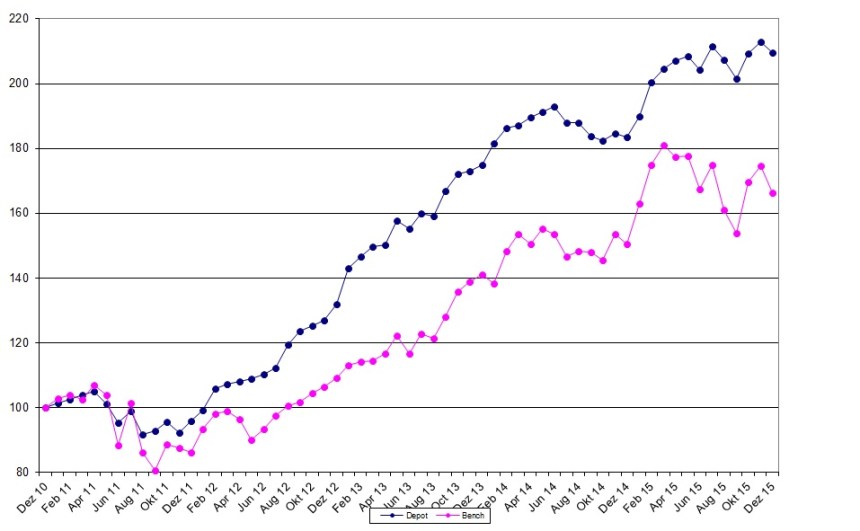
For statistic freaks a few maybe interesting stats for the 5 year period:
– there were 24 months with negative performance. On average the portfolio participated only with 67% of the negative performance
– there were 36 months with positive performance. On average the portfolio participated with 115% of the positive performance
– The Sharpe Ratio for the 5 year period is 1,53
– the highest monhtly loss for the benchmark was -15,1% in August 2011, but only -7,4% for the portfolio in the same month
– The highest monhtly gain for the benchmark was +14,9% in July 2011, however for the portfolio the best month was January 2013 with +8,6%
– in relative terms the worst month for the portfolio was July 2011 with a -11,0% underperformance
– in relative terms the best month was June 2011 with +9,2% outperformance
As I have mentioned several times, the portfolio does show some time lag. In months with very strong benchmark returns, the portfolio sometimes underperforms significantly but then manages to catch up. I think this is very typical for less liquid and out of favor stocks in general, they are not leading any market advances.
How to explain the 5 year performance
First and foremost I think the start of the blog and the portfolio was lucky in regard to timing. In 2011, there were many “casualties” from the finanical crisis available, both on the “special situation” side as well as within “normal” value stocks. A relatively risk free bond like the 2015 Depfa LT2 which matured a few weeks ago could be bought with a yield to maturity of 20%. Even in 2012 solid UK companies like Dart Group could be bought at incredibly low prices at a 5x trailing P/E.
Then the “Euro crisis” in 2012/2013 offered a further chance to buy very cheaply into Italian and French quality stocks at very low prices like SIAS or G. Perrier at low single digit P/Es.
Besides lucky timing of starting the blog and the portfolio, I think the main reason for the relatively good performance was not what I did but what I didn’t do. Some examples for this:
– I didn’t try to time the market
– avoided most stories, trends and “Fads” like “Real assets”, “Chinese consumer”, BRICs forever etc.
– stayed away from optically “falling knifes” with structural problems
– stopped selling short when I found out that I am not good at it
My biggest achievements within those 5 years were that I manage to hold my winners longer and that i corrected my mistakes usually quite fast.
Outlook & Strategy 2016-2020
I think the probability is high that the next 5 years will be not as good as the last five years, both in absolute terms as well as in relative terms for my portfolio. “Value” in the areas of my core competency (boring European small caps) has become extremely rare. Maybe my shift to larger cap companies and Emerging market related stocks will work out, maybe not. On the other hand, if someone would have asked me five years ago if I would more than double the portfolio within 5 years I would have clearly said “no way”.
As my readers know, I don’t make predictions about future stock prices. I do think that there is some value out there but mostly in areas where I am not an expert. So one of my tasks will be to learn more in areas where I only have very superficial knowledge such as Emerging markets, commodities and energy.
Will there be a big crash at the stock market in the next 5 years ? I don’t know and I wouldn’t bet on it. Market timing for me is something which clearly doesn’t add value and spending too much time on macro economic issues is also not time well spent.
So for me the strategy will remain the same as for the past 5 years: Analyze company by company, buy if they are cheap, sell when they become to expensive. Maybe the companies that I analyze wil become a little bit more exotic.
My “slow investing” philosophy so far has clearly not directly improved my returns but my nerves. So I will stick to the maximum of 1 transaction per month. The only thing I might change is that I will maybe allow myself to exchange one position per month. Otherwise I will have some indirect market timing if I sell first, then go in cash and invest again with a 1 month time lag.



 value and opportunity