Another Return of the Travel Series: Is it now time to buy Booking at 15x NTM P/E ?
Background/Intro_
Some readers might remember that I did a series on Online travel companies some years ago. Here is the link to the last post, including links to previous posts (2017 to 2022, time flies…)
I ended up investing for a short time in Expedia but, for some reason, never looked at Booking.com, which even back then was the clear market leader.
Looking at the charts we can see that Expedia and Booking have done OK. Booking actually did better than the S&P until early 2026:
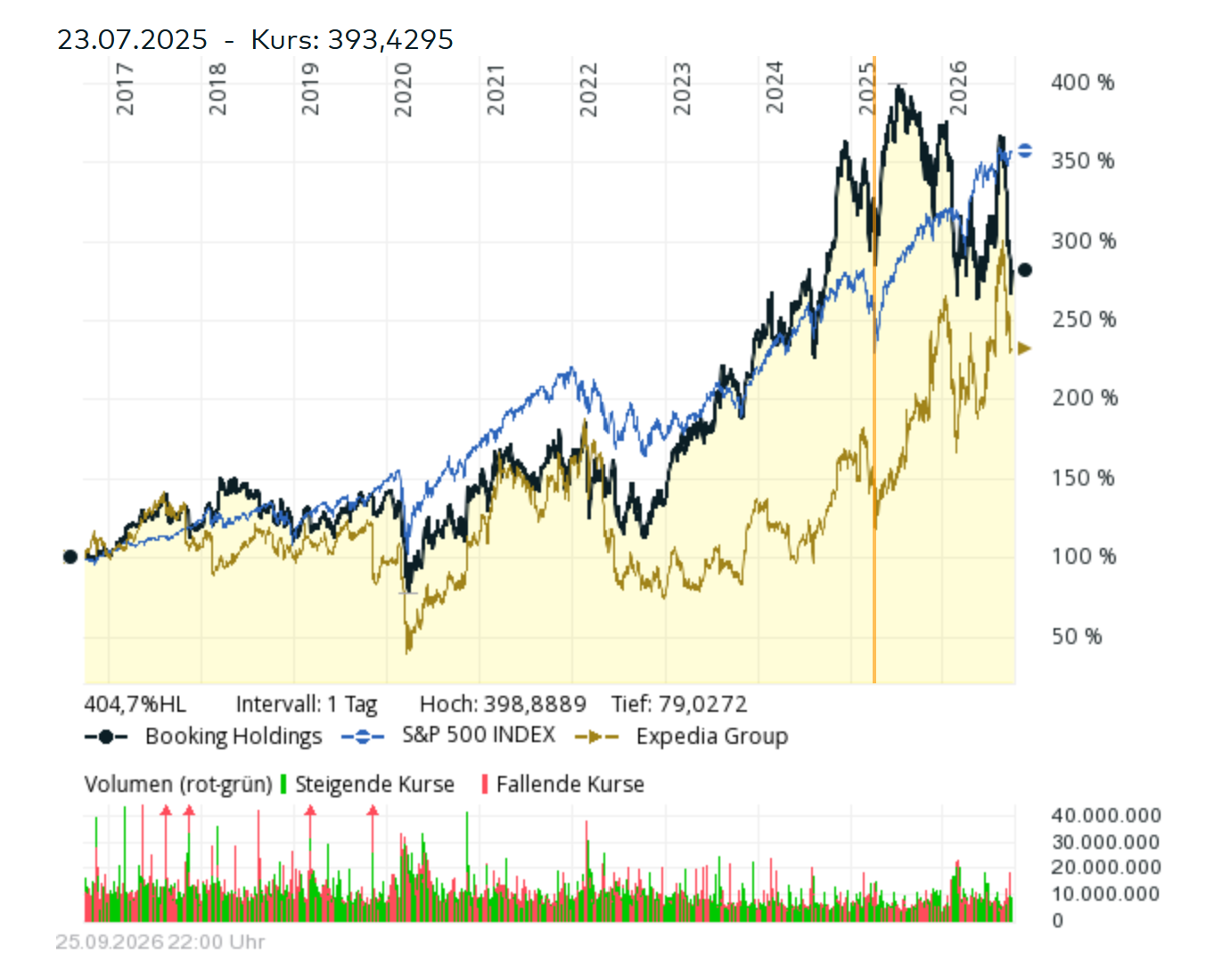
Back then when I wrote the series, the newly launched Google Travel was the big bogeyman and mostly killed the pure “display aggregators” like TripAdvisor and Trivago, whereas the “Booking engines with inventory” like Booking and Expedia did ok.
Another interesting comparison is AirBnB and Booking. Comparing both since AirBnBs much hyped IPO in Decmeber 2020 is pretty interesting:
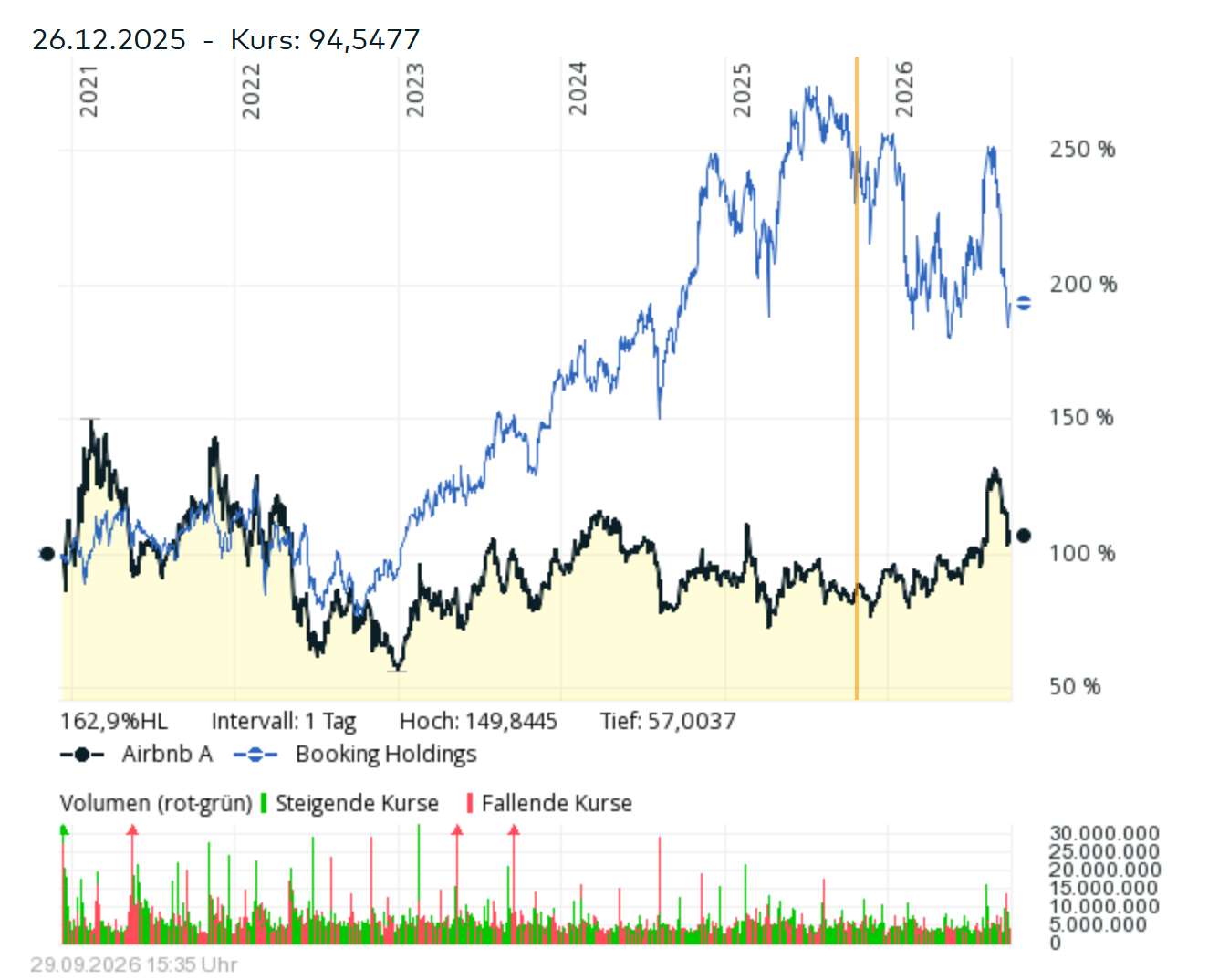
While Booking is still up nicely, AirBnB didn’t go anywher. for the last 5-6 years-
Under the hood however we can see Booking, with the exception of the Covid period, historically traded at a NTM P/E of ~25x whereas today it is only trading at ~15x NTM P/E-
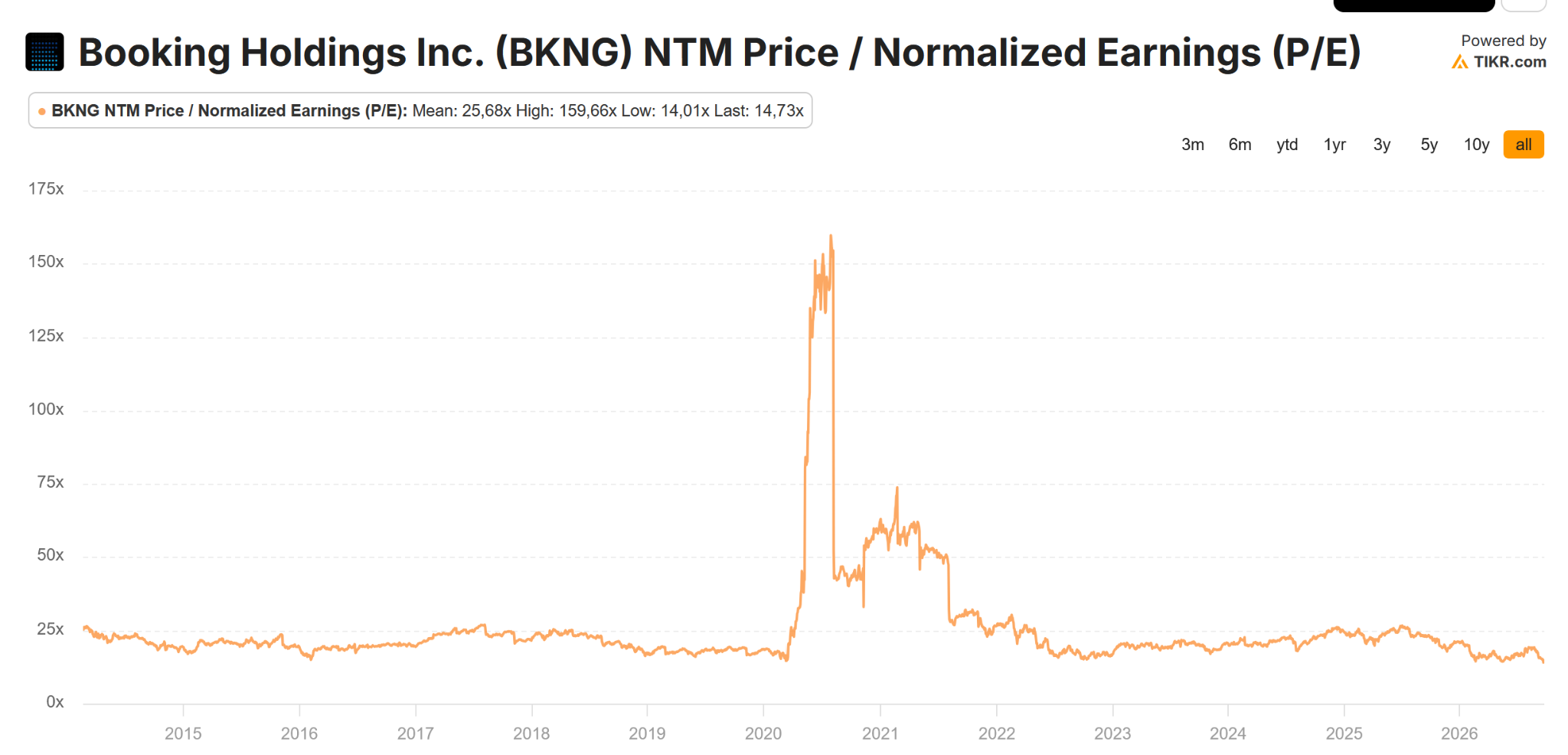
This is the reason why I decided to have at least a first look into it, as a P/E of 15 for a “high quality compounder” is not a bad starting point.
Booking has changed over the past years
One of the most striking things about Booking is how they have changed their underlying business model over the past few years compared to when I started the travel series.
They always distinguished between Merchant vs. Agency bookings. A merchant booking is when you pay to Booking first and then Booking pays the Hotel/Airline/Car rental. An agency booking in contrast is when Booking is not involved in the payment and just creates the “match”.
This is how things looked in 2018/2019:
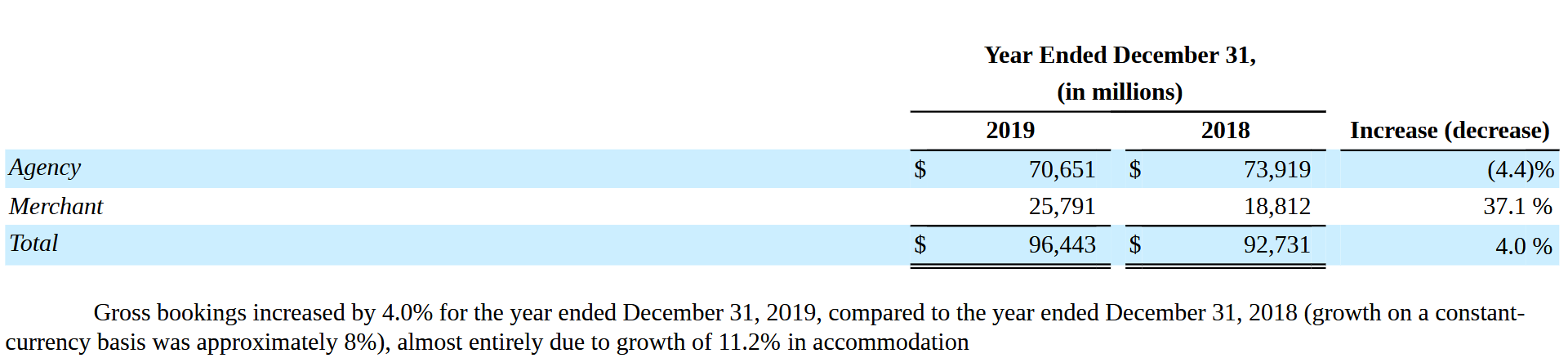
80% of Booking’s business was Agency, only 20% were merchant transactions. Now let’s compare with the first 6M 2026:

Today, 73% of the bookings are Merchant bookings and the merchant share is still increasing.
Booking initially focused on the Agency because this was market standard and easier to implement especially with the hotels but not very cash efficient, as they had to “front” all advertisement expenses and could only collect the commissions much later.
With the merchant model, similar to airlines or package holiday companies, they can create a nice, interest free “float” of customer prepayments. In total, that results in significant negative working capital, meaning that further growth actually creates capital instead of requiring capital which is a very nice position to be in.
In addition, Booking has diversified much more into apartment rentals, airline tickets and car rentals. They don’t tell us how much the share of these categories is in USD, but this part from the 2025 report shows that especially airline ticket sales are growing significantly:
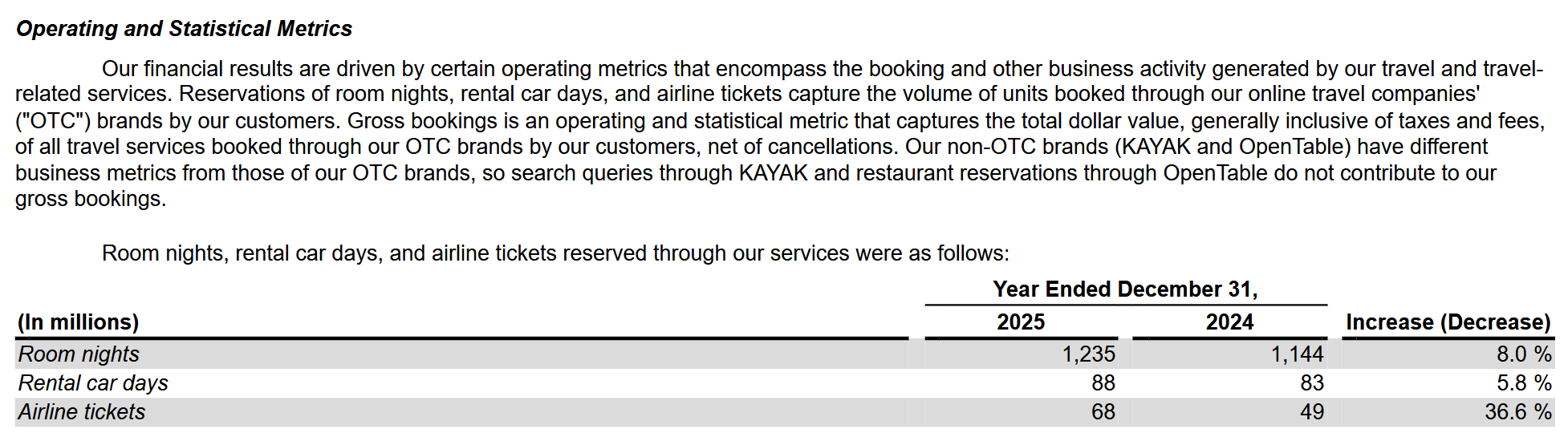
Booking is calling this the “connected trip” which is currently still a relatively small slice of the pie but seems to grow faster than the overall business:

Cash generation & share buybacks
Increasing the merchant model share means that Booking holding has been creating tons of cash despite nice growth in the past and uses most of that cash to buy back shares on top of a small dividend.
This is a chart from their latest presentation:
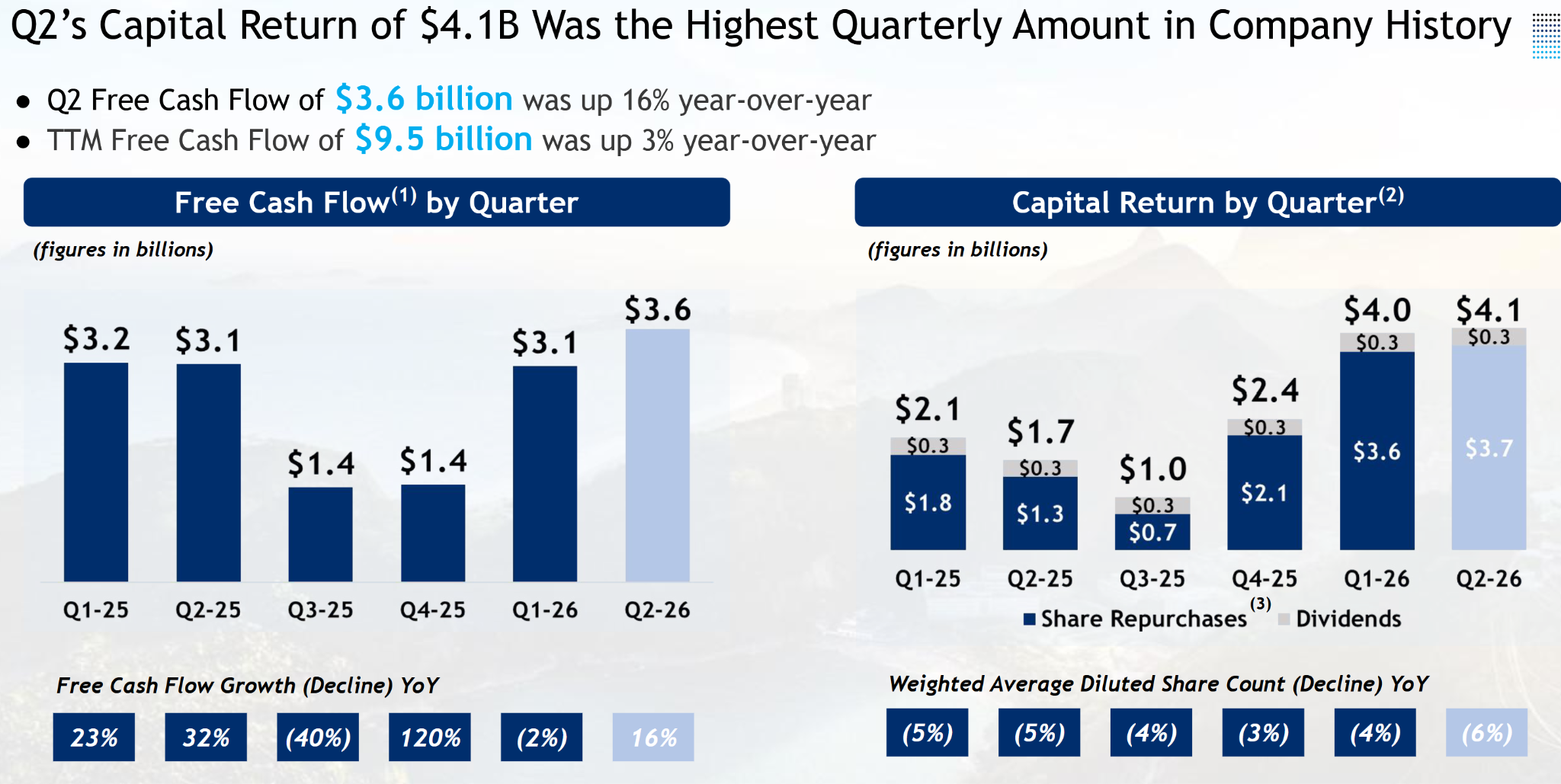
This TIKR chart shows how share count has evolved over the past 10 years:

With the exception of Covid, they have been reducing sharecount by around -5% CAGR over the past 8 or 9 years.
Geopolitical exposure
Travel and tourist related stocks like Booking are always exposed to Geopolitical tensions. As they mention in their Q2 report, the Iran war has dampened demand from the important Gulf region.
High fuel and ticket prices will also maybe lead to shorter holidays in many cases and less nights that are booked.
As we can see in Bookings 6M report, growth rates already came down in Q1 and further in Q2 because of the start of the Iran war:
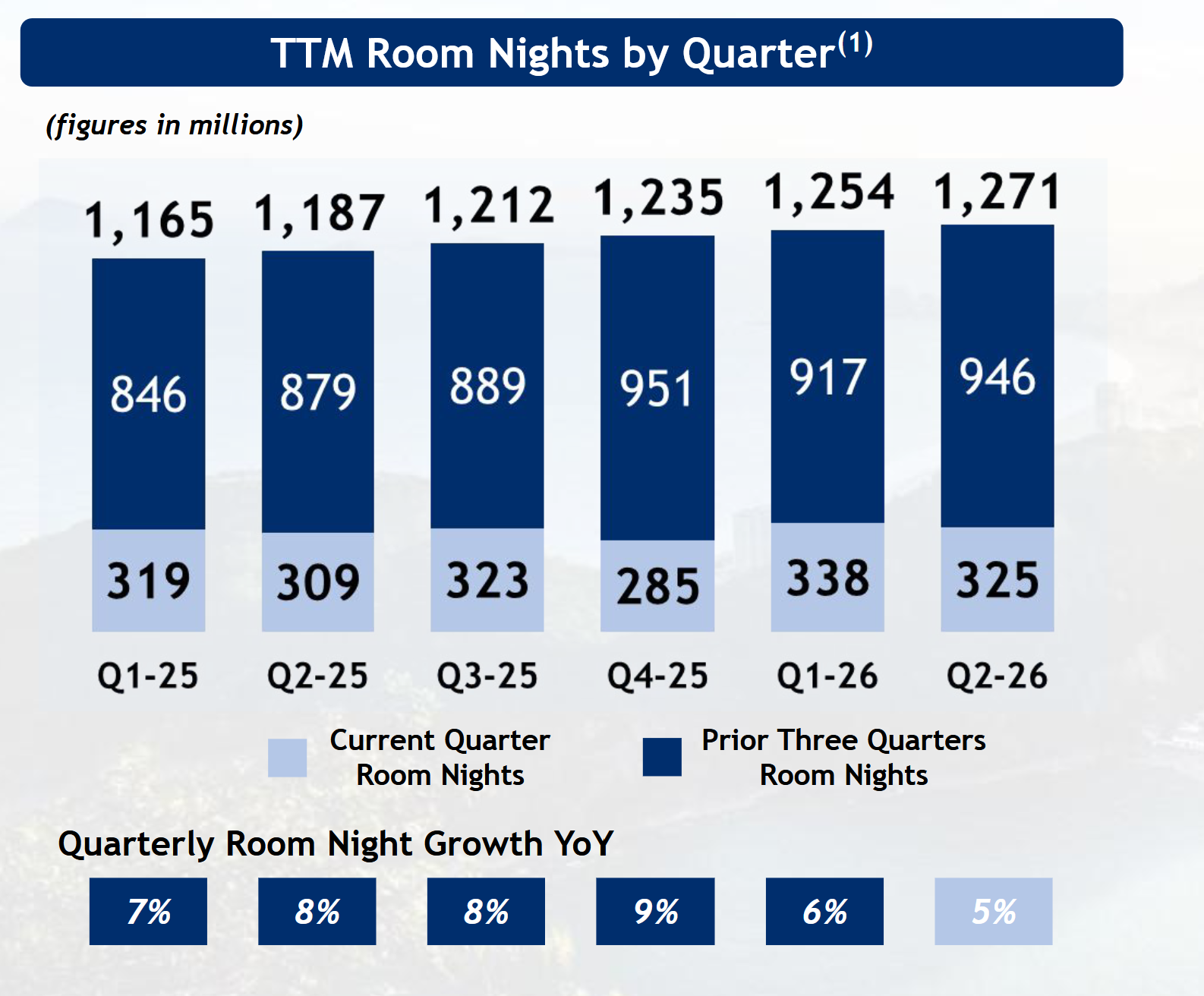
Especially the Q1 number is quite surprising, as the war started “only” at the end of February.
Normally, such a (temporary) weakness in global travel has always been a good time to invest especially in a market leader like Booking. From the lows in the initial Covid months, the stock had made 4x in the next 5 years or so. But: Also for Booking, the perceived threat of “Agentic AI” has to be considered.
So let’s move on now to the Agentic Thread (MUSE & Co)
Booking is a company where many people have some experience with the product, myself included. I have to admit that I have some kind of love&hate relationship. I love Booking for doing initial research on hotels. But in many cases I try to find out after choosing an option if I can get it at least as cheap directly. Sometimes it works, sometimes it doesn’t.
A big risk in investing especially with “consumer stocks” is always to look at ones own behaviour and then make conclusions for all the other consumers based on your own behaviour. That only works, if your behaviour is similar to the majority of consumers. If not, this can land you in a lot of trouble.
So in this case, I don’t think that my own behaviour is a good proxy for all consumers. I actually enjoy doing research for a family holiday trip, which is something that most likely not a lot of people share.
From what I am reading right now, Muse is not very good and makes a lot of mistakes. A friend of mine experimented with Clawbot, which also had its limits. But as ChatGPT, I do assume that those agents get better rather quickly.
So the question is: Will a lot of people delegate more and more tasks to these agents and which ones ?
The big question one needs to answer is the following: Is, maybe, travel a category that gets more easily disrupted by Agents compared to buying a car, an insurance policy or even a house ?
My answer to that is: I do not know, but I guess Travel is more exposed to this than Cars or houses. The next question then is: Will Agents “cut out” the middle man (Booking) or rather use the middle man as an easy source in order to fulfil tasks ?
Those are very difficult questions which in the case of Travel, I am not able to answer.
One indication that it could take more time than current “Agentic maxxers” think it takes is this page from the Booking presentation:
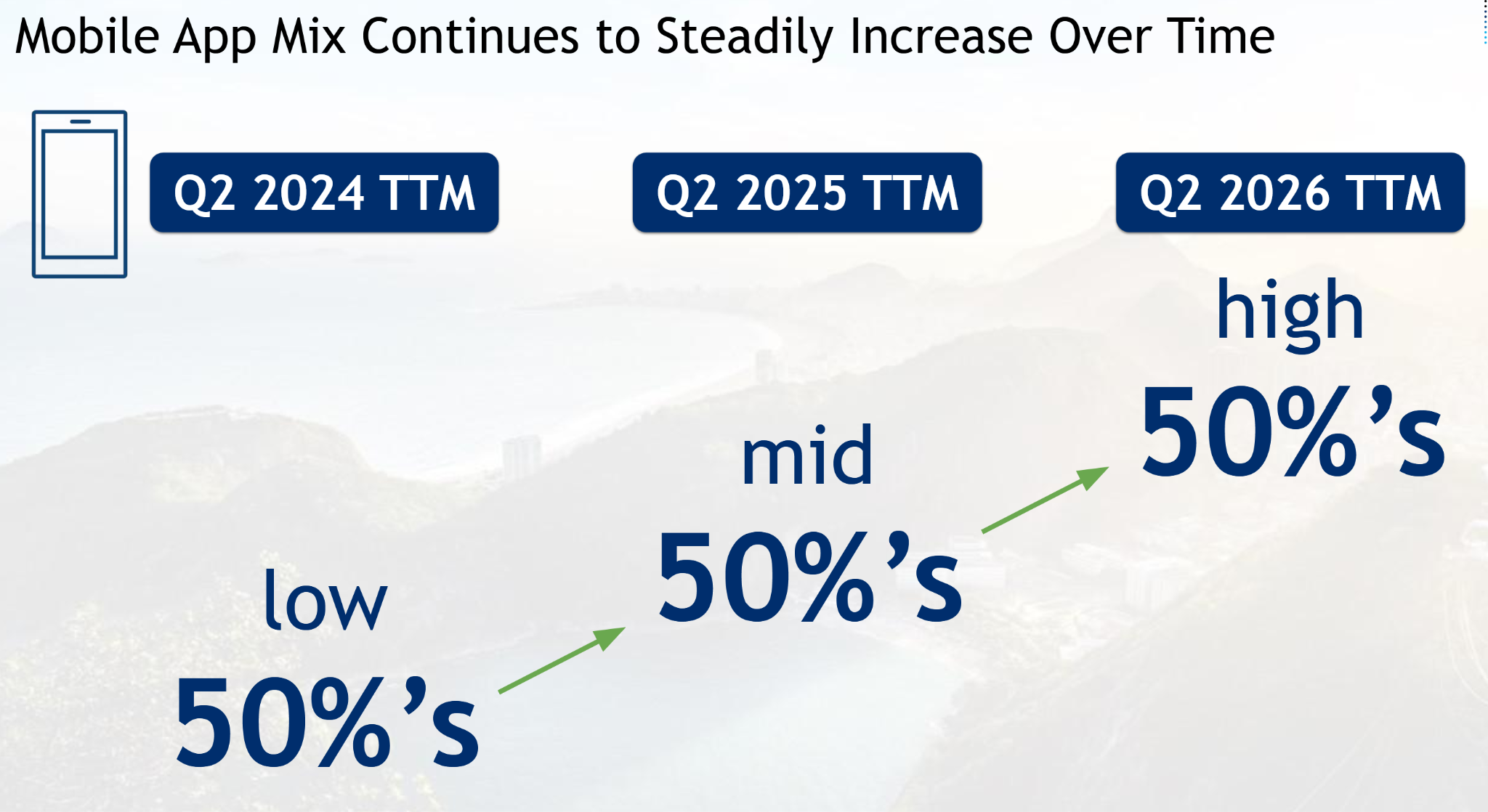
I think it’s still kind of interesting that only slightly more than half of Bookings clients are using a mobile device. This is interestingly below the average in E-Commerce which indicates that travel might be a little bit different compared to buying a new vacuum cleaner etc.
Some statistics show that more and more people use Chatbots for planning a trip, which so far however has not structurally changed the business model of Expedia and Booking, as they were able to integrate themselves into those conversations. So there is clearly also a path, where Expedia and Booking remain (very) relevant even within Agentic commerce.
On the other hand, Booking’s fast growing segments “connected trips” and airline tickets could be the first ones to see some kind of disruption.
But in any case, I find it much harder to underwrite Booking at 15x NTM P/E compared to an Autotrader at 12x or a Rightmove at 15x. Maybe I am wrong here, but only time will tell.
I do think that the risk is clearly higher for Travel and therefore for Booking than for categories such as Cars, real estate and even insurance which is regulated.
Summary:
Not looking at Booking 7-8 years ago because they were expensive, was clearly a “failure of omission”.
However, despite the rather attractive valuation, in Booking’s case, I am less sure if and how fast Agentic E-Commerce could negatively impact the business model.
Letting an AI Agent book a (cheap) flight is clearly less a leap of faith then letting an AI agent buy a new car or even a new home for you.
I will keep Booking on my watch list and might revisit if it becomes even cheaper, but for the time being, I could not convince myself to establish a position in the stock, despite all the obvious qualities of the Business model.
Appendix: Good Podcast discussing Booking’s business model
Why Booking.com built a business competitors can’t replicate
and another one


I’ve completely dropped Booking.com. When issues with foreign providers arise, their customer service doesn’t just miss the 24-hour window, they simply stop responding altogether. On top of that, they increasingly sneak in obscure ‘partner’-contracts: you book a hotel in Germany and end up receiving a VAT-free invoice from Abu Dhabi or Switzerland. It increasingly feels like Booking is holding a protective hand over shady operators. For me, it’s a hard pass: neither a buy for the stock, nor a platform I will use for personal bookings again.
I received fraudulent emails containing a shocking amount of accurate details from previous and upcoming stays. Therefore i looked up discussions regarding alleged security problems.
Interesting Question would be what age group is using booking ?
60+ I would guess they book, Aldi/Lidl Prospects, or through a travel angency
30-60 I would guess, they grew up with booking and will stick to it.
<30 I have no idea