Not aMUSEd: The UK “Portal Pain Basket” (Mony Group, Autotrader & Rightmove)
Disclaimer: This is not investment advice. PLEASE DO YOUR OWN RESEARCH
I actually started to write this post before the newest hype about “Muse”, the new AI Agent from META, really went mainstream. I decided to leave the old part and then update it instead of completely changing it.
As my DCC investment ends its “natural life” and I have begun to unwind it, I decided to have a look at a group of beaten up UK stocks that one could summarize as “Comparison portals” or “Two sided online market places”: : Mony Group (Insurance), Autotrader (cars) and Rightmove (real estate).
As the post became quite long, I also picked a track to keep you entertained while your LLM assistant is summarizing the post for you:
Green Day – Basket Case
Green Day – Basket Case [Official Music Video] (4K Upgrade)
Here a quick summary for each company:
Mony Group SE
Mony Group, the former Moneysupermarket Group is a UK focused comparison portal where people go to compare quotes for Insurance policies, loans, broadband tariffs, electricity contracts. in addition they offer a referral shopping app/system that offers Cashbacks (discounts).
This is from the 6M Investor presentation with the distribution of sales::
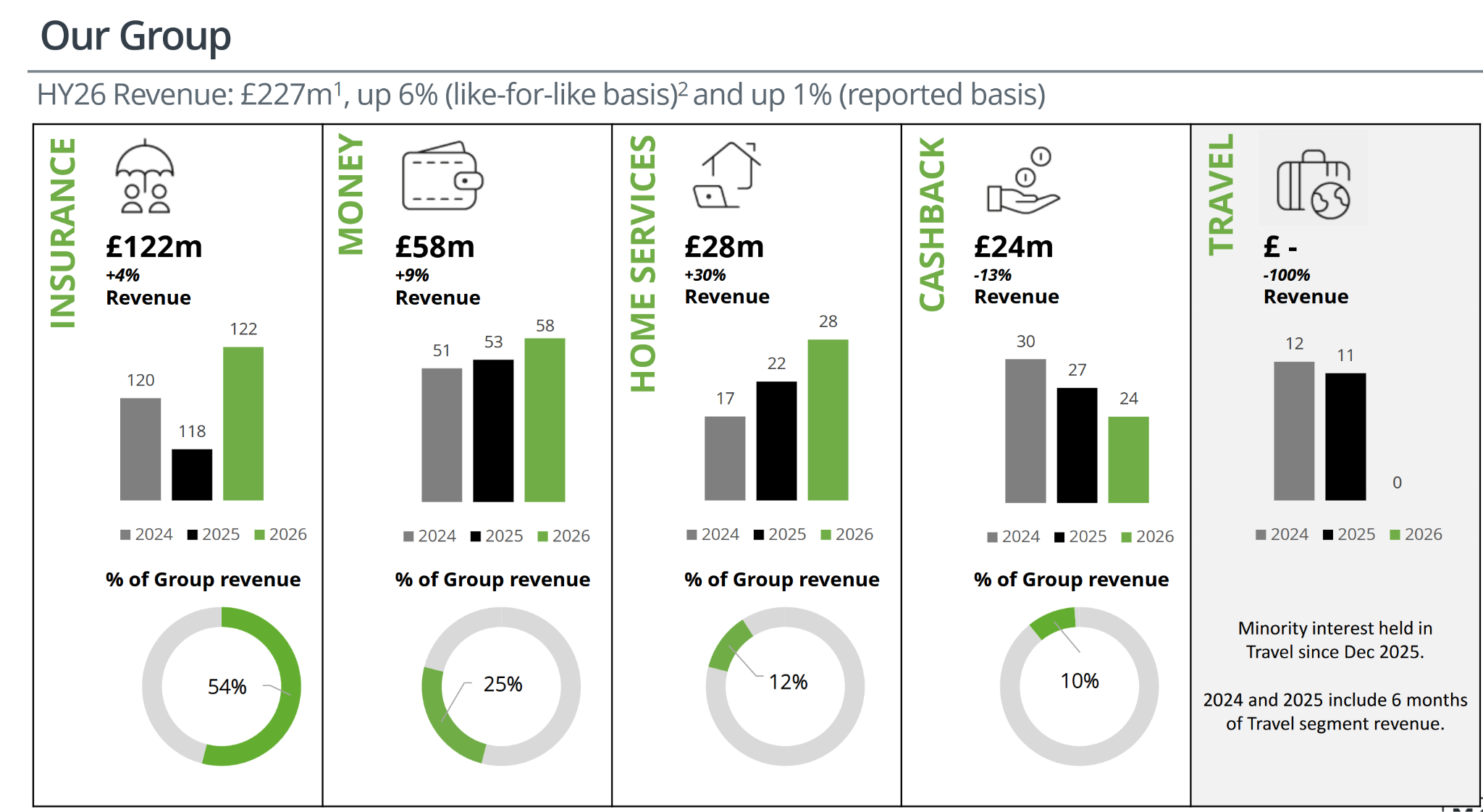
We can see that insurance is over half and that they have disinvested travel related offerings in 2025.
This TIKR Screenshot shows us that Mony’s stock was not a very good investment over the past 10 years:
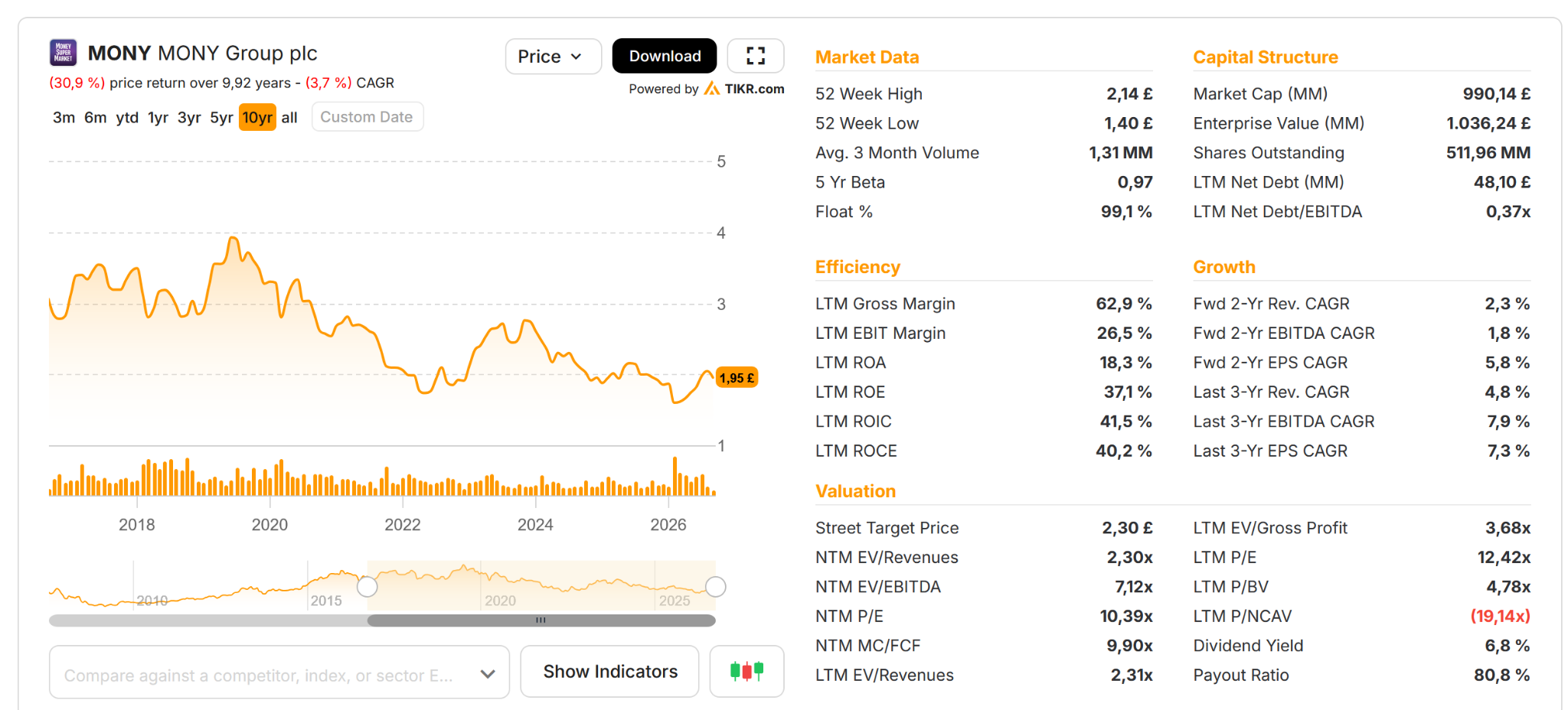
However the share price seems to have stabilized to a certain extent and the stock is cheap. The business as such is very profitable and has been growing low single digits for the past 3 years or so.
Other than the next two companies, Mony is only the number two comparison portal in the UK, pretty far behind a site called “Compare the Market” but bigger than “go.Compare” and “Confused” which used to belong to Admiral.
One important detail is that Italian Marketplace company Moltiply (former Mutui Online) is the largest shareholder with ~12% and they have been adding as recently as in June 2026.
Multiply has been collecting comparison marketplaces steadily, like Verivox in Germany or the non-UK sites from Admiral.
Autotrader
Autotrader is THE leading UK online car portal where both auto dealers and private customers are buying and selling mostly used cars. It used to be a print magazine but successfully transformed into THE dominant online market place in the UK.
It is supposed to have a market share of 75-80% in the UK. Over the last 10 years, it has not done much especially after it got hit by “SAASocalypse” fears:
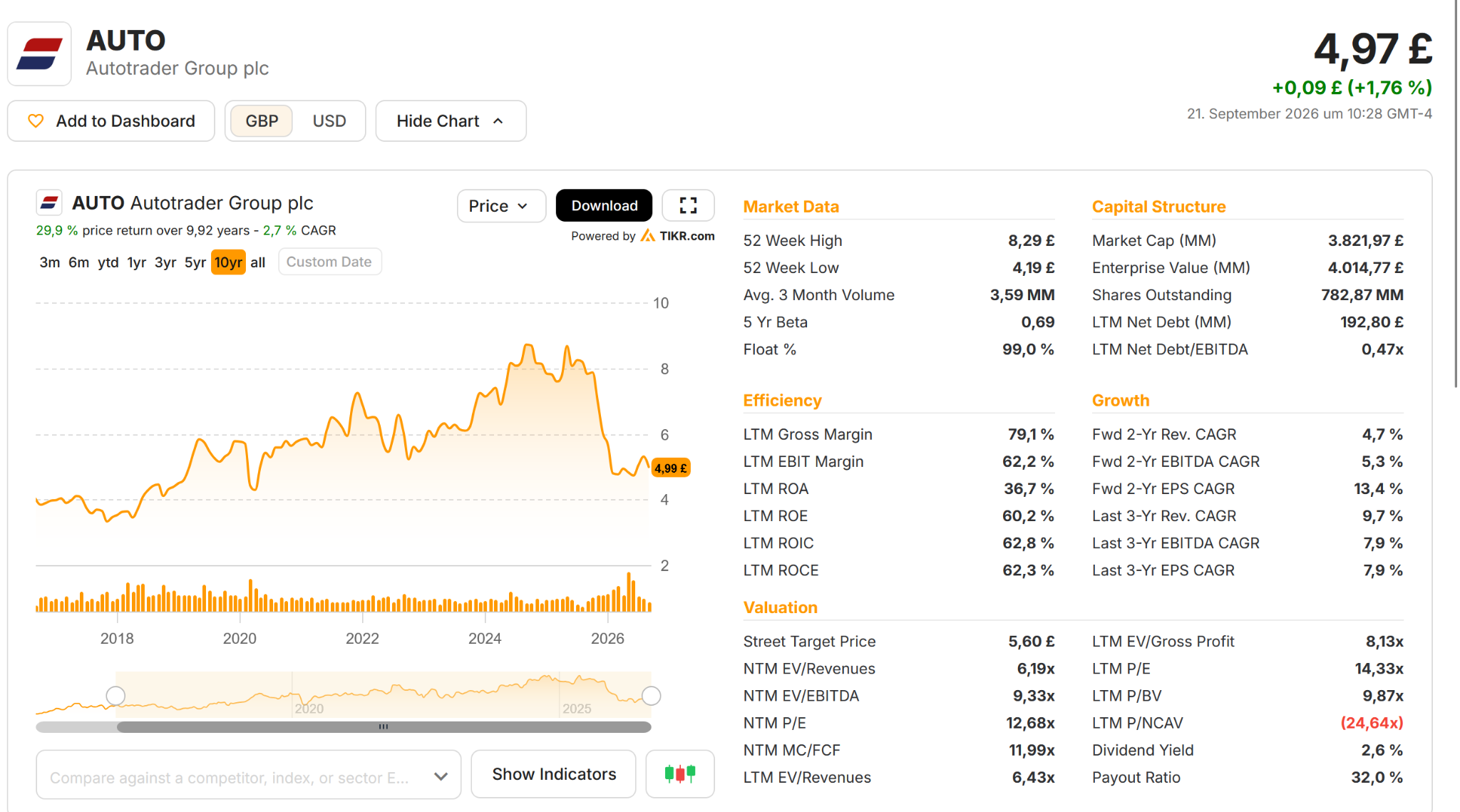
The stock is a little bit more expensive than Money Group, but almost absurdly profitable.
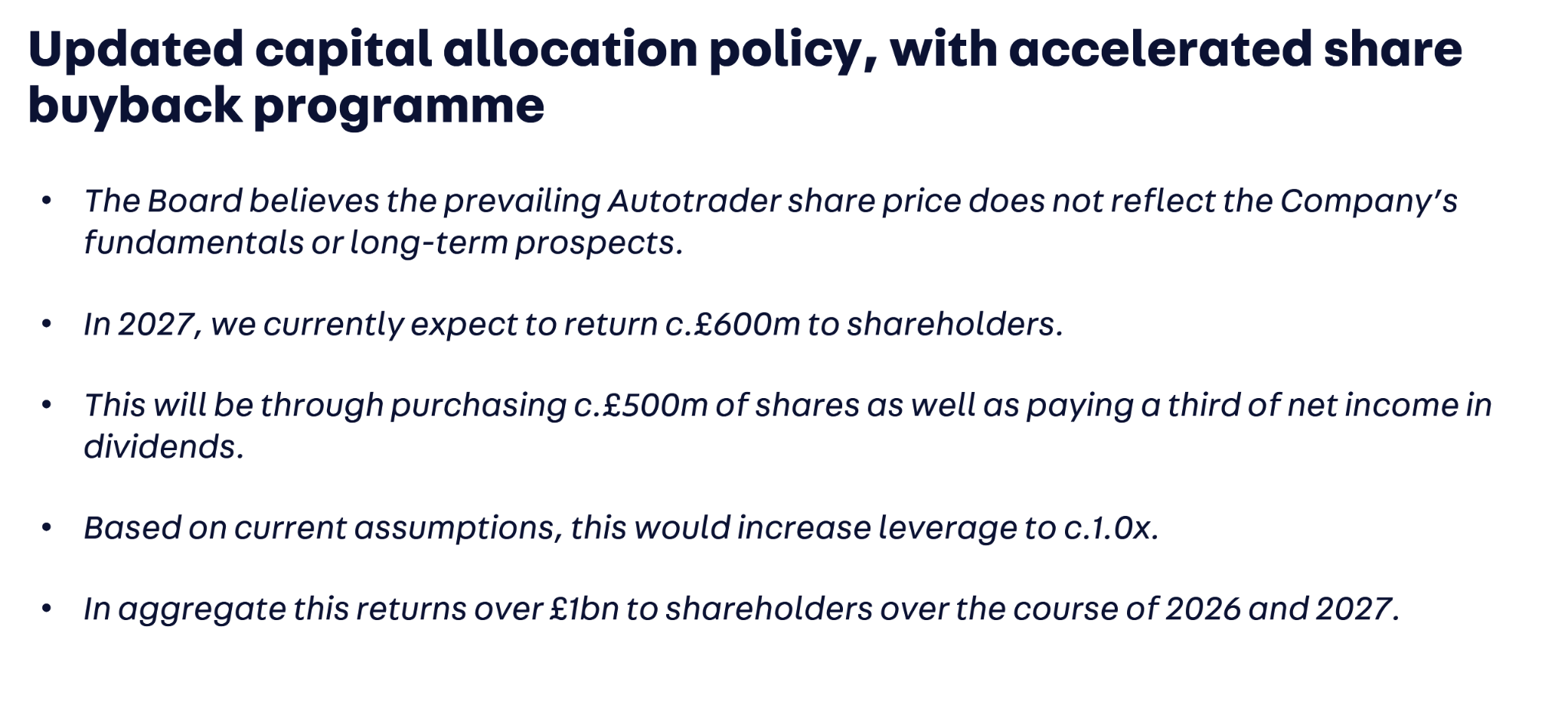
What is worth mentioning is that Autotrader has already started and committed to a massive share repurchase program:
One additional threat for Autotrade is that Amazon seems to be going for a piece of Autotraders cake and wants to enter the market still in 2026.
In the US, where Amazon is already in the market, success so far seems to be mixed at best. It reminds me a little bit about the auto tire business where Amazon started some years ago but didn’t succeed either.
Rightmove
What Autotrader is to cars, Rightmove is to real estate with the only exception that Brits are really obsessed about real estate. Almost any (friendly) Brit I know is using far too much time scrolling through right move listings.
Rightmove is the most profitable of the three and also the most expensive at 15x next year P/E.
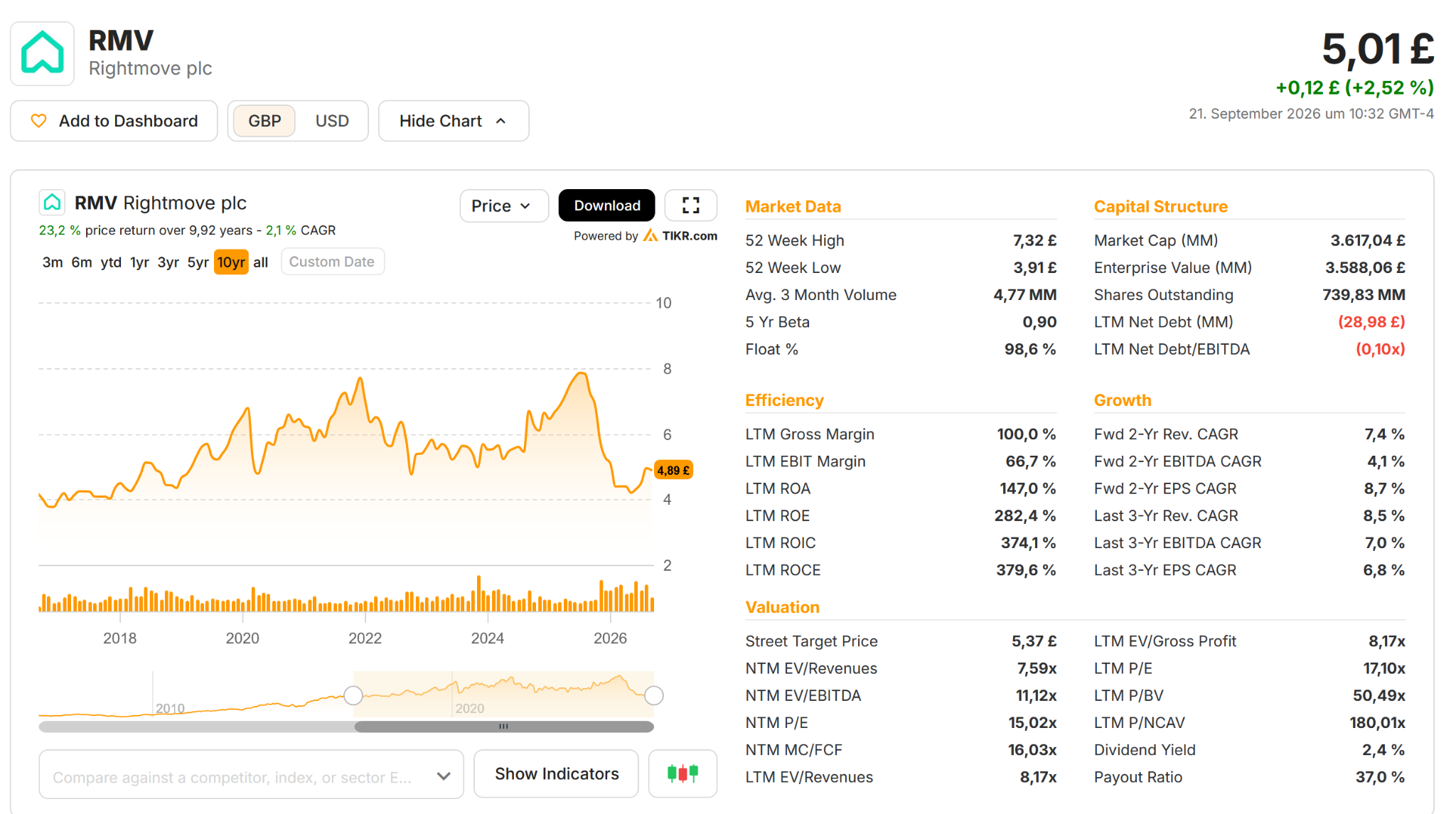
In 2024, REA, the “rightmove of Australia” tried to take over Rightmove at a final offer of 7,80 GBP/share but wasn’t successful.
Interestingly, earnings are up between 20-30% depending on which line you look at since then, but the stock is trading at a deep discount to that take-over bid.
The AI Threat:
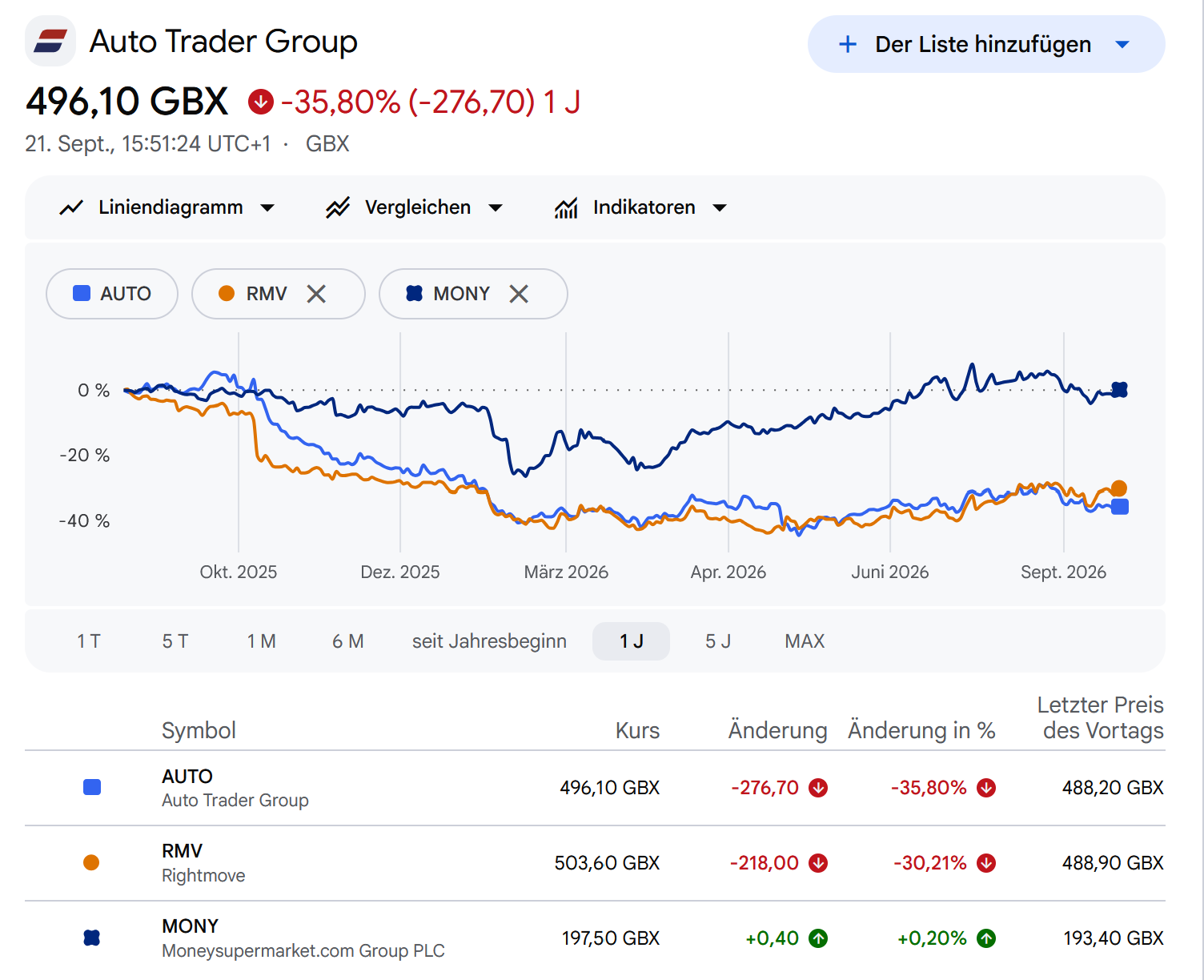
Looking at 1 year charts we can see that especially Autotrader and Rightmove were hit by AI fears, Moneysupermarket a little bit less so:
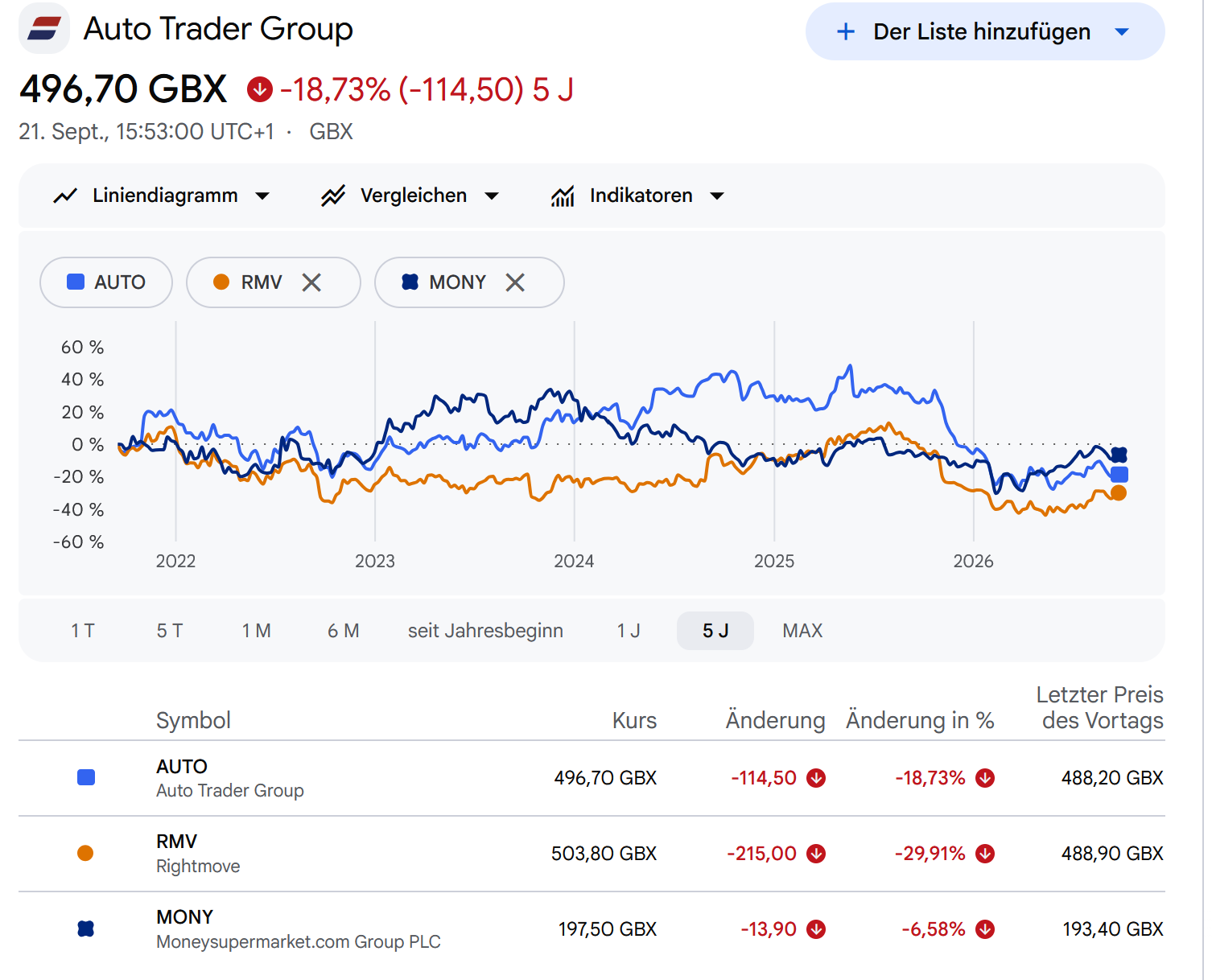
The 5 year chart shows that Moneysupermarket started to struggle earlier, in 2024:
While we are having fun with charts, we can compare Autotrader and Rightmove with Sage, the listed UK Accounting Software company:
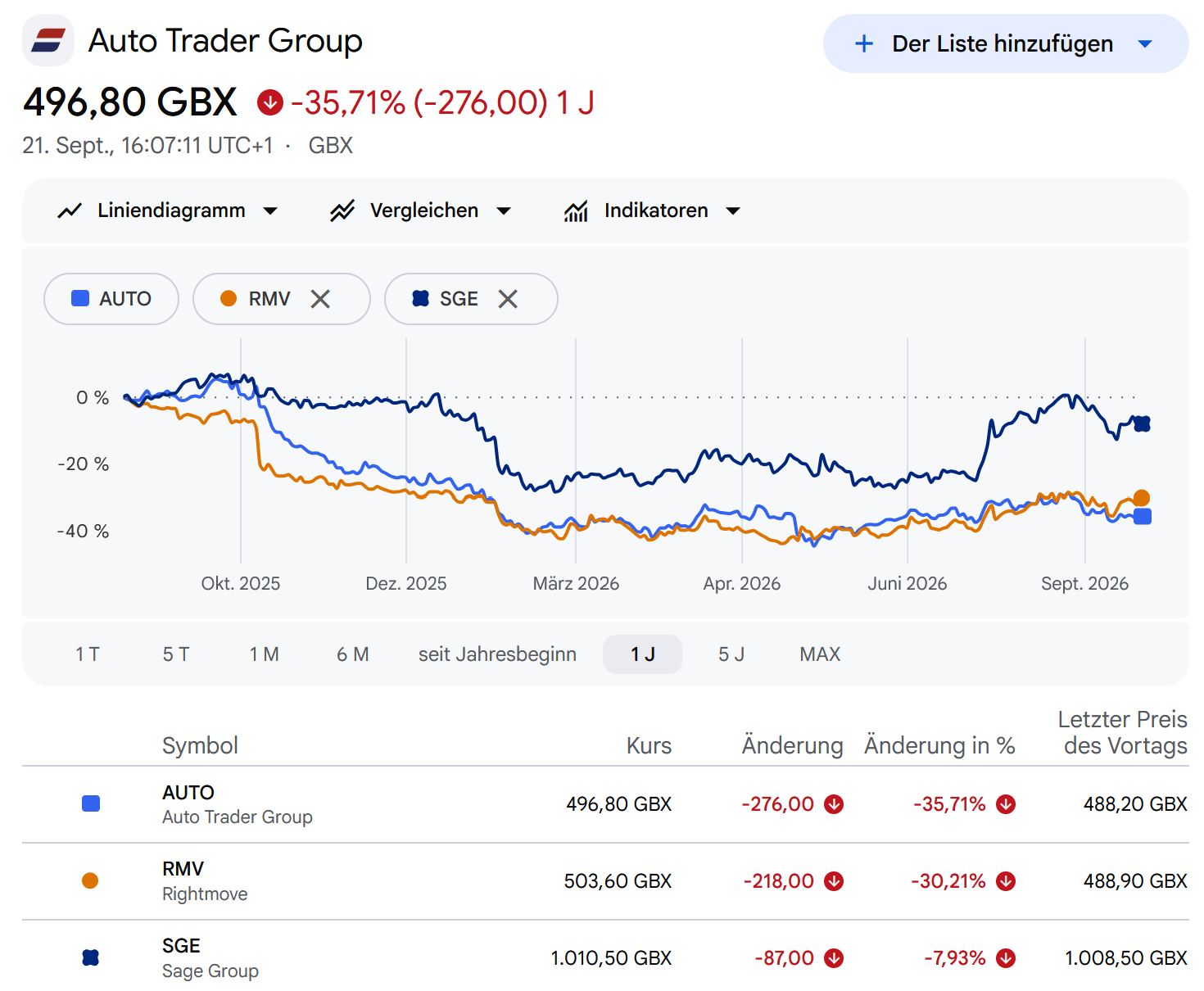
Interestingly, Sage has recovered most of its losses in the last 12 months, wile Autotrader and Rightmove so far have not.
Now to our last Chart comparison. This time Rightmove with Scout24 from Germany and REA from Australia which shows that across geographies, the stock market is really sceptical vs. portals and that this is not only a UK thing:
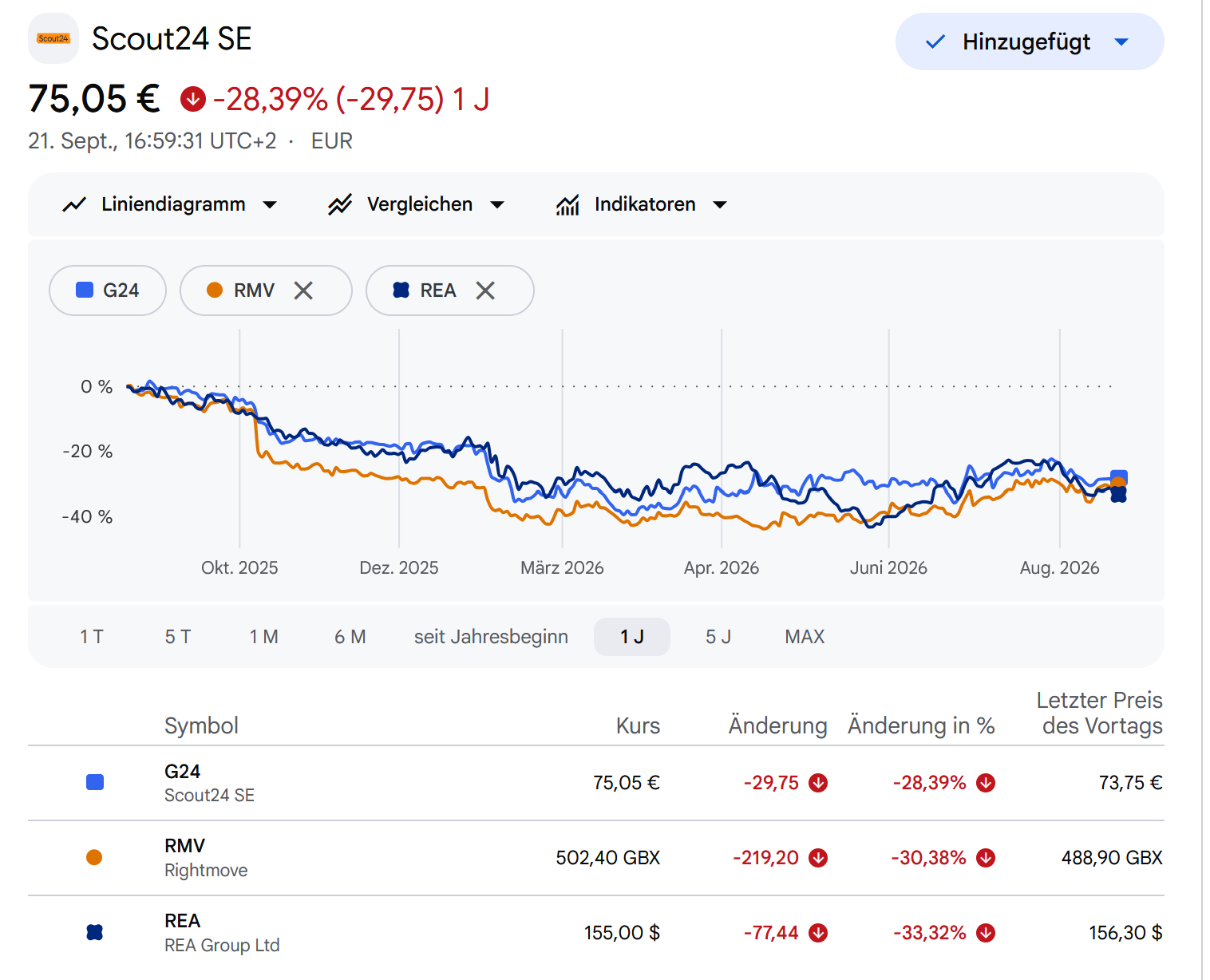
So the Billion Dollar question here is clearly: Will AI (and especially agents) disrupt the “Two sided marketplace” model and if yes, how fast will this happen ?
Clearly, Vibe coding a new AutoTrader or Rightmove or Moneysupermarket is not so hard. However that leaves you with the main task:
- how to you motivate, both, corporate and retail clients to move over to the new “platform” quickly ?
Or, will people just go to their favorite chatbot and type in: Please look for a new house and buy it for me ?
In my opinion, the audience of the current platforms could be quite sticky, especially in the case of Rightmove, which to my understanding is only partially about buying a new house and partially just entertainment.
And yes, there will be people going directly through agents but an agent in order to deliver the same result as a good comparison site/market place would need to have the same infrastructure, i.e. connections to companies in order to get the required updated information and access to actually do the transactions.
Not aMUSEd – the Update
Now while I was writing the above and also starting to build my positions slowly, the share prices of all three stocks (and its peers) started to go down pretty dramatically, as this chart shows:
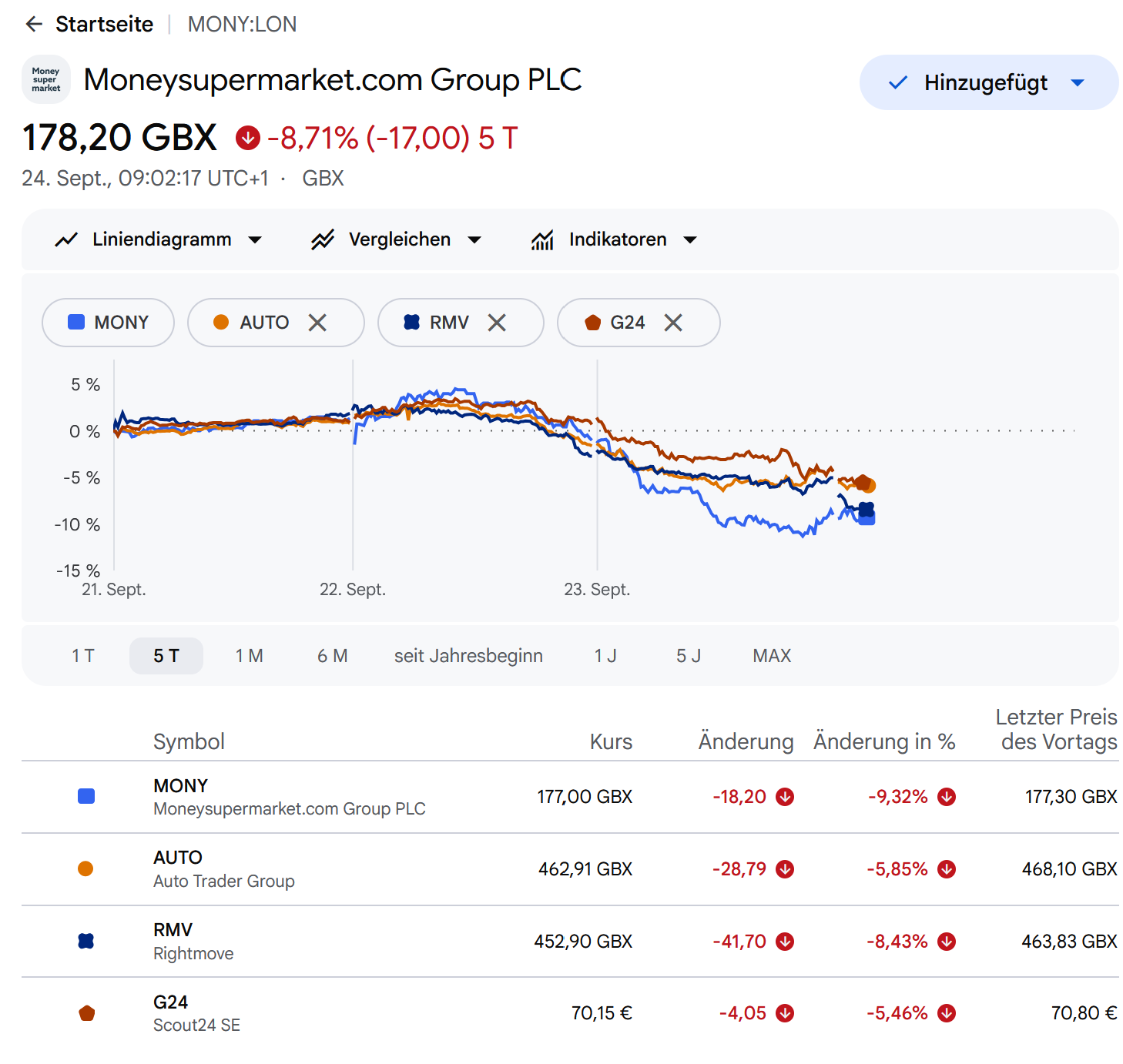
There was no individual news for those companies but rather the sudden “insight” that Meta’s launch and early success of its Agentic App “Muse” will be a problem for everyone who currently lives from comparing things online.
Muse is currently only available in the US and has shot up to the number 1 downloaded App over there.
In the past few days, among other stocks, also travel related “aggregator” stocks went down significantly because of this:
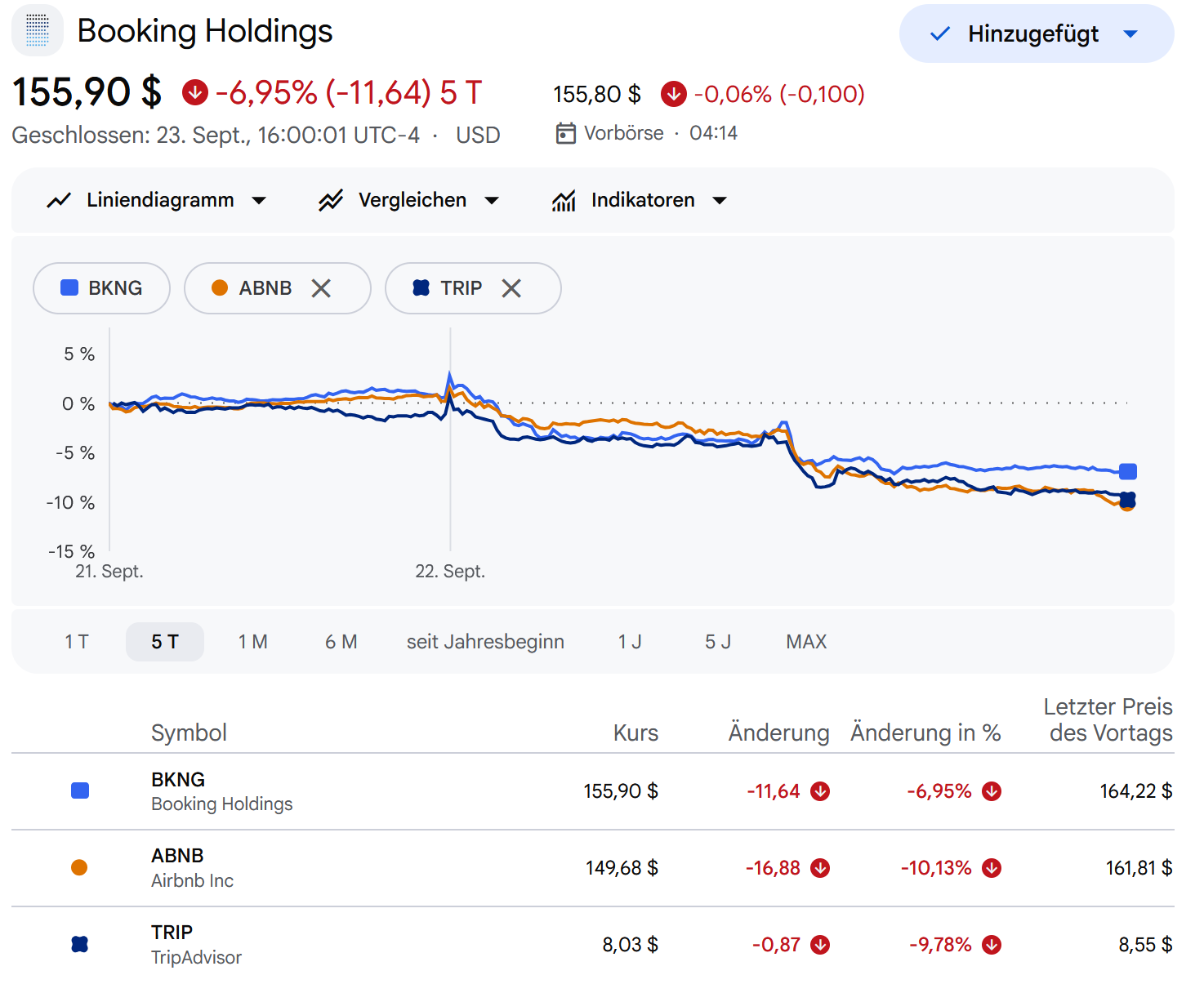
The question is clearly: How real is that fear of (short term) disruption ?
I think it makes sense to look at a few “hurdles” for the agentic take-over:
- Consumer behaviour US vs. RoW
If we look at Mony Group for instance whose main product is insurance comparison: In the UK, more than 80% of insurance policies are closed/renewed through comparison portals. In the US, this business model is quasi non-existent.
To my understanding, Americans might maybe call one other carrier if they feel that their insurance contract is too expensive, but they would never make the effort to compare their insurance portfolio on a regular basis.
In the UK, this is normal, the same here in Germany. Normally, your favourite portal will know all your relevant details and will actively send you better offers before the old contracts expire. One click and you have cheaper insurance.
So for any active comparison portal user, there is very little to gain by using an AI agent, rather the opposite. And this is before the fact that insurance comparison is a regulated business (as insurance is).
- Real time capabilities of LLMs
One thing where at least I struggle a lot with LLMs is to make sure that they really use real time information and not some stale training data. Not sure how they solve it with agents, but I guess that that might still be an issue. Especially if you are looking for a used car or a flat to rent, you need to be really quick for the good deals.
Most portals already offer some kind of “alarm” function for interesting objects. I am not sure if and how AI agents can make sure to have access to the newest offers.
- Anti-agent measures
The most interesting aspect in my opinion will be to see if and to what extent the existing owners of “comparison inventory” will allow AI agents onto their platform. Amazon for instance, has already blocked Muse, which is no surprise as Amaon’s Ad model would be jeopardized.
Amazon is also smart enough, not to let Meta access its inventory and also its ship infrastructure.
That’s maybe another point here: At least in the business world, Meta is not your partner of choice. Noone likes them, no one trusts them.
So we could go on and on, but I do not think and especially in “comparison crazy” UK, that AI Agents will be a super fast disruptive force that will make the incubents worthless over night.
But, and this is a big BUT: The stock market could act as this is the case for quite some time.
Whenever the overall AI narrative looks good and AI stocks go up, these stocks, that are perceived as AI losers will go down. No matter if the fundamentals shows something or not.
KPI overview:
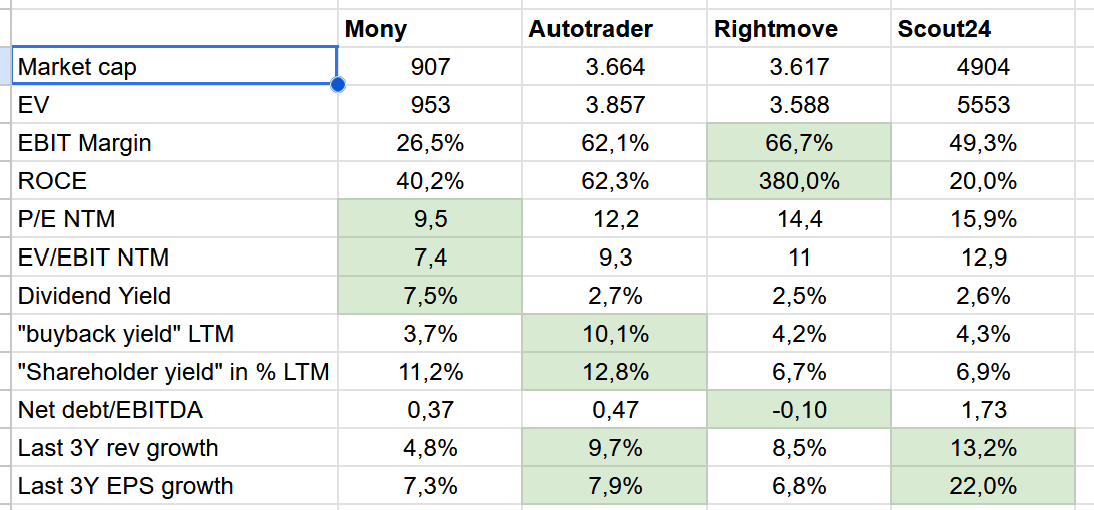
Here is a quick overview of some KPIs that I looked at, including German real estate portal Scout24 which is similar to Rightmove.
We can see that Mony is really cheap, whereas Rightmove is clearly the most profitable. Autotrader is in between with the biggest “buyback yield”.
Scout 24 is clearly more expensive, most likely because growth has been higher than for the UK players, but that is also a risk if AI Agent adoption happens faster than I assume. For this reason and because I wanted UK exposure, I didn’t include them in the basket (yet).
Multiple compression
For all 3 stocks, valuation multiples have been compressed significantly. Let’s look at Autotrader first, which was only listed in 2015:
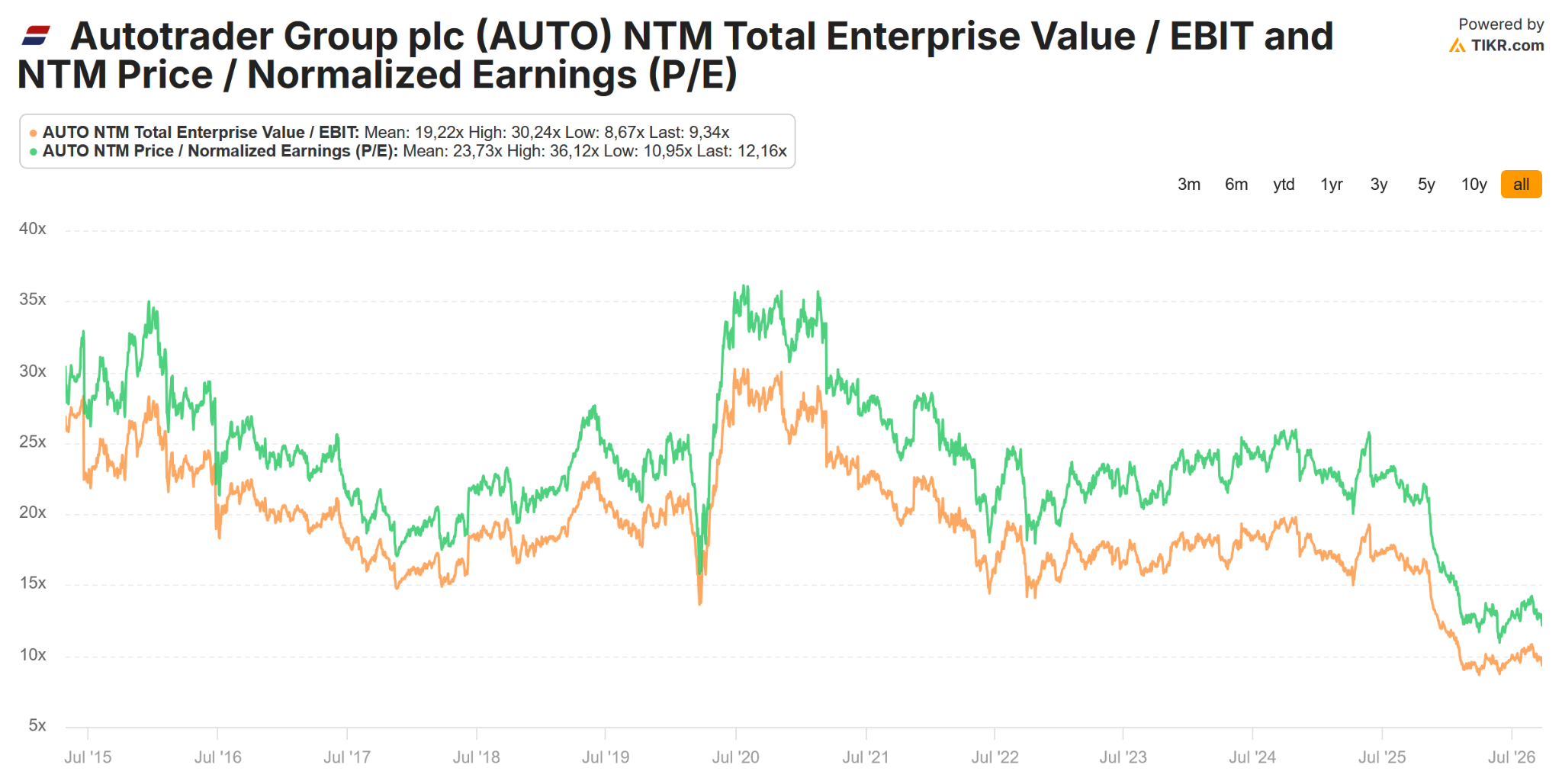
The P/E and EV/EBIT multiples are at absolute lows and at around1/2 of the historical mean.
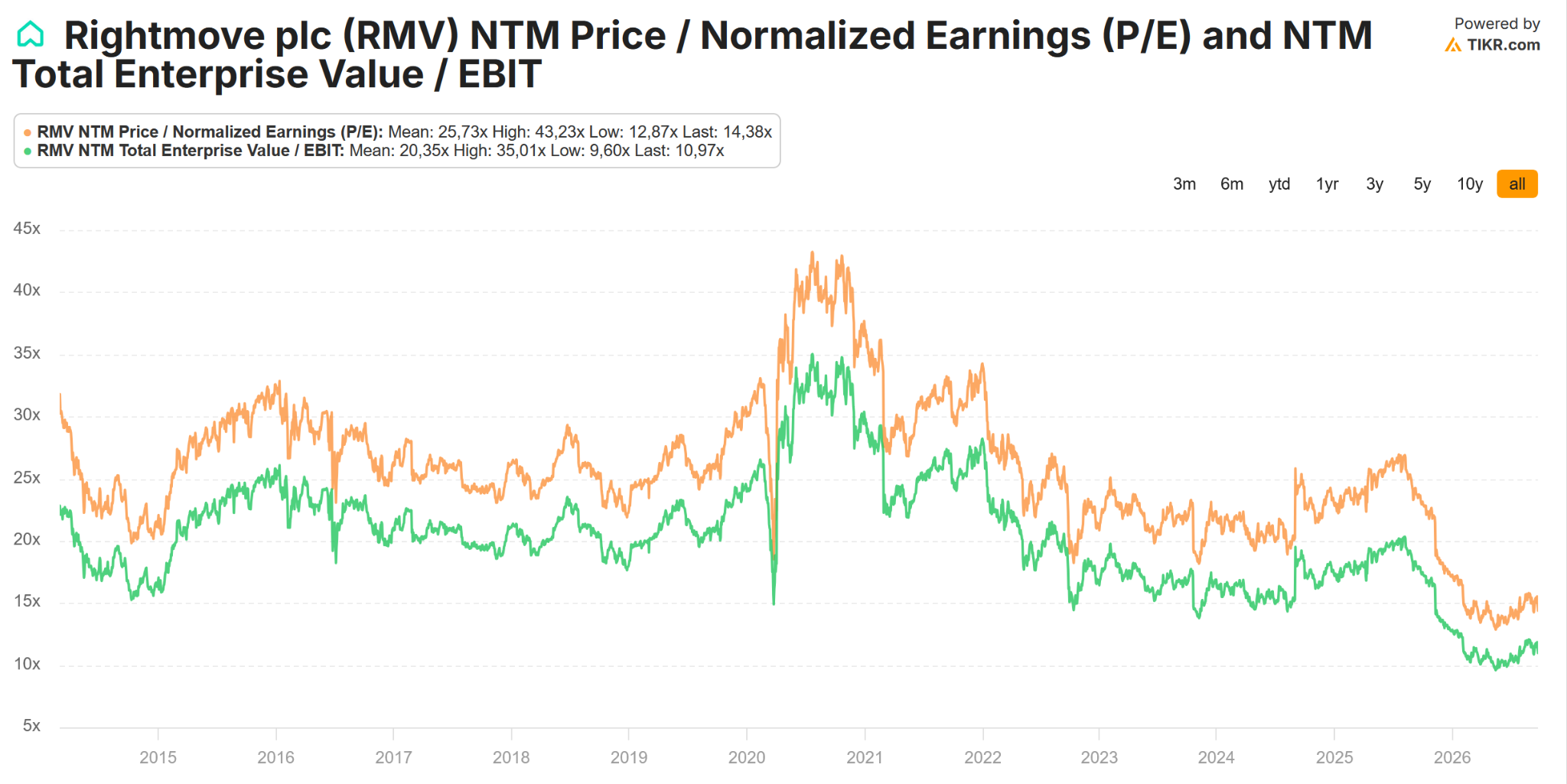
For Rightmove, this looks very similar:
Money was never that expensive but is also now historically cheap:
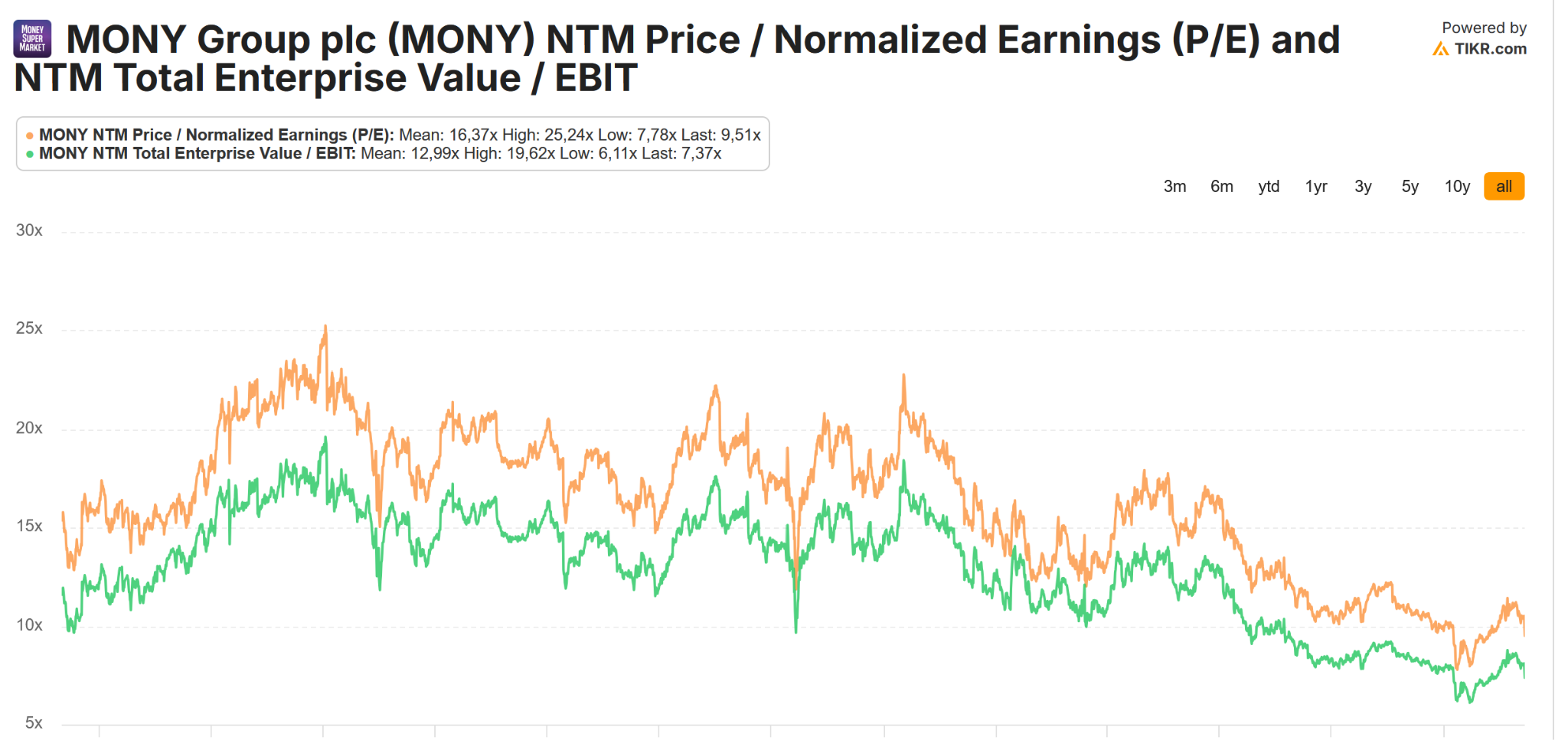
While “mean reversion” is not a good investment case as such in a disruptive environment, it clearly shows that the stocks are at least cheap compared to historical valuations. Not that long ago, investors thought that a P/E of 30x is fair for Rightmove.
The Basket:
As a start, I allocated to each UK stock (Mony, Autotrader, Rightmove) 1% of the portfolio, making it a 3% position overall. As purchase price I assume an average price at ~5% above today’s closing price each.
I will need to decide going forward if I either increase the size per stock a little or add maybe a few other UK stocks to the basket. We’ll see. At the moment I might go to 1,5% per stock and have overall maybe 5 UK stocks in that basket.
My time horizon for this trade is 15-18 months and I am looking for an upside of 30-50% in total (including dividends) if some normalization kicks in.
As the performance of my “basket trades” so far was rather mixed (Freedom Energy basket was OK, freedom insulation less so), please wish me luck on this one.
Summary:
Investing into comparison portals aka 2 sided market places at the moment is clearly a “pain trade”. The risk of getting punched in the face short term is quite high.
On the other hand, many of these businesses are extremely high quality and as cheap as they have been for the last 10 or 15 years
For the UK players, based on what we have seen in other areas, the probability of M&A action is not zero and I am also convinced that especially for the UK, the fear of a quick take over through AI agents (Muse) is overblown.


It is important to consider whether a) the information is only available on the platform and b) whether the platform makes money primarily from adds or the deals itself.
a) AI agents can find hotel prices and similar information elsewhere (maybe don’t need booking etc.), but for many one-time sales, such as houses and used cars, the platform is the only source of information available. Even AI agents need the platform.
b) If I rely on adds, it is bad if only agents use my platform. However, if I make money mainly from selling the object, and the object is nowhere else, the agent must book via the platform, right?
Indeed, platfomrs with no propriatory inventory are most vunerable. With regard to ads: I think that is one of the reasons that Amazon doesn’t allow Agents on its Marketplace. The make som much money with ads, that indeed, this revenue source could go away when agents filter out the est offer without bothering with ads.
Klingt für mich mutig. Mir ist das Pflaster mittlerweile zu heiß.
Ich sehe gute Chancen, dass das Geschäftsmodell in den nächsten Jahren übernommen / zerlegt / automatisiert wird. Und dass die Rückzahlung aus Dividenden bis dahin überschaubar ist.
Nebenbei, ich habe mich von MutuiOnline/Moltiply verabschiedet, weil mir zwei andere Aspekte nicht gefielen:
1. Steigender Umsatz bei sinkender Ertragsmarge – die Gewinne (nach Zinszahlungen) sind gefühlt stabil geblieben, während die Umsätze deutlich stiegen.
2. Steigende Verschuldung. Einerseits durch Zukäufe (siehe Verivox), andererseits durch die Beteiligung an Money. Anfangs klang es nach einer Finanzanlage, aber bei sinkenden Aktienkursen von Money haben sie weiter aufgestockt.
Ich würde mich nicht wundern, wenn Moltiply bei Gelegenheit unter Druck gerät, die Money-Anteile zu verkaufen, um die Schulden wieder zu senken.
Das könnte gut ausgehen, wenn es ein attraktives Übernahmeangebot für Money gibt. Aber wenn nicht, dann kann der Kurs von Money massiv unter Druck geraten.
Der lange Verkaufsprozess und der niedrige erzielte Verkaufspreis von Pro7 für Verivox zeigte, dass die Käufer für solche Firmen derzeit nicht gerade Schlange stehen und nicht gerade mit Geld um sich werfen.
Das Risiko muss nicht einmal nur in einem voll konkurrierenden Geschäftsmodell durch KI-Agenten liegen. Es fängt schon damit an, dass der Traffic für viele Internetseiten (Vergleichspreise etc.) sinkt, weil die potentiellen Kunden mit der KI-Voranzeige schon viel von den Vergleichsseiten sehen. Und dann leichter zum Direktanbieter weiterziehen können.
Vielleicht kannst du den sinkenden Traffic auch auf deinem Blog sehen. Ich sehe zumindest zunehmend Klagen von werbefinanzierten Homepages, dass ihr Geschäftsmodell dadurch erodiert – auch wenn KI das bislang noch nicht durch eigene Werbeeinnahmen refinanziert.
Die Kommerzialisierung von KI kommt erst in späteren Etappen.
Vielen Dank für den Kommentar. Ja, es gibt einiges was gegen Vergleichsportale spricht. Allerdings wächst ja selbst Mony noch und ist halt auch wirklich nicht teuer. Ich bin mir auch nicht sicher, ob die KI Google Übersicht wirklich aktuelle, individuelle Angebote aus den Vergleichsseiten zeigen.
Bzgl Moltiply: Eine Möglichkeit wäre m.E. dass sie sich vielleicht 100% aufs Vergelichsportalgeschäft fokussieren.
Wir werden sehen.
Big user of Claude for vibe coding, investing, research for home purchase (based on actual documents received by realtor). But their ability to replace online marketplaces is scrap. Really bad. Now… Antropic could focus on this and improve their system but is this the biggest thing to chase down the alley. After all, agentic adoption is anyway below 1% among total users as of today. Joe public is ok with search engine replacement. But this is not two sided platform.
So yes, interesting thought
Thx. We’ll see. The market stil lbelives in the magic of Muse….
Do not know how to reply to you:
“That’s what you can do in any good real estate portal right now. You specifiy what you are looking for and get an alert if something goes on sale directly. And I guess being directly at the source is faster. Rightmove is THE market for real estate in UK. I don’t see the added value of an agent here. Same for Immoscout in Germany.”
Why would I go to those websites if my agent can do that for me (I talk to my agent about everything, and it’s just a subtask for searching this)? Also, it can read images and, based on them, determine whether that is for me. It is hard for me to explain – I would propose that you test it yourself. Nowadays, it is safe to run OpenClaw on your own machine (I am still running it on a Hetzner VPS, but I work on SW and I was quite early on this). Just download it and run it – let it use your browser and do stuff for you – you will be amazed.
Anyway, I am a huge fan of your writings – so do not take this as negative feedback; it is just my opinion, and as always, nobody knows anything about markets, so this might be a good revert-to-mean, hard to say.
The danger being that the AI trade ends and everything goes down. Then with tech being seen as culprit, additional regulation in that area decreases profits. Maybe not in the UK, though.
My take is that agents will disrupt this, and Amazon can’t fight it, so it needs to bend. I have already been using my OpenClaw agent for a long time (a couple of months) for “shopping” or doing comparisons, and it does web searches, etc to get relevant data. Though it might be an opportunity for some players if they adopt it quickly and provide that kind of data easily for agents; of course, I don’t know what their monetization model would then be (sure there is already protocols that agents can pay for access). Do they get money from the supplier if they can argue that the customer came through them?
What have you been shopping with Ooen Claw ? Insurance ? Cars ? A new house ?
Shoes :joy: but my point is that I can just specify what I want, for example, about my dream apartment, and OpenClaw will create a recurring task where it scans all new apartments in the area with my “hopes and dreams” and checks images and gives them to me in the preferred order given the time span.
That’s what you can do in any good real estate portal right now. You specifiy what you are looking for and get an alert if something goes on sale directly. And I guess being directly at the source is faster. Rightmove is THE market for real estate in UK. I don’t see the added value of an agent here. Same for Immoscout in Germany.
I have been looking at classifieds from time to time. I have no definitiv opinion about agents, but one should also not forget google, eg Google Real Estate Listings, https://blog.google/products/ads-commerce/new-real-estate-ads-formats/ . But actually I am more afraid that these portals have been „milking“ their customers in the past a lot. You can do it for a while but not forever. Have a look at Hemnet, they were really dominating in Sweden (more than > 75% market share), private equity enters, „Greed has taken over“ (https://www.di.se/nyheter/hemnetkritiken-bestar-girigheten-har-tagit-overhanden/) and now they have to correct course.
That being said, I had to smile about the comment about „Brits are really obsessed about real estate“. Have a look at https://www.bbc.com/news/articles/c77xdp1e56yo ‚Rightmove is my porn‘ – the addiction to online property search
Google failed to make a dent in insurance comparison despite trying seveal times.
Alfa Financial Software is a good one. B2B software company (asset finance) on 8x fwd EBITDA and with net cash. They had PE offers in the past at much higher multiples.
Funnily enough, Alfa is indeed on my extended to do list for this project.