Author Archives: memyselfandi007

Updates: Admiral CEO, Lloyds Banking, Cranswick + Editorial (Comments)

Editorial stuff:

While I was away (without access to my account) some people complained that their comments were not shown while other comments went through. The reason is the WordPress commenting system. If you comment for the first time, I need to manually approve this first comment. Once you are approved, further comments appear automatically if you login and comment the same way than you had done for the first time. So for anyone who commented for the fist time in the last 2 weeks, the comments were still in the “to be approved queue”.
Read more

Double Book review: Tim Clissold “Mr. China” & “Chinese Rules: Mao’s Dog, Deng’s Cat, and Five Timeless Lessons from the Front Lines in China”

Tim Clissold is an English guy who happened to go to China just when China was opening up to the Western world in the early 1990s. His first book “Mr. China” tells the story how he tried to set up and invest a 400 mn USD private equity fund in China together with an US Wall Street veteran.

This was clearly not an easy task. When, after visiting 100 or more companies, he finally found some to invest in, the real problems only began. Ownership rights in China are quite flexible and in his book there are a couple of in-detail stories what can go wrong in China. As a short summary I would say that actually almost everything can go wrong in China for a foreign investor. Contracts are worth nothing and more than once a manager disappeared with most of the money. In other cases, the old owner just built a new factory next to the old one and all the workers left for the new factory and so on and so on. An interesting details was the importance of company seals (“chops”). Those company seals are much more important than anything and the one who has those seals in possession can do anything.

It might be a severe case of confirmation bias but after reading this book I felt fully vindicated for not even considering to invest in any German or US listed Chinese companies (and yes, this includes Alibaba, Baidu etc.). If you can’t even control what’s happening when you are in the country how should you have any chance if you are only invested via several questionable legal constructs.

Clissold makes it especially clear that Chinese thinking is entirely different from western thinking when it comes to business and rules that we take for granted just do not apply or even exist in China.

The second book is a more focused story on his second attempt in China, where he was called in to solve a difficult situation with regard to a big Carbon credit project and then started out to set up his own Carbon Credit investment fund in the mid 2000s. Of course he encountered the same problems as in the first try but he tried to counter them with more typical Chinese tactics which seemed to have worked better. In the end this project didn’t work either as the price of Carbon credits collapsed during and after the financial crisis.

The second book also includes more historical and philosophical background on China which makes it a “deeper” read than the first one.

Overall I can recommend both books to anyone who is interested in China in general and investing or working in China specifically. Although they are a lot of “How China thinks” books out there, this is one of the few with really first hand experience. And the books are quite well written, too.

Book review: “King of Capital: The Remarkable Rise, Fall, and Rise Again of Steve Schwarzman and Blackstone”

The title of the book is actually a little bit misleading. Yes, Blackstone and Steve Schwarzman play a large role in the book, but the book also covers the story of the whole private equity industry pretty well.

After working for DLJ and Lehman, Schwarzman started Blackstone as a 2 person M&A advisory boutique in the 1980ties. As the M&A advisory business was somehow limited, Schwarzmann and his partner decided trying to get into the then fledgling private equity business. Just before they were out of money, they got their first investor money and then became on of the most succesful Private Equity players.

What I liked the book ist that it looks not only at Blackstone but at the development of Private Equity since the 1980ties in general. There is also a lot of interesting detail to be found on specific deals which I found very interesting. For instance how Blackstone failed in Germany in the Cable sector and many more deals. Blackstone in contrast to some other players invests often in cyclical companies where timing is quite important.

Most recently they also branched out big time into Real Estate. A funny side story is the fact, that Larry Fink started Blackrock as a division of Blackstone and relatively early bough the company out for a couple of hundred million USD. Blackrock is now a 65 bn USD market cap company, almost 20 bn more than Blackstone, its former parent.

The author hinself seems to be relatively neutral or even slightly positiv on the general role of private equity and collects some good arguments.

Overall, private equity investors like Blackstone are very close to what I would call “value investors”. Clearly, sometimes they extract that value petty quickly but many times they also create and grow companies like Blackrock. Overall those guys clearly have longer time horizons than most equity fund managers and one of their strengths is that they are not meassured against benchmarks on a monthly or quarterly basis. I guess that is the main reason why they can act very countercyclical.

However, Private Equity is not a one-way street to success a s the side story of Forstmann-Little shows. In the 1990s, they were the predominant player but than went all in into telecom and technology and finally did not survive. Blackstone did some Telco deals as well but nothing which would harm them big time.

As a summary, I can highly recommend this book who has a some interest on how Private Equity works and how those guys think.

New position: Lloyd’s Banking Group (GBGB0008706128) as special situation investment

Interestingly, while looking at AerCap, I always almost automatically compared them to Llyods Banking Group. In the old days I might have bought both shares but as I limit myself to 1 new position (or one complete sale) per month I had to make a decision and it went to Lloyds. My previous analyses can be found here: part 1 & part 2
Read more

AerCap Holdings N.V. part 2 – Less tangible at a second glance

So after my first look into David Einhorn’s long pick AerCap last week, I want to follow up with some more detailed analyis in a second step.

By the way, a big “thank you” for all the qualified comments and Emails I got already after the first post, that’s the best return on investment on a blog post I can get !!!

The book value story growth

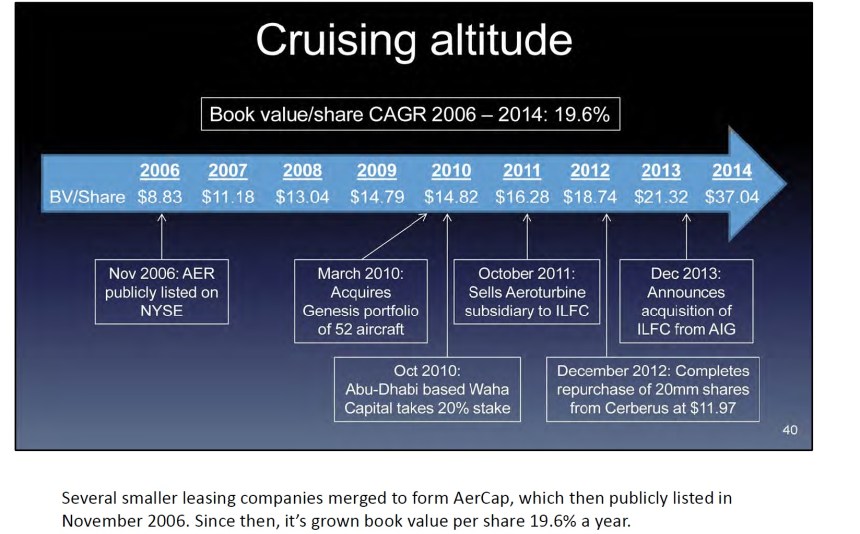
This was for me one of the core slides of Einhorn’s deck:
aercap

I mean you don’t have to be a genius to understand this: A company which trades near book value and compounds 20% p.a. is pretty much a no brainer. However, if I look at the developement of book values for financial companies, I always look at both, stated and tangible book value per share.

In AerCap’s case, the comparison looks interesting:

BV per share TBV share
2006 8,83 8,3493
2007 11,18 10,6041
2008 13,04 12,4083
2009 14,79 14,3448
2010 14,82 14,3798
2011 15,26 15,0608
2012 18,72 18,5592
2013 21,32 21,2334
2014 37,04 16,174
     
CAGR 19,6% 8,6%
CAGR 2006-2013 13,4% 14,3%

This table shows two things: Before the ILFC transaction, stated book values and tangible book values were pretty much the same and compounding around 13% p.a. Still pretty good but clearly not 20%. In 2014 however, with the ILFC deal something interesting happened: The book value per share doubled but tangible book value dropped.

The ILFC deal

So this is the right time to look into the ILFC deal. The two main questions for me are:

a) why did the book value per share increase so much ?
b) why did tangible book value per share actually decrease ?

This is how AerCap presents what and how they paid for ILFC:

Aercap2

So AerCap paid the majority of the purchase with own shares, 97,56 mn shares valued at 46,49 USD. Issuing new shares always has an impact on book value per share if the issue price is different from the book value. Let’s look at an example:

We have a company which has issued 100 Shares at 50 EUR book value per share and 100 EUR market value (P/B =2). So the total market value is 10.000, total book value is 5000. If the company now issues another 100 Shares at 100 EUR market value, we have 200 shares outstanding and 5000+10000 = 15.000 EUR total book value. Divided by 200 stocks we now have 75 EUR book value per share or a 50% increase in book value per share for the old shareholders. So issuing shares above book value increases book value per share automatically.

In AerCap’s case, it worked more or less the same way: AerCap had ~113 mn shares outstanding with a book value of around 21,30 USD per share. So issuing 97,56 mn share at a steep premium at 46,49 of course increased book value per share dramatically. The transaction alone would have increased the book value to ((113*21,30)+(97,56*46,49))/(113+97,56)= 32,97 USD per share or an increase of ~50%.

So how is this to be interpreted ? Well, clearly it was a smart move from AerCaps management to pay with its owns shares at such a nice price. On the other hand, one should clearly not mistake this a a recurring kind of thing. I would not use the historic 20% p.a. increase in ROE as expectation for the future but rather something like 13% or so in the past.

Intangibles

After looking into how much and in what form AerCap was paying, let’s look now what they actually got:

aercap3

Yes, they got a lot of planes and debt. Interestingly they assumed more debt than book value of the planes. Altogether they did get a lot of intangible assets. All in, AerCap bought 4,6 bn intangibles which is around 80 mn more than equity created through the new shares. So at the end of the day, one could argue that the new shares have been exchanged more or less 1:1 against intangible assets.

The largest part of this is a 4 bn USD position called “Maintenance rights intangible” which for me is something new. This is what they say in their 20-F filing:

Maintenance rights intangible and lease premium, net
The maintenance rights intangible asset arose from the application of the acquisition method of accounting to aircraft and leases which were acquired in the ILFC Transaction, and represented the fair value of our contractual aircraft return rights under our leases at the Closing Date. The maintenance rights intangible asset represents the fair value of our contractual aircraft return right under our leases to receive the aircraft in a specified maintenance condition at the end of the lease (EOL contracts) or our right to an aircraft in better maintenance condition by virtue of our obligation to contribute towards the cost of the
maintenance events performed by the lessee either through reimbursement of maintenance deposit rents held (MR contracts), or through a lessor contribution to the lessee. The maintenance rights intangible arose from the application of the acquisition method of accounting to aircraft and leases which were acquired in the ILFC Transaction, and represented the fair value of our contractual aircraft return rights under our leases at the Closing Date. The maintenance rights represented the difference between the specified maintenance return condition in our leases and the actual physical condition of our aircraft at the Closing Date.

For EOL contracts, maintenance rights expense is recognized upon lease termination, to the extent the lease end cash compensation paid to us is less than the maintenance rights intangible asset. Maintenance rights expense is included in Leasing expenses in our Consolidated Income Statement. To the extent the lease end cash compensation paid to us is more than the maintenance rights intangible asset, revenue is recognized in Lease revenue in our Consolidated Income Statement, upon lease termination. For MR contracts, maintenance rights expense is recognized at the time the lessee provides us with an invoice for reimbursement relating to the cost of a qualifying maintenance event that relates to pre-acquisition usage.

The lease premium represents the value of an acquired lease where the contractual rent payments are above the market rate. We amortize the lease premium on a straight-line bases over the term of the lease as a reduction of Lease revenue.

This sounds quite complicated and for some reason part of the sentences seem to have been duplicated. If I understand correctly, they assume that the underlying value of the aircraft is higher than the book value of the acquired planes. To be honest: I do not have any clue if this is justified or not.

However, as those intangibles are significant (more than 50% of book value), the case gets a lot less interesting for me. Intangibles created via M&A activity are in my experience always difficult, especially if it is esoteric stuff like this. It’s also a big change to the past of AerCap. Historically, they were carrying very little intangibles.

Funding cost & ROE

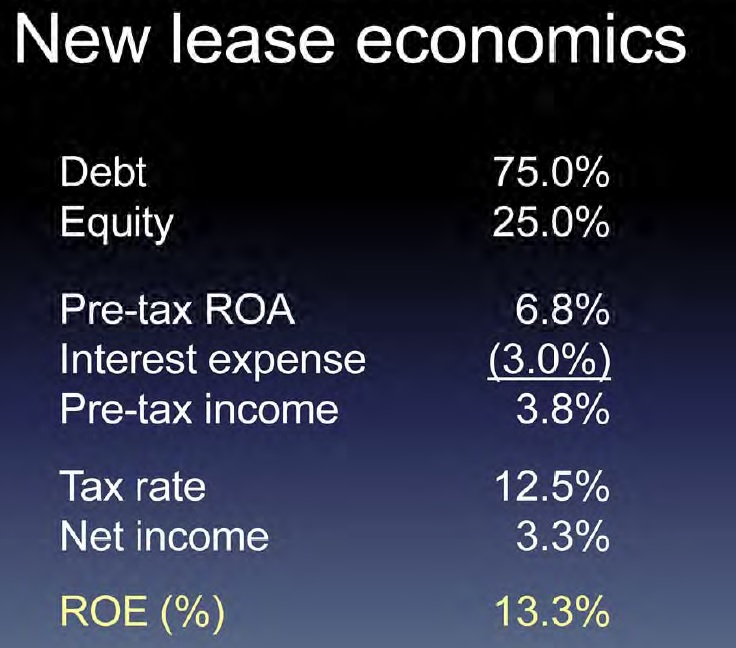
This was Einhorn’s prospective ROE calculation:
aercap roe

One of the key assumptions is a 3% funding cost. So let’s do a reality check and look at the expected pricing of AerCaps new bond issue. This is from Bloomberg:

Aercap $750m TLB Talk L+275, 99.75, 0.75%; Due April 30
By Krista Giovacco
(Bloomberg) — Commits due April 30 by 12pm ET.
Borrower: Flying Fortress Holdings LLC, a subsidiary of AerCap Holdings and International Lease Finance Corp., largest independent aircraft lessor
$750m TLB due 2020 (5 yr extended)
Price Talk: L+275
OID: 99.75
Libor Floor: 0.75%
Call: 101 SC (6 mos)
Fin. Covenants: Max LTV test
Existing Ratings: Ba2/BB+ (corp.); Ba1/BBB-, RR2 (TLB)

So AerCap is funding at a spread of 2,75% vs. LIBOR. With the 10 year USD LIBOR at 2,00%, funding would be way more expensive than the 3% assumed by Einhorn. Maybe the fund floating rate, but then the whole company would rather be a bet against rising interest rates than anything else. On a “like for like” basis without structural interest rate risk, I don’t think AerCap will generate a double-digit ROE at current spreads.

Business case & competitive environment

Within the comments of the first post, some people argued that the company is not a financing company but that the access to Aircraft is the value driver. Buying cheap aircraft from manufacturers and then selling (or leasing) them with a mark-up to clients then looks like some kind of Aircraft trading business.

For me however there is one big problem with such a business model. Retailing or wholesaling any merchandise is then most attractive as a business when 3 criteria are met:

– there are a lot of suppliers
– there are a lot of clients
– you can create a competitive advantage via physical distribution networks

In AerCap’s case, the biggest problem is clearly that there are not that many suppliers but only 2, Boeing and Airbus. Both don’t have much incentive to let any intermediary become too large so they will most likely encourage competition between Aircraft buyers.

Secondly, as far as I understand, there is no physical distribution network etc. behind AerCap’s business. So entering the market and competing with AerCap in the future doesn’t look so difficult for anyone with access to cheap capital.

Clearly, as in any opaque trading business, an extremely smart trader can always make money but it is important to understand that at least in my understanding there are no LONG TERM competitive advantages besides the purchase order flow from ILFC.

That the barrier to entry the business is not that high is proven by no other than Steven Udvar-Hazy the initial founder of ILFC and his new company Air Lease.

IPO’ed in 2010 and now the company is already a 4 bn USD market company 5 years later. Interestingly, AIG sued Air Lease in 2012 because they

were able “to effectively steal a business,” and reap a windfall at the expense of ILFC, the world’s second-largest aircraft lessor by fleet size. It described how some employees, while still working at ILFC, downloaded confidential files and allegedly diverted deals with certain ILFC customers to Air Lease, before leaving to join that firm. The companies are in the business of buying aircraft and leasing them to commercial airlines all over the world.

So to me it’s not clear what AerCap actually bought. It seems the “secret sauce” of ILFC seems to have been transferred to competitor Air Lease already. Interestingly, the lawsuit was settled a few days ago at a sum of 72 mn USD. I found that quote from Udvar-Hazy interesting:

“I want to make it clear that there is no secret sauce in the aircraft leasing business,” Hazy told analysts on a conference call. “ALC’s success is a result of a strong management team with extensive experience and solid industry relationships.”

Summary:

My problem with AerCap is the following: The financial part of the company, which I feel that I can judge to a certain extent, does not look attractive but rather risky to me. The Aircraft “buying and trading” segment on the other hand seems to be the more attractive part but for me too hard to judge in a reasonable way.

So for the time being, this is clearly not an investment for me. To look further into AerCap, two things need to happen: First they need to regain their investment grade rating and funding cost will need to drop to the 3% that Einhorn is assuming and secondly, there should be a clear impact on the share price from a potential sale from AIG.

In the current market environment clearly anything can happen and a multiple expansion could bring nice profits but personally, in a direct comparison I prefer the LLoyd’s case.

Some links

Thanks to a stock forum I discovered that John Hempton from Bronte is issuing a monthly letter for his Australian fund (H/T qed1984). The last one about China is brilliant.

An interesting article about a Whistleblower at Halliburton with some insight into the arcane world of “revenue recognition”.

Charlie Rose 30 minute interview with Ginni Rometty, CEO of IBM

Q1 report of Centaur, the US value fund run by Zeke Ashton

Must read: Roddy Boyd exposes US pharmceutical company and stock market darling Insys Therapeutics which seems to be literally “killing it”

A couple of presentations from the Ben Graham Centre 2015 Conference

Finally interesting research from German StarCapital on country by country valuations adjusted for differences in the underlying industry sectors

AerCap Holdings NV (ISIN NL0000687663) – How good is Einhorn’s new favourite ?

A friend forwarded me the latest presentation from “guru” David Einhorn where his main long pick was AerCap, an Airplane leasing company.

To shortly summarize the “Long case”:

– AerCap is cheap (P/E 9)
– they made a great deal taking over IFLC, the airplane leasing division of AIG which is several times AerCap’s original size
– they have great management which is incentivized along shareholders
– The business is a simple and secure “spread business”
– major risks are according to Einhorn mostly the credit risk of the airlines and residual value risk of the planes

There are also quite obvious reasons why Aercap is cheap and trades at lower multiples than its peers:

– share overhang: AIG accepted new AerCap shares as part of the purchase price and owns 45,6%. They want to sell and the lock up is expiring
– following the IFLC/AIG transaction, the company was downgraded to “Non-investment grade” or “junk” and has therefore relatively high funding costs compared for instance to GE as main competitor

What kind of business are we talking about?

Well, Airplane leasing is essentially a “special purpose lending business” without an official bank license, one could also say it is a “shadow bank”. What Aercap essentially does is to loan an airplane to an airline.

In order to make any money at all, they have to be cheaper than the simple alternative which would be the airline gets a loan from a bank and buys the airplane directly. As Airlines are notoriously unprofitable and often thinly capitalized, they often need to pay pretty high spreads even if they borrow money on a collateralized basis.

As any lessor funds the plane mostly with debt, the cost of debt is one important factor to make money compared to competitors. It is therefore no big surprise that GE with its AA+ Rating is the biggest Airplane leasing company in the world and that ILFC thrived while AIG was still AAA and had comparably low funding cost.

Airplane buying is tricky business

A second aspect is also clearly buying power. Planes have to be ordered many years in advance and the two big manufacturers want to be sure that they are getting paid. I assume a reliable bulk buyer gets better access to the most sought after planes and maybe even better prices. Prices for planes at least in my experience are notoriously intransparent. Nobody pays the official list prices anyway. I found this interesting article in the WSJ from 2012.

When Airbus and Boeing Co. announce orders at the Farnborough International Airshow this week, they will value the deals based on the planes’ catalog prices—which no one pays. Airline executives, when pressed for details, will probably say they got “a great deal.” But actual terms will remain guarded like nuclear launch codes.
The aviation industry’s code of silence on pricing is notable in this era of information overload. Thousands of people world-wide are involved in airplane purchases, yet few numbers spill out. That yields much mystery and speculation.

Discounts are large:

But there are ways to estimate the range of discounts. An analysis of public data by The Wall Street Journal and interviews with numerous industry officials yielded this: Discounts seem to vary between roughly 20% and 60%, with an average around 45%. Savvy buyers don’t pay more than half the sticker price, industry veterans say. But deal specifics differ greatly.

But no one wants to talk about it:

One reason for the secrecy surrounding all this, say industry officials, is psychology: Less-experienced plane buyers like to think they got a bargain and don’t want to be embarrassed if they overpaid. The safest approach then is silence. More-seasoned plane buyers also know that bragging about discount specifics would anger Airbus, Boeing or other producers and hurt the chances of striking a sweetheart deal again.

Clearly, as a large “quasi broker”, Airline leasing companies seem wo have a chance to make some money in such a intransparent market. But it is really hard to pin down real numbers. It reminds me a little bit about how you buy kitchens in Germany where the system is pretty much the same. Everyone gets a discount, but no one knows what the “true” price looks like.

But this also leads to a problem:

With the current funding costs, AerCap would not be competitive in the long run. Let’s take as a proxy the 10 year CDS spread as a proxy for funding costs and compare them across airlines and competitors (more than 50% of AerCaps outstanding debt is unsecured):

10 year senior CDS Rating
     
AerCap 215 BB+
     
     
Clients    
Air France 96  
Singapore Airlines 105 A+
Southwest 109  
Lufthansa 195 BBB-
Thai Airways 240  
Delta 256 BB
Emirates 257  
Jet Blue 362 B
     
Competitors    
GE Capital 72 AA+
Air Lease 175 BBB-
ICBC 194 A
CIT 229 BB-

So purely from the funding cost perspective, AerCap at the moment has a problem. Someone like Air France could easily fund a loan for an airplane cheaper than AerCap, so cutting out the middle man is basically a no brainer and even the smaller competitors could easily under price AerCap when they bid for leasing deals. On top of that, a lot of non-traditional players like pension funds and insurance companies want some piece of the action, as the return on investments on those leases are significantly higher than anything comparable. Even Asset managers have entered this market and have created specific funds for instance Investec.

AerCap does have a positive rating outlook, so there is a perspective for lower funding costs. Just to give an indication of how important this rating upgrade is: On average, 10 year BB financial isuers pay 2,4% p.a. more than BBB financial issuers at the moment. The jump from BB+ to BBB- will not be that big but it would increase the investor universe a lot for AerCaps bonds.

The biggest risk for AerCap

So although I am clearly no match for David Einhorn (*), I would argue that the biggest risk for AerCap is not the residual value of the planes or the credit quality of the Airlines but quite simply the refinancing risk. AerCap has to fund a significant amount going forward and if for some reasons, spreads move against them, they will be screwed. Just a quick reminder what happened to ILFC in 2011:

Credit-default swaps on the company climbed this month as global stocks tumbled and speculative-grade debt issuance all but evaporated. The cost reached as high as 663 basis points on Aug. 11, according to CMA, which is owned by CME Group Inc. and compiles prices quoted by dealers in the privately negotiated market. The contracts have held at prices that imply ILFC’s debt should be rated B2, according to Moody’s Corp.’s capital markets group.

However if they manage to to get an investment grade rating and lower their funding cost, then it could be an interesting investment as funding is cheap and they do have access to a lot of new and sought after aircraft. Again, borrowing from Warren Buffett, with any leveraged company, management is extremely important.

And one should clearly compare AerCaps valuation and risk/return to banks and not to the currently much higher valued corporates. AerCap is much more similar to a bank than anything else. This general valuation disconnect seems to be also one of major reason why GE announced the massive reorganization just 2 weeks ago. However, as far as I understood tehy will keep the leasing business as this is unregulated.

Summary:

Although I slightly disagree with the risk assessment of Einhorn’s case, I still think AerCap could be an interesting case and is worth to dig deeper. I don not have a problem investing into financial companies and I do like those “share overhang” situations. However, I will need to dig deeper and especially try to figure out how good AerCap’s management really is.

(*) I did disagree with David Einhorn already once with Dutch Insurer Delta LLyod which was Einhorn’s long pick of the year 2011. Overall in this case I would put the score of MMI vs. Einhorn at 1:0 as Delta LLoyd did not outperform.

Update: TGS Nopec Annual Report 2014 and Q1 2015

TGS Nopec is one of my larger position which I bought back in November 2013 when oil (WTI) was still trading at ~100 US and the world looked great for oil and oil service companies.

In the meantime, as we all now, the oil price fell substantially since 2014 and especially oil service companies were hit hard. In contrast to other oil service companies however, TGS share price has decoupled from oil to a large extent as we can see in the chart:

This is especially interesting as 2008/2009 for instance, TGS lost almost -70% when oil crashed back then. Almost always when I discussed TGS with other investors, the argument was like this: TGS is a great company but the price has to fall at least -50% or more as it did in the past. Well, for now they are holding up pretty well.

2014 annual report

Anyway, the 2014 annual report can be found here

I would recommend anyone to read the annual report, at least the one page letter of the CEO, which in very clear words describes how TGS operates.

The highlights from my side:

– EPS dropped significantly from 2,59 USD to 2,09 USD per share
– however there were several negative one time effects included (around 65 mn USD or 60-65 cents per share).
– interestingly they make no effort to adjust those one time effects. You won’t find adjusted numbers anywhere in the report. I like this VERY MUCH.
– Operating cashflow actually increased by 10%
– Operationally, the Americas were doing very well in 2014. Asia was growing strongly but deeply negative
– payroll costs increased by ~10% in 2014
– they are still committed to invest counter-cyclical into new data by taking advantage of low charter rates for ships

Overall, they way TGS operates, 2015 will not look good from a P&L perspective, as they expense a lot of their investments and sales might take a little bit longer than usual. However if the past is any guidance for the future, in 2-3 years time the investments will then turn into nice profits down the road.

Q1 2015 update

A few days ago, even before the official Q1 report, TGS issued a Q1 update press release. They reduced significantly the expected net revenues for 2015 as E&P companeis are delaying their projects. Additionally, they announced a significant cost cutting program:

The Cost Reduction Program will position the company for the more challenging seismic market caused by the significant drop in oil price. A key element of this program is a reduction of more than 10% of TGS’ global workforce effective from April. Restructuring charges of approximately USD 4 million will be booked in Q2 as a result of this Program. The company expects annual cost savings of approximately USD 10 million as a result of the Cost Reduction Program.

Interestingly, this 10% reduction seems to off set the salary increase in 2014. At first, the market seemed to be shocked and the stock lost around -20% intraday but since then things have recovered. Maybe the recommendation change from Goldman has lifted the stock. This is what Goldman wrote last week (via Bloomberg):

(Bloomberg) — Offshore seismic market set for structural changes as oil producers rationalize costs, optimize upstream portfolios and concentrate on efficiency, Goldman says in note dated yday.
Goldman: multi-client segment has strongest outlook; data acquisition will continue to face challenges with at least six vessels needed to leave market to achieve balance
TGS raised to buy vs sell, is best-positioned in new oil order; co.’s library has highest N. America exposure which should remain most attractive onshore area
Strong financial position can sustain div.; selloff post 1Q creates buying opportunity

So it seems that this time, TGS does get better credit for their countercyclical business model than in 2008/2009. Maybe investors have learned actually a little bit since then ?.

In any case, from my side, TGS is a clear long-term core investment. Although the industry is very difficult, TGS is very good company with strong competitive advantages. Oil companies must replace their reserves,the demand for seismic data is not going away. Maybe it gets postponed a little bit ut they don’t have a choice. Without replacing reserves, atraditional E&P will not valued as going concern but as a run-off which much lower multiples.

Even with the reduced forecasts, TGS is still very profitable and who know what opportunities show up if some of the competitors get deeper into problems.

Some links

The Brooklyn investor looks at the JPM annual report and Loews

David Einhorn’s presentation from the Grant’s Investment Conference 2015

A new White Paper from AQR called “Fact, Fiction and Value Investing” (h/t Valuewalk)

Frenzel & Herzing look at Greek company Metka

Is Google the next Microsoft ?

Some interesting thought about the issues in Turkey

And finally, Hedge Fund billionaire Paul Tudor Jones wants to change capitalism

« Older Entries Recent Entries »