Category Archives: Anlage Philosophie

Short cuts: AS Creation, Fortum, KAS Bank annual report

AS Creation

As Creation is a stock I owned in the past. Last November I had quickly updated the case and written the following:

In any case, I don’t think AS Creation is interesting at the current level of 30 EUR. At a 2014 P/E of 15-20 (before any extra write-offs on Russia) there seems to be quite some turn around fantasy being priced in.

Just a few days ago, AS Creation came out with an anouncement. There will be no dividend and the loss for the year 2014 is 9,3 mn EUR, at the upper end of the communicated range. In parallel, the CFO left the company. The loss seems triggered by a 10 mn EUR FX loss and a 5 mn EUR fine in France. They did not give further details but one can assume that the German business wasn’t that great either.

In any case a good reminder that despite cheap fundamentals, not every “value stock” is good value.

Fortum

Fortum is also a stock which I owned in the past. I sold them in autumn 2012 because I was not really convinced by the idea anymore.

Looking at the chart, we can see that Fortum has done OK since then, especially compared to like German utilities like RWE, which looked a lot cheaper back then:

Again a reminder that cheap doesn’t mean good. The even more interesting aspect is that a few days ago, Fortum finalised the sale of the Swedish power distribution grid to a consortium of pension plans and insurers for 4.4 bn EUR.

According to Reuters, the multiples were quite “Juicy” for the seller:

The deal values the network at around 16.6 times earnings before interest, taxes, depreciation and amortization (EBITDA), the same as for Fortum’s Finnish grid sale in 2013.

16,6 times EBITDA for a business which is quite comparable to my portfolio stock Electrica is an interesting price point. Clearly, you need to take some kind of discount for a recently privatized Romanian company, but I think it clearly shows what kind of prices especially pension and insurance companies are ready to pay. This makes me feel even better about the prospects of Electrica than before.

KAS Bank annual report

When I looked first at KAS Bank 2 and a half years ago, i was drawn in mostly by a very low valuation and the solid business model with a good “mean reversion” potential. that’s what I wrote back then:

Summary:

KAS Bank for me looks like a very interesting opportunity within the banking sector due to the following reasons:

+ attractive specialist business model (custodian)
+ cheap valuation even based on current “bottom of the cycle” earnings
+ valuation depressed because of overall hostility against banks
+ low or no analyst coverage
+ reversion to the mean speculation a lot less risky than with normal banks as virtually no risk of dilution (even Basel III standards are met by a wide margin)
+ potential upside ~100% over the next 3-5 years plus dividends+ low correlation / beta good portfolio diversifier

The upside has realized much quicker than i thought. As of now, including dividends, the stock return +75%. So good analysis, great return ? Well not really. Actually, if I am honest, this was mostly luck as I made a big mistake or omission when i analyzed the stock: I did not look at the pension liability. And this despite the fact that I have written and warned quite often about pensions.

In Kas Bank’s case I have ignored that because the plan was funded. That was a mistake and I will show you why.

Looking into the 2014 annual report of KAS Bank, we can see that they made a nice 24 mn EUR profit this year, which includes the one time effect of the canceled German JV. However, total equity DEcreased from 213 to 194 mn EUR. As the 2014 dividend is around 10 mn EUR, the question is clearly: Where did the other 35 mn EUR equity go ?

The solution to this question can be found on page 52, in the Comprehensive Income statement: KAS Bank lost 52,6 mn EUR pre tax) because of the increase in its pension liability. 2014 has been a brutal year for pensions. The discount rate has been reduced significantly. In 2013 I didn’t pay attention, but KAS Bank used 3,9% which was on the very high-end of permitted rates for EUR. In 2014 they had to slash this to 2,2% (page 80). It gets even crazier if we look at the gross numbers on page 81. The gross DBO increase 105 mn EUR from 182 mn to 287 mn. Luckily, some of that increase could be countered by asset increases. From an overfunding of 40 mn EUR, the plan went to break even. What really surprised me is the duration of the plan with around 22 years. The problem for me is the following: Despite the current funded status, there is a significant amount of risk in the plan. The gross size of the plan is 1,5 times the equity of KAS Bank. The run a significant equity allocation (85 mn EUR or ~ 45% of KAS Banks Equity). So in a scenario with a stock market crash with continuing low-interest rates, KAS Bank would pretty quickly be forced to do a capital increase.

Additionally, the current environment is clearly not helping KAS Bank in its core business. A custody bank is always deposit rich which is a problem now. Another second level problem is mentioned on page 18:

Treasury income, mainly securities lending, decreased by 20% to EUR 11.4 million (2013: EUR 14.3 million). The lower income from securities lending was primarily due to a market wide liquidity surplus which decreased
the prices for securities lending services.

This decrease happened even before the ECB started pumping liquidity into the markets.

So overall, I have been very lucky so far. I didn’t take into account the pension liability in my first analysis and fundamentals got worse for the business itself. Nevertheless I made good money because i bought cheap enough. Optically, the stock still looks priced oK at P/B 1, trailing P/E of 7 and 5,6% dividend yield, but fundamentally, especially looking at ultra low interest rates for quite some time, KAS Bank is in my view now at fair value.

However, I didn’t want to stretch my luck too far and therefore I sold the whole position at around 11,50 EUR per share.

Handelsbanken (part 3) – where is the upside & valuation

As this turned out to be again a pretty long post, a quick “management summary” in the beginning:

1. I do think that Handelsbanken’s UK business represents a significant opportunity for long-term growth
2. Additionally, I think that well run banks are a good opportunity as banks are in general disliked and overall risks in banking have been greatly reduced
3. However, at current valuation levels, Handelsbanken is too expensive. I would be a buyer at around 350 SEK per share or ~-15% below current prices

After trying to “kill” the Handelsbanken investment case last week, now in my third post I will look at the potential upside.

From my side, there are 2 potential “catalysts” which COULD imply future upside, which are:

1. Significant growth potential in UK and Netherlands
2. (Relative) revaluation of the banking sector in the medium term

1. Significant growth potential in UK and Netherlands

If you read the Handelsbanken annual reports over the last few years, it is not exactly a secret that they have great success in the UK. This is a table I compiled from the annual reports which shows the development of the UK branches:

Branches Operating profit Total OP UK/total
2009 62 177 13727 1.29%
2010 83 417 14770 2.82%
2011 104 639 16563 3.86%
2012 133 1006 17108 5.88%
2013 161 1173 18088 6.48%
2014 178 1652 19212 8.60%

Since the end of the financial crisis in 200, Handelsbanken managed to increase operating profit in the UK 10 times and the UK business reached almost 9% of total operating profits in 2014.

Despite a higher cost/income ratio in the UK (~55%) vs the home market in Sweden (~33%), profitability as measured by ROE is already at the same level. Opening bank branches is clearly a cost factor, so one should expect cost income ratios to even go down in the UK over time.

Gross margins in the UK are clearly higher than in Sweden. In my opinion, this has two possible explanations: First, overall interest rates are higher in the UK which makes it easier to charge more. Secondly, most of the competitors (Barclay’s, HSBC, Lloyd’s, TSB) have large legacy portfolios and need to earn margins on new business.

The big question is: can Handelsbanken continue to grow and how big could this become ? One clear driver of the growth is that UK customers are fed up with their local banks. Most of them needed bail outs (RBS, Lloyds, TSB), damaged their reputation by aggressively selling questionable products and/or tax evasion etc. (HSBC’s Gulliver with his Swiss bank account as a last example).

Handelsbanken’s market share in UK so far is tiny. I tried to collect some numbers. In this 2011 report for instance, Handelsbanken didn’t even show up. This is how market shares for instance looked for personal account:

Normally, as in many industries, size does have advantages also in retail banking. Advertising for instance are expenses which scale well. In the UK however banks with large market shares face strong headwinds as outlined in this article. Interestingly, Lloyd’s with its leading market share has a cost-income-ratio of currently around 67% and this number has improved a lot over the last year. So it’s quite interesting to see that the “dwarf” Handelsbanken is already much more efficient than the big guys.

Overall, without having examined the UK market in more detail, I do think there is room for Handelsbanken to expand and reinvest capital at attractive rates for some time.

Personally, I like the organic growth of Handelsbanken a lot. In general I find that especially in the early stages, organic growth is often undervalued. Stock investors prefer often fast growth via acquisitions. You can book a lot of accounting special effects etc. and increase EPS per share much quicker. As we have seen often however, the risk of M&A deals is a lot higher and more often than not, those deals backfire and sometimes even sink the acquirer.

In the UK for instance, recently spun-off TSB has already been approached by Spanish Bank Sabadell for a potential take over a few days ago. This is of course a quick way to add a lot of branches but also a much more risky one.

Netherlands:

Netherlands for Handelsbanken is a comparable small market. with currently 20 branches (up from 18 in 2013), the business grew by ~17%. In principle, I think the situation could be similar to the UK. a lot of the dutch banks have big legacy issues and need to earn margins. However at the moment I would look at the Netherlands as an option and not as something to actually take into account when valuing Handelsbanken.

2. (Relative) revaluation of the banking sector in the medium term

I have quickly touched this topic in the two other posts already. Banks are generally considered as “bad investments” by most participants in the stock market. This is clearly justified if we look back the last 10 years or even longer. Whereas a company like Nestle is considered a safe and promising investment at a P/E of around 23, banks are considered a pure gamble even when the trade at fractions of those multiples.

For me, this is both, a lesson in how to look at historical data and a potentially big structural investment opportunity. Let me explain why.

The main arguments against banks is that they are highly leveraged and too risky. The risk is both individual and systemic (Lehman scenario). In my opinion, the systemic risk component has been greatly reduced by what happened since the financial crisis. A lot of mechanisms have been created to prevent a second event like the run that happened in 2008/2009. For me the most important are:

– collateralization of derivatives
– bank resolution systems both national (e.g. SOFFIN) and on international level
– clear commitment and mandates of central banks
– significant increase in capital requirements internationally

For current shareholders of large legacy banks, this is not very funny at the moment. Whereas most non-banks pay dividends and buy back shares like crazy, banks have to raise capital and postpone dividends in order to shore up their capital. And clearly, in many of the mega-banks, there is plenty of toxic waste on the balance sheet to justify low valuations.

On the other hand, this creates in my opinion great opportunities for players like Handelsbanken which have little toxic waste on their balance sheet and are run efficiently. The systemic risk for those players has become a lot smaller as a potential bankruptcy of one of the old mega-banks will most likely have only little effects on other banks in the future.

The individual risk of a classic and disciplined lending bank in my opinion is relatively limited if it is run by the right people. I do not think that a conservatively run bank is riskier than any other business. I know this is a somehow controversial standpoint but to me, a standard banking business model looks a lot less complex than for instance a multi national branded consumer goods company. For me this kind of blind distrust in the banking business model creates a very interesting opportunity.

Yes, banking in general will be much more dull in the future, but als a lot safer.

The second issue I want to touch quickly is the issue of historical data. Yes, historically, banks look like terrible investments because many of them have been wiped out in the financial crisis. I cannot prove it statistically, but I think banks are also the reason why suddenly low P/E and low P/B strategies seemed to have stopped working. The now favored metric by many “data miners”, the EV has the advantage that it automatically filters out any financial company. But looking into the rear view mirror is not always the best way to make investment decisions. If you would have been a stock investor after WW II, you might not have ever invested into German or Japanese shares because they have been wiped out. But a World War luckily does not happen every 5-10 years and neither does a full-blown financial crisis.

I think that there is a good chance that due to the pressure of capital markets, in the future, returns for banks could be relatively a lot better than they have in the past, assuming that the basic banking model is here to stay. The market will squeeze banks so much that those who remain will earn good ROEs again at some point in the future. And good banks will earn very good ROEs.

Valuation exercise

There are many ways to evaluate companies. I prefer simple ones. For banks, I consider ROE and P/B as the most important factors which drive long-term returns, so a valuation model should focus on those metrics.

To have a starting point, I make the following assumptions:

– ROE will improve to 15% over 5 years (from currently 12,4%) and will stay there (15 year average is 16,5%)
– P/B will remain constant at 2,1 (15 year average is 1,7)
– Divdend payout will be 25% and handelsbanken will be able to reinvest at the above assumed ROEs

The following table translates this into a simple IRR calculation:

Current Price book 2,1                    
ROE 15%                    
                       
ROI 7,1%                    


    1 2 3 4 5 6 7 8 9 10
Book Value 200 218,8 240,1 264,4 292,1 323,9 360,4 400,9 446,0 496,2 552,0
ROE 12,5% 13% 13,50% 14% 14,50% 15% 15% 15% 15% 15% 15%
EPS 25 28,44 32,41 37,01 42,36 48,59 54,05 60,13 66,90 74,43 82,80
Implicit P/E 16,8 16,2 15,6 15,0 14,5 14,0 14,0 14,0 14,0 14,0 14,0
Retention ratio 75% 0,75 0,75 0,75 0,75 0,75 0,75 0,75 0,75 0,75 0,75 0,75
Dividend   7,1 8,1 9,3 10,6 12,1 13,5 15,0 16,7 18,6 20,7
Target Price   459,4 504,2 555,2 613,5 680,2 756,8 841,9 936,6 1.042,0 1.159,2
                       
NPV CFs -409 7,1 8,1 9,3 10,6 12,1 13,5 15,0 16,7 18,6 1.179,9
                       
IRR 12,9%                  

Under those assumptions, Handelsbanken would be trading at 1.160 in 10 years time and returning me 12,9% p.a.

Now comes the interesting part: If I would want to see my 15% p.a. which I normally require, I would need to change assumptions. First I could move the purchase price down from 409 SEK. In my model, I could pay 342 SEks per share and get my 15% annual return. I could also increase my P/B multiple to 2,6 to get my 15% or I could increase the ROE to 21% after year 6 to get 15%. To be honest, both, the multiple expansion and the ROE increase seem much to aggressive to me.

So the question clearly is: Is 12,9% potential return enough or should I insist on 15% ? With the 10 year government rate in Sweden at 1%, the 12,9% would indicate a potential equity premium of 11,9% which is far more than one would normally expect from the market. On the other hand, no one knows what long-term interest rates will be in 10 years time, so betting fully on today’s low rates is also not the best solution.

This return is also driven by the assumption that Handelsbanken can continue to reinvest 75% of their profits at attractive ROEs. In Handelsbanken’s case, I don’t think that this is unrealistic. However if they could for instance only reinvest 60% and pay out the rest in dividends, then the expected return would drop to 10,7% p.a.

Anyway, for now, I would not feel comfortable investing at the current stock price level.

Summary:

At the end of this mini-series, it has become relatively clear to me that Svenska Handelsbanken is really a great company, a true “Outsider” in regard to its business model and culture. Additionally, I do think that they have good growth opportunities in UK, which allows them to reinvest capital for some time to come attractive ROE’s.

In general, I believe than well run banks are one of the few potential bargains left in the market as investors hate them and do not see the greatly improved fundamentals of the financial “plumbing”.

Nevertheless, I do think that Handelsbanken does not fulfill my return requirements as the current price seems to have priced in some of this growth already. Unfortunately i was very slow in discovering Handelsbanken., as I could have bought them at an attractive only a few months ago. Nevertheless, I will keep them as my prime candidate on my watch list. I would love to add this “Outsider company” to my long-term value portfolio.

But again, patience is important. another positive aspect of this exercise is that I know now much better than before what I am looking for when I analyze a bank.

A deeper look into Svenska Handelsbanken (With a little help from Warren Buffett)

This is the follow up post on my first post where I compared Handelsbanken to Deutsche Bank.

Whenever I start to look at a company more seriously, I do a quick Pro/con list, starting with the Cons first in order to cool down my desire to quickly buy a stock:

Cons:

1. It’s a bank
2. Avg P/E over the last 15 years has been ~11 compared to 17 now (so historically expensive)
3. current P/B at 2,0 is higher than 15 Year average (1,7)
4. current price/tangible book at 2,2 vs. 15 year average at 1,95
5. Almost 100% more expensive (P/B) than most European banks
6. high exposure to potentially “frothy” Nordic real estate markets
7. significant amount of capital market funding (deposit to loan ratio clearly below 0)
8. past performance also due to "Luck" of not being active in Southern Europe, many Nordic banks look good, especially Swedish banks
9. threat of continued technological change (online banking, peer-to-peer lending, etc.)
10. analysts are extremely negative, significantly below all peers (on Bloomberg, from 33 analysts, only 1 has a buy, 16 holds, 16 sells). Handelsbanken is Number 600 of analyst consensus in the Stoxx 600.
11. we are current in a frothy stock market environment and the stock chart looks aggressive

Let’s look into more detail into these issues.

Re 1: It’s a bank

Many value investors stay away from banks, mostly due to the 2008/2009 crisis where former highly regarded banks (Lehman, Bear Stearns;WaMu, Countrywide) basically disappeared over night. On the other hand, Warren Buffett’s single biggest stock investment is a bank, Wells Fargo at around 27 bn USD for their ~10% plus stake.

One of the great things about Buffett is that he usually explains what he does. Wells Fargo is not different. He actually explains it in his 1990 annual report.

He starts explaining why they don’t like banks in general:

The banking business is no favorite of ours. When assets are twenty times equity – a common ratio in this industry – mistakes that involve only a small portion of assets can destroy a major portion of equity. And mistakes have been the rule rather than the exception at many major banks. Most have resulted from a managerial failing that we described last year when discussing the “institutional imperative:” the tendency of executives to mindlessly imitate the behavior of their peers, no matter how foolish it may be to do so. In their lending, many bankers played follow-the-leader with lemming-like zeal; now they are experiencing a lemming-like fate.

Because leverage of 20:1 magnifies the effects of managerial strengths and weaknesses, we have no interest in purchasing shares of a poorly managed bank at a “cheap” price. Instead, our only interest is in buying into well-managed banks at fair prices.

So this is pretty clear statement from Buffett: If you buy a bank, buy a good one.

Let’s look at the next paragraph:

With Wells Fargo, we think we have obtained the best managers in the business, Carl Reichardt and Paul Hazen. In many ways the combination of Carl and Paul reminds me of another – Tom Murphy and Dan Burke at Capital Cities/ABC. First, each pair is stronger than the sum of its parts because each partner understands, trusts and admires the other. Second, both managerial teams pay able people well, but abhor having a bigger head count than is needed. Third, both attack costs as vigorously when profits are at record levels as when they are under pressure. Finally, both stick with what they understand and let their abilities, not their egos, determine what they attempt. (Thomas J. Watson Sr. of IBM followed the same rule: “I’m no genius,” he said. “I’m smart in spots – but I stay around those spots.”)

He clearly invested in the people running the bank. That somehow contradicts other statements from him where he claims only to invest in businesses which could be run by idiots. Anyway, the second learning is: Buy good banks with good management..

Let’s look next, why and when he bought:

Our purchases of Wells Fargo in 1990 were helped by a chaotic market in bank stocks. The disarray was appropriate: Month by month the foolish loan decisions of once well-regarded banks were put on public display. As one huge loss after another was unveiled – often on the heels of managerial assurances that all was well – investors understandably concluded that no bank’s numbers were to be trusted. Aided by their flight from bank stocks, we purchased our 10% interest in Wells Fargo for $290 million, less than five times after-tax earnings, and less than three times pre-tax earnings.

As we have seen the 2008/2009 financial crisis, Buffett seems to like buying banks especially in crisis situations where they sell really really cheap. This somehow also contradicts the first paragraph. Clearly Buffett prefers to buy cheap if he has the chance.

In the following part, we can clearly see how far Buffett’s thinking went those days:

Of course, ownership of a bank – or about any other business – is far from riskless. California banks face the specific risk of a major earthquake, which might wreak enough havoc on borrowers to in turn destroy the banks lending to them. A second risk is systemic – the possibility of a business contraction or financial panic so severe that it would endanger almost every highly leveraged institution, no matter how intelligently run. Finally, the market’s major fear of the moment is that West Coast real estate values will tumble because of overbuilding and deliver huge losses to banks that have financed the expansion. Because it is a leading real estate lender, Wells Fargo is thought to be particularly vulnerable.

Interestingly, real estate prices look expensive in 1990, even before the big 20 year boom. He then gives us a hint how he actually puts numbers on risk:

Consider some mathematics: Wells Fargo currently earns well over $1 billion pre-tax annually after expensing more than $300 million for loan losses. If 10% of all $48 billion of the bank’s loans – not just its real estate loans – were hit by problems in 1991, and these produced losses (including foregone interest) averaging 30% of principal, the company would roughly break even.

In any case this did not deter him from buying Wells Fargo and they have been a great investment for him. Just for fun, I checked out the performance of Wells Fargo since 01.01.1990. Including dividends, Wells fargo made 15,6% p.a. since then, that is even 2% p.a. better than Berkshire returned for its shareholders in the same time period !!!!

Re 2: Avg P/E over the last 15 years has been ~11 compared to 17 now (so historically expensive)

This is clearly an issue. As we have seen above, buying banks at distressed prices is much more fun. One counter argument is that current margins at Handelsbanken are also below their historical means. If you assume mean reversion for instance to the 10 year average net income margin, than this would lead to an overall average valuation level. So no reason to worry here but it is clearly not a bargain either. On the other hand, Wells fargo for instance would have been a great investment for Buffett in any case as long-term for such a great company the entrance point has less relevance.

Re 3. current P/B at 2,0 is higher than 15 Year average (1,7)
Re 4. current price/tangible book at 2,2 vs. 15 year average at 1,95

Similar to 2, both measures look expensive compared to the past. “Normalized” the look better but clearly not a bargain.

Re 5. Almost 100% more expensive (P/B) than most European banks

This doesn’t worry me much. As Buffett mentioned, you should buy “good banks” not weak banks below book value.

Re 6. high exposure to potentially “frothy” Nordic real estate markets

Here we can use Buffett’s sample calculation:

At the end of 2014, Svenska had around 1.114.000 mn SEK property loans. If we assume 10% of them defaulting with a loss of 30%, we would end up with an expected loss of ~ 33.000 mn SEK. Compared to the net income of 15.000 SEK for Handelsbanken in 2014, this would mean a loss 2 times their annual profit. Not as comfortable as Wells Fargo back then, but US Banks in general have higher margins. On the other hand, there are no “no recourse” loans in Scandinavia, so one could assume that the stress scenario might be lower.

Re 7. significant amount of capital market funding (deposit to loan ratio clearly below 0)

The dependence on capital market funding was the major problem for banks in the 2007/2008 crisis. Now however, the situation has turned. With negative rates, many deposit rich banks have huge problems because you can’t really charge your retail customers for deposits (yet) but you “earn” negative rates on excess deposits. For Handelsbanken, this is much easier because they don’t have a lot of excess cash on the balance sheet. So in the current environment, this is actually an advantage.

Ee 8. past performance also due to "Luck" of not being active in Southern Europe, many Nordic banks look good, especially Swedish banks

That is absolutely true, however Handelsbanken long-term ROEs etc. are the best even within this Group.

Re 9. threat of continued technological change (online banking, peer-to-peer lending, etc.)

This is a very interesting aspect. Many banks here in Germany are closing branch after branch, whereas Handelsbanken aggressively expands by opening new branches. Their focus on branch banking is clearly counter cyclical and I am not sure how this will work out long-term. I do think that there will be continued demand for “In person” bank services but I have no idea to what extend.

Re 10. analysts are extremely negative, significantly below all peers (on Bloomberg, from 33 analysts, only 1 has a buy, 16 holds, 16 sells). Handelsbanken is Number 600 of analyst consensus in the Stoxx 600.

This is actually a big plus from my side. I own other stocks (Admiral, TGS) which score equally poorly in analyst’s ratings. In my personal opinion, analysts mostly run their ratings on a top down approach. They start with the sector and if they don’t like the sector, most companies within that sector will get bad ratings. Very often in a next step they then rank companies badly which look “expensive” compared to similar companies. They almost never look a more specific aspects. A relatively expensive company like Admiral in a tough sector will get a bad rating, non withstanding any long-term significant competitive advantages etc.

For me, badly rated companies in tough industries but with long-term competitive advantages are one of the few corners of the markets where I can find value. So this would be a clear plus for Handelsbanken as a potential investment.

Re 11. we are current in a frothy stock market environment and the stock chart looks aggressive

Looking at the chart, it is quite interesting how the stock price accelerated despite the bad analyst ratings:

looking at the shareholders list one can see that US funds seem to like the stock and buy into it, especially Capital Group, T. Rowe Price and others. Skandinavian funds rather seem to be more cautious. Personally, I am also hesitant buying into such a chart, but int theory one should better ignore it as this could be very similar to “Anchoring” a very common behavioural bias.

Summary:

Looking at the “Cons” which I have identified int he first step, I don’t see a deal breaker against investing. However, the current price level is rather “fair” than cheap. This could be justified if there would be a clear upside with regard to growth and/or growing profitability.

As the post got quite long already, I will look into the upside potential in a separate post which should hopefully follow soon.

Performance review February 2015 – Comment “Interest rate surrender”

Performance February

In February, the portfolio gained +5,7% against +7,2% for the Benchmark (Eurostoxx50 (25%), Eurostoxx small 200 (25%), DAX (30%),MDAX (20%)). Still worse than the benchmark but closer than in February. Year to date, the score is +9,2% against +16,1% for the benchmark.

For the first time since its inception (1.1.2011), the portfolio has now doubled in value with an overall gain of +100,6% against +67,3% for the benchmark.

Outperformers in Fabruary were Miko (+16,5%), Draeger (+14,7%), KAS Bank (+12,6%) and TFF (+12,4%). Losers were Koc (-10,2%), Installux (-5,2%) and the TRY Depfa Zero (-3,2%).

February showed the typical “catch up” of small caps which often outperform with a certain time lag to the liquid markets. Overall with around like 20-30% of cash & cash equivalents, I can clearly not expect to match the benchmark in such a phase. This is the strongest start into a calendar year for the stock market since I run the portfolio and my low beta approach then doesn’t work so well.

Portfolio transactions

February was a slow month. The two exceptions were that I sold out the remaining part of Cranswick and increased my Electrica position by 1%. Direct cash ist now at 12,8% plus a further 11% in cash like positions (HT1, Depfa LT2, MAN). I clearly see the problem of some shares reaching fair value and not generating a lot of great new investment ideas.

The number of holdings is now at a reasonable 25. Above 25 I don’t feel too comfortable, so if I would add a new position, I will most likely “kill” an old one. Most obvious candidates would be my smallest holdings, Koc and Trilogiq. The month end portfolio as alaways can be accessed via the “Current portfolio” page.

One remark here on my portfolio holdings: Currently, a lot of companies issue “preliminary annuals”. I always hesitate to fully read them because often they lack important information which is only disclosed in the annual report. I find it much more time effective to wait for that annual report and then decide what to do, unless something really dramatic happened.

Comment: “Changing interest”

Normally I tend to stay away from most macro related issues because it makes my head spin. This comment will be a small exception. First an interesting datapoint: What do you think was the best asset class in 2014 at least in “developed” markets ? Well, US stocks with 15,3% look strong but the German 30 year bund made around +34% in 2014. For many people this is surprising as how you can make +34% in a year with an instrument which had a yield of 2,8% at the end of 2013 but this is the “power” of duration and convexity.

But the even more interesting thing (at least for me) is that for the first time in my 20 year professional career in finance, most of the people I talk to have changed their expectations with regard to interest rates. Even back in the 90ties, everyone was convinced that interest rates could only go higher. The lower rates went, the louder the voices grew. Bond bubble, hyper inflation etc. etc. were the buzzwords and shorting the bund was the absolute “No brainer” trade.

Looking at the historical yield of the bund future (the proxy for 10 year Bund yield), we can clearly see that this “interest rates can only go up” attitude was to a large extent a combination of “Recency bias” and “Anchoring”:

bund

It clearly shows that at least for the last 25 years there was no mean-reversion in interest rates.

I guess the events early this year, mainly the Swiss Franc de-pegging plus the Draghi announcement to buy 60 bn EUR monthly for the foreseeable future combined with negative yields all around have somehow silenced many of the pundits. With negative rates, being short duration now suddenly really starts to hurt. Keeping cash in a long tem pension portfolio until now did not really hurt, but now, if you really have to pay money for deposits, people do anything to get yield. It almost looks like that negative yields force many institution to “surrender” and go long duration, no matter how low yields are. It will be interesting to see for instance what “my friends” at FBD are doing after betting on rising interest rates for the last few years.

Historically, such large scale surrender situations have often marked a mid-term turning points. I would not bet on this nor am I sure that this observation is relevant. However it is definitely a change in expectations compared to the last 25 years. Which I find interesting.

18 observations from Berkshire’s 2014 annual report

Just an upfront note: I have written down those items while reading the 2014 annual report for the first time. Usually I read them at least twice. This year’s report contains a 4 page letter from Charlie Munger (page 39), nicely summarizing the “Berkshire system”. Overall, Buffett and Munger seem to emphasize in this year’s report that they see a great future ahead for Berkshire, even without them on board.

I would recommend anyone to read the annual report first before reading any comments from secondary sources. It is a lot to read but it is definitely worth your time.

My personal take is that it will be extremely hard for any succesor to fit into Buffett’s (and Munger’s) shoes. This company was built by and around two geniuses. Yes, the “Berkshire system” does have some enduring qualities but combined with the size of the company, it will be extremely hard to deliver outstanding performance ging forward.

Call for comments: Comments from my readers about what items you did find especially noteworthy would be highly appreciated !!!!

1. 50 year history

Read more

Svenska Handelsbanken vs. Deutsche Bank – what to look for when investing in banks

Many value investors are of the opinion that banks are not investable. Either because they say the business is too complex or because they think banks are doomed anyway. Maybe due to the overall low valuations of banks, I get regularly requests on writing about how to value bank,s so at least some people seem to be interested. The greatest value investor of all obviously has no problems with investing into banks. Wells Fargo is the biggest position of Buffett at around 26 bn USD and he holds various other bank assets like the Bank of America Warrants.

A few days ago, a good friend recommended me to look at Handelsbanken from Sweden as an example how a well run bank should look like.
Read more

Update Gronlandsbanken – result and annual report 2014 & Danish interest rates

Gronlandsbanken

Gronlandsbanken has just released 2014 numbers and its 2014 annual report. 2014 results look solid: ~50 DKK profit per share, roughly 6% more than in 2013. The dividend remains at DKK 55 (dividend is paid out of pretax income). ROE has remained high at 16,3%. The result would have been even better if Gronlandsbanken would have not increased reserves. This is the quote from the annual report:

The result before value adjustments and write downs of DKK 148,6 million is the Bank’s best basis result so far. This is of course satisfactory. It is at the same time above the last announced results expectation of a result before value adjustments and write downs in the upper end of the range DKK 125 – 145 million. The result before tax returns 16.3% on year start equity after dividend.

This was achieved against a slight drop in Greenland’s GDP which I find quite remarkable. The stock market seemed to have “anticipated” those results to a certain extend as the stock price shows:

The balance sheet is still super rock solid with an equity ratio of 19% (of total balance sheet, not risk weighted assets or some similar shenanigans).

My initial investment thesis 2 years ago was the following:

– as it is the only bank in Greenland, its margins are around twice as high as the best global banks and the balance sheet is rock solid. One could call this a natural moat
– even based on the current state, current valuation implies significant upside to fair value
– the Greenland resource story could add significant growth going forward, even with maybe other banks entering Greenland
– finally, Management has started to buy shares after surprisingly good Q3 numbers
– although there is no direct catalyst, an indirect catalyst could be if some of the projects proceed well and Greenland will move into the spotlight. Gronlandsbanken is the easiest (and only) way to invest into Greenland without project specific risk

One of the issues of course is that most of the natural resources projects look a lot less likely to happen than 2,5 years ago.The annual report is as always a great resource to see what is going on in Greenland. Most projects seem to be on hold or cancelled, the only remaining interest is from China:

Among the larger projects, it has become obvious that virtually only Chinese investors continue to show a certain interest. The BANK of Greenland considers it likely and quite naturally, that the funding can come from China. Chinese enterprises are often the leaders in processing for further use in either Chinese, American, or European industry.

Especially the oil sector has been hit hard:

The prospects of the oil area are more dismal than of the mineral area. After Cairns test drilling in 2010 and 2011, oil exploration in Greenland is now greatly reduced, see Figure 8. The stagnation of the exploration in both the oil and the mineral area is expected to continue over the next few years, even though new licenses have been issued and the preparatory work is continuing in 2014 as well.
The declining interest in oil exploration is a.o. due to large oil and gas discoveries in other places, and the fall in the oil price . Of importance can possibly also be the administration and regulation of the area so far have not been regarded as sufficient by several persons in the industry.

So the bad news is that within my initial time frame of 3-5 years, I will not see any large mining or oil projects in Greenland. The upside might be that the incentive for other banks to enter Greenland will be most likely quite low.

Interest rates

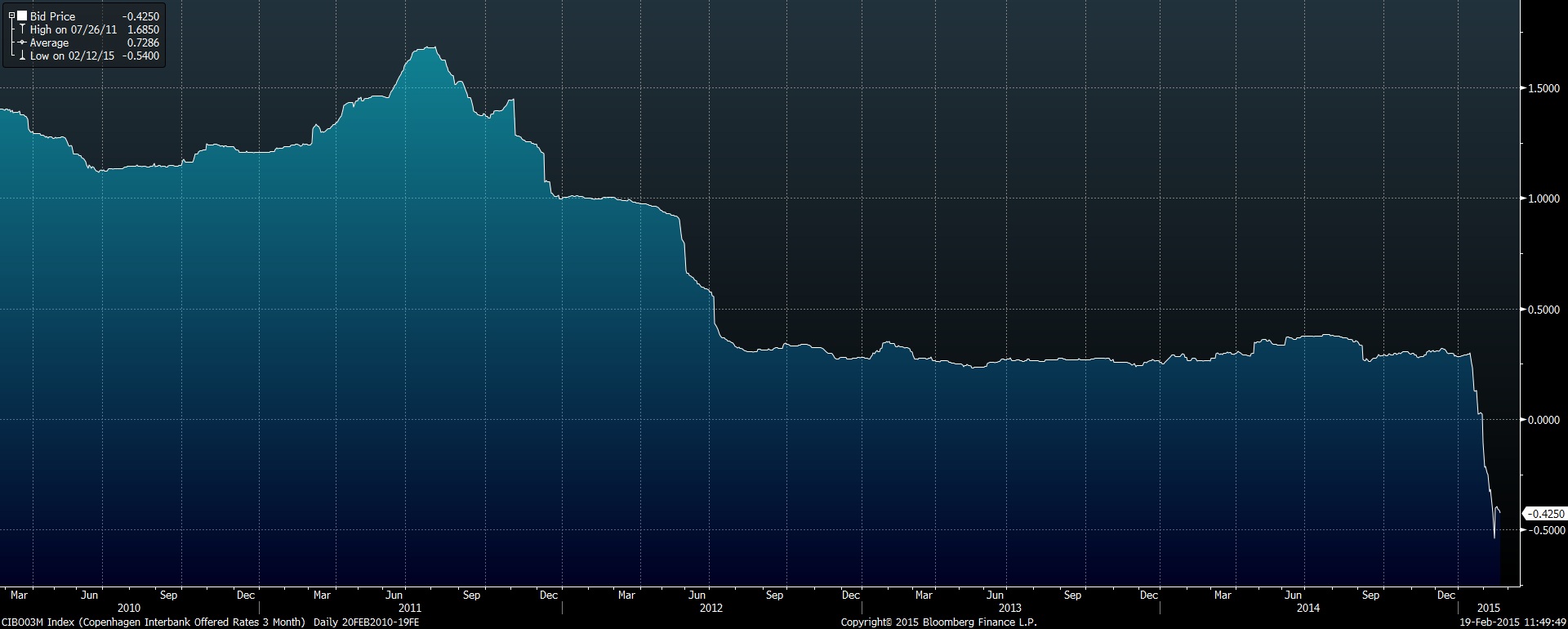
However, another thing happened which was not on my radar screen: Denmark went from having low-interest rates to negative interest rates. This is how 3 month local swap rates developed:

dkk ir

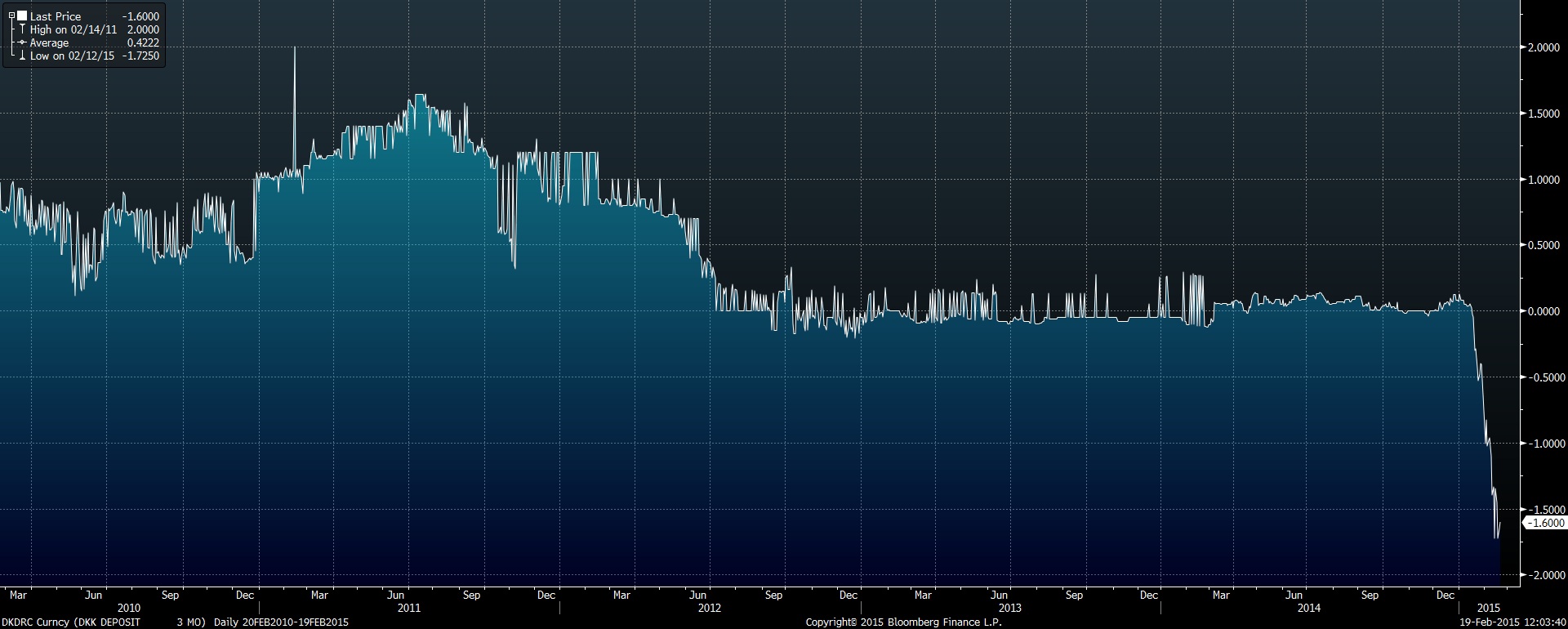
Just as a reminder: Swap rates are “unfunded”, that means based on contracts where no principal changes hands. If we look at “funded” rates, so how much money Danish banks pay for actual deposits, the situation is much more dramatic:

dkk fund

So just to put this in context: If you want to deposit money for 3 months at a Danish bank for 3 months in DKK, they charge you -1,6% p.a. for this “service” !!!!

Impact on Gronlandsbanken:

One thing about Gronlandsbanken which I liked initially but what could be a problem going forward is the following: Gronlandsbanken has a significantly higher deposit base than loans outstanding. While this is good from a liquidity and risk point of view, it is bad because those excess funds have to be invested somewhere and in local currency.

I am not sure if Gronlandsbanken could actually charge for deposits locally, so the risk is there that they get squeezed on the amounts not loaned out to customers. They seem to have anticipated this and increased their bond holdings, but still, at year end 2014, roughly 20% of the balance sheet is potentially exposed to this potential “Negative carry” problem.

On the other hand, as a EUR investor being invested into a DKK security exposes me to a “positive Black Swan” similar to the CHF/EUR move in January. If something goes horribly wrong in the EUR zone, there might be some upside in holding DKK denominated securities.

Addtitionally, any Danish pension fund and Insurance company will struggle to find income producing assets in DKK. With a dividend yield of (gross) of around 8%, Grondlandsbanken should be not unattractive and therefore support the share price in the short term.

Summary:

The underlying business of Gronlandsbanken has done surprisingly well in 2014 despite a lackluster economy. Due to the carnage in natural resource prices, the implied “resource option” has been postponed some years into the future, making the investment case less attractive compared to 2,5 years ago.

Ultra low and negative interest rates could make it more difficult for deposit-rich banks like Gronlandsbanken to maintain their interest margins. As there are not that many alternatives at the moment I will continue to hold the stock for the time being, as it also functions as a kind of “Euro Black Swan” hedge. If I find other interesting finaincial service stocks, Gronlandsbanken would be the first one to be replaced as I think that my other financial holdings (Kasbank, Van Lanschot, NN, Admiral) have a better risk/return ratio.

I will also monitor closely if and how the negative rates will feed through Grondlandsbanken’s Q1 results.

Why on earth is Seth Klarman investing 1,7 bn USD in Cheniere Energy (LNG) at 7x P/B ?

In my book review “The Frackers”, I mentioned one of the stories in the book was about Cheniere Energy:

Finally, there is a fascinating side story about the guy who is running Cheniere Energy, Charif Souki. His great idea was to import natural gas into the US and he raised several billion USD to build a huge gasification plant on the gulf coast. He clearly did not see fracking coming and his investment was worthless. Nevertheless, he was able to raise another few billion bucks and retool the facility in order to export natural gas.

This “double or nothing” gamble seems to have paid off. Seth Klarmann by the way, has just doubled its stake in Cheniere, making it their biggest public listed position at around 1,7 bn USD.

Seth Klarman

Seth Klarman is a famous value investor running Baupost Group a 25bn USD hedge fund. In contrast to Buffett, Klarman very seldom gives interviews and his fund commentaries are hard to get. Hi is considered to be the “heir” of Benjamin Graham and still sticking to the “cigar butt” approach of deep value investing. Two years ago in a Charlie Rose interview, Klarman made the following comment:

Baupost’s leading man says that he buys “cigar butts” at cheap prices. Warren Buffett used to also do this. The difference between the two legends is that Klarman stayed focused on cigar butts while Buffett’s process morphed into buying great companies at great prices and then into paying so-so prices for great companies.

Klarman does many things ordinary investors can’t do, like buying defaulted Lehman stuff etc. Not many of his investments are public and not all of his public investments are successes. Nevertheless it is clearly interesting to look more deeply into his biggest public position, Cheniere Energy.

Cheniere Energy

Cheniere’s stock chart shows the “unusual” history of the company:

Just as a side remark, somehow this chart reminds me of this funny animal:

Looking at Cheniere’s latest quarterly report, we can clearly see that Seth Klarman’s days as Graham style “net-net” investor seem to be over. Cheniere has currently around 7,5 bn net debt and 2,3 bn equity. Based on a market cap of around 17 bn USD, this is a P/B of roughly 7 times so hardly a bargain investment based on this metrics.

On top of that, the company never made a profit in its life as this table with EPS since 2004 clearly shows:

      EPS
02/21/2014 FY 13 12/13   -2,2
02/22/2013 FY 12 12/12   -1,6
02/24/2012 FY 11 12/11   -2,6
03/03/2011 FY 10 12/10   -2,3
02/26/2010 FY 09 12/09   -3,8
02/27/2009 FY 08 12/08   -6,0
02/27/2008 FY 07 12/07   -3,6
02/27/2007 FY 06 12/06   -1,5
03/13/2006 FY 05 12/05   -0,9
03/10/2005 FY 04 12/04   -0,6
N.A. FY 03 12/03   -0,4

So the question is clearly: What does Seth Klarman see to make this his biggest publicly disclosed investment ?

The best analysis I found was the one at Value Investor’s Club (accessible with guest login) from 2013, where the stock was trading at a third of the current price (Klarman bought between 60-70 USD). There is also a good article in Forbes from 2013 about the story behind Cheniere from 2013.

I try to summarize the case in a few bullet points:

– natural gas is very cheap in the US due to fracking and multiple times more expensive especially in Asia
– despite high costs, it is a pretty good business to liquify natural gas in the US and ship it to Asia in order to earn the spread
– Cheniere is in the process of finishing its first gasification plant by the end of the year 2015 and will then start to produce reliable cash flows as it has already contracted out its full production capacity for 20 years to major energy companies

The most important point is however the following quote from Forbes:

Cheniere’s Sabine Pass facility got its approval from the Department of Energy to export to any country in the world two years ago. It is so far the only facility to be cleared to export to countries that do not have a Free Trade Agreement with the U.S. And getting a non-FTA permit is a make-it-or-break-it approval for these projects, because there’s only one big gas-importing country (South Korea) with a free trade deal with the U.S. Unless a facility can export to the likes of Japan, China and India, the economics likely won’t support a multibillion-dollar build-out.

Cheniere had the luck to be the first to get this license. Later on, mostly due to the pressure of US based energy users, the US Government declined to issue further LNG “non FTA” export licenses for some time. According to Cheniere’s latest investor relation presentation, in 2014 two more “non FTA” licenses have been granted but Cheniere clearly has a head start.

Many more export facilities in the US would lead to higher prices in the US and to lower spreads compared to Asia, but for the time being, Cheniere’s primary LNG facility could be viewed as the typical “toll bridge” for US natural gas on its way to off shore destination as the other two licensed projects are still to be completed in several years time.

Cheniere itself is trying to further expand its current facility by 50% and they are projecting another site, but both projects have not yet received their license.

Valuation:

Replacement value

Despite buying at 7 times book, the question is: Could it be that Klarman is buying below replacement value ? I think it is unlikely. EV is around 25bn, stated book value of the assets is around 8 bn. Liquification facilities are not that hard to construct. all you have to do is to call someone like Bechtel and sign a turn-key project. Ok, you need the land and the permission, but overall this seems to be manageable in the US. So without going into more detail, we can assume that the current valuation of Cheniere is clearly above replacement value.

Valuation based on future cash flows

The VIC author estimates around 4-6 USD per share distributions for Cheniere’s shareholders going forward based on the first 4 trains of the initial liquification project. I have not double checked this but I will assume this number of being correct.

Reading through the roughly 15 pages of risk factors in Cheniere’s 2013 report, I would not call this a risk free business.There are still a lot of moving parts and operational risks even if the whole facility is up and running. Cheniere’s public bonds in the operational subsidiary trade at around 5,5% yield p.a. So discounting equity cash flows at the HoldCo level should be higher than that.

A) Existing facility and licence & contracted cash flows only

Cheniere has fixed contracts for 20 years. In the following table I have calculated NPS for the above mentioned EPS range and different discount rates, based on the assumption that one gets those earnings for 20 years and after that nothing (for instance any future earnings have to be applied to retire the debt):

eps/discount rate 4 5 6
6,50% 44,07 55,09 66,11
7,50% 40,78 50,69 60,83
8,50% 37,85 46,73 56,08
9,50% 35,25 43,17 51,81
10,50% 32,92 39,96 47,95
11,50% 30,84 37,05 44,46

We can clearly see, that the contracted amounts at the existing facility will not be enough to justify the current valuation of around 70 USD.

B) Existing facility, indefinite cashflows

This is the table with an indefinite stream of earnings at various discount rates:

eps 4 5 6
6,50% 61,54 76,92 92,31
7,50% 53,33 66,67 80,00
8,50% 47,06 58,82 70,59
9,50% 42,11 52,63 63,16
10,50% 38,10 47,62 57,14
11,50% 34,78 43,48 52,17

Even with an indefinite time horizon, Cheniere does not look like a “bargain stock”.

C) Existing facility + 50% capacity increase, contracted cash flows only

eps/discount rate 4 5 6
6,50% 66,11 82,64 99,17
7,50% 61,17 76,03 91,24
8,50% 56,78 70,10 84,12
9,50% 52,87 64,76 77,71
10,50% 49,39 59,93 71,92
11,50% 46,26 55,57 66,69

D) Existing facility +50% capacity increase, indefinite cash flows

eps 6 7,5 9
6,50% 92,31 115,38 138,46
7,50% 80,00 100,00 120,00
8,50% 70,59 88,24 105,88
9,50% 63,16 78,95 94,74
10,50% 57,14 71,43 85,71
11,50% 52,17 65,22 78,26

The 4 scenarios show relatively clearly that only with including future non-contracted cashflows and additional, not yet approved capacity, the stock looks interesting. In order to satisfy the return expectations of Klarman, which should be 15-20% p.a.based on his track record, he must assume further cash flows for instance from the second site Cheniere wants to contruct at some point in the future in Corpus Christi. Plus, there should be no dilution etc. from raising the rquired gigantic amounts of capital.

Maybe he is betting that the stock will trade like a bond if the company starts paing dividends ? Or is he leveraging the investment with addtional debt ?

In any case, he seems to be paying a lot for future, uncertain cash flows, which contradicts his “we still do cigar butts” statement. This is not that different from what Buffett is doing when he is paying rather expensive prices for great companies. At least for a guy with a portfolio size like Seth Klarman, the time of “cigar butt” investing seems to be over. Even he must feel th pressure that you cannot charge 2/20 for holding cash.

So to answer the question from the beginning:

Why on earth is Seth Klarman investing 1,7 bn USD in Cheniere Energy (LNG) at 7x P/B ?

I have no real idea but it might be the case that Klarman somehow need to put money at work and he expects this investment to be uncorrelated to general market as he has been quite pessimistic on equities for some time.

Summary:

For me, Cheniere at current prices is clearly one for the “too hard” pile. Klarman of course can spend a lot of money and time to fully analyze the energy markets etc. although as we know now, most energy experts have a hard time to make meaningful forcasts. But still it doesn’t look like a bargain and clearly no “cigar butt” or “net-net” kind of investment.

Funnily enough, analyzing Cheniere makes me much more confident in my Electrica investment. At least to me, the risk/return relationship there is some magnitudes better than for Cheniere. I think I will upgrade this to a full position over the next few days.

P.S.

Some other stories I found about Cheniere
http://www.alternet.org/fracking/how-powerful-friends-and-cozy-relationships-helped-cheniere-energy-cash-natural-gas-exports
http://www.octafinance.com/baupost-group-doubled-stake-cheniere-energy-still-bullish-us-lng/
http://www.mailtribune.com/article/20150125/Opinion/150129835

“Quick and dirty” portfolio risk management

In my January performance review, I made the following comment:

Overall, if you don’t have an active opinion on interest rates (which in my opinion you shouldn’t), one should make sure that the overall exposure of the portfolio is as neutral as possible with regard to interest rates. This sounds easier than it actually is. For some companies (insurers) it is relatively easy to see how their exposure is to interest rates. For others, it is much harder. But in my opinion, just checking business models against the influence of interest rates is a very worthwhile and value creating exercise.

Checking a portfolio against interest exposure (or any other exposure) involves 2 basic steps:

1) You have to make a judgement how businesses are effected by the exposure (positive, negative, neutral)
2) You have to aggregate those exposures over your portfolio

Complex or keep it simple ?

In institutional environments, risk management departments are usually staffed by legions of math or physics Phd’s which employ very complex modelling tools in order to both, come up with exposures and aggregate them. There are a myriad sophisticated risk management techniques available. Monte Carlo analysis, correlation modelling etc. etc. can be combined to come up with great looking distribution charts showing portfolio exposures against a multitude of factors.

The problem with such sophisticated models is that the outcomes are often not stable and outcomes change a lot if some inputs are changed only slightly. In many cases those models develop into your typical “black box” where people do not understand any more of what is going on and how the results are actually creates and no one dares to ask.

This is the reason why I personally think that one should prefer simple and easy to understand models even if they lack most sophisticated tools. Maybe the results are not 100% accurate but at least one can understand them.

A very simple way to analyze and aggregate interest rate exposure

For step 1), I use a very simple heuristic based on capital intensity and sector:

– banks and insurance companies a clearly negatively effected, the more traditional the business model, the more negative the impact
– capital-intensive business or real estate related stuff usually profits most from low-interest rates
– capital light businesses are relatively neutral
– any longer term fixed income investments will do very well

For step 2), I then attach a score ranging from +1 (low-interest rates are very positive) to -1 (very negative) to each position and multiply it with the percentage of the portfolio.

This is how this would look for my current portfolio:

Name Weight Impact low interest rates Weigt
CORE VALUE      
Hornbach Baumarkt 4.3% 0.5 0.02
Miko 4.3% 0 0.00
Tonnellerie Frere Paris 6.1% 0.5 0.03
Installux 3.6% 0 0.00
Cranswick 3.0% 0 0.00
Gronlandsbanken 2.5% -0.75 -0.02
G. Perrier 4.5% 0 0.00
IGE & XAO 2.1% 0 0.00
Thermador 2.6% 0 0.00
Trilogiq 1.5% 0 0.00
Van Lanschot 2.4% -1 -0.02
TGS Nopec 4.7% 0 0.00
Admiral 4.6% -0.5 -0.02
Bouvet 2.4% 0 0.00
KAS Bank NV 4.5% -0.75 -0.03
       
       
Emerging Market     0.00
Koc Holding 1.2% 0.5 0.01
Ashmore 4.2% -0.25 -0.01
Depfa 0% 2022 TRY 3.0% 1 0.03
Romgaz 2.5% 0.5 0.01
Electrica 2.6% 0.5 0.01
       
OPPORTUNITY      
       
Drägerwerk Genüsse D 4.9% 0.5 0.02
DEPFA LT2 2015 5.1% 0 0.00
HT1 Funding 4.2% 0.5 0.02
MAN AG 2.4% 0.5 0.01
NN Group 2.8% -1 -0.03
Citizen Financial 2.8% -0.75 -0.02
       
Cash 11.3% 0 0.00
       
Overall IR exposure     1.2%

The resulting score will be between -1 (totally negative) to +1 (in aggregate positive).

Overall, based on my initial judgements, my portfolio looks pretty neutral vs. low interest rates. Clearly this is no scientific approach and I would not get any academic grades for this, but still, just doing the exercise in my opinion makes a lot of sense and makes you think about your overall portfolio exposures.

Once you have created this spreadsheet, it can be used with additional columns also to look at exposures like Oil prices or EUR crisis scenarios.

Performance review January 2015 – Comment: “Life in zero gravity”

Performance:

In January, the portfolio gained +3,38%. That looks good stand-alone but pretty weak against the +8,1% of my Benchmark (Eurostoxx50 (25%), Eurostoxx small 200 (25%), DAX (30%),MDAX (20%)) for January.

[EDIT: the first version of the post stated +4,14%, that was a mistake as well as the 3,54% from the second version. Somehow my spreadsheet got screwed up]

Looking at all 5 Januaries since I run the portfolio, one can see that a 4% performance difference in January rather seems the rule than the exception:
Read more

« Older Entries Recent Entries »