Category Archives: Anlage Philosophie

Short cuts: Kabel Deutschland, Rhoen Klinikum, Greek GDP linker, Royal Imtech

Kabel Deutschland

Man, this looks like I got it really wrong. According to some press articles, now Liberty wants to buy Kabel as well for 85 EUR a share. So there seems to be a bidding war before even the first official bid has been announced.

The interesting point of this “red-hot” news is that Liberty has already once tried to buy the former Telekom Cable network in 2002 but this was not approved by the German Kartellamt.

How realistic is this ? I am not sure. Just in February, the German Kartellamt blocked the takeover of the smaller rival Telecolumbus by Kabel Deutschland itself because even the combination of KAbel Deutschland and the smaller rival was a problem for them.

So what is going on here ? I have no idea, but to a certain extent it looks like one of the best “stock promotions” ever. What kind of M&A process is this when everything “leaks” to the market ?

For some market participants, this doesn’t matter anyway. My “favourite bad research provider” Makor (yes, those guys who use the wrong formula to calculate fair prices after right issues) has the following recommendation viea Bloomberg:

We recommend initiating positions in Kabel shares, as we consider the shares trading about fair value in the context of a possible offer. However, given the strategic interests for the potential buyers (Vodafone, Liberty Media), a premium is probably justified and notwithstanding regulatory issues, a price above Eur 90/sh could easily be justified.

Wow, sometimes the stock market is so simple.

Rhoen Klinikum

Unfortunately, the “Rhoen surprise” did not last very long. Some more details were emerging . It looks like that the boss of the supervisory board (and the guy who wants to sell to Fresenius) decided, that the 5% votes of one of the blocking shareholders were not valid. The result will most likely be a court battle over up to 18 months. So lets wait and see what happens.

Greek GDP linkers

The most recent jump in the GDP linker seems to come from a “research piece” of Deutsche bank which several readers forwarded to me (thank you guys !!!).

Let’s look how the look at the nominal hurdle:

Based on the latest IMF forecasts, the 2011 level of GDP is expected to be re-attained in 2017. By fixing this point, we can then solve for the nominal growth rate required in order to exceed the nominal GDP threshold in a given year. We find that in order to exceed the threshold in 2022 (for warrant payment in 2023) would require a YoY nominal growth rate of 5.0%. A growth rate of 3.6% would be required to meet the threshold in 2024. If recovery to the 2011 level is achieved a year earlier than expected (in 2016) then the required growth rate for the first payment to be in 2023 falls to 4.2%, or rises to 6.3% assuming a year delay. These sensitivities are illustrated in the chart to the right.
Although it is far from certain, it seems reasonable to assume 2023 to be the year when payments commence on the warrants.

Ok, so the basic assumption is that the new IMF forecast from 2012 is now correct, after the initial forecast was completely wrong. Hmm, one might call this “positive thinking” if one wants to be nice.

Their final conclusion (after some “nonsense funky doodle” modeling) is as follows:

The combination of more stable macro-economic assumptions, and reduced default probability now mean that we find the current valuation of the warrants as being broadly justified (relative to the GGBs). Considering our constructive view, the additional beta of the warrants and also the additional ‘yield’, we now find the GDP warrants to be more attractive than the GGBs themselves as a means to take exposure to an eventual Greek recovery. We caveat that such a recovery remains uncertain and will likely be lengthy; implying that any anticipated outperformance of the warrants should be seen as a medium to long-term expectation.

So this conforms my view, that the GDP linker is more like a short-term “beta” play than an intrinsic value” investment as the Deutsche Bank “analysts” only take the IMF projection as fundamental basis and do not add anything new here.

Royal Imtech

Royal Imtech has released a quite bad Q1 report. It looks more and more that larger parts of the company are in real trouble and that the fraud might have been just the “top of the iceberg”. Time to take them of the “rights issue watch list”. As I am not a “fraud-turn around” investor, this seems to be the not the situations I am looking for.

Some more thoughts on generic drug companies / EGIS & Krka

A few days ago, I introduced EGIS as one of my new positions (part 1, part 2).

At that point in time I did not spend so much time on the generic drug business in general. However I think its makes a lot of sense to look at this a little bit more closely as it seems to be quite interesting. As this collection is mostly a reminder to myself, I will start with a summary and then have the details afterwards:

Summary:
The generic drug secor seems to be in a secular tailwind which might explain the nice margins for the sector as a whole. I personally do not believe fully in the “common knowledge” that company size is key, as the large players look less profitable. Finally, the market in Russia, EGIS biggest single market, seems to be a great opportunity although the risks are clearly there as well.

General business model generics:

The general business model for generic drug companies is in theory quite simple: You have to copy expired patented drugs as quickly as possible and then try to sell them either as

a) the cheapest alternative
b) as a “generic brand”

So in order to be succesful, one has either to be a trusted brand (see all the Ratiopharm adverts in Germany) or the cheapest one. As we all now, advertising has significant effects of scale, so for a small player to become a trusted brand is quite difficult. Low cost in contrast is in theory easier to achieve as a smaller player. As generic companies have to produce a lot of different products, I would assume that it is possible to become cost efficient in some drugs if one concentrates on those which have maybe a similar prodcution process.

Clearly, distribution plays a role as well. A generic drug company has to get into pharmacies. Usually, large pharmaceutical wholesalers (Celesio etc.) try to control that part of the supply chain. A big Generic company may have advantages here as well.

Interestingly, at least some of the big players do not have better margins than EGIS. Teva for instance has on average around 13% NI margin and 11% ROCE vs. EGIS 11.9% net margin and 12% ROCE for the last 15 years. So at least in hard numbers the size advantage does not look so significant. Maybe big players like Teva are not so interested in small markets like Serbia, Bulgaria and Romania ? Also some of the big US players (Actavis) are a lot less profitable than the smaller players.

Additionally, I think many people greatly mistake size and competitive advantage. Size can be a competitive advantage in some cases, but often, “diseconomics” of scale dominate, especially in companies which are the results of frequent mergers. This leaves a lot of room for smaller, more agile players to gain ground.

A further difference in business models is the fact, that some generic companies actually produce the so-called Active pharmaceutical Ingredients (API) themselves like for instance EGIS. other, like Stada buy them and only “mix” the drugs. Maybe this is the reason why Stada scores so badly both in margins and ROCE against EGIS ?

“Pay for delay”
An even more interesting business model has developed for some generic companies in the last years, the so-called “pay for delay” market. Here, R&D pharamaceuticals pay directly to Generics companies to delay their start of production and distribution. This almost seems to good to be true: You get paid for doing nothing. As often, things which are too good to be true will go away quickly. In this case, both in the US and Europe courts have already indicated that they consider this practice as illegal to a large extent.

Secular tailwind

The generic drug business has a strong secular tailwind. Medical costs skyrocket in most countries. One of the “quick fixes” for Governments is to make life easier for generics and harder for patented drugs in order to drive down costs for drugs.

Clearly, in many countries also Generic drug makers suffer, such as in EGIS home market Hungary. However, I think they can adapt better than “research companies” who need to invest a lot more into the development of new drugs.

All in all, it is better to invest into a sector with secular tailwinds than in a distressed sector.

Special Case Russia

Russia is currently the biggest single market for EGIS and the main driver for growth. The major driver here seems to be a Government led program established in 2009 to increase the supply of medication to Russian people significantly until 2020. Part of that program is also to increase the percentage of domestically manufactured drugs. So it might make some sense for EGIS to find a local partner or m&A target. Nevertheless, this will of course be risky. Stada for instance tried to take over Russia’s Pharmstandard, but ultimately failed to do so.

“Biosimilar” generics
This seems to be a big “buzz word” in generics at the moment. Biotech drugs cannot be as easily copied as “normal” drugs. Generics companies will have to invest a lot more money and effort into producing socalled “biosimilar” drugs. EGIS has already ligned up a deal with a Korean Biotech company, but as far as I understand it is only a distribution deal. Clearly an area to watch.

Krka (ISIN SI0031102120)- Slovenian Generics company

Krka is another Eastern European generic company based in Slovenia. It is nominally more expensive than EGIS, but it is more profitable as well. It might even be a “special situatioN” as the Slovenian Government which currently control the company, might be forced to sell their stake.

More to come on Krka….

Interesting Interview with the EGIS CFO 2 years ago:

Click to access Finance-EE-02-2011-PharmaInterview.pdf

When the business cycle goes down, public budgets go into the red and governments need to cut spending. This significantly affects the health sector as a major area of public spending. Thus, through the reimbursement system, a macro-economic crisis hits the pharmaceutical business usually with a delay of approximately two years.

Finally a big link dump from where I have compiled my “knowledge” above:

http://www.bostonglobe.com/business/2013/06/17/supreme-court-rules-pay-delay-generic-drug-deals-can-illegal/hACmkw0e8i00KLmJn90cSN/story.html

Click to access newport-deals.pdf

http://www.alvogen.com/Company/Strategy2016/
http://gabi-journal.net/the-generic-pharmaceutical-industry-moving-beyond-incremental-innovation-towards-re-innovation.html
http://www.economist.com/node/14742621
http://www.reuters.com/article/2011/12/21/us-actavis-generic-drugs-idUSTRE7BK1BQ20111221
http://www.nytimes.com/2012/12/04/business/generic-drug-makers-facing-squeeze-on-revenue.html?pagewanted=all&_r=0
http://www.ft.com/intl/cms/s/0/75224ab8-e8ef-11e0-ac9c-00144feab49a.html#axzz2VVMtjZCi

http://beta.fool.com/pharmteam/2013/05/02/generics/33156/

http://www.statista.com/statistics/205057/percent-of-generic-prescriptions-dispensed-by-corporation/

http://finance.yahoo.com/news/global-opportunity-generic-drug-players-152200943.html

http://jnci.oxfordjournals.org/content/93/24/1838.full
http://198.170.119.137/gen-geneurope.htm
http://blogs.terrapinn.com/total-biopharma/2012/11/21/big-generic-medicines-market-central-eastern-europe/

Click to access EFPIA%20Figures%202012%20Final.pdf

Russia

http://expo.rusmedserv.com/articl2.html

Click to access Zasimova%20final%20netti.pdf

http://de.slideshare.net/Shepherd12/russia-pharmaceutical-market-summary
http://pharma.about.com/od/Sales_and_Marketing/a/Pharmaceutical-Companies-Test-Opportunities-In-Russia.htm
http://www.reuters.com/article/2012/03/14/us-stada-russia-idUSBRE82D17R20120314

Click to access 0895_0895.pdf

Performance review May 2013 – Comment “Position sizing”

Performance:

May has been s surprisingly good month for the portfolio. Despite ~15-20% cash, the portfolio gained +4.9% against +4.5% for the benchmark (50% Eurostoxx, 30% Dax, 20% MDax). YTD this results in +19.6% against +12.0% for the Benchmark. Since inception (Jan 1st 2011), the score is now +57.7% against 22.1%. As I have said many times, this is still highly unusual if the portfolio outperforms in such a strong month, especially now with the high cash percentage.

Main drivers were: EMAK (+27%), Dart Group (+22%), April (+16%) and Tonnellerie (+13%)

Portfolio activity

May has been an unusual active month. As discussed, the following transactions took place:

– sale of IVG convertible with a total loss of -16,3%
– sale of Buzzi with a total gain of +34% (incl. dividends)
– Sale of KPN shares & rights with a gain of 11.1%
– Purchase of IGE & XAO
– Purchase of EGIS
Edit: – Short Position Focus Media has actually been bough, exit with a loss -11.9%

Portfolio as of May 31st 2013:

EDIT: Buy out of Focus Media updated

Name Weight Perf. Incl. Div
Hornbach Baumarkt 3.7% 3.4%
AS Creation Tapeten 4.3% 49.3%
Tonnellerie Frere Paris 5.7% 83.3%
Vetropack 4.1% 9.7%
Installux 2.7% 10.1%
Poujoulat 0.8% 6.4%
Dart Group 4.7% 171.2%
Cranswick 5.4% 33.8%
April SA 3.6% 19.4%
SOL Spa 2.7% 35.8%
Gronlandsbanken 2.1% 23.2%
G. Perrier 3.0% 11.3%
IGE & XAO 2.0% 4.1%
EGIS 2.5% 0.4%
     
KAS Bank NV 4.6% 27.6%
SIAS 5.5% 59.5%
Bouygues 2.4% 7.0%
Drägerwerk Genüsse D 9.2% 186.2%
DEPFA LT2 2015 2.7% 64.1%
HT1 Funding 4.6% 58.2%
EMAK SPA 5.2% 64.9%
Rhoen Klinikum 2.2% 10.8%


Short: Prada -1.0% -20.4%
Short Kabel Deutschland -1.0% -5.7%
Short Lyxor Cac40 -1.2% -15.5%
Short Ishares FTSE MIB -2.0% -14.0%
     
Terminverkauf CHF EUR 0.2% 7.9%
     
Cash 21.0%  


Value 47.5%  
Opportunity 36.4%  
Short+ Hedges -4.9%  
Cash 21.0%  
  100.0%

Comment “Position sizing”

One topic which constantly bugs me is how to size positions.

There are two extremes:

On the one side, Modern Portfolio Theory (MPT) says that the only kind of “free lunch” available is diversification. Adding additional positions means more or less the same returns but with lower risk.

On the other side are very succesful investors, including of course our heroes, Warren and Charlie, argue that one should concentrate on the big ideas only as those are the ones which drive the returns. Similar results come out of the “Kelly criterion” which says that you should bet overp proportionally more if the odds ar in your favour.

Personally, as a “part time” investor, I have the following problems:

1) I can oversee only a limited amount of companies&investments, my max is around 25-30 based on experience. So further diversification on a single investment level does not make sense

2) As I am in general very sceptical and commit only a limited time per day on research, I never really came to a stage where I was 100% sure about any investment. Even if I am 95% sure I have the nagging feeling that I missed something

3) I usually find my “edges” only in small cap stocks or smaller special situations. Small companies have much more unique risk factors than large caps. It is a real difference in risk if you invest lets say 40% into a small French software company than investing 40% of your portfolio into an international company like American Express

Point 2) is really the major issue why I hesitate to commit more than 10% of my portfolio into a single stock. I am just not confident enough in any company or investment to do so.

Looking back, my historical best investments, like for instance German bank hybrid in 2009 was made under a lot of uncertainty and I didn’t really know for sure if it plays out the way it did. The same goes for Draeger. Yes it was a multi bagger, but at least for me I was never really sure about it.

On the other hand, some small ideas where I didn’t really have a lot of conviction, performed outstanding, like Dart Group which was rather a kind of “mechanical” buy. Also sometimes a basket approach to risky or very illiquid small caps (France) makes sense.

In general, I think that there is no single optimal strategy for postion sizes. As every part of the investment process, this has to fit with the overall character of the investor, including risk tolerance, investment style and time available. With regard to the “kelly formula”, I have the fundamental problem that I neither determine the payouts nor the probabilities, so this is not a big help eithet.

For the time being, I do not have a better system for my personal situation than my current one which looks like this:

–> Full positions at 5% (increase via peformance until 10%)
–> half positions at 2.5% if I buy into a stock
–> plus a basket approach for my illiquid French small caps.
–> occasionally small position for “half baked” ideas
IMPORTANT: Weed out weak conviction positions if overall numbers of investments get close to 30 single stock investments (long & short, ex index hedges)

So far it has worked quite well, but there is always room for improvement.

Some more thoughts on EGIS

Following the first post two days ago, some more thoughts on EGIS:

Servier Group Diabetis drug scandal

One commentator mentioned, that Servier Group, the French parent is part of maybe the biggest pharmaceutical scandal in France ever. According to this article, at least 500 deaths are linked to a Diabetis drug of Servier.

Interestingly, already in 2011, EGIS denied having distributed or licensed this Drug from Servier. However they admitted, that they manufactured some of the ingredients and delivered them to Servier.

If Servier really gets fined heavily for this case, then in some aspect or another, EGIS will feel the impact. As we have seen, the internal business with Servier might be at risk.

Forinth/Hungarian interest rates

Standard CAPM tells you that you should use the risk free rate of the country a company is located as a basis to determine cost of capital. Although for EGIS this would clearly be a mistake as only 20% of their business is in Hungary. Nevertheless, I expect some tailwinds from the decrease of 10 year Hungarian Government yields from ~8.50% to 5% over the period of the last 12 months. This week, the Hungarian Central bank cut the short term rate for a 10th consecutive month.

If we compare for instance the performance of the Hungarian BUX Index for the last 12 months (+17%) against Italy (+34%), Spain (+34%), we can see that the Hungarian Index does not look extremely overvalued and with a level of 19000 would still have 50% upside to the ATH from 2007. So at some point in time there might be some kind of “catch up rally” for the Hungarian market as well.

Management/Reporting/Shareholder orientation

I cannot say anything about management so that’s neutral. Same for shareholder orientation. Ok, no buy backs or big dividends, but on the other side no negatives. Communciation is good. The annual reports. quarterly reports and analyst presentations are clear and easy to understand.

Other stuff

In March, EGIS and its US Partner Actavis settled a court case with AstraZeneca, which, according to some reports has a value of around 50 mn USD for EGIS starting in 2016.

Relative valuation

Lets look at the German generics company, Stada AG.

Stada Trades at the following multiples:

P/B 2.1
EV/EBITDA 10
P/E Trailing 19.5

ROE/ROCE have been a lot weaker in the past than EGIS, around 7% ROCE, and 8% ROE. Even if one considers that Stada is a potential take over target, I do not understand why Stada is trading roughly on 3 times the valuation of EGIS despite being less profitable over a long time period.

Looking at a more comprehensive list of generics companies, we can see that EGIS is by far the cheapest one. Only the Russian companies are at least comparable cheap. As EGIS does now a third of its business there, one should keep this in mind. Personally, I highly prefer to invest into a Non-Russian company doing in Russia than directly into a Russian company. C

Name Curr Adj Mkt Cap P/E Curr EV/T12M EBITDA Price/Sales FY2 P/FCF P/B
 
KRKA 1788.66 10.4 6.29 1.30 15.22 1.3
PHARMSTANDARD-CLS 1959.3 7.7 5.17 1.31 7.92 2.13
TEVA PHARMACEUTICAL IND LTD 25510.28 19.65 7.88 1.58 8.79 1.46
EGIS PHARMACEUTICALS PLC 562.52 7.82 3.75 1.04 8.23 0.85
HIKMA PHARMACEUTICALS PLC 2218.16 28.48 13.58 1.98 29.26 3.44
STADA ARZNEIMITTEL AG 2015.25 19.7 10.01 0.93 11.13 2.14
DEVA HOLDING AS 221.38 14.28 8.77   0 1.37
VEROPHARM 171.07 6.01 5.15 0.70 0 0.83

Absolute valuation

I think one doesn’t need to be to sophisticated here. A decent company like EGIS with a solid, non cyclical business should not trade at a P/E of 5 and P/B of 0.8. A fair price in my opinion, taking into account some issues from above should be a P/E of 10 or 1.5 times book, which would be still significantly below western peer companies.

Stock price

The stock price went up quite a bit since EGIS published quite positive 6m results a few days ago. Although one should mention that part of the positive development was driven by a positive FX result in the second quarter.

Summary:

EGIS combines some aspects which I personally find very attractive in “real” value stocks:

+ it is a very solid unspectacular business with solid returns over the cycle
+ the balance sheet is rock solid
+ valuation is extremely low both absolute and relative to peers
+ low valuation can be explained at least to a large extent by negative headline news which in EGIS case are not really justified

For me it looks a bit similar to Total Produce 2-3 years ago, where it was considered an Irish stock. If I have the choice, I actually prefer to invest in solid companies in troubled countries compared to more troubled companies in solid countries.

There is clealry some risks like

– Hungarian politics and tax risks
– court trial for Servier Group
– potentially bad/risky acquisitions

As a result, I will make EGIS a new HALF POSITION in the portfolio with 2.5% portfolio weight at a price of HUF 20.000 (*) per share..

DISCLAIMER: Please do your own research. The author might own the stock discussed already prior to posting it on the blog. Never follow blindly any tips, especially from internet sites. The information provided on this blog represents the subjective opinion of the author. Important issues might be interpreted wrong or even missing.

(*) It took me some time to finish the blog posts about EGIS. When I made my decision, the share traded at 20.000 HUF.

EGIS Pharamaceuticals PLC (ISIN HU0000053947) – Why is the stock so dirt cheap ?

Company description:

Egis Pharamaceuticals is a Hungarian based producer of Generic pharmaceuticals. Interestingly, according to their homepage, the company was founded in 1913 as a Swiss company. In 1993 it was privatised, in 1995 the majority was taken over by a French company Servier.

Valuation
Valuation based on traditional metrics looks cheap at a current price of ~ 20.000 HUfs

Market Cap ~540 mn EUR
P/B 0.8
P/E 7.5
P/S 1.0
Div. Yield: 1.3%

Taking into account ~5500 HUF net cash per share (~25% of market cap), the stock is ridiculously cheap:

EV/EBITDA: 3.0
EV/EBIT: 4.6
adj. P/E (trail 12 m): 5.5

Profitablity

On top of the cheap valuation, the company is consistently profitable, with double-digit margins:

NI margin ROE ROE cash adj
31.12.2002 9.2% 11.6% 12.7%
31.12.2003 7.0% 8.5% 8.7%
31.12.2004 8.1% 9.9% 10.2%
30.12.2005 11.9% 14.0% 14.0%
29.12.2006 15.2% 18.1% 18.5%
31.12.2007 6.5% 7.3% 7.9%
31.12.2008 11.0% 10.6% 11.6%
31.12.2009 11.8% 10.9% 12.2%
31.12.2010 14.1% 11.9% 12.5%
30.12.2011 10.5% 8.7% 9.7%
31.12.2012 14.0% 10.9% 13.6%
 
Avg 10.8% 11.1% 12.0%

Why is it so cheap ?

If a company looks so cheap, especially in today’s market environment, the first question is: Why ? So lets look at some obvious potential problems:

“Dictator discount”:
As a Hungarian company, one might think that a lot of investors are shunning Hungary because of the dictator like current government. In my portfolio, I experienced the unpredictability already once with Magyar Telekom. Although I managed to get out with a small profit, it was quite sobering to see how the company got punished by the Government via extra taxes, additional licences etc.

For Egis, this is clearly an issue. On top of price controls they are also subject to special taxes like Magyar Telekom. On the other hand they seem to be able to set off those special taxes against R&D expenses. This is from the last report:

Semi-annual drug price reductions, triggered by the price and reimbursement system that has been effective since October 2011 (the so-called blind bidding), strongly affected also this quarter, despite the fact that there was no further round at the beginning of the quarter. In addition to the blind bidding process, also the quarterly adjustment of reimbursement keys of medicines falling into the same INN category (so-called fixing) prevailed. However, price cuts focused on the blind bidding processes, consequently, the rate of price reductions effected on January 1, 2013 by Egis was negligible.
Payment obligation of drug producers on grounds of the reimbursements allocated to their drugs was raised to 20% from 12% as from July 1, 2011. In the second quarter, the total amount payable by the Company according to the turnover came to HUF 562mn. As from July 1, 2011 the rate of registration fee on medical representatives has been HUF 10mn/medrep/annum instead of HUF 5mn. On such grounds HUF 250mn payment obligation was accounted over the quarter.
In December 2012, the Parliament confirmed the R&D cost related deductibility option of payment obligations for an indefinite period of time. Accordingly, 90% of the payment obligations debiting the calendar year preceding the given year may be deducted, provided that the Company’s R&D expenses exceed 25% of reimbursement (proportionate to manufacturer’s price) paid on their products and that, within R&D spending, personnel
expenses remain above 3% of the same reimbursement amount. Pursuant to the rules of law lower rates of R&D expenses trigger lower deductions.
Entitlement to the deductibility option for the Company for the present financial year is judged on the basis of the R&D spending in the 2012/2013 financial year, consequently, the deduction allowance is accounted in the given business year while the financial settlement can be performed in the subsequent year. Taking into account the R&D expenses incurred in the second quarter of 2012/2013, 90% of the payment obligation, including also registration fee of medical representatives and surtax proportionate to reimbursement, occurring in the second quarter of the calendar year 2012, HUF 727mn were accounted as allowance.

That sounds complicated, but in the end, EGIS only paid an effective rate of 6% in the first 6 months. I am not sure how sustainable this is, the normal corporate tax rate in hungary would be 19%.

However, as a percentage of sales, Hungary doesn’t play such a big role anymore. In the current 6 month period, Sales in Hungary are 20% of total sales. In contrast, sales into Russia are now 1/3 of total sales and growing.

So to summarize the “dictator” discount theory: I don’t think this is justified. Rather it looks like that EGIS is benefiting from a very good treatment with regard to taxes at the moment, compared to companies like Magyar Telekom.

Cyclical business / easy to spot problems ahead:

For most pharmaceutical companies, patent expiry is the most obvious problems. If blockbusters expire their patents, then often profits fall off a cliff. With EGIS, this seems not a problem. As far as I understand, EGIS is mostly producing generics and not doing any R&D on own developments.

The majority share holders, Servier Group in France itself is a pharmaceutical company which does the original research. EGIS is then licensing some of their products.

So in the case of EGIS, I don’t see patent expiries as a big problem, nor is the generic business very cyclical.

Nevertheless, we do see some volatility in margins, especially in 2007 and 2011. What happened there ?

2011: If we look at 2011 vs. 2010, we can see that 2 factors contributed to the significantly lower margins:

– losses in associated companies (~-1.5% net margin)
– contribution to the National Hungarian National health fund (~3% of net margin)

So without those non-operative charges, EGIS would have shown solid ~14% net margins for 2011 as well

2007:
This looks a little bit strange. from 2006 to 2007, “material type costs” jumped significantly. According to their 2007 investor presentation, this was a result of unfavourable exchange rates (the Forint gained significantly in that period), price cuts in Hungary and a different product mix.

The USD/HUF FX effect might have been the strongest effect and this most likely explains the improving margins once the Forint became weaker again. Today, EGIS hedges ~70% of their USD exposure which should prevent most of that volatility.

So in both cases I think the problem was not a underlying cyclicality of the business model but rather a result of unfavourable exchange rates and regulation.

Dependence from major shareholders – related company transactions

The majority shareholder with around a 51% stake is Servier Group, a privately owned french pharmaceutical group with around 4 bn EUR turnover.

If we look into the last annual report unde point 24. related party transactions, we can see that between 15.20% of sales go to other Servier companies. This is not insignificant, but so far I don’t see an indication that this is not done at arm’s length.

In contrary, having a subsidiary with only a tax rate of 2% or so, if there were no minorities, I would let this company earn as much as possible in intra group transactions.

Balance sheet quality (operating leases, pensions, guarantees)

No problems here. I didn’t find any disclosure of leases and they only have a tiny pension liability. Nothing about guarantees either.

Free Cashflow conversion / low dividend / acquisition

Over the last 10 years, EGIS only showed Free Cashflow of around 400 HUF per share on average, only in the last 2 years, this went up to around 1400 HUF per share. Historically, EGIS paid only a mini dividend of 120 HUFs, so less than 0.5% dividend yield. One factor for the low free cash flow has been the fact that in the past EGIS booked purchases of fixed income securities as “investments” even if they were actually short term cash like securities. They changed that in 2011.

This year at least, sitting on 5500 HUFs net cash per share they doubled their dividend, nevertheless the 1.20% dividend yield looks small compared to for instance Magyars 14% plus dividend yield.

I am sure that the historically low dividend yield is one of the reasons why many investors avoid that stock. However if we look into the past, the money that EGIS reinvested actually led to decent growth. Over 15 years, sales in local currency more than quadrupled in line with profit. ROEs and ROIC always remained around 10-12% which is not fantastic but very solid.

Personally, I can live very well with a company which reinvests at 10-12% ROCE and not paying dividends, especially when it is so cheap as EGIS. I think such low dividend paying solid stocks are in fact one of the few “pockets” in the market where the valuations are OK because the “yield hogs” are not interested in them.

In the last few months, EGIS announced several times that they plan to use their cash on an acquisition in Russia. This is of course a risk factor, but I I understand correctly, they are going for manufacturing capacity and not for expensive goodwill type acquisitions. This is clearly a risk, on the other hand, the company is already very active in Russia for a long time and should know the market quite well.

From a free cash flow reporting perspective, acquisitions of course look a lot nicer than building you own, although the result is the same.

Preliminary summary:

So far, one can see that there are some factors why the stock trades at such low multiples. Most of those factors however are not a problem for me, so it definitely makes sense to take an even closer look in a coming post.
Buzzi revisited – time to SELL

Buzzi was part of our initial portfolio. In our initial investment thesis (German), the main reason was simple:

The stock, especially the Pref shares were significantly below book value, Buzzi had never made a loss in the past, “normalized” earnings and p/E ratios were low and it had a nice dividend yield.

We bought into the pref shares share at around 5,50 EUR

Additionally, the fact that Buzzi was only to a small extent an Italian company but rather a very international company due to the Dyckerhoff take over with large exposures in the US and Germany was maybe underappreciated.

Since then, a view things happened:

– Buzzi showed a loss twice, for 2010 and 2012 with only a mini profit in 2011
– when the price of the shares dropped in autumn 2011, I increased the position at 3.28 EUR per share
– the share price of the more expensive common shares performed a lot better than the cheap “Risparmo” shares. The difference since 01.01.2011 is a staggering 28% including dividends
– howver, both, the pref shares and the common shares outperformed the Italian stock index FTSEMIB by 17% resp. 45%

The more interesting question is: How did Buzzi perform against our initial expectations ?

In different posts I came up with different “reversion” to the mean approaches, among others

Reversion to the mean net income/PE
Initially: average P/E for the pref shares of 6. net margin of 9.6% (12 year average)
Now: After 15 years, average net margin decreased to 7.11%. Based on current sales of ~14 EUR per share results in 1 EUR per share normalized profit, so with an average PE of 6, the pref shares are fairly valued. I would argue to common shares are even overvalued.

Reversion to the mean EV/EBITDA
Initially: Assumption EV/EBITDA of 5.5 and EBITDA Margin of 26% (12 year average)
Now: 14 year EBITDA Margin is 24.8%. With current debt, the fair value of a Buzzi share would be around 13 EUR. This means the common shares are fairly valued, the upside in the pref shares without any other catalyst would be that the relative underperformance would be compensated at some point in time.

Free cash flow:
I had assumed free cash flow to equity of 200 mn EUR as “normal” level based on a 7 year history. “Adjusted” free cashflow both in 2011 and 2012 are more like 100 mn EUR, bringing down the average to 175 mn EUR. If I use this as a basis and the same discount rates I used back then (12-18% for a cyclical pref share), I end up with a fair value range of something like 4.75 EUR – 7.11 EUR per share. So the current share price would be rather in the higher part of the range.

Overall issues with mean reversion

Those three examples show a problem with “Mean” reversion plays: What is the mean ? In the Buzzi case, the mean now goes down every year, reducing the fair value for the mean reversion valuation.

Clearly, the current down cycle is a very severe one, but maybe the previous up cycles used for the mean were above the mean ?

What to do now ?

For me this is a typical situation where one should sell. Initial expectations have not been met, fair value has gone down and share price has gone up. Of course one could argue that the “mean” will go up and the sentiment is getting better with recent buy ratings among others from Deutsche bank.

In recent times, some US funds actually built up meaningful positions like Marketfield Asset Mgt. with ~2.9% of the common shares, and another, Mackay Shields with around 2.1%.

Nevertheless, I don’t think that at current levels and based on the current situation that there is a lot of “margin of safety” left in Buzzi. I will therefore sell the complete position at today’s VWAP. At the time of wirting, this would be a total gain of ~36%, mainly attributed to the second purchase at 3.28 EUR in late 2011.

IFRS 19 pensions “Voodoo accounting” – ThyssenKrupp edition

ThyssenKrupp issued their quarterly earnings today. Together with Lufthansa, Thyssen has one of the largest “pension holes” in the DAX index.

As we all know, from 2013, IFRS 19 requires to fully reflect pension liabilities “on balance”. Interestingly, in their Investor presentation, IFRS equity is not mentioned at all.

So one really has to go into the interim report to look what happened.

And again, at a first glance it doesn’t look so spectacular:

Shareholders Equity end of March is around 2.8 bn EUR, 0.77 bn less than stated for September 2012, in line with the losses. However when we look into the developement of the equity position of page 32 of the report, we can see that closing shareholders equity has actually been 7.6 bn in September 2012.

In contrast to Lufthansa, they hide their restatement in an “insignificant drop” of retained earning from March 2012 to September 2012 in an amount of ~4.2 bn EUR. Lufthansa had spread their restatement over 2 years. So there seems to be quite some leeway how to do this.

So to sum it up: Thyssen Krupp has lost ~ 4.8 bn of equity or -63% and management doesn’t even bother to disclose this to shareholders in their presentation. Well, who cares about equity anyway ?

One final remark: Thyssenkrupp uses 3,6% to discount the liabilities, which is quite high. Many other companies use 3.2% for EUR or less. As a proxy, one would multiply the difference times 15-20 in order to see what to add in percentage points to the pension liabilities.

So to scale this, we would for instance multiply 0.4%*15= 6%. With total pension liabilities of 8 bn EUR, we would need to deduct a further 500 mn EUR from equity in order to compare them with more conservative companies.

In any case, I think Thyssen will need to raise some equity capital pretty soon.

Performance April 2013 & comment: “All time highs”

Performance April 2013:

Performance for the month April was +0.5% against +2.1%, an underperformance of -1.6% vs. the Benchmark (50% Eurostoxx, 30% Dax, 20% Dax). YTD, the portfolio is up 14.0% against 4.9% for the Benchmark.

For some reason, the underperformance in April reassures me that my strategy is working. I would assume in “up months” a weaker performance than the benchmark, in down months a significant better relative performance. However, in the first 3 months of 2013, the portfolio strongly outperformed although we had seen 3 “up months” in a row and I ran at ~15% net cash in the portfolio. Despite the nice developement, one has to ask if there isn’t a lot of “hidden beta” in the portfolio.

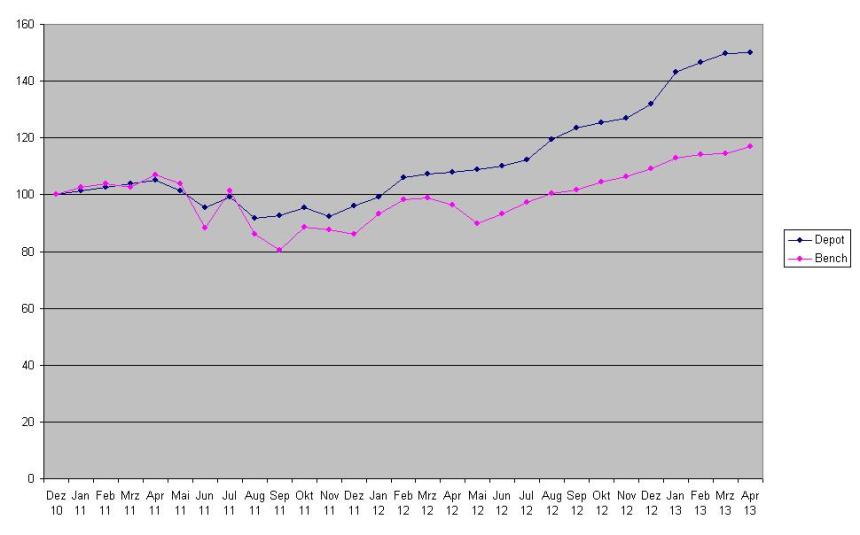
However the current month shows that the stocks do have “their own life” versus the benchmark. For instance Tonnellerie, which acted like a high beta stock in the beginning of the year came down to earth with a -17,7% performance in April. As a reader asked me for it, here is the graphical performance since Inception:

Portfolio as of 30.04.2013:

Name Weight Perf. Incl. Div
Hornbach Baumarkt 3.8% 2.8%
AS Creation Tapeten 4.7% 55.2%
Tonnellerie Frere Paris 5.3% 62.2%
Vetropack 4.4% 7.4%
Installux 2.8% 8.7%
Poujoulat 0.9% 6.4%
Dart Group 4.1% 124.0%
Cranswick 5.4% 26.6%
April SA 3.3% 4.2%
SOL Spa 2.7% 25.4%
Gronlandsbanken 2.2% 23.2%
G. Perrier 3.0% 4.8%
     
     
KAS Bank NV 4.7% 23.0%
BUZZI UNICEM SPA-RSP 5.2% 24.8%
SIAS 5.4% 48.6%
Bouygues 2.6% 10.2%
Drägerwerk Genüsse D 10.1% 193.0%
IVG Wandler 4.1% -17.7%
DEPFA LT2 2015 2.7% 58.8%
HT1 Funding 4.7% 56.4%
EMAK SPA 4.3% 31.2%
Rhoen Klinikum 2.2% 8.4%
KPN shares 0.6% 0.2%
KPN rights 0.4% -1.0%
     
Short: Focus Media Group -0.9% -8.5%
Short: Prada -1.0% -13.7%
Short Kabel Deutschland -1.0% -5.0%
Short Lyxor Cac40 -1.2% -11.7%
Short Ishares FTSE MIB -2.0% -10.3%
     
Terminverkauf CHF EUR 0.2% 6.4%
     
Cash 16.4%  


Value 42.5%  
Opportunity 47.0%  
Short+ Hedges -5.9%  
Cash 16.4%  
  100.0%

Major changes were: Increase in Perrier to now 3%, sale of Total Produce and WMF pref shares, increase in IVG convertible plus 1% KPN as a new share. For my portfolio, this was a very active month.

Comment: All time highs

A lot of newspaper articles are concerned with the current “all time highs”, both in the DAX and the S&P 500 as well as the Dow Jones. Many people argue that level is of very high significance, either as an upper boundary or support.

In my opinion this is one of the most prominent cases of “Anchoring”, a well documented behavioural finance bias. Yes, the Dax already 2 times bounced back from the 8000 point level, in 2000 and 2007 as this chart clearly shows:

However if you look at the composition of the DAX in those years one can quickly see that the Dax is a very different animal now than in the past.

Those are the Top 5 stocks now:

Weight
BASF SE 9.9%
Bayer AG 9.8%
Siemens AG 9.0%
SAP AG 8.1%
Allianz SE 7.6%

Compare this to the top 5 a mere 5 years ago on December 2007:

Weight
E.ON SE 10.1%
Siemens AG 9.9%
Allianz SE 8.4%
Daimler AG 8.2%
BASF SE 6.2%

Yes, 3 stocks are still in the Top 5 (Allianz, BASF and Siemens) but 2 out of 5 are new and the weights are significantly different.

Even if we compare the top 5 based on their P/Es, we can see that even those shares which remained in the top 5 trade at quite different P/Es:

PE 2007     PE 2013
E.ON SE 15.6   BASF SE 14.6
Siemens AG 26.3   Bayer AG 26.3
Allianz SE 7.5   Siemens AG 14.1
Daimler AG 23.3   SAP AG 25.4
BASF SE 12.4   Allianz SE 10.4

So what does that mean ?

In my opinion, the current absolute level of the DAX compared to the past is totally irrelevant. Any investment decision on such an arbitrary basis is a clear “anchoring bias”. Investment decisions should be made irrespective of index levels. If you find a cheap stock buy it, when a stock is too expensive, sell it. It doesn’t matter where the Index is compared to its past.

The Warren and Charlie Show

This year I fulfilled myself a long dream: I joined the pilgrimage to Omaha in order to listen to these 2 elderly Gentlemen

Ähhhh sorry,that was the wrong picture, I actually listened to those 2 Gentlemen

I guess you can easily find transcripts and quotes of the meeting in many places for instance here, or here.

So instead of doing this once again (and by the way a I did not take notes….), I will just make a few random observations:

1. I didn’t expect any “actionable investment ideas” and there were none

2. As a “first timer”, I found the event genuinely entertaining. They make a very good show. The movie was great and the 2 guys are really funny.

3. The questions from the audience were a lot better than in any other shareholder meeting I have been

4. Doug Kass as the evil short seller was relatively tame. He mostly asked about the obvious succession issue

5. In general, the meeting was a lot about succession, Buffet said many times “when I will be gone”

6. Buffet thinks there is no need to split the company. Berkshire’s “culture” will prevail.

7. However he indicated that Berkshire would be prepared to buy a lot of stock back at the right price

8. Sometimes the answers were a bit shallow. For instance when someone asked why Iscar is better than Sandvik (i.e. which moat), the answer was “better management” or when asked about the moat of IBM he talked about a pension problem. Buffet surely knows better but I guess he is not sharing everything with his shareholders.

9. The exhibition of the Berkshire companies looked liked a flea market to me. Maybe its my European taste but i found that they sold quite crappy products.

10. Buffet was slightly subdued about growth in America for the next few years (“New Normal” anyone ?)

11. Some Omaha restaurants behave like cafes at the St. Marcus place in Venice, Italy. One night we went to the “Chophouse“. “Unfortunately” the cheapest wine at 60 USD/bottle (!!!!) was not available any more, the second cheapest was already 100 USD …..additionally they tried to talk us into ordering magnum bottles at 295 USD … DON’T GO THERE.

The two Buffet quotes I wrote down were those:

Interest rates are to asset prices what gravity is to the apple. With such low interest rates there is not a lot of gravity for asset prices.

For many companies book value has almost no correlation to intrinsic value

Would I go there again ? I have to admit that for the shareholders meeting alone I am not sure. The whole trip is quite expensive and time consuming. However I had the privilege to attend a 2 day (invitation only) value investing conference just before Saturday in Omaha which was absolutely fantastic !!!

I met a lot of very nice people who to a large extent were very good or even outstanding value investors. Many ideas were shared and interesting discussions were made.

The whole package (conference + shareholder meeting) is definitely worth the trip.

What were my take aways ?

The “hard” take aways were:

and of course these:

And I might have some posts about some ideas which have been discussed soon……

When you get congratualations from your broker (indirectly)

I use CortalConsors as my broker for the non-German part of my portfolio, especially as they don’t charge any extra fees for French stocks. Some months ago, they started to send out performance and risk reports with some more or less usefull stuff on it.

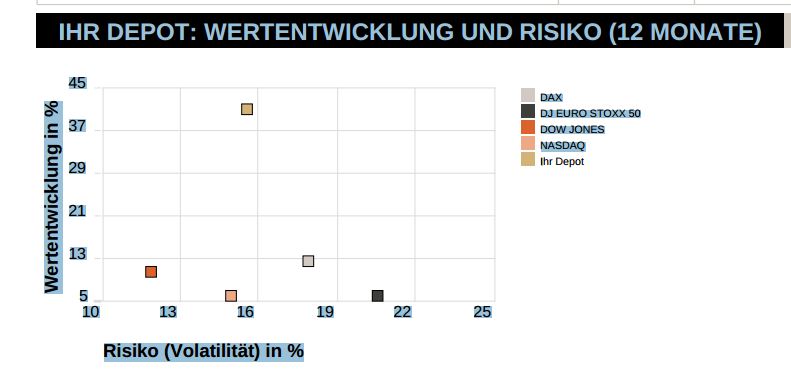
One interesting feature is a return/standard deviation graph comparing the portfolio against several benchmarks. I was really surprised how well the portfolio is doing:

risk return consors

Explanation: The vertical axis is the return in the last 12 months (until end of March 2013), the horizontal one is the volatility meassured as standard deviation. The portfolio is (of course) the lonely light orange dot in the upper part of the chart….

Clearly, this will not go on like this forever. Nevertheless, I think it also shows that value investing is not dead yet, at least for the little guys 😉

If I would do this professionally, now would be the time to make a big advertising effort …….. It doens’t get much better than that.

« Older Entries Recent Entries »