Category Archives: Anlage Philosophie

Bouygues Q3 update

The Q3 numbers of Bouygues are a first test for my Bouygues investment case.

If I update my simple sum of part valuation, we can see the following:

Market values listed companies:

  16.11 initial
Colas 96.55% 3.56 3.34
Alstom 29.40% 2.42 2.47
Tf1 43.59% 0.667 0.58
       
Total listed   6.65 6.39

So the listed subs have slightly increased in value.

Now looking at the unlisted, I will simply assume 9 Month EBITDA will equal 75% of total EBITDA:

9 month EBITDA 12M est EV Multiple EV
Bouygues Constr. 432 576 7 4,032
Bouygues Real estate 117 156 7 1,092
Bouygues Telecom 802 1,069 6.5 6,951
 
        12,075

Compared to the 6 month numbers I used last time, Telco is slightly below 6M run rates, construction and real estate perfom better.

Both, listed and unlisted subsidiaries in theory look better than at the time of my initial analysis. Net debt has slightly increased to 5.8 bn form 5 bn, mainly due to a 2 bn purchase of mobile licenses in France.

Putting this together, the updated fair value of Bouygues equity at “sum of parts” would be 6,65 bn + 12.075 bn -5.8 bn = 10.9 bn or around 35 EUR per share. From my point of view I see no fundamental reason why the shares have dropped quite substantially. I guess this is more “market psychology” following the announcement of France Telecom to cut their dividend.

However the stock chart looks really ugly now, although I am not a stock chart expert, there doesn’t seem to be any “technical” support on the downside and momentum is clearly negative:

Fundamentally the company seems to be “on track” at least compared to my investment case. So I will use today’s low prices to “fill up” again the current 2.2% position to 2.5% weight, further purchases will follow if the stock goes below 17 EUR (and fundamentals remain stable).

Underrated special situation – Deep-discounted rights issues

In many books which deal more or less explicitly with “special situation” investing, for instance Joel Greenblatt’s “You can be a stock market genius” or seth Klarman’s “Margin of safety”, many so-called “Corporate actions” are mentioned as interesting value investing opportunities.
Some of the most well know corporate actions which might yield good investment opportunities are:

– Spin offs
– tender offers /Mergers
– distressed / bankruptcy 

However one type of corporate action which is rarely mentioned are rights issues and especially “deeply discounted” rights issues.

Let us quickly look at how a rights issue is defined according to Wikipedia:

A rights issue is an issue of rights to buy additional securities in a company made to the company’s existing security holders. When the rights are for equity securities, such as shares, in a public company, it is a way to raise capital under a seasoned equity offering. Rights issues are sometimes carried out as a shelf offering. With the issued rights, existing security-holders have the privilege to buy a specified number of new securities from the firm at a specified price within a specified time.[1] In a public company, a rights issue is a form of public offering (different from most other types of public offering, where shares are issued to the general public).

So we can break this down into 2 separate steps:

1. Existing shareholders get a “Right” to buy new shares at a specific price
2. However the shareholders do not have to subscribe the new shares. Instead they can simply choose to not subscribe or sell the subscription rights

Before we move on, Let’s look to the two alternative ways to raise equity without rights issues:

A) Direct Sale of new shares without rights issues
This is usually possible only up to a certain amount of the total equity. In Germany for instance a company can issue max. 10% of new equity without being forced to give rights to existing shareholders. In any case this has to be approved by the AGM.

B) (Deferred) Issuance of new shares via a Convertible bond
Many companies prefer convertible bonds to direct issues. I don’t know why but I guess it is less a stigma than new equity although new equity is only created when the share price is at or above the exercise price at maturity. So for the issuing company, it is more a cash raising exercise than an equity raising exercise. Usually, the same limits apply to convertible debt than for straight equity.

So if a company needs more new equity, the only other feasible alternative is a rights issue. But even within rights issues, one can usually distinguish between 3 different kinds of rights issues depending on the issue price:

1) “Normal” rights issue with a relatively small discount
Usually, a company will issue the new shares at a discount to the old shares in order to “Motivate” existing shareholders to take up the offer. If they do not participate, their ownership interest will be diluted. Usually “better” companies try to use smaller discounts, high discount would signal some sort of distress

2) Atypical rights issue with a premium
This is something one sees sometimes especially with distressed companies, where a strategic buyer is already lined up but wants to avoid paying a larger take over premium to existing shareholders

3) Finally the “deeply” discounted rights issue

Often, if a company does not have a majority shareholder, the amount of required capital is relatively high and there is some urgency, then companies offer the new shares at a very large discount to the previous share price.

But exactly why are “deeply discounted” rights issues an interesting special situation ?

After all this theory, lets move to an example I have already covered in the blog, the January 2012 rights issue of Unicredit In this case:

– Unicredit did not have a controlling shareholder. One of the major shareholders, the Lybian SWF even was not able to transact at that time
– the amount to be raised was huge (7.5 bn EUR)
– it was urgent as regulators made a lot of pressure

As discussed, in the case of Unicredit, before the actual issuance at the time of communication the stock price was around 6.50 EUR, the theoretical price of the subscription right was around 3.10 EUR. However even before the subscription right was issued, the stock fell by 50 %. At the worst day, one day before the subscription rights were actually split off, the share fell (including the right) almost down to the exercise price without any additional news on the first day of subscription right trading.

But why did this happen ? In my opinion there is an easy answer: Forced selling

Many of the initial Unicredit Investors did not want to participate or did not have the money to participate in the rights issue. As the subscription right was quite valuable, a simple “non-exercise” was not the answer. As history shows, selling the subscription right in the trading period always leads to a discount even against the underlying shares, in this case some investors thought it is more clever to sell the shares before, including the subscription rights. Sow what we saw is a big wave of unwilling or unable investors which wanted to avoid subscribing and paying for new shares which created an interesting “forced selling” special situation.

Summary: In my opinion, deeply discounted rights issues can create interesting “special situation” investment opportunities. Similar to Spin offs, not every discounted rights issue is a great investment, but some situations can indeed be interesting. On top of this, those situations often are not really correlated to market movements and play out in a relatively short time frame.

Portfolio maintenance – autumn cleaning

One of the things I tend to avoid is a regular review of all portfolio holdings. It is much more fun to look at new companies than to refresh the analysis on the existing companies. As I usually scale into a position slowly, I somtimes get distracted or disturbed by stock price movements or fundamental changes.

As a result, the number of position in the portfolio increases over time and in my opinion this makes it much harder to focus.

As November is a quite dull month anyway it might also be a good month to review the portfolio.

In a first step I will look “high level” at all positions and try to come up with a “conviction” level which has only three levels: HIGH, MEDIUM, LOW and a short descritpion why this is the case.

In a second step, I want to apply the following logic:

1. If I have “HIGH” conviction, then the position should be a “FULL” position or close to full (5%) unless there is a specific reason against this
2. IF I have “LOW” conviction, then I should sell or close the position
3. For “MEDIUM”, I will have to define at a later stage what will lead either to an upgrade or downgrade for the coming year

The following list is the result of this exercise:

I will therefore “upgrade” Installux, Dart Group and the IVG Convertible to “full” 5% positions. On the other hand I will sell Mapfre, Fortum, EVN and OMV and close the Kabel Deutschland Short.

For Rhoen, I will increase to 2.5%, as I am still in the “early” stage of the investment but so far it goes according to plan.

After this exercise, the portfolio will be around 90 net long, which is kind of the “Normal” allocation.

Maybe some additional comments to the “Energy sector” which I comletely exit after this exercise:

– my initieal “simple” investment case was the following: If energy prices rise, companies with large renewable/nuclear capacity will outomatically profit as well as Oil companies
– Finland and Austria are non-critical from a regulatory point of view

The first thesis obviously was not correct. Both, EVN’s and Fortum’s Earnings decreased from the 2010 level which was the basis of the analysis. Although their balance sheets are comparably stronger, stock prcie performance was only average against the non-PIIGS peers. In relative terms, the stocks are more expensive.

At the moment I just don’t really have an invetsment case for all three companies any more. They look kind of cheap but I do not have a clear view if they will earn their cost of capital going forward. The classical utiliyt business model has been somehow disrupted by alternative energy.

Maybe I invest into them at a later stage, but currently I just do not have any special insight why they should be superior investments.

Edit:

I already sold Fortum and OMV yesterday at October 30th prices as well as the increase in Rhoen Klinikum shares.

How to screw your clients – Deutsche Bank “Aktienanleihe” edition (WKN DX2UZZ)

From time to time I use the blog to look at some “grey market” stuff, usually from obscure issuers with a very bad risk/return relationship. Examples were Prokon, WGF or Solar Millenium.

However, one should not forget that the established financial institutions are also “capable” to screw their clients over and over.

Let’s, for example, look at a currently marketed “Aktienanleihe” from Deutsch Bank with the WKN DX2UZZ.

The paper flyer comes with the slogan “Sichern Sie sich einen attraktiven Zinssatz” (meaning: secure your attractive yield right now) and a big 7% sticker.

On the second page you see “7 % interest p.a and repayment at 23.10.2012”. Then in fine print on the left side you see something like “In times of low interest rates, “Aktienanleihen” (direct translation “Stockbonds”) offer an interesting alternative with an attractive coupon but higher risk bla bla bla…”

So this is clearly a case where the bank tries to sell a quite risky investment based on a coupon which looks attractive on a nominal basis.

So let’s look at what this particular “investment” is about:

An “Aktienanleihe” is a structured bond which has the following features:

– you get a fixed coupon
– the repayment depends on the value of an underlying share
– in this case, the underlying share is interestingly the Deutsche Bank share itself
– if, at maturity, the share is below a certain level (here only a range is indicated from 60%-70%), you don’t get your money back, but you will receive the shares at the lower value

In sales speak this is sold as “Your coupon is secure plus you have a (30-40%) buffer before you loose money”.

Where is the problem ?

I do not know where the Deutsche Bank share price will be in one year’s time, but other than the Prokon and WGF securities, here the underlying is a traded security which means that the structured security can be modeled and valued.

Analytically, in a first step one has to slice the security into the funded part, a 1 year Deutsch bank unsecured senior bond and the “structure”.

We can easily find on Bloomberg the “fair price” for a 1 year Deutsche Bank Senior bond: Thats 0.65% for the Euribor plus 0.45% 1 year senior Deutsche spread. So a plain vanilla 1 year Deutsche Bond would yield 1,1%.

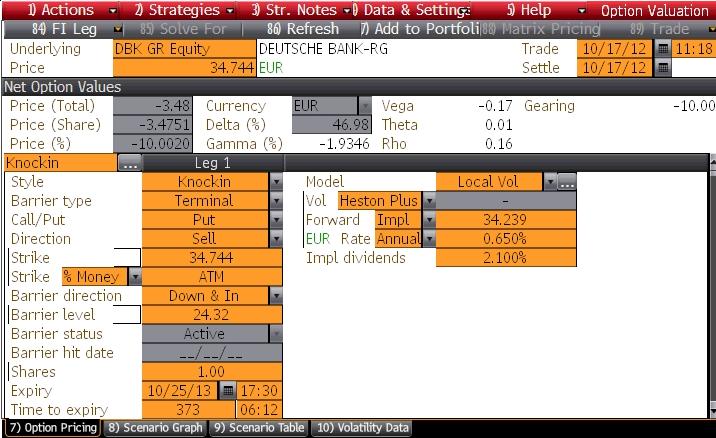
Now comes the tricky part: How to value the structure ? Without going into option pricing theory, I can tell you that the structure is basically the following “exotic option” of the following type:

“Short put with terminal knock-in feature”, meaning you, as buyer of the security are selling Deutsche Bank a put option on their own share.

Luckily, if you have a Bloomberg, you can very easily price this “beauty” with their standard option valuation tool. Please see the screenshot (i used 70%) :

What we see is that the standard valuation tool says you should receive 10% (of nominal) if you are selling such an option. Add on the 1.1% for the “plain vanilla” bond, then the “fair” value of the coupon would be 11.1% not 7%.

Why bother might some people say, 7% is better than 1% and the probability of the Deutsche Bank share going down so much is probably not so big. The problem is: Deutsch eBank takes out almost 40% of the “Fair value”. No one knows the probability, but there is a market for this kind of risk.

Deutsch Bank can easily hedge their part and directly pocket the 4% at the moment when they sell this “beauty” to the German retail investor. Although they have to share their “harvest” with the distribution partners.

For the “little investor” this is bad, because a large share of his “expected” return is taken out by the bank, which means simply on average he will loose money with this if he invests in such products.

I don’t even want to mention all the other issues like “asynchron information” if the issuer of the security is also the issuer of the underlying. There are a couple of more possibilities to screw the investor because off this.

Summary:

This Deutsche bank “security” in my opinion represents everything which is wrong with the financial system. The banks still try to sell complicated stuff to investors who don’t understand it and cut out fat fees in order to make sure the little guy looses over time.

In my opnion, the banks should have to disclose at least the “fair value” of such securiteis based on available standard models so that teh invetsor knows what amount Deutsche is earning upfront. The current disclosure would indicate that they only charge 1% addional issuing fee.

However I guess I will not see in my lifetime that banks will offer “fair products” to little investors unless they are forced too. Maybe the little guys do have to share the blame by being too greedy (or desperate), but Deutsche Bank knows exactly what they are doing.

Bouygues again: How deep does one have to dig into Telco, sell side analysts & comparable Eiffage SA

So to conclude my “Bouygues week”, a final post about the company.

In my recent post about Bouygues, a commentator said if I can’t correctly project future profitability levels for the French mobile phone market, then investing into Bouygues is not a good idea.

As I call myself a fundamental investor, I have to admit that I do not have any extra knowledge about the french mobile market at the moment.

Read more

Publishing the Boss Score -Top 25 France

Following the Top 25 Germany post, let’s look at the next big Euro stock market, France:

Top 25 France 10 Year Boss Score:

Top 25 France 5 Year Boss Score

Those lists are based on a sub set of ~ 400 french stocks.

The most fascinating aspect about the French market for me is the fact that French companies look much much cheaper than their German counterparts. Of course, both list contain some “deep value” stocks like Toupargel, where a “terminal decline” might be possible.

On the other hand, there are still enough cheap “quality” companies. For instance, if we include an additional criteria like Stock Price > 1.25x book value, we still get a nice list of cheap “higher quality” companies:

For me, France is currently one of the most interesting markets for Value investments. Despite the bad press, there are many interesting and cheap companies. It reminds me a little bit about Germany and German companies 10-15 years ago, when Germany had to suffer the “reunification hangover”.

Looking back it is hard to understand why German quality companies were so cheap. I think there is a good chance that France will do its homework. One shouldn’t forget that most of the tough reforms in Germany (Hartz 4, work flexibility etc.) were actiaslly implemented under a Socialist government.

Publishing the Boss Score – Top 25 Germany

As announced in the last post, until I find a nicer solution for the whole file, I will publish selected lists.

As there are many German readers, I start with German stocks.

First the Top 25 German stocks based on the 10 year Boss Score:

and then the German Top 25 stocks based on the 5 year Boss Score

This is based on ~400 German stocks, so it is not a complete list.

Not surprisingly, a couple of stocks are in my Portfolio (Hornbach, AS Creation, Rhoen) or were in the portfolio at some point (Frosta, Einhell, Bijou). Interestingly, one can see that in the 10 year Top 25, there is a mixture of cyclical stocks (Salzgitter, Aurubis, H&R, Bauer), Holding Co’s (Indus, Gesco), port operators (Eurokai, Bremer Lagerhaus) and Nanocaps (Nucletron)

One of the stocks I really have to check out is Mühlbauer, I always considered it as a “neue Mark” stock but maybe it is worth a second look. Also I find interesting how well the expensive “quality stocks” like Sixt and Grenke are scoring.

From the 5 year list, I find IVU and Bechtle most interesting. Eurokai might be worth a second look as well.

All in all however, German stocks look relatively expensive in my model. Other countries like France yield a lot mmore interesting companies.

All tables will be posted on the Boss Score page.

Performance review July 2012 & comments

Portfolio Performance in July 2012 was a positve +1.8%, resulting the YTD performance of 16.9%. The Benchmark performed signficantly better in August with +4.4%, resulting in an YTD performance of 13%.

Bench Portfolio Perf BM Perf. Portf. Portf-BM
2010 6,394 100      
2011 5,510 95.95 -13.8% -4.1% 9.8%
           
Jan 12 5,972 99.27 8.4% 3.5% -4.9%
Feb 12 6,275 105.90 5.1% 6.7% 1.6%
Mrz 12 6,330 107.22 0.9% 1.2% 0.4%
Apr 12 6,168 108.02 0.8% -2.6% -3.3%
Mai 12 5,750 108.90 -6.8% 0.8% 7.5%
Jun 12 5,969 110.17 3.8% 1.2% -2.6%
Jul 12 6,229 112.15 4.4% 1.8% -2.6%
           
YTD 12 6,229 112.15 13.0% 16.9% 3.8%
           
Since inception 6,229 112.15 -2.6% 12.1% 14.7%

This underperformance in such a period is not a surprise, as currently the portfolio carries a 21% cash allocation and many “low beta” stocks which only react very slowly (if at all) to short term market movements. So the “Draghi” effetc which moved the markets was almost not present in the portfolio.

For fun, I added the beta of my stock positions relatively to the respective main country indices in the overview of the portfolio as of July 31st:

Name Weight Perf. Incl. Div Beta
Hornbach Baumarkt 4.8% 4.23% 0.62
Fortum OYJ 3.6% -27.25% 0.77
AS Creation Tapeten 4.0% 3.02% 0.53
BUZZI UNICEM SPA-RSP 4.9% -10.97% 0.97
EVN 2.8% -11.61% 0.63
WMF VZ 4.0% 43.76% 0.60
Tonnellerie Frere Paris 5.1% 15.25% 0.39
Vetropack 4.5% 1.16% 0.85
Total Produce 4.2% 5.43% 0.45
OMV AG 2.2% -11.45% 0.94
Piquadro 1.3% -2.25% 0.63
SIAS 5.8% 14.46% 0.86
Installux 2.9% -4.71% 0.63
Poujoulat 0.7% 3.41% 0.70
Dart Group 2.8% 13.42% 0.71
Cranswick 2.7% 9.43% 0.59
April SA 3.2% 3.05% 0.76
       
Drägerwerk Genüsse D 8.6% 46.40%  
IVG Wandler 2.2% 8.29%  
DEPFA LT2 2015 2.8% 21.02%  
HT1 Funding 4.2% 7.03%  
EMAK SPA 5.1% 16.94% 0.42
DJE Real Estate 0.6% -2.72%  
       
Short: Kabel Deutschland -2.2% -28.24%  


Short: Kabel Deutschland -2.2% -28.24%  
       
Short Ishares FTSE MIB -2.3% 6.43%  
Terminverkauf CHF EUR 0.2% 4.42%  
       
Tagesgeldkonto 2% 21.3%    
       
Summe 97.8%    
       
Value 50.1%    
Opportunity 21.3%    
Short -4.3%    
Cash 21.3%  

I am quite surprised that overall beta is so low, avarage weighted Beta of the stock portfolio is only 0.66. Interesting to see that my “low fundamental volatility” investment style translates into a “low market volatility” portfolio.

Portfolio activity:

As mentioned before, I sold the Praktiker bonds and accepted the AIRE KGaA buyout offer. I did not yet record the proposed cash top up from the buyer, which would add ~0.4% of portfolio performance. I will only record it when cash is in the bank account.

Other than that, I recorded coupon payments for HT1 and dividends for Poujoulat and Hornbach as well as a special payment for the remaining DJE Real estate fund units.

Ongoing “programs” are further small purchases of Installux and Poujoulat as well as sales of the DJE real estate fund. I hope the position will be gone by next month.

Market commentary:

The major event was of course the “Draghi Statement” which moved markets significantly higher after a relatively weak start in July. In my opinion, the main purpose of this statement was to avoid another “summer disaster” when “Club Med” is on holiday and evil hedge funds try to exploit the absence of the Club Med financial sector.

So far it has worked but of course it could be only a “dead cat bounce”. Fundamentally, if one ignores the sensationalist mainstream press, there seem to be encouraging signs especially in the Spanish economy. The excellent “IBEX salad” blog has just pointed out the new Export record for Spain achieved in May 2012. So beneath the real estate and banking mess, the industrial sector seems to improve. So maybe this was then really “just” a normal real estate bubble deflating and not the “greek illness”. So maybe Spain is more Irish then Greek then ?

It is interesting to see that almost all of the US “moMo” stocks seem to be faltering, most recently Chipotle and Starbucks. Unfortunately I did not have the courage to short them. However shorting only on valuation is a quite difficult business and in a “no growth” environment, “real growth” stocks are in very short supply.

Outlook:

After continuously extending my Boss database, I will try to analyse more “BOSS” stocks in the next few weeks. My target would be at least one company per week. Let’s see how that works out.

Market wise I do not have a strong opinion at the moment. Although sentiment is relatively negative, overall stock market levels are not really cheap like the were in 2003 or 2009. As I am not a fan of market timing anyway, I will continue to look for undervalued single stocks and invest without really caring too much about macro events, provided that the business model looks stable enough.

Dart Group – Follow up on fuel hedging and comprehensive income

As proposed in the last Dart Group post, I wanted to take a better look at the impacts on fuel hedging.

Quick summary (or spoiler): During writing the post, I got less and less sure of what to do with the fuel hedges, so the post got very long without a satisfying end. If you are not interested in the process and accounting details, the result is: I am not sure.

Let us start with a “accounting refresher” first.

Accounting for Cash flow hedges

Dart Group uses “cash flow hedges” for their fuel hedges. What does that mean ? Normally, any derivative financial instrument would be considered a “trading instrument” and would have to be marked-to-market directly through P&L.

If a company however wants to hedge a future cashflow (doesn’t matter if in- or outflow) one can apply a technique called “cash flow hedging” which requires basically two things

1) one is able to predict future cashflows with a reasonable accuracy
2) one uses a heging instrument which is “efficient” i.e. tracks the value of the hedged

If one achieves “cash flow hedging” treatment, then the hedge will treated in the balance sheet (under iFRS) the following way:

A) the value changes in the derivatives can be recorded under “OCI” (other comprehensive income)
b) in the future, when the cashflow actually happens, the corresponding hedging gain or loss will then be added or subtracted from the then realised spot price

This is what Dart Group is doing with its fuel hedging and as Wexboy commented fully aligned with accounting standards.

However my argument was that you shouldn’t ignore those movements in OCI but try to understand them and make adjustments if necessary. In order to understand this better, we have unfortunately step beck a little bit and ask the following question:

What is a hedge anyway and when is a hedge a speculation ?

In the case of Dart and airlines in general, this question is quite difficult to answer. In an ideal world as a company, you would like to pass on all your changes in costs directly to your customers and just earn a fixed fee on your products. As we all know, prices on tickets are relatively volatile, however many clients prefer to fix a price well before they start a trip in order to be able to control their budget.

An airline could also, if they were really really good speculators, create a big competitive advantage if they for example could hedge their fuel at low prices while the competitors have to buy much more expensive fuel on the spot markets if prices are rising. However, this is clearly speculation, not hedging as it could go the other way as well.

accounting wise however, one does not distinguish between “economic” hedging and what I call speculation.

So let’s look at Dart Group.

First step: READ THE ANNUAL REPORT

Before one starts to speculate how and what Dart is hedging, it makes sense to look at the annual report to find out what they are actually saying.

On Page 21 of the 2011 report they give us the following information:

2011 2010
Average hedged Price per ton $ 870 786
Percentage of estimated annual fuel requirement hedged for the next financial year 91% 90%

So we know now, that they have hedged ~90% of ALL fuel requirements according to this and we know the price.-

On page 67 we can look at fuel costs (in GBP):

2011 2010
Fuel Cost 122.8 95.3

On page 57 we can see the fair values of the fuel hedges, both an the asset and liability side:

2011 2010
Fair value Assets Forward jet fuel contracts 55.9 16.4
Fair value Liabilities Forward jet fuel contracts -17.8 -8.7
 
calc net Fair Value 38.1 7.7
Delta yoy 30.4

On page 58 we can see that in 2011, none of the fair value movements have been recorded in equity, we can also look at the total fair value movement of the ALL hedges (including currency) which were

2011 2010
Fair value Assets all hedges 59.4 21.7
Fair value Liabilities Forwardalll hedges -24.7 -9.7
     
calc net Fair Vlaue 34.7 12
Delta yoy 22.7

So basically, fuel hedges increased by ~ 30 mn GBP in vALue, FX hedges lost ~ 8 mn GBP

On page 61 they give us another interesting piece of information:

2011 2010
Impact on Profit and Loss 10% change in jet fuel prices 3.8 0.8
2011 2010
     
Profit for the year 17.3 15.6
Exchange differences on translating foreign operations 0 0
Effective portion of fair value movements in cash flow hedges 23 10.6
Net change in fair value of effective cash flow hedges transferred to profit -1.8 0.1
Taxation on components of other comprehensive income -5.2 -3
Other comprehensive income and expense for the period, net of taxation 16 7.7
Total comprehensive income for the period all attributable to owners of the parent 33.3 23.3

One important final piece of information:

Prepayments or “deferred income” stood a 177 mn GBP against trailing sales of 540 mn GBP.

So how to interpret those numbers ?

A) as the hedges seem to qualify almost completely as “cashflow hedge”, we can assume that they use “traditional hedges” like forwards or (tight) collars to hedge

B) IMPORTANT: Dart Group “hedges” 90% of next years fuel prices, but only 177/540 = 32% of (trailing) sales are prepaid. So one could argue that in order to “truly” hedge, Dart should only hedge a third of next year’s fuel consumption as for the rest, the final sale price of the tickets is still variable.

If the competitors don’t hedge, than Dart would have locked in potentially different fuel prices than the competition for 60% of next years fuel consumption and therefore run the risk of being uncompetitive if fuel prices fall.

So coming back to the initial question: What are we going to do with the change in value in OCI for dart Group ?

I have to say I am not sure anymore. I am oK with “ignoring” the part that is covered by deferred income but I honestly don’t know what to do with the part which is “speculation”.

I have quickly checked Ryanair’s latest statements and Easyjets last annual report.

While Ryanair similar to Dart seems to hedge 90% of next years fuel cost, Easyjet only hedges 65-85% of next years fuel charges and 45-65% of the costs in 2 years time.

Ryanair interestingly said that increasing fuel prices were responsible for a 29% profit decline. That sounds strange as they were supposed to be 90% hedged. Interestingly, fuel prices for Jet fuel decreased strongly in Q2, so the problem for Ryanair seem to have been locking in high fuel costs whereas some competitors were able to buy cheaper fuel in the spot market and compete better on ticket prices.

Bloomberg even compiles hedging ratios across companies:

Jet Fuel Hedging Positions for Europe-Based Airlines (Table)
2012-07-30 07:46:25.103 GMT

(Updates with Ryanair.)

By Rupert Rowling
July 30 (Bloomberg) — The following table shows the amount
of jet fuel consumption hedged by European airlines to guard
against price fluctuations.
Data is compiled mainly from company statements and is
updated as it becomes available. Hedges are for prices per
metric ton of jet fuel, unless otherwise stated.

*T
Company/ Percent Hedging Period Price
Disclosure Date Hedged
————— —— ————– —–

Ryanair Holdings Plc
7/30/12 90% July to Sept. 2012 $840
7/30/12 90% Oct. to Dec. 2012 $990
7/30/12 90% Jan. to March 2013 $998
7/30/12 90% April to June 2013 $985
7/30/12 90% July to Sept. 2013 $1,025
7/30/12 90% Oct. to Dec. 2013 $1,005
7/30/12 90% 2013 $1,000
7/30/12 50% Jan. to June 2014 $940

EasyJet Plc
7/25/12 85% Three Months to Sept. 2012 $983
7/25/12 79% Year to Sept. 2012 $964
7/25/12 77% Year to Sept. 2013 $985

Air Berlin Plc
5/15/12 82% April to June 2012 Not Given
5/15/12 92% July to Sept. 2012 Not Given
5/15/12 61% Oct. to Dec. 2012 Not Given

International Consolidated Airlines Group SA*
5/11/12 80% April to June 2012 Not Given
5/11/12 69% July to Sept. 2012 Not Given
5/11/12 55% Oct. to Dec. 2012 Not Given
5/11/12 55% 12-month forward Not Given

Vueling Airlines SA
5/10/12 76% 2012 $1,023
5/10/12 71% April to June 2012 $1,008
5/10/12 83% July to Sept. 2012 $1,035
5/10/12 74% Oct. to Dec. 2012 $1,042
5/10/12 28% 2013 $1,027

Air France-KLM Group
5/4/12 60% April to June 2012 $1,081
5/4/12 53% July to Sept. 2012 $1,081
5/4/12 50% Oct. to Dec. 2012 $1,078

SAS Group
5/3/12 50% April to June 2012 Not Given
5/3/12 49% July to Sept. 2012 Not Given
5/3/12 48% Oct. to Dec. 2012 Not Given
5/3/12 50% Jan. to March 2013 Not Given

Aer Lingus Group Plc**
3/29/12 62% 2012 $972
3/29/12 7% 2013 $991

Deutsche Lufthansa AG
3/15/12 74% 2012 $107/barrel
(Brent crude)

NOTES:
*Hedging breakeven for 2012 at $1,003 a ton, according to May 11
presentation.
**Aer Lingus figures as of Dec. 31

Summary:

To be honest, I am not sure what to do with the fair value movements in OCI. To simply ignore them and assume mean reversion would be very naive. The extent of the movements is just too large. However the impact of the fuel hedging is difficult to estimate as it depends on the behaviour of the competitors.

In general, a positive movement in fair value should be positive for the company and vice versa. nevertheless, the whole fuel hedging issue exposes Dart to quite substantial business risk, especially for the part which is not covered by deferred income.

However, this exercise made it clear to me that running airlines is a quite difficult business, especially in times of volatile fuel prices.

For the time being, I will stick with my half position and try to learn more about it.

One technical remark with regard to hedging:

In the “good old times”, fuel hedging could be done without cash collateral. A bank would happily “step in between” the airline and the futures market and only require cash at settlement of the contract.

As one of the consequences of the finanical crisis, every bank now requires cash collateral on a short term basis from the airlines for the fuel hedging contracts. For the airlines this means a significant increase in reuqired working capital. Lufthansa et al are lobbying strongly against this, but especially for smaller carriers this is a problem.

As a proxy I would use 25% of the notional as working capital requirement for fuel hedges. For Dart this would mean that 25% of around 150 mn GP or 40 mn GBP of Dart’s liquidity should be considered as “locked” for fuel hedging cash collateral.

« Older Entries Recent Entries »