Category Archives: Capital Structure Arbitrage

A quick look at the Solarworld restructuring (XS0641270045, 6 3/8 2016)

Although I would not even touch Solarworld with a 10 foot pole, it is still interesting to see how they try to restructure their debt without going into the “ESUG” process.

Solarworld is one of the largest German manufacturers and distributors of Solar modules. In order to fund their expansion, they took on a lot of debt.

Roughly ~400 mn are loans and 550 mn are traded bonds which currently trade around 30% of nominal.

A few days ago, they announced, that some institution from Qatar will help the company plus the founder will inject as well some money.

However, this is all contingent on a proposed restructuring plan where both, the creditor banks and the bond holders of the two traded Bonds (XS0478864225, 400 mn 6 1/8% 21.01.2017 and XS0641270045, 100 mn 6 3/8, 13.07.2016) have to agree in separate meetings.

Just to make sure: This is for educational purposes only….

So let’s look into the restructuring memorandum to see how this proposal looks like:

The concept is basically to exchange the old bonds into new bonds with a lower nominal value plus some shares and a small cash component.

After the transaction, current shareholders will have only 5% of the new equity, the other 95% will be held by debt holders. Part of those new shares will be then sold to the founder and the Qataris and bondholders will get the resulting cash.

Lets look at the 2016 bond: For 1000 EUR current nominal value, bondholders will receive

57.84 EUR cash (5.78%)
7.31 “new” share
439.9 EUR nominal new bond

So here the problem starts:

1) What is the value of the new shares ?
2) What is the market value of the new bonds

1) New shares:
Here we have some possibilities to approach this. First one could use the price which is going to be paid by the founder and Qatar.

Current number of shares is 111.7 mn. After a reverse split of 150:1, this translates into 0.74 mn restructured shares for current shareholders. Then ~14.2 mn new shares will be issued, making it ~14.95 mn “new” shares in total.

The founder will buy 19.5% of the new shares for 9.75 mn EUR, Qatar pays 36.25 mn for 29%. interestingly, this translates if I have calculated correctly in different prices. 3.34 EUR per share for the founder and 8.36 EUR for Qatar.

A second possibility is to use the current share price pre dilution as a guid. However, If we look at the current price of 0.40 EUR, we can see that if I buy 150 old shares for 0.40 EUR, then I pay 60 EUR for a new share. This indicates that current shareholders do not understand how the restructuring works…

Personally, I would rather go for the lower end of the “range” between founder and Qatar. Interestingly, in one of the documents it is said, if the deal with the founder and Qatar does not happen, one would get 16.46 new shares and no cash.

So the new shares in my opinion should be valued at 7.31* 3.34= 24,45 EUR per 1000 nominal or 2.45% of current nominal.

2) New bond

So the question remains: What is the value of the new bond ? The details of the new bond can be found here.

The bond is quite complicated. The coupon is EURIBOR based, but the basis is at minimum 1% plus 5% margin. So currently this would be 6%. However, the coupons can be deferred until maturity, but then the interest rate increases.

The new bond is secured, although this is not too much different to the current bond. The current bond had “negative pledge” clauses. In some respect, the negative pledge is even stronger, because this includes all future assets as well, whereas the new “pledge” only includes current assets. Plus, they carved out the Qatar assets.

Additionally, the new bond will pay down part of the principal early. The schedule is:

1. 39.11 EUR per (new) 439 EUR principal after closing in July
2. 29.20 EUR June 2014
3. 21.43 EUR June 2015
4. 28.13 EUR June 2016

I have seen someone discounting this payments at 10% for calculating the value of the old bond, but I think this is wrong. You might do this after the restructuring happened, but before, those payments are at the same risk as the old bond.

Honestly, I find this bond too hard to value at the current stage. Based on the old bond price and the assumption for the cash and share distributions mentioned above, the implicit valuation of the new bond ~22% of the old bond or 22/44= 50% of the new bond nominal. At the current stage, with the restructuring not even implemented, this looks OK.

Comparison to Praktiker & IVG

Maybe one quick note because I have covered both Praktiker and IVG as well: The big difference here is the fact, that in the current capital structure, we have only a very small amount of secured creditors in the capital structure. So Senior holders got away quite well. For IVG and Praktiker, this is not the case. Especially for Praktiker, one should assume a recovery which is much lower than what we see here.

Summary:

Solarworld will be an interesting case if and how voluntary restructurings work in Germany. The case is very different from Praktiker and IVG but nevertheless interesting.

If the restructuring is successful, I think the new bonds might be worth another look. This is due to the fact that they are very complex and to a certain extent the “fulcrum” security, i.e. the most senior part of the capital structure.

Apart from a short of the “old” the Solarworld share (which unfortunately cannot be borrowed), the current situation does not look attractive to me.
IVG – JPM Research on property values

A friendly reader forwarded me a current equity research report from JPM about IVG.

Not surprisingly, they estimate the value of the share as zero:

Our EVA based European
Valuation Model implies zero value for IVG ordinary equity as a going concern, while a DCF driven revaluation implies zero equity value on the existing balance sheet. We therefore lower our Mar-14 EVM based price target from €2.22 to €0.01, and await the announcement of restructuring plans over summer 2013.

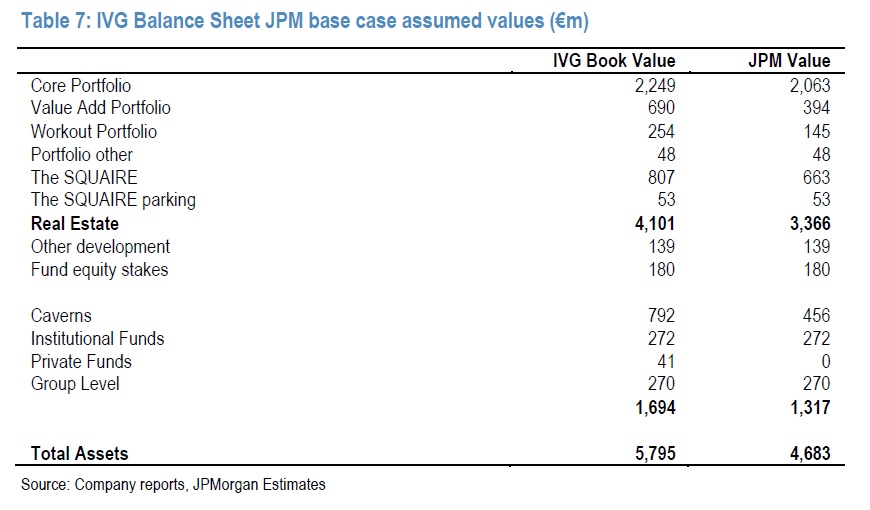
Although one might wonder, why they had a 2.22 EUR price target before. Much more interesting is that they actaully come up with an asset value for the IVG portfolio which looks as follows:

ivg jpm valuation

Although they use slightly different adjustements, thei asset value is very similar to what I calculated a couple of weeks ago:

2011 Adj. Val 2012 Adj.Val Comment
Intangibles 251 0 253 0 100% write off
Inv. Property 3,964 3,398 3,654 2,920 scaled to 7% yield
PPE 157 118 190 143 25% discount
Financial Assets 189 142 174 131 25% discount
equity part 95 71 84 63 25% discount
DTA 404 0 336 0 100% write off
Receivables 60 45     25% discount
   
Inventory 1,025 513 996 498 50% discount
Receivables 179 134 190 143 25% discount
Cash 238 238 142 142 0% discount
   
AFS 341 256 58 44 25% discount
Asset Management 275   318 1.5% of AUM
Marekt value caverns 163   140 50% of disclosed adj.
         
Total 6,903 5,351   4,540

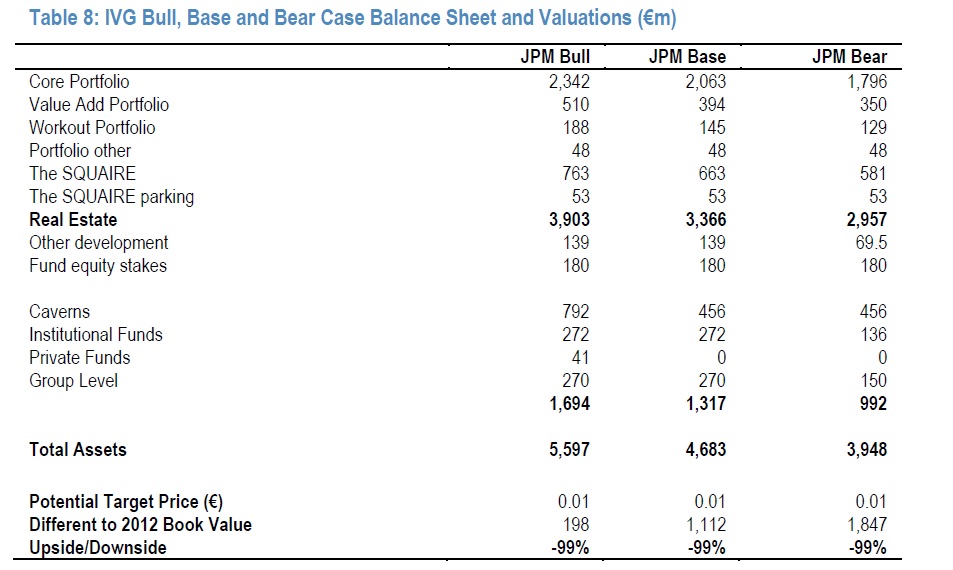
Additionally, they calculate “Bull” and “bear case” scenarios:

ivg bear case

The bear case scenario clearly would not leave a lot for convertible holders.This clearly shows the risk of the implicit “leverage” of the secured loans via the convertible.

Summary:

Although the JPM research looks a little bit superficial especially with regard to the liability structure, it is definitely worth to look at in order to get a better feeling for the underlying property values.

Their base case would imply even “full recovery” for the convertible and hybrid, although I think they haven’t modeled the liability structure correctly.

In general, their asset valuation does not look to different from mine,so for the time being I don’t see a reason to sell the convertible at current levels. Also there seems to be no reason to approve any debt for equity swaps.

However both, equity and hybrid capital seem to be clearly out of the money in most scenarios if one takes into account the full liabaility structure.

Quick update KPN – Sold rights & stock

Today I sold, both the KPN Shares and the rights .

All in all, I got around 2,91 EUR (1.68 for the shares, 1.23 EUR for the rights) which results in a gain of ~ 11.5% before trading cost. Quite a nice outperformance against the AEX with ~ 3.5% in the same time period.

Nevertheless, this was clearly a “bumpy ride” as the chart for the rights shows:

The optimal timing would have been to buy on the second day of the trading period. I guess this was the result of the very short time period between announcement of the terms and the start of trading.

I heard that for instance US investors were completely taken by suprise and couldn’t actively trade the rights.

Main reason for selling was that I was not sure if I want to exercise the rights and I have some other, in my opinion better ideas in the pipeline. Also I am not really optimistic about KPN in the long term.

In general, those “deeply discounted rights issues” are interesting special situations for a short term trade but have to be handled with a lot of care and patience …

Edit:
Someone asked me why I don’t show annualized returns for my single portfolio stocks. In my opinion, annualized returns for single stocks are pretty meaningless. The KPN Trade would have been an annualised 280% but what does such a number say ? As my investment strategy includes a lot of “sleeping” stocks, I think that showing annualized returns on single stock level do not provide any benefit at least not for me. Much more interesting than an annualized return per stock is the potential gap between the current price and intrinsic value.

How to raise capital – Deutsche Bank edition

In a surprise move, yesterday after the close of the stock market, Deutsche Bank announced that the increase their capital by ~2.8 bn.

For this they used the possibility of selling up to 10% of new shares without granting rights to the old shareholders.

So this would be the perfect case for the “formula” I mentioned yesterday:

Equilibrium Price = (price pre-cap raising announcement x # shares + price cap raising x # shares) / total # shares

The closing price of Deutsch Bank was 33.60 EUR. The price for the new shares 32.90 EUR. Outstanding shares were 929 mn, new shares 90 mn.

So the “Equilibrium Price” should have been:

(33.60 * 929 + 32.90 * 90)/ 1019 = 33.53 EUR per share.

Reality check: The stock actually opened around 33.50 but is now up +7.5% at ~35.40 EUR.

Learning experience:

The stock market is full of surprises. For some reason, the capital market considers it as extremely positive that Deutsche Bank increases its share count by 10%. I don’t know why.

And: Don’t rely on formulas…….

IVG again (and again and again)

disclaimer: The discussed investment is very risky and not recommended for any investor. There are strong hints of insider trading and permanent loss of capital and permanent loss of principal is quite likely. The author owns the investment and is clearly biased towards a positive outcome

Thanks to a reader, I received some “research” about IVG directly out of London, HF and “predator” capital (highlights are mine):

IVG – Further Thoughts

I had the opportunity to talk to the company late on Friday. I remain public on the name and have not received private information…

As one would expect, the company would not give any details of proposals being discussed with stakeholders; however, the company admitted that it had considered a number of options for repaying the convertible and deleveraging the company (which became necessary when the synloan holders indicated they wouldn’t be able to refi in September 2014)… including a rights issue which wouldn’t work due to the size required and the status of the hybrid and a quickie disposal of the SQUAIRE which would have seen a very significant discount to book.

A couple of things became clear:

· The company views the equitisation of the convertible and the hybrid as being the necessary first step in a restructuring process
· The haircut may also have to apply to the syndicated loans – especially SynLoan 1 which is under-collateralised
· The company’s fervent hope is to avoid any type of insolvency through a consensual agreement. Any type of restructuring under insolvency is currently considered a distant ‘Plan B’
· The company believes that significant value could be generated for equity investors through the continued management of the SQUAIRE and in the unencumbered caverns currently due to be delivered to Cavern Fund II in c. four years
· The company’s major shareholders are supporting the restructuring proposals – at least from their position on the Supervisory Board; that doesn’t mean that they will vote for restructuring at the AGM…
· Any new capital would require 75% approval at the new AGM
· The convertible bonds will require 100% vote of those attending a general meeting (quorum 50%); but that could be lowered to 75% under a new German Scheme
· It looks like Plan B may well be the more realistic proposition…

The German market is relatively short of ‘prime’ office space… prime would mean significant property located in the centre of major cities like Berlin, Frankfurt, Hamburg and Munich. IVG categorises most of its property as located in these cities. However, more properly it should be described as near one of these cities and very little of the investment portfolio could be described as prime… Prime properties still command premium rentals, non-prime properties face significant competition and rents are likely to fall on the renewal of tenancy agreements. The company states that €2.25bn is core/core+, €690mn is value add (needs work or on short tenancy) and €250mn is workout… in an insolvency the core/core+ valuations would come under pressure; the latter two categories may well be reflective of a going concern but I believe could well be significantly haircut in an insolvency… Furthermore I place little value in the €264mn ‘future caverns’ given the lack of interest from utilities; the fund valuations could come under pressure if EuroSelect 14 does indeed default; and tax assets are hard to transfer.

The company confirmed that:

· The debt on the SQUAIRE represent c. 60% LTV; the rental currently covers interest and the cover will improve. The company expects this debt to roll when it falls due at the end of the year
· The company also has a Core Financing: currently €570mn vs. assets valued at €800mn
· The Pegasus loan is currently €140mn and is secured on a variety of properties situated all over Germany and valued at €300mn
· SynLoan 1 is under-collateralised; I got the impression that less than 75% of the loan had collateral
· SynLoan 2 is over-collateralised but I have the impression that not by much… c. 90% LTV; obviously it benefits from the caverns disposals which should generate €300mn by the end of 2014

It would seem that it would be in the best interests of all of the stakeholders to keep the company a going concern, otherwise one can make a case that even the collateralised parts of the syndicated loans could be haircut.

Andrew Carrie ** 22nd April 2013 ** acarrie@knight.com ** +44 20 7997 2066

In my opinion only 2 parts of that “research” is interesting:

Number 1:

The company views the equitisation of the convertible and the hybrid as being the necessary first step in a restructuring process

This is the same kind of b…s… I have heard in the first few Praktiker calls. The answer is simple: Nope. The first step is that equity gets wiped out, then Hybrid then senior. However it clearly shows that will go down the same path as Praktiker tried and ask the bondholders for deferral.

If for some reason, they would succeed, this would in my opinion kill the complete (high yield) corporate bond market. If it is suddenly possible to change the sequence in teh capital structure, why should then be corporate spreads where they are at the moment ?

Number 2:

This is the really interesting part:

SynLoan 1 is under-collateralised; I got the impression that less than 75% of the loan had collateral

In some boards people were arguing: If a collateralized loan is sold at 85%, this is the proof that the senior is worthless, as even the collateral for the first priority loans is not sufficient. To be honest, I was struggling with that one most.

Well, this argument now doesn’t hold anymore. If in reality, the Synloan is only collaterallized at 75%, then a price of ~85% is in line with the current pricing of the convertible.

The uncollateralized part of the Synloan is “pari passu” with the convertible. So in case of the bankruptcy, synloan holders would get full repayment on the collateralized part (75%) plus pro rata repayment with the convertible which trades around 55%. The “fair value” of such a Synloan would therefore be 75% + (25%*0.55)= 87.5% and therefore absolutely consistent with current convertible prices.

If we assume that the buyers have quite high return requirements, then I think the fear of a zero recovery for the convertible gets even more unrealistic.

Summary:

If only for this one piece of information, the “research” as superficial as it is has greatly increased my confidence in the IVG convertible, because suddenly the prices paid for the more senior but partly uncolateralised loans makes sense.

One should still expect a very bumpy ride with “Praktiker style” attempts to bail in the convertible holders before anyone else, but at current prices, the risk/return relationship looks very good to me.

Again a disclaimer: “Don’t do this at home” and I might be subject to confirmation bias.

Deeply discounted rights issue watch: KPN NV (NL0000009082)

I had briefly covered deeply discounted rights issue as a potential “special situation” opportunity a couple of weeks ago.

Now, with KPN, we have an interesting non-financial candidate. This is what KPN issued today:

Dutch telecoms group KPN confirmed a €4bn rights issue to shore up its capital position after heavy expenses on bandwidth that have led to dividend cuts and lower profit margins.

The company announced the move along with its 2012 annual results, which showed a 3.5 per cent drop in revenues and a 12 per cent fall in earnings from the year before.

As one might expect, the stock tanked some 16% or so. Currently, at around 3.45 EUR per share, KPN has a market Cap of only 5 bn EUR, so raising 4 bn via a rights issue might require a large discount on potential new shares.

The “wild card” in this game will be Mexican Billionaire Carlos Slim who owns currently 27.5% of the company. If he fully participates as lead investor and even taking up more than his share, then the “forced selling” aspect might not be too relevant.

If for some reason, he would refuse to participate, the situation will become very interesting.

Just for fun, let’s look how the performance was for Unicredit. I would distinguish the following events / time periods:

– 4 weeks before announcement
– announcement day
– period between announcement and price setting (for new shares)
– price setting day
– period between price setting and start trading of subscription rights
– trading period
– 4 weeks after end of trading period

First the relevant dates:

Unicredit
Announcement first trade date 14.11.2011
Price setting of rights issue 04.01.2012
First trade date subscr. rights 09.01.2012
Subscription trading until 01.02.2012
 
Discount 43%
New share 2 new for 1 old

Now the relative performance:

Performance UCG MIB Relative
– 4 weeks before announcement -18.35% -4.98% -13.37%
– Date of announcement -6.18% -1.99% -4.19%
– announcement until price setting -14.40% 2.95% -17.35%
– day of price setting -17.27% -3.65% -13.62%
– price setting to start trading -26.46% -4.45% -22.01%
– trading period 73.75% 12.94% 60.81%
– 4 weeks after trading period 0.05% 2.82% -2.77%
– 6 months after trading period -32.25% -11.39% -20.86%
– 12 months after trading period 12.53% 9.53% 3.00%

In the Unicredit example, clearly the period where the subscription rights were traded showed the best relative performance of the shares. Interestingly, on the announcement day, the price drop was much less in percentage points than KPN. This might have to do with the short selling ban which was in place (at least to my knowledge) when Unicredit announced the rights issue.

Again for fun, a quick look at Banco Popular’s rights issue from the end of last year.

Again the dates first:

POP
Announcement first trade date 01.10.2012
Price setting of rights issue 10.11.2012
First trade date subscr. rights 14.11.2012
Subscription trading until 28.11.2012
 
   
New share 3 new for 1 old

and then relative performance to the IBEX:

Performance POP IBEX Relative
– 4 weeks before announcement -3.95% 5.11% -9.06%
– Date of announcement -6.17% 0.98% -7.15%
– announcement until price setting -29.95% -1.71% -28.24%
– day of price setting 4.56% -0.90% 5.46%
– price setting to start trading -8.86% 1.39% -10.25%
– trading period 8.12% 2.16% 5.96%
– 4 weeks after trading period -6.71% 3.74% -10.45%

One can see a similar pattern first, with the stock losing 4 weeks before announcement, as well as on the announcement date until the final price setting. However of the date of price setting, the stock jumped, until loosing only a little bit until starting of the trading period.

Then however, the gains within this period were relatively low compared to Unicredit. Overall it looks a lot less volatile than Unicredit, so maybe less forced selling here.

Back to KPN:

Other than Unicredit and Banco Popular, KPN had outperformed the AEX almost +11% in the last 4 weeks, so today’s large drop might compensate for this (unjustified) outperformance.

If the other two stocks are any guide, one could still expect lower prices until the price for the new shares will be set.

The stock price of KPN look really really ugly long term:

But make no mistake, any company which needs to go into deeply discounted rights issues is in trouble. This is “distressed” territory.

(…to be continued….)

Viel et Cie (ISIN FR FR0000050049) – “sum-of-parts” or long/short opportunity ?

Viel et Compagnie SAis one of the many French companies with a good Boss score. According to Bloomberg they are active in the following areas:

Viel et Compagnie is a broker of financial products for the French interbank market. The Company deals in money market instruments, and offers clients a range of derivatives.

Traditional valuation metrics look OK but not extremely exciting:

Market Cap: 194 mn EUR
P/B: 0.62
Div. Yield 6.0%
Trailing P/E 12

However looking into the companies’ annual report, one can easily see that the Bloomberg description in this case is actually not very good.

The company describes itself the following way:

VIEL & Cie comprises three core businesses in the financial sector: Compagnie Financière Tradition SA, an interdealer broker with a presence in 27 countries, Bourse Direct, a major player in the online trading sector in France, and a 40% equity accounted stake in SwissLife Banque, present in the private banking sector in France.

Now it gets interesting, Compagnie Financiere Tradition SA itself is a Swiss listed company (ISIN CH0014345117) with a market cap of currently 320 mn CHF or 267 mn EUR. Viel & Cie owns 63.54% of the company, so that should be worth 170 mn EUR.

So again, we have here a holding company, which seems to become one of my specialties…

According to the annual report (pages 85 and following), the holding company had 70 mn in cash and 25 mn liquid securities and 150 mn in debt, leaving net debt of ~65 mn EUR.

The holding company owns on top of the participations:

– 29 mn EUR “other” securities
– 89 mn receivables

If we assume a “haircut” of 50% on those assets, we are left with around 55 mn EUR “extra assets” at holding level which I would net out against the debt.

So a first sum of parts analysis would get us.

Market cap: 194 mn EUR
+ net debt 65 mn EUR
– own shares (9.4%) 20 mn EUR
= EV 239 mn EUR

Assets:

63.5% of Cie Fin. Tradition : 167 mn EUR
+ other holding assets at 50%: 55 mn EUR
= 225 mn EUR

So we have 27 mn EUR left which should cover

a) 100% in the French online broker “Bourse en ligne”
b) 40% in Swiss Life Banque Privee

According to Viel’s annual report, the online broker earned 3.5 mn EUR in 2011, so with a 10 P/E, this company would be worth 35 mn EUR

The 40% Stake in the French Swiss Life Banque Privee seems to be the result of a 2007 transaction with Swiss Life.

However, this 40% stake only generates “at Equity” profits of 2 mn EUR, even optimistically I would not attach more than 25 mn EUR valuation for this minority stake.

So bringing it together, the Sum of Parts looks as follows:

a) Cie Fin tradition 167 mn
b) holding assets 55 mn
c) Online broking 35 mn
d) 40% Banque 25 mn

Sum 282 mn EUR

Against an “EV” of 239 mn EUR, so only a slight 16% “discount”. So not really something to follow up and let’s move on with some other stock ?

Not so fast: It is quite interesting to look at the relative performance of Viel &Cie against its main participation over the past 2 years:

For some reason which I don’t understand, the two stocks completely “decoupled” in January 2011. Since then, Viel & Cie remained constant and Compagnie Financiere tradition lost ~54%. Or put it another way: In January 2011, Viel was trading at a very large discount (50% or more) to sum of parts whereas now it trades almost without any discount.

I found this very strange. Most of the value of Viel comes from its stake in the Swiss company and for some reason, Viel shareholders do not care that the major stake looses 55% ?

I don’t know if one could short Viel, but a “long CFT / short VIL” trade might be a very interesting market neutral opportunity.

Another potential idea out of this is Compagnie Financier Tradition. This could be a very interesting situation in its own.

Edit: I had originally written this post 2 weeks ago, since then Viel already lost 10% relative to Compagnie Tradition

Holding companies – Solvac SA (ISIN BE0003545531)

This is a quick follow-up on the Porsche SE post and the Holding company post.

Solvac SA (Had tip to reader G.) is the Belgian Holding company for 30% of the shares of Solvay SA, the Belgium based Chemical company. Majority shareholders of Solvac are the heirs of the founding Solvay family.

The holding company shares some interesting similarities with Porsche, for instance they hold also a 30% stake and account for the stake at equity.
Read more

Some thoughts on discounts for Holding structures (Porsche SE, Pargesa, Autostrade Torino)

In my post about Porsche SE, I concluded the following:

However on a relative basis I don’t think that there is a lot of upside in the Porsche shares, as I don’t see a quick “real” catalyst and a certain structural discount (20-30%) is justified due to holding structure and non-voting status of the traded shares.

Geoff Gannon used this summary to come up with his view on holding company discounts:

I do know something about holding companies that trade at a discount to their parts. And I don’t agree with that part of the post. If the underlying assets are compounding nicely – you shouldn’t assume a holding company discount is correct just because the market applies one to the stock.

So he is basically saying one should ignore the holding structure and look at the underlying only.

Interestingly, we had such a discussion on the blog about the same topic in the Bouygues post. Reader Martin commented that “one usually applies a 20-30% holding/conglomerate discount” which I didn’t apply in my sum-of-parts valuation.

So far this seems to be quite inconsistent from my side, isn’t it ?

I have to confess that especially for Porsche, I did not mention all my thoughts about why I applied a discount there. However maybe I can shed some light on how I look at “holding structures” and when and how to discount them.

For myself, I distinguish between 3 forms of holding companies:

A) Value adding HoldCos
B) Value neutral HoldCos
C) Value destroying HoldCos

A) Value adding HoldCos

This is in my opinion the rarest breed of HoldCos. Clearly, Berkshire Hathaway is an example or Leucadia. Those HoldCo’s add value through superior capital allocation capabilities of their management. In those cases I would not apply any discount on the underlying assets, however I would be hesitant to pay extra.

B) Value neutral HoldCos

Those are holding structures which exist for some reason, but most importantly are transparent and do nothing stupid or evil to hurt the shareholder. Ideally, they are passing returns from underlying assets to shareholders.

A typical example of such a company would be Pargesa, the Swiss HoldCo of Belgian Billionaire Albert Frère. They are quite transparent and even report their economic NAV on a weekly basisandpass most of the dividends received to the shareholders. Nevertheless, the share trades at significant discount to NAV as their own chart shows:

At the moment, we see a 30% discount for Pargessa. So one should ask oneself, why such a discount exists for such a transparent “fair” holding co ? I can think of maybe 3 reasons:

– The stock is less liquid than the underlying shares
– people do not really trust Albert Frere despite being treated Ok so far
– no one wants to invest into this specific basket of stocks

Nevertheless, one has to notice that even for such a transparent company like Pargesa, a 30% discount does not seem to be the exception.

C) Value destroying HoldCos

Here I have the privilege to have documented such a case in quite some detail, Autostrada Torina, the Italian Holding company for toll road operator SIAS SpA.

As I liked the underlying business, I thought buying at a discount, following Geoff Gannon thoughts that a nice compounding business at a discount is an ever nicer business.

However, I had then to find out the hard way that the discount of the holding company was clearly a risk premium. In this case, the controlling Gavio family “abused” the holding to buy an interest in another company (Imprgilo far above the market price. They couldn’t do this in the operating subsidiary, as the sub was subject to regulation. The Holding co stock recovered to a certain extent but in this case the underlying OpCo was clearly the better and safer investment

My lesson in this was the following: Stay away as far as possible from such “value destroying” HoldCos. They are totally unpredictable and doe not have any margin of safety.

So going back to our Porsche example, what kind of Holding company is Porsche ?

Well, it is definitely not a “value adding” holding. The question now would be if it is a “neutral” or potentially even “value destroying” hold co ?

In my opinion there are already some warning signs:

– Porsche SE already communicated that they will not distribute the cash, but build up an additional portfolio of “strategic participations”
– Porsche only issues detailed reports twice a year, accounting is rather “opaque”
– in my opinion, Volkswagen has a lot of incentives to achieve a weak Porsche SE share price in order to then acquire their own shares at a discount (and swap them into VW pref shares if possible) at a later stage. Common shareholders (Porsche & Piech family might get a better deal. Under German law it is possible to treat pref holders differently

Compared to Pargesa for example, I would definitely prefer Pargesa with a 30% discount to a Porsche pref share at 35% discount.

So to summarize the whole post:

– With holding companies, it is very important to determine the intention and risks of the holding structure
– neglecting or even “evil” holding management can quickly turn a “discount” into a real loss
– better err on the safe side in such situations
– in doubt, assume there is a reason for the discount if you cannot prove the opposite
– however for skilled activist investors, those situations might create potential. So maybe Chris Hohn has a different game plan.But don’t forget that a lot of famous Hedgefund managers (incl. David Einhorn lost a lot of money with Porsche/Volkswagen already in the past.

Underrated special situation – Deep-discounted rights issues

In many books which deal more or less explicitly with “special situation” investing, for instance Joel Greenblatt’s “You can be a stock market genius” or seth Klarman’s “Margin of safety”, many so-called “Corporate actions” are mentioned as interesting value investing opportunities.
Some of the most well know corporate actions which might yield good investment opportunities are:

– Spin offs
– tender offers /Mergers
– distressed / bankruptcy 

However one type of corporate action which is rarely mentioned are rights issues and especially “deeply discounted” rights issues.

Let us quickly look at how a rights issue is defined according to Wikipedia:

A rights issue is an issue of rights to buy additional securities in a company made to the company’s existing security holders. When the rights are for equity securities, such as shares, in a public company, it is a way to raise capital under a seasoned equity offering. Rights issues are sometimes carried out as a shelf offering. With the issued rights, existing security-holders have the privilege to buy a specified number of new securities from the firm at a specified price within a specified time.[1] In a public company, a rights issue is a form of public offering (different from most other types of public offering, where shares are issued to the general public).

So we can break this down into 2 separate steps:

1. Existing shareholders get a “Right” to buy new shares at a specific price
2. However the shareholders do not have to subscribe the new shares. Instead they can simply choose to not subscribe or sell the subscription rights

Before we move on, Let’s look to the two alternative ways to raise equity without rights issues:

A) Direct Sale of new shares without rights issues
This is usually possible only up to a certain amount of the total equity. In Germany for instance a company can issue max. 10% of new equity without being forced to give rights to existing shareholders. In any case this has to be approved by the AGM.

B) (Deferred) Issuance of new shares via a Convertible bond
Many companies prefer convertible bonds to direct issues. I don’t know why but I guess it is less a stigma than new equity although new equity is only created when the share price is at or above the exercise price at maturity. So for the issuing company, it is more a cash raising exercise than an equity raising exercise. Usually, the same limits apply to convertible debt than for straight equity.

So if a company needs more new equity, the only other feasible alternative is a rights issue. But even within rights issues, one can usually distinguish between 3 different kinds of rights issues depending on the issue price:

1) “Normal” rights issue with a relatively small discount
Usually, a company will issue the new shares at a discount to the old shares in order to “Motivate” existing shareholders to take up the offer. If they do not participate, their ownership interest will be diluted. Usually “better” companies try to use smaller discounts, high discount would signal some sort of distress

2) Atypical rights issue with a premium
This is something one sees sometimes especially with distressed companies, where a strategic buyer is already lined up but wants to avoid paying a larger take over premium to existing shareholders

3) Finally the “deeply” discounted rights issue

Often, if a company does not have a majority shareholder, the amount of required capital is relatively high and there is some urgency, then companies offer the new shares at a very large discount to the previous share price.

But exactly why are “deeply discounted” rights issues an interesting special situation ?

After all this theory, lets move to an example I have already covered in the blog, the January 2012 rights issue of Unicredit In this case:

– Unicredit did not have a controlling shareholder. One of the major shareholders, the Lybian SWF even was not able to transact at that time
– the amount to be raised was huge (7.5 bn EUR)
– it was urgent as regulators made a lot of pressure

As discussed, in the case of Unicredit, before the actual issuance at the time of communication the stock price was around 6.50 EUR, the theoretical price of the subscription right was around 3.10 EUR. However even before the subscription right was issued, the stock fell by 50 %. At the worst day, one day before the subscription rights were actually split off, the share fell (including the right) almost down to the exercise price without any additional news on the first day of subscription right trading.

But why did this happen ? In my opinion there is an easy answer: Forced selling

Many of the initial Unicredit Investors did not want to participate or did not have the money to participate in the rights issue. As the subscription right was quite valuable, a simple “non-exercise” was not the answer. As history shows, selling the subscription right in the trading period always leads to a discount even against the underlying shares, in this case some investors thought it is more clever to sell the shares before, including the subscription rights. Sow what we saw is a big wave of unwilling or unable investors which wanted to avoid subscribing and paying for new shares which created an interesting “forced selling” special situation.

Summary: In my opinion, deeply discounted rights issues can create interesting “special situation” investment opportunities. Similar to Spin offs, not every discounted rights issue is a great investment, but some situations can indeed be interesting. On top of this, those situations often are not really correlated to market movements and play out in a relatively short time frame.

« Older Entries Recent Entries »