Category Archives: Fundamentalanalyse

Bouygues Q3 update

The Q3 numbers of Bouygues are a first test for my Bouygues investment case.

If I update my simple sum of part valuation, we can see the following:

Market values listed companies:

  16.11 initial
Colas 96.55% 3.56 3.34
Alstom 29.40% 2.42 2.47
Tf1 43.59% 0.667 0.58
       
Total listed   6.65 6.39

So the listed subs have slightly increased in value.

Now looking at the unlisted, I will simply assume 9 Month EBITDA will equal 75% of total EBITDA:

9 month EBITDA 12M est EV Multiple EV
Bouygues Constr. 432 576 7 4,032
Bouygues Real estate 117 156 7 1,092
Bouygues Telecom 802 1,069 6.5 6,951
 
        12,075

Compared to the 6 month numbers I used last time, Telco is slightly below 6M run rates, construction and real estate perfom better.

Both, listed and unlisted subsidiaries in theory look better than at the time of my initial analysis. Net debt has slightly increased to 5.8 bn form 5 bn, mainly due to a 2 bn purchase of mobile licenses in France.

Putting this together, the updated fair value of Bouygues equity at “sum of parts” would be 6,65 bn + 12.075 bn -5.8 bn = 10.9 bn or around 35 EUR per share. From my point of view I see no fundamental reason why the shares have dropped quite substantially. I guess this is more “market psychology” following the announcement of France Telecom to cut their dividend.

However the stock chart looks really ugly now, although I am not a stock chart expert, there doesn’t seem to be any “technical” support on the downside and momentum is clearly negative:

Fundamentally the company seems to be “on track” at least compared to my investment case. So I will use today’s low prices to “fill up” again the current 2.2% position to 2.5% weight, further purchases will follow if the stock goes below 17 EUR (and fundamentals remain stable).

Gronlandsbanken AB (ISIN DK0010230630) – Sleepy eskimo bank or moat company with natural resource option ?

Sometimes the only reason why I research a stock is because I find it interesting for some reason, not because it will be a good investment or so.

Gronlandsbanken AB is such a stock. Although it showed up in my Top 25 Scandinavian stocks, normally I would discard that because it is a bank. With Gronlandbanken however, the fact that this is the only listed stock of a company from Greenland got me interested.

Before looking into the bank, a few facts about Greenland from Wikipedia:

– Greenland has arond 60 tsd inhabitants spread over 2 mn square kilometers, however only 400 k square kilomoters are not permanent ice (Germany has ~350 k Square kilometers)

– politically, Greenland is mostly independent since 1979, however strong ties to its former “Colonial master” Denmark remain, among others the offical currency which is the Danish Krone
total GDP is estimated to be around ~2 bn USD
– However, basically 50% of the countries GDP are transfer payments from Denmark
– Greenland left the EU in the 80ties but still enjoys free trade and other preferred treatments via Denmark
– most people basically work for the Government, the second largest sector is fishing
– Last but not least, Greenland could become one of the prime beneficiaries of climate change, as its vast natural resources could become much easier to access

The Bank:

Grondlandsbanken has been founded in 1967. In 1997 it merged with the only other bank in Greenland, Nuna Bank and is therefore the only bank based in Greenland. However it doesn’t seem to be the only bank with branches in Greenland as this post shows:

Banking
There are 2 banks in Nuuk, Greenland Bank and BankNordik. However, the latter has no cash function. There are ATMs in both banks in Nuuk, and cash in advance and Visa Card can be used in all stores and the like.

Anyway, it looks like competition is currently quite limited in Greenland in the banking sector.

Gronlandsbanken valuation looks Ok, but not very exciting:

Market cap: 830 mn DKK (~110 mn EUR)
P/E Trailing ~14
P/B 1.0
Dividend yield 6.5%

Around 65% of the shares are held by large shareholders, among them with 14% the Government of Greenland. So “free float” is around 30-35% or 35-40 mn EUR only.

Interestingly, value shop Sparinvest has a 0.44% stake . Another value fund which I didn’t encounter yet, Nielsen Global Value holds 5% as well. For them it seems to be a quite significant position with 5% portfolio weight according to the latest fact sheet.

Thankfully, no sell-side analyst has discovered the stock yet.

The stock is up 56% YTD, however this is still less then 50% of the peak price back in 2007:

Not surprisingly, the stock has a very low beta of ~0.55 vs. the Danish stock index.

But why buy a bank at book value if you can get banks for 0.3 times book ?

Well, there are a few things which are “not normal”:

– Gronlandsbanken has an equity ratio of 17.3% (that’s right, not Tier 1 ratio or such crap)

– their net interest margin is around 4%-5%, Return on assets is around 1.7% If we compare this to the most profitable banks like HSBC (1.9% – 0.6% and Standard Chartered (2.4% and 0.9%) or DNB (1.4% -0.6%), we can see that Gronlandsbanken is at least twice as profitable as the most profitable European bank.

Due to the high ratio of equity, ROEs do not look spectacular, but still my model calculates ~15-16% total ROE with a relatively low volatility. According to my model, the fair value for such a company should be around 1.3 times higher than the current market price.

Especially interesting for me was the 2011 annual report from Gronlandsbanken.

The pages 8-16 are definitely the best summary of the economic situation in Greenland I have been able to find. Most interesting was the following passage:

Greenland at a Cross-Road
Looking forward the economy of Greenland will come to a cross-road because most likely the economy will follow one of the following paths:
1. If one or more of the major projects are built, enormous pressure will be exerted on the economy of Greenland with concurrent high rates of growth and pressure on inflation. Based on current analyses, a great deal of the required labour force will be from abroad.
2. If none of these major projects is built, the major challenge in Greenland will be to create jobs and to ensure economic growth.
Within a few years, we can be expecting either very high rates of growth or zero-growth, or perhaps even negative growth. On the other hand, it is harder to imagine a middle-of-the-road scenario with reasonable and sustainable rates of growth since there are few growth-drivers in the economy (except for metals and minerals).

So this is fundamentally a very interesting “Binary” situation with a clear “trigger”.

Some of those “projects” mentioned are relatively interesting as well:

– Oil: Uk Cairn Plc seems to have drilled for oil but has found nothing yet
– a public listed company called London Mining Plc is trying to develop a large iron ore mine
– ALCOA seems to be interested in building a large Aluminium plant
– there seems to be a “rare earth” project buy an Australian listed company called “Greenland Mineral and Energy”, the so called Kvanefjield deposit.

Additional interesting articles form the Web about the natural resources developement in Greenland

Natural resources and Oil in Greenland
Cairn’s drilling results in Greenland
Chinese interest in Greenland
Chinese workers to be “Imported” ?

So it seems to be that the Government in Greenland seems to “warm up” to the natural resources projects. Maybe this is the reason why Management is buying shares since end of October. The amounts are not huge but every other day one can see purchases.

Summary:

Although I wish I had discovered Gronlandsbanken some months ago, I still think it is a really interesting stock:

– as it is the only bank in Greenland, its margins are around twice as high as the best global banks and the balance sheet is rock solid. One could call this a natural moat
– even based on the current state, current valuation implies significant upside to fair value
– the Greenland resource story could add significant growth going forward, even with maybe other banks entering Greenland
– finally, Management has started to buy shares after surprisingly good Q3 numbers
– although there is no direct catalyst, an indirect catalyst could be if some of the projects proceed well and Greenland will move inte the spotlight. Gronlandsbanken is the easiest (and only) way to invest into Greenland without project specific risk

As a result, I will start with a 1% position in order to further track this interesting “opportunity” stock.

Boss Score Harvest: Accell Group (NL0009767532) – maybe another time

Accell is by far the best Scoring stock in my Boss Score Top 25 Benelux. According to Bloomberg their business is focused on bicycles:

Accell Group NV designs and manufactures racing, children’s, hybrid, mountain, electric, and luxury bicycles. The Company manufactures its bikes under the brands Batavus, Hercules, Koga-Miyata, Lapierre, Mercier, Loekie, Sparta and Winora. Accell also makes bicycle accessories and fitness equipment. The Company markets its products in Northern and Central Europe.

Traditional metrics:

Market cap 299 mn EUR
P/E 8,1
P/B 1.19
P/S 0.39
EV/EBITDA ~ 12Div. Yield 7.4%

So the company looks cheap from a P/E perspective, but expensive from an EV/EBITDA point of view. Debt to Equity is ~56% or 5.12 EUR net debt per share.

Business model

Accell is producing and wholesale distributing bicycles, not retailing them. They have been constantly acquiring smaller competitors over the last years. Bicycles were good business over the last years. If we look at the currently listed manufacturers, we can see that valuations are generally quite high (just for fun I added Shimano to the peer group):

Name Mkt Cap P/B P/E EV/EBITDA T12M P/S PM LF ROE LF ROIC LF
                 
MIFA MITTELDEUTSCHE FAHRRADW 62.7 2.0 83.2   0.6 2.0 2.2  
MERIDA INDUSTRY CO LTD 894.6 4.7 17.6 17.0 1.6 6.7 29.6 13.8
SHIMANO INC 4664.3 2.5 17.1 8.3 2.0 12.3 15.2 14.2
GIANT MANUFACTURING 1510.0 4.1 18.9 12.7 1.1 5.7 22.7 12.4
ACCELL GROUP 300.6 1.2 8.1 12.3 0.4 4.6 15.0  
DERBY CYCLE AG 242.6 3.7 21.7 11.4 1.0 4.8 22.3 20.5

I guess this is mostly due to the fact that the bicycle producers have gained from two major tailwinds: high fuel prices and E-Bikes. One can also see that Accell looks relatively cheap on a P/E and P/B basis.

From a business model perspective, I see some positive and some negative aspects for bicycle producers:

+ there are no really dominant retailers for bicycles. So a large producer does have a better competitive advantage
+ the business is not very capital-intensive
+ there is a secular trend in many countries / cities to a more bicycle friendly environment (health and fuel cost, see for instance here)
+ The internet might not disrupt the sector as much as other area
+ the market is still divided between many smaller players, so further consolidation might be possible

Howver there are also some factors which I consider negative

– brand awareness: People might pay a little more for a branded bike but there is not so much brand loyalty like for instance cars
– the high tech part of bicycles are mostly outsourced to suppliers. Best example is Shimano which has basically a monopoly on gear shifts
– it is therefore quite easy for small competitors to start production, as welding a frame is not so difficult and you can buy the parts pretty easily
– the European market is protected by a heavy 48.5% tariff. According to the Bloomberg article, this has been extended 3 years until 2014. But if this falls, the European producers would be in big difficulties soon. A good general source for market data, news etc. is this website.

So to sum up the industry:
The industry has/had some secular tailwinds, however the overall competitive landscape is average. Combined with the really expensive overall valuation, the listed companies look vulnerable to a certain extent. The success of the European producers might also be a result of the massive tariffs for Chinese manufacturers, so there is also some kind of “regulatory” risk.

Company valuation:

The company scores so well in my model because they have shown phenomenal ROE and ROICs in the last years and steadily increasing net margins:

ROE Ni Margin EPS EBITDA/share
31.12.2002 17.02% 2.6% 0.41 1.01
31.12.2003 20.34% 3.2% 0.55 1.23
31.12.2004 24.23% 3.9% 0.77 1.59
30.12.2005 22.51% 4.2% 0.88 1.70
29.12.2006 21.72% 4.3% 1.00 1.91
31.12.2007 19.91% 4.2% 1.30 2.17
31.12.2008 23.89% 5.3% 1.48 2.86
31.12.2009 23.07% 5.7% 1.65 2.88
31.12.2010 21.91% 6.3% 1.79 2.64
30.12.2011 20.39% 6.4% 1.93 2.13

However I also showed EPS and EBITDA per share over this period. The strange thing is that EBITDA per share and earnings per share more or less “converged” whereas in earlier years, the relationship EBITDA to EPS was on average 2:1.

So let’s quickly compare the 2003 P&L (from the 2003 annual report) against 2011:

2003 % 2011 %
Sales 289   628.5  
Material cost -184.5 -63.8% -420.2 -66.9%
Personel -45.1 -15.6% -82.9 -13.2%
Depr. -3.8 -1.3% -7.4 -1.2%
other oper. -39 -13.5% -83 -13.2%
Financial /part -2.5 -0.9% 8.6 1.4%
Tax -4.9 -1.7% -3.1 -0.5%
Net 9.2 3.2% 40.5 6.4%

So we can clearly see that there is a big “special” effect in 2011’s results. If we look into the P&L, we can see the following note:

This is the result realized with the sale of the in 2011 acquired 22% investment in Derby Cycle AG. The result consists of the capital gain less corresponding expenses.

So this was a nice but one-time gain during the (short) fight for Derby cycle, the German listed bicycle manufacturer where Accell lost out against Dutch competitor Pon.

So let’s look at 2010 instead to see if this was a “normal” year:

2003 % 2010 % Delta
Sales 289   577.2    
Material cost -184.5 -63.8% -373.9 -64.8% -0.9%
Personel -45.1 -15.6% -76.6 -13.3% 2.3%
Depr. -3.8 -1.3% -7.5 -1.3% 0.0%
other oper. -39 -13.5% -73.3 -12.7% 0.8%
Financial /part -2.5 -0.9% -4.1 -0.7% 0.2%
Tax -4.9 -1.7% -5.8 -1.0% 0.7%
Net 9.2 3.2% 36.0 6.2% 3.1%

One can see that also in 20110, there must have been some special effects, for instance the tax rate looks low. Again the notes give the following explanation:

The effective tax rate is the tax burden relating to the book year divided by profit before tax. The effective tax burden amounts to 20.6% (2009: 27.5%). Accell Group and the Dutch tax authorities agreed on the applicability of the so-called patent/innovation box. For the years 2007 – 2009 part of the Dutch taxable profit is taxed against a tax rate of 10% (instead of 25,5%), resulting in a refund of b 1.7 milion. In 2010 part of the Dutch taxable profit is taxed against a tax rate of 5% (instead of 25,5%) resulting in a tax saving of approx. b 1.0 milion. In accordance with IAS 12 a tax receivable is recorded as tax receivable for an amount of b 2.7 milion.

So just based on those 2 examples, I would already state that “earnings quality” at least in 2010 and 2011 is somehow mixed. Especially the 2011 result would look a lot worse than reported if they wouldn’t have the gain.

Other considerations:

So let’s have a quick overview on some other check list items:

+ Good growth over the last 10 years
+ Consistent payout of around 509% of net income
+ good underlying “story”: E-Bikes, roll up opportunity
+ only covered through 7 local analysts, bad ratings (which i see as a positive)

– many acquisitions
– increasing share count (increase by 50% over the last 10 years)
– accounting “special effects”, operating results more volatile than they appear
free cashflow generated only ~ 20% of stated earnings over the last 14 years
insiders are/were constantly selling according to company info
deteriorating Business in 6M 2012 despite large acquisition, again suspiciously low taxes
– balance sheet now much weaker after Raleigh acquisition (more debt, more goodwill)
– according to the shareholder information on the company web site, there seems to be some kind of take over poison pill in place which limits any take over /control premium catalyst
The stock price seems to be clearly reflecting those issues:

On a 2 year basis we can clearly see that the stock looks vulnerable:

Longer term, the cahrt looks relatively OK, the stock had an incredible run over the last 10 years or so:

So let’s stop here and summarize:

– the reported earnings, especially in 2011 do not show fully the underlying results
– Accell made a rather large acquisition into a difficult market
– going forward, it is pretty clear we will see lower earnings and lower profitability
– if things deteriorate, there is not a lot of margin of safety in the balance sheet (high debt load, Goodwill)
– the business doesn’t look a lot like a moat either
– insiders are constantly selling, any take over seems to be unlikely
– despite the low P/E, valuation is rather expensive on an EV/EBITDA basis and cash flow generation to earnings is weak

So in short, despite the fantastic score, the company at the moment does not look attractive to me. Past profitability seems to be clearly above the historical achievable mean. As I don’t by in principle into “stories” like E-bikes, I will not invest in the stock.

Allow me a small excursion at the end:

Accell might still be a good investment going forward, but in my opinion it is not a good “value” investment. Why ? For a value investment it is not enough to look cheap. You have to have a margin of safety. This comes in two forms

– either a margin of safety based on the balance sheet (Graham style)
– or a margin of safety in the business model (moat, Buffet style).

Accell in my opinion has neither. Maybe they will make a ton of money with E-Bikes or not. I don’t know. But if things get worse, there is not real downside protection for the stock. As a value investor one should not speculate on stories or secular trend, because they can change more quickly as one might think (see Solar).

Boss Score harvest: Morgan Sindall Plc (UK GB0008085614) – negative invested capital

Morgan Sindall ist one of the best scoring UK companies in my Boss Score screener, so I thought I might have a closer look into it.

Company description per Bloomberg:

Morgan Sindall Group PLC operates a specialist construction group. The Group’s activities include office design, fitting out, refurbishment, building contracting, property investment, and related specialist services. Morgan Sindall operates in the United Kingdom and the Channel Islands.

Traditional metrics look Ok, no “deep value” but “cheap”:

Market Cap 293.5 mn GBP
P/E 8.7
P/B 1.2
P/S 0.1
EB/EBITDA 5.4x
Dividend yield 6.9%

Other quick check Items:

+ company has no financial debt (GOOD)
+ management holds significant shares (GOOD)
+ however no majority shareholder (GOOD)
+ constant and high ROE/ROE/ROIC (GOOD)
+ long established operating history (GOOD)
+ relatively low beta against Footsie of 0.66 (GOOD)
+ almost no pension liabilities (GOOD, important for UK companies)
large intangible assets (TO BE CHECKED)
– low but stable margins (TO BE CHECKED)
UK only construction company (TO BE CHECKED)
– volatile free cashflows (TO BE CHECKED)
– increasing share count over the last decade (TO BE CHECKED)

So the big question one has to solve with Morgan SIndal is: How do they manage to have such stable margins although they are so razor-thin ? “Classical” competitive theory would suggest that a company with 1-2% margins is in a very difficult situation from a competitive point of view. Morgan Sindal howver seems to be able to constantly earn those razor-thin margins and turns them into great ROEs with efficient capital management.

Prof. Margin ROE ROA
31.12.1998 1.8% 48.4% 34.7%
31.12.1999 1.6% 30.7% 26.9%
29.12.2000 1.7% 29.7% 27.5%
31.12.2001 1.6% 27.4% 26.1%
31.12.2002 1.0% 15.9% 16.0%
31.12.2003 1.3% 20.0% 21.4%
31.12.2004 2.0% 27.0% 28.1%
30.12.2005 2.3% 27.5% 28.1%
29.12.2006 2.2% 25.4% 26.0%
31.12.2007 1.9% 25.6% 26.8%
31.12.2008 1.8% 25.0% 26.1%
31.12.2009 1.5% 16.4% 16.5%
31.12.2010 1.4% 13.9% 14.2%
30.12.2011 1.5% 14.4% 14.8%
 
Avg 1.7% 24.8% 23.8%

The table clearly shows the discrepancy between “moat like” returns on assets and “distressed” profit margins.

Interestingly, Morgan Sindall is also an extremely good long term performer. The longe term chart does only show this to a certain extent:

Over the last 20 years, Morgan Sindall was under the Top 20 performers of the UK small cap index, with an incredible performance of 15.4% p.a. vs. 4.6% for the UK all share index.

I guess the low margins are also one of the reasons, why Morgan Sindall is not the darling of UK stock bloggers.

Paul Scott for instance writes:

Construction company Morgan Sindall (MGNS) report a “satisfactory first half”. It seems to consistently throw out about 75p EPS each year, and pays 42p in divis. So at 615p it looks fair value. I don’t like this type of company with huge turnover £2.2bn p.a., and wafer thin profit of around £40m p.a., as they are only one problem contract away from a profits warning & potentially insolvency.

John Mc Elliot covered it a little in his Valueinquisition blog, but I think he didn’t buy and his blog is not very active anymore.

There is also a rather shallow article on Motley Fool Uk.

Sell side wise, the stock is covered from 8 analysts, 5 buys, 3 holds, the more recent recommendations were buys. So not a totally uncovered stock but definitely not in the spotlight.

Business model

The company is first and foremost a construction company. Additionally the provide “fit out” services for offices and “affordable housing” projects. A new business field is called urban regeneration.

A quick look into the balance sheet quickly shows where the capital efficiency comes from: Negative working capital

Let’s quickly look at 2010/2011 net working capital:

2010 2011
Inventories 146.0 141.1
Amounts due from constr. Cust 228.6 178.4
receivables 186.5 229.2
cash 108.9 148.6
  670.0 697.3
     
     
Trade payables -620.9 -667.2
amounts due construction contr. -78.8 -70.7
others -14.1 -39.4
  -713.8 -777.3
     
Net -43.8 -80.0
Net ex cash -152.7 -228.6

Nice business if you can get it, at least from a Working capital perspective. Where does that come from ?

A quote from the notes of the 2011 annual report:

The average credit period on revenue is 15 days (2010: 23 days). No interest is charged on the trade receivables outstanding balance. Trade receivables overdue are provided for based on estimated irrecoverable amounts.

and:

The directors consider that the carrying amount of trade payables approximates to their fair value. The average credit period taken for trade purchases is 28 days (2010: 25 days). No interest was incurred on outstanding balances.

So a “Quick and dirt” calculation tells us: Morgan Sindall gets paid 15-28 = -13 days earlier than they pay their bill. 13/365*2 bn = 80 mn EUR on average “net negative working capital”, so the year-end numbers above are somewhat higher than average.

What I find even more amazing is the fact that property, plant and equipment is a mere 21 mn GBPs, the rest of the long term assets are Intangibles and special investments. Only 6 mn in property (freehold, financial lease) and 15 mn EUR in equipment.

They only have around 24 mn operating leases for buildings outstanding, so no big issues. So the Negative working capital is additionally funding all the fixed assets (excluding goodwill) and some more

So my stupid question is: Where do they get all the machinery etc. from ? The answer seems to be simple. Outsorcing. For example to Speedy Hire Plc as this web site shows.

Speedy Hire’s balance sheet is like the (bad) mirror image of Morgan Sindall: Lots of fixed assets, positive net working capital. Higher gross margins but very volatile. Operating cashflow looks better, mostly because of depreciation of the fixed assets.

Howver if we look at Speedy’s historical numbers we see that despite the higher net margins, the business model of Speedy Hire is much more volatile and returns less on capital:

NI Margin ROE
31.12.1998 4.0% 19.8%
31.12.1999 15.5% 26.9%
29.12.2000 -12.0% -17.4%
31.12.2001 2.1% 4.0%
31.12.2002 9.2% 17.9%
31.12.2003 10.3% 20.4%
31.12.2004 8.8% 18.0%
30.12.2005 8.7% 17.7%
29.12.2006 7.9% 17.1%
31.12.2007 5.0% 11.4%
31.12.2008 -11.4% -27.1%
31.12.2009 -5.2% -8.8%
31.12.2010 -5.4% -8.1%
30.12.2011 0.5% 0.7%
 
Avg 2.7% 6.6%

To me it seems that Morgan Sindall managed to pass on a lot of capital requirements and volatility onto its “partners” like Speedy hire.

Summary:

Despite being an UK construction company working on very thin margins, Morgan Sindall seems to have a very interesting business model. They run the firm as a whole on negative invested capital requirement (ex Goodwill) which is quite an achievement and seem to have outsourced a lot of volatility.

Together with the other positive aspects mentioned above, this definitely is worth a deeper look into it and the UK construction sector. The main question is if the comapny is cheap enough to offer a “margin of safety”.

To be continued……

<

Boss score harvest Bouygues family – back to Bouygues SA (FR0000120503)

After looking at one of the main subsidiaries Colas in the last post, let’s have a quick look back at Bouygues, the holding company itself.

Sum of part valuation

As I have mentioned in the initial post, Bouygues has 3 listed subsidiaries, Colas, TF1 and Alstom as well as 3 unlisted major subs which are Bouygues Construction, Bouygues real estate and Bouygues Telecom.

To get a feeling for a “sum of parts” valuation, we should start with the listed subs and then make assumption for the unlisted ones.

Read more

Boss Score harvest: Bouygues “family” (Bouygues SA, Colas SA, Alstom SA, TF1) part 1

When I published the https://valueandopportunity.com/2012/09/26/publishing-the-boss-score-top-25-france/ Top 25 Boss Score List for France, I was not aware that in the 3 lists, basically all listed subsidiaries including the mother company of the Bouygues Group showed up.

As far as I have seen, Bouygues owns the following percentages in those listed companies:

Colas SA       96.55%
Alstom SA   30.71%
TF1            43.59%

Read more

Interesting short idea from Bronte (and a free course in forensic accounting): Focus Media (Chinese RTO)

For those who don’t read the outstanding Bronte Capital blog regularly, I can ony recommend: put it on your priority reading list.

After his not so well timed Richemont short, he has now set his eyes on Chinese company Focus Media from China.

Focus Media is a (on paper) fantastically profitable company from China wich was already subject of a Mudddy Waters report.

John Hempton has now a real series of very detailed posts about the company:

Read more

Leveraging Investment returns if you are not Warren Buffet and you do not own an Insurance company

This post was inspired by an interesting paper which explores how much of WBs success is attributable to leverage.

The authors calculate that Buffet applied (mostly through his insurance float and debt a leverage ratio of between 1.4:1 to 1.6:1 over the life of Berkshire.I would speculate that this might be even higher if one factors in his sales of S&P puts and CDS protection.

However, for the ordinary investor it is quite difficult to gain access to cheap insurance float and the AAA funding cost Warren Buffet enjoys.

So what are the alternatives for “normal” investors ?

Read more

Reply SpA part 3 – Strange cashflow –> RED FLAG ALERT

In the last two posts (part 1, part 2) about Reply, I mentioned that there was some questionable provisioning for overdue receivables and that free cash flow generation in general looks relatively weak.

So let’s look at a further example, if and how reliable Reply’s accounting is.

In 2009, Reply made an interesting deal, as stated in the 2009 annual report:

Acquisition of Motorola Research centre
In February 2009 Reply Group, through the subsidiary company Santer Reply S.p.A., finalized the acquisition of the Motorola research centre based in Turin.
The acquisition, accountable as a “net asset acquisition” was purchased by Reply for a symbolic amount of 1 Euro and comprised 339 employees, 20.6 million Euros in cash, 2.9 million Euros of assets and liabilities for 23.5 million Euros. Reply has committed to the operation on the basis of the research perspectives outlined at the time of acquisition and the agreements defined with the public administrations (Region and Ministry of Development).

Such agreements foresee that the Piedmont Region finance through a free grant a maximum of 10 million Euros on the condition that the Research centre carries out projects within the research and development of Machine to Machine (“M2M”) and that proof can be provided. Furthermore, the Ministero dello Sviluppo Economico (S.M.E.) has made a commitment to grant the Research centre a loan for a maximum of 15 million Euros of which 10 million a free grant for research and development projects similar to those agreed with the Piedmont Region.
In the last months the Board of directors of Reply Group and Santer Reply S.p.A have outlined and defined organizational strategies of the course of business of the Centre. More specifically costs related to research projects have been quantified and the financial resources necessary for such research projects and means of disbursement have been defined by the Public Administrations.

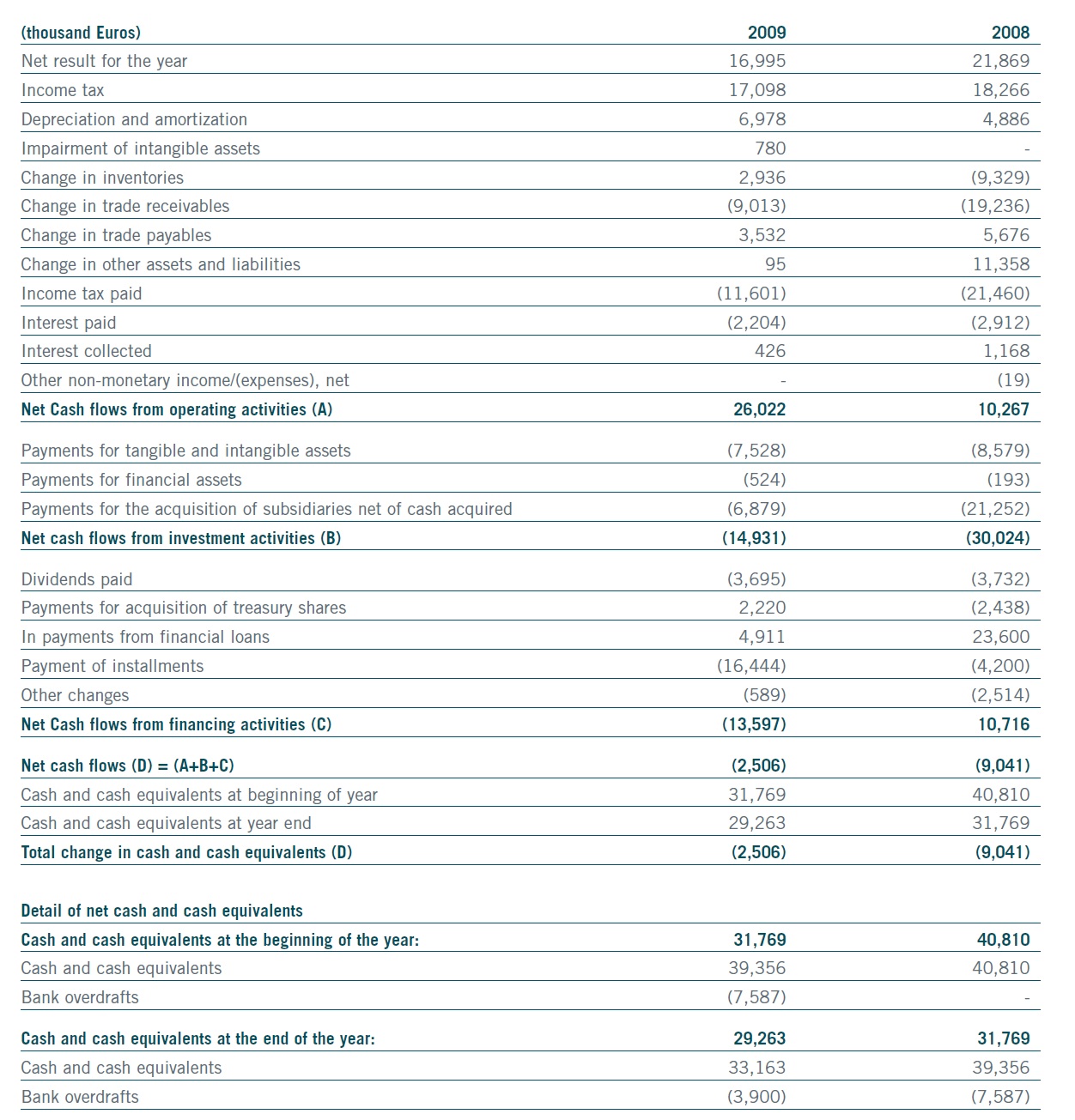
So they “bought” a company for 1 EUR which had 20.6 mn in cash. In theory, we should see this as a positive investing cashflow in the CF statement. Lets look at the 2009 statement:

Strangely, the stated “payments for the acquisition of subsidiaries net of cash received” is negative !! We know that they only paid 1 EUR, received 20 mn and didn’t do other big acquisitions in 2009.

I do not know where they actually booked the acquired 20 mn EUR liquidity, but this is very very strange.

The second part of the puzzle are the Government grants out of this deal.

In their notes, they state the following:

Government grants
Government grants are recognized in the financial statements when there is reasonable assurance that the company concerned will comply with the conditions for receiving such grants and that the grants themselves will be received. Government grants are recognized as income over the periods necessary to match them with the related costs which they are intended to compensate.

So what in theory should happen is the following:

-when they receive the money, the book a liability against the money (P&L neutral)
– then over time they reduce the liability by booking this release as profit

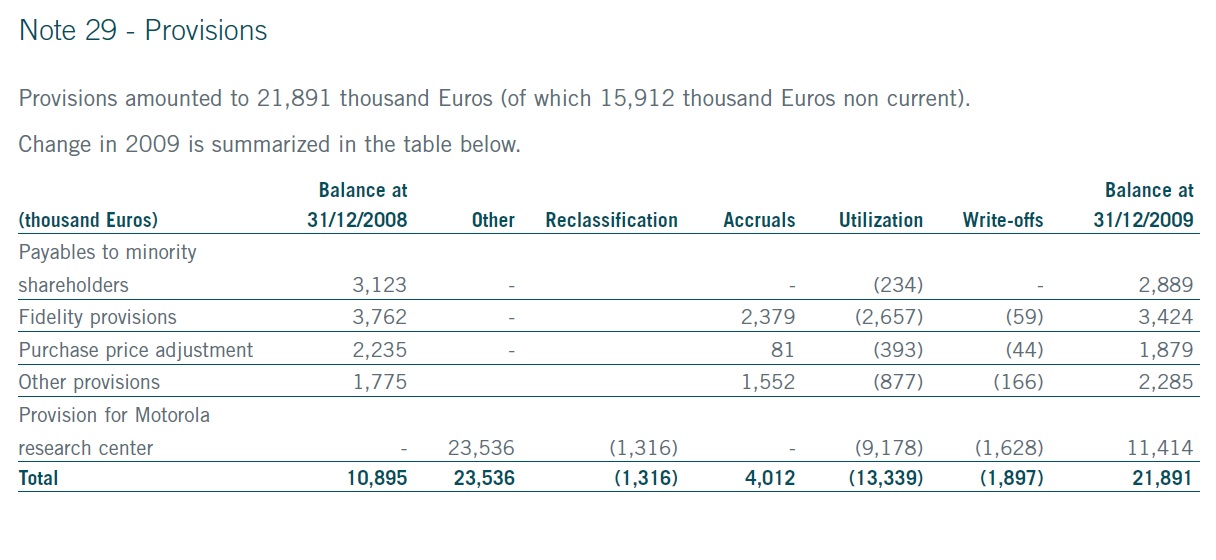
Based on Note 29, Reply booked already such a provision of ~23 mn EUR at the end of 2009, from where they used half of it again. I am not sure why,but again, where is the corresponding asset ? I would assume somewhere in other receivables (as they may not have received the Government money in 2009).

If one of the readers really understands what is going on here, then please help me.

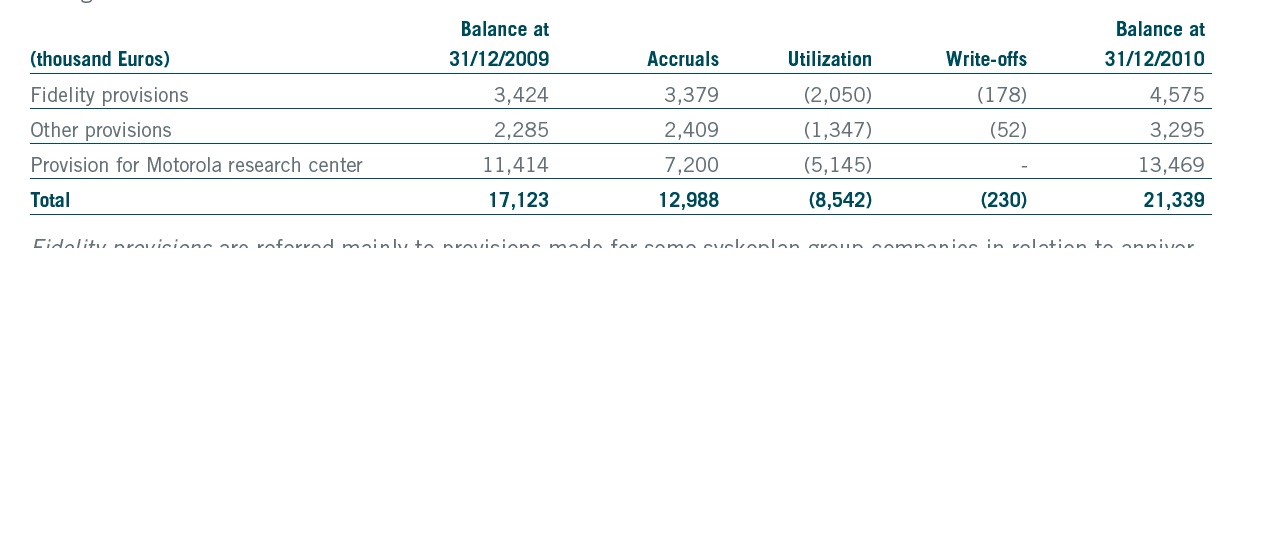
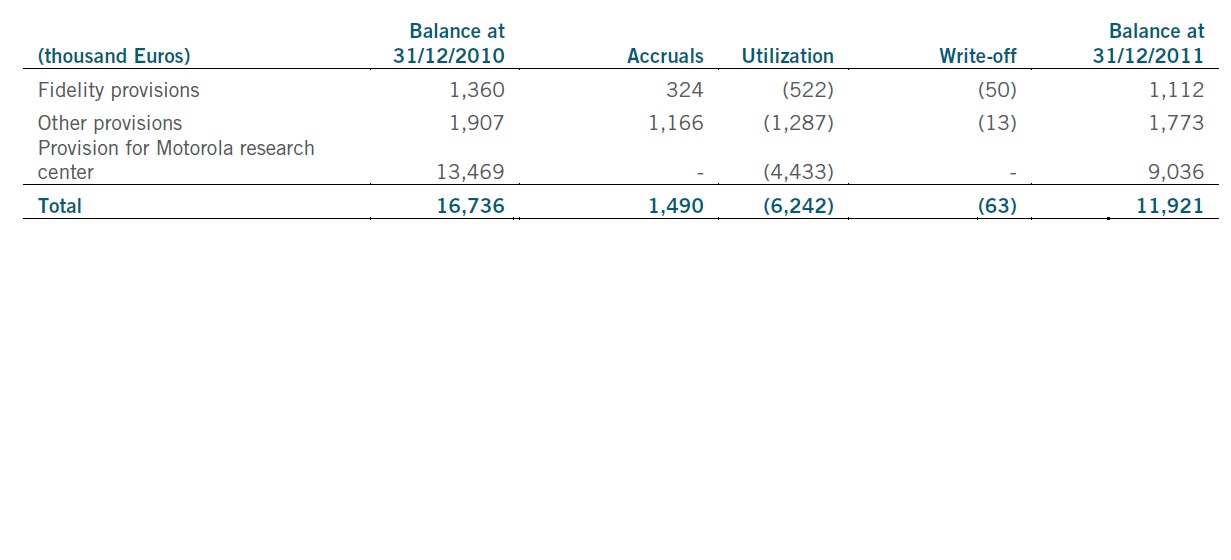
In 2010, the provisioning continues, it looks like the increase and use those provisions as they like to:

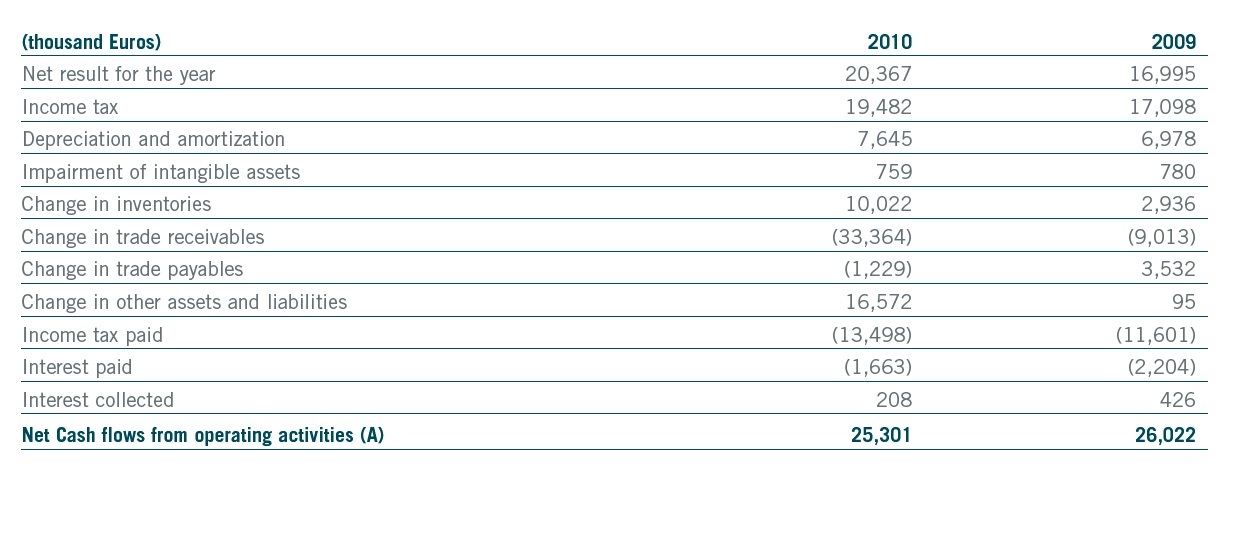
This might explain why the very unusual and unexplained line item “changes in other assets and liabilities” makes up 2/3 of Reply’s 2010 operating cashflow.

in 2011, the provision is still significant:

So what does that mean ?

In my opinion, there is poor visibility in the accounts and especially in the cash flow statements. We know now, that the Motorola transaction netted them around 40 mn EUR net cash, but didn’t show up in the investment cashflow. As it didn’t show up in financing cashflow neither, it has to be moved into operating cash.

As operating cash in total from 2009-2011 was only 55 mn EUR, basically a large amount of the operating cashflow in this period seems to be non-operating and coming from the acquired Motorola Research center.

At this point it is time to stop and summarize:

– at least to me, the accounting and cashflow treatment of the Motorola acquisition is not transparent
– together with the weak cash flow generation, large goodwill position and a large number of acquisitions this is A BIG RED FLAG

Maybe I am just not clever enough, but my philosophy to avoid companies with large intangibles and non-transparent accounting makes me stop here and not further investigate the company.

Reply SpA (ISIN IT0001499679) part 2: – Peer Group, Free Cash flow & receivables

First of all thank you for the many helpful comments in part 1 of the Reply post.

I think as a next step, a standard Peer Group comparison might be interesting. I selected a couple of midsize European IT system providers. Lets look how they compare based on some standard ratios:

Name Mkt Cap (EUR) P/E EV/EBITDA (FY1) Return on Equity 3 Yr Average
REPLY SPA 159.56M 5.76 3.48 15.39%
BECHTLE AG 638.40M 11.02 6.21 13.20%
TIETO OYJ 984.66M 15.91 5.42 10.28%
PRODWARE 51.15M 3.51 3.06 18.47%
CANCOM AG 127.49M 9.37 4.6 16.46%
SOPRA GROUP 465.04M 10.05 4.43 17.58%
ATOS 3.90B 20.87 4.29 5.59%
GROUPE STERIA SCA 335.76M 5.96 3.91 7.31%
COMPUTACENTER PLC 750.09M 9.42 4.45 13.81%
INDRA SISTEMAS SA 1.30B 9.34 6.77 20.07%
         
Avg   10.12 4.66 13.82%

One could say despite good profitability, all of those companies are relatively cheap. Apart from tiny Prodware, Reply is the second cheapest despite above average ROEs.

Interesting are of course also the operating statistics:

Name Days Sales Outstanding (A/R Days) Revenue per Employee Operating Profit per Employee Operating Margin
REPLY SPA 169.5 128.67k 14.22k 11.05%
BECHTLE AG 49.0 364.10k 14.96k 4.11%
TIETO OYJ 72.1 100.87k 5.64k 5.60%
PRODWARE 152.8 93.23k 14.82k 15.90%
CANCOM AG 47.0 259.60k 8.80k 3.39%
SOPRA GROUP 124.0 83.29k 7.30k 8.76%
ATOS 84.7 92.98k 5.77k 6.20%
GROUPE STERIA SCA 59.6 87.44k 6.26k 7.16%
COMPUTACENTER PLC 64.8 298.50k 7.65k 2.56%
INDRA SISTEMAS SA 226.5 86.47k 8.67k 10.03%
         
Avg 105.0     7.48%

It is obvious, that Reply and Indra (from Spain) do have issues with receivables. Reply Germany only has ~64 days of receivables outstanding. Based on profit per employee Reply looks good as well on par with German Bechtle and French prodware. Operating margins are far above average.

So what not to like ?

The answer is relatively clear if we look at this tabel: Free Cashflow

Name FCF Yld Dvd Yld
REPLY SPA -11.99% 2.92%
PRODWARE 5.87% 1.08%
ATOS 9.94% 2.44%
CANCOM AG 10.23% 2.79%
BECHTLE AG 3.91% 3.24%
GROUPE STERIA SCA 13.52% 4.27%
COMPUTACENTER PLC 13.07% 4.43%
SOPRA GROUP 3.63% 4.75%
TIETO OYJ 5.17% 5.45%
INDRA SISTEMAS SA 6.95% 8.66%

As we can see, the business is usually quite cash generative, only Reply has negative free cashflow. How comes ?

As some of you might know, I like to structure the cash flow statement a little bit differently to see where the cash goes to:

2011 2010 2009 2008 2007 Total
Op CF 4.7 25.3 26.0 10.3 19.6 85.9
Delta WC -21.8 -24.6 -2.5 -22.9 -9.9 -81.7
Free CF adj. 26.5 49.9 28.6 33.2 29.5 167.6
             
             
Capex -7.8 -5.8 -7.5 -8.6 -4.7 -34.3
acqu -8.0 -4.1 -6.9 -21.3 -7.1 -47.3
             
Div. -4.5 -3.3 -3.7 -3.7 -3.0 -18.2
             
other fin cf -4.6 -13.9 -9.9 7.0 2.2 -19.2
             
             
Depr. -6.0 -7.6 -6.9 -4.9 -4.0 -29.4
Capex-Depr -1.8 1.9 -0.6 -3.7 -0.7 -4.9
 
Net income 24.2 20.4 16.6 18.9 15.7 95.8
FCF adj/NI 109.7% 244.9% 171.7% 175.2% 188.0%

So over the last 5 years, 50% of the free cashflow had to be invested back into working capital, 25% into acqisitions, the rest into Capex, dividends and financing.

If we look at 2010, we can see that this was a very strange year with a big jump in cashflow whereas 2011 looks rather bad, especially compared to net income.

One of the major factors in 2011 for the low cashflow seems to be an abnormally high tax payment (30 mn va. 13 mn the year before). I have to admit that taxes are my weakest point in my analytic skill set and I don’t really understand this. The 2010 payment seems to have been lower than the tax expense, the 2011 higher, on average they seem to be similar to expenses.

Receivables:

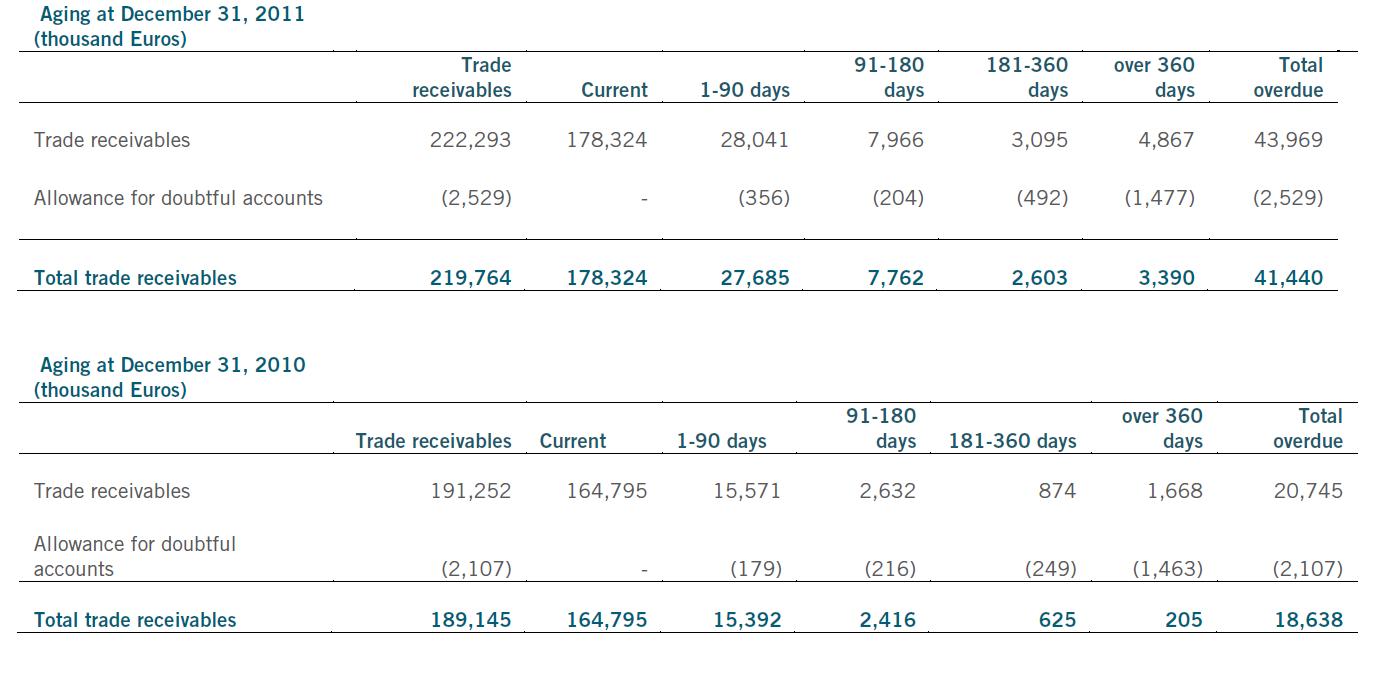
Now to the fun part. Let’s look at he 2011 report and we see something truly worrysome here:

“Overdue” receivables jumped up from ~10% of receivables to almost 20% of receivcables. We can also see that in 2010, almost 100% of the 360 day overdue receivables were written of, wheres only 25% were written of in 2011.

Let’s compare 2010 and 2011:

1-90 91-180 181-360 > 360
Overdue 2010 15.6 2.6 0.9 1.7
allowance 0.2 0.2 0.2 1.5
in % 1.15% 8.21% 28.49% 87.71%
 
  1-90 91-180 181-360 > 360
Overdue 2011 28.0 8.0 3.1 4.9
allowance 0.4 0.2 0.5 1.5
in % 1.27% 2.56% 15.90% 30.35%

This is a real issue from my point of view and could mean some “optimistic” accounting on the side of Reply SpA. If we would apply the same percentages as in 2010, we would get the following additional charges:

1-90 91-180 181-360 > 360
Overdue 2011 28.0 8.0 3.1 4.9
2010% 1.15% 8.21% 28.49% 87.71%
2011 allow (2010) 0.32 0.65 0.88 4.27
Delta -0.03 0.45 0.39 2.79

So this would mean 3.6 mn pre tax charges. One could even argue that based on the recent developements even higher charges would be necessary so for instance a full write off of 360+ receivabels. So we migth want to adjust Reply’s earnings maybe for ~5 mn EUR pre tax or 2.75 mn (~30 cents per share) after tax, which would still give us EPS of ~ 2.60 or a P/E of 6.6.

Summary:

Free cashflow generation at Reply is somehow limited as 50% of FCF go directly into an increase in working capital. Additionally, receivables accounting seems to be optimistic. So we have already 2 reasons why the stock is so cheap. However I will have to dig a little bit deeper to understand if there is still value there.

In general, I do have problems when I discover “optimistic” accounting as I loose confidence in their overall accounts. For a company like Reply with a lot of goodwill and intangibles, the accounting should be more on the conservative side.

« Older Entries Recent Entries »