Category Archives: Fundamentalanalyse

ITE PLC (ISIN GB0002520509) – Super profitable market leader in Russia at a bargain price ?

After a “Near death” experience with Sistema, I am nevertheless still interested in companies with significant Russian exposure as a “counter-cyclical” EM play, however preferably with less “Oligarch” risk. A very interesting company with a significant Russia exposure is ITE Plc, the UK-based company. According to Bloomberg

ITE Group Plc is an international organizer of exhibitions and conferences. The Company provides
its services to customers in a variety of commercial and industrial sectors, including travel and
tourism, construction, motor, oil and gas, food, security, transport, telecommunications, and
sports and leisure.

The good thing with UK companies is that usually some blogger has covered the stock already. WIth ITE, this is the case as well. Among others, there is a very good Seeking Alpha post, from the Portfolio 14 blog and als the Interactive Investor covers the stock.

I agree with all posts. Organizing exhibitions is good business:

+ you don’t need a lot of capital (negative working capital due to prepayments)
+ once an exhibition is established, it creates a network effect which is relatively difficult to duplicate
+ although the business fluctuates with the cycle, costs are to a certain extent variable
+ it’s a nice b2b business, connecting a large number of exhibitors of with a large number of interested visitors
+ despite or because of e-commerce, personal contact in the form of trade fairs etc. seems to become even more important
+ the company has no debt

The “catch” is of course that most of their exhibitions take place in Russia and the former GUS. Clearly, not the easiest part of the world to be at the moment.Looking at the past 16 years since their “reverse IPO” in 1999, we can see that the business has suffered in downturns such as the Russian default but always recovered. However, mostly due to the weak ruble, comprehensive income in the last few years was mostly lower than stated income:

Year EPS Compr. Income In% of EPS
29.12.2000 0,03    
31.12.2001 -0,13    
31.12.2002 -0,01    
31.12.2003 0,03    
31.12.2004 0,04    
30.12.2005 0,07    
29.12.2006 0,07 0,07 99%
31.12.2007 0,09 #N/A N/A #WERT!
31.12.2008 0,09 0,09 97%
31.12.2009 0,13 0,11 86%
31.12.2010 0,10 0,12 121%
30.12.2011 0,13 0,10 82%
31.12.2012 0,13 0,13 98%
31.12.2013 0,14 0,09 64%

The valuation looks quite cheap, especially the EV/EBIT and EV/EBITDA ratios for such a business with high (historical) growth rates:

P/E ~9
EV/EBITDA 5,9
EV/EBIT 7,0
P/B 4,4
Div. Yield 5,0%

After reading some of the reports, I found a couple of things I didn’t like:

– focus on “headline” profits, excluding amortizations and “restructuring charges”
– Management fully incentiviced on “Headline profits”, not ROIC or ROE etc..
– Falling knife Stock chart
– one of the biggest “rainmakers”, Edward Strachan retired a few months ago.
– trade fares and exhibitions often have a time lag of 6-12 months to the general economy. So the worst in Russia for ITE might come only in the next few quarters.

Peer Group

There aren’t that many “pure play” trade fare /exhibition companies listed but I tried to compile a list to the best of my knowledge. Two of the companies listed below (Kingsmen & Pico) are actually more supliers to exhibitions than promoters/organizers:

Name Mkt Cap (GBP) EV/EBITDA EV/EBIT P/E P/S
ITE GROUP PLC 434,5 5,3 7,0 9,9 2,2
TARSUS GROUP PLC 198,7 7,7 12,0 16,4 2,6
UBM PLC 1267,5 9,6 14,4 9,9 1,7
MCH GROUP AG 237,8 7,2 13,9 11,9 0,8
FIERA MILANO SPA 182,0 156,0 #N/A N/A #N/A N/A 0,9
KINGSMEN CREATIVE LTD 87,1 5,9 6,4 10,9 0,6
PICO FAR EAST HOLDINGS LTD. 182,6 6,7 9,6 11,2 0,7

If we look at P/Es, most of the companies trade relativelly cheap at around 9-11 times earnings, but long term ROE and margins at ITE are clearly a class of its own. The big question is: Can they sustain those margins in the long run ? Many of the listed peers as well as the unlisted ones like Deutsche Messe tried (at least before the crisis) to get into the Russian market.

The problem could easily be that ITE is too profitable. Past average net margins of 20%-25% are far higher than any of the competitors. Deutsche Messe for instance, which aggressively expands into EM earned a net margin of 3% in 2013. Clearly, It is not so easy to kick out ITE, but if the difference in margins is so big, at some point in time competition will begin to bite. although it’s not easy to establish a succesful trade fair or exhibition, it is relatively easy to start one. So yes, there is a network effect but the barriers to entry are still relatively low. A good example for this can be seen currently at TESCO in the UK. For quite some time it looked that they are protected by their dominant position and had margins 2 or 3 times higher than their continental peers. But once the competitors like Aldi and Lidl, who could only dream of such margins in other markets, were big enough, margins for the leader deteriorated pretty quickly.

Valuation

Based on what I described above, I would make the following assumptions:

– going forward, net margins will be lower than in the past. In the past they achieved margins of 20-25%, I will calculate with 18% (thats what they made in 2012 and 2013)
– in order to reflect the additional risk in Russia, I will require more return. My normal requirement would be 15%, here i need 5% more or 20% p.a.

So if I assume that in 3 years time, ITE will again do the same amount of sales as in the FY 2013, this would be 0,80 GBP per share. At 18% Net margin, they would then earn around 14,4 pence per share. A “fair” P/E for such a company could be around 15. So the 3 year target price would be 14,4*15= 2,16 GBP.

However, in order to earn my 20% p.a. , I need to discount my target: 2,16/ (1,2)^3 = 1,25 GBP. This is however a lot lower than the current price of 1,70 GBP

So for me, under those assumptions, LTE is not a buy, I would buy once the price is at or below 1,25 GBP per share.

Summary:

It really took me some time with ITE Plc. I really like the business model of trade fair /exhibitions. Although cyclical, it seems to be good business with a certain protection. For ITE however, I fear the worst is yet to come. With the oil price plunging and the “Russian situation” unchanged, including more potential trade sanctions etc., the next year will be even harder than the last for ITE.

I would stil buy them if they are cheap enough, which, at the moment they are not. They would need to drop a further 30% in my opinion to make them really intersting and compensate me for the additional risk. I will however try to look at some other similar companies going forward. Especially Pico Far East and Kingsmen looked interesting at first sight.

It could easily be that I am too cautious due to my losses with Sistema (“Recency bias” ?), but at the moment I rather make the mistake of being too conservative.

EVS Broadcast Equipment (BE0003820371) – A super profitable market leader at a bargain price ?

The company:

EVS Broadcast Equipment SA is a Belgian company developing and selling state-o-the art equipment mostly to broadcasters and TV production companies, enabling them to store, edit and broadcast live camera images on a fully digitalised basis. They are especially strong in the area of live sporting events.

Growth and profitability

Looking at the current valuation multiples:

P/E (2013) 13,0
EV/EBIT 14,0
P/B 5,2
Dividend yield 7,0%

we can see that EVS is not super cheap. However if we look at past profitability and growth numbers numbers, we can see that EVS is still “super profitable” at levels which only can be explained by significant competitive advantages:

5 y avg 10 y avg
Profit Margin 30,8% 36,5%
ROE 55,2% 63,5%
Sales growth 3,30% 12,70%
EPS growth -5,40% 22,30%

However, if one looks at the growth figures we can clearly see that the “High growth” phase seems to be clearly over, but they are still incredibly profitable.

Why are they so profitable?

This is a quote from the 1999 annual report (which is by the way a very good report):

The EVS Group sells its equipment to radio and television channels as well as to people providing services to these channels. This is a professional market where quality and technical performance of the equipment is often more important than its price.

Plus another quote from the 2002 annual report:

Investments

Production of the equipment manufatured and marketed by ECS and NETIA does not require important tangible investment. Nor does R&D require any considerable investments, since engineers and programmers work directly on the machines to be sold or on PC type equipment for the sftware developement.”

So building “mission critical” equiment with low price sensitivity combined with low to no physical capital needs sounds like a pretty good business case. But how do you get into such a desirable position ?

Again, the best explanation is given in the 1999 annual report:

In 1994, most recorders used by television channels were tape recorders, although hard disks already had replaced tapes for recording purposes in the
computer area. Three factors have since then influenced the use of hard disks rather than tapes for professional video recording :
• the increased capacity and higher performance of hard disks,
• their lower cost,
• considerable progress has also been made in compression : for example, the JPEG system allows an average compression ratio as low as 5:1 in the memory space required to record a picture.

EVS strategy on the huge professional recorder market has been to pinpoint those applications for which hard disks would offer the user a substantial competitive advantage over tapes. By the end of 1996, the number of professional recorders installed throughout the world was estimated at about 352 000 units, for 60 000 users.
Among these, tape recorders accounted for about 340 000 units, compared to 12 000 disk recorders.

So what EVS did in the mid/late 90ties was a classical “disruption”: At that time, most broadcasts were recorded on physical tapes which had a lot of disadvantages. In sports for instance if you wanted to show a replay, the recording had to be stopped, rewinded and replayed. In between, no recording could be done,so often the consequent action on the field was unrecorded. EVS as one of the first companies offered a digital solution, which allowed continuous recording and easy access to slow motion etc.

The second boost came in the mid 2000s with the introduction of full HD and HDTV which sped up the change from tape to digital and required new generation of servers.

EVS became the defacto industry standard for most of the digitalised live TV production around the world, especially for sports. Somewhere I read that they claim a 95% market share in certain areas. With all the money pouring into professional sports these days, it still looks like a pretty good place to be a “niche market leader”.

Will EVS stay so profitable ?

This is a much harder question to answer compared to “why are they so profitable”. The question boils down to: Are the obvious competitive advantages sustainable ?

According to theory, two potential competitive advantages could e relevant for EVS: Size advantages and the network effect.

Network effect:

As far as I know, EVS did use mostly open source and industry standards, so in theory it should be relatively easy to replace EVS’s equipment. It seems however that the software implies a certain way to do things that doesn’t make it that easy to simply copy the stuff. EVS equipment seems to define work processes and many people in the field might prefer a known, working process to a new one even if its cheaper. The technicians are trained on the gear and might prefer this to any other gear. Nevertheless I would argue that there is no strong network effect at work here but maybe a “soft” one.

Size advantage

Although EVS is still a relatively small company, within its niche, it is huge. They had a big headstart into the current technology and have built up significant technical knowledge which is not easy to copy. Any small competitor who wants to compete with based on the same technology will have a big issue. Even if they would be able produce slightly better gear, they would still need to build up a sales and service organizition and spend a lot of money on getting access to all those potential clients. This would be different if a competitor would be coming into the market “vertically”, for instance guys like Sony who produce the cameras etc. but for some reason that didn’t happened. Maybe the niche overall is too small to justify a big investment by a “vertical” competitor.

For me, the biggest issue might be that once again the technology will change and allow another disruptor into the business. A small hint could be seen in a interesting research report from media technolgy research company Devoncroft (report is free but registration required).

For EVS, one of the most “dangerous” developments could be what is described on page 36: The move from specialised IT gear for real time processing to “generic” gear. EVS delivers “spezialised” gear and software. This is how a typical EVS “box” looks like:

I am not sure how solid their business would be if the “Boxes” were seperated from the software and this would clearly open the door for disruptors.

Limits to Armchair Investing

At this stage, there are clearly limits to Armchair Investing. With the time available for me, it is impossible to judge for me if EVS will be able to keep its high margins or not. If margins “normalize”, then the current price for the stock might be still high. If margins remain high and the market still grows then the stock would be a “high quality” bargain. However I do not feel comofrtable to make any judgement here.

Some other observations

– Founders sold down early, only one remaining (CTO)
In 1999, the three founders and their families owned around 57% of the company. Since then, 2 of the three left and the remaining one has reduced his ownership to ~6%. It seems that they were not fully convinced about the long term prospects of EVS.

– they are currently building crazy expensive heaquarters in Belgium.

Overall cost is expected to be around 60 mn EUR. This is from the 6 month report:

At the end of 2011, EVS started the construction of a new integrated building in the proximity of its current location in Liège, in order to gather all employees of EVS headquarters, split today in 6 different buildings. EUR 39.4 million have been invested by the end of June 2014 (less EUR 5.2 million of subsidies booked at the same date). The total budget for the project (including some higher investments in future-proof equipment) is estimated between EUR 55 and EUR 60 million.

EVS has in total 500 employees, with at least 1/3 outside Belgium. So spending ~200k EUR per employee for a new headquarter is absolutely insane in my opinion.

– current CEO is a “manager”, no ownership

The current CEO came from outside and has no stock ownership. He does have stock options and I have not seen a single share purchase of management ever.

– potential “diworsification”

The new strategy is to diversify “verticaly” into post production technology as the core sports area seems to be somehow saturated. EVS tried to diversify early on, but both attempts failed (digital radio, digital cinema). Maybe vertical diversification works better but if the high margins can be retained ?

– weak first half of 2014 indicates increasing pressure on margins

Normally, EVS always performs strongest in years with large sports events. 2014 with the Winter olympics in Sochi and the Football Worldcup in Brazil should have beenn a great year for them. However, despite rising sales, profit went actually down compared to the “non event year” 2013. 2015 with no events willbe even harder for them. So the trend clearly is negative at the

The stock price also shows that the market does not look that favourable at EVS’s prospects following the 6 month numbers:

Summary:

EVS is an interesting company. As a clear niche market leader with fantastic historic profitability , it could be a great investment especially if the diversification strategy would work. On the other hand, there are several qualitative factors which i found distrubing, especially with rgeard to the new HQ and the lack of “ownership” within management and employees. On top of this, 2015 will be a tough year for them anyway so it might be the wrong time to invest in any case. So for me it is just a stock for the watch list with the next review in Q3 2015.

Vossloh (DE0007667107) – another potentially interesting “Fallen Angel” with an activist angle ?

Vossloh AG is a mid-sized German company and calls itself “a leader in the rail infrastructure and rail technology”.

Looking at the stock chart we can clearly see that not everything is going well there:

Vossloh lost almost 50% from their peak 3 years ago. If we look at some profitability measures of the past 10 years we see an interesting pattern:

EPS Profit Margin ROE
30.12.2004 3,91 6,2% 18,5%
30.12.2005 3,08 4,8% 13,3%
29.12.2006 2,98 2,0% 5,7%
28.12.2007 4,26 7,0% 18,2%
30.12.2008 6,30 11,5% 31,1%
30.12.2009 6,57 7,5% 18,5%
30.12.2010 7,32 7,2% 19,0%
30.12.2011 4,32 4,7% 11,0%
28.12.2012 4,15 4,8% 12,4%
30.12.2013 1,00 1,1% 3,1%

Vossloh showed only little impact during the financial crisis but then results deteriorated. They showed a small profit for 2013, but for the first half-year 2014, they shocked everyone with an “Accounting Bloodbath”, showing a loss of ~12,20 EUR per share, wiping out all profits for the last 3 years and some more.

So what happened ?

This is a quote from the CEO letter of the 2010 annual report:

For the years ahead, we intend to accelerate our growth while sustaining the rate of profitability. It is especially in the international markets that we will be amplifying our presence and we will be scoring in particular with the new products. For 2011, we are targeting group sales of €1.4 billion and an EBIT above €160 million.

This is from the 2011 CEO letter, where profits already declined:

Dear Stockholders:
Following a series of very successful fiscal years marked by above-average growth rates Vossloh suffered setbacks in 2011. Contrary to our expectations, Group sales and earnings declined. The chief influencing factors were the slowdown in the progress of Chinese rail projects, which only became evident as the year proceeded, the suspension of shipments for a major project in Libya and, from the summer onward, weak demand in key European rail markets. Under these circumstances, the Rail Infrastructure division’s sales, which at around 65 percent of the Group’s continued to contribute the lion’s share of revenue, dropped for the first time in years, by some 13 percent. The sales shortfall at Vossloh Fastening Systems was especially severe at the Chinese location and could not be offset by business elsewhere. The Switch Systems unit also performed below expectations due to the military conflict in Libya, which prevented the planned extensive shipments to that country in 2011. In addition, in several European countries demand slackened and price pressure stepped up.

In 2012, the outlook for 2013 was not that good but still “solid”:

However again, they disappointed, as stated in the 2013 annual report:

There were two significant reasons for the downward development in 2013: For one, we were confronted with extensive non-recurring charges that were due to expenses for the final out-of-court settlement of a dispute in the Transportation division in an amount and extent that was not to be expected. For another, there were additional expenses in this division in connection with the processing of several projects, which entailed additional and unexpected losses of earnings. In contrast, the Rail Infrastructure division performed significantly better than expected, and revenues as well as the result increased significantly. The Fastening Systems business unit primarily contributed to this positive development.

Not too surprisingly, both, the CEO and COO stepped down in February making way for a new management. Normally, CEO hate to step down even after management disasters so what happened ?

The activist angle:

Vossloh had been more or less controlled by the founding Vossloh family for more than 100 years although they only owned around 34%. Since 2011 though, another strong shareholder emerged: Hermann Thiele, the owner of German unlisted company Knorr Bremse who had built up a stake of close to 30 % from 2011 to 2013.

Although Thiele is not widely known and keeps a low profile, he is one of the most succesful German entrepreneurs of the last 30 years. He bought Knorr Bremse in 1985 as one would call it a “leveraged management buyout” and then grew the company by a factor of 15-20 times over the last 30 years. Despite being a non-listed company, Knorr Bremse issues a relatively good annual report where onr can see that the company is spectacularly profitable. Net margins of 8-9% and cash adjusted ROICs of more than 30% are clearly an indicator that this guy seems to know what he is doing. Besides that, depending on how you value Knorr Bremse, he is also one of the richest persons in Germany.

A little side story: World famous BMW AG once was the engine subdivision of Knorr Bremse until 1922 when it was sold to an investor as they didn’t find the engine business interesting enough……

In 2013, he finally succeeded in being elected as boss of the supervisory board against the explicit wish of the founding family. The founding family finally sold most of their shares in late 2013. It was him who kicked out the old management and brought in 2 new guys, among them the new CEO Hans Schabert who used to run the rail operations of Siemens.

In one of Thiele’s rare interviews in 2013 he stated that Vossloh is his private investment. Although he likes the business, he doesn’t want to take full control and leave Vossloh listed.

As a supplier to the rail industry, he knows the sector pretty well. I could imagine that long-term this might help Vossloh to get back on track. However I do not believe that he will remain a minority shareholder for ever. I do think that sooner or later he will try to take control. There would be clearly synergies between Knorr Bremse and Vossloh as both have the same clients and Knorr is even a supplier to Vossloh’s locomotive unit.

The 6 months 2014 “accounting massacre”

If you ever want to see a “how book as many losses as possible” financial report then look at the recent 6 month report from Vossloh. The new management wasted no time and did not even wait until year-end in order to write down everything they could.

Even in the investor presentation, they don’t make the slightest attempt to normalize the result.

Digging deeper into the report, you will find among others:

– goodwill write offs
– inventory write downs
– extra provisions against “risks”
– and even a charge because they did an early retirement of a higher coupon debt facility, which is clearly earnings accretive in the future.

In their outlook the state that one can expect some more losses in 2014 but from 2015 on Vossloh will be profitable again. But they did not specifc how profitable. Operationally they made already some significant changes. So overall this looks a little bit similar to the Van Lanschot story. The new CEO (with the support of the Supervisory Board) has written off whatever he could in order to show increasing profits going forward.

However there could also be a problem here. At some point in time, Thiele could decide that he doesn’t want to share the upside of a turn-around with the other shareholders and try to take Vossloh private as cheaply as possible. Other than Cevian at Bilfinger, Thiel has no track record with capital markets and many “old school” German business tycoons do not care very much about minority shareholders. This is clearly a risk to be considered

What could be a “turned around” Vossloh be worth ?

This is an overview of average margins (10/15 Years) of Vossloh and its 3 listed European “pure play” competitors:

Avg NI Margin  
  10 Y 15 Y
Vossloh 5,67% 5,19%
CAF 5,40% 6,46%
Faiveley 6,50% 5,00%
Ansaldo 5,98% n.a.

Overall, I would say a 5,5% net profit margin on average is not unrealistic. Based on 2013 1.325 mn sales and assuming no growth, this could mean that Vossloh at some point in the future makes ~ 73 mn EUR profit or ~5,5 EUR per share If we assume a 12-15 P/E range, this would mean that a target share price of 66-82 EUR would be realistic.

Based on today’s price of ~49 EUR this would mean a potential upside of 35-68%. However one should assume that this turn-around needs at least 3 years. For a turn around, I personally would require a higher return than for a normal “boring” value stock as there is clearly a risk that the turnaround does not work out as planned.

If I assume a target return of 20% p.a., i would need to be sure that the price of Vossloh is in 3 years at around 85 EUR. This is clearly at the very upper end of my target range. So I would either need to have more aggressive assumptions or I would need a lower entry price. As a value investor, I would not want to bet on growth or on a shorter time frame for the turn around, so the only alternative is to wait for a lower entry price.

Taking the midpoint of my range from above at 74, I would be a buyer at ~42 EUR per share but not before.

How does this compare to the Bilfinger case ?

A few weeks ago, I was looking at a similar case, Bilfinger. Similar to Vossloh, an activist investor (Cevian) managed to get rid of the CEO and tries to turn around the company after mutliple earnings disappointments.

At a high level comparison I like Vossloh’s underlying business better. Bilfinger clearly has some structural issues especially with its power business where the underlying market (electrictiy) is undergoing a big fundamental change whereas the railway business to me seems fundamentally intact. On the other hand, Cevian as “activist” has a very good reputation and is easier to “handicap”. They will most likely treat minority shareholders fairly and do some kind of spin off etc. So the risk of getting screwed by the activist is lower.

In a dirct comparison however I would prefer the “activist risk” at Vossloh against the fundamental issues at Bilfinger. Additionally, the real “accounting bloodbath” at Bilfinger hasn’t happened yet.

Summary:

In general I think Vossloh could be an interesting turn around story, especially considering the involvement of German self-made billionaire Hermann Thiele. I do like the industry better than for instance Bilfinger. It is clearly cyclical but I don’t see any structural issues. On the other hand, the current price is too high with regard what I would expect for such a relatively high risk “turn around” investment. The “Mean reversion potential” at the current price is not high enough, I would need a ~20% lower share price to justify an investment.

Looking at the chart, this might not be unrealistic as the stock price is still in free fall and any “technical” support levels would be somewhere around 39 EUR per share if one would be into chart analysis. In any of those “falling knife” cases, patience is essential anyway.

Vossloh will therefore be “only” on my watch list with a limit of 42 EUR where I would start to buy if no adverse developments arise. Additionally I will need to check Vossloh against Alstom once

Quick check: Grindeks AS (ISIN LV0000100659) – P/E 4.9, P/B 0.6 Baltic value or “red flag” alert ?

Introduction:

Via my “home forum”, someone brought up the Latvian Pharma company Grindeks AS. The company looks similar form the business model to Hungarian company EGIS and Croatian Krka which I covered some months ago

Valuation wise, the stock looks like a clear “no brainer”:

Market cap: 62 mn EUR (at ~7 EUR per share)
P/E trailing 4.9
P/B 0,59
P/S 0,6

ROIC, ROE, net margins all solid “double digit” numbers. My own, mechanical “Boss Score” would indictae a fair value of at least 3 times the current market cap.
The only issue coming up is the fact that the company never paid a dividend.

There is also a quite obvious reason why the stock is cheap: The majority of sales goes to neighbouring Russia, which clearly is not very popular with investors these days. As I do not have an issue with this “Headline risk” as long as I get compensated accordingly, I looked into the annual report 2013 in order to find out more.

As with Australian Vintage, I scan the report for unusual or problematic things first.

In Grindeks case, I was puzzled by a quite unusual balance sheet position called “Advance payments for financial investments “ something which I haven’t seen before. The explanation in the notes says the following:

In 2012 the Company has signed purchase agreement with Dashdirect Limited regarding purchase of the controlling interest in the equity of HBM Pharma (Slovakia). As of the date of signing these financial statements the agreement is partly completed. The main activity of the HBM Pharma is production of the medical substances. As of December 31, 2013 the Company’s and Group statement of financial position contains advance payments related to the before mentioned purchase agreement in the amount of EUR 11,670,000. The Group management is certain that this deal is going to be finalized during 2014.

In my experience, it is not uncommon to take over M&A targets in several steps, but it is quite uncommon to pay money first and get nothing in return. A few days ago, Grindeks issued another news item which covered this strange transaction.

The numbers look OK, Grineks seem to pay only 6 times P/E of the target company. However another sentence looked strange:

Orders of JSC «Grindeks» make up about 30% of the total “HBM Pharma” s.r.o. turnover

So they are buying a company where they are the biggest customer anyway, also strange. So I decided to google a little bit and found this:

On July 8, 2010 Lithuanian-domiciled Central and Eastern European (CEE) specialty pharmaceutical company Sanitas, AB sold its 100% shareholding in subsidiary HBM Pharma s.r.o in Slovakia to Latvian company Liplats 2000, SIA. HBM Pharma was primarily engaged in toll manufacturing activities and the entity has been sold with all of its existing toll manufacturing contracts. As previously announced, sales, marketing and regulatory divisions in Slovakia and the Czech Republic were separated from HBM Pharma and retained in Sanitas Group prior to the divestment.
Sanitas acquired HBM Pharma (previously named Hoechst Biotika) from Sanofi Aventis in July 2005.

So a Latvian company called Liplats 2000 bought HBM in 2010. Googling further, I found this document on HBM’s website, describing a cross border merger between Liplats 2000 and HBM. The most interesting part of this document ist the last line in the final page: From Liplats side, a guy called Kirovs Lipman signed.

Now Kirovs Lipmans happens to be the majority shareholder of Grindeks. So effectively, Grindeks is buying this M&A target from theit majority shareholder (and former CEO). This is from Grindeks annual report:

Kirovs Lipmans – Chairman of the Council Born in 1940. Kirovs Lipmans has been the Chairman of the Council of “Grindeks” since 2003. Simultaneously K.Lipmans is also the President of the Latvian Hockey Fede
ration, the Member of the Executive Committee of the Latvian Olympic Committee, the Chairman of the Board of “Liplats 2000” Ltd. and JSC “Grindeks” Foundation „For the Support of Science and Education”, the Chairman of the Council of JSC “Kalceks” and JSC “Tallinn pharmaceutical plant”, also the Member of the Council of JSC “Liepajas Metalurgs”. Graduated from the Leningrad Institute of Railway and Transport

So to summarize it at this point: Grindeks never paid any dividends but makes a major acquisition and pays money upfront to a company controlled by the majority shareholder, without any disclosure of this potential conflict of interest.

Of course, theoretically, this could have been an “arm’s length” deal with no disadvantages for Grindeks, but the probability that something is “fishy” is quite high, combined with the fact that they never paid dividends.

Maybe I am too cautious here, but an undisclosed significant “related party” transaction is a big red flag for me.

Coincidentally, Grindeks also issued Q1 numbers a few days ago which didn’t look good. Sales in Russia tumbled. This seems to be a very Grindeks specific problem, as for instance Krka showed strong Russian sales in Q1 despite the “Russian crisis”.

Just to be clear: A “red flag” doesn’t need to be the ultimate “value driver”. Reply SpA is a good example. Since my “red flag” alert, the stock made a whopping 276% return.

Summary:
For me, Grindeks is, depsite the attractive valuation, an absolute no -go. Undisclosed related party transactions combined with a lack of dividend makes this a speculation rather than a value investment. I don’t know if there are Corporate activists in the baltics, but this would be a good target. Additionally, they seem to have some specific operating issues as well, so no buy, watch only.

Exotic Securities: Piraeus Bank Warrants (ISIN GRR000000044)

Background:

First of all a hat tip to Profitlich & Schmidtlin which had mentioned this idea in their first quarterly letter.

Piraeus Bank is one of the “survivors” of the Greek Banking sector. As with other Greek banks, the bank was “rescued” by the Government via a dilutive capital increase, with the Greek Government as a majority shareholder. Those private investor who participated in the capital increase got as a kind of “compensation” (and exit vehicle) some Warrants “for free” which allows them to buy back the shares until 2018 from the Greek Government. Those Warrant are traded quite actively on the Athens Stock Exchange.

Maybe in order to make it more fun, the Greek Government spiced up the Warrants with some extra features which are ( a kind of term sheet can be found here)

one Warrant gives the right to purchase 4,476 shares from the Hellenic Stability Fund (so its non dilutive”)
– the final maturity is 02.01.2018, however there seems to be a kind of “forced” exchange possibility on 02.07.2016
– the Warrants can be exercised every 6 months, so its technically a “Bermudan option”
– the strike price increases every 6 months after a predetermined formula

At a first glance, this “thing” seems to be really hard to value. Bloomberg for instance does not offer to value “Bermudan Equity options” in its standard option valuation tool (OVME).

Bermudan Option

Let’s take a step back and look at principal option types. The two classical types are:

European Option: This option can only be exercised at the final maturity date
American Option: This option can be exercised on every day during the term of the option

Nevertheless, there is normally very little difference in the value of an European option and American one if all other things are equal. The main reason for this is that in normal cases, the “time value” of an option is usually positive until the very last day. Exercising an American option early and “throwing away” the time value normally doesn’t make sense. For “normal” stock options, the only reason to exercise early would be a large dividend payment before maturity which will reduce the value of a (long Call) option, but in most cases one can ignore the valuation difference between an European and American option.

On the other hand, the increasing strike price of the Piraeus Warrant is economically equal to a dividend, so we cannot just ignore this feature and value it as a European Option.

This is the call schedule and the corresponding strike prices for the Warrant:

Call Date Strike Delta
02.01.2014 1,734  
02.07.2014 1,768 0,034
02.01.2015 1,811 0,043
02.07.2015 1,853 0,043
02.01.2016 1,904 0,051
02.07.2016 1,955 0,051
02.01.2017 2,015 0,059
02.07.2017 2,074 0,059
02.01.2018 2,142 0,068

From what I know, Piraeus Bank is not supposed to pay out any dividends in the foreseeable future. So in order to replicate the increasing strike, we could assume that the increasing strike is similar to a dividend assumption and we model this as an option with a strike of 1,734 EUR and dividends as shown in the column “Delta”.

Using the Bloomberg Option Valuation tool “OVME”, the same volatility and the assumption of a July 2016 maturity, the value difference between an European and American Option would be almost 20%, i.e. the American Option with the possibility to exercise at any day is 20% more valuable than the European one. This is due to the fact that I can basically wait until the last day before the synthetical dividend is paid an exercise then. So I don’t lose any time value and save myself the full dividend compared to an European exercise.

In our case however, I have to exercise 6 months earlier. With the OVME tool, I can for instance also calculate the value of an American vs. European Option for 6 months, “simulating” the time between for instance 03.07.2014 and 02.01.2015. For those 6 months, the valuation difference between an American and an European Option is only ~ 10%. Again, the “Bermudan” option is worth less than an American.

If I am actually in the last 6 months of the warrant maturity, the day after the last exercise possibility, the option will be exactly worth the value of a European Option. The day before it will be worth slightly less.

Anyway, as a very simple working assumption, I will assume that the “Bermudan” feature overall is worth 5% more than a European option.

Valuation of Piraeus Warrant

In order to value the Pireaus Warrant, we will have to make one further assumption: What is the final maturity ? If I understand correctly, the Greek Government has the possibility, to sell the shares after July 2016 without compensation to the Warrant holders if the Warrant holders do not convert. So as a realistic assumption one should use July 2016 as final maturity and not January 2018.

By the way, this “mechanic” of selling the shares without compnesation is a very strange featre for a Warrant.

In the following exercise I will use as the share price for Pireaus the level of 1.73 EUR, for the warrant 0.94 EUR (price at the time of writing)

As the first valuation steps, we can now do the following:

1) calculate the price of the warrant per share which equals the current traded warrant divided by 4,475. This would be 0.94/4,475= 0,21 EUR per share
2) “plug in” the price into the option calculator and solve for implied volatility (based on the current strike of 1.734 EUR and the “synthetic” dividends)

As a result we get an implied volatility of ~31.3% for the European Option, 26.2% for the American . This is rather at the low side for Piraeus. It is always a big question which volatilities to use, short-term (10 day) or longer term. Only 10 day historical volatility would justify such levels, trailing 305,50 and 100 day volatility is more in the 40-50% range.

We can now do a third step and

3) plug in for instance 45% as volatility and add 5% premium on the price of the European option to get to our value estimate. In this case this would result in a fair value of 0.33*1.05= 0.35 EUR per share or ~1.56 EUR for the Warrant. Compared to the 0,94 EUR per share, this would mean that the warrants trade at around 40% discount to their “fair value” which is quite significant.

So should one now run out and buy this undervalued security ? I would say: Not so fast, we need to consider at least one other factor

Potential shortening of maturity

The Greek Government as counterpart has quite a bad reputation for sticking to its terms. By googling a little bit, i found this quite revealing story from Reuters.

Two quotes here:

Some of Greece’s biggest banks and their advisors are starting to press the country’s banking rescue fund to look at ways to speed up their return to wider private ownership, banking sources say.

“They recognize that there are arguments to support the early retirement of the warrants,” he said, adding that the proposals would be favorable for the HFSF because it would no longer face a ‘cliff’ of all the warrants being exercised together.

However, any changes would have to be approved by the troika of European Commission, European Central Bank and IMF officials overseeing Greece’s bailout, who would be keen to make sure any changes did not disadvantage the HFSF or gift overly generous terms to the private investors.

In my opinion, this should make any holder of the Warrants really nervous. Currently, the Piraus Warrants do not have any intrinsic value, as the price of the share is below the strike. So all value is time value. With the option valuation tool we can play around a little bit with the maturity. Shortening the maturity (all other things equal) by 6 months for instance reduces the value of the Warrant by -10%, shortening it to July 2015 would reduce the value by more than -20%. The “break even” based on a 45% volatility would be some kind of “forced exercise” at the end of October 2014.

I do not know under which law the warrant has been issued, but if it’s under Greek law, then anything could be possible.

Valuation of Piraeus Bank

Finally a quick glance at the valuation of Piraeus Bank itself. Piraeus is currently valued at around 1,2 times book value. This is on a level with banks like Standard Chartered or Banco Santander, high quality diversified banks. However this is much higher than other domestic or regional players like for instance Unicredit (0.74) , Intesa (0,84), Credit Agricole (0,64) or even HSBC (1.05).

So without going into much detail, Piraeus bank looks rather expensive and a lot of recovery expectations seem to be priced in already.

Summary:

At a first glance and under some critical assumptions, the Piraeus Warrants do look undervalued by around 40% based on historical volatilities and the price of the Piraeus share. However there seems to be significant risks, that the terms of the Warrant could be subject to change with a negative impact on the warrant. ALso the valuation level of Piraeus bank itself looks rather optimistic.

I would not want to own the Warrants “outright”. For someone who is ale to short the shares, a delta hedged position could be interesting in order to “harvest” to low implied volatility, although there would still be the risk of the change in Warrant terms.

I haven’t looked at the other Greek banks where similar warrants have been issued.

Random thoughts on Emerging Markets, Contrarian investing and Circle of competence

Since I have started the blog, I have been actively avoiding (or even shorting) anything which has significant Emerging markets exposure. This was quite a controversial strategy as for the last few years, investing in Emerging markets or companies with high Emerging market exposure was considered to be one of “THE” no-brainers in investing, along with commodities and residential real estate. Who doesn’t remember the famous “cleanest dirty shirt” slogan from Pimco’s El Erian ?

The momentum of Emerging markets carried them over the Eurozone crisis up until the end of 2012. Interestingly, even after first warning signs emerged like falling commodity prices, free-falling orders for companies like Caterpilar, the Batista bankruptcy etc. last year, the story of the “Emerging market consumer” and the swift transformation from investment led economies into happy consumer countries seemed to be still alive.

Now however, at least in the public perception, people are surprised that the infamous “decoupling” of the BRICs & Co was (as always) more wishful thinking than anything else. Interestingly again, the mood quickly turns from “no brainer” to “full panic”. On the other hand, European stocks, which 2 years ago were seen as total disaster, are touted as the most promising asset class despite being now much more expensive than 2 years ago.

As a contrarian investor, this is the time when one should pay attention and prepare oneself. On the one side, current sentiment tells me that I should become more careful with my high percentage of European stocks, on the other hand, I think it will be a good time trying to expand my circle of competence and start to look more into stocks with Emerging Markets exposure.

However, as a contrarian investor, one should be aware that one is always too early, both in the way in and the way out. This is basically the opposite side of the momentum investor. Psychologically, in my experience, most stock investors seek “instant” gratification. If you buy a new stock, you want the stock go up directly in order to have positive feedback on your thesis. Very few people can stomach declining share prices especially for new investments. In institutional environments there is a very high implicit pressure to invest into stocks with positive momentum as this increases the likelihood to look good in the short-term and this is all that counts, even in many so-called “value investing” outfits.

Back to Emerging markets: The truth is, I know very little about Emerging markets. I have documented one attempt with Pharmstandard as a special situation, where I was clearly luck to get out in time. So one clearly needs to have some sort of strategy.

In principal, there are various ways to gain exposure to Emerging markets:

1. diversified funds/ETFs of Emerging market stocks
2. single emerging markets stocks which are traded on accessible stock exchanges
3. Companies in developed markets with significant EM exposure

Personally, I think it makes most sense to extend the circle of competence in little steps. So investing in a company based for instance in China, where I have no clue how the market works and which is active in an industry where I don not have a lot of experience might be a very bad idea or the equivalent of pure gambling. One should also avoid obvious “compromised” sectors like German listed Chinese companies as the likelihood of systematic fraud is too high in my opinion.

The diversified approach has also big problems. In many markets, for instance Turkey, banks have a huge weight in the indices. As banks are the most vulnerable companies in a real crisis, index investing often turns out to be a suboptimal approach.

This leaves in my opinion two alternatives:

A) Invest in EM companies where I know the sector / business very well
B) Invest in developed market companies with significant EM exposure

Strategy B) in the current stage is relatively difficult, as especially in the consumer and automobile sector, people seem not to believe in any crisis or downturn. Yes, companies like Adidas, Yum or Volkswagen have underperformed the DAX this year, but they are not cheap.

Strategy A) has the drawback that often only a few companies are easily available to invest. In Turkey for instance, there is only a handful companies traded outside Turkey and one might not easily find traded ones in the prefered sectors.

One important caveat: In my experience, both booms and busts take longer to play out as everyone thinks. So there is absolutely no hurry to fully jump into EM stocks now. On the other hand it is very unrealistic to actually identify the low point. So once a certain investment is identified which is attractive, one should buy without trying to time the market.

In any case, for the rest 2014 I will try to look at the one or another company with significant EM exposure instead of chasing the few remaining undervalued European or American stocks. I might even start positions in some and prepare for a lot of pain, both for missing a continuing rally in Europe and for losses in new investments. But that is what contrarian investing is all about.

How to value IFRS 19 Pension liabilities – Part 2: Inflation

AFter the introduction and some technical aspects in the first part, let’s look at how inflation is impacting pension liabilities. Inflation in my experience is something which is widely misunderstood when it comes to pension plans.

In many countries, especially Germany and UK, defined benefit pension plans work in general the following way:

Accumulation/active phase:
For active employees, each year the work for the company, they get promised a pension in relation to their current salary. So the longer they work and the more they earn, the higher the future pension promise. Companies have to disclose the assumption for the increase in salaries. Salary increases are a function of inflation and promotion. People who work a long time in companies and get promoted, usually increase their salary much more than inflation. Nevertheless it is fair to assume that in many cases, inflation will be reflected in salary increases.

Payout phase
Once an employee has retired, his pension payments are often linked to an inflation rate. In Germany for instance, those payments are linked to the German CPI (consumer price inflation) but with a minimum increase of 1% in any case.

Inflation Compounding
What many people don’t realize is that a permanent increase in the inflation level has a compounding effect, the adverse effect of course with decreasing inflation level. Roughly, an increase in inflation by a certain percentage has the same “sensitivity” as the discount rate.

Example Thyssen:

Thyssen Krupp for instance uses in their annual report 2012/2013 the following assumptions (Germany):

– Inflation rate for pension payments 1.5%
– Wage increases 2.5%

They show that a 1% change in the discount rate will change the pension liability by around 920 mn EUR. With a current net pension liability of 6.2 bn we can “reverse engineer” the duration of the liability simply by dividing 20/6.2 bn ~ 15 years.

This duration can be used both, as a simplified multiplier for changes tinterest rates and changes in assumed inflation rates. For instance if one assumes 2% instead of 1.5% as future inflation, the pension liability would be 15×0.5%=7.5% higher than it is shown on the balance sheet.

Inflation expectation vs. break even inflation rates

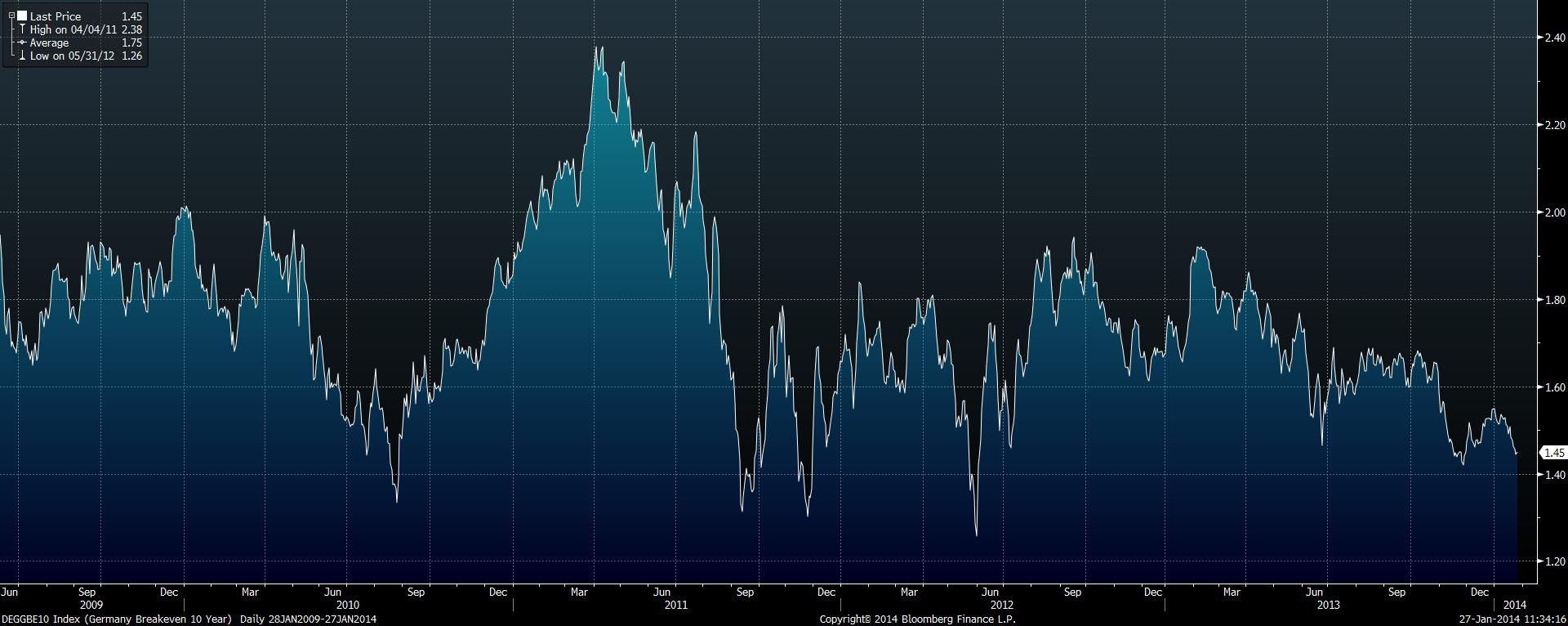
Many people especially here in Germany do think that we will see higher inflation going forward. I would not base my inflation expectations on subjective opinions but on observable market prices. Luckily we do have observable market prices for inflation: So called “inflation break even rates“, i.e the yield differences between nominal bonds and inflation linked bonds of the same issuer with the same maturity.

In order to adjust for inflation, one should always use those break even rates, as they are the best (and actually traded) proxies for inflation. Let’s look quickly at German Break even rates:

DEGGBE10 Index (Germany Breakeve 2014-01-27 11-34-09

So we can see that currently, the break even rate is very close to the actual assumed inflation rates for Thyssenkrupp and we do not need to adjust for this. However, when inflation rates would go up, we would need to adjust and the impact can be huge. For further information about inflation linked bonds, there is a lot of stuff available, for instance here.

Deflation put

There is however one “small” problem with the approach above: The price difference between inflation linked bonds and nominal bonds includes the scenario of deflation. Normal, EUR based inflation linked bonds will have a floor at 0% inflation, i.e. they don’t loose nominal value in a deflation scenario. German pension plans however have a floor at +1% inflation. If I would compare a German Inflation linked bond with a floor at 0% and one with a floor at 1%, the one with the 1% floor is clearly more valuable, which means that this put granted to the retirees is definitely worth something. Modelling inflation linked options is quite complex, so as a proxy I would use maybe a 2-3% top up for German pension plans in order to reflect this 1% “floor” granted to the retirees.

Common myth: Inflation component is not important as profits of the company and or nominal interest rates will increase with inflation

This is an argument I often hear: You don’t need to care about the inflation in pension liabilities, as the profit of the company will increase with inflation. A second argument is that if inlfation increases, interest rates will automatically go up and thus, offsetting the increase. Let’s tackle the issues one after another:

Company profits and inflation
Honestly, I think not many of us do really know how a period of increasing inflation looks like. In Germany for instance, the inflation rate was between 0-2% p.a. for the last 20 years, a real increase in inflation was experienced the last time around the date of the reunification in the late 80ties and early 90ties as this chart shows:

It should be clear from the past that not all company can simply pass inflation to customers and maintain (or even grow) profits. In my opinion, especially those companies with large pension liabilities have vulnerable business models, especially capital-intensive companies like Thyssen and Lufthansa. Software Companies like SAP for instance will be able to pass most of their cost increases to customers, but they don’t have an issue with pension liabilities anyway. Especially vulnerable in my opinion are utilities, where power prices in inflationary periods are often capped by regulators, whereas input costs often rise quickly

Inflation and interest rates

In the past, high inflation risks often went along with high interest rates, especially in the 70ties and 80ties. The relationship was mostly: Inflation spiked and central banks then had to increase interest rates in order to reduce economic activity and get inflation under control. This time however it might be different. Central banks all over the world have made it clear that the want higher inflation AND low interest rates in order to lower Sovereign debt burdens. It is not clear if they do achieve this, but I think it is also optimistic to assume automatically higher interest rates in the future if inflation picks up.

Quantifying inflation risk pragmatically:

If we look at all the points above, it should be clear that having a liability which will increase with increasing inflation is worse than having for instance a senior bond liability with fixed payments. Even if we use and adjust for current break even rates, there is always the risk that inflation increases above that, especially now, with the Central banks clearly targeting higher levels. As we have seen above, companies with a very strong competitive position and low capital intensity, we can assume that they will be able to earn their margins even under increased inflation. A company which is very asset intensive (i.e. depreciation will be too low in an inflationary scenario), will however get a “double whammy” via increasing pension liabilities.

My proposal to quantify inflation risk would be the following:

– company where inflation has no impact (or even positive) on profit: No adjustment necessary
– company where inflation impact is unclear: 5%-10% “risk adjustment”
– company where inflation impacts business negatively: 10%-20% “risk adjustment”

Those adjustments are very rough proxies for the amounts which would be calculated by a fully fledged risk model but I think as a rough indication this is better than nothing.

Summary:

So summing it up: In order to reflect inflation risks in a typical inflation linked DBO pension plan correctly, one should make the following adjustments for a prudent valuation:

1. Check if assumed inflation rate is close to relevant “Break even” inflation rates implied in traded inflation linked bonds. If not adjust with the difference multiplied with duration.
2. If there is a minimum inflation “guarantee”, further adjust with a 2-3% upwards adjustment for the liability
3. Determine if the underlying business is negatively effected from inflation. In doubt, use a 5%-10% mark up, if there is a clear negative relationship, use a 10%-20% mark up to reflect the uncertainty compared to a fixed liability

Again, I know that this are very rough proxies and you don’t need to do that. But for a prudent valuation, especially for companies with large pension liabilities, it would be very optimistic not to make adjustemnts for inflation risk.

Compagnie Du Bois Sauvage (BE0005576476])- See’s Candy in a Belgian wrapper ?

While researching Ackermans & Van Haaren, I stumbled over another smaller diversified Belgian holding company called Compagnie Du Bois Sauvage (CBS).

The company doesn’t look too exciting with the following “standard” metrics:

P/B 0.92
P/E 16.6 (mostly meaningless for Holdcos)
Div. Yield 3.3%
Market Cap 340 mn EUR

The company presents itself as a holding company, active in Real estate and strategic participation plus a so-called “treasury” division.

The strange name of the company (wild forest) is explained on the website as well as the origins.

However it is much more interesting what they are doing now, especially the strategic holdings. The company divides the participations into the following pillars:

-financial
-industrial
-food
-other

Financial:

This segment consists only out of 2 investments:

1) A 26.41 stake in a tiny Belgian Credit insurance company and

2) much more interesting a 12% stake in one of Germany’s oldest and most succesful private banks, Berenberg .


According to the CBS report, Berenberg has around 300 mn EUR equity and earned on average around 20% return on equity over the last 3 years, which is very very good. They seemed to have bought the stake in 2002 from an US shareholder.

I tried to reconcile the numbers in CBS annual report with the official annual report of Berenberg but it did not match. I think Berenberg reports only their bank, not the complete Group

Nevertheless a very interesting and high quality asset

Industrial

CBS discloses the following stakes:

– a 1.56% stake in listed Belgian metal group Umicore

– a 29% stake in listed Belgian automotive supplier Recticel

– 29% in an unlisted US plastics company called Noel

Nothing special here, very diversified but in my opinion without a clear focus or strategy.

Food – Neuhaus Chocolate & Pralines

This is in my opinion the “highlight” . The main company in this segment is Neuhaus, a famous Belgian chocolate manufacturer where CBS owns 100% of the company . According to Wikpedia, Neuhaus has actually invented the “praliné” as we know it.

Neuhaus was actually a separate listed company until 2006 and then taken private by CBS.

Out of curiosity, I did not follow my normal “Armchair investing” approach but did some real research. Neuhaus positions itself at the very high end of Chocolate and praline manufacturers. When i went into one of the biggest downtown department store in Munich, i was surprised that they actually charge 5 EUR for a 100 g chocolate bar and up to 75 EUR for a 1 Kilo representative praline selection. I bought myself a 250 gram pack for 17 EUR which looked like this:

I am not an expert chocolate, but someone else is, Warren Buffet. That is what he said about See’s Candy: (from 1998):

It is a good business. Think about it a little. Most people do not buy boxed chocolate to consume themselves, they buy them as gifts— somebody’s birthday or more likely it is a holiday. Valentine’s Day is the single biggest day of the year. Christmas is the biggest season by far. Women buy for Christmas and they plan ahead and buy over a two or three week period. Men buy on Valentine’s Day. They are driving home; we run ads on the Radio. Guilt, guilt, guilt—guys are veering off the highway right and left. They won’t dare go home without a box of Chocolates by the time we get through with them on our radio ads. So that Valentine’s Day is the biggest day.

Can you imagine going home on Valentine’s Day—our See’s Candy is now $11 a pound thanks to my brilliance. And let’s say there is candy available at $6 a pound. Do you really want to walk in on Valentine’s Day and hand—she has all these positive images of See’s Candy over the years—and say, “Honey, this year I took the low bid.” And hand her a box of candy. It just isn’t going to work. So in a sense, there is untapped pricing power—it is not price dependent.

Neuhaus is doing pretty much the same but with a twist: Their increase in sales seems to come to a large extent from Airport duty free stores. So instead of the Californian car driver you have the European business man or tourist but the principle is the same.

The biggest difference in my opinion is only the price. While See’s currently charges 18 USD per pound, Neuhaus actually gets away charging more than twice with 33 EUR (~40 USD).

It seems to be that for one, “Belgian Chocolate” allows them to charge premium prices. On a recent inland flight I quickly checked an Airport store in Munich, and indeed, Neuhaus together with Lindt was sold at very high prices at a premium location. The third brand was Feodora, the premium brand from Hachez, a privately owned German chocolate manufacturer.

Out of fun, I created a table of the developement of Neuhaus from the CBS annual report. The turn around and growth since acquisition is impressive:

Neuhaus 2003 2004 2005 2006 2007 2008 2009 2010 2011 2012
                     
Sales   64.52 70.88 83.9 96.25 102.25 105.7 119.9 133.47 149.27
Net   0.505 1.34 3.33 6.95 8.94 10.31 10.95 11.63 12.02
Equity   25.98 26.5 29.55 36.37 45.18 50.89 57.6 53.24 58.79
                     
Net margin   0.78% 1.89% 3.97% 7.22% 8.74% 9.75% 9.13% 8.71% 8.05%
ROE     5.1% 11.9% 21.1% 21.9% 21.5% 20.2% 21.0% 21.5%
                     
CAGR Sales     9.9% 18.4% 14.7% 6.2% 3.4% 13.4% 11.3% 11.8%
CAGR Earnings     165.3% 148.5% 108.7% 28.6% 15.3% 6.2% 6.2% 3.4%

Not only did they achieve a great turnaround, but Sales doubled and ROEs have been constantly at 21-22% p.a.since 2007. This resulted in a 10 times increase in earnings over this period.

If we look for instance to market leader Lindt from Switzerland, we can see that Lindt has a slight advantage in margins, but Neuhaus in growing more and has a better (and more stable) ROEs .

Lindt 2003 2004 2005 2006 2007 2008 2009 2010 2011 2012
                     
Sales p.s.   9,151 10,255 11,721 13,210 11,389 11,126 11,309 10,944 11,765
Net incom p.s.   684 788 947 1,123 1,158 851 1,061 1,084 1,198
Equity   3,638 4,421 5,224 6,195 6,519 7,168 7,410 7,095 7,695
                     
Net margin   7.47% 7.69% 8.08% 8.50% 10.16% 7.65% 9.38% 9.91% 10.19%
ROE     19.6% 19.6% 19.7% 18.2% 12.4% 14.6% 14.9% 16.2%
                     
CAGR Sales     12.1% 14.3% 12.7% -13.8% -2.3% 1.6% -3.2% 7.5%
CAGR Earnings     15.3% 20.2% 18.6% 3.1% -26.5% 24.6% 2.2% 10.5%

Don’t forget that the market is valuing Lindt at a 30x P/E, I think a 25x P/E for Neuhaus would not be unrealistic, as the business looks like a nice high ROE compounder.

In a M&A transaction, I could imagine even a higher multiple for such a premium brand from a strategic buyer.

Valuation:

Interestingly, CBS discloses NAVs on bi-annual basis, the last value being 270 EUR per share at June 30th 2013.

So we can easily use the template from the annual report and plug in own values:

What about a Holding Discount ?

I have written about how I look at Holding Comanies. In CBS case, I am neutral. I like that they are able to strike really good deals (Neuhaus, Behrenberg) and hold them for the long term. On the other hand, some of the activities look like trying to kill time. Positive: transparent and conservative NAV calculation. Overall I would not necessarily require a big discount here, maybe 10-15% or so.

Compared to GBL/Pargesa for instance we do not have a double holding structure and the main assets cannot be invested directly. So definitely a lower discount here. Compared to CIR, there is also only little leverage in the company.

SO let’s look at the sum of part valuation now:

% Value Comment
Neuhaus Chocolate 100.00% 300.00 PE 25(2012)
Behrenberg 12.00% 54.00 at 1.5 times book
Umicore 1.56% 60.53 At market
Recticel 28.89% 47.67 at market
Noel Group 29.37% 4.64 PE 10
Other   20.00 as disclosed
       
Codic Real Estate 23.81% 24.52 at book
other reals estate   60 as disclosed
cash etc.   20  
       
Sum   591.36  
Net debt   -80  
NAV   511.36  
       
shares our   1.6  
NAV per share   319.60  
Holding Discount   271.66 -15%
Upside   25.19% at EUR 217

What we see is that before applying the holding discount, the stock would have an upside of around 50% which would be OK for me. After applying the discount, the potential upside shrinks to 25%.

Other Info:

The guy behind CBS is Guy Paquot, a well-known Belgian investor. He owns close ~47% of the company.

According to this article, he comes from a rich family and was knighted in 2000 by the Belgian King. He stepped down in 2010 and is no official director anymore, but I guess he still influences the company to a large extent as the dominating shareholder

The Fortis situation

There is one dark chapter in CBOs history: As part of their activities they also invest into Belgian stocks. In 2008 however, they seemed to have received insider information about the upcoming nationalization of Fortis and were able to sell the stock before.

Because of this episode, the CEO actually was imprisoned for a few days and Guy Paquot came back from “retirement”.

It seems to be that one member of the supervisory board of CBS was also in the supervisory board of Fortis and passed the information. In 2008, it was speculated that the fine might be 40 mn or more.

The company settled the dispute finally in last November for a 8.5 mn EUR payment without committing to any wrong doing.

Stock price

Interestingly, the November settlement seems to have been some sort of catalyst, as the stock gained almost 30% in the aftermath.

The stock seems to have bounced off from the 2011 level of 230 EUR but overall I would say the chart looks ok.

Summary:

Compagnie du Bois Sauvage is an quite unusual stock. Among a strange combination of businesses, there is a prime asset hidden which I think is comparable to Buffet’s famous “See’s Candy” which accounts currently for 60% of the value of the company under my assumptions. If Neuhaus keeps growing at this pace for 2-3 more years, the percentage of Neuhaus could be even bigger.

My own valuation shows an upside of around 25% from current prices after a 15% holding discount which is too low for me to buy . So although I like the company and the two great assets (Neuhaus, Behrenberg), the current price is not attractive enough for me +. For me, A stock price of 185 UR would be required or maybe profits (and valuations) of the two prime assets increase enough to justify an investment.

P.S: I started looking at the company and writing this post already in November 2013, when the stock was around 190 EUR. This is the reason why the post is so long despite the missing upside.

AKKA SA (ISIN FR0004180537) – Finally a French- German success story ?

Akka technologies is a French company which is described in Bloomberg as follows:

Akka Technologies provides high-technology engineering consulting services. The Company specializes in scientific project management and engineering, mechanical, electronic, computing, and telecommunications project management and engineering, as well as industrial project management and engineering.

Valuation (at 22 EUR)

P/E 8.6
P/B 2.2
Div. Yield 3.0%
EV/EBITDA 5.0
EV/EBIT 6.0
Market Cap 320 mn EUR

The stockprice developed relatively well since the IPO in 2006:

This is supported by a very impressive EPS increase from 0.63 EUR in 2006 to 2.82 EUR in 2012.

Business model:

The company describes itself as „R&D outsourcing“ company. Mostly active in automobile and aviation. Main clients: EADS (22%) and Daimler Benz (28%).

I think it is a little bit more than a „high class“ temp agency. In their half year report they highlight for instance those projects:

• Daimler has just entrusted MBtech with its largest project so far, involving the design of a future vehicle.
• Renault is relying on AKKA for the industrialisation of three new vehicles in China.
• Airbus has entrusted the European coordination of one of its major contracts to AKKA.

Nevertheless, I think their business shows similar cyclical characteristics than their clients. They surely need less fixed assets, which should make results less volatile after deprecisation, but this is definetly not a super stable must-have service business. If times are getting harder for the clients, they will most likely cut first in their „outsourced“ R&D before firing their own guys. On the

I am not sure how dependent they are on the know how of the engineering companies. I guess that the clients try to avoid too much know how transfer.

Overall, this kind of business model can be quite attractive. Competitors like ALTRAN; Atkins (UK) or Bertrand (Germany) earn easily 15-20% ROICs as the business requires not much capital. This translates on average into valuation ratios which are twice as high as for AKKA (Bertrand trades at 11xEV/EBITDA, Altran at 9.6x) .

AKKA for instance showed a net Income margin of around 4.5% over the last 10 years which, due to the low capital requirements, translated into an average ROIC of around 20% which looks very attractive, especially combined with the strong growth.

Why ist he stock cheap ?

Akka used to make acquisitions in the past, but usually only smaller ones. Until 2011, the company had significant cash on hand.

In 2012 however, they made a real big acquisition: The took over a full division of Daimler called MBTech.

The acquisition as such is not unreasonable, although some issues are clearly visible:

– Akka had to take on additional 100 mn in debt to finance it
– MBTech had only one customer: Daimler
– the company is barely profitable, despite the boom in the auto industry

On the other side, Akka got the company quite cheaply (almost at book value) because no one else wanted it. As Akka was already present in Germany, the do have experience and the logic, that such a division, once it is free from ist big parent, improves a lot, does make sense.

Daimler seems to have guaranteed business for 5 years. In the meantime, Akka needs to find new clients. So far, Akka seems to proceed slower than planned with the turn around and overal profitablity is now suffering clearly. Nevertheless, from a pure business point of view this could be an interesting turn around situation ifg the plan works out.

Loking at MBTechs recruiting web site one can see that they are currently searching for 200+ engineers. Daimler, the main client of MBTech has just released surpisingly good numbers. So for the time being it doesn’t look bad.

On the other hand, the purchase of MBTech could be considered to be some kind of „spin off“. As part of the large Daimler conglomerate, this small organization was most likely „rotting“ in the backwaters. Now, within a much smaller focused organization like Akka, theoretically, a lot of improvements could be expected.

Qualitative aspects

On the plus side, the company is still majority owned by the Founder/CEO Maurice Ricci with > 50% ownership. He is 52 years old and will most likely be in the company for a while.

BUT:

Going through my quality checklist, some issues really bother me. When I look at a company, I ususally google for pictures of the CEO and board members plus I try to watch videos to get a „subjective“ impression.

When I googled Maurice Ricci, I got among others, this link http://www.racingsportscars.com/driver/photo/Maurice-Ricci-F.html

And those pictures:

So Maurice Ricci seems to enjoy race driving quite a lot. I do have a BIG problem with CEOs who have extravagant hobbies such as race driving.

There are quite a lot of examples of race driving CEOs which drove their company „against the brick wall“, among others, Ulrich Schumacher from Infineon and Eike Batista.

My theory ist hat as a race driver you have to go to the limit all the time in order to be succesful, if you fail, you just need to get a new car. However, if you are shareholder in a company run by such a CEO, you have the risk that your stocks will bet he „old car“….

This alone would be just a warning sign, but when I went through my list, some other slightly worrying issues emerged:

Akka SA behaves a little bit irrational with regard to funding, both in 2011 and 2013, they issued new shares (1 new for 10) but paid a dividend as well. For shareholders, this is clearly value destroying (costs for rights issue, taxes on dividend).

Even more worrying ist he fact, that the CEO didn’t seem to particpate in the rights offering. According to the annual report, his percantage declined more or less with the increased share count.

It looks a little bit that he needs more than the 600 k salary to finance his lifestyle and therefore still pays out the dividend although it would be better to reinvest.

Finally, I am alaways careful if a company does a big acquisition compared to ist size. In this case it seems to have been relatively cheap

Overall, Akka only scores 13 out of 28 in my qualitative check list, which is not enough for my „core value“ portion.

Interestingly, I did some „scuttlebut“ with some French investors and they had a quite high opinion of the company from the operational and technical point of view.

So what now ?

We have a stock which is quite cheap but does only score „mediocre“ with regard to quality. For me, there is one line where I would not make any compromise: Accounting and integrity . If I have the feeling that a company is „cooking“ the books or if management has been involved in shady deals in the past, I will pass.

Here however, this is not the case. But clearly the risk is higher. So what we need here is better understanding of the potential values of the investment.

In order to keep it simple, I define 3 „probable“ scenarios, all three based on a 3 year horizon

1. Status quo.
The company does how it does now. Stock price remains constant

2. Bad case
The lowest net margin for Akka since they are listed has been 3.7% in 2009. If we use this as a basis and the current P/E of 8.5 (and again sales of 900 mn) then we would end up with a earnings of 2.2 EUR per share or a fair value of 18.60 EUR.

3. Good case
In the past, Akka was able to earn a net margin of around 5%. If we assume that they can turn around Germany in 3 years time and generate an overall amount of 1 bn sales, we would have a net income of around 50 mn EUR or around 3.30 EUR per share

If we further assume that they will then trade at a p/E of around 12-15 times as most of the peers, we have a target price range of 39.6 -49.5, with the midpoint at ~45 EUR.

In the next step, I try to come up with simple probabilities and the calculate the 3 year IRR.

The simplest psoobility is always: Equal weight, 33.3% probability each. The result is calculated quickly:

3 year Horizon – Equal weight
Akka Prob
Low case 33.3% 18.6
Status quo 33.3% 22
Good case 33.3% 45

Expected value in 3 yaers 28.53
IRR p.a. 9.1%

So if we assume, all three scenarios are equally likely, weg et an IRR of 9.1% over 3 year which is not very attractive.

We could also look at the scenario where we can assume that the turnaround is basically a 50/50 gamble:

3 year Horizon – 50/50 turnaround
Akka Prob
Low case 25.0% 18.6
Status quo 25.0% 22
Good case 50.0% 45

Expected value in 3 yaers 32.65
IRR p.a. 14.1%

In that case we would get an IRR of 14.1. Not bad, but as this is clealry an above average risk stock maybe not enough.

If we assume a 75% probability of the MBTech turn around, we get the following picture:

3 year Horizon 20% IRR
Akka Prob
Low case 12.5% 18.6
Status quo 12.5% 22
Good case 75.0% 45

Expected value in 3 yaers 38.83
IRR p.a. 20.8%

So in order to come to a 20% IRR which I think would bet he right „Hurdle“, one has to be quite sure that the turn around is succesful.

If one uses the 50/50 scenario to find the „status quo“ level which would provide an expected 20% IRR, we would end up with 18 EUR.

So long story short summary:

I would buy the stock either if the price would be around 18 EUR or if I am convinced that the turnaround is happening with at least 75% probability (and the car sector is not cratering).

So for the time being, despite looking attractive from a pure valuation point of few, the risk/return for Akka is not good enough in order to qualify as core value. As it is no “special situation” neither (at least not in my definition), for the time being it will be a stock for the watch list only.

« Older Entries Recent Entries »