Category Archives: Opportunities

NN Group NV – “Hands off” IPO or interesting special situation ?

NN Group is the name of the soon to be just IPOed Insurance subsidiary of Dutch ING Group. NN Group sounds a little bit strange but is the “traditional” name of the Dutch Insurance company, “Nationale Nederlanden”.

As a value investor, normally, IPOs are an absolute “No go”. Benjamin Graham famously said that one should never touch an IPO because almost always, the stock price is overhyped and the risk return relationship is not good. Especially now with the market reaching new highs, buying IPOs doesn’t seem a good idea.

So why could this IPO be different ? In my opinion there are some good reasons:

1. ING is obliged to sell.

ING had to be rescued in 2008 by the Dutch Government under the condition that they dispose their full insurance activities. They cannot simply spin off the business because they need the money to pay back the Dutch Government and shore up the bank balance sheet.

This is form a recent Bloomberg article what they have done so far and what they committed to:

ING, the recipient of a 10 billion-euro bailout from the Netherlands in 2008, agreed with EU regulators to complete its disposal program by the end of 2016 and to sell more than half of NN by the end of next year. ING also still owns about 43 percent of Voya and a stake of about 10 percent in Sul America SA (SULA11) in Brazil.

The company is open to selling the Sul America stake, worth about 566 million reais ($253 million) based on the Rio de Janeiro-based insurer’s market value, in a block trade, Chief Executive Officer Ralph Hamers said in an interview in Sao Paulo yesterday.

2. The company is an “ugly duck” at first sight

The remaining insurance compqny is a strange combination of Netherlands, Eastern Europe and Japan with some Investment Management thrown in. In German, one would call the business mix a “Resterampe”, so the remains of what could not be sold directly. The majority of the business is Life insurance, which itself is clearly suffering from low interest rates.

The company shows more or less zero profits for 2013, however a couple of items could be considered true “One offs” in order to look better in the future, for instance the large charge against the closed Japanese VA business. Also Q1 2014 showed a loss, this time because of a charge in relation to pensions.

So now one can accuse ING of “dressing up the bride”, rather the opposite.

3. European Insurance is one of the sectors with the lowest valuations anyhow

The Stoxx 600 has currently a P/E of 24,8 and a P/B of 1,9. Compared to this, the Insurance sector trades at a trailing p/E of 12,4 and P/B of 1,21. This is even cheaper than banks and utilities. Within the insurance sector again, the Life Insurance sector is even cheaper. There are clearly many reasons for those low valuations, especially that interest rates are so low which makes it hard for life insurers to earn their guarantees and a spread on top if this.

4. The IPO valuation looks cheap compared to the sector.

The company comes to the market at around 50% of book value. Considering that they don’t have a lot of Goodwill, this looks cheap even compared to the generally low valuations for life insurance companies. Dutch competitors Aegon and Delta Llyod trade at P/Bs of 0,7 and 1,3, the average for European Life insurers is ~1.4 including UK, and around 1 excluding UK.

5. The company looks like a target

Looking at this IPO, there seems to be a big sign on the company saying “split me up”. This strange combination of businesses is clearly not value enhancing. Splitting the company up for instance into a Dutch entity and selling down the rest could be a pretty easy exercise for an activist Hedge fund. I could also imagine that some Asian financial companies would be interested in acquiring a solid Dutch “brand”-.

6. The company is relatively solid

If one looks at the “usual suspects”, like Goodwill, pensions etc. there is not much to be found. The company had 6 bn of defined benifit liabilities in 2013 but actually got completely rid of them in early 2014 against an extra charge. I consider this as very positive and a good sign that they really cleaned up a lot of stuff befor doing this IPO. Additionally, another insurance specialty, so-called “DACs”, which are capitalized distribution costs only play a very minor role at NN compeared to other life players like AXA.

They do have some leverage but overall I would rate the balance sheet quality as “above average” for the sector.

7. The US IPO went relatively similar

There is a blue print for this transaction: Voya, the former ING US IPO. The US business was also supposed to be pretty ugly, so ING placed the first tranche very very cheap at below 0,4 times book value. Since then however the valuation seems to slowly approach those of other US life insurers and the stock almost doubled since IPO:

Other thoughts:

Management incentives
What I didn’t find out in the annual report or in the IPO prospectus was how the NN Group management is aligned with shareholders going forward.

In situations like this, a lot depends on Management, especially if they want to actually increase sahreholder value or if they want to maximise salaries which is easier in a bigger company and which would make reasonable spin-offs and disposals unlikely. So this is something to be watched.

Management has committed to a quite aggressive dividend payout ratio of 40-50%, starting with a large payout already this year in autumn. I am not a dividend investor, but this greatly reduces the risk of stupid acquisitions.

Distribution agreements with ING Bank

Life Insurance is mainly distributed via banks these days (often along with a mortgage loan). NN has an exclusive agreement with ING Bank according to the IPO porspectus until 2022. Although this is a limited time frame, this is very valuable as banks now charge high upfront fees in order to access their distribution channel.

Summary:

In my opinion this “IPO” of NN Group is much more similar to the classic “spin-off” than a “real” IPO. ING has to sell, the underlying business looks ugly at first sight and there is a lot of overall negative headline news for the sector and the specific business fields. As a result, other than with a normal IPO, the valuation is very cheap.

As I feel comfortable with the headline risks at this price level, I will invest a “half position” (2,5%) of the portfolio into NN Group at current prices (21,70 EUR). The short form investment thesis is that one gets an above average quality insurance business for a below average price.

Again, this is clearly not a “no brainer” and will need (lots of) patience, but over 2-3 years, the price of the shares could be easily 50% higher (including dividend distributions) if they reach average valuation ratios and the one-offs turn out to be real one-offs.

Depfa: No sale, LT2 and the “Kebab Zerobond” (ISIN XS0221762932)

Warning: The securities discussed are illiquid and/or risky and the author might have bought them already before publishing the posts. Please do your own research and if you decide to invest nevertheless, use apropriate limits !!!

Background:

For readers of my blog, Depfa is no stranger. I did buy a 2015 floating tier 2 subordinated bond in 2011 and this has been a very good investment so far.

To summarize the story of Depfa for “new” readers quickly: Depfa was initially a “full service” German mortgage bank which then split up into a German mortgage bank (Aareal) and an Ireland based “public funding” bank (Depfa Plc). Shortly before the Lehman crisis, Depfa got bought by another German mortage bank, HypoRealestate (itself a spin-off from Hypovereinbsank). The rest is history: Depfa/Hyporeal Estate was the first bank to go belly up and needed to be rescued by the German Government.

After beeing rescued, the startegy was to concentrate on German Mortgage banking and to sell the old Depfa part (which has been “cleansed” from PIIGS exposure via a bad bank). The sale process seemed to have been already quite far advanced, with Leucadia as favourite, before very surprisingly the German Government pulled the sale in the last minute before closing.

Germany has intervened to prevent bailed-out bank Depfa from falling into US hands just hours before a deal was about to be struck.

The government’s financial market stabilisation fund, known as Soffin, said on Tuesday evening that Depfa should be wound down by the German authorities rather than sold for what would have been €320m to US investor Leucadia, according to people familiar with the deal.

What does that mean for Depfa bonds in general ?

Tier 1 bonds of Depfa got hit quite hard, although one must say that they enjoyed a great run up until then as this chart shows:

The reason here is I think the expectation that the FMS, which will have the task to run down Depfa, will not do anything actively with the subordinated bonds, whereas any private buyer would have tried to get the subs out as soon as possible under par in order to realize value more quickly.

Although it is not clear, how Depfa will be passed over to FMS (most likely a sale at book in my opinion, in order to facility a Hypo Real Estate sale in 2015), I think it is fair to asume that sooner or later FMS will be the owner of all assets and liabilites.

FMS itself is a Government owned “bad bank”. As bad banks need constant refinancing, FMS issues new bonds on a regular basis like this one. FMS is owned by SOFFIN, the German “bank rescue” vehicle, which itself carries an explicit Government guarantee. A good description of the FMS can be found here (in German, page 108 ff).

So once, Depfa has been transferred to FMS, in principle the liabilites should be considered FMS liabilities which again carry a AAA rating and trade more or less at levels similar to KfW.

Impact on subordinated bonds

The bloomberg article above mentioned that Depfa subordinated investors were afraid of the following:

“The main risks facing creditors now are the risk of burden-sharing as well as an indefinite coupon ban,” the analysts wrote in a note to clients on May 14. “It’s difficult to see clear upside from current levels and further volatility is likely.”

I share the opinion that it is very unlikely that coupons on Tier 1 bonds will be paid in the near future, although, at some point in time FMS might want to buy out the Tier 1 investors as well. But at current levels (50% of nominal), this is not a very attractive speculation.

However for the Tier 2 bond I own, the transfer of Depfa to the FMS is actually good news. I cannot think of any realistic scenario which would lead to a loss for the Tier 2 until maturity in 2015. If they would like to screw those bond holders, I am pretty sure they will have issues refinancing and this is the last thing they want. The LT2 bond priced consequently barely moved as we can see in the Chart:

So far, the LT2 has been a very good investment. Around 30% annualised return with, in my opinion, very little risk. If one has cash to park, I think the bond is even now a very interesting investment. You get around 5% annualized return until maturity December 2015 which is effectively Governemnt guaranteed.

I will therefore increase the position from a “half position” to a full 5% as I have plenty of liquidity in the portfolio to park.

The Depfa 2020 TRY “Kebab Zerobond” (ISIN XS0221762932)

When I started to look at Emerging markets earlier this year, especially when I looked at Koc Holding, I was surpried that Depfa had Turish Lira bonds outstanding.

When you search in Bondboard.de for TRY bonds which are traded in Germany it is even interesting to see that the 2020 Depfa TRY Zero bond is the highest yielding TRY bond available.

At a current yield of ~13% p.a., the bond trades around 4% p.a. wider than a 2 year longer EIB Zero bond and around 3% wider than similar Turkish Government (coupon) bonds.

Why does the bond look cheap ?

1. First of all, I think the problem is that the “official” rating of Depfa is BBB. Many investors will simply compare the bond with other financial BBB issues and apply respective spreads. As many of the Italian and Spanish banks are BBB as well, BBB financial spreads are high.

2. The bond is relatively small (425 mn TRY) and illiquid as the 100 K TRY denomination will deter many smaller investors (at ~47%, you need to pay around minimum 17k EUR to buy one bond). I think also, many investors prefer coupon paying bonds to zero bonds, for most investors “zero” bonds are an exotic security

3. Finally, I think not many people did like the combination of the Depfa structural risk and the TRY currency risk. Either you like Emerging markets and TRY or you want to play the Depfa capital structure, but usually not both.

However for me, the bond is the ideal combination: I do like the Depfa risk as I think that any Senior Depfa bond will be a AAA equivalent bond after the transfer to the FMS. Additionally I do also like the TRY risk. Clearly, there is downside potential and he TRY/EUR is still volatile as the chart shows:

As an investor you can gain (or loose) money with this bond based on 3 risk faktors:

A) TRY/EUR exchange rate. Based on the current interest rate differential, the market assumes that the TRY will devalue vy ~8% p.a. against the EUR.Perosnally, I see a good chance that the devaluation could be less than that. Under many metrics (PPP, BigMac index etc.) the TRY is fundamentally cheap compared to EUR and USD although there is clearly political and econimical riskimplied. The currency factor is clearly no “free lunch”.

B) Turkish interest rates. As a zerobond, the bond has a duration of ~6,5 years, i.e. if interest rates go up or down 1% the bond price will move +/-6,5%. Currently the yield curve in Turkey is flat or even inverse, with the short end slightly higher. even if long term rates stay constantand only short terms go down, one can expect some “extra juice” from the potential roll down of the bond.

C) Depfa Spread. Compared to an EIB Bond, the implicit credit spread is around 3-4% p.a. although in my eyes the credit risk is similar to an IB or german Government bond. I think there is also a good chance that this could normalize over 2-3 years. If there is some rating action following the transfer, this could even happen quicker.

All in all, I find the TRY Depfa bond very attractive and will by a half position for the portfolio. As the risk is predominantly TRY, I will allocate it to the Emerging Markets bucket.

My expectation is that I can make ~50%-60% in local currency within 3 years, if the yield curve normalizes and the Depfa Spread tightens including the normal “carry” of 13%. If half of that shows up in EUR, I will be already very happy 😉

Hedge fund edition

For a smart (hedge) fund with good access to securities lending, a long (Depfa)-short (TRY EIB 0% 2022) trade could be interesting. Despite the slight duration mismatch, this could be an interesting way to speculate on the relative spread tightening between Depfa/FMS and the EIB bonds with an interesting implicit positive carry, although I am not sure how easy it is to borrow the EB bonds.

Summary:

In my opinion, the planned transfer of the old Depfa to the FMS is good news for LT2 and Senior bonds of Depfa, as the bonds become effectively German Government equivalent. I will therefore increase my existing lT2 position up to 5% and invest a half position (2,5%) into the Depfa 2020 TRY bond as Emerging Market investment.

P.S.:Why did I call this the “Depfa Kebab bond” ?

Doner Kebab is the most popular German fast food.

Based on Turkish ingredients, the current form (with salad etc.) is supposed to be a Turkish-German invention and in my opinion a good omen that a Turkish-German combination can be really delicious…..

MIFA Update (2) – And why I would prefer Russian shares to German Bonds

The story around the German bicylce producer MIFA seems to get more and more interesting. Yesterday I posted the update on the (not so surprising) losses detected now from previuos years of dubious inventory accounting.

A few minutes after I published the post, MIFA came out with another “breaking news” which starts the following way:

MIFA: Investment agreement with Indian bike manufacturer HERO concluded,
equity investment pursuant to capital increases from authorised capital

– Investment agreement with OPM Global B.V., a subsidiary of Hero Cycles
Ltd., about an equity capital investment in the amount of EUR 15
million concluded

– FERI EuroRating Services AG reduced issue rating of corporate bond

– Annual General Meeting expected for third quarter of 2014

From the headline one would conclude that the rich Indian “uncle” finally will save the company. Handelsblatt for instance translated this into a headline which one could translate into “MIFA secures investor”.

For the real “juice” of this announcement, you have to read down a little bit towards the end of the annoncement:

The investment commitment by OPM Global B.V. entails significant financial contributions of MIFA’s financing partners and is subject to various conditions precedent, especially to the condition of a haircut in the amount of EUR 15-20 million of the bondholders as well as an exemption from the German Financial Supervisory Authority (BaFin) from the obligation to make a public takeover offer under the The German Securities Acquisition and Takeover Act.

So to understand this again, the facts:

– The 2013 issued MIFA bond has a total volume of 25 mn EUR
– most likely, the covenants of the bonds are breached, so MIFA would have to pay back the bond on short notice
– the “Indian uncle” will only invest, if bond holders accept a haircut of 60-80%

Normally, if a company cannot pay back a bond, the company will go into default. the shareholders will be wiped out and the company then changes ownership from the shareholders to creditors i.e. bondholders for instance via a debt/equity swap.

at MIFA, they try to reverse the order. Let’s look at another part of the announcement: Hero is commiting to pay 15mn for the following shares:

The cash capital increases shall comprise a 10% capital increase with subscription rights being excluded and a subsequent rights issue with a total number of 4.9 million new shares to be issued. OPM Global B.V. has undertaken to subscribe all such shares which together with additional existing shares to be transferred from
certain existing shareholders would result in an overall participation of the investor of up to 47 %.

With currently 9,8 mn shares, only (0,98 +4.9) = 5.88 mn new shares will be issued. With a total new sharecount of 15,68 mn shares, the old shareholders would keep economically (9,8/15,68) =62,5% of the company while senior bondholders would keep only 20-40% of their bond prinicpal. In my opinion it should be the other way round.

It will be interesting to see if bondholders are accepting this pretty obvious blackmailing. The argument will most likely be that if they don’t accept, they will end up with nothing. Praktiker by the way tried a similar tactic, going to bondholders first . In Praktiker’s case, both shareholders and bondholders ended with nothing.

That the proposed transaction would be better for shareholders than for bond holders shows clearly in the price action this morning. While the bond lost further from around 33% to around 27% (or -20% in relative terms), the shares are up more than +20% at the time of writing.

Coming back to my headline: When i bought my first two small Russian share positions (Sberbank, Sistema) many people commented that they would never buy Russian shares because property rights are not respected in Russia. This might be even correct, but you get very cheap valuations and if they do respect property rights, tzhe potential upside is high.

In German bond markets however, property rights are even worse in my opinion once a company is in trouble. As we learned at IVG, subordinated bond holders can be wiped out without blinking an eye and looking at the last few cases, senior bond holders are now expected to rescue the company before shareholders commit a single cent. Under German insolvency proceedings, often the old management carries on (WGF) and wipes out bondholders as they wish. However, other than in Russia, there is no upside to this if you buy a newly issued German bond at par. So for me, if I would need to choose between a newly issued German Corporate bond and a Russian stock, the choice is clear….

The sad part of this story is that this event along with many other similar event will hurt corporate bond issuance in Germany in the long run, especially for smaller companies. With the banks continuing to shrink, this is not good news for those German Mittelstand companies who need debt funding.

I am somehow tempted to become a “bond activist” here….Let’s see how this continues….

Update: Portugal Telecom & Oi Merger & Oi capital increase

DISCLAIMER: The stock discussed is again very risky and not a typical “value stock”. Please do your own homework and never commit large amounts of your capital to such investments. The author might buy or sell the shares without giving advance notice. Do your wn homework !!

Last year I had a mini series (part 1, part 2, part 3) about the merger between Portugal Telecom and the Brazilian Oi. My initial idea was a long PTC / short OI deal as the mechanics of the merger seemed to imply a signifcant dilution for OI shareholders.

Interestingly, since I wrote the first post in October 2013, both shares lost siginficantly, however Oi with around -37% more than double than PTC with -15%.

Oi is now in the process of preparing the planned capital increase and it looks that they did push through the share offering though there have been some hickups along the way.

Just as a quick reminder:

Oi was supposed to do a big capital increase first before then the company gets merged with PTC.

Oi seems to have priced the new shares aggresively at the bottom of the expected range:

Grupo Oi SA, Brazil’s largest fixed-line telephone carrier, priced an offering of preferred shares at 2 reais each, at the bottom of the indicative range set by bankers, sources said on Monday.

So at current prices with PTC at ~3 EUR and OI common shares at 2,50 Reais (or ~0,81 EUR) PTC sharesholders will receive “new shares” of OI at the value of 2,2911 Euros plus 0,6330 “CorpCo” shares which should equal common shares. So at 3 EUR there seems to be a small discount but I think this is hardly exploitable as an arbitrage situation.

For me, the current situation is an interesting combination of a special situation (capital increase regardless of price) and Emerging Markets exposure.

However, much more interesting for me is that aspect:

It is pretty clear that Oi wanted to raise a defined amount without really caring about the share price. This looks similar to EMAK and Unicredit in Italy 2 years ago. This is one of the rare cases where we clearly have a seller who does not care about the price but just wants to raise a fixed amount of money.

The “special-special” aspect of this one are the following feature:

1. We do not have subscription rights despite the massive amount of new shares
2. We have the additional complexity of the subsequent PTC merger

In such a situation, it is extremely hard to come up with a solid valuation of the business. Both, OI and PTC look very cheap on a trailing EV/EBITDA basis but honestly, i did not try to figure out how the combined entity will look like. Oi minorities clealry got screwed by this transaction whereas PTC shareholders had been protected to a certain extent.

The good part of the this capital raising is that the entity will have some fresh cash which will allow them to operate for some time. Although there is clearly the risk of further dilutions if they want to bid for instance for additional businesses in Brazil.

Summary:

For me, the Oi capital increase looks very similar to situations like EMAK and Unicredit, where the companies issued new shares regardless of price. This increases the possibility that the price has been pushed significantly below fair value. Buying PTC now looks like an interesting way to get exposure to the merged entity at a depressed price. I will therefore invest a 1% position into PTC at current prices (3 EUR) for my “special situation” bucket.

Short cuts: Gronlandsbanken, SIAS SpA, Thermador, April

Gronlandsbanken

Already some weeks age, Gronlandsbanken reported 2013 numbers and published their 2013 annual report, which is again a must read for anyone interested in Greenland. The bank seems to be a little bit more optimistic than last year.

Profit was around 10% lower than in 2012, which is not bad for a stagnant economy. The dividend has been kept stable which means the dividend yield of around 7,8% at current prices. Overall, Gronlandsbanken in my opinion still offers a lot of positive optimality, although it might need a few more years to really see an impact of potential large-scale mining projects. Better than with a “classical” option, I get paid for waiting.

SIAS Spa

Sias released 2013 results last week (in Italian only). Traffic was again down compared to 2012, but revenues increased due to the purchases out of the South America proceeds. They earned 0,61 EUR per share resulting in a trailing P/E of 13.8. For a “average” company like SIAS, this is already relatively expensive in my opinion, so I will sell down half of my current position (5,3%) at current prices, which would result in a profit of close to 100% for this part.

Thermador

Finally, Thermador released 2013 numbers and its English language annual report. Sales declined in a tough market by -2%, profit slightly more from 4.96 EUR per share to 4,68 EUR. Cash flow however was very strong due to a significant release of working capital, net cash is now around 32 mn EUR or ~ 7,4 EUR per share. The cash adjusted P/E of around 14 for a high quality firm like Thermador is in my opinion still adequate.

April SA

Already a few day<s ago, April presented preliminary 2013 results. Overall profits were a little bit lower than in 2012 resulting in 1.22 EUR Earnings per share against 1,38 EUR in 2012. Although this is the 5th decline in a row, this time the reason seems to be almost exclusively in the lower interest rates. I think one can expect that from a operational point of view, the bottom should be near.

Interestingly, they still earn very nice ROCEs even at those depressed levels. Adjusted for cash, they trade at single digit P/E which implies in my opinion still a good risk/return relationship.

Energiedienst Holding (CH0039651184) revisited

Almost exactly one year ago, I looked at Energiedienst Holding, the Swiss/German Hydropower utility.

That was my summary from last time:

The current system for renewable energy in Germany (selling renewable electricity into the market at any price with the consumer paying the difference) is hell for “traditional” utilities including hydro power.

The German utilities have maybe underestimated the extent of renewable production, otherwise they could have done the exactly same thing themselves. Now however, the are in a kind of “death grip” between having to run their expensive black coal and gas plants for peaks and the artificially low electricity prices. Combined with unfavourable natural gas delivery contracts, especially for E.on the air will remain quite thin.

So unless something changes significantly, German utilities (including Energiedienst) will need a long long time to adjust capacity and change their business models.

So the first questions is of course: Did something change ?

Well, firstly, the stock price of Energiedienst dropped a further -25% form around 38 CHF to currently around 29 CHF. So just from the pure valuation point of view, the stock clearly looks cheaper:

P/B 0.86
P/E 12
EV/EBIT 12
EV/EBITDA 7
Div. Yield 5.1%.

Energiedienst released preliminary numbers for 2013 today. At a first look, it doesn’t look pretty. EPS came in at 1.99 EUR per share, the third consecutive decline since the peak at 2.70 EUR in 2010.

Looking further into their preliminary numbers, I was especially surprised by this:

  2013 2012 change in %
EBIT in Mio. € 79 99 -20%
EBIT Segment Deutschland in Mio. € 53 56 -6%
EBIT Segment Schweiz in Mio. € 27 43 -38%

Profit in Germany was only slightly lower, but we see a big drop in Switzerland which is surprising. In the text they mention that they took a special charge for long-term electricity purchases in the first half-year so one can assume that this has to do with the Swiss business. So not surprisingly, Free Cash Flow looks better than earning:

  2013 2012 change in %
Free Cash Flow in Mio € 79 83 -5%
Bruttoinvestitionen in Mio. € 44 57 -23%

This results in a total net cash balance of 146 mn EUR at year-end or 4.40 EUR per share which is almost 20% of the current market cap. So “cash adjusted” P/E is around 10. Additionally, they announced some kind of strategy change and review, however without any real details

OK, so we do have a relatively cheap but declining business, why bother ?

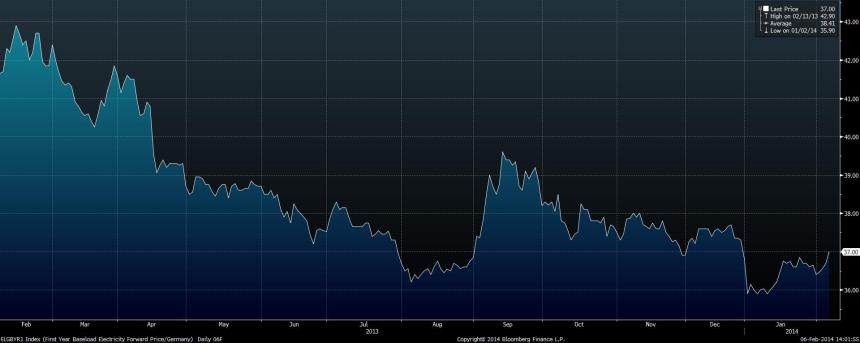
First, at least to me it looks that Electricity prices have at least for now stopped their free fall as those two charts show:

I am clearly not an expert on electricity prices, but with the currently mild winter (or no winter at all), I would have expected a further drop but that doesn’t seem to happen at least for now.

Political environment

Since last year, again some things have changed. We have now the “GroKo” in Germany, the coalition between the two large parties, conservative (CDU) and Social democrats (SPD). Interestingly, the boss of the junior party SPD, Sigmar Gabriel, has taken over the responsibility for Energy.

As I described a year ago, under the current system, mostly retail clients have to pay a surcharge in order subsidize above-market prices offered to the owners of solar and wind power plants. Many large companies are not subject to this “tax”.

The surcharge is increasing every year, both because of lower wholesale prices and additional capacity. However, pressure is building up against this system from many sides. Clearly, the established utilities are fighting against this as hard as they can and threaten to switch of expensive gas-fired power plants which are essential for net stability. But now, also the EU commission started to look into the exceptions for large companies already in December.

Also the core voters of the SPD are mostly lower-income recipients which are most effected by increasing electricity prices along rising rents. So Sigmar Gabriel, the SPD energy minister has to do something in order to stop further retail price increases or he will have no chance of winning the next election. Some ideas were already floated, mostly a limitation of future renewable capacity and lower rebates in the future. The concept drew a lot of critic from all side, although some parts, especially the requirement for direct marketing of renewable power doesn’t seem to be that bad.

In parallel, the bankruptcy of wind energy “pioneers” like Prokon shows that even under current high transfer payments, the big boom in new renewable energy seems to be mostly over and I guess investors will be much more careful in the future.

On top of that, the big utilities are taking out a lot of conventional capacity in Germany, party also in order to increase the pressure on the politicians.

So without being an expert in those issues, it looks like that the “tide might be turning” at some point in time in the future with regard to electricity prices or at least that they are not falling that much more. But this is clearly my own opinion and cannot be supported by a stringent theory or facts.

But why Energiedienst ?

As I have written before, the big traditional utilities like RWE, EON etc. have a lot of other problems, like too much debt, nuclear liabilities, pensions, problematic foreign subsidiaries etc. Even Verbund, thy Austrian Hydro Power utility has a lot of issues with Italian and other foreign investments. Energiedienst, on the other hand does not have those additional issues.

Energiedienst still looks more expensive than its peers:

Name P/E EV/T12M EBIT EV/EBITDA T12M P/B Dvd 12M Yld – Net Net D/E LF
             
ENERGIEDIENST HOLDING AG-REG 11,8 10,2 5,9 0,8 5,2 -7,8
VERBUND AG 9,4 9,8 4,8 1,1 3,8 70,5
RWE AG 108,3 7,2 3,0 1,5 7,4 77,9
MAINOVA AG 15,4 50,5 23,3 2,3 2,4 76,4
E.ON SE 12,2 8,2   0,7 8,3 45,2
ENBW ENERGIE BADEN-WUERTTEMB 51,0 13,0 6,1 1,4 3,1 43,0
LECHWERKE AG 21,7 21,6 14,7 3,1 2,8 -55,8

They do not jump out of this comparison table as the “super cheap” utility. But if we look at Lechwerke in comparison, a comparable, regional, Hydropower utility in Bavaria owned by RWE, sometimes quality is honored with very rich valuations.

In my opinion, the quality of Energiedienst, especially in comparison to EON, RWE & Co is not reflected in the share price. Clearly they suffer as well from current electricity prices and they are not a growth stock, on the other hand, as a hydropower generator without variable input cost, they will benefit the most from increasing prices.

The downside at the current level is in my opinion relatively protected, unless they do something really stupid with their net cash. This is in my opinion the key issue to watch going forward. Energiedienst will generate a lot of cash as reinvestment requirements will be rather limited. If they owuld actually start ti buy back shares, this couldbe a nice surprise but there is no indication that they willdo so.

I am aware that buying a German utility stock now is a pretty contrarian play and many people will say EON and RWE are cheaper and could more speculative upside or not to invest in utilities at all. My focus however is more on the downside, where I think Energiedienst is much better protected than the big, indebted players. So overall, I think the “full” risk/return relationship of Energiedienst is better.

Summary:

An investment into Energiedienst is clearly a bet on constant or higher electricity prices based on potential political changes, so it is rather a “special situation” investment with regard to potential regulatory changes from the current, unsustainable status quo. What I like about this bet is that to a large extent this will be driven by political actions which will be either uncorrelated or even negatively correlated to the overall economic situation and hence, to the rest of my portfolio.

My return target over 3 years would be the annual dividend of currently 5% plus a stock price increase of ~30% which would indicate a target P/E of 13-14 at current Earnings (ex then cumulated cash).

So for the portfolio, I will initiate a 2.5% position for the “special situation” bucket at ~29.50 CHF / 24.50 EUR per share.

Prime Office AG (DE000PRME020) – Strange rights issue

I have linked to the “special situation” stock Prime Office already in the past. The story in short:

Oaktree has effectively taken over a struggling German Office Reit by contributing a portfolio of office assets of their own. They then changed the status from REIT to “normal” company. In order to reduce the debt level, they started a rights issue a few days ago.

However this rights issue has a strange twist: Although the subscription rights are already traded (ISIN DE000PRME1B7), they did not publish the subscription price of the new shares yet.

Just as a reminder, let’s look how the value of a subscription right is calculated (from Stockopedia)

The calculated value of a subscription right. The theoretical value of a right during the cum rights period – which is the interval after the announcement of the rights offering but before the stock trades on an ex-rights basis – is calculated by the formula:

(Stock Price – Rights subscription price per share) / # of rights required to buy one share + 1

What we do know is that there will be 8 new shares for 23 old shares, that they are offering (up to) 46.58829 mn shares and that they want to raise 130 mn EUR. So one could calculate a theoretical subsrciption price of (130/46.59) = 2.70 and a value of the subscription right at the time of writing of (2.81-2.70)/(23/8+1)= 0.0283 EUR which is silghly lower than the traded prcie of 0.031 EUR per right.

But what I am asking myself is the following: Why did they do this in such a strange way ? Why didn’t they fix the price in the beginning as in very rights issue I have seen up to now ? I have no idea but I will watch that one closely.

Celesio Merger arbitrage “Post mortem”

So roughly 10 days after the first failed attempt, Haniel today announced that they have an agreement with both, McKesson and Elliott and that Haniel will sell for 23,50 EUR per share to McKesson.

What happened in between ? Elliott, after the failed attempt further increased its stake to 32% (including convertibles).

In a second step, Elliott sold its stake for an undisclosed price to Haniel, which then in turn sold the 75% plus stake to McKesson at the initial 23,50 EUR.

This structure achieved the following goals:

– Elliott got more than 23,50 EUR
– McKesson does not have to pay more than 23,50 EUR

The “Looser” is clearly Haniel, which will have proceeds lower than 23,50 EUR per share. A friend of mine argued that most likely Haniel paid 24,50 EUR which would roughly equal the initial 23 EUR per share. If this is that case, then we would have the paradox outcome, that the majority owner got the lowest price, the minority a little bit more and the Hedgefund the most.

This is something to keep in mind for potential future merger arbitrage deals: The minority shareholders might not get the same deal as the activist shareholder, at least in the cases where a majority shareholder is selling. In this case, the minority holders got a 50 cent better price than the initial bid, but I could imagine scenarios where there is also the risk of a lower bid.

Interestingly, the stocks jumped today over 25 EUR, I guess some people are already speculating on a compensation payment following the Profit & loss transfer agreement which is the logical next step after the purchase.

Personally, I don’t think that there is a lot of upside, but who knows ? In any case, I think Elliott played that one pretty well for themselves. In any case, this is a hard blow to JP Morgan as M&A advisor to Haniel.

There could be open questions if the whole deal could be interpreted as “acting in concert” between Elliott, Haniel and McKesson. In this case, the bid for all shareholders would need to be increased to the price paid from Haniel to Elliott. I have no idea how likely that is and would not bet on this either.

Celesio – why merger arbitrage is hard business

Let’s start with a few quotes from yesterday’s post:

a) It is almost 100% assured that the bid goes through, there is now a “floor” under the stock price at 23,50 EUR

and

I have written above that this was a “Low risk” bet. In reality, I do not know if it was high risk and I was very very lucky or if it was indeed low risk. In statistics, one would call this a “beta error”, assuming that one was right but in reality the probabilities were very different. For me the best way to handle this is to do only small “bets”, keep track of assumptions and outcomes. Systematic “beta errors” in investing in my opinion are very dangerous as this will inevitable lead to some disastrous outcomes in the long run (Bill Miller).

Very rarely, one gets such a direct feedback from the market. McKesson said yesterday around 7 pm that they did not reach the 75% threshold and dropped the bid.

So this was clearly no a low risk M&A arbitrage situation but a high risk one and I was very very lucky to exit just in time.

McKesson themselves seems to be surprised as well:

“This is fresh news to us. We obviously had the support of the management team, we had the support of the family, which obviously was a significant holder, we had the support of Elliott, which was one of the vocal players in this process,” he said. “The best I can speculate is that people either forgot the tender date or they somehow believed that there is more on the other side of this.”

Let’s quickly check the facts:

In their 9th notification, dated January 9th, 2 pm, McKesson reported the following:

As of the Notification Reference Date, based on the regular conversion price, the aggregate number of Celesio-Shares held by the Bidder and/or persons acting jointly with it plus the number of Celesio-Shares for which the Takeover Offer has been accepted plus the number of voting Celesio-Shares which can be acquired through instruments pursuant to section 25a WpHG amounts to 106,213,544 Celesio-Shares; this corresponds to approximately 62.44% of the currently issued share capital and the currently existing voting rights in Celesio. In relation to the acceptance threshold in section 13.1 of the offer document the aggregate number amounts to 107,617,021 Celesio-Shares, which corresponds to approximately 52.94% of the share capital and the voting rights in Celesio on a fully diluted basis.

This was a significant increase against the 44,88% (fully diluted) a day before.

How much did Elliott own ?

This is from their official “recection” notice as of December 23rd:

Elliott Associates, L.P. and Elliott International, L.P. together with affiliated entities (“Elliott”), which own or have an interest economically equivalent to over 25% of Celesio AG (1)
(1) Calculated in accordance with Section 25a of the German Securities Trading Act (Wertpapierhandelsgesetz/WpHG), in connection with Sections 21, 22 and 25 WpHG

Elliott did report surpassing the 25% threshold in late November 2013.

If I read this correctly, they owned 25.1% on a non-diluted basis.

So let’s do quickly the math with what we have available:

  Undiluted Diluted
McK 107,617,021 62.44% 52.94%
Elliott 42,803,603 25.16% 21.06%
Total   87.60% 74.00%
       
Celesio      
Shares undiluted 170,100,000    
Shares diluted 203,281,113  

So this is interesting: Even with Elliott tendering its full stake, McK was still short 1% to their threshold on a diluted basis.

Could it be that this whole thing was just an accident ? No super-clever play by Elliott but rather a stuoid one ? Were other people assuming like myself that the offer period would be extended ? I don’t know, but I think it would have been better if MCK had said something about the offer period.

Looking back at the Rhoen chart after the first bid failed, one can expect the stock price to be very very volatile:

Anyway, I will watch this from the side line and will be extra carefull with the next M&A arbitrage situation….

Celesio Merger Arbitrage – follow up (and exit)

On Thursday, acquirer McKesson and Elliott agreed on a slightly increased offer 23.50 EUR (vs. 23 EUR) per share which Elliottt promptly accepted.

Interestingly,the stock trades now higher than the offer:

Apparently, during Wednesday some people already anticipated the increased offer. Technically, the acceptance period has not been extended and closed on Friday, January 9th according to the official statement. Honestly, I do not understand this. If I read §21 of the German take over law correctly, any late change in the offer automatically extends the offer period by 2 more weeks. I will need to double-check this.

The offer for the 2018 bond was also increased to 123.4 according to the amended bond offering document.

So what to do now with the price of he shares trading above the 23,50 EUR offer ?

Going back to the initial post, that’s how I valued the shares back then:

Now if we want to speculate on a top up, we have to make two assumptions: How likely is a top up and how large will it be ? In order to keep it simple, I would assume a 50/50 chance for a top up and as I like “round” numbers, I assume 5 EUR per share or a final offer at 28.

This leads us to the following expected value under those assumptions:

Exp. value Celesio share = (3.4% x 17) + (48.3% *23) + (48.3%*28)= 24.25 EUR or around 10.6% higher than the current share price.

So if we leave aside the rather bad mistake in calculating the upside potential, the price is now where I saw the “fair value” before, although I was totally wrong about the size of the “top up”. The reason that I still can make some money was that I bought below the initial bid price and the stock price did overshoot the offer.

Now we do have a very different situation compared to some weeks ago:

a) It is almost 100% assured that the bid goes through, there is now a “floor” under the stock price at 23,50 EUR
b) on the other hand it is a lot less likely that the bid will be further increased.

I can think of two reasons why the stock is currently trading above 23,50 EUR:

1) People are hoping that Elliott might have one last trick up in its sleeve to increase the offer within a relatively short time
2) Speculation that McK wants to quickly achieve a squeeze out and will buy more shares and/or have to pay some compensation for implementing the profit and loss transfer agreement (similar to MAN).

Overall, the “new” situation for me is harder to grasp and the time frame is more difficult to estimate. One should also expect, that Celesio will show most likely a lot of extra charges etc. in the next few quarters in order to both, build some buffer for Mckesson in the future and to discourage shareholders bidding up the remaining shares.

So for the portfolio, I will exit the position at current prices with a modest gain of around 6.5% for the shares and a little less for the bonds. Not spectacular but also not bad for a 4 week and relatively low risk investment.

One final remark on such M&A Arbitrage situations:

I have written above that this was a “Low risk” bet. In reality, I do not know if it was high risk and I was very very lucky or if it was indeed low risk. In statistics, one would call this a “beta error”, assuming that one was right but in reality the probabilities were very different. For me the best way to handle this is to do only small “bets”, keep track of assumptions and outcomes. Systematic “beta errors” in investing in my opinion are very dangerous as this will inevitable lead to some disastrous outcomes in the long run (Bill Miller).

« Older Entries Recent Entries »