Category Archives: Opportunities

Quick check: CIR Spa (ISIN IT0000080447) – HoldCo sum of part play with “special situation” catalyst ?

This is an idea I read recently on the beyondproxy blog/site.

As my first attempt at this post somehow disappeared, I will now just copy the introduction from the beyond proxy post:

CIR Group is a company whose story is an intricate all-Italian tale of family ownership, corruption and dirty politics. This unique combination of factors seems to be frightening investors away from the company thereby causing its shares to become substantially undervalued. Within the next two quarters however, the Italian courts will decide on a legal dispute that will put an end to the tale and, most likely, a higher valuation on the stock.

CIR is structured as a holding company. It owns controlling interest in four businesses (Sorgenia, Espresso, Sogefi and KOS) and has substantial investments in alternative assets such as hedge funds and other financial instruments. Its liabilities consist mainly of €300mm of publicly traded bonds and €564 million of legal reserves.

and this is the “kicker”:

CIR carries a €564 million liability that has been booked as “Borrowings”. In reality, this is not borrowed money – it is a legal reserve for an infamous legal proceeding that has been making headlines in Italy for the past twenty years: the so-called ‘Lodo Mondadori’.

The author (a Italian grad student by the way) then values the company with a simple sum of part model, using share prices for the listed subsidiaries (Espresso, SOGEFI) and NAVs (P/B=1) for the unlisted shares (utility Sorgenia, hospital KOS). As a result, the author sees an upside of at least 20% in any case or up to 135% in case of a positive outcome of the “Berlusconi situation”

I think this is a good starting point, but I would adjust the approach slightly:

1. add control premiums to the participations
2. adjust NAVs for unlisted participations if appropriate (and comparables are available)
3. deduct finally a control premium for the CIR share

One could ask: Why add control premiums and then deduct them again ? Well, clearly, being a minority shareholder in the middle of an Italian shareholding chain is not the best position to be in. The main effect of this approach is to deduct a control premium from the expected Berlusconi settlement. This should be done as one does not know what happens with the money. I assume it will not be paid out as a dividend.

Assumptions:

1. For a control premiums in both cases I assume 30%
2. For the unlisted utility, I will use a P/B valuation not at nAV but at 0.5 times NAV. This is in line with similar Italian utilities like Iren (0.58) and Enel (0.6). I use 0.5 because the others are even profitable, Sorgenia is not.

First step: Sum of parts ex “Berlusconi”

CIR Spa 12/2012          
 
Assets          
    mn EUR MTM Control premium MTM + prem
Participations 1,192        
– Sorgenia   197.7 186 30% 241.8
– Espresso   341.7 178 30% 231.6
– Sogefi   106.9 172 30% 223.7
– KOS   99.2 99.2   69
– CIR Investimenti   421 421   421
– others   25.5 25.5   25.5
           
Receivables (group) 320   320   320
Cash, securities 291   291   291
other 67   67   67
Total 1,870   1,760   1,891
           
Liabilities          
LT debt -299   -299   -299
“Berlusconi liability” -564   -564   -564
Other -68   -68   -68
Total -931   -931   -931
           
NAV 939   829   960
shares 793.3   793.3   793.3
NAV per share 1.18   1.05   1.21

This rather simple table shows how i moved from the current “carrying values” in the HoldCo balance sheet of CIR Spa Holding to my mark-to-market valuation BEFORE applying the overall control discount. Remark: Using consolidated numbers for a company consisting of mostly 50% participations does not make a lot of sense.

Step 2: Berlusconi scenarios and control discount

before tax After Tax Per sh NAV Upside -30% control Upside
               
Base case       1.21 27% 0.85 -11%
Berlusconi min 150.0 97.5 0.12 1.33 40% 0.93 -2%
berlusconi max 564.0 366.6 0.46 1.67 76% 1.17 23%
Belusconi Mid 357.0 232.1 0.29 1.50 58% 1.05 11%
last news -15% 479.4 311.6 0.39 1.60 69% 1.12 18%

Here you can see the base case (as is) and 4 potential scenarios for the payment, assuming that 150 mn before tax is the minimum. The upside is calculated based on a current share price of 0.95 EUR per CIR SpA share

We can see that after applying the -30% control discount on the sum of part, without the Berlsuconi settlement, the shares look rather expensive. The max. upside with around +28% is rather limited at this price.

So it looks like that some of the expected Berlusconi payments are already priced in. At that price, I don’t think CIR SpA is attractive if one applies a 30% control discount.

Legal disputes /court cases as special situationss

In general, legal disputes are often quite interesting special situations. This is a quote from the 1951 edition of Ben Graham’s 1951 edition of “security analysis” (via CS Investing):

Class D Litigated Matters.

There are fairly numerous cases in which the value of a security depends largely on the outcome of litigation. This may involve a damage or subordination suit (e.g., International Hydro Electric, Inland Gas Co.); disputed income tax liability (e.g., Gold and Stock Telegraph, Pittsburgh Incline Plane); an appeal from a reorganization plan wiping out stock issues (e.g., St Louis Southwestern Ry., New Haven R.R.). In general, the market undervalues a litigated claim as an asset and overvalues it as a liability. Hence the students of these situations often have an opportunity to buy into them at less than their true value, to realize attractive profits—on the average—when the litigation is disposed of.

What kind of holding company is CIR SpA ?

A few months ago, I had a post about how I distinguish Holding companies:

For myself, I distinguish between 3 forms of holding companies:

A) Value adding HoldCos
B) Value neutral HoldCos
C) Value destroying HoldCos

Back then, we saw that even for a “value neutral” holding like Pargesa, a 30% discount applied. So implicitly I assume CIR SpA is value neutral as well. At least the reporting is quite transparent. In the past, CIR was involved in many typical Italian Feuds like Olivetti and Mondadori, but I haven’t read anything that they try to screw minority shareholders of their own group.

Although Benedetti Junior looks a little bit like someone who enjoys doing shady deals 😉

According to the last annual report, Benedetti Senior has ceded control of CIR SpA to his sons.

Summary:

Although I like the unique aspect of this special situation, the potential upside is NOT attractive enough to justify an investment at current prices.

I will keep this on the radar but I would not invest above ~0.70 EUR. I would need 50% upside in order to justify the risk of the underlying companies which are clearly struggling.

Friday night IVG Bombshell

Friday night, 8 pm seems to be a good time to land a real bombshell. IVG distributed an Adhoc notice with some update information about the upcoming restructuring.

Among other stuff, the comment on potential recovery rates in a liquidation. This is the German original:

ergäbe folgende Befriedigungsquoten: ca. 96% bis ca. 100% für Objektfinanzierungen (Carve out debt), ca. 86% bis ca. 89% für den syndizierten Kredit von 2009 (Syn Loan II), ca. 46% bis ca. 55% für den syndizierten Kredit von 2007 (Syn Loan I) und ca. 27% bis ca. 41% für die Wandelanleihe. Die Gläubiger der Hybridanleihe und die Aktionäre der Gesellschaft würden in diesen Fällen voraussichtlich jeweils keine Befriedigung erhalten.

So nada/niente/rien for Hybrid and Equity and only 27%-41% for the convertible. This is significantly below the latest trade of around 58% as of today.

After all, my summary from May seems to be spot on:

the likelihood of IVG “surviving” long term in my opinion is very small or even zero. So equity and hybrid should be avoided

I am really glad that I sold out:

Overall, for the portfolio I would for the time being sell down the position at current rates and eat the loss. I am pretty sure that I am too early but as I know that I am a rather bad short term speculator, I want to play this safe.

This is by no means over yet but it doesn’t look good.

Interestingly, Third Avenue seemed to have bought into IVG earlier this year. That’s what they say in their last shareholder letter:

Our analysis determined that the IVG Convertible Bond swere most likely the “fulcrum” security in the capital structure. In other words, holders of the IVG Convertible Bonds are likely to participate in a debt-for-equity restructuring, and the subordinated securities(preferred and common) would retain little or no value. IVG Convertible Bonds mature in 2017, but holders have an option to put the bonds to the company in 2014. The Fund purchased approximately 5% of the outstanding IVG Convertible Bonds at an average cost of sixty-eight cents on the dollar. As a larger holder,we anticipate having a seat at the table with the company

Man, that sounds really stupid. Even I had found out that the “fulcrum” security were the loans. it seems to be that Marty Whitman’s successors got a little bit sloppy.

So let’s get some Popcorn and watch what will happen on Monday.

Short cuts: Kabel Deutschland, Rhoen Klinikum, Greek GDP linker, Royal Imtech

Kabel Deutschland

Man, this looks like I got it really wrong. According to some press articles, now Liberty wants to buy Kabel as well for 85 EUR a share. So there seems to be a bidding war before even the first official bid has been announced.

The interesting point of this “red-hot” news is that Liberty has already once tried to buy the former Telekom Cable network in 2002 but this was not approved by the German Kartellamt.

How realistic is this ? I am not sure. Just in February, the German Kartellamt blocked the takeover of the smaller rival Telecolumbus by Kabel Deutschland itself because even the combination of KAbel Deutschland and the smaller rival was a problem for them.

So what is going on here ? I have no idea, but to a certain extent it looks like one of the best “stock promotions” ever. What kind of M&A process is this when everything “leaks” to the market ?

For some market participants, this doesn’t matter anyway. My “favourite bad research provider” Makor (yes, those guys who use the wrong formula to calculate fair prices after right issues) has the following recommendation viea Bloomberg:

We recommend initiating positions in Kabel shares, as we consider the shares trading about fair value in the context of a possible offer. However, given the strategic interests for the potential buyers (Vodafone, Liberty Media), a premium is probably justified and notwithstanding regulatory issues, a price above Eur 90/sh could easily be justified.

Wow, sometimes the stock market is so simple.

Rhoen Klinikum

Unfortunately, the “Rhoen surprise” did not last very long. Some more details were emerging . It looks like that the boss of the supervisory board (and the guy who wants to sell to Fresenius) decided, that the 5% votes of one of the blocking shareholders were not valid. The result will most likely be a court battle over up to 18 months. So lets wait and see what happens.

Greek GDP linkers

The most recent jump in the GDP linker seems to come from a “research piece” of Deutsche bank which several readers forwarded to me (thank you guys !!!).

Let’s look how the look at the nominal hurdle:

Based on the latest IMF forecasts, the 2011 level of GDP is expected to be re-attained in 2017. By fixing this point, we can then solve for the nominal growth rate required in order to exceed the nominal GDP threshold in a given year. We find that in order to exceed the threshold in 2022 (for warrant payment in 2023) would require a YoY nominal growth rate of 5.0%. A growth rate of 3.6% would be required to meet the threshold in 2024. If recovery to the 2011 level is achieved a year earlier than expected (in 2016) then the required growth rate for the first payment to be in 2023 falls to 4.2%, or rises to 6.3% assuming a year delay. These sensitivities are illustrated in the chart to the right.
Although it is far from certain, it seems reasonable to assume 2023 to be the year when payments commence on the warrants.

Ok, so the basic assumption is that the new IMF forecast from 2012 is now correct, after the initial forecast was completely wrong. Hmm, one might call this “positive thinking” if one wants to be nice.

Their final conclusion (after some “nonsense funky doodle” modeling) is as follows:

The combination of more stable macro-economic assumptions, and reduced default probability now mean that we find the current valuation of the warrants as being broadly justified (relative to the GGBs). Considering our constructive view, the additional beta of the warrants and also the additional ‘yield’, we now find the GDP warrants to be more attractive than the GGBs themselves as a means to take exposure to an eventual Greek recovery. We caveat that such a recovery remains uncertain and will likely be lengthy; implying that any anticipated outperformance of the warrants should be seen as a medium to long-term expectation.

So this conforms my view, that the GDP linker is more like a short-term “beta” play than an intrinsic value” investment as the Deutsche Bank “analysts” only take the IMF projection as fundamental basis and do not add anything new here.

Royal Imtech

Royal Imtech has released a quite bad Q1 report. It looks more and more that larger parts of the company are in real trouble and that the fraud might have been just the “top of the iceberg”. Time to take them of the “rights issue watch list”. As I am not a “fraud-turn around” investor, this seems to be the not the situations I am looking for.

Rhoen Klinikum special situation – Nice suprise

Rhoen Kliniikum was a special situation, where I took a half position last year. The simple idea was that the failed take over attempt by Fresenius would “revive” at some point in time plus the stock was solid and relatively cheap.

Now it seems that this is paying of sooner than expected. In today’s shareholder meeting, the existing poison pill which killed the take over was effectivly removed according to this article:

The existing requirement that 90% of shareholders have to approve a merger was changed into 75% requirement. This means that the current players which tried to block the take over by Fresenius (Braun and Asklepius, 5% each) either will have to give up or buy some more shares.

Both should e very positive for the shareprice.

AFter hour, the shareprice jumped already ~20%:

If the price gets near the old offer (22,50 EUR), I would sell the position.

Note to myself: Check TNT Express again…..

Kabel Deutschland & Vodafone reloaded

One of my two remaining short position gets “smoked” today. Kabel Deutschland is up ~7% to a new ATH:

The reason is once again the (now somehow confirmed) rumour that Vodafone wants again to take over KAbel Deutschland:

It started (again with the “rumour” as last time:

(Reuters) – Vodafone Group Plc has made an informal takeover bid within the past week for Germany’s biggest cable company, Kabel Deutschland Holding AG, Bloomberg reported, citing people with knowledge of the matter.

In the meantime, to my surprise, Vodafone confirmed the talks:

LONDON—Vodafone Group PLC said it has approached Germany’s biggest cable operator Kabel Deutschland Holding AG about a possible takeover, a move that would mark the U.K. mobile-phone company’s largest acquisition in Europe in more than a decade and add more customers to its triple-play offering of TV, mobile and broadband.

“There is no certainty that any offer will ultimately be made, nor as to the terms on which any such offer might be made,” Vodafone said in a brief statement Wednesday.

Kabel Deutschland confirmed it has received a preliminary approach from Vodafone, but also said there is no certainty an offer will be made.

So this is clearly against my expectations when I made the short. I have to admit that I don’t understand Vodafone. Why would they start such talks again with the danger of a leak again when the exact same thing happened a few months ago.

My only explanation is that they are either extremely desperate or extremely stupid. Or both.

Vodafone shareholders didn’t seem to be too enthusiastic either. So lets wait and see what happens. One first lesson is clear: Never underestimate the stupidity of others. Vodafone has done already one horrible overpriced German acquisition (Mannesmann) in the past. However, most likely most of those people who did this back then were already fired and now they make the same mistake again.

Clearly I also made a mistake here. It is definitely much more risky to short stocks with no majority shareholder in an industry which is famous for overpaying for M&A transactions.

EDIT: Real time comment for a quite “famous” Vodafone investor:

Vittorio Colao the urbane but seemingly incompetent CEO of Vodafone is the new Sir Fred Goodwin.

Some more thoughts on IVG & “ESUG” special

DISCLAIMER
As always do your own research. Don’t follow tips blindly. In this specific case I would not recommend any private investor to invest in this security as the situation is very complex and more bad news should be expected.

Just a remark at the beginning:

Some people asked me why I post so much on such a crappy company like IVG and do not post more about “great value stocks” like IGE & XAO. The answer is quite simple: First, I don’t find that many attractively priced value stocks any more. Secondly, the blog was always meant to be a value AND opportunity blog. Opportunities in my definition are one-off situations where the payout is relatively independent from overall market movements. Additionally I think the IVG case is so interesting, that it would be a crime not to look at this in detail. Complicated capital structure, new German insolvency law, US hedge funds, real estate exposure etc. There is so much to learn here.

Back to IVG:

Lets start with a question from the comments:

Now regarding the convertible I have some questions
1) Going concern scenario:
a)How likely is it in your view that they keep as a going concern in 2014 (ie are able to refinance the convertible)
b) At what value will IVG refinance the convertible
c) How are they going to do it (sell property, give equity …)
3) Bankruptcy
a) How much will be the recovery value
b) How long does to realize the recovery value
c) Is the IRR worth it?

Well, the answer is: I don’t know. But we can start with a very easy guess (and of course everyone can criticize and make it better):

1) Start with 50/50: That would be the base assumption if you don’t know better with every binary “option”.

At the current price of ~60% we can work back the recovery quite easily (very simplified:

60% = (0,5*100 %) + (0.5*x%) with x being the recovery.

So the implicit recovery would be (60%-50%)/0.5= 20%.

But attention: those 20% would represent the market value of the then defaulted security. If we assume that the workout period is 3-5 years in a real “messy insolvency”, and buyers of defaulted securities charge at least 20% p.a., then this implies a current recovery value between 20% * (1.2)^3 = 35% and 20% * (1.2)^5 = 49%.

So to make this clear: If the current ultimate recovery is 50% and they need 5 years to distribute the liquidation proceeds, the current price of the convertible is a fair price !!! It would be a very big mistake to calculate the current value of the underlying assets and not take into account the time delay. (This is by the way one of the lessons from Zeke Ashtons presentaton to which I linked in the last post).

As I mentioned before, in my opinion, the current asset value is more like 80%, so I would expect (immediately after insolvency) a price range of 32%- 46%. Based on a 50/50 percentage, this would move the current fair value to a range of 62-73% of nominal, slightly above the current value of 60%.

Based on this binary scenario alone, I guess the convertible bond would not merit an investment at the moment, as the downside is quite significant.

However as most things in live, also the IVG situation is not binary. As it was discussed in the blog already quite a few times, some hedge funds are looking into “restructuring” the company without a liquidation in the end.

Logic behind the restructuring idea – REIT & Taxes

In my opinion, the restructuring idea does have some logic and might even create value. Why so ?

As far as I understand, the Hedgefunds want to lower debt in order to be able to transform IVG or a part of it into a REIT and in that process sell down/spin-off the other stuff like the asset management and the Caverns.

IVG in its current form does not make a lot of sense for investors. If you invest int IVG because of the real estate, the profit gets taxed 2 times, once on the corporate level and then again on investor level. A real estate investment via a REIT gets taxed only at the investor level, there are (almost) no taxes on the corporate level. If we assume 30% taxes, a fully equity financed real estate portfolio would be 30% more valuable in a REIT than in a normal company. Adding debt reduces the difference but even with debt at the level of IVG, there is still a tax disadvantage of maybe 15% or so of the current IVG vs.a REIT.

Another point which might make a restructuring event much more likely than a liquidation are taxes. On the one side I assume that the DTA will stay in a restructuring event, therefore greatly enhancing the overall value, secondly, there is no need to sell the real estate and pay property transfer taxes (up to 5% in Germany). So the restructuring alternative sounds like a no brainer compared to the liquidation scenario for almost every party involved in this.

How would/should the restructuring work (“ESUG”) ?

Well, this is the hard part and I do not have a lot of experience with that in detail. Plus we have a relatively new insolvency law in Germany (“ESUG”) which has not yet been tested in such a big case.

Let us look into the “ESUG” (“Gesetz zur Erleichterung der Unternehmenssanierung”) a little bit more closely. ESUG is meant to bring the concept of the American chapter 11 to Germany. Up until now, it was very difficult under German bankruptcy law to really restructure a company. The new “ESUG” which came into effect in MArch 2012 should change this.

However, until now there are not that many succesful restructuring stories in Germany.

If one googles “ESUG” one can find a lot of issues with the new law, for instance here at WiWo or here at Handelsblatt.

The best overview about the current status of the ESUG that I found was this study from Roland Berger. A very good document how the debt/equity swaps works can be found here.

To summarize what I have learned from this:

– there seems to be a big issue currently for holders of subordinated bonds, as they are not represented separately within the ESUG process. Another reason to avoid the IVG HYbrid.
– so far, there is no precedent for a debt/equity swap. Unchartered territory so to say, especially for senior unsecured holders
– However, there seems to be checks and balances in place that unsecured holders receive shares etc. according to the “fair value” of the claims.
Decisions are taken by simple majorities. I guess this is done by debtor group. So “hold-outs” do not really matter in the restructuring scenario anymore

What does that mean for IVG ?

In my opinion, the restructuring case via ESUG is the most likely one. Thinking it through, it is even for the convertible holders most likely a lot better than liquidation. The DTA could remain in place (and have value), one doesn’t have to pay property transfer tax etc. The question is clearly how much of that value will be shared by the “super senior” creditors.

One the one hand, IVG will be “THE” test case for the new law and people involved (advisors etc.) will make sure that senior holders will be treated fairly to a certain extent so that this kind of restructuring will happen more often (and create fat fees for advisors….). On the other hand, the Distressed debt players with a lot of restructuring experience could try to use this to make a absolute “killing” on the back of the unsecured holders. As the Jackpot is quite high with 4 bn plus, this is a real concern.

So after this preliminary ESUG analysis, I think now that the restructuring event is very likely.

Back to the calculation

So finally back to a calculation of a fair value. Staying with simple 50/50 rules I assume the following:

1) There is a 50% chance for a proceeding according to ESUG. Within the ESUG process, I assume with 25% propability that the unsecured holders get screwed (25% recovery), and a 25% probability that the unsecured holders get a fair share (75% recovery)
2) for the remaining 50% probability I will again divide into 25% for the payback at par and the liquidation scenario.

So my current fair value for the convertible looks like:

0.25 x 75% + + 0.25 * 25% + 0.25 x 100% + 0.25 x 40% = 60%

Of course, this calculation is highly subjective and any of the assumptions can change pretty quickly and will not remain stable over the course of time.

So under this asumption, the convertible is fairly priced, no big upside from an intrinsic value point of view.

What now ?

To be honest, I am not so sure anymore. Do we see something like a short bounce if they come up with some sort of rescue attemptlike at Prakiker ?there I got out too early, howver now the bond is already back to deeply distressed levels:

I would argue that this is less likely for IVG as the small investors will not touch this due to the high nominal value and the “pros” are a little bit more cautious here.

On the other hand it could be an interesting situation once the “ESUG” restructuring is running or even as restructtured equity play.

Summary:

Looking a little bit deeper into the different possible outcomes, for me a few important take aways remain:

– the likelihood of IVG “surviving” long term in my opinion is very small or even zero. So equity and hybrid should be avoided
– the restructuring scenario (ESUG) might not be so bad for the senior bonds as many fear although it is unknown territory
– there is still the possibility that IVG manages to repay the convertible at par, but it is not very likely as for most secured creditors, a ESUG style reorg would not hurt that much
– buying inot the secured loans at 80% looks like a lot better value, however I can’t do this as private investor

Overall, for the portfolio I would for the time being sell down the position at current rates and eat the loss. I am pretty sure that I am too early but as I know that I am a rather bad short term speculator, I want to play this safe.

To Do: Read more about ESUG. Any tips for a good book are highly appreciated !!!

DISCLAIMER
As always do your own research. Don’t follow tips blindly In this specific case I would not recommend any private investor to invest in this security as the situation is very complex and more bad news should be expected.

IVG – JPM Research on property values

A friendly reader forwarded me a current equity research report from JPM about IVG.

Not surprisingly, they estimate the value of the share as zero:

Our EVA based European
Valuation Model implies zero value for IVG ordinary equity as a going concern, while a DCF driven revaluation implies zero equity value on the existing balance sheet. We therefore lower our Mar-14 EVM based price target from €2.22 to €0.01, and await the announcement of restructuring plans over summer 2013.

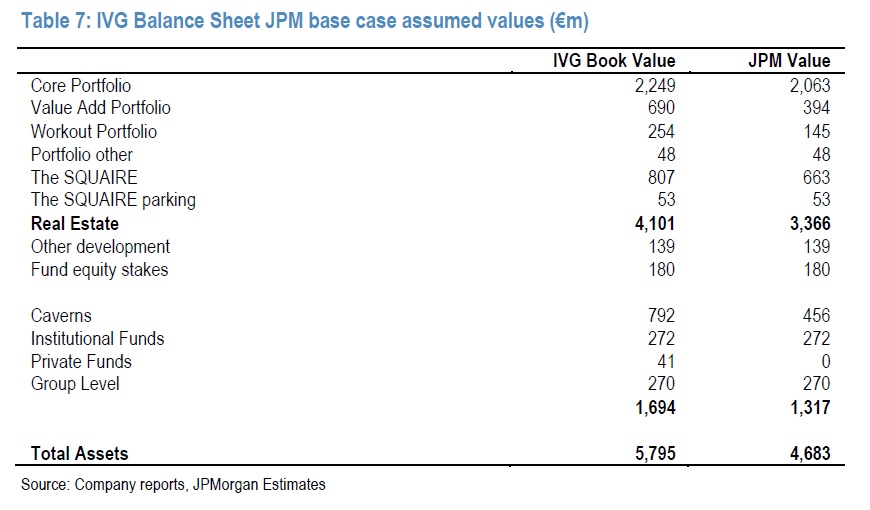
Although one might wonder, why they had a 2.22 EUR price target before. Much more interesting is that they actaully come up with an asset value for the IVG portfolio which looks as follows:

ivg jpm valuation

Although they use slightly different adjustements, thei asset value is very similar to what I calculated a couple of weeks ago:

2011 Adj. Val 2012 Adj.Val Comment
Intangibles 251 0 253 0 100% write off
Inv. Property 3,964 3,398 3,654 2,920 scaled to 7% yield
PPE 157 118 190 143 25% discount
Financial Assets 189 142 174 131 25% discount
equity part 95 71 84 63 25% discount
DTA 404 0 336 0 100% write off
Receivables 60 45     25% discount
   
Inventory 1,025 513 996 498 50% discount
Receivables 179 134 190 143 25% discount
Cash 238 238 142 142 0% discount
   
AFS 341 256 58 44 25% discount
Asset Management 275   318 1.5% of AUM
Marekt value caverns 163   140 50% of disclosed adj.
         
Total 6,903 5,351   4,540

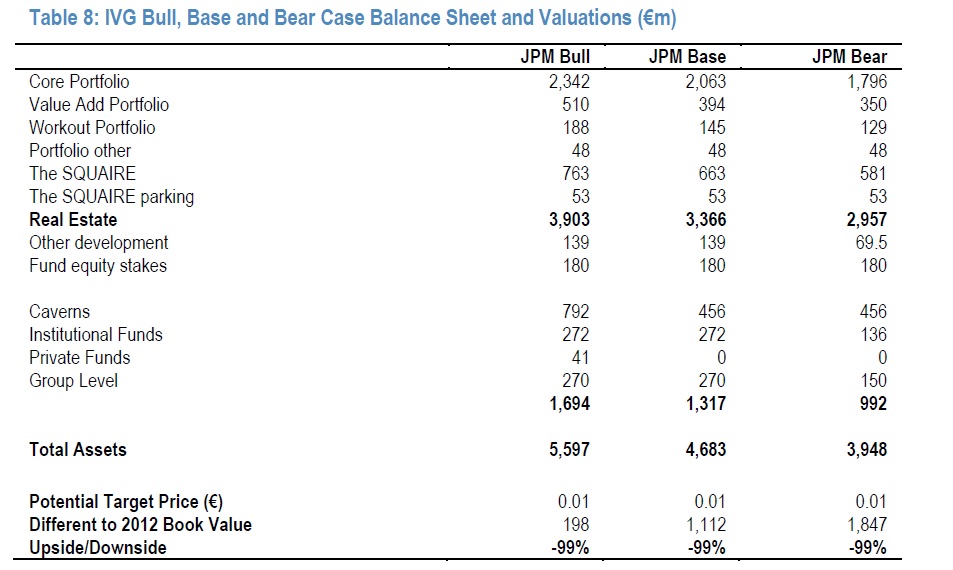
Additionally, they calculate “Bull” and “bear case” scenarios:

ivg bear case

The bear case scenario clearly would not leave a lot for convertible holders.This clearly shows the risk of the implicit “leverage” of the secured loans via the convertible.

Summary:

Although the JPM research looks a little bit superficial especially with regard to the liability structure, it is definitely worth to look at in order to get a better feeling for the underlying property values.

Their base case would imply even “full recovery” for the convertible and hybrid, although I think they haven’t modeled the liability structure correctly.

In general, their asset valuation does not look to different from mine,so for the time being I don’t see a reason to sell the convertible at current levels. Also there seems to be no reason to approve any debt for equity swaps.

However both, equity and hybrid capital seem to be clearly out of the money in most scenarios if one takes into account the full liabaility structure.

The weekly IVG post – more info on hedge fund activity

Thanks to a reader, I got this piece of information:

23-Apr-13
19:04
IVG eases constraints to secondary buyers to open direct talks with distressed investors

Story:
German real estate group IVG Immobilien lifted restrictions for secondary buyers of its corporate loan facilities last week, two sources familiar with the situation said.

With distressed buyers rapidly moving into IVG’s bank debt, management decided to remove hurdles for alternative investors, who had so far been forced to sub participations. Around EUR 500m loans moved into the hands of hedge funds and other distressed investors in the past month.

“The company simply found out that a lot of its bank debt had changed hands and inevitably would need to deal with these people [hedge funds] in the next months,” the first source said. Under the loan documentation, secondary buysiders needed the company’s approval to become lenders of record. With restrictions in place, new buyers would have been left out of the negotiating table in the restructuring process and forced to act through the mediation of the bank which sold the debt piece at discount to the fund.

The Bonn-based group announced it would restructure its capital structure on 27 March taking a holistic approach to the workout of its capital structure. Negotiations will include senior lenders, convertible holders, hybrid holders, and shareholders as the company aims to reach an out-of-court agreement.

“As a distressed debt holder you would have had a seat only through the bank you had bought from,” the second source commented.

“For IVG is better to lift restrictions and talk straight to the distressed investors. The easing of the constraints could help broaden the buyside space and support the price of the loans going forward,” the first source noted.

Following the EUR 500m trades earlier in April, another EUR 200m debt piece has been shown to potential buyers since Thursday of last week, including a EUR 100m strip of syndicated loan 1 and a EUR 100m tranche of syndicated loan 2. The two pieces, issued in 2007 and 2009 respectively, both mature in September 2014 for a combined bullet repayment of EUR 2.11bn.

The 2007 syndicated loan 1 is currently indicated in the 81 area, while the 2009 syndicated loan 2 is seen at 91, the two sources and a trader said.

The two loans are secured against different assets, with the 2007 syn loan 1 looking undercollateralised and the 2009 syn loan 2 marginally overcollateralised at book value, the first source said.

“From this, you need to calculate what the recovery value is in terms of distressed scenario,” he added.

“I would still wait before going long on IVG bank debt,” a buysider commented. “We went private, but there’s very little clarity on asset coverage. Using some market comparable, I would feel comfortable buying into the syndicated loan 1 only below 70.”

Under the EUR 2.11bn of loans due in September 2014 and around EUR 740m of project financing loans and other facilities, sit EUR 400m 1.75% unsecured convertible notes due 2017 and EUR 400m 8% perpetual hybrid notes. Both bonds took a dip in the last few days.

Convertible notes tripped down around 20 points to the low 50s in the last 10 days as bondholders are increasingly seen at risk of full equitisation, the first source commented.

“In a windup situation, converts could end up out of the money,” the first source said.

Convert holders could exercise a put for redemption at par in March 2014 to get their money back before the senior facility is due in September. However, senior debt holders could notify the company they are not going to refinance the September facilities, which would mean IVG would not be a going concern anymore.

Perpetual notes are indicated in the mid 10s, down around seven points in the same period, the trader said.

While the company hired Rothschild and Freshfields Bruckhaus as financial and legal advisors respectively, the creditor classes have appointed no advisors yet.

by Luca Casiraghi

Source:
Debtwire

In my opinion, the most interesting pieces on that report are

a) the pricing points: 81% for the undercollateralized loan and 91% for the collateralized

For, this reinforces two of my arguments (but again, I am surely biased):

– those buyers do not apply huge haircuts to the collateral (if they pay 90% for the 110% collateralized loan)
– In my opnion, it does not make sense for a HF to buy the collateralized loan at 91% if you expect insolvency and a 2-3 year workout period. To me this looks more like the “molest the other banks” strategy.

b) interestingly, the funds bought in on a kind of “Non voting” basis. In the syndicated loan markets, usually one has direct members of the syndicate at the beginning. As there is always some trading going on, banks sometimes sell the loan on a “sub participating” basis to a third party. Without the approval of the lender, those third parties have no vote if something has to be changed with the covenants etc.

So the price paid for those first tranches includes a certain discount for the risk that for some reasons IVG would not grant those rights to the buyer. One can compare this to buying a pref share instead of a common share.

All in all, this kind of reassures me that the probability for a “hard default” at IVG is maybe a little bit lower than some market participants think.

BUT AGAIN THE DISCLAIMER: DO YOUR WON WORK. I CANNOT RECOMMEND BUYING IVG SECUTITIES TO ANYONE. THIS IS HIGHLY RISKY WITH AN UNCERTAIN OUTCOME

Bad research KPN edition (and why my readers are a lot smarter than professional analysts)

This is “research” directly from Bloomberg:

KPN NA: 2.74 TARGET: 2.20-2.40
April 25, 2013
We recommend shorting KPN on the share issue announcement. The equilibrium price is Eur 2.04/share and the stock price should trend toward this level in the near future.
Equilibrium Price = (price pre-cap raising announcement x # shares + price cap raising x # shares) / total # shares.
The shares were trading at around 4.0 pre-announcement and there were 1.431 bn shares outs.
The company is issuing 2.84bn shares at 1.06. This works out 2.04/share. Let’s imagine that thanks to the cap raising the
fundamentals are slightly better now than they were before, and we set our target at 2.20-2.40, or 10-20% lower than the current price. The stock should be sold/shorted.

Let’s look at their “formula”:

Equilibrium Price = (price pre-cap raising announcement x # shares + price cap raising x # shares) / total # shares

“Wow, they are professionals and have a formula, this must be right” was my first thought and I briefly thought that I have made a mistake. Although I had a nagging feeling that the formula (or the application of it) was not right.

Enter readers JM and Martin in the comments of the last KPN post:

26. April 2013 um 09:57 | #8 Antwort | Zitat | Bearbeiten
ok…I join the game. When the capital increase was announced the share price was Euro 3,1…so 3,1+1,06+1,06/3 = 1,74. If the dust settles this share price is my personal target…more I do not expect .

memyselfandi007
26. April 2013 um 10:35 | #9 Antwort | Zitat | Bearbeiten
The day BEFORE the capital increase was announced, the stock price was 4.10 EUR.

Martin
26. April 2013 um 10:55 | #10 Zitat | Bearbeiten
(4.10+1.06+1.06)/3=2,073
price today 1,56
discount 24,7%
As there were cost for KPN real economic discount is somewhat lower.

Martin and JM (by the way, thank you for your many helpful comments) are using the very same formula, however with one big difference: They compare the result with the stock price AFTER the rights have been split of.

So the question is: Who is right ? The “professional” reasearch on Bloomberg or the comments on my amateur blog ?

Well, if you are a KPN shareholder before and KPN would sell the new shares directly to new shareholders at 1.03 EUR per share, then of course the old shareholders would be massively diluted.

In reality however, no one is able to by the shares directly at 1.03. You can only access those cheap new shares by buying the subscription rights which have been giving to the old shareholders as compensation for the dilution.

So the big mistake made by the “professional” analyst was that he somehow forgot to account for the subscription right. as the subscription right was worth 1 EUR pr share, suddenly an overvalued share according to the “professional” is an undervalued share.

How can a “professional” be so stupid ?

My guess is that the “analyst” mixed u a rights issue with an issue of shares without rights. Companies usually can issue a certain amount of shares (usually max. 10%) directly to new shareholders without any rights to old shareholders.

In those cases, the announcement is usually made shortly before the trading day starts and then the formula above is applied to the price the day before and the price for the new shares.

Nevertheless it is really embarrassing for any institution that such a mistake slipped through and this report gets actually published on Bloomberg

Applying the formula to a rights issue

The “formula” rests on 3 critical assumptions:

1) The price of the shares on the day before the announcement is exactly the right (and efficient) price. There was no information out there before about the capital increase

2) Nothing happened in between

3) the additional capital will not create any additional value

I think all three assumptions are quite difficult to hold for the KPN rights issue. Talk about the issue started already in September last year, so at the time of the announcement (Feb. 5th), the stock price reflected already a part of that.

Also, the time period between announcement and pricing of the issue is quite long with 6-7 weeks.

Summary:

It is amazing, how bad some of the “professional” research actually is. In that case the analyst used a formula without accounting for the subscription rights. However this also shows that in those situations, the price discovery might be not fully efficient.

I wouldn’t put too much faith into the “formula”, as the application towards rights issues really stretches the implied assumptions.

KPN rights issue: Final terms

I have covered KPN as a potential “deeply discounted risghts issue” special situation in the past.

Today, KPN announced the final terms for their rights issue (bold marks mine):

2 for 1 rights issue of 2,838,732,182 new ordinary shares at an issue price of EUR 1.06 for each ordinary share
• Issue price represents a 35.1% discount to the theoretical ex-rights price, based on the closing price of KPN’s ordinary shares on NYSE Euronext in Amsterdam at 24 April 2013
AMX has committed to subscribe for the Rights pro rata to its current participation in the issued share capital (excluding treasury shares) of 29.77%
Record Date for Offering is set at 25 April 2013 at 5.40 pm CET
Exercise Period runs from 9.00 am CET on 26 April 2013 until 3.00 pm CET on 14 May 2013• Rump Offering (if any) is expected to take place on 15 May 2013

What I find very remarkable is that there is only a very short time period between announcement of the terms and the start of the trading of the rights. Basically they announced today and trading starts tomorrow.

For the portfolio, I will start with a 1% investment as a rather “short term” special situation based on current prices of around 2.61 EUR per share. Lets wait and see how that one works out.

« Older Entries Recent Entries »