Category Archives: Value Stocks

Magic Sixes meets Boss Score: Mr. Bricolage (ISIN FR0004034320)

As some might remember, I kind of like the Magic Sixes Screen (P/E < 6, P/B 6%) initially mentioned by Peter Cundill.

Many of the “Magic Sixes” companies are declining and/or cyclical companies which do not score well on my Boss Screen which is looking for stable companies.

The exception at first sight seems to be French DIY chain Mr. Bricolage.

Read more

Some half year updates – Poujoulat, Total Produce, Dart Group, Installux

Poujoulat:

Quite surprisingly, Poujoulat announced a stock split 1:4,, this is the release from Poujoulat:

En date du 21 juin 2012, l’Assemblée Générale de la société POUJOULAT a décidé la division par 4 de la valeur nominale de l’action POUJOULAT négociée sur le marché ALTERNEXT Paris. Cette mesure permettra de fluidifier les échanges et de rendre le titre POUJOULAT plus accessible (son cours étant actuellement supérieur à 130€) En pratique, l’opération de division par 4 sera réalisée sur les soldes EUROCLEAR du vendredi 7 septembre prochain et sera effective le lundi 10 septembre à l’ouverture du marché. Les détenteurs d’actions POUJOULAT se verront attribuer automatiquement 4 actions nouvelles pour une ancienne.
Les droits antérieurs rattachés aux actions ne seront pas modifiés, notamment le bénéficie du droit de vote double pour toute action gérée au nominatif pur depuis plus de 24 mois. Le nombre d’actions POUJOULAT en circulation sur ALTERNEXT Paris sera ainsi porté de 489 750 à 1 959 000.

Let’s wait and see if this somehow helps the stock or not.

Read more

KAS Bank NV – half year results

Kas Bank, my latest portfolio addition released H1 results today.

Topline one sees a decrease, but the important part, commission income remained stable at 36.5 mn EUR. Underlying administrated Assets increased nicely.

Especially interesting was this statement:

In H1 2012, investment funds’ demand for KAS BANK’s independent custody services increased further in connection with the coming AIFM Directive which will take effect in mid-2013. This European Directive will impose tougher requirements for the custodial function of investment institutions.

This looks like a structural “tail wind” for custodians.

All in all, the 0.56 EUR earnings for the first 6 months looks like a solid profit at this point of the cycle. As the result does not yet include the sale of the Clearnet stakes, I think full year results should come in at least at 1 EUR per share.

So far, KAS Bank seems to do relatively well in this low part of the cycle. I will therefore continue to build up a full position (5%) of the portfolio. Trading volume in KAS Bank was low the last few days but picked up today.

KAS Bank NV (NL0000362648) – Specialist banking opportunity ?

DISCLAIMER:
This is not meant to be an investment advice. Please do your own work. The author might have bought or sold the stock already prior any discussion. Don’t trust ANYONE with stock tipps or other easy ways to make money.

In general I try to stay away as far as possible from banks. However KAS Bank NV (NL0000362648) might be interesting.

KAS Bank itself describes its business as follows:

KAS BANK N.V. is the independent European specialist in securities services and risk control and reporting services for professional clients in the pensions and securities industry.

KAS BANK pursues a ‘pure play’ strategy, underlining the bank’s absolute neutrality and independence. A low risk profile is integral to its services and is reflected in the quality of its balance sheet and its high solvency ratio.

So this is important why it is technically a “bank” effectively it is a sort of service company with a banking license.

Based on traditional metrics the company looks relatively cheap although technically all the banks are cheap.

MArket Cap: 100 mn EUR
P/B: 0.6
P/S: 0.2
P/E Trailing 10.0
Div. Yield 7.2%

Before diving into the details one should always ask the question: Why might KAS Bank be an interesting investment ? My thesis (which will then have to be tested) is the following:

+ Service based business model should show less volatility than credit based bank models
+ as client base etc. is Netherlands and Germany fundamental fall out from EUR crisis should be low
+ stock price might have been punished by overall issues with banking industry
+ business should be cash generative increased cap. requirements should be not a big problem
+ no risk of dilutive capital increases
+ small market cap and low analyst coverage might further nake stock unattractive

Earnings history & volatility

As a financial stock with mark to market accounting KAS bank doesnt look that good in my “boss” model but this is to be expected for any financial stock with mtm assets and liabilities.

If we look at 5 year figures provided by KAS Bank we can clearly see that the overall results were less stable than I would have assumed:

2007 2008 2009 2010 2011
net asset value 14.19 11.49 13.27 12.83 11.36
basic earnings per share 3.41 -2.7 1.69 1.27 0.7
dividend 2.6 0.45 0.73 0.73 0.5

On the plus side they paid a dividend each year however earnings were quite volatile with a big loss in 2008 caused by impairments.

Looking into the 2008 annual report one quickly sees the following comment:

Impairment losses on loans, including Lehman and one Madoff-related investment, bonds and equities in the available-for-sale portfolio, goodwill and two exceptional charges reduced the net result for 2008 by €58.7 million.

On a gross basis those impairment charges were ~5 EUR per share so quite significant. Further on they give more details on the losses:

As a result of this exercise, the bank has recognised impairment losses on loans and advances totalling €35.3 million (2007: nil). This item is made up of impairment losses on receivables in respect of securities lending positions with Lehmann Brothers Inc as client (€9.6 million) and in respect of an investment indirectly caught up in the serious fraud case involving Bernard L. Madoff Investment Securities LLC (€11.8 million). The rest of
the impairment losses (€13.9 million) relates to loans and advances to clients who are expected to be unable to repay their loans in full and, based on objective evidence, in connection with which the securities provided as collateral have fallen sharply in value.
Available-for-sale investments
The portfolio of available-for-sale investments is made up of shares and bonds and, with regard to both, there is objective evidence of impairment losses of €21.9 million (2007: €1.5 million) and €11.0 million (2007: nil), respectively. The difference between the cost and the current fair value has been transferred from the revaluation reserve to the income statement.
Intangible assets
The deterioration in market conditions has led the bank to make a downward adjustment in the future profit projections for the subsidiary in Germany acquired 1 July 2008, involving the recognition of an impairment loss of €5.2 million in respect of goodwill. This goodwill impairment loss is not allowable against tax.
Other equipment
In connection with the vacating of leased premises in 2007, all the previously capitalised costs of alterations to the building, totalling €3.2 million, were written off.

So all in all it was a combination of different financial crisis related write-offs which caused those impairments. We can clearly see that the business model includes at least some credit risk so its not a “Pure” service function. Going forward I guess the whole industry has learned from the “Lehman moment”.

Business model

At this point it makes sense to look at how the business model of a custodian looks like. Simply speaking a custodian manages the technical aspects of a security portfolio. The custodian executes trades records and receives interest coupons and dividends on behalf of the investor and sometimes offers “add on services” like reporting accounting cash management securities lending programs etc.

Some more background of the custodian business can be found for instance here or for a real deep dive this 100 page + overview of the industry.

In general one could asay that the custodian business is an interesting growing business however it is not clear if specialists or universal banks will profit most. Personally I think that after the crisis a specialist with “untarnished” reputation might have a certain reputation advantage.

In principle one can simplify the custodian business into 2 parts:

1. Transaction and service fees
2. Spread on “float”

The first part is relatively easy and is depending on the size of the administrated portfolios and the frequency of transactions. The second part is more difficult.

Custodians are a typical “float” business. If we look at KAS Bank’s 2011 accounts we can see at first a huge amount of leverage:

We have 5.2 bn EUR of liabilities against only 170 mn equity. However if we look at the funding side we see the following split:

Of the ~5 bn EUR financial liabilities around 0.5 bn are deposits from other banks so called “wholesale” funding. 4.5 bn are from non banks. Of the non-bank money again 0.7 bn are time deposits and 3.8 bn are “demand deposits”.

The non-bank demand deposit is the interesting part. Although this amount is fluctuating significantly a large part of this is “float”. usually every day some of the securities either pay interest dividend or mature. So KAS bank has a constant cash inflow from its client portfolios. Only few clients manage those cash flows on a day-to-day basis. Normally they only act if a certain amount accrues.

Custodian banks sometimes offer interest for those accounts at usually well below market rates. In normal times the custodians than invest those funds into the “normal” money market and earn a nice spread.

However at the moment, with short term interest rates at zero this “spread” is almost zero to. So for custodian banks the “float” part of the business is at its worst point in the cycle. KAS Bank (as many others) even took this further in investing part of the float into a security portfolio which at times can produce some mtm changes as we all know.

Looking at the pure “net interest result” without derivatives we can clearly see that KAS Bank could generate even in 2008 around 30 mn net interest result whereas in 2011 this amount dropped to 20 mn EUR pre tax.

Net commission income at the moment is around ~70 mn EUR this used to be ~90 mn EUR p.a. in the good days.

So we can see that both pillars are at the moment at a depressed status. Another interesting aspect is that custodians scale quite well. More transactions do not require a lot of more expenses if the infrastructure is in place. So if business (and interest rates) pick up profits will increase over proportionally.

Potential “Moat”

Custodian business in principle is a kind of “commodity” business. However there are some significant switching costs associated with changing custodians especially with more complex institutions like pension funds and insurance companies.

Within total costs for managing financial assets custodian fees are a relatively small cost block however in the overall process the custodian is very important.

So many institutions will think twice before changing an existing custodian relationship because any cost advantage will not be very big compared to the potential hassle.

I would call this a “weak” moat.

Current developement:

KAS Bank doesn’t issue quarterly reports only short “trading updates”. The Q1 update was Ok in line with 2011. However they mention a special positive effect of 4 mn EUR:

The half year report is scheduled for end of August in a couple of days

Non-operating result in Q1 2012 comes to €2.0 million and is chiefly attributable to the revaluation of a number of perpetual loans from banks. The proceeds of the planned sale of the shareholding in LCH.Clearnet will contribute €4.3 million net to the result in 2012.

So this seems to be a realization of a “Hidden asset”.

Dividend policy:

The stated dividend policy seems to be quite shareholder friendly:

Dividend policy
In accordance with the dividend policy discussed with the General Meeting of Shareholders, our target is to distribute 60-80% of the net result, where the profit permits and unless prevented by exceptional circumstances.

Shareholders

Interestingly KAS Bank does not have a dominating shareholder. LArge shareholders according to the annual reports are:

5% holdings
The following institutions have given notification of holdings of 5% or more in KAS BANK pursuant to the Financial Supervision Act and the Decree on Disclosure of Control and Major Holdings in Listed Companies.
– Delta Lloyd N.V. 12.2%
– APG Algemene Pensioen Groep N.V. 8.8%
– Delta Deelnemingen Fonds N.V. 8.6%
– ING Groep N.V. 7.9%
– All Capital Holding B.V. 5.3%
– KAS BANK N.V. 5.1%

Historically ING held more than double the current amount and sold down half of their stake in 2007 and 2008.

Some smaller positions are held by funds the only known value investor is Sparinvest with a 0.17% share. However the seem to have a “Poison Pill” in place for unfriendly take overs. So this limits any take over (and short term catalyst) “fantasies to a certain extent.

The stock is followed only by a few Dutch analysts 4 of 5 analysts have a buy rating with target prices between 10-13 EUR per share.

Management:

Management owns smaller positions in the stock and some options but compared to salaries (which ar Ok by the way) stock exposure of management is relatively small.

Balance Sheet quality

Overall balance sheet quality seems to be Ok. intangibles are ~14 mn EUR or less then 10% of equity. Disclosure for the AFS portfolio could be better. They only publish rating categories with the disclaimer

* No sovereign exposure on the PIIGS countries

So there would be some room for improvement.

Valuation

For me KAS bank is one of the few financial institutions where I would see a good “reversion to the mean” opportunity. They currently trade at an approximated “normalised” bottom of the cycle P/E of 7 and P/B of 0.6.

Average EPS over the last 14 years was 1.74. If we assume that conservatively They can achieve the 1.75 at some point in time in the future and a “fair P/E would be 10 then the share could be worth ~17,50 EUR. Average Price/Book over the last 14 years was about 1.2 so this would imply a double on current P/B of 0.6 if things return to “Normal” for KAS Bank.

Looking at the two profit pillars one could come up with the following valuation approach:

1. Pretax income on “float” ~25 mn EUR over a cycle
2. Fee income trading income etc. 100 mn EUR p.a. over a cycle
Minus 100 mn cost would be 25 mn EUR pre tax or ~ 20 mn EUR p.a. post tax of annual profit

Discounted by 10% this would again give us a value around double the current market price.

So from a valuation point of view I would say that KAS Bank should be worth double before any growth and excluding any future catastrophes.

Stock Price

The stock chart looks relatively ugly:

From a momentum point of view one shouldn’t touch the stock. In contrast to most other banks the stock didn’t rebound at all in the past few weeks. This might reflect that KAS Bank has not a lot of PIIGS exposure. Positively one could say that at least based on the last few months the stock price has found a floor at around 7 EUR.

Personally I think that KAS Bank now has reached a “fundamental” floor so in this case i will again ignore stock price “momentum” to a certain extent.

Interestingly, Beta to the AEX is only 0.62, which fits very well into my “low vol” strategy. What is very strange but interesting is the fact that Kas Bank is not really correlated to anything. Just for fun I looked at the 1 year correlations against the Dutch Index the Stoxx Banking index and ING:

SX7E↑ KA INGA AEX
SX7E 1.00 0.27 0.86 0.83
INGA 0.86 0.28 1.00 0.89
AEX 0.83 0.32 0.89 1.00
KA 0.27 1.00 0.28 0.32

Although this is not the most important decision point for me, the low correlation of KAS Bank makes it very attractive from a portfolio risk point of view.

Summary:

KAS Bank for me looks like a very interesting opportunity within the banking sector due to the following reasons:

+ attractive specialist business model (custodian)
+ cheap valuation even based on current “bottom of the cycle” earnings
+ valuation depressed because of overall hostility against banks
+ low or no analyst coverage
+ reversion to the mean speculation a lot less risky than with normal banks as virtually no risk of dilution (even Basel III standards are met by a wide margin)
+ potential upside ~100% over the next 3-5 years plus dividends+ low correlation / beta good portfolio diversifier

For the portfolio I will start as usual with a half position (2.5%) and then decide after the half year report if I want to increase.

Portfolio updates & ManU short

Draeger Genußscheine

After the dramatic increase in the Draeger Genußscheine, the portfolio weight of this position increased to aropund 11%. As 10% is my maximum treshold, I will sell down to 10% of portfolio weight from today on.

Manchester United short

Manchester United is now avaliable to short at Interactive Brokers. Therefore I will start with a 1% portfolio weight short position as of today as discussed in the post.

On the third trading day, the stock showed already a similar pattern to Facebook after the IPO, with the banks supportiung now at 13,40 USD after the IPO price didn’t hold.

Rebalancing: Total Produce, Hornbach, Vetropack

Due to differences in performance and paid out , some of my core holdings dropped significantly below the 5% target thresholds, among others:

– Total Produce (~4.2%(
– Hornbach (~4.5%)
– Vetropack (4.16%)

For those 3 companies, I will add to a full 5% over the next days depending on volume.

DISCLAIMER

By the way, please do not forget that I might own or buy or sell the mentioned securities privatley and read the disclaimer.

Some thoughts on utility stocks (Fortum, EVN)

In my portfolio, I have 2 utility stocks, Fortum OY from Finland and EVN AG from Austria. Both are part of the portfolio since the beginning.

The idea behind those two investments were the following:

1. utility stocks in general looked cheap and relatively save at that point in time
2. both, EVN and Fortum had a large share of non-carbon electricity generation capacity. “Fossil fuel” burners were expected to suffer as they need to pay more for the carbon emissions in the future
3. both companies are located in countries which are not directly impacted from the EUR crisis, so the risk of special taxes etc. should have been low

So far the investment thesis didn’t really work out.

First, the utility index underperformed with -8% the corresponding full index (Stoxx Europe 600) by a whopping 11%.

Second, both EVN and Fortum managed to underperform the utility index. EVN by -3.7%, Fortum by a dramatic 30.4% (including dividends)

If we look at the index constituents, we can see some interesting things:

Perf. 12/2010 –
   
DRAX GROUP PLC 41.2%
NATIONAL GRID PL 37.8%
UNITED UTILITIES 36.1%
SEVERN TRENT 34.5%
PENNON GRP PLC 28.7%
SSE PLC 18.2%
CENTRICA PLC 5.7%
ENAGAS SA -3.5%
RED ELECTRICA -11.6%
SNAM SPA -12.4%
TERNA SPA -12.8%
GAS NATURAL SDG -13.9%
ENEL GREEN POWER -20.7%
EDP -22.6%
E.ON AG -22.8%
GDF SUEZ -27.3%
ENDESA -29.8%
RWE AG -34.2%
ENEL SPA -34.3%
FORTUM OYJ -37.1%
VERBUND AG -42.2%
SUEZ ENVIRONNEME -42.6%
EDF -46.3%
IBERDROLA SA -47.0%
VEOLIA ENVIRONNE -62.8%

Frist thing to notice: “Renewables” really did badly, Mostly Iberdrola, Verbund and Fortum but also Enel Green Power. UK utilities did best. At least peripheral utilities did underperform as well, however French utilities were the worst (EDF, Suez, Veolia).

If we exclude UK and go for “EURO” utilities, the picture looks relatively speaking better, with a total return of -23.82%, this index performed really badly, EVN here (although not in the index) looks like a clear outperformer. Fortum still doesn’t look that good…

Perf. 12/2010-
   
ENAGAS SA -3.45%
RED ELECTRICA -11.56%
SNAM SPA -12.37%
TERNA SPA -12.85%
GAS NATURAL SDG -13.85%
ENEL GREEN POWER -20.37%
EDP -22.64%
E.ON AG -22.93%
GDF SUEZ -27.49%
ENDESA -29.75%
RWE AG -34.24%
ENEL SPA -34.39%
FORTUM OYJ -37.06%
VERBUND AG -42.23%
SUEZ ENVIRONNEME -42.67%
EDF -46.34%
IBERDROLA SA -46.95%
VEOLIA ENVIRONNE -62.76%

So looking back, what happened, especially to Fortum ?

– first of all, the Finish government introduced a special tax for Fortum although they didn’t need to. Bad luck
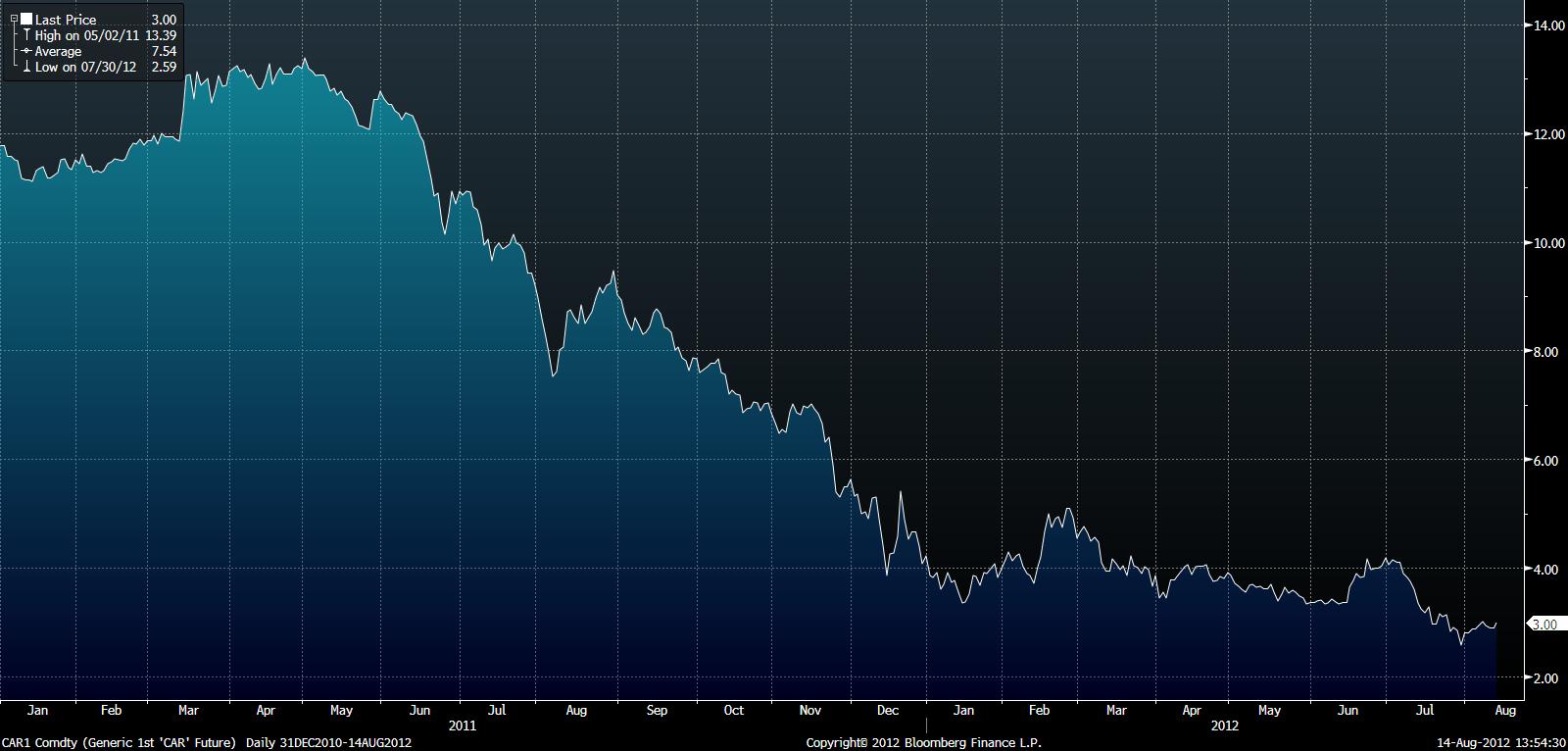
– secondly and more importantly, the price for carbon emission rights fell dramatically. As the following chart shows, CER prices fell a dramatic -75% from mid 2011 until now.

So the “Built in” (and as we know now “priced in”) competitive advantage of renewable power generators against “conventional” generators seems to have narrowed. Interestingly, the big divergence between Index and renewables opened up only in the last few months.

Additionally, the business model of electricity genrators in general seems to have eroded somehow, as it seems to be that they are on the worng side of the current political debates. Maybe not without their own fault.

If we look at the performance numbers above, we can see a second interesting detail:

Gas utilities (apart from the French) and grid operators do a lot better than electricity generators. The top 5 performers are either gas utilities (Enagas, Gas Natural) or Grid operators (Red, Snam, Terna).

A quick look on relative valuation shows that Fortum is still relatively expensive, as well as EVN, although EVN should be treated differently:

Name BEst P/E EV/BE EBITDA Curr Yr  
 
RWE AG 8.11 4.37 6.40%
EDF 8.07 4.80 6.28%
HERA SPA 10.49 5.16 2.12%
ENBW ENERGIE BADEN-WUERTTEMB 15.98 5.54 3.27%
GAS NATURAL SDG SA 7.68 5.67 2.58%
IBERDROLA SA 6.76 6.02 3.45%
GDF SUEZ 12.15 6.10 4.18%
E.ON AG 8.82 6.21 7.19%
REDES ENERGETICAS NACIONAIS 7.29 6.55 10.11%
A2A SPA 6.65 6.75 7.00%
ENAGAS SA 9.28 7.27 7.48%
ROMANDE ENERGIE HOLDING-REG 14.26 7.44 8.93%
ENERGIEDIENST HOLDING AG-REG 15.36 7.91 7.66%
FLUXYS BELGIUM 18.23 8.34 8.95%
FORTUM OYJ 10.16 8.36 6.21%
EVN AG 9.01 8.60 8.44%
SNAM SPA 11.73 8.74 7.75%
VERBUND AG 13.66 8.87 8.29%

So looking back, it was not a good idea to buy the “Carbon story” although I was lucky to a certain extent with EVN. However going forward I still have to find out what I am going to do. At the moment, Gas Natural does look quite attractive.

I think the Carbon Emission Right (CERs) might also be an interesting area to look at.

more to come…..

Piquadro update – SELL

While I am looking at luxury companies which I could short, one should not forget that Piquadro, which I would call also a “Tier 2” brand, has issued its quarterly report just yesterday.

Unfortunately, Piquadro matches my “short thesis” quite well, with sales down significantly in its indirect channels and only relatively limited grwoth in the direct channel. Working capital increased which is a result of the increasing direct operated stores. In general, invested capital increased significantly, financed by additional debt.

So the change in the distribution model seems to be not a swift one as the Italian indirect sales really seem to melt away.

Time to go back to my initial investment thesis and valuation exercise.

My conservative case implied a 16% EBITDA margin. In the current quarter, we are at 1.77/11.3 = 15,67%, so optimistically we are within the conservative case regarding EBITDA Margin.

However if we look at the valuation grid that I used, we can clearly see that 2% growth was my worst case scenario for the conservative case:

Growth 2% 3% 4% 5% 6%
Discount            
  7% 2.06 2.57 3.43 5.14 10.28
  8% 1.71 2.06 2.57 3.43 5.14
  9% 1.47 1.71 2.06 2.57 3.43
  10% 1.29 1.47 1.71 2.06 2.57
  11% 1.14 1.29 1.47 1.71 2.06
  12% 1.03 1.14 1.29 1.47 1.71

In reality, EBITDA decreased by -29% vs. Q1 2011 and operating CF became negative. I have to admit, that looking back I kind of ignored that running own stores worldwide is a very different business model than selling wholesale in Italy.

As a consequence, I will sell down Piquadro from tomorrow on, as my initial thesis (international sales compensate domestic sales) clearly doesn’t play out.

There might be some takeover / going private speculation (the Samsonite CEO mentioned that they might be interested in Italian luggage makers after TUMI has become too expensive), but I am not willing to speculate on this.

Additional thoughts about Mapfre SA (ISIN

Thursday’s post about Mapfre outlined the general idea behind the investment.

With this post I want to add some more details to the case

Time horizon & type of investment

Just to make it clear: I do not expect a quick solution to the EUR problems. So the time horizon for this investment should be at least 2-3 years (or even 3-5 years). The type of investment is what I would call a “sum of part” value investment with a contrarian aspect for the Spanish business

Insurance valuation

Some investors use “tangible book” as most appropriate vluation basis, for instance Bruce Berkowitz in his AIG case.

In my opinion “tangible book value” is only a very very crude meassure. The big problem with Insurance companies is the fact that not only the value of the assets are hard to value but also liabilities, esp. insurance reserves are by no means “fixed”.

Currently, this is most obvious for life insurance contracts with guarantees, where under normal GAAP, liabilities remain “at cost” whereas assets are marked to market. This had the perverse effect that after the big decline in interest rates, life insurers showed nice profits on their bond holdings, but the liabilities are severly under water. As the “gearing” of reserves to quity in life insurance is usually around 20 times, one can easily calculate how quickly any “tangible book” disappears if reserves would be marked to market.

With insurance, it is a little bit like cable television (and my unsuccessful Kabel Deutschland short): If no one cares (and especially the regulator), you can run the business without “real capital”.

Coming back to “tangible book”: Real mtm tangible book would be a helpful measure, but even industry or company insiders are not able to calculate this. So one should better take accounting tangible book value for insurers with extreme care…..

Spain is not Greece ?

A few quick thoughts: In my opinion, Spain is not Greece because of 3 major structural issues:

A) Spain didn’t have a spending problem before the crisis hit. So their problems are clearly a result of the crisis, not a structural (and maybe cultural) deficiency like in Greece.

B) Again, I would like to link to Ibex Salad which gives a more balanced outside view on what is happening in Spain. In my opinion, especially the developments in regard to exports show that a lot of positive things are happening in SPain below the “surface”. This will take time but it is not so hopeless like in Greece.

c) And one should not forget that Spain is the country with the highest population growth rate in Western Europe (apart from Luxembourg).

Capital increase

As one commentator rightly pointed out, MAPFRE did several right issues in the last few years:

2011: 77.2 mn shares at 2.466
2010. 94.4 mn shares at 2.008
11/2009: 63.63 mn shares at 2.58
03/2009: 124.8 mn shares at 1.41
11/2008 68.6 m shares at 2.21

One could indeed ask why they pay relatively high dividends and in parallel issue new stock. This is surely one of the reasons which negatively impacted the shares in the past. The only “excuse” is that they really managed to grow in this period while many others had to increase capital just to maintain their business.

Overall investment case:

Just in order to illustrate the “drivers” of Mapfre’s valuation a little bit better, I created a quick and dirty valuation metrics to show what impacts I expect both, for the Spanish and the International business:

Spain      
LatAm/Int   bad status quo Good
  bad 1.56 2.08 2.59
  Status quo 2.51 3.03 3.55
  Good 3.44 3.96 4.47

What this should show is that the developement in Spain is less relevant than the international developement. If LatAm continuous to perform well, the MArgin of Safety is quite high, no matter what happens in Spain.

EDIT: For some reason, the price of Mapfre now jumped at over 1,67. So I only got 1/5 of my planned allocation so far. Based on my learning experience with April SA, i will not increase my 1.50 EUR limit.

Mapfre SA (ISIN ES0124244E34) – LatAm “pearl” hidden under PIIGS cover?

Mapfre SA is THE Spanish Insurance company.

The stock used to be a “star performer” in the past, but suffered from the PIIGS crisis and is now back at 2009 lows:

As many financial companies based in the PIIGS countries, the stock looks relatively cheap:

Market Cap: 4.6 bn EUR
P/E trailing 5.4
P/B 0.65 (Tangible 2x)
P/S 0.2
Dividend Yield 10.4%

Well known problems include:
– ~50% of the premium income is from Spain (market leader with 20% market share)
– of course large PIIGS exposure (~8 bn EUR in Spanish Govies alone)
– Tangible book still lower then stock price (Tangible book is the main criteria used by many insurance investors like Berkowitz)
– Spain is “toast” anyway (current genreally accepted wisdom)
– Troubled bank Bankia is 15% shareholder of Mapfre (and cooperation partner)
– Mapfre has a majority shareholder, take over is highly unlikely

However if one looks more closely at Mapfre, some very interesting points can be identified:

+ Mapfre is mostly a Property and Casualty insurer, which means that the underlying insurance business is not directly affected from the financial crisis

An interesting fact about motor insurance and crisis: When times are bad, people tend to drive less miles with their car and use public transport more often or stay at home. This means that fewer accidents happen and insurers have to pay less claims. A pretty countercyclical business.”

+ Mapfre has something, most other insures don’t: Strong growth !!! Even in the first 6 months 2012, premiums increased more than 10% yoy, despite decreases in the Spanish home market

+ this leads us to the second point: Mapfre’s Business is increasingly international. In the first 6 months in 2011, the split of Spain/Non-spain was 50/50, it is now 30% Spain and 70% international.

+ Mapfre is market leader or in the top 3 in most Latin american countries, most notable they have 20% market share in Brazil and 10% in Mexico.

+ using market multiples, the Brazilian and Mexican subsidiary could be worth more than Mapfre’s market cap

Margin of Safety ?

The big question for anyone who wants to be a “Value Investor” is the question: Is there a margin of safety, or more precise, if there is a haircut in Spain, will I lose money ?

In my opinion, the possibility to lose money PERMANENTLY is relatively small even in a haircut scenario medium and long term due to the following facts:

1. Mapfre is the Spanish market leader an Insurance regulation is complex. So if Spain would really haircut its bonds, I would assume that the regulation would be adjusted so that Mapfre will not need to use a lot of new capital. So dilution risk is relatively low comapred to banks.

2. In contrast to the banks, an insurer is normally not forced to sell “underwater” assets, as the policy holders cannot easily demand their money back.

3. Even in the case of a capital requirement, Mapfre could sell minority shares in its LatAm subsidiaries to rich locals (Carlos Slim anyone ?) and easily raise money, one needs only to look at EDP from Portugal.

4. Especially in its home market and in its major LatAm operation, Mapfre has a strong “Moat” due to established sales channels and economics of scale

So yes, this will definitely be a very volatile future for Mapfre, but I am pretty sure that they will survive even a Spanish Haircut despite the relatively high “gearing” towards Spanish Sovereign bonds.

One of the short term risks will be that they might cut their very generous dividend at some point in time like Telefonica, but as in the case of Telefonica, this might be already included in the current stock price.

Sum of part Valuation:

I will do this very “quick and dirty”, just to show the potential:

Spanish business:

There is one “pure play” Spanish competitor with a similar business mix, Grupo Catalana Occidente (ISIN ES0116920333). Their comps look as follows:

P/S 0.4
P/B 1.0
P/E trailing 6.4

If we use P/S as the simplest multiple, Mapfre’s domestic business based on 2011 premiums of 7.8 bn EUR would be worth 3.1 bn EUR
International business:

For Brazil, Mexico Chile and Colombia (the most attractive LatAm countries) , I would use a P/S multiple of 1.0, for all the other Lat Ams a multiple of 0.5 which results in 5.9 bn EUR market value of the LatAm ops.

For 2 bn “international” premiums (US, Turkey, Portugal) I would use a 0.4 premium multiple, adding a further 0.8 bn EUR

From the 4.2 bn other international businesses, I would value the attractive Assistance business with a multiple of 1, the rest with a 0.4 multiple. This adds another 2 bn .

This results in a total sum of part value (before liabilities) of 11.8 bn EUR. I have identified around 2.5 bn EUR financial liabilities at a quick glance, so this would result in a business value of 9.3 bn EUR or ~3.20 EUR per share based on current multiples for the Spanish business, without taking into account market leadership etc.

LT2 Bond

As an alternative to the stock, Mapfre has also an interesting LT2 bond outstanding (ISIN ES0224244063). The bond has a 30 NC 10 structure, which means that for the first 10 years since issuance (until 2017) it pays a fixed coupon and then changes into a floating rate.

LT2 means that coupons could be deferred but are cumulative.

The bond has a 5.921% fixed coupon and trades around 60%, which would translate into a 19% yield p.a. if Mapfre calls in 2017. YTM would be 9.4%.

Summary:

MApfre SA is an interesting way to speculate on a Spanish recovery. The long term Margin of Safety comes from the value of the LatAm business which is profitable and still growing strongly. Although it is not likely at the moment, a sale or spin off of the LatAm subsidiaries could unlock the “real” value of the stock.

As the stock will be very volatile going forward, I will “scale in” for the portfolio over the next 10 days up to an 2.5% position (0.25% per day) with a limit of 1.50 EUR per share.

Dart Group – Follow up on fuel hedging and comprehensive income

As proposed in the last Dart Group post, I wanted to take a better look at the impacts on fuel hedging.

Quick summary (or spoiler): During writing the post, I got less and less sure of what to do with the fuel hedges, so the post got very long without a satisfying end. If you are not interested in the process and accounting details, the result is: I am not sure.

Let us start with a “accounting refresher” first.

Accounting for Cash flow hedges

Dart Group uses “cash flow hedges” for their fuel hedges. What does that mean ? Normally, any derivative financial instrument would be considered a “trading instrument” and would have to be marked-to-market directly through P&L.

If a company however wants to hedge a future cashflow (doesn’t matter if in- or outflow) one can apply a technique called “cash flow hedging” which requires basically two things

1) one is able to predict future cashflows with a reasonable accuracy
2) one uses a heging instrument which is “efficient” i.e. tracks the value of the hedged

If one achieves “cash flow hedging” treatment, then the hedge will treated in the balance sheet (under iFRS) the following way:

A) the value changes in the derivatives can be recorded under “OCI” (other comprehensive income)
b) in the future, when the cashflow actually happens, the corresponding hedging gain or loss will then be added or subtracted from the then realised spot price

This is what Dart Group is doing with its fuel hedging and as Wexboy commented fully aligned with accounting standards.

However my argument was that you shouldn’t ignore those movements in OCI but try to understand them and make adjustments if necessary. In order to understand this better, we have unfortunately step beck a little bit and ask the following question:

What is a hedge anyway and when is a hedge a speculation ?

In the case of Dart and airlines in general, this question is quite difficult to answer. In an ideal world as a company, you would like to pass on all your changes in costs directly to your customers and just earn a fixed fee on your products. As we all know, prices on tickets are relatively volatile, however many clients prefer to fix a price well before they start a trip in order to be able to control their budget.

An airline could also, if they were really really good speculators, create a big competitive advantage if they for example could hedge their fuel at low prices while the competitors have to buy much more expensive fuel on the spot markets if prices are rising. However, this is clearly speculation, not hedging as it could go the other way as well.

accounting wise however, one does not distinguish between “economic” hedging and what I call speculation.

So let’s look at Dart Group.

First step: READ THE ANNUAL REPORT

Before one starts to speculate how and what Dart is hedging, it makes sense to look at the annual report to find out what they are actually saying.

On Page 21 of the 2011 report they give us the following information:

2011 2010
Average hedged Price per ton $ 870 786
Percentage of estimated annual fuel requirement hedged for the next financial year 91% 90%

So we know now, that they have hedged ~90% of ALL fuel requirements according to this and we know the price.-

On page 67 we can look at fuel costs (in GBP):

2011 2010
Fuel Cost 122.8 95.3

On page 57 we can see the fair values of the fuel hedges, both an the asset and liability side:

2011 2010
Fair value Assets Forward jet fuel contracts 55.9 16.4
Fair value Liabilities Forward jet fuel contracts -17.8 -8.7
 
calc net Fair Value 38.1 7.7
Delta yoy 30.4

On page 58 we can see that in 2011, none of the fair value movements have been recorded in equity, we can also look at the total fair value movement of the ALL hedges (including currency) which were

2011 2010
Fair value Assets all hedges 59.4 21.7
Fair value Liabilities Forwardalll hedges -24.7 -9.7
     
calc net Fair Vlaue 34.7 12
Delta yoy 22.7

So basically, fuel hedges increased by ~ 30 mn GBP in vALue, FX hedges lost ~ 8 mn GBP

On page 61 they give us another interesting piece of information:

2011 2010
Impact on Profit and Loss 10% change in jet fuel prices 3.8 0.8
2011 2010
     
Profit for the year 17.3 15.6
Exchange differences on translating foreign operations 0 0
Effective portion of fair value movements in cash flow hedges 23 10.6
Net change in fair value of effective cash flow hedges transferred to profit -1.8 0.1
Taxation on components of other comprehensive income -5.2 -3
Other comprehensive income and expense for the period, net of taxation 16 7.7
Total comprehensive income for the period all attributable to owners of the parent 33.3 23.3

One important final piece of information:

Prepayments or “deferred income” stood a 177 mn GBP against trailing sales of 540 mn GBP.

So how to interpret those numbers ?

A) as the hedges seem to qualify almost completely as “cashflow hedge”, we can assume that they use “traditional hedges” like forwards or (tight) collars to hedge

B) IMPORTANT: Dart Group “hedges” 90% of next years fuel prices, but only 177/540 = 32% of (trailing) sales are prepaid. So one could argue that in order to “truly” hedge, Dart should only hedge a third of next year’s fuel consumption as for the rest, the final sale price of the tickets is still variable.

If the competitors don’t hedge, than Dart would have locked in potentially different fuel prices than the competition for 60% of next years fuel consumption and therefore run the risk of being uncompetitive if fuel prices fall.

So coming back to the initial question: What are we going to do with the change in value in OCI for dart Group ?

I have to say I am not sure anymore. I am oK with “ignoring” the part that is covered by deferred income but I honestly don’t know what to do with the part which is “speculation”.

I have quickly checked Ryanair’s latest statements and Easyjets last annual report.

While Ryanair similar to Dart seems to hedge 90% of next years fuel cost, Easyjet only hedges 65-85% of next years fuel charges and 45-65% of the costs in 2 years time.

Ryanair interestingly said that increasing fuel prices were responsible for a 29% profit decline. That sounds strange as they were supposed to be 90% hedged. Interestingly, fuel prices for Jet fuel decreased strongly in Q2, so the problem for Ryanair seem to have been locking in high fuel costs whereas some competitors were able to buy cheaper fuel in the spot market and compete better on ticket prices.

Bloomberg even compiles hedging ratios across companies:

Jet Fuel Hedging Positions for Europe-Based Airlines (Table)
2012-07-30 07:46:25.103 GMT

(Updates with Ryanair.)

By Rupert Rowling
July 30 (Bloomberg) — The following table shows the amount
of jet fuel consumption hedged by European airlines to guard
against price fluctuations.
Data is compiled mainly from company statements and is
updated as it becomes available. Hedges are for prices per
metric ton of jet fuel, unless otherwise stated.

*T
Company/ Percent Hedging Period Price
Disclosure Date Hedged
————— —— ————– —–

Ryanair Holdings Plc
7/30/12 90% July to Sept. 2012 $840
7/30/12 90% Oct. to Dec. 2012 $990
7/30/12 90% Jan. to March 2013 $998
7/30/12 90% April to June 2013 $985
7/30/12 90% July to Sept. 2013 $1,025
7/30/12 90% Oct. to Dec. 2013 $1,005
7/30/12 90% 2013 $1,000
7/30/12 50% Jan. to June 2014 $940

EasyJet Plc
7/25/12 85% Three Months to Sept. 2012 $983
7/25/12 79% Year to Sept. 2012 $964
7/25/12 77% Year to Sept. 2013 $985

Air Berlin Plc
5/15/12 82% April to June 2012 Not Given
5/15/12 92% July to Sept. 2012 Not Given
5/15/12 61% Oct. to Dec. 2012 Not Given

International Consolidated Airlines Group SA*
5/11/12 80% April to June 2012 Not Given
5/11/12 69% July to Sept. 2012 Not Given
5/11/12 55% Oct. to Dec. 2012 Not Given
5/11/12 55% 12-month forward Not Given

Vueling Airlines SA
5/10/12 76% 2012 $1,023
5/10/12 71% April to June 2012 $1,008
5/10/12 83% July to Sept. 2012 $1,035
5/10/12 74% Oct. to Dec. 2012 $1,042
5/10/12 28% 2013 $1,027

Air France-KLM Group
5/4/12 60% April to June 2012 $1,081
5/4/12 53% July to Sept. 2012 $1,081
5/4/12 50% Oct. to Dec. 2012 $1,078

SAS Group
5/3/12 50% April to June 2012 Not Given
5/3/12 49% July to Sept. 2012 Not Given
5/3/12 48% Oct. to Dec. 2012 Not Given
5/3/12 50% Jan. to March 2013 Not Given

Aer Lingus Group Plc**
3/29/12 62% 2012 $972
3/29/12 7% 2013 $991

Deutsche Lufthansa AG
3/15/12 74% 2012 $107/barrel
(Brent crude)

NOTES:
*Hedging breakeven for 2012 at $1,003 a ton, according to May 11
presentation.
**Aer Lingus figures as of Dec. 31

Summary:

To be honest, I am not sure what to do with the fair value movements in OCI. To simply ignore them and assume mean reversion would be very naive. The extent of the movements is just too large. However the impact of the fuel hedging is difficult to estimate as it depends on the behaviour of the competitors.

In general, a positive movement in fair value should be positive for the company and vice versa. nevertheless, the whole fuel hedging issue exposes Dart to quite substantial business risk, especially for the part which is not covered by deferred income.

However, this exercise made it clear to me that running airlines is a quite difficult business, especially in times of volatile fuel prices.

For the time being, I will stick with my half position and try to learn more about it.

One technical remark with regard to hedging:

In the “good old times”, fuel hedging could be done without cash collateral. A bank would happily “step in between” the airline and the futures market and only require cash at settlement of the contract.

As one of the consequences of the finanical crisis, every bank now requires cash collateral on a short term basis from the airlines for the fuel hedging contracts. For the airlines this means a significant increase in reuqired working capital. Lufthansa et al are lobbying strongly against this, but especially for smaller carriers this is a problem.

As a proxy I would use 25% of the notional as working capital requirement for fuel hedges. For Dart this would mean that 25% of around 150 mn GP or 40 mn GBP of Dart’s liquidity should be considered as “locked” for fuel hedging cash collateral.

« Older Entries Recent Entries »