A few thoughts on Free Cash Flow (and how easy it is to arbitrage this number)

For many Value Investors, “Free Cashflow” has become the most important “mantra” in order to decide if a stock is attractive or not. Especially in the area of technology stocks (Dell, Microsoft, Cisco, HP), the stated large free cashflows are or were the the major arguments from some investors why the invested in those stocks.

A few examples:

Dell: In February, David Einhorn disclosed a stake in DELL (which however he just sold again…), Katsenelson is a big fan of Xerox because of its large free cash flow and of course many many value investors love Cisco and Microsoft.

Let us quickly look at how Free Cashflow is defined (from investopedia):

Definition of ‘Free Cash Flow – FCF’
A measure of financial performance calculated as operating cash flow minus capital expenditures. Free cash flow (FCF) represents the cash that a company is able to generate after laying out the money required to maintain or expand its asset base. Free cash flow is important because it allows a company to pursue opportunities that enhance shareholder value. Without cash, it’s tough to develop new products, make acquisitions, pay dividends and reduce debt. FCF is calculated as:

EBIT(1-Tax Rate) + Depreciation & Amortization – Change in Net Working Capital – Capital Expenditure

It is important to notice that “Capital expenditure” only includes “direct” expenditure, like actually buying machinery etc.

Investopedia adds a pretty important point:

It is important to note that negative free cash flow is not bad in itself. If free cash flow is negative, it could be a sign that a company is making large investments. If these investments earn a high return, the strategy has the potential to pay off in the long

I think this is a point, many market pundits tend to ignore, but more on that later.

An even more important point is not mentioned in this definition: Free Cashflow does not include cash outflows for M&A activity

So let’s look at a simple example for a model company:

Base case:

EUR
EBIT (1-tax rate) 10
Depr 5
Change WC -1
Capex -3
   
   
Free Cashflow 11
   
   
Financing cashflow 0
 
 
Total cashflow 11

So our company shows a free cashflow of 11 EUR in this period and a similar total cashflow.

Case 1: Old School – Buying a new machine at year end with a loan for 15 EUR (I use year end in order not to “disturb” depreciation etc.)

We get the following result:

EUR
EBIT (1-tax rate) 10
Depr 5
Change WC -1
Capex -3
Machinery -15
 
Free Cashflow -4
 
Loan 15
Financing cashflow 15
 
 
Total cashflow 11

Aarrrg, negative free cashflow many investors would say, negative free cashflow, stay away from this stock !!!!

So a clever company might do one of the 2 following things:

Case 2: Classic FCF arbitrage: Operating leasing

In this case the company enters into an “Operating lease” contract at year end. The machine gets delivered as in a direct contract, but if the contract is structured correctly, neither capex nor loan show up in the balance sheet in that year (only the lease payments in subsequent periods)

EUR
EBIT (1-tax rate) 10
Depr 5
Change WC -1
Capex -3
Machinery 0
   
Free Cashflow 11
   
Loan 0
Financing cashflow 0
   
   
Total cashflow 11
 
Off balance sheet  
– machinery 15
– operating leasing liability -15

On a reported free cash flow basis, without adjustment, going forward, the company will look quite asset and capital efficient. However, this kind of FCF “arbitrage” will end under IFRS when operating leases will become “on balance”.

Case 3: M&A transaction

Now consider the following: For some unknown reason, one competitor is currently selling a subsidiary which only owns the brand new machine we wanted to buy and nothing else. The competitor is selling the company for the same price as the machine. Again we finance this through a loan.

The simplified CF statement looks the following:

EUR
EBIT (1-tax rate) 10
Depr 5
Change WC -1
Capex -3
Machinery 0
   
Free Cashflow 11
   
Acquisition -15
Loan 15
Financing cashflow 15
   
   
Total cashflow 11
   
Off balance sheet  
– machinery 0
– operating leasing liability 0

So “Heureka”, we have the machine on balance without impacting the Free cashflow and everyone is happy.

To be honest, this example is somehow unrealistic, but on the other hand this is exactly what is happening with many technology firms at the moment. Those companies show high free cashflow because they don’t spend a lot on investments but acquire new technologies vie M&A transactions.

If they would build this on their own, the cost would run negatively through free cashflow in contrast to the M&A expense.

There is a good post at Seeking Alpha which shows free cashflows over the last 5 years for 6 tech companies (RIMM, MSFT,DELL, NOK, AAPL, HPQ) without and including acquisitions.

For companies with a clearly declining core business like DELL and NOK, those M&A cash outs definitley have to be treated as mainenance Capex, but to be on the safe side, M&A for tech companies and pharmaceuticals should always be included in free cashflow.

This is exactly the reason why Jim Chanos has identified Hewlett Packard as the ulitmate Value Trap despite a trailing 25% FCF yield at current prices. HPQ acquisitions are not “growth investments” but “maintenance Capex” to counter their declining core business or to say it differently: The current reported “free cashflows” are more like liquidation cash flows.

Summary:

– Free cash flow can be a good indicator for the value of a company
– however one should be aware that there are many ways to “arbitrage” free cash flow
– I have only shown a few of them relating to investments but many others exist
– one should be especailly carefull to use FCF for companies which do a lot of acquisitions or use Operating leases extensively
– calculating free cash flow after acquisitions and changes in operating leases is a crude but good way to identify “problematic” companies
– some companies might be very good investments despite negative Free Cash Flows because they have good investment opportunities and finacne “conservatively”
– it will be interesting to see with what the financial industry will come up if Operating leases will come “on balance”. I have seen already attempts to structure leases as payables…..
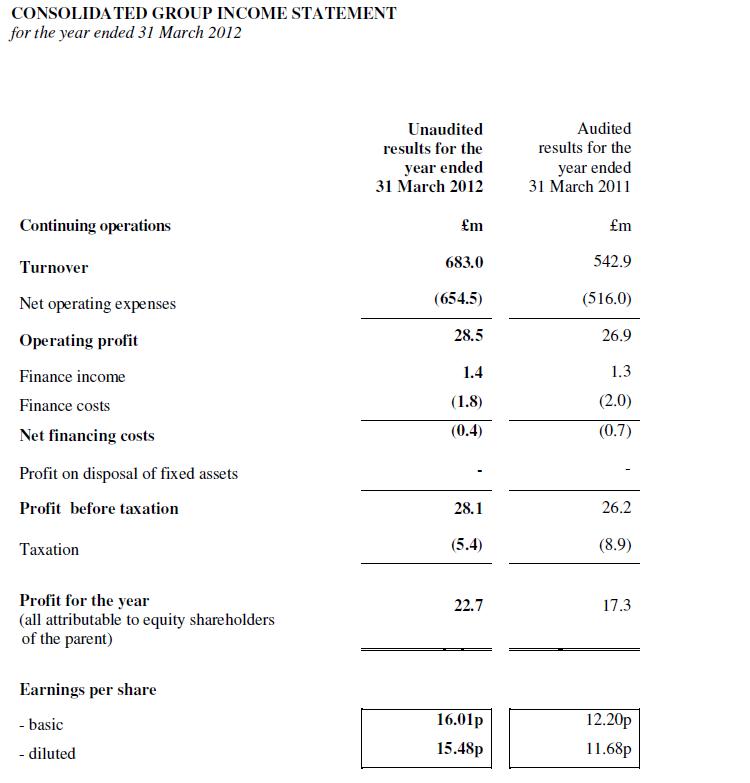
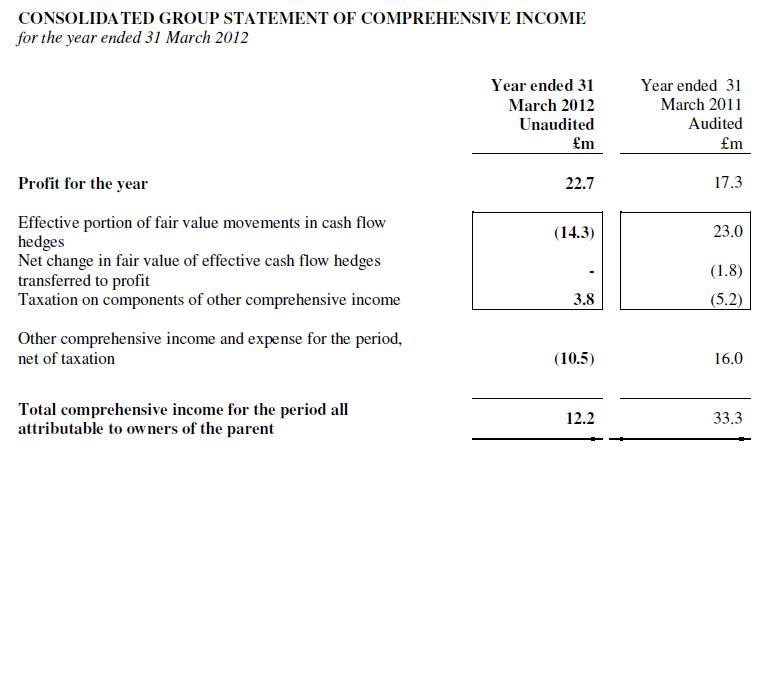
Why comprehensive income matters – Dart Group Plc

I have mentioned a couple of times that in my opinion, the so-called “comprehensive income” is a much better indicator for shareholder wealth created than net income or earnings per share.

In my experience, almost no one cares to look at what happens after the net income line. Usually, comprehensive income is stated on a separate page anyway.

A good example to turn this into an interesting practical exercise is the most recent preliminary annual report from Dart Group, one of my Portfolio holdings

The first thought is of course “Yippie yeah”, a really significant earnings increase, P&E of 4 etc etc.

Richard Beddard at the excellent Interactive Investor blog even says the following:

The highest earnings yield ever calculated by the Human Screen is 35%. It’s so high, he’s wondering if air line and road-haulier Dart has bust his value yard-stick.

Highlights

Adjusted operating profit up 9%
Adjusted return on tangible assets: 4%
Net profit of £23m compared to net cash flow of £95m (£48m after net capital expenditure)
Net cash after approximate capitalised lease obligations of £125m is £34m, 5% of tangible assets
Per-share dividend up 7%

Not so fast. I guess that Richard stopped at page 9 of the interim report and didn’t bother to read that strange stuff at page 10 which looks as follows:

So we have additional items which significantly decreased shareholders equity but didn’t need to be recorded in normal earnings but comprehensive income. In this case we are looking at fuel hedges.

Items which can be recorded in comprehensive income are:

– Unrealized holding gains and losses on available for sale securities ( a trick often used by banks and other financials)

– Effective portion of gain or loss on derivative instruments (cash-flow hedge);

– Foreign currency translation adjustments (i.e. change in value of a foreign subsidiaries net asset value)

– Minimum pension liability adjustments.

Normally people would argue that those items are “non operating” and therefore not or less relevant. However, as it affects shareholder value, in my opinion it is very important to look at those item to determine real value creation for the shareholder.

Coming back to Dart Group: The fuel hedging is an essential part of the business model. Fuel costs are around 20% of sales and cannot be passed directly too customers, especially for the prepaid part. I will have a separate post on how to interpret the fuel hedges but for now the important point is:

The result of the fuel hedges should be treated as part of the normal business of Dart Group.

Therefore real 2011/2012 earnings for Dart are rather around 9 pence per share and not the 16 pence recorded in the income statement. Still cheap (PE of 9) but not “busting any value yardstick”.

Summary:

Any value investor interested in the total value creation of a company for shareholders should include all items of the comprehensive income statement into his valuation. Many companies are very good in shifting all unpleasant stuff into this section. Especially for financial companies, recorded earnings are more or less meaningless without the items in comprehensive income. Also fuel hedges for airlines or other fuel cost eexposed companies should be viewed as relevant.

Catching up: Praktiker, Aire KGaA, Tonnelerie, Fortum

Time to catch up on my portfolio shares…

Praktiker:

As announced, I sold out the Praktiker bonds right after the annula shareholder meeting. Including accrued interest, I realised 43.65%, a small gain against the initial (“dirty”) Price of 41.62%.

I will do a more detailed “post mortem” analysis later as I think that Praktiker implies some important lessons for senior bond investors.

AIRE KGaA

The AIRE KGaA tender offer was finally settled on July 17th for EUR 18.25. Cash quota for the portfolio is now above 20%.

Just right now, the bidder again increased the offer to 19.75 EUR per share

They really seem to want to delist the company. The nice thing about the offer is the fact that the increase applies also to those who have tendered the shares at 18.25 EUR !!! Thank you !

Tonnelerie

Tonnelerie issued a rather vague but positive outlook for the next year. s they ussually don’t do this at all, this might be the reason behind the recent positive stock price developement.

Fortum

Fortum issued relatively weak half year interim results. The stock price since then dropped by more than 20% bellow the 2009 lows. Buying opportunity or value trap ? Somthing I have to analyse further. However it is clear that my initial investment thesis (higher oil prices, higher energy prices, higher profit) didn’t really work out. Same for EVN and OMV.

Weekly Links

Interesting article about an US fund manager who is bullish on European banks

Investing checklist

Interview with Zeke Ashton (Centaur Capital)

Stefan from Simple Value Investing is starting a parallel blog in English. Highly recommended !!!

I don’t know if I had already explicitly linked to the excellent Long Term Value Blog. Check out the Half Year portfolio review, a very interesting and unique portfolio.

Finally, in case you are interested how Mexican Drug cartells build their “moats”, read here

WMF AG catalyst – lessons learned: Good idea but weak execution

Now the expected catalyst at WMF has happened:

Current majority share holder Capvis sells as exected. The only surprise in my opnion is that the buyer is KKR, another (and maybe the most famous) PE investor:

KKR pays 47 EUR per ordenary share (+25% premium), but only the 3 month average of ~32 EUR for the pref shares-

So with my pref shares, I earned some money but lost out on the take over premium. And this although reader JM recommended the switch already in February.

So despite being a quite good deal for the portfolio (~+40%), the switch would have made a great dea out of this (+80%).

So hopefully lessons learned: Only the ordinary stocks will be enjoying the take over premium, not necessarily the pref shares.

For the time being, I will keep the pref shares to see if KKR changes it mind at some time. If they want to take the compeny private, they need also to buy the prefs…..

Praktiker bond – sell on bad news ?

Yesterday, Praktiker held its annual shareholder’s meeting in Hamburg. Unfortunately, I could not attend,but it seems to have been prime time entertainment for everyone who attended.

Some very lively articles about Praktiker can be found here and here.

The story is quite interesting, Austrian shareholders, representing 15% had a majority in the meeting, as less than 30% of shareholders were attending. At first, they opposed the plan of the management to first increase the share capital and then bring in US Investor Anchorage with a “super senior loan” and pledging its most valuable subsidiary, max Bahr against the loan.

As a response, management told shareholders that they will go directly into bankruptcy protection i shareholders don’t agree.

At the end, the shareholders seem to have approved the plan to bring in Anchorage after a capital increase.

Among my many posts about this interesting situation, especially my post about the possible scenarios.

In parallel, I have been doing some background checks on Anchorage and the picture does not look really good. Anchorage as a “distressed debt” specialist was among others involved in the bankruptcy of traditional German car parts manufacturer Honsel.

“Distressed debt” sounds like a very neutral word, but the business model of those “sharks” is relatively “dirty”: they come in via a loan, but they structure the loan though covenants in a way that they can call the loan pretty soon if they want.Once they are in this position, they can then force the company into bankruptcy, wipe out shareholders and senior bond holders.

At praktiker, this look like “Shooting fish in the barrel” for Anchorage: The do not only get the most valuable subsidiary pledged, but the concept includes making the subsidiary even more profitable by taking over the best Praktiker locations, leaving the “rest” for the others.

So this strategy even improves the position of Anchorage to the disadvantage of shareholders and bondholders. In My opinion, the Austrian shareholders are “feather weights” in this fight against Anchorage.

Within my scenario analysis, I would weight the “bankruptcy, zero recovery scenario” within the next few years at 50% probability. From what I have seen, the super senior loan will even expire before the senior bond

As it looks now, the market seems to interpret the result of the annual meeting positively, this opens the opportunity to sell the bonds at a small profit which I will do.

How goes the famous line: “You have to know when to hold ’em, you have to know when to fold ’em”….

Red flags for investments: “Transformational” acquisitions – Example Walgreen

Walgreen is one of the few large US stocks which looks good on my “Boss” Screen, with a consistently high ROE and low volatility. So I put it on my “priority” research to do list.

However,last week I dropped them from the list because of this.

Pessina had already hinted that his preferred exit would be via another merger rather than a fresh stock exchange listing: “If you do an IPO, you create financial value,” he said. “If you do a transformational deal, you create financial value and industrial value.”

Firstly, it is interesting that the seller makes this quote. Clearly, for him it was transformational as he transforms himself financially into a billionaire.

Secondly, if we look at some big “transformational deals in the past, we see that many of them fail.Some well known examples:

Daimler Chrysler
AOL Time Warner
RBS ABN Amro (Fortis, Santander, my all time favourite. everyone involved got screwed in the end))
Allianz Dresdner
Travelers Citicorp
Kraft cadbury
Vodafone Mannesmann

The list is endless. I actually don’t remember large “transformational” deals which actually worked well.

This aspect has not been unnoticed. A famous study by Bain showed that around 70% of large mergers fail:

Bain & Company M&A team leaders David Harding and Sam Rovit challenge the most common deal presumptions in Mastering the Merger: Four Critical Decisions That Make or Break the Deal (Harvard Business School Press, November, 2004) and found that while 70% of large deals fail to create meaningful shareholder value, 80% of the Fortune 100 companies have relied on mergers and acquisitions to fuel their growth over the past two decades.

The reasons are stunningly simple:

Bain examined over 50 case studies, analyzed 15 years of M&A data and surveyed 250 CEOs and senior executives about real-world successes and failures. They found that the top three reasons deals derailed were:

1. Ignored potential integration challenges (67%)

2. Over-estimated synergies (66%)

3. Had problems integrating management teams and/or retaining key managers (61%)

If we look at this article, Walgreen seem to rely heavily on point 2:

The deal will lead to cost and revenue benefits across both companies of $100 million to $150 million in the first year and $1 billion by the end of 2016, according to the statement.

Back to the Bain study. They identified a few critical success factors:

— Frequent acquirers outperform the pack – the more deals a company made, the more value it delivered to shareholders; the “frequent acquirers” outperformed the “never-evers” by a factor of two

— Frequent acquirers buy in good times and bad – frequent acquirers that bought constantly through both tough economic environments and boom times outperformed those that bought primarily in growth periods by a factor of 2.3; they also outperformed the “recession buyers” by a factor of 1.4

— Most successful dealmakers start small then ramp up – firms that focused on small deals on average outperformed those that made big bets by a factor of almost 6

In my opnion, Walgreen is unfortunately a very infrequent acquirer, to my knowledge it is the first acquisition outside the US and they only made one other acquisition in the US in the past few years. It rather looks like a desperate move to counter shrinking business in the US, which is never a good motivation to do a deal.

So despite the low valuation of Walgreen, this acquisition is definitely a “red flag” for any investor, as the chance for a positive outcome seems to be very low. However it looks like a great deal for KKR and Mr. Pessina. If you think about this, KKR and Pessina bought at boom prices in 2007 and seem to at least double their money after 5 years.

An additional remark on international expansion from retailers:Two of the best retailing companies of the world, Walmart and Tesco found out the hard way how difficult it is to transform local cometitive advantages into international markets. Walmart for instance failed in Germany, Tesco is still struggling in the US. As Bruce Greenwald said in “competition demystified”: All competitive advantages are local.

Summary:

Based on historical numbers, Walgreen would look like an interesting “Boss” investment. However the large acquisition completely changes the picture. As outlined above, the success rates of such “transformational” acquisitions are 30% or lower. And historical numbers do not not ho
ave a lot of predictive power in such situations
.

So without any special insider knowledge, one should generally stay away from such stocks which in my case would also be the advise for Walgreen.

Sure it can work out, but the odds are strongly against a positive outcome.

How to correctly calculate Enterprise Value

After all that heavy macro stuff, back to the nitty-gritty world of fundamental analysis.

Let’s have a look at Enterprise Value, which as concept is gaining more and more attention, among others famous “Screening guru” O’Shaughnessy has identified Enterprise value as the most dominant single factor in his new book. Also a lot of the best Bloggers like Geoff Gannon and Greenbackd prefer EV/EBITDA

Interestingly many people seem to just use and accept the “standard” Enterprise value calculation.

How to calculate standard Enterprise Value

Investopedia has the “normal” definition of Enterprise Value:

Definition of ‘Enterprise Value – EV’
A measure of a company’s value, often used as an alternative to straightforward market capitalization. Enterprise value is calculated as market cap plus debt, minority interest and preferred shares, minus total cash and cash equivalents.

Investopedia also offers an interpretation

Investopedia explains ‘Enterprise Value – EV’
Think of enterprise value as the theoretical takeover price. In the event of a buyout, an acquirer would have to take on the company’s debt, but would pocket its cash. EV differs significantly from simple market capitalization in several ways, and many consider it to be a more accurate representation of a firm’s value. The value of a firm’s debt, for example, would need to be paid by the buyer when taking over a company, thus EV provides a much more accurate takeover valuation because it includes debt in its value calculation.

So this is a good hint how to understand Enterprise Value: It originates from take-over valuation, most prominently from Private Equity investors or “old style” corporate raiders.

How to UNDERSTAND Enterprise Value

The private equity / Raider business in principle is relatively easy: You buy a company (or achieve full control) and then in a first step you extract all existing cash and/or assetswhich are not necessary to run the business from the company. In a second step, the corporate raider will then put as much debt onto the target company’s balance sheet and let it pay out as a dividend or capital reduction.

The more the Raider can get out quickly either as excess cash or as a “dividend recap” (short form for a debt financed dividend) the higher the return on investment.

The first important aspect: Excess cash OR excess assets

As I have written above, a raider of course likes best plain cash lying around. On the other hand, the raider will happily sell anything which is not really required to run a business and pocket this cash as well. However mechanical screeners will only capture cash on the balance sheet, not any “extra assets”.

A good example is my portfolio company SIAS. Their EV/EBITDA decreased strongly because the “exchanged” their extra asset in the form of a South American minority stake into cash. Another “extra Asset” company would be EVN with its Verbund stake.

Including the Verbund stake, EVN looks quite expensive at EV/EBITDA 8.3 (EV ~ 4 bn, EBITDA ~ 500 mn) against 5-6 EV/EBITDA at RWE and EON. However if we deduct the “extra asset” of 25% Verbund (~1.6 bn EUR) from the 4 bn EV, we suddenly end up with an EV/EBITDA of <5, a lot cheaper for this very conservatively run utility company.

In my experience, it is much more interesting to find companies with extra assets which don't show up as cash on the balance sheet. This was mentioned before as favorite technique of value legend Peter Cundill.

Next step: What to add to Enterprise Value

So its pretty clear that the less debt a company has the more a PE/raider will be willing to pay.

But it is also important to understand, how the capacity to put debt into a company is determined. Especially in the US, the debt will be put into the target in the form of corporate bonds. In order to sell them, you need to have a rating.

The lower the rating the more expensive the debt. In practice, raiders will try to achieve a BB rating as this is usually the “sweet spot” before bond spreads go up dramatically.

Rating agencies have relatively simple ratios to determine maximum debt loads within a certain rating category, however the most important point is this one:

Rating companies add additional items to determine debt capacity which are:

pension deficits or unfunded pension liabilities
– financial and operating leases (capitalised)
– any other known fixed payment obligations (cartel fines, guarantees etc.).

Economically, those items are very similar to financial debt which is usually included in the EV calculations, as they represent fixed payment obligations which sometimes (like pensions) even rank more senior than debt.

It is therefore no wonder that with a “standard” EV/EBITDA screener, often UK retail companies with huge (underwater) operating lease and pension commitments show up as “cheap” and then people are surprised that they go bankrupt soon (Game Group anyone ?).

Special case: prepayments

Prepayments are an interesting feature of some business models, among other for instance at Dart Group.

Normally, a company produces its goods first and then sells them again receivables until cash is then finally collected. In the case of prepayments, cash comes first in against a payable and the good gets produced at a later stage and then delivered with no further cash inflow to the customer. If the prepayments do not carry any formal restrictions, the company in theory can use the cash for whatever it wants. So for instance if a company can finance inventory out of payables, the prepayment cash could be used to finance even machinery or to reduce financial debt. So to make a long story short: cash from prepayments without formal restrictions should be considered “free cash” and deducted from enterprise value.

How to calculate Enterprise Value correctly:

So now we have all ingredients to correctly calculate Enterprise Value:

a. Equity Market cap
PLUS
b. Financial debt (long + short term)
PLUS
c. minorities, preferred
PLUS
d. financial leases and operating leases
PLUS
e. pension deficit or unfunded pension liabilities
PLUS
f. any other fixed liability which has to be repaid independently of the business success

MINUS
g. cash or cash equivalents
MINUS
h. “extra assets”, assets not required to run the business

Of course, EBITDA has to be adjusted as well in order to make usefull comparisons.

Basically we have to add back leasing expenses and pension expenses to EBITDA in order to compare the ratio against other companies.

Summary:

Standard screening EV/EBITDA does omit various relevant elements of an “economical” Enterprise value. Adjusting it for relevant items will prevent an investor to end up with relativ obvious value traps.

I am willing to bet that a back test on the adjusted EV/EBITDA ratios would generate even better results than the “standard” EV/EBITDA calculations.

Performance review June 2012 & comments

June finished with a big bang in the markets on the last trading day. So instead of a 1% outperformance for June on Thursday, the Portfolio underperformed -2.6% for the month. However as discussed before I don’t take monthly numbers to serious.

So quickly the updated Portfolio performance table:

  Bench Portfolio Perf BM Perf. Portf. Portf-BM
2010 6,394 100      
2011 5,510 95.95 -13.8% -4.1% 9.8%
           
Jan 12 5,972 99.27 8.4% 3.5% -4.9%
Feb 12 6,275 105.90 5.1% 6.7% 1.6%
Mrz 12 6,330 107.22 0.9% 1.2% 0.4%
Apr 12 6,168 108.02 0.8% -2.6% -3.3%
Mai 12 5,750 108.90 -6.8% 0.8% 7.5%
Jun 12 5,969 110.17 3.8% 1.2% -2.6%
           
YTD 12 5,969 110.17 8.3% 14.8% 6.5%
           
Since inception 5,969 110.17 -6.7% 10.2% 16.8%

The portfolio gained 1.2% in June, mainly driven by HT1, SIAS, EMAK and AS Creation. YTD, the portfolio is now up +14.8% with a relatively low volatility.

The portfolio composition has changed somehow against last month, especially with regard to the 3 new entries, Dart Group, Cranswick and April. For April SA, I took advantage of the low prices in the second half of last week and bought a 3% position, Installux has now reached 2% (and paid a 8 EUR dividend last week…).

Name Weight Perf. Incl. Div
Hornbach Baumarkt 5.0% 4.98%
Fortum OYJ 4.0% -20.73%
AS Creation Tapeten 4.0% 0.50%
BUZZI UNICEM SPA-RSP 4.6% -17.94%
EVN 2.8% -11.04%
WMF VZ 3.8% 33.87%
Tonnellerie Frere Paris 4.8% 7.03%
Vetropack 4.4% -3.42%
Total Produce 4.3% 6.70%
OMV AG 2.1% -14.04%
Piquadro 1.4% 1.24%
SIAS 5.9% 15.58%
Installux 2.0% 0.04%
Poujoulat 0.1% -1.57%
Dart Group 2.5% 1.18%
Cranswick 2.6% 1.53%
April SA 3.1% -0.67%
     
Drägerwerk Genüsse D 8.7% 44.55%
IVG Wandler 2.0% -0.64%
DEPFA LT2 2015 2.9% 22.53%
AIRE 5.0% 109.69%
HT1 Funding 4.7% 9.48%
EMAK SPA 5.1% 15.59%
DJE Real Estate 2.3% -3.65%
Praktiker 2016 2.4% -2.85%


Short: Kabel Deutschland -2.2% -25.63%
     
Short Ishares FTSE MIB -2.4% 3.56%
Terminverkauf CHF EUR 0.2% 4.42%
     
Tagesgeldkonto 2% 13.6%  
     
Summe 100.0%  
     
Value 49.3%  
Opportunity 33.1%  
Short -4.4%  
Cash 13.6%

Outlook & Actions:

As discussed before, I will accept the AIRE KgAA offer at 18,25, so cash will increase again. In parallel, I will still try to collect some more Installux and Poujoulat shares but apart from this I am currently done with buying.

In the next few days it will be interesting to see how the situation at Praktiker developes. If the “locust” succeeds with its “super Senior” loan I might sell the bonds.

As written before, on a macro level I see lower tail risk in the Euro zone going forward, although a real recovery might be still far away. I am still mostly concerned with the situation in China and the other “BRICs”. Everyone takes it for granted that China powers ahead and transitions smoothly from an epic construction boom into a happy consumer economy, but if you look closely to the other BRIC’s like India, one can see the BRIC story is crumbling at an increasing speed.

As a consequence I will try to stay clear of too much BRIC and commodity exposure. At some point in time it might be interesting to short some “can’t lose” stocks with large BRIC exposures.

« Older Entries Recent Entries »