Monthly Archives: February 2012

Nintendo Co. – from “Moat Superstar” to Net-Net ?

There was an interesting article in Business Week about Nintendo, which is expected to book its first lost since a long long time.

One of the quotes were:

It’s hard to say whether Nintendo can regain its footing, says Melissa Otto, director of active equity at TIAA-CREF, the manager of retirement accounts for employees of nonprofit institutions. The company’s stock has fallen so far—shares reached a 52-week low on Jan. 27—that it’s approaching the company’s cash value, she says. “They have a fantastic track record,” Otto says. “They have a wonderful brand. But the question is: Does the consumer care now?”

A quick look into the balance sheet shows:

The company currently trades close to book value (P/B 1.2). Net current assets are only slightly lower, no goodwill, no financial debt.

Cash and marketable securities were around 6000 Yen per share per end of year 2011. There seems to have been a certain cash burn in the first 9 months of FY 2011, this is somthing to watch. However this could also be an FX conversion effect if the cash was held for instance in EUR.

Interestingly for the 9 Month 2011, tha largest part of the announced losses were currency losses.

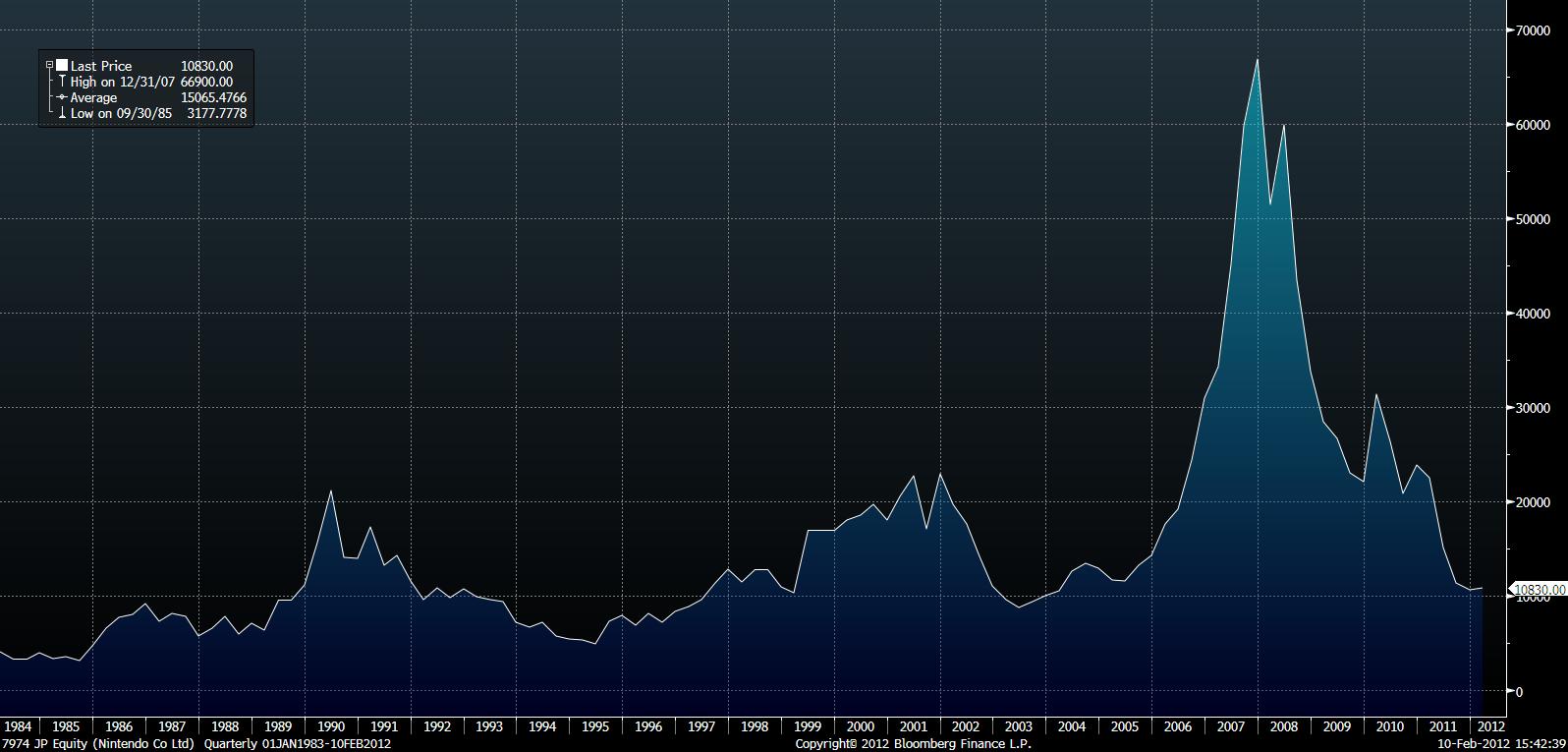
The stock chart in YEN looks quite bad, we are back at 1989 levels:

Shareholders:

The shares shares are widely held, no dominating shareholder. 10% are treasury shares. I wonder wether this would be a nice target for some shareholder activism….

Analyst sentiment is bad (which is good).

For the time being, I have no idea how to value Nintendo, but it is definitely something to watch. The “Intangible” value of the game franchises (Mario, Pokemon etc.) could be huge, however there are many well known headwinds like Mobile phone games etc.

If Nintendo again manages to reinvent itself like they did with the WII, then the upside could be huge. If they fail, at least they will not go bankrupt any time soon.

In any case, Nintendo is an interesting example how a “Moat” or “Gillette Razorblade” business model can dissappear through technological change pretty quickly, at least in the consumer electronics area. So watch out Apple.

Hyundai Motors capital structure arbitrage continued

Yesterday, I posted some first thoughts about a potential Hyundai Capital Structure arbitrage.

I know (through Thomtrader) that it is possible to buy the pref shares, but the short side for the commons is more difficult.

As mentioned, there are traded single stock equity futures on the Korean Stock exchange, but I think it might be difficult for private investors to find a broker who offers this access. I didn’t find any Hyundai Motors CFDs, so shorting through CFDs doesn’t seem to be feasable either.
Read more

German Preference share spreads & Hyundai Motor capital structure arbitrage

Last year, I had a couple of posts about preference shares in general (part 1 and part 2) and spreads between German common shares and pref shares in particular (here).

II looked at a post of Valuation Guru Damodaran, who tries to come up with a theory of explaining the spreads between votung an non-voting shares.

Among other factors, his assumption is that shares with voting rights should generally trade at a premium and c.p. the premium should be higher for badly managed companies where a change of control event is likely.

When we looked at German pref shares, we could see that in certain cases this held up but not in general.

How do spreads look right now ? Let’s look at current spreads from quoted German companies with both, common and pref shares compared to last July:

Company VZ ST Current spread old Delta
MINERALBRU UEBERKING-TEINACH 6.81 12.04 76.8% 100.0% -23.2%
METRO AG 27.43 29.64 8.1% 52.4% -44.4%
MAN SE 60.1 83.52 39.0% 47.3% -8.4%
BAYERISCHE MOTOREN WERKE AG 44.85 69.04 53.9% 46.9% 7.0%
SIXT AG 13.24 15.63 18.1% 27.3% -9.3%
FRESENIUS MEDICAL CARE AG & 44.9 54.71 21.8% 17.4% 4.5%
EUROKAI KGAA 20.35 25.542 25.5% 15.5% 10.0%
WMF*WUERTTEMEB METALLW-AKT 29.2 32.5 11.3% 7.1% 4.2%
SARTORIUS AG 39.84 36.083 -9.4% -1.9% -7.5%
RWE AG 30.565 32.605 6.7% 7.3% -0.6%
DYCKERHOFF AG 31.77 30.01 -5.5% 4.1% -9.6%
BIOTEST AG 38 39.51 4.0% 3.3% 0.7%
AHLERS AG 10.401 9.86 -5.2% -0.5% -4.7%
EFFECTEN-SPIEGEL AG 12.29 12.749 3.7% 1.4% 2.3%
KSB AG 442.05 483.1 9.3% -1.4% 10.7%
HUGO BOSS AG -ORD 76.01 68.02 -10.5% -9.2% -1.3%
VOLKSWAGEN AG 142.6 127.6 -10.5% -9.2% -1.3%
FUCHS PETROLUB AG 38.075 34.29 -9.9% -13.1% 3.2%
HENKEL AG & CO KGAA 47.31 40.1 -15.2% -17.4% 2.2%
DRAEGERWERK AG 70.66 53.58 -24.2% -21.2% -2.9%

Most interesting is the developement at Metro, where spreads between prefs and common shares almost disappeared. The most prominent example against Damodaran’s theory, BMW (well managed, no chance of change in control) even increased it’s spread.

If we look at BMW again, we can see that after a some tightening, the spread is almost back to it’s peak:

Personally, I don’t really understand this. Of course liquidity is better for the common shares and they are in the DAX, but a 50% higher valuation for the common shares with a controlling shareholder family who does not want to sell doesn’t make sense.

Another intersting idea from Thomtrader are Hyundai Motors pref shares.

Hyundai pref shares (3 different series) trade at around 48-60 k Won against 220 k for the regular shares. That is a ratio of ~4-5:1, a massive discount. Again, this can not be explained through “conventional wisdom”.

If we look at the historical spread between the pref shares and the common Hyundai Motor shares, we can see that historically they were correlated quite well but are now diverging since the last couple of months:

Although I do not want to own them outright, a long Hyundai Pref short common shares trade looks interesting. One could buy 4 Pref shares and short (I don’t know if this is possible in reality) 1 common share.

Historical correlation is around 0.85, not perfect but Ok. The nice thing is that we have a good carry of ~ 3 pref dividends, which translates into a “carry” of around 7% for the nominal position (in hedgefund lingo) before borrowing costs, non-frefundable taxes etc..

Again the “Volkswagen” risk of shorting common shares should be relatively small as it is yet to be proved that anyone can take over a Korean Company.

This is a trade I am actually considering is another “capital structure” trade similar to the Draegerwerke long/short.

UPDATE: I just saw that there are single stock futures traded in Korea. I am not sure if a private investor can trade this but as an institutional invetsor, this should be possible.

“Risk free” rates and discount rates for DCF models

In the discussion to the Piquadro valuation, I quickly mentioned that the concept of “risk free” rates is a difficult concept at the moment.

Let’s have a quick look at the “academical” world:

CAPM

If we look at the CAPM (no matter if one beliefs this or not) we can see that the risk free rate of return plays an important role there. First, it is the basis return on needs to achieve with any investment, secondly it also influences the equity risk premium.

Risk free rate of return

The definition of the risk free rate itself is quite “fishy”. Investopedia for example states:

Investopedia explains ‘Risk-Free Rate Of Return’
In theory, the risk-free rate is the minimum return an investor expects for any investment because he or she will not accept additional risk unless the potential rate of return is greater than the risk-free rate.

In practice, however, the risk-free rate does not exist because even the safest investments carry a very small amount of risk. Thus, the interest rate on a three-month U.S. Treasury bill is often used as the risk-free rate.

This is of course not really applicable for any serious long term investor. Damodaran has a nice paper about “risk free rates” here.

His major points are as follows:

The first is that there can be no default risk. Essentially, this rules out any security issued by a private firm, since even the largest and safest firms have some measure of default risk. The only securities that have a chance of being risk free are government securities, not because governments are better run than corporations, but because they control the printing of currency. At least in nominal terms, they should be able to fulfill their promises. Even this assumption, straightforward though it might seem, does not always hold up, especially when governments refuse to honor claims made by previous regimes and when they borrow in currencies other than their own.

So this is important: No default risk !!! So it is wrong for instance to use current yields of Italian Govies for valueing Italian stocks, as considerable default risk is embedded in current spreads. The “country” risk could/should be embedded into the equity risk premium, not into the risk free rate. A hypothetical Italian company with 100% of its business in Germany for example, should only get a very small country risk charge if any.

A second point is the following:

There is a second condition that riskless securities need to fulfill that is often forgotten. For an investment to have an actual return equal to its expected return, there can be no reinvestment risk.

In theory, one should discount annual cash flows with the respective annual risk free rates. With a flat yield curve, this is not so important but for steep yield curves the differences can be significant. However in practice Damodaran recommends using the duration of the cash flows of the analysed investment as proxy for the risk free rate. As the best proxy if we don’t want to do this, he recommends the 10 year rate.

For the EUR, he recommends specifically the following:

Since none of these governments technically control the Euro money supply, there is some default risk in all of them. However, the market clearly sees more default risk in the Greek and Portuguese government bonds than it does in the German and French issues. To get a riskfree rate in Euros, we use the lowest of the 10-year government Euro bond rates as the riskfree rate; in October 2008, the German 10-year Euro bond rate of 3.81% would then have been the riskfree rate.

With regards to currencies he says this:

Summarizing, the risk free rate used to come up with expected returns should be measured consistently with the cash flows are measured. Thus, if cash flows are estimated in nominal US dollar terms, the risk free rate will be the US Treasury bond rate. This will remain the case, whether the company being analyzed is a Brazilian, Indian or Russian company. While this may seem illogical, given the higher risk in these countries, the riskfree rate is not the vehicle for conveying concerns about this risk. This also implies that it is not where a project or firm is domiciled that determines the choice of a risk free rate, but the currency in which the cash flows on the project or firm are estimated.

The most common mistake with currencies is usually to use current exchange rates for future cashflows which then results in a preference for projects in countires wiht high nomnal rates.

About Inflation, he is not really clear in my opinion. He argues basically, inflation does not matter because we get the same result if we use yields of inlfation linked bonds combined with inflation adjusted growth rates.

Especially the current situation, where we see negative real yields in many markets, one could argue about his appoach. A negative real yield means for an investor, that the “risk free” nominal asset would have a guaranteed loss in real purchasing power over the investement horizon.

Consider for instance the UK: 10 year gilts run at 2.158% yield, this would be the proxy for the risk free rate. Current inflation runs at 5%, UK 10 year implied inflation from inflation linked bonds is around 3%.

So if I would use the 10 year gilt as proxy as the risk free rate, I woul dalready accept a loss of -1% p.a. in real terms p.a. or almost -3% p.a. based on current inflation rates.

I think this topic might justify even a doctorate thesis, but in my opinion, one could go the following pragamatic way:

Proxy for risk free rate: Higher of 10 year risk free Govie Yield in currency or inflation ).

So in the case of the risk free rate for an Italian company I would compare:

a) 10 year risk free EUR rate = 10 year bunds = 1.89%
b) Inflation: Currently =3.4%

I would the use the higher of the two rates, 3.4 %. This would be a pragmatic way to avoid unnecessary country risk premium and still make sure, the risk free rate does not imply a guaranteed loss in real terms.

Creston Plc – business model & valuation

Yesterday, I “introduced” Magic Sixes stock Preston Plc, which based on first check is worth a closer look.

One of the improvements in my “investment process” which I try to achieve in 2012, is trying to understand better the respective business models of the companies I am analyzing. This is something where I do not have a lot of experience but let’s see if this adds some value.

Creston PLC business model

As mentioned, I am neither an expert in business models nor in the advertising agency business, but in my opinion the busienss model can be ccharacterized the following way:

+ very low fixed asset requirements (which is good)
The company does not have any fixed assets which is understandable because you only need some PCs and rent office space to run such a business.

+ limited working capital requirements
The company had in the last 2 business years almost zero net working capital, however as mentioned before, in the last 6 months receivables had increased to a certain extend. Still, we can conclude that the busienss itself does not require significant amounts of capital

+ People’s business
Jan Hendrik commented that this might be a typical “people’s” business. Based on a simple metric one can conclude that this is cleary the case here. Employe expenses for the 2011 financial year are 46.5 mn GBP, or ~80% of total expenses.

From what I know, salaries pretty low in the junior levels because a lot of people want to get into the “creative business”, however on a senior levelö salaries tend to be pretty high as companies have to make sure that the most creative employees don’t just switch companies (and take their clients with them…).

+ barriers to entry

Based on my understanding, the barriers to entry into the ad/pr agency markets are pretty low. Evidence is the large number of ad agencies. Contracts are tendered by corporate clients on a regular basis. I would assume that the company posseses some sort of proprietory data & information as well as customer relationships, but nothing which would count as a “real” barrier to entry against any competitor.

Maybe Creston as a mostly UK based player has some niche advantages, but overall this seems to be a very competitive market. Further proof for this are relatively low NI margins (~5%, fluctuating between 1.5% and 8.5) over the last few years. I also doubt that the business is really scalable.

Summary business model: Creston seems to be in a very competitive industry with low barriers to entry, however the business requires only a minimum of capital. Nevertheless, it would be quite aggressive to really assume significant growth for the future. So the “investment thesis” would be rather a “reversion to the mean” theme.

Historical profitablity

NI Margin ROIC
2001 1.4% 1.2%
2002 3.8% 5.5%
2003 4.9% 6.6%
2004 4.8% 5.1%
2005 3.6% 7.2%
2006 6.4% 7.8%
2007 5.9% 5.9%
2008 7.9% 8.0%
2009 8.4% 6.2%
2010 3.5% 7.7%
avg 5.1% 6.1%

As indicated before, the net income margin averages at around 5% over the last 10 years, however with some volatility. Much more interesting is the low return on invested capital. With 6.1% this is clearly below any cost of capital number. Before I said that the business model doesn’t really require assets, so why is this number so low ?

The answer is relatively easy: Goodwill. ROIC includes goodwill and the low single digit return tells us one thing: Creston just spent too much on those acquisitions, so the returns on puchase price are not really good.

If one looks at the company history in the 10 year report, one can see that every second year companies were bought and sold. Much of the free cashflow generated did go into those acquisitions, only a small amount was distributed to shareholders. Usually, small M&A transaction can be positive, but the track record for Creston is not great. We also don’t know if this is going to change in the future.

Another disturbing issue is the fact that numbers of shares increased significantly in the past:

shares mn
2001 11.2
2002 11.2
2003 21.9
2004 25.2
2005 36.6
2006 54.9
2007 55.6
2008 55.7
2009 61.3
2010 61.3

I could only find one “straight” capital increase in 2002 (5.6 mn shares at 0.60 GBP), so they seem to have paid a couple of their past acquisitions with stocks. So at the end of the day, Management seems to have been quite easy on increasing the numbers of shares in the past, which is not good for the shareholders.

Quick valuation:

Asset Value
Without any real assets, the downside for Creston Plc is basically unlimited. If things go south and key people leave, I highly doubt if there would be any value left. I have no idea how much the goodwill is worth, but my worst case assumption would be zero.

Earnings Power Value

If we assume a “reversion” to the mean approch, we can think about 5% net income margin for Creston going forward. As there are no interest payments, depreciation is neglectible, net income might be a good proxy for Free cashflow.

Based on current sales of annualized 70 mn GBP, expected profit in a steady state would be 3.5 mn GBP, discounted with 10% would give us a market capp of 35 mn GBP, slightly above the current 31 mn GBP.

At that point, we can stop. Without a downside protection, the “steady state” valuation is around the current price level. Without any competitive advantages and general economic headwinds, the stock looks unattractive, despite qualifying under the “Magic Sixes” criteria.
Magic Sixes quick check: Creston plc

Regular reader know that I run a “Magix Sixes” screening for investment idea generation.

This idea is from Peter Cundill’s book and is a very simple screen: Stocks which trade below 0.6 book, below 6 PE and have a dividend yield of > 6%.

As one could imagine, the result of this search are not really “wide moat” beauties…

However, one new entry, Creston PLC doesn’t look too bad.
Read more

« Older Entries Recent Entries »