Author Archives: memyselfandi007

Update Gronlandsbanken – result and annual report 2014 & Danish interest rates

Gronlandsbanken

Gronlandsbanken has just released 2014 numbers and its 2014 annual report. 2014 results look solid: ~50 DKK profit per share, roughly 6% more than in 2013. The dividend remains at DKK 55 (dividend is paid out of pretax income). ROE has remained high at 16,3%. The result would have been even better if Gronlandsbanken would have not increased reserves. This is the quote from the annual report:

The result before value adjustments and write downs of DKK 148,6 million is the Bank’s best basis result so far. This is of course satisfactory. It is at the same time above the last announced results expectation of a result before value adjustments and write downs in the upper end of the range DKK 125 – 145 million. The result before tax returns 16.3% on year start equity after dividend.

This was achieved against a slight drop in Greenland’s GDP which I find quite remarkable. The stock market seemed to have “anticipated” those results to a certain extend as the stock price shows:

The balance sheet is still super rock solid with an equity ratio of 19% (of total balance sheet, not risk weighted assets or some similar shenanigans).

My initial investment thesis 2 years ago was the following:

– as it is the only bank in Greenland, its margins are around twice as high as the best global banks and the balance sheet is rock solid. One could call this a natural moat
– even based on the current state, current valuation implies significant upside to fair value
– the Greenland resource story could add significant growth going forward, even with maybe other banks entering Greenland
– finally, Management has started to buy shares after surprisingly good Q3 numbers
– although there is no direct catalyst, an indirect catalyst could be if some of the projects proceed well and Greenland will move into the spotlight. Gronlandsbanken is the easiest (and only) way to invest into Greenland without project specific risk

One of the issues of course is that most of the natural resources projects look a lot less likely to happen than 2,5 years ago.The annual report is as always a great resource to see what is going on in Greenland. Most projects seem to be on hold or cancelled, the only remaining interest is from China:

Among the larger projects, it has become obvious that virtually only Chinese investors continue to show a certain interest. The BANK of Greenland considers it likely and quite naturally, that the funding can come from China. Chinese enterprises are often the leaders in processing for further use in either Chinese, American, or European industry.

Especially the oil sector has been hit hard:

The prospects of the oil area are more dismal than of the mineral area. After Cairns test drilling in 2010 and 2011, oil exploration in Greenland is now greatly reduced, see Figure 8. The stagnation of the exploration in both the oil and the mineral area is expected to continue over the next few years, even though new licenses have been issued and the preparatory work is continuing in 2014 as well.
The declining interest in oil exploration is a.o. due to large oil and gas discoveries in other places, and the fall in the oil price . Of importance can possibly also be the administration and regulation of the area so far have not been regarded as sufficient by several persons in the industry.

So the bad news is that within my initial time frame of 3-5 years, I will not see any large mining or oil projects in Greenland. The upside might be that the incentive for other banks to enter Greenland will be most likely quite low.

Interest rates

However, another thing happened which was not on my radar screen: Denmark went from having low-interest rates to negative interest rates. This is how 3 month local swap rates developed:
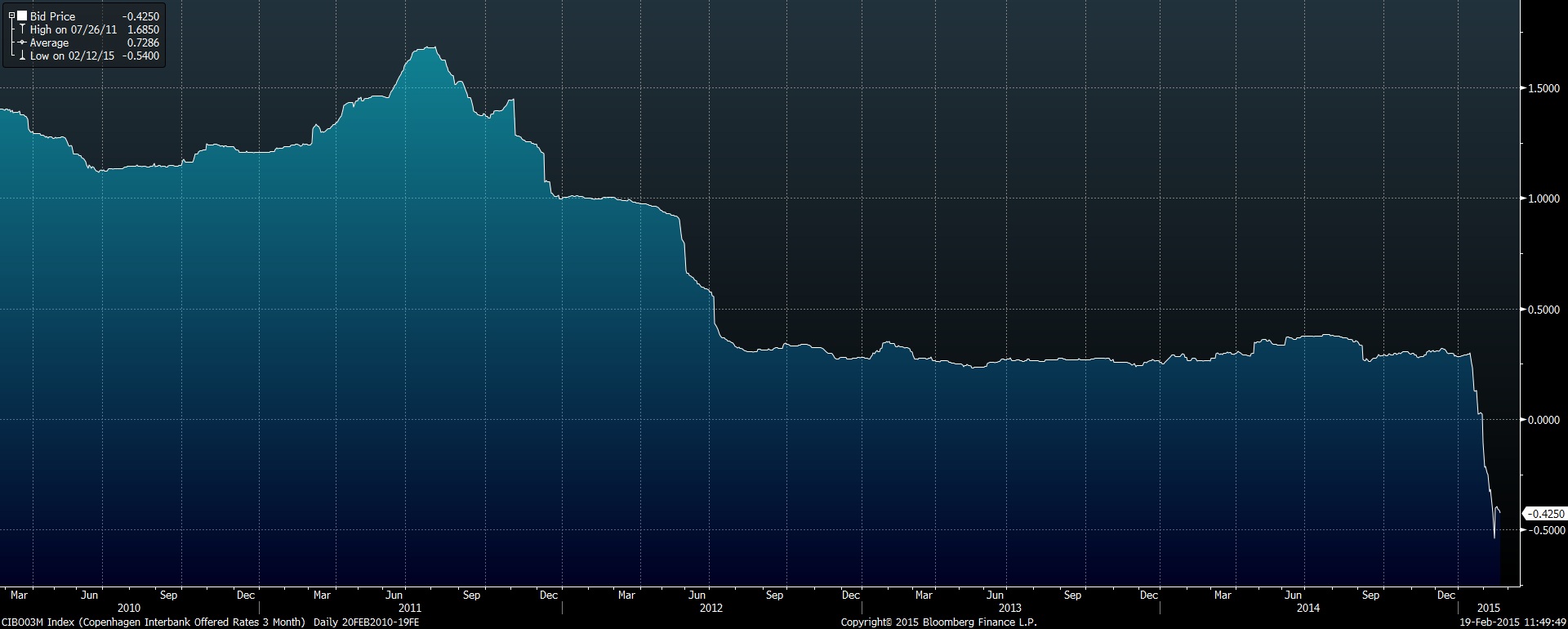
dkk ir

Just as a reminder: Swap rates are “unfunded”, that means based on contracts where no principal changes hands. If we look at “funded” rates, so how much money Danish banks pay for actual deposits, the situation is much more dramatic:
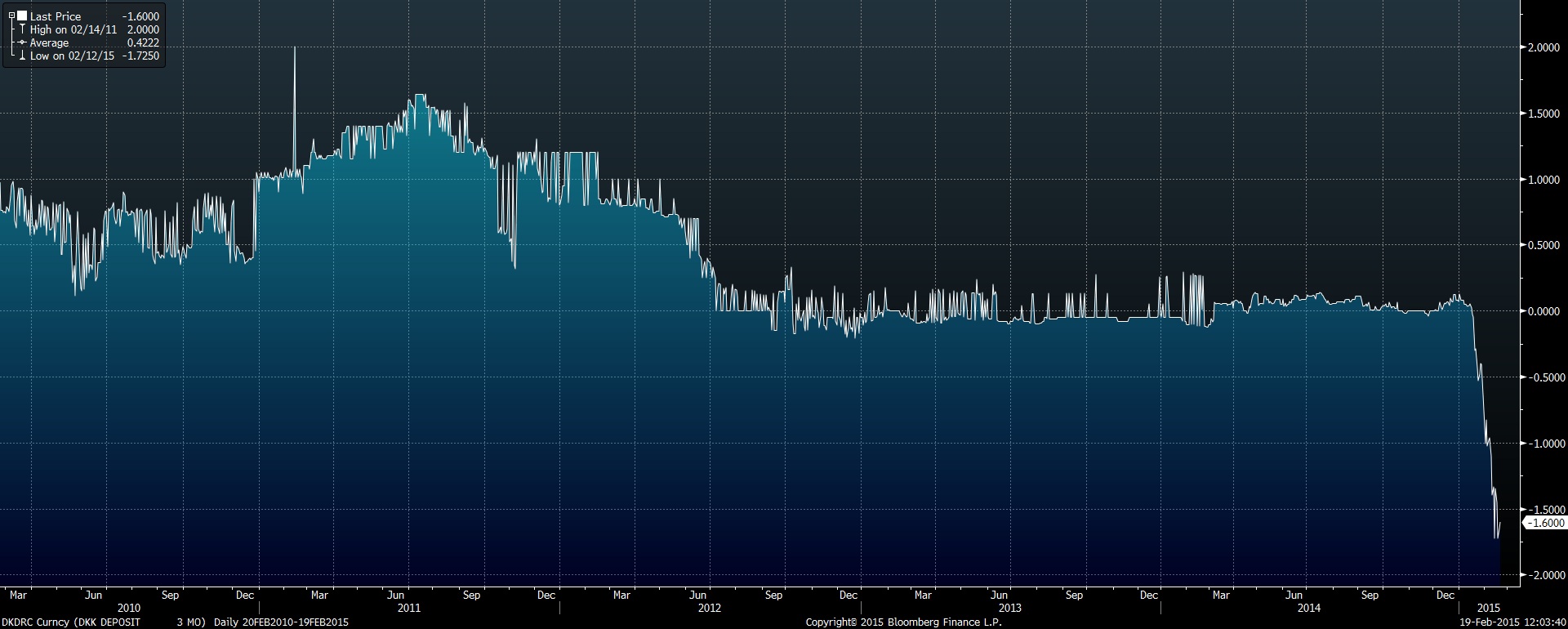
dkk fund

So just to put this in context: If you want to deposit money for 3 months at a Danish bank for 3 months in DKK, they charge you -1,6% p.a. for this “service” !!!!

Impact on Gronlandsbanken:

One thing about Gronlandsbanken which I liked initially but what could be a problem going forward is the following: Gronlandsbanken has a significantly higher deposit base than loans outstanding. While this is good from a liquidity and risk point of view, it is bad because those excess funds have to be invested somewhere and in local currency.

I am not sure if Gronlandsbanken could actually charge for deposits locally, so the risk is there that they get squeezed on the amounts not loaned out to customers. They seem to have anticipated this and increased their bond holdings, but still, at year end 2014, roughly 20% of the balance sheet is potentially exposed to this potential “Negative carry” problem.

On the other hand, as a EUR investor being invested into a DKK security exposes me to a “positive Black Swan” similar to the CHF/EUR move in January. If something goes horribly wrong in the EUR zone, there might be some upside in holding DKK denominated securities.

Addtitionally, any Danish pension fund and Insurance company will struggle to find income producing assets in DKK. With a dividend yield of (gross) of around 8%, Grondlandsbanken should be not unattractive and therefore support the share price in the short term.

Summary:

The underlying business of Gronlandsbanken has done surprisingly well in 2014 despite a lackluster economy. Due to the carnage in natural resource prices, the implied “resource option” has been postponed some years into the future, making the investment case less attractive compared to 2,5 years ago.

Ultra low and negative interest rates could make it more difficult for deposit-rich banks like Gronlandsbanken to maintain their interest margins. As there are not that many alternatives at the moment I will continue to hold the stock for the time being, as it also functions as a kind of “Euro Black Swan” hedge. If I find other interesting finaincial service stocks, Gronlandsbanken would be the first one to be replaced as I think that my other financial holdings (Kasbank, Van Lanschot, NN, Admiral) have a better risk/return ratio.

I will also monitor closely if and how the negative rates will feed through Grondlandsbanken’s Q1 results.

Why on earth is Seth Klarman investing 1,7 bn USD in Cheniere Energy (LNG) at 7x P/B ?

In my book review “The Frackers”, I mentioned one of the stories in the book was about Cheniere Energy:

Finally, there is a fascinating side story about the guy who is running Cheniere Energy, Charif Souki. His great idea was to import natural gas into the US and he raised several billion USD to build a huge gasification plant on the gulf coast. He clearly did not see fracking coming and his investment was worthless. Nevertheless, he was able to raise another few billion bucks and retool the facility in order to export natural gas.

This “double or nothing” gamble seems to have paid off. Seth Klarmann by the way, has just doubled its stake in Cheniere, making it their biggest public listed position at around 1,7 bn USD.

Seth Klarman

Seth Klarman is a famous value investor running Baupost Group a 25bn USD hedge fund. In contrast to Buffett, Klarman very seldom gives interviews and his fund commentaries are hard to get. Hi is considered to be the “heir” of Benjamin Graham and still sticking to the “cigar butt” approach of deep value investing. Two years ago in a Charlie Rose interview, Klarman made the following comment:

Baupost’s leading man says that he buys “cigar butts” at cheap prices. Warren Buffett used to also do this. The difference between the two legends is that Klarman stayed focused on cigar butts while Buffett’s process morphed into buying great companies at great prices and then into paying so-so prices for great companies.

Klarman does many things ordinary investors can’t do, like buying defaulted Lehman stuff etc. Not many of his investments are public and not all of his public investments are successes. Nevertheless it is clearly interesting to look more deeply into his biggest public position, Cheniere Energy.

Cheniere Energy

Cheniere’s stock chart shows the “unusual” history of the company:

Just as a side remark, somehow this chart reminds me of this funny animal:

Looking at Cheniere’s latest quarterly report, we can clearly see that Seth Klarman’s days as Graham style “net-net” investor seem to be over. Cheniere has currently around 7,5 bn net debt and 2,3 bn equity. Based on a market cap of around 17 bn USD, this is a P/B of roughly 7 times so hardly a bargain investment based on this metrics.

On top of that, the company never made a profit in its life as this table with EPS since 2004 clearly shows:

      EPS
02/21/2014 FY 13 12/13   -2,2
02/22/2013 FY 12 12/12   -1,6
02/24/2012 FY 11 12/11   -2,6
03/03/2011 FY 10 12/10   -2,3
02/26/2010 FY 09 12/09   -3,8
02/27/2009 FY 08 12/08   -6,0
02/27/2008 FY 07 12/07   -3,6
02/27/2007 FY 06 12/06   -1,5
03/13/2006 FY 05 12/05   -0,9
03/10/2005 FY 04 12/04   -0,6
N.A. FY 03 12/03   -0,4

So the question is clearly: What does Seth Klarman see to make this his biggest publicly disclosed investment ?

The best analysis I found was the one at Value Investor’s Club (accessible with guest login) from 2013, where the stock was trading at a third of the current price (Klarman bought between 60-70 USD). There is also a good article in Forbes from 2013 about the story behind Cheniere from 2013.

I try to summarize the case in a few bullet points:

– natural gas is very cheap in the US due to fracking and multiple times more expensive especially in Asia
– despite high costs, it is a pretty good business to liquify natural gas in the US and ship it to Asia in order to earn the spread
– Cheniere is in the process of finishing its first gasification plant by the end of the year 2015 and will then start to produce reliable cash flows as it has already contracted out its full production capacity for 20 years to major energy companies

The most important point is however the following quote from Forbes:

Cheniere’s Sabine Pass facility got its approval from the Department of Energy to export to any country in the world two years ago. It is so far the only facility to be cleared to export to countries that do not have a Free Trade Agreement with the U.S. And getting a non-FTA permit is a make-it-or-break-it approval for these projects, because there’s only one big gas-importing country (South Korea) with a free trade deal with the U.S. Unless a facility can export to the likes of Japan, China and India, the economics likely won’t support a multibillion-dollar build-out.

Cheniere had the luck to be the first to get this license. Later on, mostly due to the pressure of US based energy users, the US Government declined to issue further LNG “non FTA” export licenses for some time. According to Cheniere’s latest investor relation presentation, in 2014 two more “non FTA” licenses have been granted but Cheniere clearly has a head start.

Many more export facilities in the US would lead to higher prices in the US and to lower spreads compared to Asia, but for the time being, Cheniere’s primary LNG facility could be viewed as the typical “toll bridge” for US natural gas on its way to off shore destination as the other two licensed projects are still to be completed in several years time.

Cheniere itself is trying to further expand its current facility by 50% and they are projecting another site, but both projects have not yet received their license.

Valuation:

Replacement value

Despite buying at 7 times book, the question is: Could it be that Klarman is buying below replacement value ? I think it is unlikely. EV is around 25bn, stated book value of the assets is around 8 bn. Liquification facilities are not that hard to construct. all you have to do is to call someone like Bechtel and sign a turn-key project. Ok, you need the land and the permission, but overall this seems to be manageable in the US. So without going into more detail, we can assume that the current valuation of Cheniere is clearly above replacement value.

Valuation based on future cash flows

The VIC author estimates around 4-6 USD per share distributions for Cheniere’s shareholders going forward based on the first 4 trains of the initial liquification project. I have not double checked this but I will assume this number of being correct.

Reading through the roughly 15 pages of risk factors in Cheniere’s 2013 report, I would not call this a risk free business.There are still a lot of moving parts and operational risks even if the whole facility is up and running. Cheniere’s public bonds in the operational subsidiary trade at around 5,5% yield p.a. So discounting equity cash flows at the HoldCo level should be higher than that.

A) Existing facility and licence & contracted cash flows only

Cheniere has fixed contracts for 20 years. In the following table I have calculated NPS for the above mentioned EPS range and different discount rates, based on the assumption that one gets those earnings for 20 years and after that nothing (for instance any future earnings have to be applied to retire the debt):

eps/discount rate 4 5 6
6,50% 44,07 55,09 66,11
7,50% 40,78 50,69 60,83
8,50% 37,85 46,73 56,08
9,50% 35,25 43,17 51,81
10,50% 32,92 39,96 47,95
11,50% 30,84 37,05 44,46

We can clearly see, that the contracted amounts at the existing facility will not be enough to justify the current valuation of around 70 USD.

B) Existing facility, indefinite cashflows

This is the table with an indefinite stream of earnings at various discount rates:

eps 4 5 6
6,50% 61,54 76,92 92,31
7,50% 53,33 66,67 80,00
8,50% 47,06 58,82 70,59
9,50% 42,11 52,63 63,16
10,50% 38,10 47,62 57,14
11,50% 34,78 43,48 52,17

Even with an indefinite time horizon, Cheniere does not look like a “bargain stock”.

C) Existing facility + 50% capacity increase, contracted cash flows only

eps/discount rate 4 5 6
6,50% 66,11 82,64 99,17
7,50% 61,17 76,03 91,24
8,50% 56,78 70,10 84,12
9,50% 52,87 64,76 77,71
10,50% 49,39 59,93 71,92
11,50% 46,26 55,57 66,69

D) Existing facility +50% capacity increase, indefinite cash flows

eps 6 7,5 9
6,50% 92,31 115,38 138,46
7,50% 80,00 100,00 120,00
8,50% 70,59 88,24 105,88
9,50% 63,16 78,95 94,74
10,50% 57,14 71,43 85,71
11,50% 52,17 65,22 78,26

The 4 scenarios show relatively clearly that only with including future non-contracted cashflows and additional, not yet approved capacity, the stock looks interesting. In order to satisfy the return expectations of Klarman, which should be 15-20% p.a.based on his track record, he must assume further cash flows for instance from the second site Cheniere wants to contruct at some point in the future in Corpus Christi. Plus, there should be no dilution etc. from raising the rquired gigantic amounts of capital.

Maybe he is betting that the stock will trade like a bond if the company starts paing dividends ? Or is he leveraging the investment with addtional debt ?

In any case, he seems to be paying a lot for future, uncertain cash flows, which contradicts his “we still do cigar butts” statement. This is not that different from what Buffett is doing when he is paying rather expensive prices for great companies. At least for a guy with a portfolio size like Seth Klarman, the time of “cigar butt” investing seems to be over. Even he must feel th pressure that you cannot charge 2/20 for holding cash.

So to answer the question from the beginning:

Why on earth is Seth Klarman investing 1,7 bn USD in Cheniere Energy (LNG) at 7x P/B ?

I have no real idea but it might be the case that Klarman somehow need to put money at work and he expects this investment to be uncorrelated to general market as he has been quite pessimistic on equities for some time.

Summary:

For me, Cheniere at current prices is clearly one for the “too hard” pile. Klarman of course can spend a lot of money and time to fully analyze the energy markets etc. although as we know now, most energy experts have a hard time to make meaningful forcasts. But still it doesn’t look like a bargain and clearly no “cigar butt” or “net-net” kind of investment.

Funnily enough, analyzing Cheniere makes me much more confident in my Electrica investment. At least to me, the risk/return relationship there is some magnitudes better than for Cheniere. I think I will upgrade this to a full position over the next few days.

P.S.

Some other stories I found about Cheniere
http://www.alternet.org/fracking/how-powerful-friends-and-cozy-relationships-helped-cheniere-energy-cash-natural-gas-exports
http://www.octafinance.com/baupost-group-doubled-stake-cheniere-energy-still-bullish-us-lng/
http://www.mailtribune.com/article/20150125/Opinion/150129835

Some links

Arte documentation (German) how Amazon disrupts publishing (h/t Blicklog).

Jet.com wants to attack Amazon. The founder has sold diapers.com to Amazon and worked for 2 years “inside”.

Tesla seems to be ready to produce batteries which will power your home

Pat Dorsey abandons somehow moats and is betting on managers instead. With his new German investment Aurelius AG, he might be betting on the wrong guy….(MS Deutschland bond scandal).

Highly recommended: Damodaran on the mess that is Petrobras

Ed Morse, one of the very few who predicted the drop in oil prices, expects much lower prices in the next few months

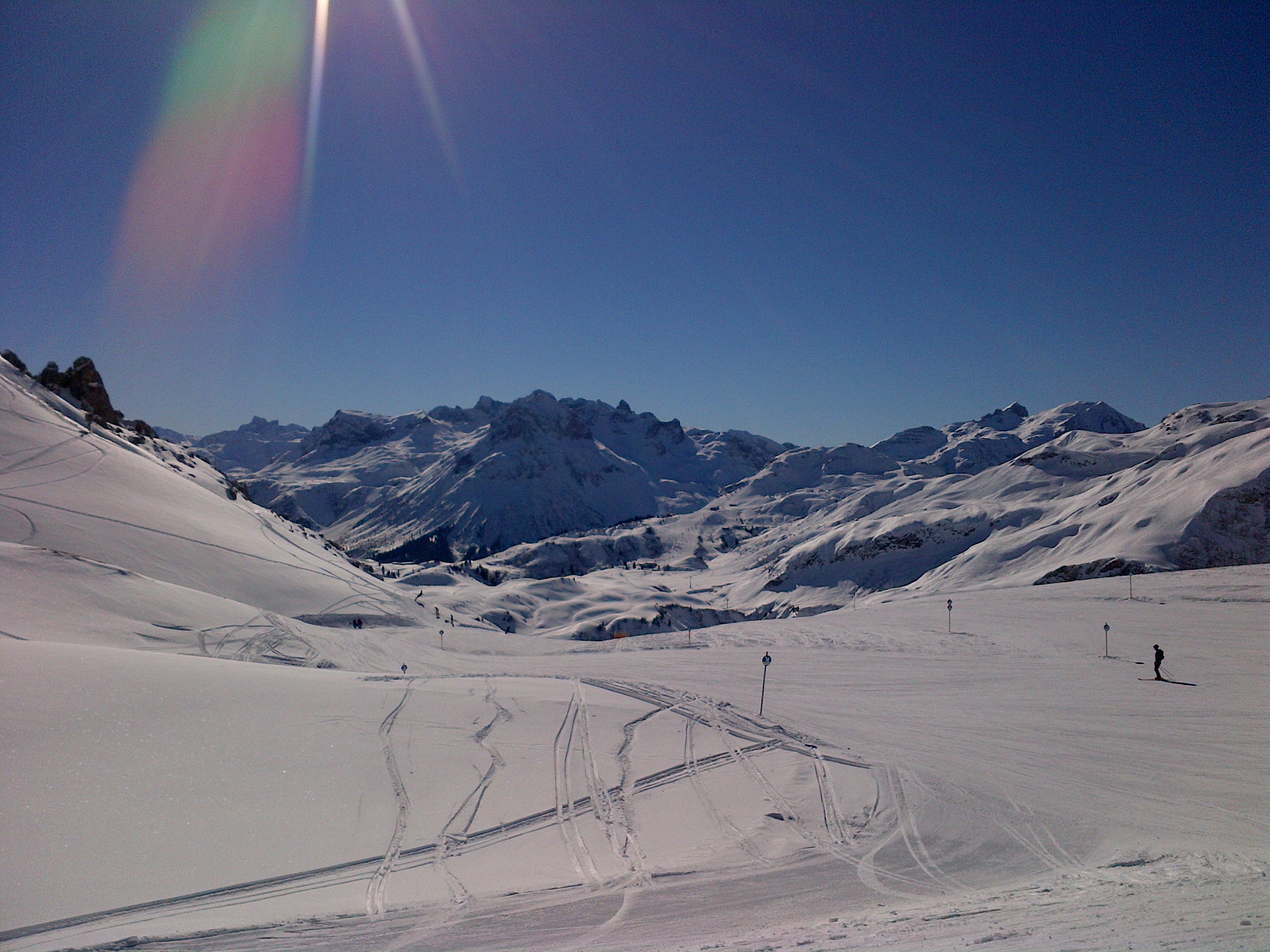
And finally, based on the “overwhelming demand”, a few pictures from a recent skiing trip (Austria, Warth/Lech):

IMG-20150212-00158

IMG-20150212-00160 (1)

“Quick and dirty” portfolio risk management

In my January performance review, I made the following comment:

Overall, if you don’t have an active opinion on interest rates (which in my opinion you shouldn’t), one should make sure that the overall exposure of the portfolio is as neutral as possible with regard to interest rates. This sounds easier than it actually is. For some companies (insurers) it is relatively easy to see how their exposure is to interest rates. For others, it is much harder. But in my opinion, just checking business models against the influence of interest rates is a very worthwhile and value creating exercise.

Checking a portfolio against interest exposure (or any other exposure) involves 2 basic steps:

1) You have to make a judgement how businesses are effected by the exposure (positive, negative, neutral)
2) You have to aggregate those exposures over your portfolio

Complex or keep it simple ?

In institutional environments, risk management departments are usually staffed by legions of math or physics Phd’s which employ very complex modelling tools in order to both, come up with exposures and aggregate them. There are a myriad sophisticated risk management techniques available. Monte Carlo analysis, correlation modelling etc. etc. can be combined to come up with great looking distribution charts showing portfolio exposures against a multitude of factors.

The problem with such sophisticated models is that the outcomes are often not stable and outcomes change a lot if some inputs are changed only slightly. In many cases those models develop into your typical “black box” where people do not understand any more of what is going on and how the results are actually creates and no one dares to ask.

This is the reason why I personally think that one should prefer simple and easy to understand models even if they lack most sophisticated tools. Maybe the results are not 100% accurate but at least one can understand them.

A very simple way to analyze and aggregate interest rate exposure

For step 1), I use a very simple heuristic based on capital intensity and sector:

– banks and insurance companies a clearly negatively effected, the more traditional the business model, the more negative the impact
– capital-intensive business or real estate related stuff usually profits most from low-interest rates
– capital light businesses are relatively neutral
– any longer term fixed income investments will do very well

For step 2), I then attach a score ranging from +1 (low-interest rates are very positive) to -1 (very negative) to each position and multiply it with the percentage of the portfolio.

This is how this would look for my current portfolio:

Name Weight Impact low interest rates Weigt
CORE VALUE      
Hornbach Baumarkt 4.3% 0.5 0.02
Miko 4.3% 0 0.00
Tonnellerie Frere Paris 6.1% 0.5 0.03
Installux 3.6% 0 0.00
Cranswick 3.0% 0 0.00
Gronlandsbanken 2.5% -0.75 -0.02
G. Perrier 4.5% 0 0.00
IGE & XAO 2.1% 0 0.00
Thermador 2.6% 0 0.00
Trilogiq 1.5% 0 0.00
Van Lanschot 2.4% -1 -0.02
TGS Nopec 4.7% 0 0.00
Admiral 4.6% -0.5 -0.02
Bouvet 2.4% 0 0.00
KAS Bank NV 4.5% -0.75 -0.03
       
       
Emerging Market     0.00
Koc Holding 1.2% 0.5 0.01
Ashmore 4.2% -0.25 -0.01
Depfa 0% 2022 TRY 3.0% 1 0.03
Romgaz 2.5% 0.5 0.01
Electrica 2.6% 0.5 0.01
       
OPPORTUNITY      
       
Drägerwerk Genüsse D 4.9% 0.5 0.02
DEPFA LT2 2015 5.1% 0 0.00
HT1 Funding 4.2% 0.5 0.02
MAN AG 2.4% 0.5 0.01
NN Group 2.8% -1 -0.03
Citizen Financial 2.8% -0.75 -0.02
       
Cash 11.3% 0 0.00
       
Overall IR exposure     1.2%

The resulting score will be between -1 (totally negative) to +1 (in aggregate positive).

Overall, based on my initial judgements, my portfolio looks pretty neutral vs. low interest rates. Clearly this is no scientific approach and I would not get any academic grades for this, but still, just doing the exercise in my opinion makes a lot of sense and makes you think about your overall portfolio exposures.

Once you have created this spreadsheet, it can be used with additional columns also to look at exposures like Oil prices or EUR crisis scenarios.

Some links

Always a good read: Rob Vinall’s (RV Capital) annual letter featuring US based Credit Acceptance Corp. as major new investment

Don’t miss the new issue of Graham and Doddsville featuring among others Bill Ackman and Corsair Capital

Very good (long form) post on the future of television networks vs. Netflix, Amazon & Co

GMO’s Q4 letter contains an intersting part on oil, fracking etc. from Jeremy Grantham. He references this NYT article on oil by Daniel Yergin which is also a good read.

Some (Australian) perspectice on iron ore and China

AlphaVulture has a very unique perspective on Amaya, the new online poker power house. It could actually be a rather interesting short opportunity.

WertArt has discovered closed end Italian Real estate funds. Something to look at more closely…..

Performance review January 2015 – Comment: “Life in zero gravity”

Performance:

In January, the portfolio gained +3,38%. That looks good stand-alone but pretty weak against the +8,1% of my Benchmark (Eurostoxx50 (25%), Eurostoxx small 200 (25%), DAX (30%),MDAX (20%)) for January.

[EDIT: the first version of the post stated +4,14%, that was a mistake as well as the 3,54% from the second version. Somehow my spreadsheet got screwed up]

Looking at all 5 Januaries since I run the portfolio, one can see that a 4% performance difference in January rather seems the rule than the exception:
Read more

Book review: “The Frackers: The Outrageous Inside Story of the New Billionaire Wildcatters ” – Gregory Zuckerman

“The Frackers” is the story about a bunch of crazy US “wildcatters” who managed to find a way to extract enormous amounts of oil and natural gas from rock formations which were thought (by conventional wisdom) as not to be worth drilling.

They way they achieved it was actually not to invent anything new, but to combine and refine existing technologies (horizontal drilling and fracking) which allowed them to produce oil and gas at competitive costs.

For potential investors there is a lot to learn in the book, among other stuff:

1. Being too early is the same as being wrong. It took a long time to make it work and those who started early often did not have the means to pull through.

2. One of the key innovations was to use less chemicals than before in the fracking fluids. One more example that innovation often means less and not more

3. The guy who had the breakthrough idea with adding less chemicals to the fracking fluid did actually not profit much from his invention

4. Established companies like Exxon, Chevron etc. mostly missed the opportunity because they relied on “conventional wisdom” which said that shale is not relevant. Funny enough, one of the best shale regions (Barnett) lies literally below Exxon’s headquarters. They were sitting directly on top of a big energy source but ignored it and went to Indonesia, Nigeria etc.

5. The most aggresive and fastest growing “frackers” did not produce the best long term returns for shareholders. If you compare for instance the two companies of the main characters, Aubrey McLendon’s highly leveraged Chesapeake Energy against Harold Hamm’s conservatively run, 70% CEO owned Continental Resources, it is not difficult to see which is the better long term concept for shareholders:

For non-US readers like myself it was also interesting to see how the dynamics between wildcatters and land owners play out. Without landowners having a profit stake in the production, getting permission for fracking would be much more difficult. This is maybe the reason why fracking in Europe will never get done as the government has the monopoly on natural resources.

Another thought: I think in the current discussion of how the oil price impacts the US economy, it is not enough to look just at the direct jobs created by the E&P companies. If you assume that in total, the shale boom increased daily US oil production by 5 mn barrels, at an oil price of 80 USD per barrel, around 150 bn USD have flown back into the US economy annually instead of going to OPEC countries or other non-US oil producing countries. I guess fracking had a much bigger impact on the US economy’s revival since the financial crisis than the Fed.

Finally, there is a fascinating side story about the guy who is running Cheniere Energy, Charif Souki. His great idea was to import natural gas into the US and he raised several billion USD to build a huge gasification plant on the gulf coast. He clearly did not see fracking coming and his investment was worthless. Nevertheless, he was able to raise another few billion bucks and retool the facility in order to export natural gas.

This “double or nothing” gamble seems to have paid off. Seth Klarmann by the way, has just doubled its stake in Cheniere, making it their biggest public listed position at around 1,7 bn USD.

Overall, I found the book very interesting and I would say that it is a MUST READ for anyone interested in the oil industry. It is well written and entertaining as well as informative. Highly recommended !!!

When dividends matter (Hint: Mostly not at all)

Today I read an article in one of the major German Newspapers, Frankfurter Allgemeine, about the merits of investing in stocks.

I know that the year is still young, but this article (in German) might be easily the worst article of the year on stock investing.

They offer 3 “compelling” reasons why stocks are attractive:

– dividends are increasing
– stocks are still below all time high if you look at a pure price index (the old FAZ index)
– the dividend yield according to them is 2,9% and higher than 10 year Bunds (0,5%) or BBB bonds (1,5%)

They even recommend to buy stocks just before the dividend payment to collect the dividend and then sell. They finally show a calendar with all dividend dates of the major German stocks in order for the readers to be prepared.


Technicalities:

For some reason, the author doesn’t seem to know the existence of an “Ex-dividend” adjustment for stocks. I guess this guy also buys bonds the day before they pay the coupon or so. Including taxes and execution costs, I am pretty sure this kind of “dividend hopping” has negative expected value.

Anchoring bias

Secondly, it is interesting that you see such a nice example of an “anchoring bias” in a major newspaper. For investing in stocks it doesn’t matter if the stocks trade at an all time high or all time low. All that matters is if stocks are valued adequately in relation to their intrinsic value which in turn is determined by future profits and cash flows. With a “strategy” like that one mentioned, you will miss most bull markets and happily buy into bear markets. Congratulations !!!

Where is the problem with dividend yields ?

Well, before I further insult the writer of this article, the problem is that many people seem starting to think that somehow dividends are like “coupons”. This is clearly the side effect of the current low-interest rate environment.

There are also many statistics which point out that over a very long period of time, dividends have been a significant part of stock market returns.

However just buying stocks with high dividend yields is actually a loosing strategy as Dreman, O’Shaugnessey and others have shown. For me, the problem is two fold:

1. High current dividend yield stocks are often value traps

When companies get in fundamental trouble, they often try to preserve their “sacred” dividend until the bitter end. For some reason, canceling a dividend is been seen as the ultimate ratio before the real troubles begin. So it is quite common, especially in capital-intensive industries that struggling companies keep up their dividend despite an eroding business, as it could be seen with E.on, RWE or the banks. Sometimes you even see companies paying dividends and issuing dilutive shares at the same time just to keep up the illusion of a constant, “coupon like” dividend like Santander just recently.

Those long term returns mentioned above are actually much more the result of high growth, low dividend yield stocks which over a long-term grow so much that after 20 years or more, the dividend in relation to the original purchase price is then huge.

Especially these days, dividend yield is a very imperfect measure for shareholder returns anyway. Including share buy backs and looking at total shareholder return is the much superior strategy as for instance Mebane Faber has shown in his book.

2. Psychology: Yield hogs get slaughtered

A “yield hog” is someone who only looks at coupons or yields and not on total returns. If you buy a bond and the issuer does not go bankrupt, you get the coupon and the principal back. If you buy a stock, you might get your dividends (or not), but you never get your principal back. In contrast to a bond, you have to sell the stock to someone else in order to get your principal back. However there is clearly no guarantee that you will your principal back as “mr. market” might disagree on the value he wants to give you.

Psychologically, “Yield hogs” often cannot stand draw downs on the stock price and then get “slaughtered” when the panic sell in a bear market (often after doubling up on the way down). In some areas like insurance or pension funds, where you need to show a current yield, this “yield hog mentality” is basically baked into the business model and can be observed cycle by cycle.

So when do dividends add or indicate value ?

In my opinion, the only case where dividend yields are important if you invest in “deep value” cheap non-growing companies with a lot of cash flow and questionable capital allocation skills or dangerous environments. In such cases, having a paybacks via high dividends lowers the “risk duration” of an investment significantly.

In my portfolio for instance, Installux, Romgaz and Electrica are such candidates where I would not invest if they would just accumulate earnings. but be careful: i ti snot the dividend which makes them good investment but the undervalued nature of the stock. Admiral for instance, a company I really admire, would do much better fo its shareholders if they would buy back stock instead of paying 6-7% dividends. The long term compounded return would be much better without the tax on the dividend income.

As always, Warren Buffett has summarized it nicely several times why dividends are actually stupid for good companies.

Quick summary:

Investing in stocks because of the dividend yield is an extremely stupid way to invest. Either you will end up holding a lot of value traps and/or you will lose your nerves in the inevitable downturns.

Dividends should only been considered in context with the underlying business model and in combination with the capital allocation (reinvestment, share buy backs, debt levels), but never ever as a stand-alone investment criteria.

Dividends ARE NOT COUPONS and stocks are not “yield replacements” for bonds !!

Some links

If you’ve got 2 hours time this week, don’t miss Barry Ritholz talking to Bond legend Bill Gross (Part 1, Part 2). HIGHLY RECOMMENDED !!!

The guy who blew up AIG’s sec lending is back as a hedge fund manager

Punchcardblog likes subprime retailer Conn’s

Nate from Oddballl finally goes activist on a small net-net company

Bill Gates released his personal annual report

Greenlight’s Q4 2014 letter including a comment on Citizen’s Financial

Target is another proof that retailers often work not well across borders

Updates: Energiedienst (CH0039651184) & Vossloh (DE0007667107) voluntary tender offer

Energiedienst

My first transaction this year was to sell my shares in Energiedienst.

Looking at the Swiss Francs chart, where Energiedienst has its primary listing, this looks like genius timing:

However in Euro, it looks pretty stupid:

In Euro, the shares jumped from around 25,20 EUR to around 27 EUR at the time of writing, a upmove of around 7% against a loss in Swiss Francs of around -10%.

So what happened ? Well in case you were not on a Moon mission last week you might have heard about that Swiss Franc “thing”. The Swiss Franc increased around 17% against the Euro within a very short time frame. What we can see above is relatively easy: The stock price in Swiss Franc fell, but not enough to off set the CHF/EUR movement. This is very strange, especially in the case of Energiedienst.

Energiedienst operates (based on sales) around 85% of its business in Germany and only 15% in Switzerland. So even if we assume that the business in Switzerland is not negatively affected, the increase in EUR should have been theoretically only 0,15*17%= 2,6% in EUR and not +7%.

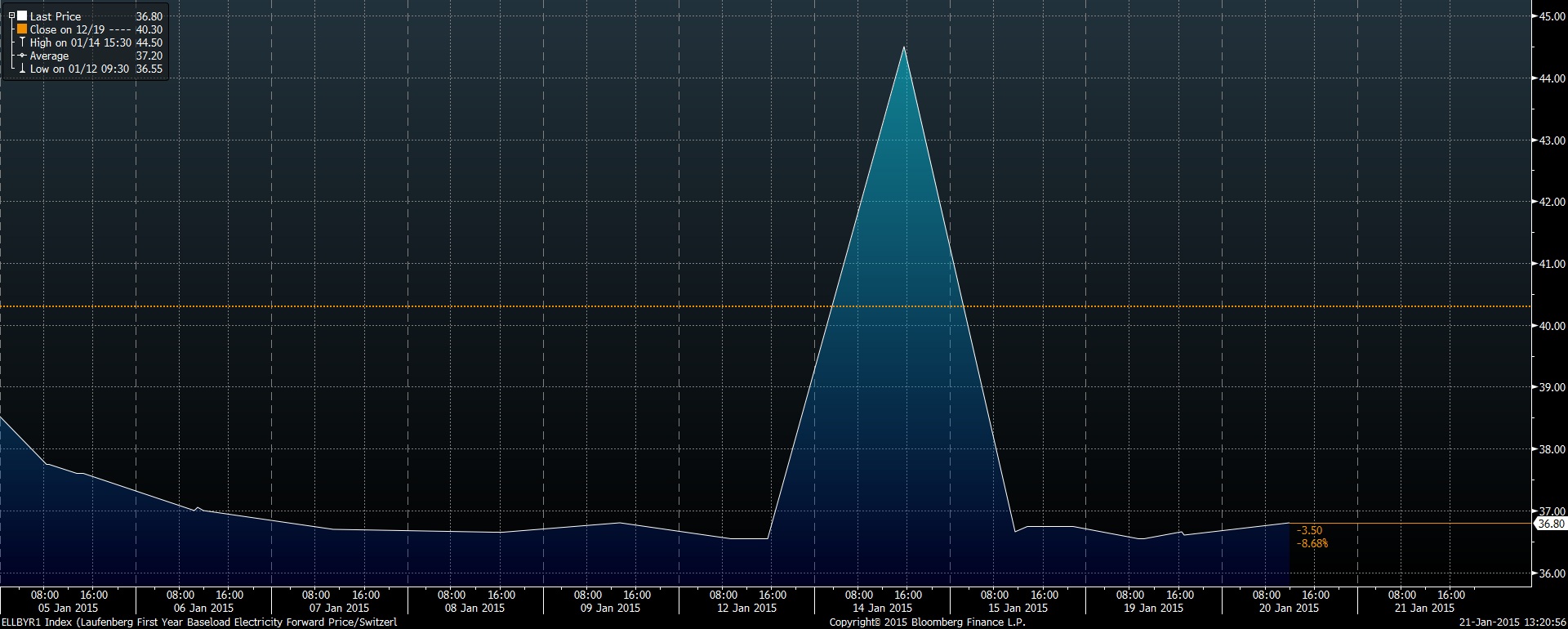
If we look at Swiss Power prices however, we see something interesting: With the exception of the one day, they directly adjusted in EUR terms as we can see here for instance in the Swiss 1 year forward electricity prices:

swiss power EUR

So in this case, electricity prices seem to be more efficient than stock prices, as there seems to be a very quick and liquid market to arbitrage away those currency differences quickly. Nevertheless I lost money by selling to early but in this case it was not my fault.

Vossloh

Back in September, I presented Vossloh as a potential fallen angel with activist involvement. This is what I wrote back then:

Based on today’s price of ~49 EUR this would mean a potential upside of 35-68%. However one should assume that this turn-around needs at least 3 years. For a turn around, I personally would require a higher return than for a normal “boring” value stock as there is clearly a risk that the turnaround does not work out as planned.

If I assume a target return of 20% p.a., i would need to be sure that the price of Vossloh is in 3 years at around 85 EUR. This is clearly at the very upper end of my target range. So I would either need to have more aggressive assumptions or I would need a lower entry price. As a value investor, I would not want to bet on growth or on a shorter time frame for the turn around, so the only alternative is to wait for a lower entry price.

Taking the midpoint of my range from above at 74, I would be a buyer at ~42 EUR per share but not before.

On November 7th, Vossloh actually hit the 42 EUR threshold but somehow I was not quick enough and passed to buy some shares. Since then the shares recovered nicely to around 54 EUR when yesterday, the following news hit the wires:

On 20 January 2015, KB Holding GmbH decided to make a voluntary public takeover offer to the shareholders of Vossloh Aktiengesellschaft, Vosslohstraße 4, 58791 Werdohl, Germany, for the acquisition of all ordinary bearer shares with no par value, each share representing a proportionate amount of EUR 2.84 in the share capital (the ‘Vossloh-Shares’).

KB Holding GmbH intends to offer the payment of a cash consideration per Vossloh-Share in the amount of the weighted average domestic stock exchange price during the last three months before the publication of this
announcement according to Sec. 10 para. 1 sent. 1 WpÜG pursuant to Sec. 5 para. 1 and 3 of the Regulation on the Content of the Offer Document, Consideration for Takeover Offers and Mandatory Offers and the Release from
the Obligation to Publish and Issue an Offer (WpÜG-Angebotsverordnung), as determined by the German Federal Financial Supervisory Authority (Bundesanstalt für Finanzdienstleistungsaufsicht, BaFin). This consideration is expected to be in a range between EUR 48 and 49 per Vossloh-Share and will be published immediately after being notified by BaFin.

KB Holding GmbH currently holds 29.99 percent of the shares in Vossloh Aktiengesellschaft.

The stock managed to gain some more and closed at around 56 EUR per share:

So the first question is: Why does he offer 49 EUR per share if the shares are trading already at 55 EUR ?

This one is pretty easy: Thiele was already owning 29,99%. In Germany, once you cross 30%, you have to make a mandatory offer at the trailing 90 “VWAP” stock price. My guess is that Thiele clearly wants to take control, but maybe not now and not at 55 EUR. So he used the occasion to come out with this lowball offer, because this releases him from any further mandatory offers and he is not forced to take more shares than he actually wants.

After the offer has expired and Thiele has crossed 30%, he only needs to disclose purchase once he crosses 50% and even then he does not need to make a mandatory offer as the voluntary offer releases him from making any subsequent offers.

Is the stock still attractive at that level ?

Well, we know now that Thiele clearly wants to take control. But we also know that he is a very shrewed operator with little interest in minority share holders. He controls the management of the company already (he actually hired the new CEO) as he ist already the strongest shareholder.

For anyone who followed the blog and the German Corporate law discussion, the biggest issue is the following: Under current law, Thiele could decide (or his CEO) to delist from the stock exchange. This is now possible in Germany without even getting any kind of shareholder approval. This would force many funds out of the stock as normally unlisted stocks are not permitted under most fund regulations. Even for hardcore hold outs this would mean low or no transparency etc. etc.

I have seen a recent study (Solventis, “Endspiele”) that since the change in law (or the change in interpretation), on average stocks lost around -25% following the announcement of a delisting.

Overall, at the current price the risk/reward ratio is in my opinion neutral. There is some room left with regard to a fair value and mean reversion, on the other hand one should be careful with regard to any minority unfriendly actions from Thiele & Co.

As a learning experience, I should maybe watch my watchlist a little bit closer in order not to miss such opportunities as in November.

« Older Entries Recent Entries »