Category Archives: Anlage Philosophie

Housekeeping: rejected, sold and forgotten

Some weeks ago, there was a very good post over at Barel Karsan. I think he hit exactly the right spot here:

Some time after you’ve purchased a stock, you probably have a pretty good idea as to whether you made a good decision or not. This is because you likely follow the stocks you have purchased fairly closely. This feedback mechanism allows you to fine-tune your stock purchase criteria so that you don’t make the same mistakes again. But often, some of the best lessons to be learned come from the stocks you didn’t buy, but considered buying!

I would even add to this, that one should also still try to follow the stocks one has sold in order to find out if the selling decision has added value or not.

So I built up two tracking lists. The first list consists of the stocks which were in the portfolio at one pint in time but sold. I want to track the relative perfomance of the stock and the benchmark since the sale.

Tracking list stocks sold

Stock Date Sale price Current Perf Perf BM Delta
Ensco 23.02.11 53.12 56.5 6.4% -5.0% -11.4%
Sysco 08.04.11 28.0 29.8 6.3% -6.7% -12.9%
Apogee 19.05.11 9.4 13.0 38.1% -7.3% -45.4%
ENI 13.07.11 15.7 17.6 12.3% -5.6% -17.9%
Tesco 15.07.11 403.0 314.1 -22.0% -4.5% 17.5%
Tsakos 20.07.11 9.3 6.6 -28.7% -4.8% 23.8%
DEGI International 09.08.11 27.8 29.8 7.4% 14.9% 7.5%
CS Euroreal 09.08.11 51.9 41.6 -19.8% 14.9% 34.7%
Axa Immoinvest 09.08.11 37.3 27.6 -26.0% 14.9% 40.9%
Pargesa 17.08.11 63.9 66.5 4.0% 12.8% 8.9%
Medtronic 17.08.11 32.2 38.1 18.4% 12.8% -5.6%
Beneton 17.08.11 4.6 4.6 -0.3% 12.8% 13.1%
Noble 17.08.11 31.64 39.1 23.5% 12.8% -10.7%
Bijou 31.08.11 63.5 70.6 11.1% 13.9% 2.8%
RWE 27.09.11 27.8 35.2 26.5% 19.2% -7.3%
Einhell 02.11.11 32.3 33.0 2.1% 14.2% 12.1%
Microsoft 09.12.11 25.1 32.0 27.4% 13.4% -14.0%
Frosta 03.01.12 16.7 18.0 7.7% 9.7% 1.9%
Westag 03.01.12 18.3 17.1 -6.7% 9.7% 16.3%
Magyar 24.02.12 2.0 1.9 -5.6% -0.3% 5.3%
KSB vz 15.02.12 439.9 435.9 -0.9% 0.9% 1.8%
Autostrada 06.03.12 6.3 5.9 -6.3% 3.4% 9.7%
             
Avg           4.7%

A negative delta means the stock has outperformed since I have sold it, positive delta means the benchamrk has performed better. On avarage one can see that the sell decisions added value, outperforming the benchmark based on this simple measure by ~4.7%.

Analysed but rejected stocks

Stock Date Sale price Current Perf Perf BM Delta
Ameron 10.03.11 69.8 85.0 21.8% -4.0% -25.8%
UPM 16.11.11 8.2 10.4 27.5% 14.8% -12.7%
Home Retail 30.08.11 122.5 104.1 -15.0% 17.1% 32.2%
Hewlett Packard 22.08.11 24.5 24.6 0.8% 21.5% 20.7%
Delta Lloyd 15.04.11 17.7 13.4 -24.3% -5.3% 19.0%
Esso SAF 06.12.11 63.4 75.5 19.1% 12.2% -6.9%
April 05.01.12 11.5 15.7 37.2% 11.5% -25.7%
Creston 03.02.12 49.8 60.0 20.6% 0.4% -20.2%
Nintendo 10.02.12 10830.0 11380.0 5.1% 1.8% -3.3%
Lingotes 24.02.12 3.0 3.0 0.0% -0.3% -0.3%
Colefax 08.03.12 223.0 223.0 0.0% 0.0% 0.0%
 
Avg           -2.1%

Here, the rejected stocks have performed on average better than the benchmark. Of course I can not say if they performed better than the portfolio, but it tells me that my “filtering” at least throws out interesting stocks even if I do not finally buy them.

In parallel I try to keep a record why I sold them and why I didn’t buy them, but in theory I can search in my blog as well. This is by the wy one of the really nice things about blogging.

Summary: I think it is a great exercise to look at “past” stocks and keep an eye on them. There might be the time when they become interesting again and “refreshing” old knowledge is much easier than starting from the beginning.
Spin-off watch – TNT and Cable & Wireless

Following last years oposts about spin-offs (part 1, part 2, part 3), I tried to keep track of some of the more interesting spin off situations.

TNT Express

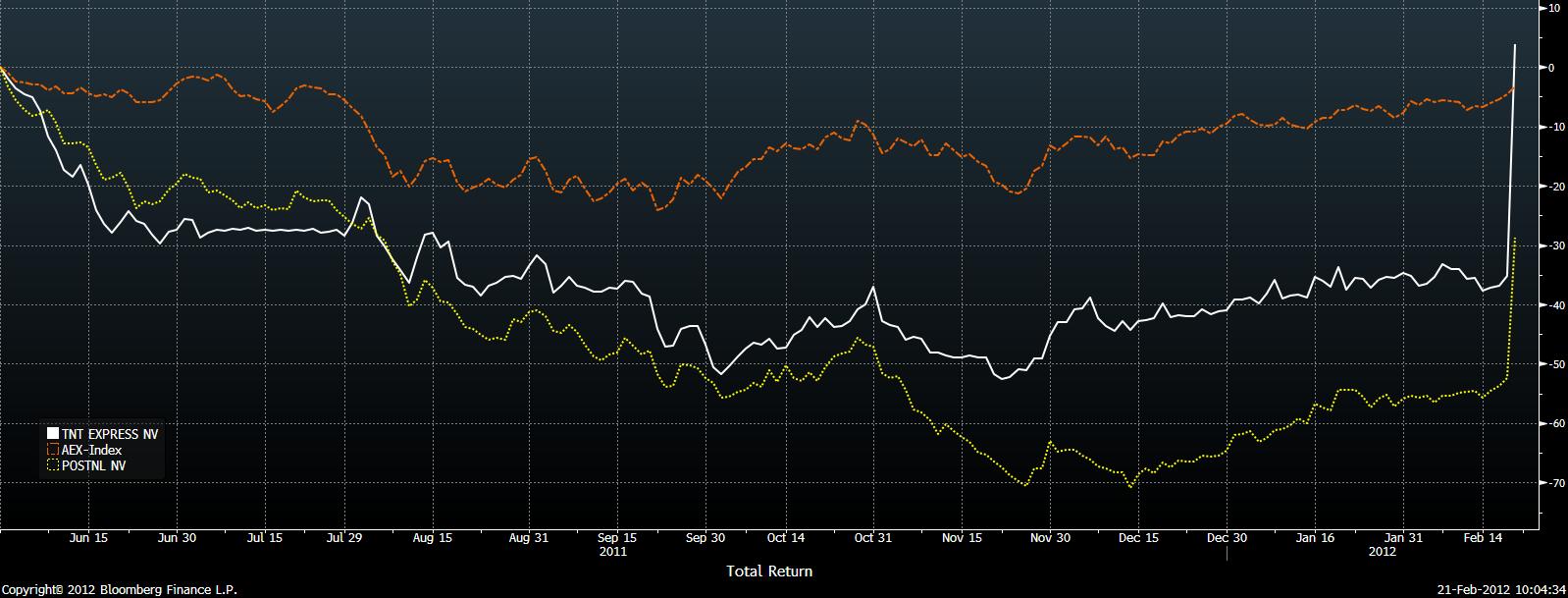
TNT Express was the express service spin-off from the Dutch Postal company. I had them on my research pile somewhere at position 10 to 15. However on the weekend, UPS made a 9 EUR per share offer for TNT Express, roughly a 50% premium on the previously traded price.

If we look at the chart, until last week, both shares significantly underperformed the index since the spin-off happened, only TNT Express made it above the index after the offer.

The 30% stake of TNT Express which PostNL owns, has almost the same value as PostNL’s market value. So PostNL might be an interesting company to look at.

Cable and Wireless

Cable and Wirless, the UK telephone company spun off the “international” part into Cable and Wireless Worldwide in February year. The international part was supposed to be the sexy part, but due to management and accounting issues, the stock suffered.

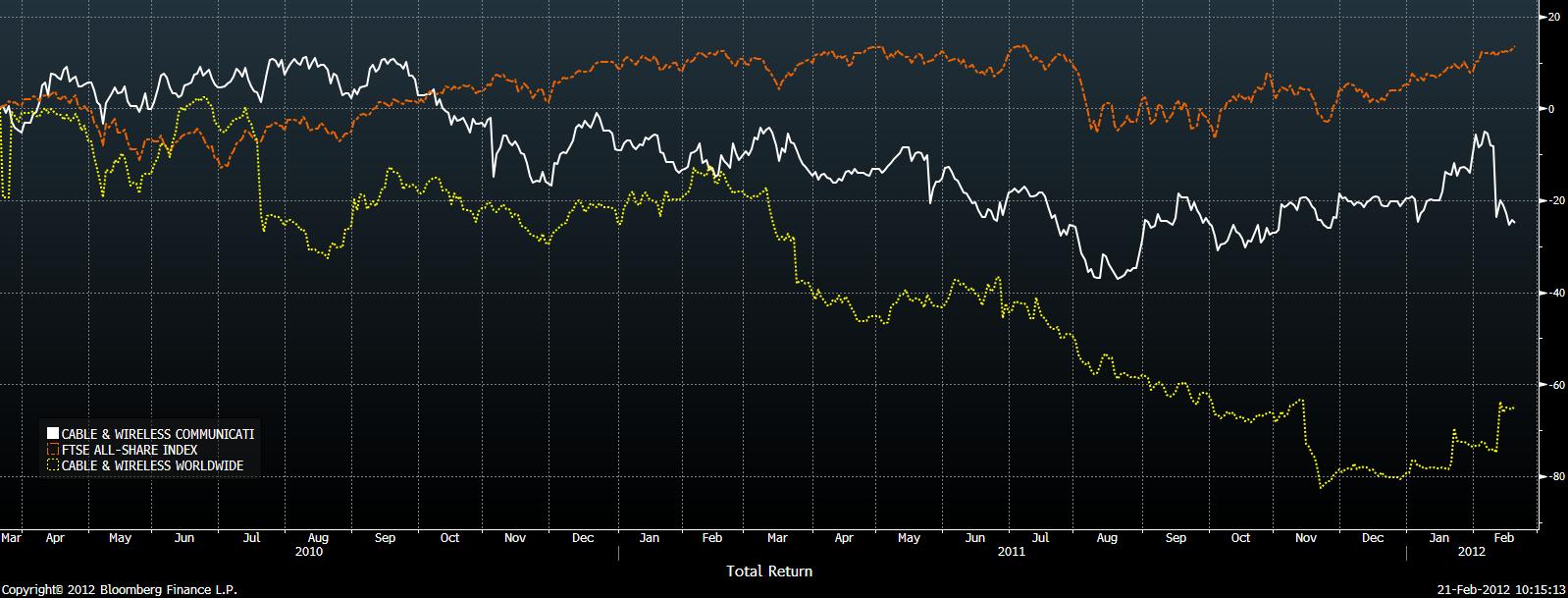
Last week, there was the rumour that Vodafone might be interested in hte “boring” part, the UK fixed line operations. However there was no confirmation from Vodafone and so the shares didn’t manage to rise as TNT Express did.

Again, as with TNT/PostNL, both parts underperformed the index significantly, as the chart shows:

So is there something to learn form this ?

Both cases show that spin offs per se are not a sure thing at all. In the case of C&W it rather looks like a desperate measure of a desperate company. In both cases, the performance after the spin-off event was relatively bad, so there is no need to hurry aftger spin offs are executed. As with all other “special situation” investment startegies, patience is required.

Hyundai capital structure arbitrage – final thoughts

Following part 1 and part 2 about my thoughts on a potential Hyundai Motors capital structure arbitrage deal, I wanted to summarize my thoughts and come to a conclusion.

In between, some new information came up:

a) it is possible to trade single stock futures in Korea thorugh Interactive Brokers
b) the mentioned US ADRs are actually ADRs on Hyundai Motor pref shares, so no “cheap” short potential
c) a contact told me that stock borrowing costs for Hyundai Motors common shares in Korea would be about 3-4%

Based on this new information, the relative value trade (short common shares, long pref shares) looks less attractive.

Traditional long-short

In the traditional short with a long position in the pref shares and a short position in the common, the “carry” would be calculated as follows:

Yield long position (3.77%) minus yield short position (0,80%) minus cost stock borrowing (3-4%).

So we would end up in the best case with 0% carry, in the worst case with -1 % carry for the long short position. Negative carry trades are much less attractive because you actually loose if nothing happens. A good carry trades gives you something in case nothing happens (“positive cary”) plus upside to compensate against the potential unlimited risk from the short position.

Long pref / short future

The problem with the long pref and short future strategy is that one has to fully fund the long position as the short future does not provide funding. So the overall potential return on investment is much lower than a fully funded long short trade. Only if you believe that the pref shares could close the valuation gap dramatically you would get an interesting return out of this strategy. However I do not have any view on this.

So to summarize this: based on current dividend yields and and stock borrowing costs, the long-short trade does not look too attractive as it doesn’t provide a positive carry. The long pref / short future trade might not be worth the effort too implement it as the upside potential is relatively limited and now real catalyst is on the horizon.

Nintendo Co. – from “Moat Superstar” to Net-Net ?

There was an interesting article in Business Week about Nintendo, which is expected to book its first lost since a long long time.

One of the quotes were:

It’s hard to say whether Nintendo can regain its footing, says Melissa Otto, director of active equity at TIAA-CREF, the manager of retirement accounts for employees of nonprofit institutions. The company’s stock has fallen so far—shares reached a 52-week low on Jan. 27—that it’s approaching the company’s cash value, she says. “They have a fantastic track record,” Otto says. “They have a wonderful brand. But the question is: Does the consumer care now?”

A quick look into the balance sheet shows:

The company currently trades close to book value (P/B 1.2). Net current assets are only slightly lower, no goodwill, no financial debt.

Cash and marketable securities were around 6000 Yen per share per end of year 2011. There seems to have been a certain cash burn in the first 9 months of FY 2011, this is somthing to watch. However this could also be an FX conversion effect if the cash was held for instance in EUR.

Interestingly for the 9 Month 2011, tha largest part of the announced losses were currency losses.

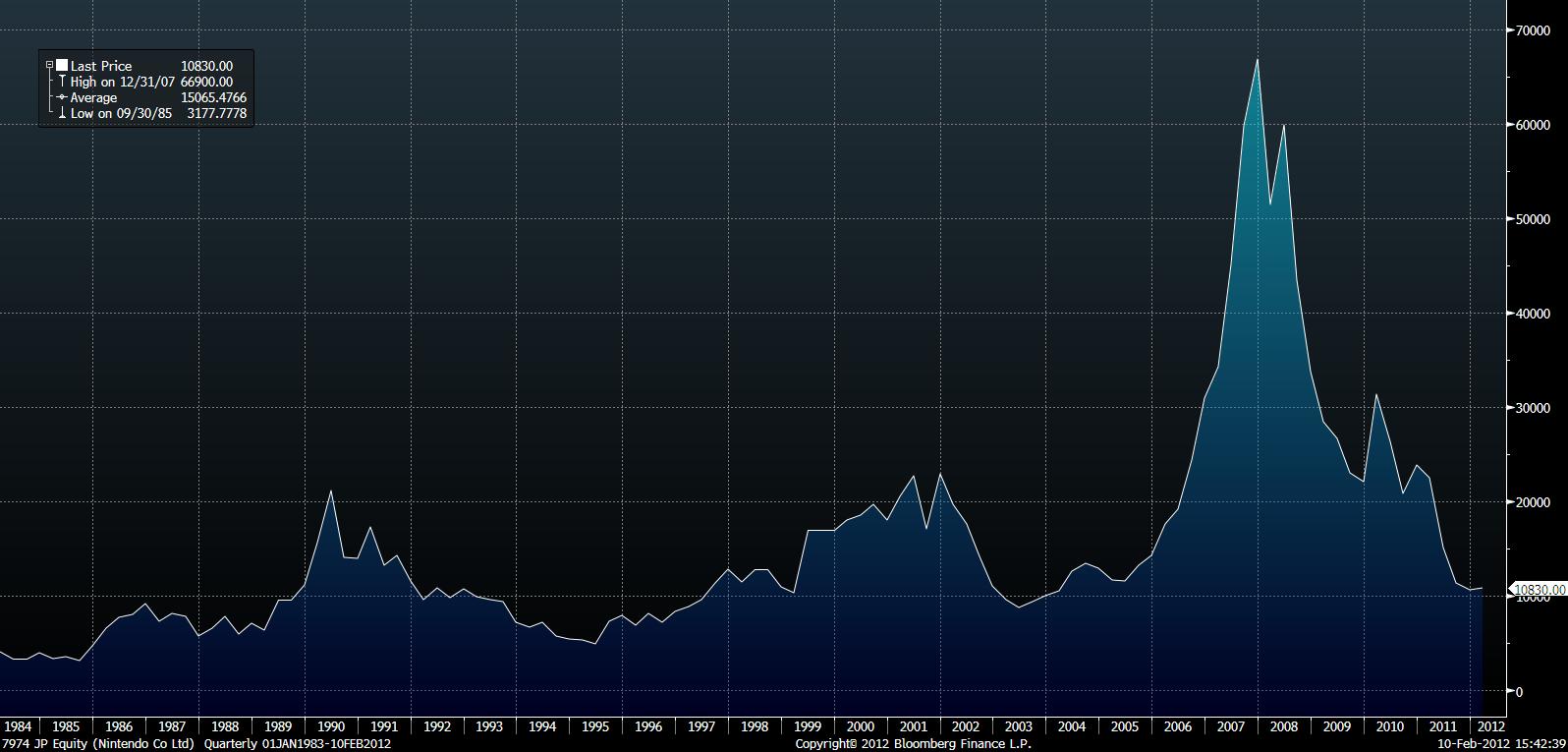
The stock chart in YEN looks quite bad, we are back at 1989 levels:

Shareholders:

The shares shares are widely held, no dominating shareholder. 10% are treasury shares. I wonder wether this would be a nice target for some shareholder activism….

Analyst sentiment is bad (which is good).

For the time being, I have no idea how to value Nintendo, but it is definitely something to watch. The “Intangible” value of the game franchises (Mario, Pokemon etc.) could be huge, however there are many well known headwinds like Mobile phone games etc.

If Nintendo again manages to reinvent itself like they did with the WII, then the upside could be huge. If they fail, at least they will not go bankrupt any time soon.

In any case, Nintendo is an interesting example how a “Moat” or “Gillette Razorblade” business model can dissappear through technological change pretty quickly, at least in the consumer electronics area. So watch out Apple.

“Risk free” rates and discount rates for DCF models

In the discussion to the Piquadro valuation, I quickly mentioned that the concept of “risk free” rates is a difficult concept at the moment.

Let’s have a quick look at the “academical” world:

CAPM

If we look at the CAPM (no matter if one beliefs this or not) we can see that the risk free rate of return plays an important role there. First, it is the basis return on needs to achieve with any investment, secondly it also influences the equity risk premium.

Risk free rate of return

The definition of the risk free rate itself is quite “fishy”. Investopedia for example states:

Investopedia explains ‘Risk-Free Rate Of Return’
In theory, the risk-free rate is the minimum return an investor expects for any investment because he or she will not accept additional risk unless the potential rate of return is greater than the risk-free rate.

In practice, however, the risk-free rate does not exist because even the safest investments carry a very small amount of risk. Thus, the interest rate on a three-month U.S. Treasury bill is often used as the risk-free rate.

This is of course not really applicable for any serious long term investor. Damodaran has a nice paper about “risk free rates” here.

His major points are as follows:

The first is that there can be no default risk. Essentially, this rules out any security issued by a private firm, since even the largest and safest firms have some measure of default risk. The only securities that have a chance of being risk free are government securities, not because governments are better run than corporations, but because they control the printing of currency. At least in nominal terms, they should be able to fulfill their promises. Even this assumption, straightforward though it might seem, does not always hold up, especially when governments refuse to honor claims made by previous regimes and when they borrow in currencies other than their own.

So this is important: No default risk !!! So it is wrong for instance to use current yields of Italian Govies for valueing Italian stocks, as considerable default risk is embedded in current spreads. The “country” risk could/should be embedded into the equity risk premium, not into the risk free rate. A hypothetical Italian company with 100% of its business in Germany for example, should only get a very small country risk charge if any.

A second point is the following:

There is a second condition that riskless securities need to fulfill that is often forgotten. For an investment to have an actual return equal to its expected return, there can be no reinvestment risk.

In theory, one should discount annual cash flows with the respective annual risk free rates. With a flat yield curve, this is not so important but for steep yield curves the differences can be significant. However in practice Damodaran recommends using the duration of the cash flows of the analysed investment as proxy for the risk free rate. As the best proxy if we don’t want to do this, he recommends the 10 year rate.

For the EUR, he recommends specifically the following:

Since none of these governments technically control the Euro money supply, there is some default risk in all of them. However, the market clearly sees more default risk in the Greek and Portuguese government bonds than it does in the German and French issues. To get a riskfree rate in Euros, we use the lowest of the 10-year government Euro bond rates as the riskfree rate; in October 2008, the German 10-year Euro bond rate of 3.81% would then have been the riskfree rate.

With regards to currencies he says this:

Summarizing, the risk free rate used to come up with expected returns should be measured consistently with the cash flows are measured. Thus, if cash flows are estimated in nominal US dollar terms, the risk free rate will be the US Treasury bond rate. This will remain the case, whether the company being analyzed is a Brazilian, Indian or Russian company. While this may seem illogical, given the higher risk in these countries, the riskfree rate is not the vehicle for conveying concerns about this risk. This also implies that it is not where a project or firm is domiciled that determines the choice of a risk free rate, but the currency in which the cash flows on the project or firm are estimated.

The most common mistake with currencies is usually to use current exchange rates for future cashflows which then results in a preference for projects in countires wiht high nomnal rates.

About Inflation, he is not really clear in my opinion. He argues basically, inflation does not matter because we get the same result if we use yields of inlfation linked bonds combined with inflation adjusted growth rates.

Especially the current situation, where we see negative real yields in many markets, one could argue about his appoach. A negative real yield means for an investor, that the “risk free” nominal asset would have a guaranteed loss in real purchasing power over the investement horizon.

Consider for instance the UK: 10 year gilts run at 2.158% yield, this would be the proxy for the risk free rate. Current inflation runs at 5%, UK 10 year implied inflation from inflation linked bonds is around 3%.

So if I would use the 10 year gilt as proxy as the risk free rate, I woul dalready accept a loss of -1% p.a. in real terms p.a. or almost -3% p.a. based on current inflation rates.

I think this topic might justify even a doctorate thesis, but in my opinion, one could go the following pragamatic way:

Proxy for risk free rate: Higher of 10 year risk free Govie Yield in currency or inflation ).

So in the case of the risk free rate for an Italian company I would compare:

a) 10 year risk free EUR rate = 10 year bunds = 1.89%
b) Inflation: Currently =3.4%

I would the use the higher of the two rates, 3.4 %. This would be a pragmatic way to avoid unnecessary country risk premium and still make sure, the risk free rate does not imply a guaranteed loss in real terms.

Unicredit rights issue – update

Tomorrow will be the last trade date for the subscriptions rights. So far, the shares are doing really well. the subscription rights recovered from a low of ~0,45 cents to currently around 2,12 EUR.

This is still well below the theoretical value of 2.29 EUR ((3.09-1.943)*2).

Looking at the relative Performance:

Since the rights started trading (January 9th), Unicredit has outperformed the FTSE MIB by +35% and competitor Intesa by +25%, howver since January 1st, Unciredit has underperformed the MFTSE MIB and Intesa by ~-26%

In the last few days, some good news emerged:

– the Abu Dhabi Sovereign Wealth fund had committed to increase its stake
– Zurich Financial Services seems to be interested in buying part of the Turkish JV

So from a investment point of view, a lot of the forced selling seemed to happen in the first 2 days of the subscription right trading period. I had expected that towards the end the price would come down again but it doesn’t look like that at the moment.

Dispite the significant discount of the rights, I will not start a long/short trade, as a lot of the expected outperformance has already occured in the last few days.

Efficient capital markets – Unicredit rights issue edition

In any finance course, market efficiency is one of the most important parts of the curriculum. The Therory says the following:

There are three major versions of the hypothesis: “weak”, “semi-strong”, and “strong”. The weak-form EMH claims that prices on traded assets (e.g., stocks, bonds, or property) already reflect all past publicly available information. The semi-strong-form EMH claims both that prices reflect all publicly available information and that prices instantly change to reflect new public information. The strong-form EMH additionally claims that prices instantly reflect even hidden or “insider” information.

Read more

2011 – Portfolio and Performance Review

Performance (see also the current portpolio page)

December 2011 was the best month for the portfolio in absolute terms so far with + 4.03% against -1.62% of the Benchmark (50% Eurostoxx50, 30% Dax, 20% MDAX). For the whole year, this results in a performance of -4.1% against -13.8%. On a monthly basis, the picture looks as follows:
Read more

« Older Entries Recent Entries »